Get every episode summarized
Each time Consider This from NPR publishes, we email you a written briefing from the transcript — the topics, who appeared, and any specific claims, with the ad reads skipped.
Email me new episodesFree for 3 shows. No card needed.
About this episode
Consider This from NPR is made possible by:
“It's considered this from NPR, where every day we go deep on one big news story. NPR's Will Stone reports on that line between proven medical treatments and alternative health practices.”From the transcript
This episode was produced by Gabriel Sanchez, with engineering by Eowyn Fain. Our director is Elena Burnett.
It was edited by Adam Raney.
Our interim executive producer is Courtney Dorning.
Support public media with NPR+ and enjoy perks for over 25 podcasts like this one. This show’s perks include bonus episodes and sponsor-free listening. Learn more at plus.npr.org.
See pcm.adswizz.com for information about our collection and use of personal data for sponsorship and to manage your podcast sponsorship preferences.
NPR Privacy Policy
Get every episode summarized
Each time Consider This from NPR publishes, we email you a written briefing from the transcript — the topics, who appeared, and any specific claims, with the ad reads skipped.
Email me new episodesFree for 3 shows. No card needed.
Hosts & guests

Transcript ready
153 searchable segments. Every word is indexed and playable.
Full transcript
Consider This from NPR — Reporting on the science of saunas. Machine-transcribed; use the interactive transcript above to jump the player to any line.
It's considered this from NPR, where every day we go deep on one big news story. NPR's Will Stone reports on that line between proven medical treatments and alternative health practices. If you're envisioning study subjects, smoking weed and sipping free booze, then you have a pretty good picture of this experiment. Consider this. For centuries, people have sought out sonas and hot springs for their supposed healing properties. Coming up, we talk to one reporter about understanding the science behind those claims, all while enjoying some time in the sauna himself. From NPR, I'm Alyson Adhorty. Stay tuned for the following announcements and messages from our sponsors. Support for NPR and the following message come from Washington Wise. Americans made in Washington can affect your portfolio every day.
Washington Wise from Charles Schwab is an original podcast that unpacks the story's making news and how they may affect your finances and portfolio. Host Mike Townsend and his guests explore policy initiatives for retirement savings, taxes, trade, and more. Download the latest episode and follow at Schwab.com slash Washington Wise or wherever you listen. This message comes from the Nature Conservancy. For 75 years, the Nature Conservancy has helped protect remarkable natural places, places that do more than take your breath away, places that sustain livelihoods, places that anchor memories and traditions, places that are an undeniable part of who you are. Together, the Nature Conservancy and supporters ensure these natural places and the people and wildlife that depend on them thrive for generations to come. Learn more at nature.org slash 75. This message comes from Mint Mobile. If you're tired of spending hundreds on big wireless bills, bogus fees, and free perks,
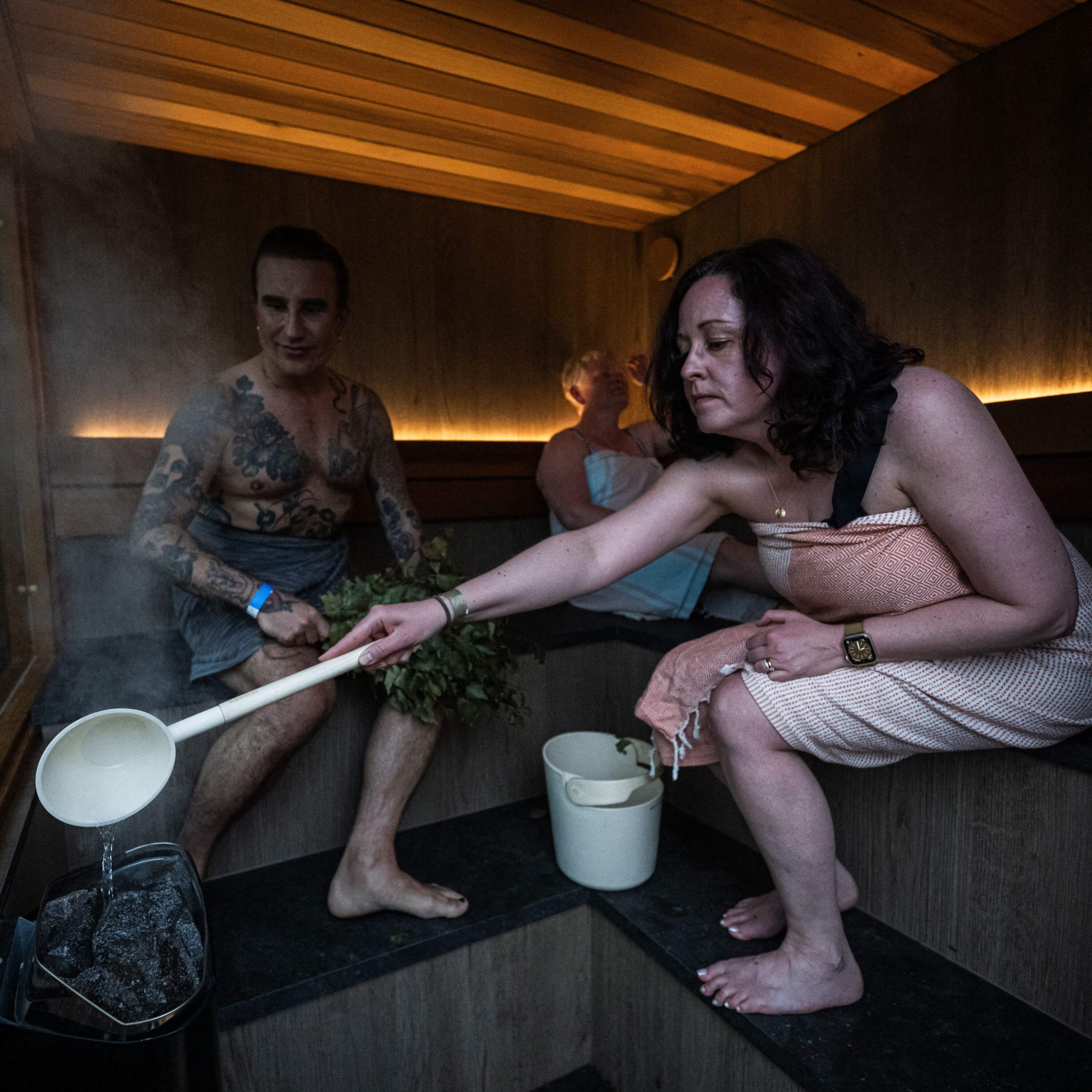
Mint Mobile is for you. Shop plans at MintMobile.com slash switch. Taxes and fees extra. See Mint Mobile for details. In September, NPR Science correspondent Will Stone traveled to Oslo, Norway for the International Son of Congress. It's basically a chance for the Son of World to nerd out. You have scientists, business operators, advocates. They're all here for a few days to talk about everything from the health benefits to the finer points of Son of Culture. The program included party hopping and heat treatments in quote floating Son of Villages, all in the pursuit of science. So for this week's reporter's notebook, I wanted to talk to Will about arguably the toughest assignment, head NPR. I mean, come on, you got in a sauna in Oslo. Like was it as blissful as it sounds? How jealous should I be? Pretty jealous. This was not my normal trip into the field.
I never had to wear a bathrobe before doing a reporting trip before. So I will say when you go into a sauna with all your reporting gear and fully glow, not as blissful as it is in my sound. Fair. But seriously, what were the questions that were driving your reporting on the story? A few things. I mean, this isn't really just about sauna or sauna. This is really about the broader field of heat therapy, which is something when we look across, right, cultures, the world have been doing for millennia, whether that's sauna or steam bath or geothermal, right? Many places have these traditions. And what's interesting to me is that the science on the other hand is still pretty limited here. I mean, there's a whole field of thermal physiology, scientists who are looking at how our bodies respond to temperature, including heat. And there's plenty of research on what happens to our bodies acutely in the heat with our
heart rate or blood vessels. But the research on how you actually translate that into advice for people, and you can say definitively, oh, this is good for cardiovascular health or mental health. These large human trials haven't been done. And this is a moment where the field is trying to basically organize itself. So it can do the type of work that will really legitimize this as a lifestyle intervention. So I found it interesting to see the scientists working through their process at this moment. Okay. So you met scientists studying things like cardiovascular health, metabolism, mental health. What is the most surprising thing you learned about what the evidence actually supports versus kind of what we see on Instagram or what the wellness industry claims? But honestly, just how little we know, I was pretty surprised when you ask the scientists who are doing these studies, who are deeply immersed in the literature.
They will be pretty frank and tell you there are just a lot of things we don't know. And including social media loves protocols, right? And kind of how long you should be doing it and how often to get this result. You ask the scientists and they say many different protocols have been tried. You really don't know at this point how to make recommendations that are very evidence-based. And so while there are some really compelling studies that have been done, like for example, in Finland where everyone uses sauna and those have shown strong associations between all kinds of health benefits in sauna use like for cardiovascular health, for mental health, you can't just basically extrapolate that and say, well, this is good for everyone. You need to do the tough painstaking studies. And then on the flip side, what was interesting to me was that a lot of the claims that you'll
see, for example, like at your gym, you know, outside the sauna or outside a hotel, you know, a hotel sauna are not necessarily evidence-based either. And they're actually kind of, we have better evidence to suggest it's not as dangerous as it can sound when you read one of those plaques. Oh, like the warnings outside the room, you said. Yeah, I mean, definitely drinking in sauna, we can say, don't do that. But so some of these are actually, you know, founded in real evidence, but others actually need to be updated. So it's, there's an interesting way in which there are certain claims being overhyped. And then in other areas where we do have some evidence, it just hasn't really trickled down. And I just want to make sure I understand you there. You mean like a sign that could say, like, don't stay longer than 10 minutes? Exactly. There's, you know, and all of this is done because generally it's hard to translate the work being done, you know, by a thermal physiologist in their lab to, you know, what goes up at a
sauna and the hotel. Yeah, exactly. Yeah. Okay, so I want to turn to your larger beat. You have covered the alternative health movement for some time now. I'm thinking things like peptides, psychedelics, high intensity exercise. I'm curious, well, what drives your reporting as you cover this moment in alternative health? Yeah. You know, alternative is an interesting word because a lot of what I cover now is really part of the mainstream. And by that, I mean, like, you know, the wellness movement, longevity, the embrace of like biohacking and things that originated in Silicon Valley wanting to optimize yourself. I mean, that's everywhere now on social media. And it's even being championed right at the highest levels of government. So I think what drives my reporting is just understanding, you know, where the evidence lies for a particular treatment or remedy that's being promoted. And then the gap between what's being said about that and what we know.
For me, I find that often with these trendy therapies, there's like a curious scientist there, you know, somewhere doing this research. And then what's actually happened to their findings, how those have taken on a new life on social media is quite interesting because it's usually not at all they would actually tell you. So I think, you know, there's an interesting tension here with many of these therapies. I mean, we have peptides that are like the GOP1 weight loss drugs. Those have been studied quite a bit in large trials, right? And many Americans are using them now. Then we have the wellness peptides, which have almost not been studied at all in any kind of human clinical trials. Some have almost no human data behind them. So the claims that they do any number of things for longevity or recovery or skin. Often, those are not grounded in the kind of high quality evidence that most people might
imagine they were. Will Stone covers health and science for NPR. Thank you so much for talking with us. Oh, it was fun. Thank you. This episode was produced by Gabriel Sanchez. It was edited by Adam Rainey. Our director is Elena Bernet. Our interim executive producer is Courtney Dorning. It's considered this from NPR. I'm Alyssa Nadwani. Stay tuned for the following announcements and messages from our sponsors. Support for NPR and the following message come from Washington Wise. Decisions made in Washington can affect your portfolio every day. Washington Wise from Charles Schwab is an original podcast that unpacks the story's making news and how they may affect your finances and portfolio. Host Mike Townsend and his guests explore policy initiatives for retirement savings,
taxes, trade and more. Download the latest episode and follow at Schwab.com slash Washington Wise or wherever you listen.
More episodes
More from Consider This from NPR

The story unfolding at Cornell is dismayingly familiar
Consider This from NPR

A botched execution raises questions about death penalty protocols
Consider This from NPR

Meta just launched an AI agent and others are following. Is the internet ready?
Consider This from NPR

Sexual assault on campus is a problem. Can laws help address it?
Consider This from NPR