Get every episode summarized
Each time The Transformation Network™ publishes, we email you a written briefing from the transcript — the topics, who appeared, and any specific claims, with the ad reads skipped.
Email me new episodesFree for 3 shows. No card needed.
About this episode
“I'm Leah Rowley, human in permanent beta, neurosrategist, mom to three amazing humans, married to one legendary soul, and your no-fluff permissions lead to stop waiting.”From the transcript
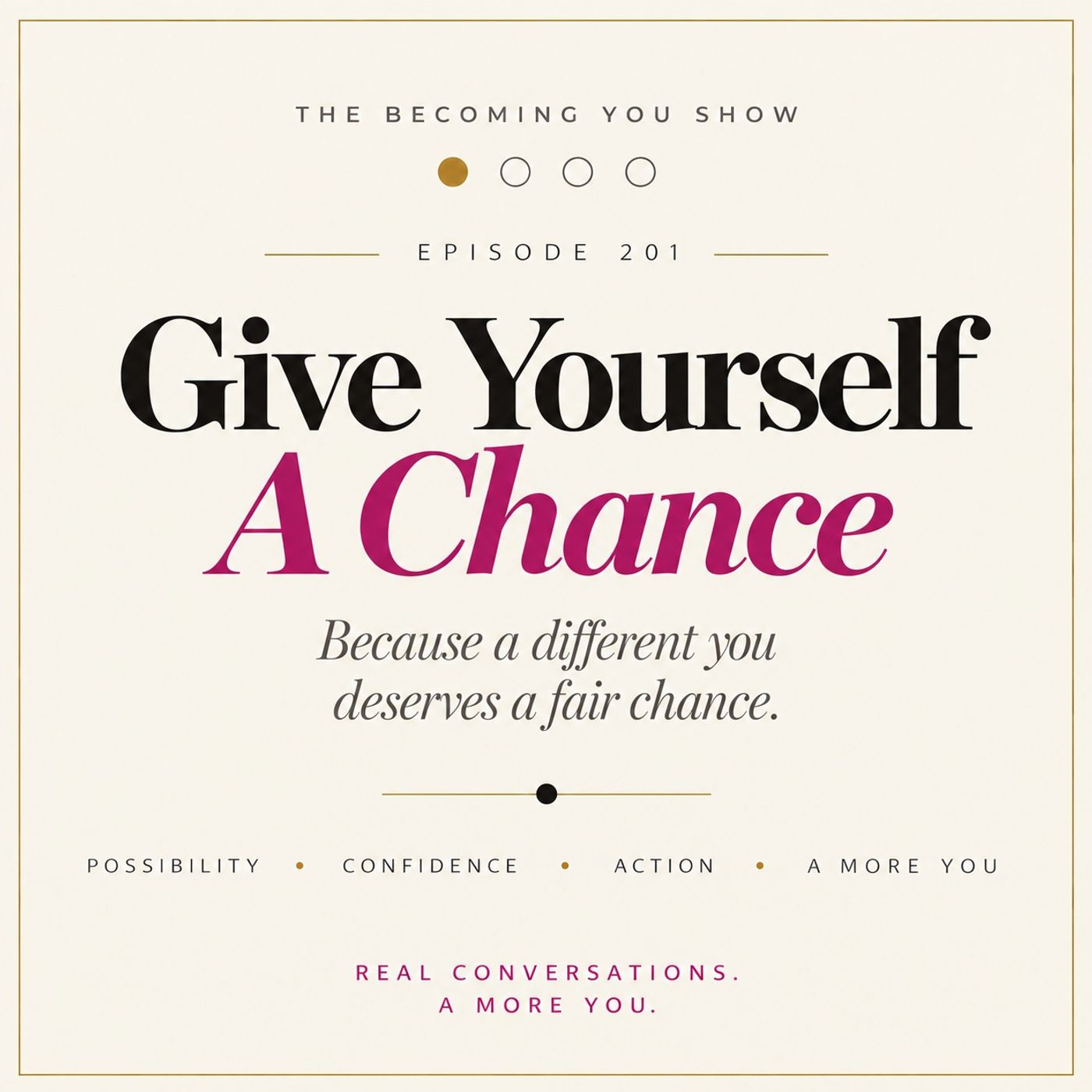
In this episode of The Becoming You Show, we're talking about what it really means to give yourself a chance...not by pretending circumstances aren't hard or guaranteeing you'll succeed, but by creating the conditions that make change possible.
We'll explore the difference between having a valid reason and creating a life you actually want, why action often has to come before confidence, and how small “mastery experiences” can create new evidence about who you are and what you're capable of.
You'll walk away with three questions to consider: Where are you asking for an outcome you haven't created the conditions for? What are you waiting to feel before you allow yourself to act? And what evidence about yourself could you create, not discover over the next 30 days?
Because self-confidence isn't knowing you're going to win. It's knowing you'll have your own back while you find out.
Maybe you don't need to believe in yourself all the way yet.
Maybe you just need to give yourself a chance.
Get every episode summarized
Each time The Transformation Network™ publishes, we email you a written briefing from the transcript — the topics, who appeared, and any specific claims, with the ad reads skipped.
Email me new episodesFree for 3 shows. No card needed.
Transcript ready
369 searchable segments. Every word is indexed and playable.
Full transcript
The Transformation Network™ — 201. Give yourself a chance. Machine-transcribed; use the interactive transcript above to jump the player to any line.
Welcome to the Becoming You Show, where limits get torched and possibility takes the mic. I'm Leah Rowley, human in permanent beta, neurosrategist, mom to three amazing humans, married to one legendary soul, and your no-fluff permissions lead to stop waiting. Every week we rewire rain patterns, smash, hand me down mindsets, and dive into the daring, identity shifting conversations, most people dodge. Ready to turn potential into proof? Grab your pen. Your next chapter starts now. Do you ever excited about this conversation? And this is what I want to talk about today. And I'm feeling a little spicy, so some of you like the spice, some of you aren't so sure of the spice. But I really want to talk about this concept, this idea that has been kind of rattling around in my mind,
as I've been having conversations with my clients and my friends and quite frankly, with myself. And that is this idea of, are you even giving yourself a chance? I don't mean believing so hard that you're convinced that you're going to win, and that success is inevitable, and that I'm not talking about pretending that circumstances and situations aren't hard. I'm definitely not talking about some motivational version or inspirational sentence around. You can do anything if you just believe harder or if you just put your mind to it, although all of those things are great. But I'm meaning something even more practical than that. And here is the question, have you actually, and I really want you to think about this question,
and not deflect, but kind of have it sit on your heart a bit. Have you actually arranged your life in a way that gives you a legitimate chance at the thing that you say that you want? Are you arranging your life in a way that gives you a legitimate chance of getting what you want in your life? Because I've been thinking a lot lately about how people have completely understandable reasons for why they haven't. And I've heard them all, and maybe it's you, right? You're exhausted. The season of life is challenging. You've got kids, money's tight. You've already tried it a thousand times, like how many more times do you need to try it? You've been disappointed before, and you're all done with the whole game of disappointment.
Someone hurt you. You're rebuilding. You're starting later than you thought you should. Maybe you're starting earlier than most. And so it'd be understandable why waiting a little longer would be just verifiably okay. You don't have the support. You wish you had. You don't exactly know what you're doing. How you're going to get there, why you're even doing it, right? The economy, you're past. You guys, the list goes on and on and on, right? And if you didn't find yourself in that list, I'm guessing you can come up with some reasons. And here's the thing. Here is the thing. No one would blame you. No one would. People understand. They would understand whatever it is, whatever condition that you're putting on, why it is that you can't have what you want, why it is that you're not even giving yourself a chance. Right? They would understand that. You could explain why you haven't done the thing, right?
Why you haven't changed the relationship? Why you haven't started the business? Why your business hasn't scaled in the way that you've wanted it to? Why you haven't taken care of yourself? Why you haven't gone after what you want? Why you haven't? Why you haven't? Why you haven't? And your explanations? Wildly valid. Wildly valid, right? But this is what, this is kind of what I've been like teasing around in my mind in preparation for this podcast. Is that no one would blame me is very, is a very different standard than this is the life that I want. Okay, those are two completely different statements of understanding, right? No one would blame me. And this is what I want for my life. And sometimes we have to be willing to stop asking whether our reasons are understandable, whether or not people would get them, whether or not we could sell people on our own
negotiation with what it is that we want. And start asking whether the life those reasons are creating is one that we're willing to keep living and and continue to tolerate. Because a reason can be, as I've mentioned, wildly valid without being at all useful, right? Something happened. It mattered. It changed you. It made something harder. All of those things could be true. I tried. And in this conversation, I'm not going to ask you to invalidate any of it. I'm just asking you a different question. And that question is what now? What now? Because eventually if we want something different, we have to stop using all of our energy proving why where we are makes sense.
Why we can explain it away and start using some of that energy to create the conditions for where we want to go, to set up our life intentionally so that it can support what it is that we want. In other words, give yourself a chance, right? Give yourself a chance. If I were to ask you, are you giving yourself a shot? Are you giving yourself a chance? Are you setting yourself up for success? What is your answer? Without any sort of blame or shame, just what is your answer? Most people would answer no. And here's what I'm telling you in the kindest way possible. If you don't have what you want, you're not giving yourself a chance. And you want that to be the reason. Because if that's the reason, guess what else is true? You can give yourself a chance. So I see this a lot in my coaching. People will come to me with an outcome, with a result that they want, desperately want.
Probably have been trying for decades to get what it is that they want. And when we start looking at their life, looking, not judging, but looking at their life, we realize something, something. They haven't actually created conditions that support the outcome that they're asking for. They haven't intentionally created the space that aligned with the results that they want. So let's bring this practical. Let's say you want a different relationship with your spouse. Maybe that's what you want. You come to your session and you're like, I just, I want more connection with my spouse. I want more intimacy with my spouse. I want to feel like we're best friends again. Okay? That's what you say you want. And then we look at the conditions. Right? And the only time that you're having any sort of meaningful conversations is when
something has gone really wrong. It's so interesting when I'm doing like marriage coaching, like couples rally in a crisis. I mean, they are solid in a crisis. It's just all the other days that they lack that level of intimacy and connection. Right? Most of the communication is logistical. Right? Like who's picking up the kids and what's for dinner and did you pay that bill and what time will you be home and what are our plans for the weekend? And then we wonder why we don't feel as deeply connected as we want to. And there's nothing wrong with you. There's nothing wrong with them. The only thing that's wrong is we haven't created the conditions for that level of connection. Right? So I'm going to give you a couple of others just just kind of like open up your mind around. Okay? I really want you to think about what you want. And then as I run through these, I want you to really be honest with yourself.
Are you giving yourself a chance? Are you setting up your life where the conditions for that result for what it is that you want? Are laid out, mapped out, and allow for a shot. So maybe what you want is your business to grow. Okay? You tell me that you want your business to grow and you tell me that this is the revenue goal that you want and then this is the client goal that you want and you want more opportunity and you want it more exposure. Okay? And and yet you're spending a lot of your time improving the product, changing the website, making another deck, reworking the offer, rerecording videos. You're spending tremendous time learning and planning and perfecting in almost zero time, actually getting in front of the people who could buy what it is that you're selling. Not again, nothing wrong with you, just the conditions that you're allowing yourself.
Right? Because you're asking for an outcome, right? More clients, more revenue, without creating the conditions that actually make that outcome likely. Right? If you want more clients, you have to ask for more clients. If you want a better website, then you double down on the website. But most people don't come to me and say, hey, I want to grow my business. I think I need a better website. Right? But they use the website to buffer the discomfort of rejection. Right? So a lot of the conditions that we're putting into place create a lot of vulnerability. And that's when we get to do the work. Okay? So, but we have to understand the conditions that are setting up before we can even have the coaching conversation. Let's just say, so that's business. So we did relationships, deeper connection with our significant other spouse, business, healthier, get better, feel better physically.
So, you tell me you want more energy, you tell me you want to feel stronger, maybe you want to lose weight. Right? You want to take better care of yourself. And then when we look at the conditions that you're providing for yourself, that we're looking at the chance that you're giving yourself. And we're not giving ourselves one. We're not prioritizing sleep. We might get five, six hours a night. Right? We're eating whatever is available between meetings. Because we haven't planned ahead on what it is that we were going to eat. And we haven't allowed ourselves some space between the meetings to actually fuel our body and the way that we know would support ourselves feeling better. We run from one obligation to the next. And then at 7.30 at night, you're expecting this exhausted version of yourself to somehow summon the motivation to go work out. And when we don't, we offer ourselves all sorts of critiquing around how lazy we are and
unmotivated and undisciplined we are. I don't, I think that is much less likely. What's more likely is that we've created conditions in which succeeding is incredibly difficult. Incredibly difficult. I'm going to give you one more because I've been navigating this one a lot too, which is not just our relationships with our significant others in our life, but our children. Okay? So maybe you want a better relationship with your teenager. Okay? You want them to talk to you. You want them to spend time with you. But, but I want you to think about the last five, ten interactions that you had with them. Okay? Were they connection? Or were they, well, did you do this? Did you do that? Why isn't this done? Where are you going? When will you be home? Did you turn that in? What'd you think about this? And don't forget, again, not inherently wrong. And parenting absolutely requires some of those conversations.
But if I'm asking for connection, if what I want is connection with my teenager and almost every interaction I'm creating feels like correction, I might need to look at those conditions. Deeper friendships. But you're the one waiting for everyone to invite you. Maybe you want to write the book, but there's not one hour on your plan in your calendar for writing. Maybe you want to feel less overwhelmed, but you've built a life where every available inch of space gets filled and all of these loops that you have to stay open. It's almost like you don't want to close them so that you can stay in your overwhelm. Right? You want financial peace, but you won't look at the numbers because looking at them makes you feel uncomfortable. You want a different career, but you've spent years thinking about leaving and zero hours minutes, months, exploring what leaving could actually look like.
Maybe you want to feel more confident. But the conditions that you've allowed for yourself is that you've organized your life around avoiding anything that could make you feel uncomfortable. And that is the way confidence is built. And this is where I really want us to be careful because the conclusion isn't, I'm the problem. The conclusion is, maybe I just haven't given myself a shot. Maybe I haven't given myself a fair chance. That, my friends, is very different and it's incredibly hopeful. Because if I'm broken and there's something wrong with me, then I have a very big problem. But if the conditions aren't supporting the outcome, as I said earlier, conditions can change. So here's the question that I want you to sit with. And it's what I opened up this podcast with. Where in my life am I asking for an outcome, where in my life am I wanting a result that I haven't actually created the conditions for?
Not to shame yourself, but to get really curious. What conditions would give myself a better chance? I'm not even saying to execute on the conditions. I'm just saying give yourself some options to choose from, to give yourself a fighting chance at what it is that you want. Okay. So there's another way that I see us with holding a chance from ourselves. And that is we wait to feel something before we allow ourselves to act. We say, right, that we'll do this when we'll do that when we feel more competent or that we'll record the video when we're less nervous or we'll start working out when I motivated. Or I'll have the conversation when I'm, you know, I'm not so emotional or maybe more time has passed. I'll go to the event. You guys are so many of them. And when we think the feeling is supposed to come first, right,
competence, then action, motivation, then action, readiness, then action, courage, then action, then we're always going to be waiting for a feeling. And I'm not saying that that's necessarily bad. If you've been in my podcast for the length of it, you know you can create feelings on purpose. You know you're just a thought away from feeling something different. But I also want in this podcast of giving yourself a chance to actually, right, take action. Right? Sometimes the feeling that you're waiting for is on the other side of the action, the behavior that you're avoiding. And this is a concept in psychology and it's called self-efficacy. And psychologist Albert Bendora spent decades studying it. His work is brilliant. If you're in a nerd geek like me, dive into his work, but simply put self-efficacy is our belief and our ability
to do what's required in a particular situation. Self-efficacy is I have a belief that I can do what is required to do. And it's one of the most powerful ways that we build that. One of the most powerful ways that we build that level of self-efficacy, that willingness, that belief in ourselves is what Bendora refers to is mastery experiences. That's his terminology. So what does that mean in plain English? We experience ourselves doing things, taking massive action. We try. We handle something. We figure something out. We have the conversation. We do the workout. We fall down, flat on our face and discover, wait, we can get back up. We do something that we weren't really sure that we could do. And now our brain has evidence. It didn't happen before.
That is how we build that level of experiences. That is how we create and give ourselves a chance is by taking action. I just wanted to think about how backwards we sometimes have confidence. So many of us are waiting to believe in ourselves before we'll give ourselves the experience, aka the chance, aka the shot, that would give us the reason to believe in ourselves. You guys, this is huge. Maybe confidence doesn't come and then you walk into the room. Maybe you walk into the room while your heart is pounding. And walking into the room becomes the evidence. Maybe motivation doesn't come and you work out instead. Not needing motivation, discipline, work ethic to be a requirement. Maybe you just put on your shoes and you get busy doing a workout. And then afterward your brain has just one more piece of evidence that says, huh, I said I was going to do
something and I did it. I want you to give yourself a chance. I want you to give yourself a shot at this life that you get to live. And to not defer this chance that you get on good valid reasons. That was the first thing that we talked about or an emotion that you prefer to either have a head of time because that would be nice, just not required, or to assure yourself that whatever feeling that you have on the other side of it, you can handle it. So that's really where a lot of this confidence work that a coach around comes from. And it's where confidence really becomes interesting to me because I think a lot of us have had
confidence all wrong. So what confidence actually is, and it's the thing that we're working on in the lab all month long, if you're not in there, we'd love to have you in there, right? Is what it is and what it isn't. Confidence can be a thought, it can be a feeling, it can be a state of being, a way that we learn to relate to ourselves. And we tend to think that self-confidence means that I know I'm going to win or I know this is going to work or I know that I'm right or I know that they will like me or I know I will fail, but I don't think that's the deepest version of self-confidence. Here's why, because you can't know most of those things. You can't control whether they choose you. You can't control whether they say yes to you. You can't control whether the conversation landed in a way that will be received with understanding. You can't control whether the business works exactly as you imagined. You can't control whether or not you get rejected. You can't control whether
or not, in a lot of instances, this particular thing fails or it doesn't. So if confidence, I want you to get this. If confidence requires certainty about and outcome about this thing about other people, confidence is always going to be really fragile and likely, most likely outsourced. So what if self-confidence is something else altogether? Right? Maybe, what if real confidence is I don't know exactly how this is going to turn out. And I don't know exactly what other people are going to do because what I know for sure is they're going to do what they do. They're going to be them. But what I do know with a thousand percent in certainty is I'm going to have my back, my own back while I find out. Which means that I can fail and not turn against myself. I can get rejected and not make it mean something about my worth or my loveability or my likeability or my or my leadership capabilities. Right? I can change my mind without deciding that I'm unreliable or
that other people are going to be disappointed. I can make a mistake without making that mistake turn into something about who I am. That's a different kind of confidence, you guys. That's a relationship. That's a relationship that is built through experiences. And that relationship is the one that you have with yourself. Right? So this is the last question that I'm going to ask you to think about today. And it is this, what evidence about yourself could you create over the next 30 days? What's the evidence about yourself that you could create? I love the word create here because so many of us keep looking backwards for evidence. Right? Am I disciplined? Well, let me examine the last 10 years. Am I brave? Well, let me review every scary thing that I've ever done. Am I someone who follows through? Well, here's the list of all the times that I did it.
Can I trust myself? Well, let me pull up the entire case file that I have on myself. And then we use our past to determine what's available to us next. But what if you're allowed to create new evidence? Right? What if this invitation isn't to look for evidence? Right? Rather produce it. So if you want evidence that you're someone who takes care of your body, right? If we go back to what it is, you want it help. Right? If you want evidence that you're someone who takes care of your body, right? You don't need to lose 30 pounds to do that. You take a walk today for five minutes and then guess what? You do it tomorrow. That's evidence. If you want evidence that you can build something, right? You could build a company. You can build a business. You don't need a multi-million dollar company to do that. You need to make it offer. You need to get rejected. Somebody needs to say,
yes or no to it. That's evidence. If you want evidence that you can have difficult conversations, you don't have to become someone that loves confrontation. You don't have to read a thousand books on crucial conversations. No, guess what you do. You have one. You have the one that you've been avoiding. Evidence. If you want evidence that you can trust yourself, make one small promise to yourself today. Keep it. One, right? If you want evidence that you belong into this room, get into the room. If you want evidence that rejection won't destroy you, that you can have a backbone to it, make it offer. Ask someone where no is genuinely possible. Go into a hotel room, ask for a discount for the night. Who knows, you might even get one. But they also might say no to you. Okay, great. And you lived another day. I'm guessing they gave you a room, Kay and you went
up to the room and you're fine. Right? If you want evidence that you can survive being misunderstood, stop over explaining decisions. The evidence is out there to be found. Create it. Create it for yourself. Too many times we ask our past to provide evidence. I want you to stop. I want you to stop asking your past to provide evidence for a person you're only now deciding to become. There's no possibility in the past. There's no potential in the past. It's all in your future. Does your past have data? Absolutely. It's information. It can absolutely teach you. Yes, it can explain some things. But it doesn't have to be the verdict. Right? You can create new evidence today. So a couple of really quick things. Evidence isn't that giving yourself a chance, giving yourself a shot at what you want isn't trying harder. Right? It's not more effort. It just
requires you doing something that you weren't doing yesterday. Sometimes it's doing less. Sometimes it's asking for help. Sometimes it means resting. Sometimes it means changing your environment. Sometimes it means getting support, ending something, starting something, saying yes, saying no, making a decision, closing a loop. Right? Sometimes giving yourself a chance means no longer forcing yourself to succeed inside circumstances and situations that keep requiring you to be tried yourself in order to stay in them. And then explaining it away because everyone would understand. Okay? Have you created conditions that give yourself a reasonable chance of becoming who you say you want to become? That's the question. That's the question. So your fair chance audit. You ready? Three questions. Where in my life am I asking for an outcome that I haven't actually created the conditions for? Right? Your marriage, your health, your business, your parenting, your friendships,
your finances, your peace. Okay? Don't judge it. Just look where is what you want? Are you not creating conditions for what it is that you want? The second question is what am I willing to feel before I allow myself to act? Right? What am I waiting to feel before I allow myself to act? Am I waiting to feel confident? Am I waiting to feel motivated? Am I waiting to feel disciplined? Am I waiting to feel whatever it is? Okay? And the third one is what evidence about myself could I create over the next 30 days? Not someday, not next year, not after this quarter, not after this season, not today, right now. There's evidence. I just am looking for you to find it. And maybe it starts by putting yourself in a position where you finally have a fair chance to become someone that you believe in and have the support. And if that is true for you, the inner lab is that spot, is that place, is that community that will help you to do that. So you don't have to do it alone.
We all need a level of support from time to time. So let inner lab help you and help be that support for you. So give yourself a chance, friends. You deserve the chance. You deserve a chance. Give it to yourself. Okay. See you next week. My friends. Talk to you soon. Bye. And replay your future. It is yours. And then share this with someone who's still waiting to be chosen, still waiting for permission and remind them they don't need a breakthrough that they are the right way. Until next time, my beautiful friends. Invest in you and keep becoming.
More episodes
More from The Transformation Network™

Nectar and Teeth: Red flags & Toxic Love
The Transformation Network™

The Soul Shines
The Transformation Network™

The October 1st Gateway: History, Astrology, and the Power of the "1"
The Transformation Network™

The Responsive Universe Part 2
The Transformation Network™