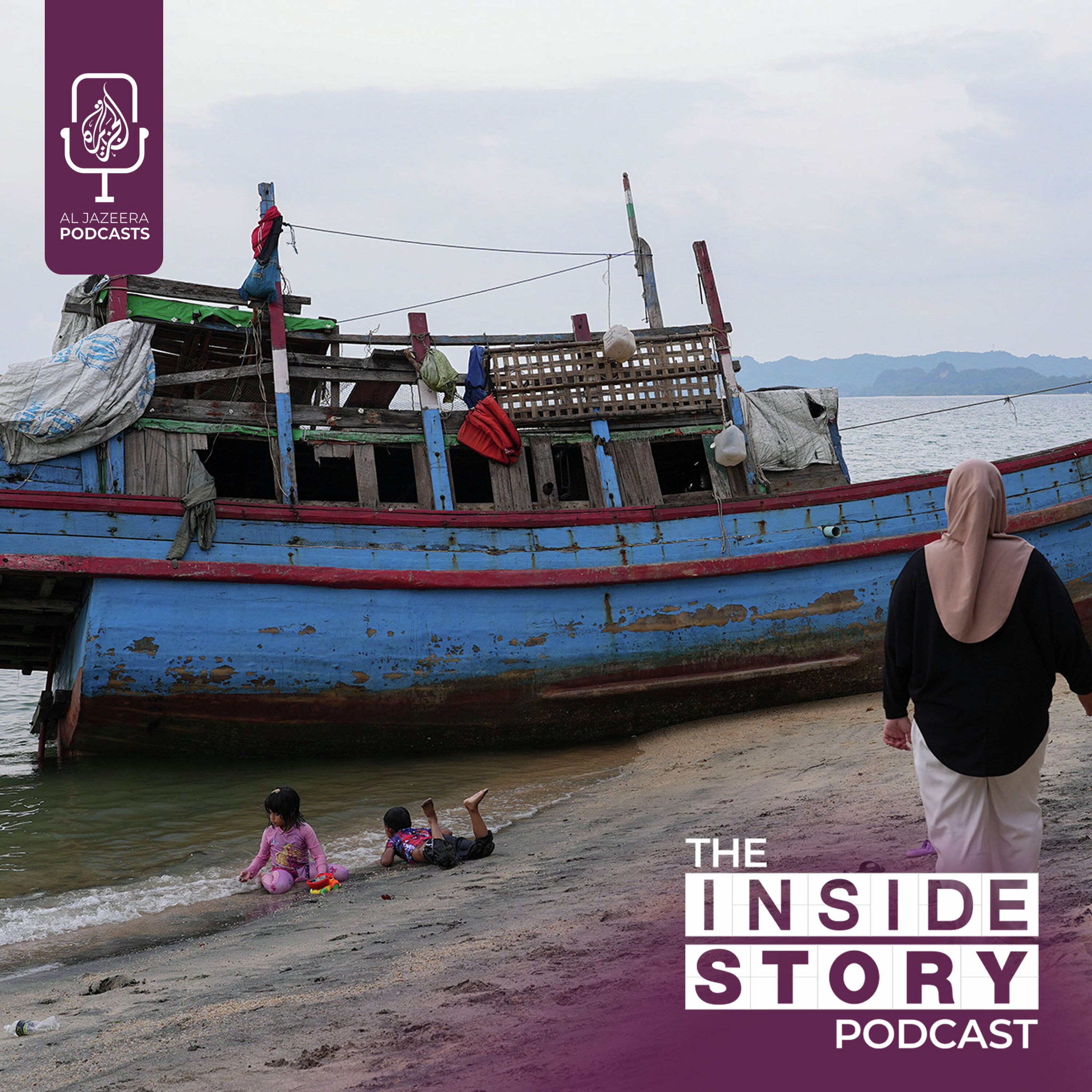
Why is Malaysia sending back Rohingya refugees to Myanmar?
Get every episode summarized
Each time The Inside Story Podcast publishes, we email you a written briefing from the transcript — the topics, who appeared, and any specific claims, with the ad reads skipped.
Email me new episodesFree for 3 shows. No card needed.
About this episode
“Al Jazeera Podcasts Malaysia's sending back thousands of Rahinga refugees to Myanmar. It calls it a voluntary process, but many are raising safety concerns. And what does it mean for hundreds of thousands of Rahinga forced out of their country?”From the transcript
The Malaysian government is facing accusations of forcibly deporting Rohingya refugees, a charge the government denies. It says the process is voluntary and coordinated with Myanmar’s government. But human rights groups say this process violates international law by sending refugees to countries where they risk facing persecution or torture. So, will this concern stop the Rohingya being sent back to Myanmar?
In this episode:
-
Phar Kim Beng, Director of the Institute of International and ASEAN Studies and Geopolitics Professor at the University of Malaysia
-
Lucky Karim, Democracy and Human Rights Advocate and Founder of Refugee Women for Peace and Justice
-
Maung Zarni, Genocide Scholar and Co-Founder of the scholar-activist network, Forces of Renewal Southeast Asia
Host: Imran Khan
Connect with us:
Get every episode summarized
Each time The Inside Story Podcast publishes, we email you a written briefing from the transcript — the topics, who appeared, and any specific claims, with the ad reads skipped.
Email me new episodesFree for 3 shows. No card needed.
Know when Lucky Karim turns up
Follow Lucky Karim and once a week we email you every new episode they appeared on — including guest spots the show notes never mention, because we read the transcript.
Follow Lucky KarimFree. Pick your own day and time.
Hosts & guests

Transcript ready
211 searchable segments. Every word is indexed and playable.
Full transcript
The Inside Story Podcast — Why is Malaysia sending back Rohingya refugees to Myanmar?. Machine-transcribed; use the interactive transcript above to jump the player to any line.
Al Jazeera Podcasts Malaysia's sending back thousands of Rahinga refugees to Myanmar. It calls it a voluntary process, but many are raising safety concerns. So what's behind the move? And what does it mean for hundreds of thousands of Rahinga forced out of their country? I'm Imran Khan and you're listening to the Inside Story podcast, while we dissect, analyze and help define major local stories. And let's bring in our guest, Same Kuala Lumpur, Far Kim Bengh, Director of the Institute of International and ASEAN Studies and Geopolitics Professor at the University of Malaysia. In Washington, DC, Lucky Karim, Democracy and Human Rights Advocate, and the founder of Refugee Women for Peace and Justice, who was forced to flee her home in Myanmar at the age of 14 in 2017 and spent six years in the world's largest Rengar refugee camp in Cox's Bazaar in Bangladesh. And in Kent, in the UK, Mojang Zani, Genocide
Scholar and co-founder of the Scholar Activist Network, Forces of Renewal, Southeast Asia. A warm welcome to each of you. I'd like to start with Far in Kuala Lumpur. First, every single major human rights organisation has condemned this move to take these, to repatriate these Rengar refugees. It's illegal under international law. So what's the justification here? I can't speak for the rest of the region or even nations that have actually received those refugees from Myanmar, but from the perspective of Malaysia, specifically from the policies standpoint of Prime Minister Anway Brahev. The repatriation seeks to pacify or modify the feelings among some Malaysians who feel that the number of refugees coming into Malaysia has been too high and causing various local implications as a result of which this has been one of those
undertakings that can facilitate the safe repatriations of Myanmar refugees back to Myanmar, under the guidance of the best protocols possible. Far use the word safe there. I want to put that word to Lucky Kareem who's in Washington, DC. Lucky is it safe for them to go back? Well, the idea of sending Myanmar nationals, I would say deporting not repatriation or relocating the Myanmar nationals including Rengar from Malaysia to Burma, is very clear. Even this week alone, the military's URSTAC in Wakana State killed according to the reports at least more than 50 individuals. And so that tells us already that demonstrates the current conditions on the ground do not allow any or Hengar or any Myanmar nationals for a resubrient time back to our home in Wakana State or across Myanmar more broadly. Up on anything in its aspect, which is more
concerning is at this point, there are political issues from the military side, especially on Hengar as our crisis. And the case was brought up before the Court of Anatole Court of Justice, which is from where now we are speculating judgment to come out and be issued in a couple of months against the Myanmar military by the Gambia. And at the same time, the military continued to bomb and use their estrucks and continued to record people forzebly across Myanmar and specifically in Wakana State. And so any self-return or voluntarily sustainable return of for Hengar and other Myanmar nationals does not allow the current condition does not allow into Wakana State or across Myanmar at this point. I'm going to come to in just a second, but I want to put that point to far, you're sending these people to their death. Well, the Malaysian government's approach is one based on diplomacy and negotiation,
whether one uses the word deportation or repatriation. Basically, the government has actually come up with a plan that can ensure the sound and safe return of this refugee. Now does that mean that there will be sound and safe indefinitely? That's obviously not something that we can predict and foresee. However, under the circumstances, there is peace-mew progress between the leadership in Nabilidhal in Myanmar and Putrajaya in Malaysia. Ma'am Zani, once again, what we're seeing is a domestic political agenda that's playing out and affecting people. A lot of social media in Malaysia is very anti-Hengar. A lot of the opinion pieces and newspapers, etc., are very anti-Hengar. Do you think that's playing into the government's decision? Yeah, I want to make a three very brief point, directly relevant to your question.
Number one, there is certainly a global racist mobilization trend, including US, UK, that all over Europe and places like India, where far-right ruling parties were whipping up anti-immigrant, anti-refugee, and anti-Muslim rhetoric. That's all over the world. So this Malaysian act by former Dizzid and Prime Minister, on what Abraham fits perfectly the global trend ideological far-right direction. Secondly, the Malaysian professor here, I mentioned that it is conducted in accord with the best protocol. Well, there's no best protocol for sending people back to the harm's way. When you know for a fact, the country is engulfed in civil war.
This is more than the semantic difference in the deportation, repatriation, reflumar, whatever you want to call it. That's not true. Malaysia is obligated, like any other U.M. member state, to abide by international humanitarian law, refugee conventions, whether Malaysia is a state party or a signatory to international law. And number three, there are two categories of people that are being forcibly against their will, being sent back to Myanmar, the Rohingyas, who are the primary victims of genocide. That has been going on for decades. And Malaysia itself, the different leadership, successive governments have denounced and condemned Myanmar military for
committing genocide. And now you cannot turn around and say, I'm going to stop you there because I'm going to stop you there because with the government, it's still engaged in genocide of war against Rohingya. I'm going to stop you there because I want to put all of those points to far. Your response to that please. Well, basically, the Malaysian government has thought hard and in the most comprehensive manner on how to deal with the junta, not just between Malaysia and Myanmar, but from the context of ASEAN. And one of the basic understandings that they can actually extract from the whole ASEAN process is that there are more member states in ASEAN, which is comprised of 11 countries altogether in Southeast Asia that are now tilting towards engaging Myanmar in a very face and gradual manner. And the return of this refugee, numbering no more
than 1,476 for the first repatriation is just one of those moves that has to be taken. In a second phase, maybe there will be about 2,400 people being returned to Myanmar. But either way, the Malaysian government has put in the best practices in order to make sure that no one will come into Hamzui when they are back in Rakhine or in any part of Myanmar. Lucky, one of the things Farah is saying is it's actually the ASEAN states name. The ASEAN block is the Association of Southeast Asian Nations. It's the trade, it's the political block that talks about all of this. Has ASEAN therefore let the Rhehinga refugees down and has been doing it ever since the 90s? Well, I want to begin with saying, Malaysia for so long has been one of our great supporter and friend, a list of our Hengi community, one of the few countries in ASEAN who has stored a
really strongly and advocated for the inclusionists and rights of our Hengis, including those that have been hosted in their country. They frequently receive Hengi of Flynn from Cox's Berserriff G camp, Flynn from Burma, Flynn the genocide, Flynn the camp, and seeking refuge into their country. And so as ASEAN largest host of us in Southeast Asia, who host majority of our people, they have been the strongest supporter and in solidarity, have advocated and demonetized human rights and a strong list, stored up with the Hengi community and other human rights actors from the ASEAN and one of the strongest countries who spoke up against the genocide were committed by the Barmi's military. And now coming down to the to the repatriation or whatever we want to call it. So they traditionally have been friends, but now they get rid of them. I would say there are new policy on Rohingya specifically and Mirma National Smobrali
and the idea of sending people and their new policy, the way they're framing it, that there's a condition in Mirma and the Mirma military have agreed to take these people back. It has politics to do behind the scene from Mirma since the military continued to seek legitimacy and reclamation from ASEAN and in our national community members and other European countries. And so that gives them a lot more opportunity to do to take their own part and to take advantage of it. Well, well, the downside for Rohingya and other Mirma nationals, why are they going back? Simply, there's no home for these people to return back to. And as I said, before, it's very clear, the condition on the ground does not allow any Mirma nationals, not just Rohingya, for a separate turn back to our home at this point. Mangeh Zani, let me ask you this question. There is a debate between sovereignty of a country and international law. Mirma is not signatory to the refugee convention, so it can do this,
but should it do it? No, actually, the Mirma can, I mean, yeah, empirically speaking, Malaysia is interacting with another government that using is sovereign power, however, the certain international humanitarian laws are obligatory and reformar of forcible return of populations, particularly refugees, whose forcible return would raise a high risk of physical harm to them. And Rohingya fits that category because they are the genocide victims and they have no equal protection citizenship. There's also another category of non-Rohinger Mirma nationals. If you look at the busload of people who are boarding, to be taken to the port,
from where they will be transported on Mirma naval vessel, back to Mirma, they are conscriptable age. And Mirma military has forcibly conscripted thousands of young men and women, especially men, young men, into its army to fight and engage in ethnic repression against people across the country. So we know for a fact, conscription has been enforced and you are sending back people who fled persecution or who fled the different types of economic repression whatever, into harm's way. That is not within sovereign right of Malaysia. That Malaysia is obliged and obligated to abide by international humanitarian law that requires it not to send people back to
harm's way. Thank you. You said a lot and we do have limited time on the show. I want to go back to far here. Far one of the things that was interesting to me that you said is that the Malaysian government is speaking to the hunter in Myanmar that it's negotiating with them, but it's not negotiating a safe place for them to go. It's simply negotiating for them to go. That has to be a dangerous precedent right? It might be a dangerous precedent. However, one has to look at the observation in a larger context. Prime Minister Anway Rahim, as was mentioned by two of your commentators earlier, has the background of being a former dissident. That's all true. Now, Prime Minister Anway has also made the effort of engaging Thailand which enjoys a strong relationship with the military junta or Tanmadau in Myanmar to set up all kinds of meetings in Bangkok. That process
has actually taken place years ago. Eventually, we have now reached a point where certain minor number of people can be sent back to Rheingia or sent back to Myanmar or Rakhine. Will that and kill certain degree of risk maybe? But does that necessarily lead them to extermination completely? No one is completely sure at this stage. It's one of those policies move. If you are not completely sure, you shouldn't be doing it. Lucky, I want to come to you here. Asian, as we were talking about this earlier, Asian has, as you've said, not really done enough, but Malaysia is speaking to the junta. Is that legitimizing the junta in your eyes? Well, it is clearly not only we shouldn't call it negotiation with the military junta, to try to deport these people, Myanmar, nationals, or Rheingia specifically to Myanmar. But they're
also openly inviting the Myanmar military for an official visit into their country, which signals the other Asian countries as one of the second largest host to Rheingia specifically. And one of the longest supporters of us invited Myanmar military at this point where we are almost in the finish line, we're almost waiting for a judgement to be issued by the wall court in just a couple of weeks on the case that was brought up before the court by the Gambia against the Myanmar military. And this is exactly when the Malaysia is inviting openly and officially the Myanmar military to visit their country, which will legitimize their co- in 2021. They're so-called election in December and everything else that they're looking for and they're dying and hungry for legitimacy and international recognition. So it's not only sending people and forcing people into war in Myanmar while the civil war continues and the forced corruption continues in our country, but also giving them
legitimacy and more recognition. Well, any sympathy with the argument that you have to talk to the hunter in Myanmar that this is the only way forward. That Malaysian argument has been put forward. Do you have any sympathy with that? Excuse me, have you directed the question to me? Yes, sorry, yes, Ma'am. Yeah, I think that what Myanmar military hunter, which now operates under the façade, a civilian democratic façade through the Shem election, what this entity in Myanmar wants is normalization with the different countries. And you know, I mean, like your political scientists and others talk about legitimacy, but what it wants is normalize the relations with Myanmar under the military's control. And mind you, military is no longer in charge of the entire national
territories. It is internally, you know, fractured and severe like entity with varying degrees of violence, political violence and military conflict going on across the country. And those who are returned to Rakhine State, Myanmar military only controls a few enclaves, the capital city, and the headquarters of its military and Chinese, you know, pipeline, the rest are in the hands of another anti-brohanger armed group called our economy representing Buddhist Rakhine. And so I think I think the trend across Southeast Asia now is to normalize the relations with Myanmar. And this is the bigger picture. And it's not just a Myanmar military wanting normalization, but the ASEAN members individually is going out on their limbs to reembrace this regime that will be declared
genocide by the international court of justice, as Lucky said in the next several weeks. And this is a serious issue. No, I'm going to stop you there because you put a lot of points here. One of the points I want to pick up with you far is this idea of normalization with the military counter in Myanmar. Malaysia doesn't really have any relations with Israel. It's been a strong supporter of the Palestinian cause. It has been outspoken about the Palestinian cause. What's the difference there? And with what the Myanmar hunter is doing? Well, obviously that's a very good question, but there's no moral equivalence in that sense, because Israel has been long known as a regime that is extremely brutal. In the case of Myanmar, however, ASEAN, or several member states of ASEAN, in particular Thailand, has actually attempted to initiate some kind of dialogue, not often with any kind of success, but based on the sources
that I have in the Thai government and also the academia in Thailand, they see a window of opportunity for Malaysia and Thailand and the rest of ASEAN to reengage Myanmar, not completely cut off and isolate them, but reengage them, which is why when we send the people back to Rakhine, it's only a very small number. How many might be a small number, but you are sending them into. Thank you. Go ahead. You don't think that to do the U.N. member state Israel and Myanmar, that before the international court of justice, facing the genocide allegations, you don't think there is no moral equivalent. These are genocide cases, and how can you possibly say something so empirically legally equal as no moral equivalent? I have argued myself.
You've made your point very clearly, and we are running out of time, but I actually do want to put that to lucky. This is a genocide. You've talked about this being a genocide, and it may well be under the international courts, that is what they will describe it as. Is there any way that all the ASEAN countries, international community, should be speaking to the military hunter, or is that not something you want to see? Well, ASEAN, for a long time, there are five-point consensus, and their annual dialogue and conversation is a negotiation. So, with the Myanmar or without the Myanmar, continue to happen. And the next shareman, which is to be the Singapore, and there is a lot of betrayal by Malaysia is doing it legally, politically, as well as one of the ASEAN members,
and one of the, as I repeatedly mentioned, one of the second largest host to this Rohingya population from Myanmar, there's a lot of betrayal in doing so. And it's not while the community, speaking of Rohingya community, is so grateful for what they've so far done, including providing refuge into thousands and hundreds of Rohingya, seeking refuge in their country. But at the same time, however, the condition on the ground does not allow, and it is very important for ASEAN countries, including Malaysia, who are pretty close to Myanmar and can see things more practically, and these people are fleeing genocide, these people are coming on this tiny boats, and being picked up and received by their forces, by their nationals, by their members of the country and the people of Malaysia. And so, they know where these people are fleeing from, and then they know where they're coming from. It is important for ASEAN countries to speak up against those deputation and force to return to Myanmar, where the condition does not allow,
and it is also important for Malaysia to reconsider their decision, and to really think beyond the border, beyond the North River, beyond the mountains, and look around the country, whether the condition allows Rohingya to return back to Rakhon or not. I want to thank all our guests for Kim Bing, Lucky Karim and Muang Zani. This episode was produced by Muhammad Ali Shih, Laura Khan, Maria Kavan Trishvili, and Jimmy Gettahun. Studio Sian was by Ellie Elhani, and the programme was edited by George Joseph, Catherine Nuhan and Joseph Reyes, and you can catch every episode on the Insouce Story podcast. Don't forget to subscribe and review us on your favourite podcast app. Share the episode and leave a comment too, we'd love to hear from you. Join us for the latest season of the Doha Devates podcast, with true seeking conversations about our modern world. We'll ask big questions and hear different perspectives. I'm Muhammad Hassan, and this season we bring together voices from across the globe to test and challenge ideas,
explore meaning, and discuss the issues shaping our lives. Join the conversation on the Doha Devates podcast.
More episodes
More from The Inside Story Podcast

Can Iraq handle future security challenges alone?
The Inside Story Podcast

Why has Trump rejected Iran's peace proposal?
The Inside Story Podcast

How will Saudi Arabia deal with the Houthis?
The Inside Story Podcast

Can a warming Arctic become an important commercial highway?
The Inside Story Podcast