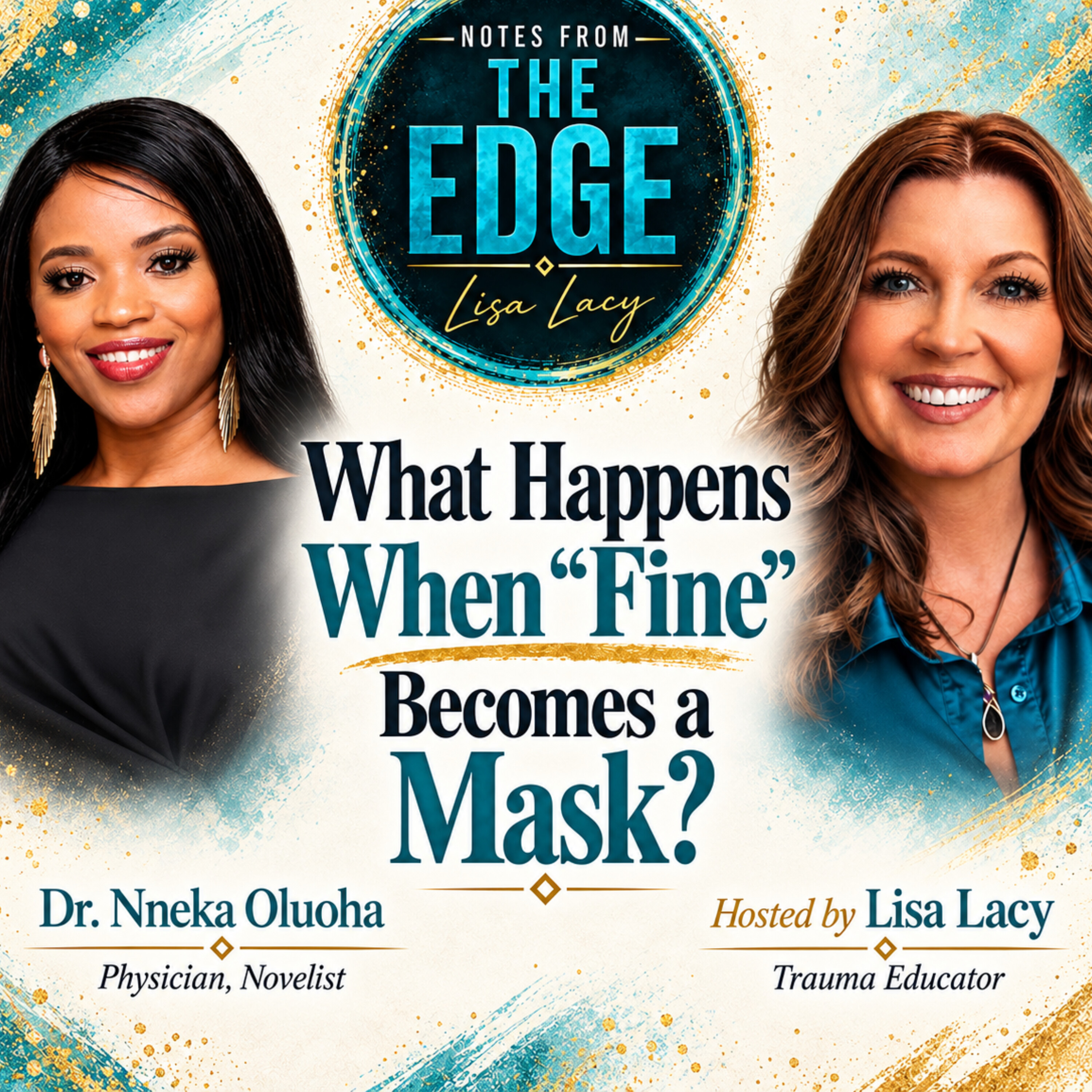
What Happens When “Fine” Becomes a Mask? High-Functioning Depression, Immigrant Identity, Motherhood & Survival Roles with Dr. Nneka Oluoha
Get every episode summarized
Each time Notes from the Edge publishes, we email you a written briefing from the transcript — the topics, who appeared, and any specific claims, with the ad reads skipped.
Email me new episodesFree for 3 shows. No card needed.
About this episode
“The Second Day It Update Binge Podcast He kept yelling out, dude, yes, dude. Bad dates, big reveals, awkward phone calls. The Second Day It Update Binge Podcast Maybe I'm just being too picky It was weird.”From the transcript
What happens when being capable becomes the very thing that keeps people from seeing you’re struggling?
In this episode of Notes From the Edge, Lisa Lacy sits down with Nigerian-American physician, novelist, and storyteller Dr. Nneka Oluoha for a conversation about high-functioning depression, cultural expectations, motherhood, immigrant identity, and the roles we perform to survive.
Dr. Nneka explores why the person who appears strongest may be carrying the most, why “I’m fine” can become a practiced performance, and how competence, strength, and responsibility can eventually become a prison when we never allow ourselves to put them down.
She also shares her experience moving from Nigeria to the United States, navigating multiple identities as a physician, mother, wife, immigrant, and writer, and finally reclaiming the part of herself that had always wanted to write.
Her novel, Live For Me Nkem, uses fiction to take readers inside depression not only through the person experiencing it, but through the family living beside her.
In this episode:
• High-functioning depression and performing “fine”
• Competence and strength as survival roles
• Immigrant identity and navigating two cultures
• Motherhood, responsibility, and mom guilt
• Why successful people struggle to ask for help
• Depression’s impact on the entire family
• Listening instead of trying to fix someone
• Reclaiming parts of yourself buried beneath responsibility
• The power of storytelling to create empathy around mental health
Sometimes support is not having the perfect advice. Sometimes it is simply being willing to sit beside someone in the dark.
Connect with Dr. Nneka Oluoha:
LinkedIn-Nneka Oluoha
Connect with Lisa Lacy:
What did you perform in order to survive?
Welcome to the Edge.
See Privacy Policy at https://art19.com/privacy and California Privacy Notice at https://art19.com/privacy#do-not-sell-my-info.
Get every episode summarized
Each time Notes from the Edge publishes, we email you a written briefing from the transcript — the topics, who appeared, and any specific claims, with the ad reads skipped.
Email me new episodesFree for 3 shows. No card needed.
Transcript ready
490 searchable segments. Every word is indexed and playable.
Full transcript
Notes from the Edge — What Happens When “Fine” Becomes a Mask? High-Functioning Depression, Immigrant Identity, Motherhood & Survival Roles with Dr. Nneka Oluoha. Machine-transcribed; use the interactive transcript above to jump the player to any line.
Ghosted After The First Date? We make the call you're afraid to make. The Second Day It Update Binge Podcast He kept yelling out, dude, yes, dude. Bad dates, big reveals, awkward phone calls. The Second Day It Update Binge Podcast Maybe I'm just being too picky It was weird. Subscribe and binge today. If you dare, Available Wherever You Get Your Podcast. is supported by your Southern California Kia dealers. Around Southern California, it's easy to spend plenty of time behind the wheel. Whether you're commuting from OCE or heading to Santa Barbara for the weekend, going farther between fuel stops is something everyone can appreciate. That's exactly what Kia's hybrid lineup is built for. Kia offers five hybrid models that combine turbocharged power with hybrid efficiency, with some delivering more than 600 miles of driving range on a single tank.
One model that really stands out is the all-new 2027 Kia Tell You Ride Hybrid. It offers seating for up to seven passengers, the competence and capability of a three-row SUV, and a turbocharged hybrid powertrain that delivers impressive efficiency for fewer stops at the gas station. It's ready for weekday errands, weekend getaways, and everything in between. If a hybrid fits the way you drive, Kia has a model designed to fit your needs. Learn more at Kia.com or visit your Southern California Kia dealer. Welcome to Notes From The Edge, where we have the conversations we should have been having all along. We talk about the things that we're not talking about. I'm your host, Lisa Lacey, writer, trauma educator, executive advisor, and author of the upcoming memoir, Notes From a Certified Matt Woment. Welcome to The Edge.
Hey, my friends, welcome back to another episode of Notes From The Edge. I am your host, Lisa Lacey, and this is the place we have the conversations we should have been having all along. Guess what? You ain't talking about it, but today we're gonna. And our special guest today is Dr. Neca Aloha, who is a Nigerian-American position novelist, speaker, and storyteller, whose work explores the intersection of all the things we love to talk about in here, mental health, culture, family, immigration, faith, identity, and resilience. Born and educated in Nigeria before immigrating to the United States, and then continuing her medical career in California, she brings both a physician's perspective and a storyteller's understanding to conversations about the emotional struggles that can exist beneath outward success, you guys. Her forthcoming literary novel,
Live For Me, Nakeem, examines depression, marriage, motherhood, family relationships, cultural expectations, and the immigrant experience through the life of a Nigerian woman who appears highly capable while privately struggling, and I know we're talking directly to some of you today. So through medicine and fiction, Dr. Aloha explores the truths people often have difficulty saying directly and uses storytelling to reduce stigma, create empathy, and make hidden suffering visible. Dr. Neca, welcome in. And how are you today? Welcome the notes from the edge. Thank you so much Lisa. I'm so glad to be here with you today. Yeah, I'm glad to have you. The minute I saw you as a potential guest, I was like, yes, these are all the things we absolutely love to talk about in here. And because it's notes from the edge, we're going to go ahead and dig right in, all right?
All right. All right. Well, let's talk about your book first. Because your character, the character you've created and your fiction novel, performs competence and gratitude and motherhood and outwardly professional success and emotional stability and I'm assuming fine, right? But at what point do you feel, especially living your lived experience and writing this novel, what point do you think that something that helped us survive eventually becomes a prison that we're living inside of? I think for most people that includes me as well, is being able to create that distinction. Sometimes what has helped us to survive was, it's absolutely necessary. Things like competence, showing up, giving your 100%, being dependable, being reliable, being that child you need to be,
being the mother you need to be, being the neighbor, you know, the friend, everything that you should be, is what has helped you make it this far. But sometimes you need to know when to take a break for yourself or when to rest or when to ask for help. If you keep performing all the time and being that person you think you should be, then it becomes a prison. Because you're still deep in that role that you don't realize that this is now a role. This is no longer you. It's now a role that you're performing. And you need to put it down for a few minutes, even for a few hours or even days or however long you might need. If we keep carrying these expectations with us, if we keep being what people want us to be and not being who we should be, even for a few minutes, then at that point is a prison towards. And sometimes we don't even see it. We don't even see it. We don't even see it. We don't even see it.
We don't even see it. We don't even see it. We don't see it. We don't see it at all. And we're just there. I love that. Sometimes people don't see us at all. Because the mask and the performance is so good. What I love about you that you brought up with you today is the idea of just dropping the role for to practice for a day, maybe half a day. So for you, when did you realize, wow, I'm really successful, but I'm kind of struggling behind the scenes. What was that moment or collision of moments that made you realize, you know, I'm performing now and it's no longer serving me? I think for me, when I came to that, to that realization was right before I wrote my first book, this book we're talking about live for me came,
that's when I came to that realization, because all my life, I've always seen myself as a writer. You know, I was a writer for us before I became a physician. So the words on books have always called to me. I loved, I'm the little girl who read Shakespeare, you know? So at the point, I kind of saw myself and I was like, I've actually not published anything yet, but I'm living this life, you know, I go to work on my schedule, I show up, I take care of people, I come back, I take care of my family, the daughter that is expected, I'm the wife, I'm supposed to be, I'm all these things, but I haven't done anything with my rights and that's my passion. And that's when I, and that's when I, I had to reevaluate my life and kind of look at it and say, okay, I keep telling myself, I'm very busy, which I am, you know? I wouldn't discredit that. So I'm busy, there's no time to write, it takes a lot of work, which is all true,
but I realize that maybe if I can put a side or just write down one word at a time, or even if it's a few words a day, that would get me on the way, you know, to doing what I would love to do. So I did just that and obviously it was not easy, but here I am today. Well, congratulations, my friend, that is huge. And I love that you did this excavation and evaluated your life and said, I'm a writer, I'm not writing, and I'm going to write, I'm friends out there that have a book in you. She started with a few words a day, it can be done. Because you're right, you're right, Dr., we do tell ourselves, I'm too busy, I don't have time, I've got to do this, or I've got to do this, or I've got to do this, and there's all kinds of stuff that gets in the way. So I love that you, you know, dropped the role mask and performance by writing your novel, which I'm assuming was very cathartic
for you, was it a healing process for you going through writing it? It was, it was an incredible journey, you know, because my book, Liefermin, Kim was written through multiple points of views. So I have in Kim's perspective, I have her husband's perspective and the birth of her children, and she has four children. So I thought I lived all those roles while writing my book. So I knew it, I was in Kim, I was going through her depression with her. This podcast is supported by your Southern California Kia dealers. It's hard not to notice how many electric vehicles are on the 405, 101, and 10 freeways these days. Better technology, convenient charging, and longer driving range are making the switch to electric more practical than ever. Kia offers three all electric models that combine performance, technology, and capability. With compatible DC fast chargers, they can charge to 80% in less than 30 minutes,
making it easier to get back on the road. One model that really stands out is the 2026 Kia EV9. It's an all electric SUV with three rows of seating, over 300 miles of all electric driving range, and the capability and technology you'd expect from a modern SUV. Whether it's your daily commute to Burbank or a weekend drive to Ohio, the EV9 is built to fit the way you live. If you're ready to make the move to electric, Kia has an EV designed to fit your needs. Learn more at Kia.com or visit your Southern California Kia dealer. At QVC, fall shopping is more than just checking out. It's discovering the brands you love across beauty, fashion, home, and culinary, all in one place. Whether you're getting ready for crisp mornings, cozy nights, or everyday moments, QVC has what you need for the season ahead, with brands like Lori Geller, Philosophy, Ninja, and so many more.
Shop now at QVC.com. I was going through her journey with her. I was finding the answers alongside her. Then I was her husband too. I was frustrated with her. Trying to get her to seek for help, trying to understand why she wouldn't, or what was going on, and trying to understand how to help, or how to be there for her. Then I was her kids too. I was frustrated with her. I loved her. I lived all those rules within them. And I asked myself at some point, why did I make her four kids? We're just making a little more challenging. This is a much challenging. It seems like you hit yourself. When you make her have four kids, at the point, they said, maybe I should make her have three kids instead. But I felt like all of those kids, because I already had them down on paper. They all brought different things to the story. At that point, they felt like I couldn't get any of them out of the story.
Once you're in there, they're in there. And very new. It sounds like you've really embodied this work. And I love that. I do talk to a lot of authors on the podcast. And I've never heard one talk so definitively about embodying the character. So that's such beautiful, beautiful work. Now, there is an assumption that if somebody is working, parenting, doing all the things that you do, doing all the things that encam did in the book, showing up, laughing, that they've got to be okay. And nobody worries about them, right? So why can the highest functioning person in the room sometimes be the one who's suffering one, sometimes the most, and two, what are we missing? I think what we're missing might be the real conversations, because there's this culture of, how was your date?
Oh, it was great. That's what you expected to say. Or how you doing, oh, I'm fine. I'm doing great. That's what you're expected to say. If you say anything beyond that, you see the people's faces start to change. You know, if you say, oh, I think I might be struggling a little bit. And then you see the person you're speaking to, they almost close off. There's a close-up expression. They might take a step back. They might be like, oh, no, I'm not ready for this. You may not say enough loud, but you can read it very clearly. So because of that, many people have learned to hide what they really feel. They go with, oh, I'm great. Oh, I'm fine. Because that's what they're expected to say. That's what they're expected to respond with. So in the midst of this, how they really feel is being buried. And sometimes, unfortunately, this is not only limited to strangers. It's only limited to us. Because if a stranger doesn't know how to know how you're doing,
that might be okay. But when the people close to you, also do not really want to know, that's where the problems start from. Maybe it might be a mother- child who has son. How are you doing today? And he says, oh, I'm not doing so well. And she's like, oh, no. And maybe what you want to hear that? Because maybe her own expectations, maybe from culture, should be strong. Because we give them some time to tell boys, you know, why are you crying are you a girl? You know, or you have a girl being told, oh, why are you crying? You're the eldest child, you should be the responsible one, the strong one. And, and you know, sometimes they grow up carrying these things. And they put these pressures on themselves too as well, apart from the pressures from family or anything else. And that pressure is there to be successful to look like you're successful. And, and everybody, these, these expectations. And sometimes it comes from the job too. Maybe you're the head of the company or you're the, a very
strong presence in the company or wherever it is that you do work. And you have that pressure to always come show up, always give 110% and you expect that of yourself. So if you find that you might be struggling, you might feel like I'm not the one to, to mention this is not me. It maybe is the janitor who should struggle, not the head of the company or it's this sort of a person that should struggle, not me. So people don't speak up or ask for help. They expect that of themselves. And they, it becomes a mask that they wear and they carry them on to the melonga can. Well, and that's just it. And, you know, I was a, I was in high performing survival for 20 years and the end result was total mental collapse. We can only carry so much. What I loved about what you said is, you know, the executive who's running the business is judging themselves for struggling, right? We shame ourselves. I should be. I could be.
So I love that you're bringing attention to that that no matter what your position is, that's a role, right? So no matter what your position is, you're human underneath all of that. So yeah. And finding the right people to tell the truth to is important. Yes, yes, because if they're the ones that are taking a step back, maybe they're the ones that don't really want to hear about your day. So finding those safe people, my friends out there, if you are struggling is pretty key because if you find somebody who isn't supportive, it may shut you down and you may not open up again. So, yeah, so let's get to how you ended up here. So you grew up in Nigeria and then built a medical career in the United States and California. So talk to me about what happens psychologically when you're trying to balance two cultures while carrying everything you carried, taking care of everything,
taking care of the family, taking care of your practice, how in the world did you do all of that? Yeah, that's an interesting question. So obviously the culture is the culture between Nigeria and the United States is very different. So after I immigrated, there was a phase of the culture shock. You know, Nigerians in general, we tend to be more more chatty. We tend to talk, we tend to be the loudest voice in the room, the most visible presence in the room. And while here, people are a bit more quiet, you know, not everybody, obviously, that's an old vaginalization, but in in a nutshell, people are a bit more quiet. So there was that of, oh my goodness, I mean, I'm in the flat and I don't even know who my neighbor is. I don't hear any noise from that. Yeah, but stay very isolated, don't we? We're going to isolate ourselves. Right. It's me over here and I'm hiding. I am now.
So that was the first surprise to me of not knowing who lived right next door to me and that general quietness was, I've always been an introverted person. I always valued quiet, but that felt a bit too quiet. That was so strange. Then also like trying to accomitize to have in different types of food available and then trying to write in exams, of course, that was tough to make it into the medical field here and then being a mother as well. So sometimes I feel like I'm being several people at the same time. The person I am with my kids because they are growing up here, their culture seems to be entirely different in this generation now. So the person I am with them is different from the person I am with my parents or even with my husband. And when I go to work as well, I'm somebody different because now I need to relate to my patients and my co-workers
and the staff around me need to relate to them, not as Nigerian-necker, but someone that is somewhere in between. There's no doubt that too. And also comes up in the little things. Like for instance, a co-worker inviting you out to eat, then you think, oh, what kind of places it? Can I even eat the food? That's there. Yeah. So and then deciding that, okay, I will show up not because of the food, but because I want to be with these people, they're my co-workers and I enjoy their companies. I'm going to go there for that reason. This podcast is supported by your Southern California key adealers. Living in Southern California, your SUV needs to do a little bit of everything. From the daily commute to weekends at the beach, road trips to Palm Springs and family adventures in Big Bear. That's why having the right SUV matters. Kia has an SUV built to fit just about every lifestyle, with traditional gas, hybrid, and all electric models. Across the line up, you'll find sophisticated design, rugged capability, generous cargo space, available seating
for up to seven, and on select models, driving range of more than 600 miles. One model that really stands out is the all-new 2027 Kia Celto's. It's a small SUV with big SUV capability, featuring class leading interior space, unavailable turbocharged engine, and available multi-terrain all-wheel drive. Whether you're navigating city streets or heading out for a weekend in the mountains or along the coast, it's ready for wherever life takes you. Whatever your lifestyle, Kia has an SUV designed to fit your needs. Learn more at Kia.com or visit your Southern California Kia dealer. At QVC, fall shopping is more than just checking out. It's discovering the brands you love across beauty, fashion, home, and culinary, all in one place. Whether you're getting ready for crisp mornings, cozy nights, or everyday moments, QVC has what you need for the season ahead, like Laura Geller, Philosophy, Ninja, and so many more. Shop now at QVC.com.
And also finding out how to say no to some foods without coming off like you're being offensive. So there's all of that juggling involved too as well. And that's something that in-camera also embodies in my book, Lifaminkan, because she's also an immigrant, she's a wife, she's a mother, and she's also battling with her mental health concerns. So she also feels that that pressure to be several different people at the same time. Only the difference is that she might not have done the best job of hers in the beginning. But along with her, I joined to learn how she goes and what she carries with her. And I love that. And as we read it, we can learn with her. So you're a physician who chose fiction, and you've already said, hey, I was a writer first, but you chose fiction to talk about depression. What do you feel like we can learn from a story from Nikim's journey that
we wouldn't learn if you were seeing us as a physician or just talking to each other. Why is and you're a storyteller? And I'm a trained storyteller too, so I believe in the power of story. So for you, what can we learn and why can we learn so much better with stories, especially when it comes to something that needs to be talked about more mental health and depression specifically? I think the role where fiction plays a good role is that in real life, let's say you go to see your therapist, maybe it's on our session, or you go see a psychiatrist, or even another medical provider. And you hear the statistics, you hear about postpartum depression, you hear about depression, you hear about PTSD, it's just something that you heard. Sometimes, you know, by the time you're in the parking lot, it's kind of is gone already.
So it's just something that was just true not you, and you're like, okay, depression, this is the said is symptoms, the signs, blah, blah, blah, and then it's gone. And life for me in chem is not it's not the test book on depression, it's fine, it's in no means, it's not a guide on how to manage depression, it's not a medical test book in any way, I'm not a psychiatrist, but that being said, it does invite the reader to sit in the chem's experience for a few hours, for you know, some hundred pages. So by the time you get through sitting in high spirits, seeing what she sees, feeling what she feels, and not just hard to you, you get to see it from the best spectres of our children too, because you learn how depression affects the entire family, most times you think of it as, oh, this is this person suffers from depression, but no, it's almost like the whole family is suffering right alongside with her. So by the time you sit with her, and experience all of this, you come away with a deeper understanding of how depression
affects not only one person, but entire family. So, and I think that something that fiction does really well, you know, it kind of holds onto your hands and it pulls you in into this story, into this experience, and while you're in there, you experience all of that, and that knowledge is almost like something that you've lived. So, so you it's no longer something that you heard, it's not like you actually had that experience. And I think after having that kind of experience, we become more empathetic, we understand more. We might be willing to give a little bit more of ourselves to someone else that is in need, because sometimes the key to helping someone who is struggling is actually being able to listen. And sometimes if you don't know what you're listening to, you may not even hear it, you know. If you if you open yourself up and you have an idea, what the lived experience might be, then you're a better support person for someone who might be struggling.
Or it might even help you understand yourself even better. Yeah, because you're living it with her, right? Yeah. Yes. Yes. I love that. That you embody the experience like you embodied or experience while you were writing it. So, we go on a journey. Yes. Journeys are actually where we learn the most. So, I love that. Yeah, I love that. So, let's talk to the people that might be struggling. So, we opened up with that question, hey, how are you? And the accepted answer is great. Good, fine. I'm fine. We perform fine. So, what should we be doing instead? What would you like to see happen if you come to me and you go, hey, Lisa, how's your day? My day's a little off, right? Maybe I just got an argument with my husband or found out
some news from the corporate side of my life. How should we approach each other differently? I think for the person who is asking the question, maybe be a bit more open to hearing beyond the words, because most times there's some kind of clueless hints. I know we are all great performers and we read this mask very well, but sometimes there's always a hint, maybe an unfinished answer, like, oh, it was great. Well, it was great. And we would love to be, oh, yeah, sure, sure, oh, it's good to hear. So, we just got it off and move on. Maybe we need to be at work on time or there's something that we need to do or we just feel like we're not ready to listen. And we're like, okay, that's good that you're doing okay. It was good to see you. All right, catch up next time. We move on. So, maybe just take a minute to say, are you sure? It sounds like there was something
you were going to say. And even if the answer ends up being, oh, no, I'm sure I'm okay. And then you may say, if you do have something to talk about, I'm here to listen. Sometimes it's just offering that ear might be enough, you know? It really is sometimes, isn't it? It is. I mean, sometimes you just have to externally process it. And so my friends and I have a thing where we go, you know, do you do you want advice today? Or do you want me to just listen? And sometimes my best friend will be like, do you want to be right today? And I'll go, yes, I want to be right today. And then the next thing is like, you were the asshole in that situation. So, you like it. But we do. We have that agreement that we ask each other, hey, you know, what are your needs right now? Do you need me to just be here and listen and sit with you in this tough moment? Or are you open to some suggestions or advice around it? And it really helps.
Because sometimes just having another part or, you know, what? Dr, sometimes just sitting with somebody, even if it's in silence. Oh, yes. I think that actually, yeah, I actually have that in my book too. And that's part of the, that's actually part of the, at the education in front for those who sit in the dark and for those who have learned to sit beside them. So, that's actually the dedication to live for Minkam. And I think in Kams' husband does that, that's one of the things he does while, you know, he's just lent to just sit quietly beside her in her dark space. So, yeah. Yeah. Which is, I think it's hard for people to do because we want to fix it. We want to judge it. Or we're so uncomfortable with our own emotions, maybe around it, that it creates challenges. So, I love the opening in your book because it is a
reminder to us that just sitting next to somebody in silence is sometimes enough. Yes. Yeah. Right? Yeah. Yeah. Yeah. I think sometimes the silence can be, can be challenging because just like you said, we want to, we want to fix it. We have our opinions and thoughts about it. But sometimes some depression, there's some parts of it that, you know, the person who is going through it has to do by themselves. And there's only so much you can do. And sometimes the much you can do is to sit beside them while they do the rest. And Minkam becomes to that, you know, when, if all the needed silence, we should be willing to and able to give it to them and just sit quietly beside them. But that's not always easy to do. But sometimes that's what we need to do. Yeah. It's not always easy. But again, it can be absolutely so beneficial. And I love your point
that this work is sometimes a very solo journey. It's our internal work to do and work through. And it's our dark night to go through. And it will always come out on the other side eventually. If we can find the right support underneath us while we go through it. And that includes supporting ourselves through it. So yeah, I do think you're right. It's because we, we feel like we have to do more. Yes. And we don't. Let me know. Yeah, I love that. Well, Dr. Nekka, where can people find this beautiful book of yours? So Lee from Minkam is available on Amazon. He's currently up on pre-order right now as we speak. Yeah.
Bans and Noble books.com and you know, many major retailers. It goes live on September night. So September night, that's when the actual fiscal coffee will be in our hands. But you know, right now we can pre-order live from Minkam. Wonderful, guys. Please go there. There's going to be a clickable link. You don't have to write any of that down. There will be a clickable link right underneath this in the show notes where you can go. Please go pick up the book in pre-sell preferably. So she can come out as the number one bestseller before it even launches. That would be fantastic. All right, my friend. We ask our guests a couple of questions before we let them go. Are you ready? Yes. Okay. The first question is in your own life, what have you performed in order to survive and what did dropping that role, mask, or performance do for your life?
I think the major one I would say would be with competence and that's also integrated with strength. So you know, being here, being a physician, you're unbeen and mother as well, you're expected to have all the answers, you're expected to show up, do what you need to do. And you know, I think for me, for the most part, I thought that with my with my children, I felt like I always had to have their answers, I always had to do what they needed. And sometimes, you know, I was sometimes all the time being a mother is not a job you can't put down, you can't really take a break, you can barely get the restroom break. So I feel like I had to learn to say this is this is mommy's time, you know, go go have spent some time with your dad. Or I even had to learn to accept help from from other relatives, you know, and say, oh, can you watch
I can watch them for a few hours while I, you know, do this or do that because there was some there was some sort of guilt because whenever I when I go to work and come back, I feel like this is my time with them. There was the guilt of if I have someone else watch them, then I'm not being the mother I should be. I'm not being who I should be with them. But then I realized that if I spend all this time at work and spend all this time with them, then there's no time for me. I had to learn that, you know, setting aside even if it's an hour a week for myself, didn't make me a bad mother or a terrible mother, I just meant that I had more to give to them when I'm with them. So I had to learn to put that aside. 100% you do end up having more if you give yourself the time, but mom guilt is sneaky guilt. So I get it, I get it. All right, the last question is what do you want us to be having more
conversations about? What do you want us to be talking about that you're not hearing us talk about? I think maybe what how we really feel, and that's one of the cultural things I thought when I first came here, I feel like in Nigeria when you asked someone how you opened up a whole trap door and everything comes spilling out. So if you do not wish to hear it, maybe you do not do not ask. But yeah, it's a bit different. There's a script for it as an answer, oh, how are you today? Oh, I'm great. And I found that very, that was one of the cultural changes I felt when I first came here. Oh, someone asked me how I am and they actually do not want to know. That's very strange. I don't ask if you don't want to know. Yes, I like that stance. I love that stance. I'm from Zara and I don't ask if you don't want to do absolutely. Well, we are going to spend so many people
your way to help you in free cell. Congratulations on the book and congratulations on being willing to jump out of your comfort zone, carve out the time for yourself and take this journey with the characters in your book. So exciting. Friends out there, I'm going to ask you the same question. What are you performing in order to survive? And what might setting that role mask or performance down do to just lighten your load a little bit? I am your host, Lisa Lacey here with our guest, Dr. Nega Luha. And when you find the answer to that, we will both see you at the edge. Thank you so much, Doctor. Thank you so much, Lisa. At QVC, fall shopping is more than just checking out. It's discovering the brands you love across beauty, fashion, home and culinary, all in one place. Whether you're getting ready for crisp
mornings, cozy nights or everyday moments, QVC has what you need for the season ahead with brands like Laura Geller, Philosophy, Ninja and so many more. Shop now at QVC.com.
More episodes
More from Notes from the Edge

What Happens When Trauma Becomes Your Identity? Sexual Assault, Trauma Healing,...
Notes from the Edge

Who Are You Without the Role? Survival Performance, Masculinity, Midlife Reinven...
Notes from the Edge

What Does the FBI Teach You About Being Human? From Pastor to FBI: Faith, Trauma...
Notes from the Edge

What If Behavior Isn’t the Problem? Childhood Trauma, Adoption, Nervous System R...
Notes from the Edge