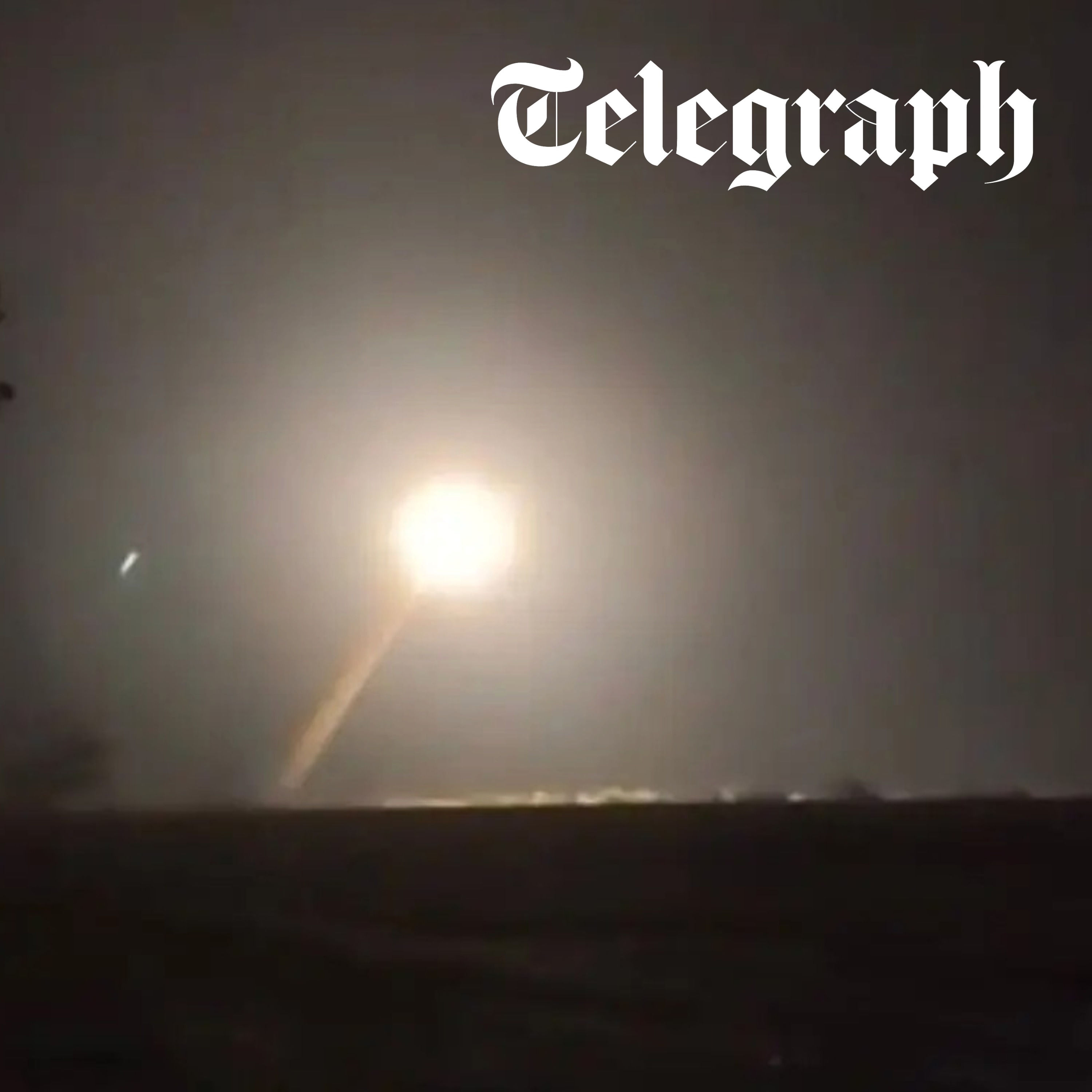
Ukraine fires home-grown ballistic missile in combat for first time
Get every episode summarized
Each time Ukraine: The Latest publishes, we email you a written briefing from the transcript — the topics, who appeared, and any specific claims, with the ad reads skipped.
Email me new episodesFree for 3 shows. No card needed.
About this episode
“The Telegraph For the first time ever in the US, the best U23 wrestlers in the world descend on Las Vegas for the 2026 Galaxy U23 World Wrestling Championships at the UNLV Thomas and Max Center from October 12 to the 18.”From the transcript
Day 1,678.
Today, Ukraine successfully uses its FP-7 ballistic missile for the first time, though they won’t disclose on what or where. Meanwhile, reports point to Russia's sinister plans for the winter which include isolating Ukraine’s main largest cities from the power grid. Russia has vowed to use ‘all the weapons at its disposal’ in case of a war against Nato. We bring you a Telegraph scoop on the Russian biker who masterminded the Leipzig drone incident, plus exclusive footage from a former Ukrainian drone pilot.
Contributors:
Adelie Pojzman-Pontay (Host on Ukraine: The Latest). @Adeliepjz on X.
Jade McGlynn (Senior research fellow, King’s College London). @DrJadeMcGlynn on X.
With thanks to Dimko Zhluktenko, from the 413th Regiment of Ukraine’s Unmanned Systems Forces (@dim0kq on X).
Producer: Rachel Porter
Senior Producer: Lilian Fawcett
Video Producer: Tom Steed
Social Producer: Natalia Makohon
Studio Director: Meghan Searle
Executive Editor: Francis Dearnley
Created by David Knowles
NOW IN FULL VIDEO WITH MAPS & BATTLEFIELD FOOTAGE:
Every episode is now available on our YouTube channel shortly after the release of the audio version. You will find it here: https://www.youtube.com/@UkraineTheLatest
CONTENT REFERENCED:
Putin has told military leaders to abandon rules of war, Zelenskyy says (Financial Times):
https://www.ft.com/content/c2ad4cd1-a08a-4f55-8d57-fa83dbfa98af?syn-25a6b1a6=1
Exclusive: The Russian biker ‘spy’ behind airport drone attack (The Telegraph and Welt am Sontag): https://www.telegraph.co.uk/news/2026/10/02/unmasked-russian-biker-spy-leipzig-airport-drone-attack/
Russia Is Planning Its Most Powerful Blow Yet to Try to Freeze Ukraine (The New York Times):
https://www.nytimes.com/2026/10/02/world/europe/russia-ukraine-winter.html
Ukraine Has an F-16 Emergency (Wall Street Journal):
https://www.wsj.com/opinion/ukraine-f-16-maintenance-delays-russia-sabena-engineering-85ca626a
Dr Jade McGlynn’s Insights survey of internally displaced persons (Centre for Statecraft and National Security, King's College London):
https://totinsights.org/idp-survey-2026.html
Dimko’s charity Dzyga’s Paw:
Dimko’s book, Ordinary Guy At War:
https://kovyla.pub/books/ordinary-guy-at-war-a-ukrainians-journey-paperback-29
On the double biopic about Charles de Gaulle wartime actions, Résistance (Part I) and Liberté (Part 2):
https://www.imdb.com/title/tt28553375/
If you’re interested in sponsoring Dom’s upcoming defence event, email our colleagues at [email protected]
EMAIL US:
Contact the team on [email protected]. We continue to read every message, and seek to respond to as many as possible.
Thumbnail image credit: @ZelenskyyUa/X
HIGHLIGHTS:
- Ukraine fires home-grown ballistic missile in combat for first time
- Exclusive footage: 24 hours as a frontline drone pilot
Hosted on Acast. See acast.com/privacy for more information.
Get every episode summarized
Each time Ukraine: The Latest publishes, we email you a written briefing from the transcript — the topics, who appeared, and any specific claims, with the ad reads skipped.
Email me new episodesFree for 3 shows. No card needed.
Hosts & guests
Transcript ready
535 searchable segments. Every word is indexed and playable.
Full transcript
Ukraine: The Latest — Ukraine fires home-grown ballistic missile in combat for first time. Machine-transcribed; use the interactive transcript above to jump the player to any line.
The Telegraph For the first time ever in the US, the best U23 wrestlers in the world descend on Las Vegas for the 2026 Galaxy U23 World Wrestling Championships at the UNLV Thomas and Max Center from October 12 to the 18. Don't miss your opportunity to see Team USA's wrestlers battle for gold on the world stage right here in the United States. Tickets are on sale at UNLVTickets.com. Get 20% off by using Code Team USA. Your Willard Trust shouldn't be in the wrong hands. Cobble together from an AI answer or a generic template. Legal Zoom was built to help with your situation, with self-guided tools or the assistance of an attorney without the price tag of a traditional law firm. 2.2 million families made their Willard Trust with Legal Zoom. Yours can be next. When you need a legal hand, visit Legal Zoom.
Legal Zoom provides access to independent attorneys and self-service tools. Legal Zoom is not a law firm and does not provide legal advice. There's a fire inside you you can't ignore. Stand still, not a chance. You're a lifelong learner who's come this far. Now we are here to help you keep going further. Capella University, what can't you do? Visit Capella.edu to learn more. I'm Adely Poshman-Ponte and this is Ukraine, the latest. Today, Ukraine successfully used its FP7 ballistic missile for the first time, though they will not disclose on what. Meanwhile, reports point to Russia's sinister plans for the winter, which include isolating Ukraine's largest cities from the power grid and hitting the country's three nuclear power plants. Russia also vowed to use all the weapons at its disposal in case of a war against NATO. We bring you a scoop on the Leipzig drone incident and Dr. Jade McGlin analyses the situation in Oleshky.
Finally, we have exclusive footage from a former drone pilot. Bravery takes you through the most unimaginable hardships to finally reward you with victory. The Russia does not want peace. First, we share our help with Ukraine and our freedom and our European values. We can't leave the Russia with Ukraine as a European. It's Friday, the 2nd of October. Four years and 220 days since the fall-scale invasion began. Today, I'm joined by Dr. Jade McGlin of King's College London and friend of the podcast, Dimko Schlucktanko,
from the 413th Regiment of Ukraine's unmanned system forces. So let's start with the FP7 ballistic missile, which is domestically produced in Ukraine, in which has been used in combat for the very first time. It's a major milestone for Kiev's push to build its own strike weapons. President Zelensky announced the breakthrough in a social media post, although he didn't reveal the exact target, location, or outcome of this strike. An advisor confirmed to our friends at the Kiev Independent, we want to tell. The president said, FP7, first combat use, thank you for the result. Next up, production. The missile is made by Ukrainian defence company Firepoint, has a 200 km range and carries a 150 kg warhead. The same firm is also working on the FP9 ballistic missile, which, with its range of up to 855 km, could be used to strike Moscow. Marking Ukraine's defenders day on Thursday, Zelensky thanked all of our defenders
who were working to return Russia's sick war to where it came from. Let's move to updates on the frontline. Ukraine's defence forces reported 207 combat engagements on Thursday. On the south, Zelensky Axis, Ukrainian units repelled 11 enemy attacks. Russia launched one assault in the Kupiansk direction, 7 near Zeloviansk, 27 near Constantinivka, and 30 in the Pukrofs direction. There were also another three attacks near Le Mans, which were repelled. Let's look at Russian overnight strikes now, which killed one person and injured two more in the capital. Officials said in a telegram post that a fire broke out on the upper floors of an apartment building as a result of the attack. The southern bridge in central Kiev was hit again late on Thursday and into the early hours of Friday, just as we were walking into the studio, Kiev was still completely paralyzed with traffic jams. As we reported yesterday, a strike on the bridge Wednesday night into Thursday seemingly caused
no structural damage, allowing it to reopen shortly after. But as a result of these latest strikes, all traffic on the bridge, including the metro, has been suspended. Eye witness footage from residents shows flames on the bridge and smoke. An FPV attack on a civilian bus this morning in Kramatorsk wounded two people. On to the Energy War. President Zelensky has said that Ukrainian spy agencies had obtained information suggesting Russian President had scrapped the constraints that governed earlier air campaigns. Zelensky told The Financial Times, Putin said there are no rules now. The shift apparently came in September, as Russia was intensifying its strikes campaign against Ukraine. Russia would aim to isolate its larger cities, namely Kiev, Harkiv, Odessa, and Lviv from the rest of the country as winter sets in. Meanwhile, the New York Times has gained access to a presentation from Foreign Affairs Minister Andrei Sibir to European partners, showing that Russia wanted to, I quote,
freeze Ukrainians into submission. The intelligence came from an intercepted Russian plan to methodically attack Ukraine's energy system until it's collapsed, using up to 1,000 missiles, drones, and bombs. The document says that Russia intends to shut down Ukraine's three operating nuclear plants. And one of the ways they could be planning to snag Ukraine's power lines and blow them up would be with a new Shea head drone fitted with metal whiskers. It's believed that Russia has already deployed two of these drones. The new modification means the drones have thin rods protruding from the nose, seemingly to detect and strike high-voltage power lines that would be difficult to hit with a conventional warhead. At the same time, as Dumb reported earlier in the week, Russia is now deploying a jet-powered drone armed with a specialized warhead, capable of slicing through steel structures, including electricity substations. And now over to Ukraine's hits on Russia overnight. Ukraine hit oil infrastructure, including the Volga-Grad
luke oil refinery, which is one of the country's largest processing facilities. That's according to Ukraine's general staff. Another target was one of Russia's largest gas processing and petrochemical plants, as well as a major oil transport station facility in the Samara Oblast. Ukraine's defense forces said the plant produces raw materials for explosives used in artillery shells. Zelensky confirmed the strikes in a post on X this morning and added that successful operations were also carried out in the Black Sea and in the Voronezh, Nizhnyi Novgorod and Krasnodar regions. These strikes included airfields, industrial facilities, a missile and space center and an ammunition depot belonging to the Russian forces. Next, we have an exclusive from the telegraph in our colleagues at Velt Amsantag, both part of the Axel Springer Global Reporter's network. A Russian biker has been revealed as the suspected mastermind of the failed bomb plot at Germany's Leipzighaler Airport in August. This is of course the incident which saw a drone carrying a tin of explosive
fly into the wing of a Ukrainian airliner. Germany later accused Russia directly of being behind the plot. Our colleagues have revealed through classified intelligence documents and interviews with senior Western intelligence officials that Russian national end biker Oleg Leverishkin planned the attack. It was then carried out by a Belarusian proxy. Leverishkin has reportedly maintained contact for years with Denis Smoljani Nov, an alleged chief planner of Russian bomb attacks across Europe. A report by Lithuanian intelligence seen by the telegraph said Smoljani Nov led the Ukraine Department at the GRU Russia's Foreign Military Intelligence Service. The Leipzig attack has been linked to a unit within the GRU which German intelligence officials say is the main driving force behind these Kremlin-ordered operations. Those Lithuanian files also revealed links between the Leipzig attack and a wider network of sabotage plots across Europe, all allegedly orchestrated by a hardline unit in the GRU.
There's a lot more detail to this story and it's a fantastic bit of work by our colleagues at the telegraph and Veltam Sontag. So make sure to read it in full after you've finished listening to this podcast, of course. We'll link to it in the show notes. Let's move on to the diplomatic realm now. Vladimir Putin has vowed that Russia would use all weapons at our disposal in the event of a conflict with NATO. Speaking at his annual Valdivorum, the Russian President echoed warnings from Moscow earlier this week that it would be ready to use nuclear weapons if NATO tried to isolate the Kaliningrad-X-Clive. As Sophie reported yesterday, we think that statement was in response to a series by Sky News, which traced how the UK might respond to a hypothetical Russian attack, including by isolating Kaliningrad, which sits between Lithuania and Poland. But no need to worry, apparently, because Putin told the conference in Moscow that Russia has no intention of attacking anyone. He insisted Moscow is not threatening anyone and was merrily responding to warnings by Western leaders that Russia could attack a NATO country by the end of
this decade. Going back to Ukraine, the country has rebuffed claims made in the Wall Street journal earlier this week that Kiev is facing an F-16 emergency. An editorial in the newspaper claimed that half of Ukraine's fleet of the fighter jets was out of commission due to maintenance limbo. But a spokesman for the Ministry of Foreign Affairs, he or she, Tichy, denied this. In a post on X, he admitted conditions are demanding, and that sustaining the aircraft is challenging. But he also said, recent reports alleging catastrophically low aircraft availability rates and excessive long maintenance turnaround times are simply false. Contrary to these claims, our industrial sustainment partners are not only continuing to deliver overhauled aircraft for doing so at an increasing pace. Turnaround times are decreasing, not increasing. After the European Union controversially removed two Russian oligarchs from its sanctions, Kiev is responding by bolstering its own list. Ukraine is planning to sanction 20 additional Russian
oligarchs for in Minister Andrei Sabea, who described the move as an asymmetric response to the EU decision. Sabea added that Canada had confirmed it would not lift its own sanctions against delicious Usmanov and Mikhail Friedman, who were both delisted by Europe after pressure from France, Slovakia and Luxembourg. Ukraine is working with other allies, including the UK, Japan and Australia, to make sure the men remain sanctioned elsewhere. Let's turn now to the occupied territories, with our regular update from Dr. Jade McGlin, senior research fellow in head of the Ukraine and Russia program at King's College London. I caught up with Jade earlier about her recent polling inside the occupied territories, the situation in Oleshky, and the latest resistance activity. Here is our conversation. Hi, Jade, good to have you back. We have a lot to talk about today, so where do you want to start? If it's okay with you Adely, I thought we would start with some fresh polling from internally displaced people from the occupied territories that we've just received back. The polling was
carried out by operative now, so it's here, so essentially we pulled over a thousand people who are originally from the occupied territories, and we did a similar poll last year as well, so we've got a point of comparison, though some of the questions are new. And the general has opposed top lines are people still are not overly enthusiastic about how effective the Ukrainian government and international humanitarian organisations support internally displaced people inside Ukraine, but some more interesting elements include still a very strong majority, believe that most of the population left in the occupied territories is not happy about the Russian occupation, and about 20% believe that there isn't hidden resistance to the occupiers in the occupied territories, and over 50% believe there is, and then quite a lot of them find it hard to say. We also asked
them about what behaviours do they think create a risk of violent actions? Obviously there's quite a lot of those, unfortunately, and then we also ask, we give them a list of non-violent actions and ask them which of them they perceive as useful and worth risks in the temporarily occupied territories. Another interesting question is how many people keep in touch with their acquaintances or family in the temporarily occupied territories? And last year it was a majority, just about who, or plurality I suppose who do, and this year that number's gone down, and the number of people who quite adamantly do not keep in touch with their family or relatives or acquaintances under occupation has gone from 37.6% into 2025 to 49.2% into 2026, so there seems to be a hardening there. Of those who do speak to their acquaintances and friends, the largest proportion speak at least
several times a month if not more, around 15% speak several times a week and 13% every day or almost every day, and the main way that they keep that contact by quite some margin, so 65.5% is telegram. I'm curious about that statistic, the fact that people do not keep in touch with their families outside of the occupied territories as much do you think that's because they're more scared? I mean obviously it's always been very dangerous to keep in touch with people from outside occupation, or is it also a weakening of family ties because it's been so long? I mean we didn't ask the question, perhaps in hindsight we should have done sort of why not, but it's quite a personal question based on conversations that I've had a lot, most often it is a fear element, so it's quite well known that let's say you have your parents in the occupied territories, the Russians can take them or hassle them in order to get to you in free Ukraine or in
Europe, and the only way to really get them to leave your parents alone is to block your parents on all social messaging apps and to cut off all connection with them, and there have been several cases that I'm aware of where parents have been released after doing that because they understand that okay the parents aren't going to be leveraged that they can use to get the individual in Europe or in free Ukraine to conduct whatever operations it is they want them to conduct. So the general advice from the Ukrainian security services is to block contact with your parents for their sake and for your own sake as well as for the sake of not being involved in some of Russia's sabotage actions and so on because obviously a lot of people would do things they think they wouldn't in order to protect their parents if their parents are in the hands of the FSB. Also I'm wondering of the people who are pulled, how frequently had they
managed to escape the occupied territories and where had they been crossing into Ukraine because a couple of years ago I'd been to the checkpoint at Dummanova with the Belarusian border and as was my understanding at that time it was the only basically place you could cross coming from Russia into Ukraine is that still how people come through? So yes people do still use that crossing point between Belarus and Vodin regions. There's still the only one that's open because of course the coast crossing was opened in the first couple of years and I mean in the first years where you had a crossing point around Vasilivka down in Zapirysia but that was in 2022 so mostly people go around the houses for a long time people would cross into here into Estonia actually it was one of the kind of crossing points where a lot of people go out a lot of people from Marryport seemingly and you know other kind of points because a lot of these people now essentially have a Russian passport regardless of whether they wanted one so they can provide that there's no
mark against them to say that they're extremist or under suspicion they can leave the occupied territories and then travel like a Russian so they can go to Georgia and then the issue is in renewing their Ukrainian documents if they were destroyed which very often they were or if they were confiscated it differs a little bit by place sometimes they were sometimes they weren't so there are ways out I mean it's funny there are families that travel in and out of the occupied territories like their specific services that are available to it but not for everybody so maybe not for the sort of people that we discuss on these podcasts or people who are perceived to be pro-Ukrainian but definitely let's say for kind of nanos or older people there is an established way they're called flights but they're not flights they're coaches and they're often sort of 40 hours 30 hours that can take you saying from mellotoppa winter bellows into Warsaw and then back again so I just like us to zoom in in the occupied territories on this issue of Roleshky
which we've talked about a lot in the last couple of weeks for the terrible famine that is being instigated by the Russians who are using civilians as human shields and preventing any food to be delivered but you've had some thoughts and maybe some new information about the situation I mean I do have no information I was speaking to some of the people who are providing the food who they get sent by a drone we spoke with someone who's been involved in resistance coordination and then to former partisans one of whom is from Holla Police down which is not much further away from a Leshky and is also in a pretty grim situation and whilst I think it's really important that all of this attention is being paid to a Leshky and that solutions are being found always partial always not perfect but I suppose the positive new wonders you know a Leshky is an extreme example but there are many places in the occupied territories that are in not much better over states there's been some excellent Russian opposition reporting from
places like Sivere Donetsk up in the Hansk region and of course places as well also along the left bank there are showcase parts of my report but huge sections of it you know haven't had water I suppose what I'm saying is I think it's really important that there's this focus on a Leshky and certainly it's a positive thing in terms of the attention being paid but if it just enters on a Leshky I think a real chance will be missed because often the way we speak about Russian occupation is as if oh well they've just conquered these areas and now they're running them but they're not really running you know the infrastructure situation vast majority of people is horrific there is no access towards hundreds of thousands of people there is no reliable access to heating there are problems with connection and none of these things are really spoken about it says if Russia is kind of managing the occupation and governing but there's not really an economy to speak of I mean yes a Leshky is the most horrific example for a range of different reasons including
Rubicon bases Russian drone unit bases near the area including the consequences of Russia blowing up the Kovkadan there are things that make it even worse but the situation across left bank of her son is horrific and the situation across the occupied territories is on a scale from that's quite bad to this is an absolute crisis and the fact that Russia doesn't let us see it doesn't mean it's not happening and it also doesn't mean that nothing can be done I mean Leshky is a really complicated situation due to the military concerns and yet still something can be done and one of the interesting questions that we gave in the poll was because we were debating this between ourselves and the team so we asked the those who've left the occupied territories do you support Ukrainian strikes on the occupied territories and it was a resounding yes that they do support strikes on their home regions and one of the conversations we were having a bit at the event
but also with some of the guys afterwards was you know that really the Ukrainian government needs some messages that is very little they can do for people who choose to stay in occupation and some of them may be very good reasons but there's really very little that can be done because Ukraine has to prioritise its own military forces and objectives and its civilians and free Ukraine but this is what some of the Ukrainians who are from the Okved territory so have more right to say these things than I do we're saying but I was interjecting if I have such a right to do so to say well that's fine provided that there are lots of mechanisms for people to evacuate and again what came up in the polling when we asked ok why do your friends and relatives not evacuate you know the main reason was that they do not have the money to do so because while I appreciate it doesn't sound like a huge amount of money to maybe me or you actually 500 euros per person or up to a thousand is quite a huge amount of money for people in the occupied territories that's a real block and then also when they get back into Ukraine are there facilities there to really support
them where they can live with some dignity where they're not told when they're allowed to shower where their children are housed in like places that are safe and that's not a criticism I would really make to the Ukrainian government in that case because I think they've gotten off on their plate but I do think they're an awful lot of international humanitarian organisations of huge budgets often paid for by Western taxpayers and I know that many of them are doing really really excellent work so I hate to be critical but clearly there is a gap. One of the conversations that came up during your event at King's College last week which was actually fascinating because I think it was probably one of the only points where the different people you'd invited didn't quite agree was whether it was important to keep stories from the occupied territories and especially of the resistance in the media. I wondered if you could give our listeners an overview of the debate and also what you think about this because obviously this is what we do. Yeah no I think it's a really important
question so you're right so one of the speakers was very adamant about its importance one of the speakers was like no it shouldn't be covered and then one of the speakers was which I think is the closest to our terms position is yeah cover it but just don't be stupid which I like. So our term himself speaks obviously a lot about the resistance but it's about doing it in a way where you're not damaging operational security and you're not saying anything that people have told you not to and it's always that balance I think and I'd say there's two different things to balance in terms of how I think about it is just me personally. The most important one of course is operational security so that you're never ever saying something that might in any way jeopardize or bring visibility to specific people in the occupied territories because that's what you don't want to do anything that can trace back to them except to accept that term so that's one of the reasons why we never create content if that makes sense we're just using the already public that we
can then check for occupation source or for other sources but the second aspect that is also a really hard one is is completely legitimate that Ukraine has its own like information warfare going on and so it should bluntly like Britain did it during World War II all of kind of our propaganda campaigns Ukraine's an existential fight of course it's going to do information campaigns but as much as I support the fact that they have to do this I also don't want to be a part of them if that makes sense because I do sometimes worry that it has a negative effect on people in the occupied territories if you're just making stuff up about what's happening then so I see my role as to genuinely try and work out what resistance is there and is happening and at least to draw attention to the fact that there is still this resistance in the occupied territories without at any point trying to say and there's millions of people and they've all got a machine gun at home because first of all you're then potentially fueling a lot of paranoia inside the Russian
security services to start going after people for things that aren't actually real second anybody in the occupied territories would know that I'm talking absolute nonsense so I would be discrediting myself and also adding to that sense that I think many people in the occupied territories feel that not only do people not really care but that they really have no idea what's going on there which is understandable because how can we if we can't go but let's not give them further justification for that what must be a really horrible feeling of abandonment and being misunderstood this is one point I've all this because agreed on and I really strongly agree with them these people need to be understood as heroes just as much as the guys in the front on the front because they have fought in really difficult conditions and it feels not right to just not speak about resistance in our grigor and if these people are choosing to make things public and the activities can be found by a second source just being reported anyway to a Russian and Ukrainian language audience I think it's reasonable to also report it to an English language audience no absolutely
I completely agree with that and I think one of the reasons why it's important to talk about them is that they're not forgotten neither by the rest of the world nor by history in a way because it's important to have that legacy to be out there to show the West and show allies that that people are still fighting that people are resisting and I guess my last question on the subject Jade before we move on to the regular updates is of what's being reported in the media I'm speaking more about English speaking media but in general you talked about operational security to what extent what we read is stuff that the FSB and the Russians is already aware of I would say that the FSB and the Russians at the very least have the potential to be aware of a lot more than we might expect you hear some very serious accusations when I was speaking to some friends from occupied part of Zapparizia and they were telling me about an evacuation several months ago now the lady is safe they were talking about how during that occasion and during several lovers
it became clear that the FSB checkpoint in the occupied territories you have to pass through and you're trying to leave the FSB had access to something called obrug live access now these are allegations that I have no way of of confirming but others have also said that it's true to an extent that I tend to believe it now what is obrug is essentially a list of almost like the military status of Ukrainian so Ukrainian men normally so it's like the Ukrainian obrug is like the Ukrainian internal as if it's data set or software for seeing if men are serving essentially are you a draft or are you already serving what's your status and of course for the FSB and the checkpoint they use this to see whether or not you have family who are serving in the Ukrainian armed forces and it makes a decision on whether or not you're allowed to pass the checkpoint or not or it can do in any case and we'll certainly almost definitely lead to a conversation so the FSB have access to an incredible amount of it and that's something from Ukraine so if we're
talking about inside the occupied territories the real issue of the FSB is I think we spoke well last time deeply corrupt and sometimes incompetent in terms of their powers and what they have access to it's huge but there is also just a human error function especially if you're really corrupt and that's what's really motivating you so those are it's those spaces and those spaces of human error in theory I mean the FSB can read pretty much anything on telegram that is an in-secret chat and they all have keywords for example which will draw their attention certain things where your safer is on certain encrypted applications but then of course you have to be very careful about how you handle those because if you go past the checkpoint with encrypted applications you need a few phones it's very complicated and also it's just normal in the same way that if you speed like we were talking to people who are still in contact with friends and others in the occupied territories and some of the people who are speaking at the King's event beforehand
and obviously you're asking like in a very western or kind of rules way what are the different security protocols and like we have all of these security protocols and they sound very very good obviously I won't go into them but they said to be honest after a while you do just have people who will just send a message via telegram or slip up on these things and you can't really stop it so often what comes across is you can have all of these best laid plans whether or not you're the FSB or whether or not you're somebody helping the Ukraine Armed Forces but in practice you're just going to make the same human mistakes that anybody makes and it's really difficult to guard against that. Yeah absolutely I see what you mean. Shall we go to the regular updates then? I don't know if there are many because I know it's been there could be quite short reports in recent months so what are they? That's continuing so there are two updates on the 17th and 25th of September, both of them in Maru for both of them concerning arson or military vehicles and it's interesting that
it's arson to me because that would suggest that it's a case where a car is parked is not possible to get a droning time and so somebody has to act on the ground and it's a case where maybe that risk may be decided to be taken because in general if you look at the share we were collating like last night for different reasons just the sheer number of of hits in the occupied territories. Using coordinates for drones, reference of that's middle strike or from what it's deeper strike and it's really you know quite large amounts ever since the middle strike campaign began earlier this year so I think it makes total sense that the on the ground resistance activities are going to reduce and people are going to focus instead on I suppose intelligence gathering like with voice scurs and I have to say I think the provided people can be encouraged to use the operationally secure methods and not to just send stuff via telegram it's definitely a positive because it keeps
people there safer whilst aiding by those who have chosen to do so aiding the Ukrainian on forces. Thank you so much as usual it's fascinating to hear your insights and we'll post the link to your research in the polling in the show notes and we'll catch up in a couple of weeks. Thank you. The single customer agent made for the entire journey from qualifying sales leads to resolving support issues, Finn works across teams carrying context from one conversation to the next. There's a fire inside you you can't ignore stand still not a chance you're a lifelong learner who's come this far now we are here to help you keep going further Capella University what can't you do visit capella.edu to learn more cooking up a storm dressing to impress staying fit and healthy whatever interests you you'll find it in the telegraphs newsletters explore the complete collection
from recipes with Diana Henry to fashion and beauty with me Lisa Armstrong get the best of our journalism delivered to your inbox visit telegraph.co.uk slash newsletters today and now let's end the week on a special short film friend of the podcast dimcoge look tentco is a Ukrainian soldier who until recently operated drones in the Donbass he shared hours of exclusive footage with the telegraph showing with the high-risk role looks like in practice from dawn till dusk from taking shelter in a van hidden by trees to running down into a bunker he documents and narrates a day in the life of a drone operator the film was produced and edited by Jack Leather and if you're listening to this episode the video version combines the footage
shared by dimcoge with clips of the drones in action Russians prioritize killing drone operators overall almost any other target my priorities to keep the infantry safe they are the kings of Ukraine's battlefield where will when and keep our independence as the Ukrainian drone operator it was my job to help bring down enemy soldiers or delete Russian idiots as I call it this is what my life looked like my name is dimcoge doncoge and I am active duty Ukrainian soldier I've been a drone pilot and now transition into a lessons learned section in 413s and men's systems regiment raid I've been piloting the ISR drones
also known as intelligence surveillance and reconnaissance from the spring to winter 2025 my main job was to provide the live footage intelligence from the battlefields in the bus we're bringing the drones in the special drone cargo boxes and assemble them on site hello all it takes us a couple of minutes and then I put a camera in the nose the battery in the back and do pre-flight checks with my brothers and arms the drone has a camouflage painted on top actually I did this this is made specifically for defending a Russian interceptor drones it's designed in a way that when it sees you from above our drone will blur into the terrain alright this is a funny moment because I'm usually not a smoker like never but these are like special malboro mental cigarettes from Japan that were quite popular in Ukraine at the battlefield so after lighting them up I head into the wheat field to launch my drone this bright thingy
wire that I'm holding is a part of the pulley system which catapults the drone up in the air and my first job here is to check that is intact and functional so any more function here will mean that will risk getting heard and the drone could be damaged and as a pilot I am responsible for the launch of the drone the flight and the entire operation here the commander of my unit comes up to help launch the drone and we have some curious random guys in the van stop near us for a chat probably they are looking for the position for the air group or something then I attach the drone to the pulley system and I check all of the switches on my controller and prepare for the launch as you can hear my radio I'm constantly in touch with the command center to ensure that the airspace near us is safe place my hand on a shoulder to make sure that he doesn't fall backwards
at the launch I push the left joystick upwards to give it a maximum throttle and the right one to gain the altitude as fast as I can here once the drone reaches a safe altitude I transfer the control from the remote control to a computer program on the laptop basically we're in the middle of the field so we are a clear target so we rush back into the trees into our improvised command post into a van a desk van by the way was crowdfunded through a e-printing charity Ziggespa which I'm proud to say that they have crowdfunded over six million for Ukraine's technological war effort and I used to be a founder of that charity there are two laptops on the desk it's like a table that you would take hiking with the you the left one is for the camera controller so my body his job is to find the enemy and capture the best possible footage with the camera he's
highly skilled in spotting the infantry and tannas are more vehicles artillery pieces three lines that are being used for a shelter any traces of life the laptop on the right is mine I'm responsible for flying the drones so I need to have more of a situational awareness what type of mission we are doing what is the weather and how we could get the most of the leverage from the conditions so it's in our favor for the mission and for the result I just plan everything to spend as much time as we can doing useful work with our brothers in arms hitting the targets that we find or finding the targets to be hit further we have several ways that we can communicate what we can see from the drone mostly used is the live stream of our footage into delta it's our command and control battlefield management kind of a tool available to everyone in Ukraine's army I could also use the live voice chat to give information in real time for instance to coordinate a strike with
let's say a high mars group who is interested in working some targets that we show here in the live stream my priorities to keep the infantry safe and we work for them essentially they are the kings of Ukraine's battlefield and they are doing the hardest hardest job ever here I share some snacks to boost the energy levels be it jerky high protein and easy to eat while you're flying if you have an hour person with you force guy you could have someone to cook proper food like amarees and stuff but snacks like this they can keep going this type of a drone mission could last for three or four hours that's how long the battery will last once we go back landed safely it only takes maybe like 10 minutes to change the battery take the SD card to dump all of the footage on our laptops to start uploading data into command and control system and then we
could fly again immediately both day and night going down in a bunker feels much safer you can go into a concrete capsule where you could take off your body armor because you cannot sit with that humanly possible for days and days even if a drone hits your position you'd be probably okay because anything under 10 kilograms of charge could cause only a slight concussion and not much more so you'll not get hurt badly this bunker was probably built in 2024 2025 and it's in a pretty good shape it's almost new I don't really mind too much about the lack of light or anything else I'm just happy to be safe here you know here I'm unlocking the capsule as a lot of the few valuables inside some of the equipment that we use there is also my phone number on the door in case anyone else needs to get in here to check the connection I go onto the starling gap or
start the bug app on my phone it will literally tell me whether there are like any cable problems or extra spoofing so that starling mine I will function as good as we think it should starling is a big enabler on a cranes battlefield and we be in real trouble without it it means that we could communicate quickly and live stream on delta the green device here is a drone feed interceptor it could intercept an analog encrypted feed through the radio which means that it works best against FPV drones flying near us so we could see them approaching us and take appropriate measures another challenge is the Russian electromagnetic warfare it masses up the readings on compasses so we use like maybe five of them and take the average reading because you need to know the compass that within the drone that's somewhat in the same range of the readings that you have
on normal compasses and more basic challenge here is climb in a tree here I was changing the battery on a beacon system and nearly fell down some of those systems we use for navigation based on the radio tree angolation finally it is time for us to leave I tried to leave my position under the cover of night for safety here you could see two friends netting and rain bed weather means that Russian drones cannot fly that well and the nets are the extra protection for us and every day would end at like 10 p.m. but there were times when you stay in the bunker for a week and flying on stop for a week Russians are pushing hard and we are doing our best to defend our homes I reflect on it I feel like this was the most valuable and impactful thing I have ever done in my life and I'm super proud of it where will win and keep our independence
Dimko mentioned the charity he set up Zegas Paul which supports font line soldiers will add a link in the show notes if you want to learn more and a final thought from me which is really a recommendation for the weekend following from our conversation with Jade on the importance of partisan networks being talked about in order to be remembered by history and how there is much fighters as the people who are on the font line well if it is showing near you I would highly recommend you watch the biopic on Charles de Gaulle and how he built the resistance from London during World War II for all the American movies about the Second World War it's rare to see the role of French partisans included in the narrative of liberation and too often I've heard it be either ignored or mocked by English speakers and watching the films I saw many parallels with Ukraine and yes I said films with an S because it's two of them each three hours bear with me and yes I am trying to force Francis to watch it so we can talk about it the first one is called Resistance and the second which ends on the liberation of Paris Liberty and yes it is in French but it
is subtitled as South Korean director Bong Joon-ho famously said during an Oscar ceremony once you overcome the one inch tall barrier of subtitles you will be introduced to many more amazing films be curious everyone and have a good weekend will be here same time same place on Monday Jack we are Ukraine the latest is an original podcast from the telegraph created by David Knowles every episode featuring us in the studio maps and battlefield footage is now available to watch on our YouTube channel subscribe at www.youtube.com slash at Ukraine the latest there's a link in the description if you appreciate our work please consider following Ukraine the latest on your preferred podcast app leave us a review as it helps others find the show and please also share it with those who may not be aware we exist you can also get in touch directly and ask questions or give comments by emailing UkrainePod at telegraph.co.uk we promise we continue to read every message
even if we can't reply to you all you can also contact us on x you'll find our handles in the description as ever we're especially interested to hear where you're listening from around the world and finally to support our work and stay on top of all of our Ukraine news analysis and dispatches from the ground please subscribe to the telegraph you can get one month for free then two months for just one pound at www.telegraph.co.uk slash Ukraine the latest Ukraine the latest was today produced by Rachel Porter in audio and Sophie Sullivan in video the executive editor is responses only the series creator is David Knowles my name is David Knowles thank you all for listening goodbye you've never been one to settle stand down or stand still you're a lifelong learner energized by excellence there's a fire inside you you can't ignore you've got competition to outrun momentum to build on and your own high standards to meet stop now not a chance
at Capella University we help you catch what you're chasing because you've always had the drive now go earn the degree Capella University what can't you do visit capella.edu to learn more
More episodes
More from Ukraine: The Latest

Russia launches new missile at Ukraine after losing 46,000 troops in September
Ukraine: The Latest

Fleeing Russians using Ukrainian civilians as 'human shields' in Kharkiv
Ukraine: The Latest

Scientists cling to burning building after Russian raid & Ukraine's Operation Vi...
Ukraine: The Latest

Exclusive interview: Ukraine’s drone chief Robert ‘Magyar’ Brovdi – ‘We will tur...
Ukraine: The Latest