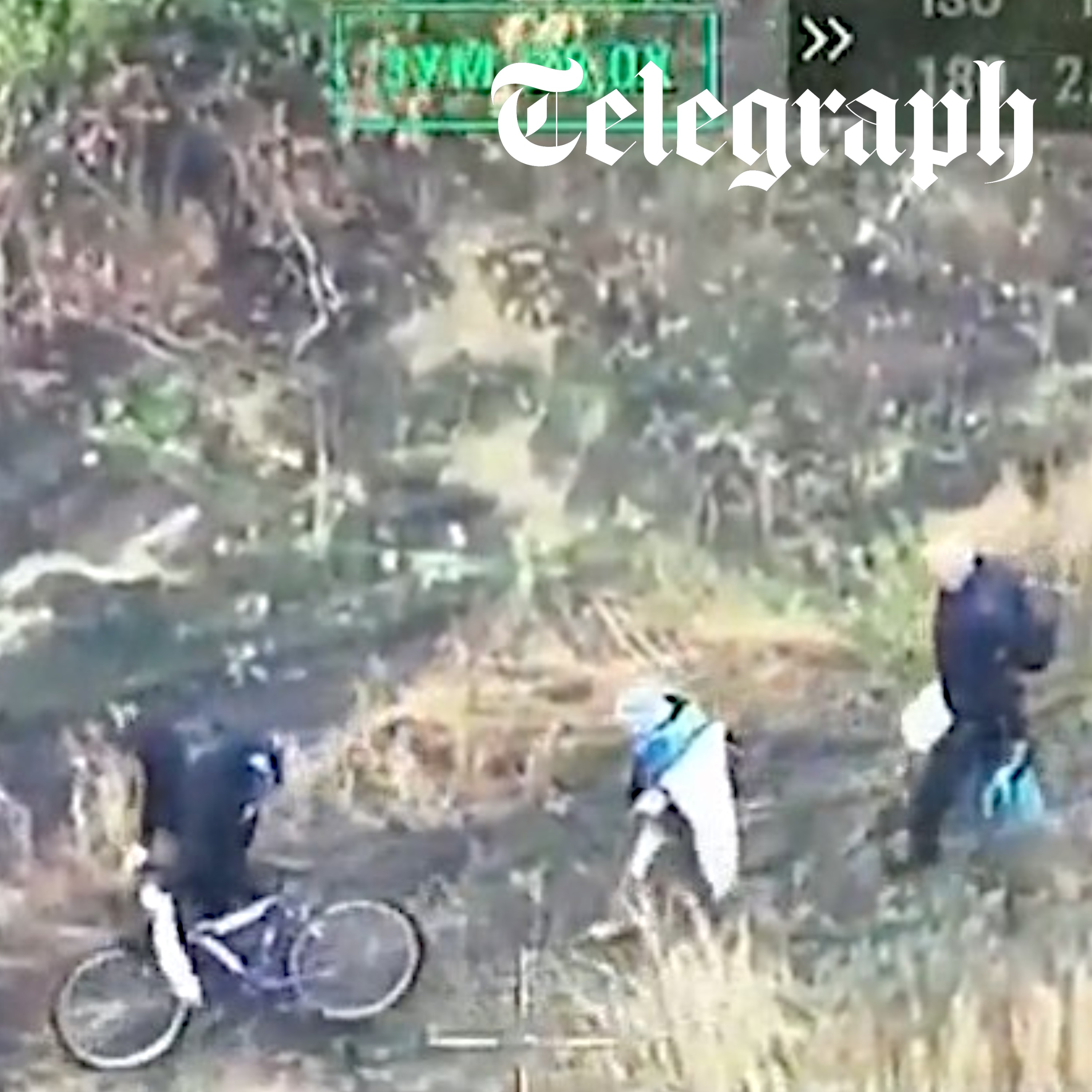
Fleeing Russians using Ukrainian civilians as 'human shields' in Kharkiv
Get every episode summarized
Each time Ukraine: The Latest publishes, we email you a written briefing from the transcript — the topics, who appeared, and any specific claims, with the ad reads skipped.
Email me new episodesFree for 3 shows. No card needed.
About this episode
“The Telegraph I'm Frances Dernley and this is Ukraine, the latest.”From the transcript
Day 1,676.
Today, amid yet more deadly strikes on Kyiv and the surrounding oblast – and as parts of airspace above Poland are once again shut down – we bring you developments causing deep concern across Europe. President Trump, frustrated by the lack of progress and eager to unlock a path to business, is reportedly considering a deal with the Kremlin that would see the US ease sanctions on Russia in exchange for the release of political prisoners. Then, Francis is joined by journalists from the Kyiv Independent to talk about why Ukrainians feel “betrayed” by Europe.
Contributors:
Francis Dearnley (Host on Ukraine: The Latest). @FrancisDearnley on X.
With thanks to Francis Farrell, Toma Istomina, and Dominic Culverwell of the Kyiv Independent.
Senior Producer: Lilian Fawcett
Video Producer: Sophie O’Sullivan
Social Producer: Tom Steed
Studio Director: Meghan Searle
Executive Editor: Francis Dearnley
Created by David Knowles
NOW IN FULL VIDEO WITH MAPS & BATTLEFIELD FOOTAGE:
Every episode is now available on our YouTube channel shortly after the release of the audio version. You will find it here: https://www.youtube.com/@UkraineTheLatest
CONTENT REFERENCED:
Exclusive: Trump's push for a Ukraine energy truce runs into a Putin problem (Kyiv Independent)
https://kyivindependent.com/trumps-push-for-a-ukraine-energy-truce-runs-into-a-putin-problem/
Putin envoy, US officials discussed Ukraine war and energy initiatives, US official says (Reuters)
Trump’s Latest Appeal to Russia Could Outrage Even His Allies (Simon Shuster for The Atlantic)
https://www.theatlantic.com/national-security/2026/09/trump-russia-putin-ukraine-sanctions/688808/
Frontline Club Event with the Kyiv Independent on 1st October (Francis Dearnley moderating):
The Kyiv Independent Live in London on 2 October:
https://tickets.kyivindependent.com/events/thekyivindependentlive/2281999/r/frontline
If you’re interested in sponsoring Dom’s upcoming defence event, email our colleagues at [email protected]
EMAIL US:
Contact the team on [email protected]. We continue to read every message, and seek to respond to as many as possible.
HIGHLIGHTS:
- Fleeing Russians using Ukrainian civilians as 'human shields' in Kharkiv
- Huge blaze after Russian bomber crashes in Far East
Hosted on Acast. See acast.com/privacy for more information.
Get every episode summarized
Each time Ukraine: The Latest publishes, we email you a written briefing from the transcript — the topics, who appeared, and any specific claims, with the ad reads skipped.
Email me new episodesFree for 3 shows. No card needed.
Hosts & guests
Transcript ready
289 searchable segments. Every word is indexed and playable.
Full transcript
Ukraine: The Latest — Fleeing Russians using Ukrainian civilians as 'human shields' in Kharkiv. Machine-transcribed; use the interactive transcript above to jump the player to any line.
The Telegraph I'm Frances Dernley and this is Ukraine, the latest. Today amid yet more deadly strikes on Kiev and the surrounding Oblast and as parts of Polish airspace are once again shut down,
we bring you developments causing deep concern across Europe with President Trump frustrated by the lack of progress and eager to unlock a path of business is reportedly considering a deal with the Kremlin that would see the US ease sanctions on Russia in exchange for the release of political prisoners. Then we step back for a strategic overview of the war's key developments as winter approaches in conversation with journalists from the Kiev Independent. The Russians is not what it is. If I'm president I will have that war settled in one day 24 hours. We can't leave the Russian to the European Union.
It's Wednesday, the 30th of September, four years and 218 days since the full-scale invasion began. And later I'll be joined in the studio by friend of the podcast senior frontline reporter at the Kiev Independent, Francis Farrell. It's Deputy Chief Editor, Toma Eastdomina and Business Reporter Dominic Kolverwell. But first the key update. Starting in the military realm, Russia has conducted yet more overnight missile and drone attacks on Kiev. As we're recording this, the casualties are being reported as three killed and six injured. A child died and two adults were also injured in the surrounding Oblast. Over a dozen explosions rocked the capital, starting shortly before 3am local time causing power outages and damage to residential property in several parts of the city. Moscow launched 188 drones, 86 of them jet-powered, as well as zircon, onyx and escander missiles, according to Ukraine's Air Force, which said it intercepted five missiles and 155 drones.
Ukraine's biggest private energy firm, DTEX, said Russia's overnight attack damaged energy infrastructure and is restoring energy to 8,000 customers on Kiev's left bank. In the wider region, residents were asked to postpone the use of powerful electrical appliances. Debre from the attack was found at an unnamed embassy in the city center, according to Kiev Mayor Vitaly Klitschko. And in another familiar story, across the border, Poland's air traffic authority announced airports in Zhejów and Lublin temporarily suspended operations due to military activity amid last night's attacks. This is becoming an increased occurrence, hence the story reported yesterday that Warsaw is changing its rules of engagement in order to take down drones earlier. On a similar theme, moving further south, a drone flew into Moldovan airspace, crashing outside a village during last night's mass attack. Currently, there have been no injuries reported or damage to property. Moldovan police and army teams are at the site.
As we all know, air defense is the key issue of the moment, and yesterday, President Slenzke announced Ukraine has received a new delivery of missiles for NASA's air defense systems. It's not clear where this package has originated from or the quantity of the munitions, but he added that a very important agreement had also been reached about a new delivery of patriots. In much needed brighter news for Ukraine's air defense, his Belgium will also transfer three US-made F-16 fighter jets to Ukraine by the end of the year. Slenzke announced the agreement following discussions with Belgian Prime Minister Bart Vavar adding that Ukraine had already received urgent deliveries of F-16 ammunition from Belgium and Spain. Just as a reminder, F-16s are used defensively to intercept your head type drones and cruise missiles, as well as offensively along the front line. According to analysis by Defence Express, Ukraine could operate between 96 and 129 western fighter jets by 2030. As a slight but connected tangent, if you missed it in yesterday's episode, we dissected in some detail the ongoing debates about western weapons procurement.
US voices, including the Supreme Allied Commander of Europe since 2025, General Alexis Grincouch, are increasingly arguing that procurement decisions must be based on performance, not geography. Let's hear him now. To sustain this, I do caution against codifying preferences as to where military hardware is made. A focus on where something is made, rather than how well it performs in combat, how well it performs on the battlefield, only benefits are adversaries. So keeping the EU and NATO moving in sync toward procuring the best equipment for a men and women in uniform must be our ultimate goal. Now that clip tellingly was shared by the US ambassador to the EU. It's a similar argument to the one made by former Secretary of the US Army, Dandriscoll in Foreign Affairs magazine. But it sits opposite to, for example, the UK government's position, which is to use the Defence Budget to drive domestic benefit, not just to get the best bang for your buck, as Don would say, regardless of one's country. So expect this point of tension to only become stronger over the months and years ahead.
But returning briefly to the air war before what's happening on the ground, a Russian TU-95 strategic bomber crashed during a training flight in a MIR oblast. That's in Russia's far east, bordering China, yesterday killing six crew members and injuring one according to the Russian Defence Ministry. The preliminary cause was an on-board fuel explosion. I think the most interesting detail about this is the location. The bomber belonged to the Strategic Aviation Group base that Ukraine could airbase. Russia had recently relocated part of its nuclear capable strategic aircraft to protect them from Ukrainian strikes on air bases closer to the border. Let's turn to the ground war next. The Kiev Independent reports that Russian soldiers are using civilians, including children and elderly individuals as human shields while fleeing Nikupiansk in Harkiv oblast. Ukraine's heartier corps released footage not yet independently verified by the Kiev Independent, which allegedly shows Russian troops wearing civilian clothes guiding the group through a village into one of the gas pipelines Don was discussing on Monday.
That group was forced to walk over 10 kilometers through the pipeline towards Russian occupied territory. In response to the footage, Ukrainian Foreign Minister Andrei Sibia called for the violations of international humanitarian law to be formally documented, investigated and prosecuted. But let's end with the diplomatic realm and there have been some interesting developments here. Russian envoy Kieril Demetriyev held constructive meetings with the US Treasury and Energy Department officials in Washington on Monday according to Reuters. Those discussions focused on resolving the war and establishing potential post-war US Russia energy and critical mineral initiatives. US negotiators are reportedly exploring a proposal to relax sanctions in exchange for Moscow releasing political prisoners, an important story by friend of the podcast Simon Schuster in the Atlantic. Right, how a few months ago Donald Trump's envoy to Eastern Europe, John Cole, came to the President with a new idea for breaking the deadlock in US relations with Moscow.
The plan involved a quick pro quo, reminiscent of the Cold War. The Kremlin would freeze some political prisoners and the US would reward their release by easing sanctions on the Russian economy. Trump signed on, says Simon, adding, this new initiative, which is still in its early stages and has not been previously reported, promises to advance several of Trump's goals at once. It would help reintegrate Russia into the global economy and broaden Trump's talks with the Kremlin beyond the intractable war in Ukraine, which his envoys have failed to end after more than a year of diplomacy. It would create a path for the US to sign lucrative deals involving Russian oil, diesel, rare earth minerals and other commodities. And as a bonus, the release of prisoners on humanitarian grounds could bolster Trump's case for his long-covered Nobel Peace Prize. Now, I've lost count on the podcast how many times we've discussed stories that should be wake-up calls for Europe. But this does feel potentially seismic if it comes to pass. As the Peace discusses, this approach has been tested with Belarus, seeing coal negotiate the release of hundreds of prisoners for Belarusian jails in exchange for US sanctions relief.
What isn't clear though is how the White House would be able to legally ease the sanctions now that Congress has passed that critical bipartisan bill, which locked in several key sanctions against Russia by law rather than executive order. If our listeners on the hill have insights on that, please do write to us. One thing seems obvious, as the key independent confirms today, Trump doubts that Putin will agree to an energy ceasefire with Ukraine before winter. And therefore, in search of some sort of political victory before the midterms, is likely to try and find rapid solutions to complex problems. That is dangerous indeed, as the war in Iran has shown all too clearly. So those are the updates before we go to our guests. If you're finding this podcast helpful, please do subscribe to Ukraine the latest on YouTube. It's free and means you can join our community page over there. That's where we share exclusive content where you can chat to us and fellow followers of the podcast. We'll put a link to subscribe and to that page in the show notes.
Coming up, as you know, I'll be joined by three journalists from the key of independence to talk about Ukraine's winter readiness and lessons from Operation Vivaldi. Well, I'm delighted to be joined by our guests from the esteemed key of independence, a real pleasure to see some familiar faces and new ones amongst you. So we've got senior frontline reporter, Francis Farrell, familiar to many of you, of course, the key of independence deputy chief editor, Thomas Isdominer, and business reporter Dominic Colberwell. Welcome all. You've recently flown in from Kiev. We've of course been talking about the ballistic missile strikes, the jet-powered drones. Perhaps, Francis, you could start just by giving us a summary at the moment of the mood in the capital. Yeah, so it was just two days ago that we left Kiev in the evening and that was a day where it was almost like one of the most insane we've had in terms of daytime jet drone attacks. There were two big targets hit in the city center. There was the Academy of Sciences. That's where you saw the image of those people on the window sills and this medical facility as well.
And all of this is happening while there are basically like full day long air alerts. And so that's the question. Like, do you continue your life? Are you running back and forth from the basement? I think the answer is for most people in Kiev, including us to be honest, is that we can't afford to just live in a basement from now and we can't afford this. This is not quite enough of a threat if it makes sense for us to just give up on the daily life that we've been having for years, but it is making it more tense. And in a way, like, just in terms of the sound, you're hearing the jet engines, you're hearing the air defense like the large caliber kind of anti-air cannons. You're hearing other kinds of sounds, some explosions far away, some nearby. And I was just thinking it almost sounds a little bit like a frontline city does. Like, did a year ago, for example, before the Russians got too close. And I think it was actually my last day before I left my last evening, before I left to London, that I first heard an interceptor FPV fly off from somewhere outside my window.
And that high-pitched FPV sound, even though it was a Ukrainian interceptor, that's something I associate with being on the frontline. And so I think society is still not quite adjusting. It's just happening to them. And now it's going to get colder, we're going to go into winter, and it'll take a few more weeks and months, I think, to see what that really starts to do to a huge European city like Kiev. We'll come back to interceptors' patrons as a theme a little bit later on, but Dominic, if I could come to you next. Energy is one of your core focuses at the Kiev independent. What's your sense of the picture at the moment? So I think everyone is expecting it to at least be as bad as last year in terms of blackouts and lack of heating. I mean, the problem is that Ukraine still doesn't have enough decentralized energy systems, especially around Kiev. So I think the western part of the country will kind of be okay, they have enough generation, but it will be Kiev where it's very, very difficult.
And what we heard is that essentially at the center of Kiev won't have any heating throughout the entire winter. So you still have these big power plants, which provide most of the kind of heating. And they're just sitting ducks, right? Like you can't, you can build concrete shelters around substations and they have, and Ukraine has done that. But you can't build a concrete shelter around a massive power plant, right? Like it's just physically impossible. So everyone expects them to be taken offline. We saw like the attacks have been ongoing on the energy facilities just throughout the year. But I think earlier today was the kind of first time we've really seen the start of the winter campaign, which is when Russia launches these mass attacks with drones, with ballistics, with jet-powered drones now as well, I'm assuming. So we saw the one thermal power plant to the south of Kiev get targeted. And I think going into October, especially when the weather starts to drop, we're going to see that a lot.
Now what that means for the population, I think people will start to leave Kiev on mass. It's really hard to say how many people are going to leave and who has the means to leave. I think probably old people will stay just because they don't have the disposable income or another place to stay. But younger people I think will leave the city, family certainly. There is a kind of evacuation or a program to help old people. In my apartment block, about a month ago, people from the city administration were coming around and asking old people, hey, do you plan to leave over Kiev because we can help you with that and get you to safety. Well, you mentioned there the winter campaign, the potential impacts of the Russians trying to make the capital unlivable. I mean, Tom, what's your sense about how serious that will be in looking at the situation from Kiev and attitudes there towards other European capitals? What is the sense of things on that perspective?
Yeah, I think to kind of build up on what both Rensys and Dominik said, I've never been to a frontline city like Kramatorsk, for instance. But I can say for sure that it hasn't been as dangerous in Kiev as it is now. There's only presence of drones, of constant threats. And on top of that, just the constant presence of stress and understanding that there is this major unpredictability and instability in your life. That's disrupting people's lives and I think in major ways. And I think that's precisely the goal, right? Because some of these targets are important targets and are helpful to Russia, they undermine Ukraine's economic stability, they undermine some critical infrastructure. But a lot of those strikes are also just random buildings sometimes, right? And they're not necessarily very important targets, but they do create the sense of just constant danger.
And they are just terrorizing the population. That's why we call them what they are. They are terror attacks. And it's unfortunately, having exactly the effect I think that Putin is hoping for, people are increasingly tired, increasingly stressed. I think in a lot of people, I know some residents who have been very serious about security measures in their lives. To the point that they would go to the subway station and spend the night on the station every time there's a warning about a major attack. And some people stop doing that because they just don't have capacity and energy to keep doing it anymore. And it's a very counter intuitive thing to do in this situation, right? It's irrational. People care less about their lives, but this is the effect that this campaign is having on them. And at the same time, this is happening when Ukrainians are increasingly frustrated with the government because we unfortunately had two years at this point of non-stop corruption scandals arising, new details emerging about the level of corruption,
but also the level of cynicism that goes into these decisions, that some officials that are, I think, privileged to be leading a country at war, to be making decisions that have such a huge influence and could bring the country to a better place and a safer place. But instead, they're choosing their own interests, they're choosing to enrich themselves. We had not just details about some corruption schemes, but we also had tapes released by the anti-corruption bodies of Ukraine and in those tapes when you listen to them and you realize how certain officials think about these things, how the well-being of the population that they're supposed to be taken care of is not even part of their thinking on a daily basis. It's extremely disappointing. And this is basically where Ukrainian people are now. We're dealing with a major threat, external threat from Russia, obviously, that is only doubling down on these attacks and making life more and more unlivable in big cities and also across the front line.
But also, there's this internal enemy, right? The people who betray us from inside Ukraine and whose decisions also affect how prepared we are for winter, how prepared we are in terms of countering these threats, because, for instance, when we talk about jet-powered drones, this is the threat that we've known for about a year, at least when this first started using them. And if we know anything about this war, we know that it's a matter of time when a certain capability will be scaled up and we will have to deal with it on a new scale, right? And so, a lot of the effort on the authority side that goes into these schemes and enriching themselves could have been going into things that could have helped us now deal with this crisis better. And so, there's that situation. On top of that, we have decisions like removing Russian oligarchs from sanctions lists at the same time from Europe, while all of this is happening.
And if we could expect it from Slovakia, we definitely couldn't expect it from France. Why, how did this happen? Why are we making, why are we sending this major political signal now to Russia that it's fine? You can bombard Kiev the way you are, you can destroy their energy grid and just put all the people in Ukraine in darkness for the winter, and we will make this political decision, and we will continue to figure out a way to do business with Russia, to negotiate with Russia. And I think the Ukrainian people feel betrayed by nearly everyone at the moment, and it's a very hard place to be when drones are flying above your head every day. Well, France is whenever we speak together, we usually have a strategic overview of where we are at that moment of the war. This feels like quite a good moment to discuss that, and zooming out from the capital, looking at the strategic pitch at the moment, we've seen Operation Vivaldi.
What does that tell us about Ukraine's capabilities on the battlefield? What's your sense about the impact of a possible partial or full Russian mobilization? But also, where are we from your sense in the diplomatic realm at the moment, as we enter this, what could be a, to Dominic's point at a terrible winter? Well, it's a really strange time, to be honest, in the sense that, you know, for the last two years or so, or even more, I would have, you know, said, and I still would say that the most important indicator of where that balance of power is, is the frontline, and the battlefield, the strongest card Ukraine can have going into an negotiation, is, you know, a rock-solid defense Russia's losing people every day, but they're not getting anywhere on the frontline. And the strongest card Russia can have is a collapsing Ukrainian defense, where, in at least one or two locations, where it makes sense for them not to stop, because they just keep taking more land, and Ukraine can't, the two over stretch, they can't hold them.
But now we're in a position where that actually, that side of things is going really well for Ukraine. I think we've had the narrative kind of roller coaster go up and down about the frontline, you know, we were talking about how it was stable, there were counter-offensive going, and then there was a period where, you know, the front got really close to Donbass, and Kostya Nthinivka seemed to fall really quickly, and then people, you know, flipped over to the other side and said, oh, it's actually, it's actually going to be really bad. But the truth tends to be a lot more stable, and we have seen a really stable, positive shift for Ukraine over this year. Due to a few things, I think, one thing that has been huge, it's difficult to measure, the effect of it has been the middle strike campaign, the advantage that Ukraine has been having with styling, and with these cheap hornet drones, which I'm sure you've talked about, which are flying deep behind the frontline, and really, even now that they've faded from the headlines,
still causing a lot of pain for Russian logistics. The change from Commander-in-Chief Sirsky to Dropady, I think, has been huge going forward. Did you always see the after effects of that? So I'd interrupt, but do you think we're actually already seeing that, or do you think that's going to come further down the road? Yeah, I mean, it's difficult to kind of find some big headline changes, but I think even from the very first weeks of him coming into power on the military side, you know, the fact that he audited the assault forces, which I've talked about here before, stopped them getting the insane disproportionate replenшments that they were getting assigned them to the biggest ones to some of Ukraine's biggest core. And has now made this really important decision to divide the fight for Donbas between Ukraine's probably two most prestigious and successful core, the Third Core, and Dazov, the former, which was the one that went ahead and did Operation Vivaldi in the last few months.
All of this is huge in terms of actually fighting the war of attrition effectively on the front line, actually understanding that you're fighting against a much bigger adversary that has more people that can afford to fight them without regard for human life. So maybe you have to take care of them yourself. Maybe you have to, you know, it matters not only killing the enemy, but losing fewer of your own. And what I've heard from commanders in the field is that there has been a change, you know, just even one small thing that I heard on my last trip was that previously there was an issue where commanders were, they were always being ordered to retake a lost position. No matter whether they had the men for it or not, if they didn't have the men, they would need to find new infantry among the drivers, among the artillerymen. And this was a huge problem that was characteristic of the Sirsky style of war. And now on the Drapati I was told that a directive went out saying that if you get such an order, but you understand that this doesn't make sense for you and your tactical picture and you don't have the people to do it, then you don't have to do it.
And that's just like a huge mentality shift that is huge going forward. And so, you know, now, yeah, we do see Operation Vivaldi, we see, you know, Ukraine being given if they have the right circumstances, the right resources, they can go forward. And in general, although we see the war changing technology-wise, you know, every six months or so, which is true. On the other hand, when you ask commanders about what the fight looks like, you know, of course, Ukraine's brigades are low on infantry, low on manpower, which they have been, and that's not a problem that's going to go away, not a problem that's going to be replaced by humanoid robots as feter of might think. But they also have the problem of Russia's, you know, using these infiltration tactics, but none of those are new problems. And they've actually adapted and they've changed the way they fight. And we see more and more control on the frontline. The issue is, of course, if Russia does decide to mobilize, that is a just hundreds of thousands of extra more people that will need to be churned through on the battlefield.
That is be strategic opportunity for Russia to create real dilemmas for Ukraine's military, which is still overstretched. They're focusing on the Donbass, but that allows Ukraine to also focus its defense there. But if they choose to, you know, move on the northern border again, or in the south again, that could create real problems. But more than anything, I think it's an indication of the fact that they're not interested in peace. You see the military budget from two days ago. And that, you know, that is an understanding that we're in this for the long haul. And instead, the more decisive front now might be this, the long-range game, the total war, which we haven't really seen until now. But this war of economies, of warehouses, and I think it is now crucial, I think, for all of us to whether it's the defense industry, whether it's Kiev, the defense ministry. And Ukraine's backers in Europe to understand that solving this challenge, not only finding an interceptor that can shoot down a jet-powered drone, but resourcing the scaling up of that technology, which is usually always the hardest part, is a critical challenge now going into winter.
Dominic, another theme of this year has been the efforts to try and see the 90 billion Euro loan from the EU unlocked, and thereby begin that money to be able to filter in to Kiev. We talk a lot on the podcast, and certainly people commenting on the war speak a lot about the state of the Russian economy and its health at the moment. Now, to a certain extent, we just don't know. But when you look at the Ukrainian economy, the fact that we've got this money coming in, do you see that as stabilized, or do you see that actually as something that is under-explored as a very serious issue? Maybe not now, maybe not in a month or two months, but let's say in six months time, when winter is still very much present. I think as the war shifted this summer to a war of economies, we were seeing like Ukraine's economy just bleeding out. It's a complete disaster. Sir, is that why we're putting it bleeding out? Yeah, so it started really with the attacks on the poor infrastructure down in Odessa.
I mean, it probably took where it started. I mean, Russia has always been targeting Ukrainian businesses, but we're talking about really scaling up these attacks. So the worst part was the worst start was attacking the ports in Odessa. Now, that just meant that ships just didn't want to come into Ukrainian waters. They didn't want to dock because Russia was just blowing up civilian vessels, blowing up ports, silos, whatever. That port blockage just meant that Ukraine couldn't get out its key agricultural exports, which I like, is main source of exports. It couldn't also export the metallurgy products either. So you had two of the biggest economic drivers, one of the two biggest economic drivers in Ukraine, basically just unable to make money abroad. The metallurgy industry since then has essentially shut down. Asal Middle Clivoli said, and they're the biggest steel producers in Ukraine, they said last week that they would be unable to safely restart operations. That's partly because they can't get the money from exporting the goods, but also they are being directly targeted by missiles now.
And Russia knows exactly where to hit in the steel industry, and they know where these critical machineries are that they can just take off line. And that's what we're seeing. And it's just really hampering the economy. The economic growth, the Khrins economy going into the next year probably won't grow. Some economists might have even said that it may actually decline. And there's, I mean, it's so hard to know how you can support the economy right now in Ukraine. I mean, businesses are just being targeted left right in the center. The warehouse is distribution networks. If you have people fleeing Kiev over the winter, you're not going to have enough workers in the city. Productivity will go down. And then, I mean, I don't see a way. Unless the EU provides more financial support for that to be a kind of optimistic forecast for the economy going into next year.
Well, that's what I was briefly going to just follow up on that on is there's a lot of these recovery conferences, Ukrainian recovery conferences that are talking about like post ceasefire, how Western governments can be investing. But in many ways, I would argue it's an unhelpful conversation, not completely unhelpful, but we should be prioritizing keeping Ukraine afloat now. In terms of Western investment, is there money going in that in the senses is at least helping contribute that isn't just alone that is actually that critical investment, which also has a political aspect, which is that it's further entwining economies in Europe. So for the most part, no, like there's been a few kind of mega deals here and there, like in the telecommunications sector, Taiwan, Taiwanese company recently announced that they wanted to acquire the like the second biggest cement plant. And Ukraine, which would like completely caught me off guard, but that's going to be, you know, don't think it's going to be critical for the recovery as well. I think it was like a 700 up to 750 million euros that investment, but those are like really rare deals.
So for the most part, there is very little foreign capital coming into Ukraine where you are seeing for an investor's excited is the defense tech sector, right? Like every investor I meet who comes to Ukraine is always some like Americans or Germans or whoever they come over to Ukraine and they think, well, maybe we'll kind of set up a fund for, you know, the IT sector or something here, but then very quickly they switched their mind and they're like, okay, well actually the defense tech is where it's at. So you're seeing a lot more partnerships now, you have like big primes like Raytheon, etc, coming into Ukraine to find Ukrainian partners to kind of help them scale. And I think that really is where going into next year, you're going to see the biggest deals and the most kind of action going on. And that's exciting. That's kind of the most exciting part of the economy in Ukraine because everything else is pretty, pretty crim. I'm Venisha Rainey and I'm Roland Olofand.
As hosts of the telegraphs podcast Iran the latest, it's our job to keep you up to speed on what's going on in the Middle East. Join us every day as we ask, can the US put an end to Iran's nuclear ambitions once and for all? Who will come out on top in the peace talks? Has this war damaged America's ability to take on China? And what are the long-term implications for the wider world? Search Iran the latest and listen wherever you get your podcasts. We're also now on video. Watch us on YouTube and on the telegraphs website. Well Tom, your deputy chief editor at the Kiev Independent and thinking about these long-term themes that we've just been touching on. What big stories do you expect to be reporting on over the next few months? Perhaps also you can talk a little bit about how covering this war has changed, let's say in the last year or two. Well as I mentioned over the last several years we've started to cover increasingly more corruption in domestic politics because we had to.
Because there were too many stories that we couldn't look away from and we are a newsroom that is based in Ukraine but reports for the international audience actually faced our fair share of challenges there and backlash from our own audience. It's not the kind of backlash that we would face early on in the full-scale invasion but it's still there. The reason why is because our audience, a lot of people in our audience, discovered Ukraine in 2022 and for a lot of them Ukraine equals Zelensky and Zelensky equals Ukraine. And we are trying to make it very clear in our coverage that that's not the case because Zelensky is here for this senior. Yes, it's this presidential term is sort of indefinite for now and we don't know when it will end but it will end at some point Ukraine is known for being very strict about changing presidents regularly and as soon as that's possible he will not get reelected most likely. And we get a lot of backlash but we think it's very important for international audience to know this story because we want international audience to have the full picture of what is happening here.
We're not a propaganda or outlet, we're not there to communicate only the good sides of Ukraine so it's very important for us. And we actually want the international audience that cares about Ukraine to be our ally in that, in Putin pressure on the Ukrainian government to clean up corruption, to reform, to do the job. And as we've seen, it works really well when the Ukrainian public and the international partners work together in Putin that pressure like last year when Zelensky is office tried to strip interruption bodies of their independence. Together, those two sides had a very good result. So we wanted to continue to happen and we want the international audience to know that this is the demand from inside of Ukraine. This is what Ukrainians want. But it's extremely frustrating when we get emails from our readers sometimes telling us how we as Ukrainians should think about this, how we should appreciate Zelensky and how we shouldn't cover him critical right now.
So that's how the coverage has changed. But at the same time, most recently in the past weeks and months, as we've seen this increase in attacks on Kiev, I think we've become a lot more reactive. And it's like week after week that I noticed that they look at our coverage and understand that we just react to attacks a lot. We follow up on the stories that are related to attacks and there's a lot less space for discovery conversations for deeper stories, which is okay. In times of crisis, this is what we should be doing. We should be covering the most important stories. And that's the most important stories. The way that we're doing in Ukraine is horrible. As I said, it's taking a huge toll on Ukrainians and the world needs to understand that. And we're constantly having the same discussions actually about how do we make this come across? How do we help people abroad feel this attack, this campaigns, the way we feel them, the way we'll live through them? And it's challenging. But we want to keep looking for them.
And I think that will be the biggest story. And the way it happened last year during the energy crisis, I think it will be a similar case where the newsroom will ultimately be focused on one story. The ongoing campaign, the crisis and just joining forces and covering the most important things. But logistically, we as a newsroom now working on all kinds of scenarios in preparation for winter. We're talking to partners abroad and looking for ways to relocate our people. We are looking to set up a hub in Kiev that will be equipped with everything needed and have a rotation system basically so that we have teams on a rotation basis in Kiev because there might be a chance that staying for everyone just won't be possible. And because when we talk about the upcoming crisis, we potentially aren't just talking about energy cuts or heating cuts. We're talking about issues with water supply and just literally unlivable back to the Stone Age situation.
And we obviously want to do a good job with reporting, but we also want to make sure that our team survives and stays sane after this crisis. So as a story, and we're working on preparing and bracing ourselves. We do absolutely invaluable work on behalf of us here at the telegraph, but also our many listeners of viewers around the world. The work that you guys do is so important for keeping us informed and forming our reporting. And as you say, it has real tangible effects in the way that Ukraine is approaching this wall. But Francis, you wanted to jump in there. Yeah, I mean, I was just curious to ask you, I guess, because we've, I mean, I think we feel for those of us who've been here since 2022 as well reporting that every kind of year or every half year has its own kind of flavor almost in terms of like the overriding, not only the overriding, the bigger stories, but the feeling that we get. And now this, this one is one that's dominated by maybe even a little bit less attention on the front line, but the war of the economies and and the corruption situation.
But I'm curious for you having done this pretty much day in day out for for over four years now and hearing all of this, you know, being very deep inside it, but also still being located in the outside foreign information context. Do these flavors kind of get across and what is the flavor for you of where we are now in second half of 2026? Well, I think it certainly does come across. I'd like to think that in our reporting, we draw attention to a lot of the themes that we've spoken about today. I think the view from London and the view perhaps from from some of the European capitals, of course, they all have their own unique approach to this war because of their own histories is, I think, generally speaking, a lack of understanding about the seriousness of the situation economically, the seriousness of the situation in terms of the need for, as you said earlier on, accelerating weapons development so that interceptors so that hatred alternatives can get to Ukraine quicker.
And it seems that no capital in Europe, including this one, is able to assert itself enough and act boldly enough to supersede the United States. And until we can get to that point and it may well take a crisis to get to that point, I feel the same frustration that we've talked about before. And that is a common theme now over the last two or three years, which is that fundamentally this is Europe's fight. This is the fight not only for Ukraine, but it is for the future of security on the continent. And there is still, I think, a very, very slow awakening. And I feel immensely frustrated that despite all of the warnings and the increased escalations, the hybrid warfare, the state-sanction terrorism that we're seeing across European countries, there is still this reluctance to act preemptively and assertively to try and shift the dial and change the dynamics in the war.
And fundamentally, I don't see the strategic picture as being drastically altered by European support now for, let's say, two and a half, three years. And I think that that's not good enough given the actions that we've seen of the United States and the philosophy that is being adopted by the White House. And so that's my frustration to answer your question. So I think we share it. I think we share it with you. I come in and out of the UK sort of a few times a year. And I feel that this time when I've come back, there's a lot more talk about being prepared for kind of hybrid warfare. I was wondering, do you feel that there is a genuine change now from the British society to be kind of more mentally prepared for the kind of stuff that Ukrainians are going through, the blackouts, food shortages, things like that? That's a great question. I think certain, let's say, gears of society of government are churning now in terms of thinking about this very seriously.
And they are talking about it. Are leaders talking about it enough? No, I don't think so. And so your broader question, are the public prepared for this? No, I don't believe so. Not in a way that yes, people are certainly reading more about it. And they are talking more about it. But in terms of practical steps for worst case scenarios of energy when it comes to rapid escalation or crisis on the content, I still don't think people are prepared for that. And I think that's a failure of communication from politicians across the political spectrum. That's not a part of Zan point. I think this is a continual thing. And I think it is also I'm afraid as we've talked about in the podcast many times, something more deeply ingrained culturally and philosophically that we have generations of leaders who came of age in a very different world situation, wars were very different. And that's where they made their names. And that's how they understand the world. And then you've got a generation that were told that wars weren't meant to be possible, that everything was going to be pretty rosy as a result of the world becoming a smaller place thanks to the internet.
And so I think that unfortunately and tragically despite the however much, and we should still be talking about it and still much for warning, it will be dragging people kicking and screaming, I think. My mom started to prepare. I've been like, camera to her for the last two years. So she's just pickling loads of food. She's got to like just a shed is just filled with canned food. And she's got like a water storage as well. And my mom, you're going to be you're going to be just fine. And the bus gets narrow. Well, let's hope so. But thank you all very much for your time this afternoon as say again, a huge privilege to see you as colleagues and friends as well as the invaluable work that you do on behalf of everybody who's watching listening. So please continue that. And just a reminder that we're doing event together at the frontline club tomorrow here in London. That's that's Thursday. And on Friday, you've got your own event here in London. Perhaps someone just to end you could just tell us a little bit about the thinking behind that event and what you're going to be doing here on Friday. Yeah, so we're preparing something very special. It will be a storytelling night. Five members of our team will be telling their stories related to war. Some are more focused on the reporting they've done and places they've seen some are more focused on their personal story.
But all of those stories are very special and they kind of capture different aspects and different experiences of leaving through this war and reporting on this war. And we it's it's not something we do often it takes a lot of preparation and we've been working very hard and we want to do this special night for our audience here because we actually London is the city that has the biggest number of paid members of the given dependent across the world even though our country is wise our biggest audience is in the United States. So maybe the rest of the great Britain wants to like catch up. But yes, we have a lot of members here, a lot of supporters here and we're looking forward to meeting them sharing our stories and there will be a moment where we can chat with them, answer their questions and just get to know them better. And it's it's always special for them when we they get to meet us after you know following us from from this distance, but it's very very special for us to meet people who support us, who care, who are here and don't feel the immediate threat and don't have to support us in this very tangible serious way, but they do.
And it's it's given us a lot of energy to keep going and we need that energy more than ever now. So this is what we're doing. We will be happy if your audience can join us. Well, we'll have a link in the show notes to both of those events and thank you all very much for joining us. We had a dorm and a Francis in the studio didn't lead the other dorm and didn't lead me either. But anyway, thank you all very much for your time and we'll be back same time soon. Good bye everyone. Thank you. Thank you. Thank you all very much.
Thank you all very much. My name is David Knowles. Thank you all for listening. Goodbye.
Thanks for watching. Thanks for watching.
More episodes
More from Ukraine: The Latest

Ukraine fires home-grown ballistic missile in combat for first time
Ukraine: The Latest

Russia launches new missile at Ukraine after losing 46,000 troops in September
Ukraine: The Latest

Scientists cling to burning building after Russian raid & Ukraine's Operation Vi...
Ukraine: The Latest

Exclusive interview: Ukraine’s drone chief Robert ‘Magyar’ Brovdi – ‘We will tur...
Ukraine: The Latest