Get every episode summarized
Each time Revisionist History publishes, we email you a written briefing from the transcript — the topics, who appeared, and any specific claims, with the ad reads skipped.
Email me new episodesFree for 3 shows. No card needed.
About this episode
Revisionist History is made possible by:
“This is Jacob Goldstein from Business History. When the internet arrived, most people used it to look things up. ChatGPT work goes beyond answering questions.”From the transcript
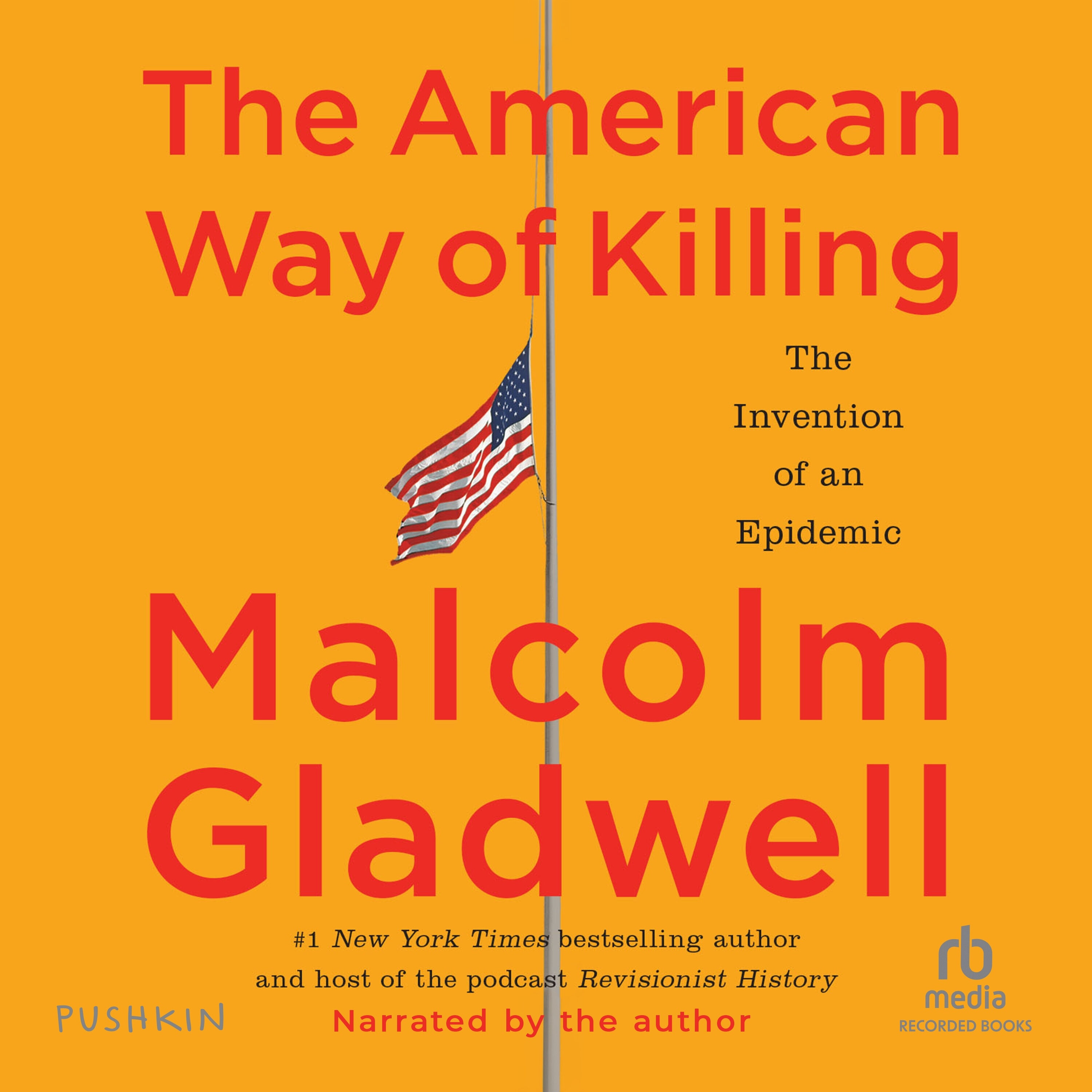
In Malcolm’s new book, The American Way of Killing, he investigates why gun violence in the United States is so much worse than every other country in the West. Today, we’re sharing a chapter from the audiobook and over the next four weeks we’ll air episodes about the gun violence epidemic in America. Later in the series, Revisionist History looks at how Baltimore turned its homicide problem around, and why it took so long. You can pre-order The American Way of Killing at pushkin.fm/audiobooks or wherever books are sold.
See omnystudio.com/listener for privacy information.
Get every episode summarized
Each time Revisionist History publishes, we email you a written briefing from the transcript — the topics, who appeared, and any specific claims, with the ad reads skipped.
Email me new episodesFree for 3 shows. No card needed.
Hosts & guests
Transcript ready
632 searchable segments. Every word is indexed and playable.
Full transcript
Revisionist History — The Invention of an Epidemic. Machine-transcribed; use the interactive transcript above to jump the player to any line.
This is Jacob Goldstein from Business History. When the internet arrived, most people used it to look things up. Others saw what it could really do. The same is true with ChatGPT. ChatGPT work goes beyond answering questions. Give it a goal plus things like notes, files, feedback, data, or project plans, and it can help create a brief, analysis, deck outline, tracker, or workflow. You stay in control reviewing the work and choosing the final result. Put ChatGPT to work on your most ambitious ideas and projects. Get started at chatgpt.com by selecting Work Mode, available on Plus and Pro plans. Let's talk about something everyone has an opinion on, healthcare. We all know it should work better than it does. Often, believe that too, and they're trying to improve it. They're helping healthcare teams and pharmacy services work together, like bringing primary care and prescription drugs straight to your home so you can stay on top of your health. Optims also building technology that connects the whole healthcare system
so it can better take care of the whole person, you. Optim is making healthcare work as one for everyone. See what Optims up to at Optim.com. We spend hours deciding what to buy, but there's a split second decision that can make a break a sale. Do you have the trust to hit buy now? Agentech Commerce is testing that moment more than ever, and that's where PayPal comes in. With 25 years of checkouts, 400 million consumer accounts globally and the benefit of purchase and seller protection, all of which make sure wherever a purchase starts, it ends with trust. Build for payments, growth, and agentech. PayPal open, build for all business. Visit PayPalOpen.com. Purchase and seller protections on eligible transactions only. Terms apply. See PayPal.com slash risk-management for details. Purchase and seller protection on eligible transactions
Purchase and seller protection on eligible transactions. Hello, hello everyone. It's Malcolm Gladwell. I'm here today to bring you something special. A chapter from my new book, the American Way of Killing, the invention of an epidemic. It's chapter two called the slave owner's lament. And it is to use the word we love here at revisionist history. The absolutely banana story behind a second amendment to the US Constitution, the gun rights amendment. With guest appearances by 18th century Virginians, a brilliant Australian linguist, the delightfully named historian Carl Bogus, a lot of cranky Supreme Court justices and most of all, a charismatic African slave named Gemmy. I am pleased to announce the publication of my new book, the American Way of Killing, the invention of an epidemic. Four episodes in all, on maybe one of the most complicated and perplexing of American social issues.
My new book is coming out September 29th. You can find all of my book two dates on my website, global.com, come and see me. And if you're in the New York area, I'll be at the 90 Second Street Y in conversation with Katie Tour of NBC News on the evening of September 29th, which should be really fun. Doing this book, open my eyes, and I hope it will do the same for you. You can get the American Way of Killing at whatever books store you frequent or online platform you like. And you can find the audiobook version at pushkin.fm slash audiobooks or wherever you get audiobooks. I want to close my eyes and forget my sorrow. I don't care if the devil takes tomorrow. Ashes to ashes if I'm a...
I won't leave all my troubles dust to dust. Chapter two, the slave owner's lament. In the early years of the 18th century, in the long stretches of marshland known as the South Carolina Low Country, the local authorities decided they needed to dig a network of canals leading off the Stono River. The Stono is a title channel just south and west of Charleston, snaking its way between Johns Island and James Island. In the spring, its banks would overflow, flooding roads and homes and farmland, and the idea was to build the equivalent of storm sewers off the river. They were six feet deep and 15 to 20 feet wide, so substantial that many are still there today. Digging them out of the heavy mud was a massive undertaking. Historian Peter Charles Hoffer writes,
quote, bending over shovels and mattocks in the snake and insect infected waters. The diggers were exposed to the elements, disease and exhaustion. He went on. The summer heat would create terrible thirst, but the brackish water at the digger's feet was filled with deadly bacteria, parasites, and waste. End of quote. This was not a task, the white colonists of South Carolina, would ever dream of doing themselves. It was a job for their slaves. Imagine a group of two dozen or so bondsmen as slaves were often euphemistically called, digging ditches off the Stono River. It's early September 1739. The profits from rice cultivation in that part of South Carolina were so large that it was often cheaper for plantation owners to work their slaves to death and buy replacements, and to try and keep their existing slaves alive. So these were men fresh off the boat from Angola
and what was then called Congo with a K. It was a Saturday. They had been out in the hot sun all day and faced the prospect of having to do the same thing the following day because ditch digging was considered so urgent that the normal Sunday day of rest was suspended. They were exhausted. Their white overseer had left early. They were on their own. Across the river from where they were working was a general store called Hutchinson's. At the end of the workday, they crossed over the river and made their way to the store for food and refreshment. No one knows exactly when and why this ragged band of slaves changed course, but between the ditches and Hutchinson's exhaustion turned to anger. One of the group, Gemmy, emerged as the leader. The store was closed. They broke in. They found two men inside. They killed them both. Someone would later alleged that the rebels cut off their victims' heads
and impaled them on a stake outside. They looted the store, taking rifles and ammunition and alcohol with them. They started off marching down the road, beating drums and crying, liberty. Other slaves joined them. It was now the middle of the night. When they saw the houses of slave owners, they made a decision. Is this someone who treats us with even a modicum of kindness? If so, they skipped the house. If not, they burned the house down and killed everyone inside. One contemporary account reads, they marched on with colors displayed and two drums beating, pursuing all the white people they met with and killing man, woman, and child when they could come up to them. End of quote. By morning, they were more than a hundred strong and miles from the Stono River. Since it was Sunday, most of the white population of the low country was in church. So Gemmy's band marched on without incident.
Finally, they were spotted by South Carolina's Lieutenant Governor, William Bull. Bull had been sounding the alarm for some time that South Carolina slaves, quote, which were the state's chief support, may in little time become their enemies, if not their masters, and that this government is unable to withstand or prevent it. End of quote. One of his companions raised to a nearby church, Wiltown, Presbyterian. He rounded up as many men as he could, news spread, other men grabbed their guns and joined. The rebels were resting on Ponds Ponds Road near Jacksonboro. The two sides clashed. And in a fierce and bloody encounter, the rebels were defeated. This is Jacob Goldstein from Business History. Imagine Henry Ford trying to create the assembly line. He had factory plans, production schedules, supply information, research, and ideas coming from all directions.
His team spent years studying how to make the process work. Now, imagine having chat GPT work. Chat GPT work can help with big projects that have lots of steps. You give it the goal, along with real information, like notes, files, reports, feedback, and project plans. It can use approved apps, connected tools, and files to help turn all of that into something useful. A plan, an analysis, a tracker, a presentation outline, or a workflow you can keep improving. And you stay in control. You give direction, review the work, approve actions, and choose the final result. Would Henry Ford have built the assembly line faster with chat GPT? We'll never know. Ford didn't have chat GPT. You do. Put chat GPT to work on your most ambitious ideas and projects. Get started at chatgpt.com by selecting work mode, available on plus and pro plans. This episode is sponsored by BetterHelp. If I could wake up tomorrow and be better at one thing,
it would be cleaning up the kitchen. I know that sounds really, really trivial. I miss the oatmeal on the floor. I'm daydreaming when one of my children spills an entire box of raisins on the ground. The cat starts eating table scraps off the kitchen counter, and this fact somehow doesn't register with me. I'm good at lots of things, not this. And no one realizes this more than me. I need to be better. I know I know this all sounds very ridiculous, but it's not. Better is a feeling defined by you. And for BetterHelp, it's a BetterHelp therapist who really gets you. It's a focus on global emotional well-being, with thousands of therapists and millions of members in over a hundred countries. It's progress. Sun up and get 10% off at BetterHelp.com slash Gladwell. That's better H-E-L-P dot com slash Gladwell. Now is the time to plan ahead to show up in ways that matter.
That's where four imprint comes from. Four imprint have promotional products that work as hard as you do. Durable, useful, and designed to make a lasting impression. Think quality apparel your team will wear again and again, including popular and exclusive brands. Drinkwear that's enjoyed again and again. Bags, notebooks, tools and tech items that don't just look good, but actually get used. With thousands of customizable options, four imprint makes it easy to find what fits your brand and your budget. You'll get expert help, free samples and their 360-degree guarantee means you can be four imprint certain your order shows up just right right on time. Whether you're gearing up for fall events or simply planting ahead for the season, four imprint helps your brand show up, stay useful, and make connections that last. Explore the possibilities at fourimprint.com. Four imprint for certain.
If you were a slave owner in the south, you knew about the Stone or Rebellion, especially if you lived in South Carolina over, Virginia. You read about it in the newspaper, or someone who was there wrote you about it, or told you about it at church, every white planter knew that a day of reckoning was coming. In Barbados, where many of the founding fathers of the South Carolina colony came from, the British could barely keep their slaves under control. Uprisings were a constant worry on the slave ships coming from Africa. Slaves ran away, they fought back, they engaged in frequent acts of disobedience and resistance. You could whip your slaves into submission, starve them, punish them, or simply sell the troublemakers to someone else, but at the end of the day you had to live with the reality that it was only a matter of time before the cauldron bubbled over. At the Monticello plantation in Virginia,
where Thomas Jefferson lived with his immediate family, there were as many as 140 slaves at any given moment, and only a few white overseers. In South Carolina, slaves composed over 70% of the total population of the colony, if you ventured out as far as the Stono River, the ratio of black to white unplantations reached 10 to 1, or even 15 to 1. If you had to ride to town on business, or go to the state capital for a few days, leaving your wife and children at home, could you feel safe? Thomas Jefferson would famously describe the practice of slavery as grabbing a wolf by the ears. It was too dangerous to continue, but too dangerous to stop. And then comes the Stono Rebellion, and that pit in your stomach becomes a molten mass. What was behind Jimmy's insurrection? They were headed south, which suggests that perhaps they were trying to reach Florida,
then under Spanish control, where escaped slaves could find safe haven. But if that were the case, why did the slaves go on such a rampage? A more plausible explanation, and to the slave owners of the south, the more terrifying one, is it Jimmy and his followers would just out for blood. This is how the law professor Carl Bogus described it to me. They beat drums and made noise and cried out liberty and flew flags and asked people to join them. I think clearly they're objective. We're just going to kill as many of you as possible. The question was a lot of rage. This chapter is about the Second Amendment to the United States Constitution. The sentence that squats at the very center of every discussion of the place of guns in American society. It's about how the conversation around the Second Amendment is every bit as dishonest as the conversation around assault rifles. And why is it dishonest?
Because it pretends that we can talk about the meaning of the Second Amendment without regard to the motivations of the men who conceived of it back in the 18th century. As historian Peter Charles Hoffer has written, the master portrayed himself as the good father, the head of an extended household in which slaves were childlike laborers, women were submissive helpmites, and servants were obedient and loyal. Masters could put on a stern face like the biblical patriarchs or act the loving and affectionate father. Hoffer is speaking of the psychology of the white men who grabbed their guns at Sunday morning and rode off to confront Jimmy's band. But it was all an act. He goes on. However, he handled sentiment and authority. The planter was an anxious man. The only major country in the world other than the United States
to give its citizens the constitutional right to bear arms is Mexico. Article 10 of the Mexican Constitution reads, the inhabitants of the United Mexican States have the right to keep arms at home for their protection and legitimate defense. With the exception of those prohibited by the federal law and those reserved for the exclusive use of the Army, Navy, Air Force, and National Guard. Federal law will state the cases, conditions, requirements, and places where inhabitants can be authorized to carry weapons. Those two sentences that make up Article 10 were written in 1917, firmly in the modern era. You may or may not agree with this intent, but there is no uncertainty about what it means. It says, plainly, that the Mexican government cannot take guns away from its citizens.
At the same time, though, it gives Mexico's lawmakers a very clear set of instructions about how they can limit that right. The government can define the quote, cases, conditions, requirements, and places, where guns are and are not allowed. Mexico has had its own very serious problems with lethal violence in recent years, but none of Mexico's problems with controlling guns are caused by any ambiguities in the country's constitution. Article 10 is crystal clear. By contrast, the Second Amendment to the United States Constitution, America's equivalent to Article 10, is a puzzle. A well-regulated militia, being necessary to the security of a free state, the right of the people to keep and bear arms, shall not be infringed. That sentence was written in the late 18th century,
an era closer to Shakespeare's time than our own, and no one would write a sentence like that today. It starts with what some linguists call an initial being clause, which is a thought that precedes the main body of the sentence. So, quote, a well-regulated militia, being necessary to the security of a free state, comma. Then, after that comma, is what's known as the operative clause, quote, the right of the people to keep and bear arms, shall not be infringed. End of quote. We don't use initial being clauses much anymore. Moreover, we would almost never use a being clause next to an operative clause, where the two clauses have different subjects. That last quirk is what makes the Second Amendment so awkward to our ears. We keep expecting that militia, the subject of the initial clause, is also going to be the subject of the main clause.
And to our grammatical bewilderment, it isn't. The first half of the Second Amendment is perched on the second half, like a top hat, on an elephant. So, what does it mean? What is the relationship between those two clauses? Does the early reference to a militia mean that the right of the people to keep and bear arms applies strictly in the context of military service? Or is the reason that the first half has as its subject militia, and the second half has as its subject right, that was supposed to think of them as separate thoughts, with the initial being clause acting as a kind of throat clearing? Militias are necessary, also owning guns is a right. For years, this was an open question. It was the kind of thing that bookish legal scholars, or gun enthusiasts, might argue over.
But the meaning of the Second Amendment wasn't something the Supreme Court spent much time thinking about. In its entire history, through the early years of the 21st century, only a handful of Second Amendment cases had ever come before the Court. And they concerned narrow and tangential issues, like whether Americans had the right to carry a sought-off shotgun in public. The First Amendment, which guarantees the right to free speech, or the Fourteenth Amendment, which grants all Americans equal protection under the law, raised the kinds of questions that commanded the Supreme Court's time. The Second Amendment was an afterthought. All of that changed, however, when in 2008, the Supreme Court agreed to hear a case called District of Columbia V. Heller. It involved a police officer in Washington, D.C., named Dick Heller, who thought he should be able to keep his handgun at home,
just as he was able to keep a handgun on him while he was on duty. Under D.C. law, however, personal handgun ownership was forbidden, denied a gun, Heller sued, saying that D.C.'s law violated the Second Amendment, and the case rose all the way to the Supreme Court. Of course, if the United States had a version of Mexico's Article 10 in its Constitution, deciding District of Columbia V. Heller would have been straightforward, was the District's law permissible under the authority given to the government to limit the cases, conditions, requirements, and places where guns are allowed. Plainly, it was, but the Second Amendment is not Mexico's Article 10. It is an initial being clause attached awkwardly to an operative clause like a top hat on an elephant. And in order to figure out whether Heller's Second Amendment rights were violated, the court first had to figure out what the Second Amendment meant.
In other words, before they could be jurists, the Supreme Court justices had to be grammarians. So it was that on Tuesday, March 18, 2008, the US Supreme Court assembled to hear this most consequential of cases. Imagine to see. The justices are seated in a row behind a long curved mahogany table in the court's central chamber, an imposing room in the grand neoclassical revival style. 44-foot ceilings, 24 ionic columns in marble, shipped from LaGuria, Italy. Supreme Court cases begin with the oral arguments, when the judges hear lawyers for both sides advocate for their clients. And here is how the proceedings that day begin. The lawyer for the District of Columbia Walter Dellinger goes first. The Second Amendment was a direct response to concern over Article 1 section 8 of the Constitution,
which gave the new National Congress the surprising, perhaps even the shocking power to organize, arm, and presumably disarm the state malicious. To Dellinger, it was clear that the people drafting the Second Amendment were thinking about malicious. That's why they put the being clause, a well-regulated militia, being necessary to the security of a free state, at the beginning of the sentence, framing our understanding of the operative clause. The amendment's first clause confirms that the right is militia-related. The Second Amendment is about the right to bear arms in the context of military service. The DC ban on handguns then is perfectly appropriate. Immediately, the Chief Justice of the United States, John Roberts, interrupts. If you're right, Mr. Dellinger, it's certainly an odd way in the Second Amendment to phrase the operative provision.
If it is limited to state militias, why would they say the right of the people? In other words, why wouldn't they say state militias have the right to keep arms? The Chief Justice is saying that if the initial being clause and the operative clause were intended to be read as one seamless thought, they would have the same subject. Dellinger shakes his head. Mr. Chief Justice, I believe that to phrase the people and the phrase the militia were really in sync with each other. You will see references in the debates of the Federalist Farm where he uses the phrase, the people are the militia, the militia are the people. It may look like two clauses with different subjects, but it should be read as two clauses with synonymous subjects. Got that? The oral argument is only a minute old, and the Supreme Court has turned into the equivalent of a fifth-grade classroom
with the students at the Blackboard puzzling over how to parse a sentence. It's just this Anthony Kennedy's turn. It seems to me that there is an interpretation of the Second Amendment that conforms the two clauses and in effect delinks them. The first clause, I submit, can be read consistently with the purpose of simply reaffirming the existence and the importance of the militia clauses. And so in effect the amendment says we reaffirm the right to have a militia, we've established it, but in addition there is a right to bear arms. The being clause Kennedy is saying can be delinquent from the operative clause. Kennedy is one of those people who see the first clause about a well-regulated militia as an or a derv that has nothing to do with the entree. And the entree in his reading is all that matters. The right of the people to keep and bear arms shall not be infringed.
The Second Amendment guarantees that everyone in the US has the right to own and carry a gun. DC's law is unconstitutional. Deltinger replies, no, no, no, that makes no sense. That's not how being clauses work. The function of a being clause is to clarify the meaning of the rest of the sentence, to contextualize the operative clause. Otherwise, why would the framers of the Constitution have put it there at all? What you see is a clause that literally transposes to this because a well-regulated militia is necessary to the security of a free state. The right of the people to keep and bear arms shall not be. The subject of the coup d'armes in both clauses. The back and forth continues, justice, and an inscoliate chimes in. No, no, no. You don't see how there's any contradiction between reading the second clause as a personal guarantee and reading the first one as assuring the existence of a militia.
The two clauses go together beautifully. Since we need a militia, the right of the people to keep and bear arms shall not be infringed. Deltinger tries to counter. Yes, but once you assume that the clause is designed to protect the militia, surely it's the militia that decides whether personal possession is necessary. Kennedy jumps in again. Do you think the second clause is related to something other than the militia? No, I think the second clause... The exercise began with one student at the blackboard with a piece of chalk, diagramming the sentence. But now the whole class is involved. Everyone jostling for space at the front of the room while they furiously add their own notations. Asked to weigh in on one of the most serious of all social issues facing the United States. The Supreme Court has instead become hung up on the grammatical structure of a sentence drafted more than 200 years before.
Written in a style of English that no longer exists. The fight over assault rifles is a dishonest conversation because it pretends to address a real issue when in fact every assault rifle band devotes more pages to the high-powered rifles exempt from the band than the band itself. But the second amendment conversation is equally dishonest because you can't debate 18th century grammar if all you know is 21st century grammar. And you can't understand the meaning of an 18th century sentence unless you know something about the person who wrote that sentence. So let's start again and try and imagine what an honest conversation about the second amendment looks like. The second amendment was written by James Madison, maybe the most intellectually distinguished of the founding fathers. Madison once wrote, the use of words is to express ideas.
Purpose security therefore requires not only that the ideas should be distinctly formed, but that they should be expressed by words distinctly and exclusively appropriate to them. End of quote. Madison was known for carefully reading the writings of his contemporaries and removing a phrase or editing a passage that he didn't think was quite right. He was precise, almost persnickety about language. As the literary critic, Louis Shadler wrote once, in an analysis of Madison's prose, quote, the importance of having proper words in proper places was always strong in his mind, end quote. In his work on the single most important intellectual and civic project of his lifetime then, it is inconceivable that Madison just dashed off a quick thought and left it at that. Madison never dashed anything off.
The reason the second amendment is problematic is simply because it was written according to a set of rules and grammatical norms that no longer exist. To understand what he really meant then, we have to think as he a man of the late 18th century did. We need to enter the mind of James Madison. There are two ways to do this. The first is to the use of what are called linguistic corpora. These are massive research databases that contain hundreds of thousands of digitized documents going back in some cases many hundreds of years. Think of them as Google, but for dusty old manuscripts buried deep in library archives. For example, there is something called the corpus of founding era American English maintained by Brigham Young University in Utah which holds more than 120,000 separate documents from the period 1765 to 1799, totaling over 130 million words.
If you want to know how many times George Washington dangled a participle, the C-O-F-E-A can tell you. So what do linguistic corpora tell us about how James Madison used being clauses? The most extensive empirical analysis of Madison's prose has been done by an Australian linguist named Carrie Sullivan. Sullivan picked four corpora that were most relevant to the period both before and after the routing of the Constitution, a span covering 650 years. She made a database of every sentence containing a being clause. She found 1,363. Then she combed through each example looking at the way the being clause was being deployed. Her first conclusion confirms why Madison's sentence is so mysterious to us today. In the past 100 years she found it has become extremely rare to find a sentence in published English where an initial being clause and the main clause that follows have different subjects.
She writes, quote, since this type of being clause fell into disuse about 100 years ago. It is reasonable that modern readers would not have good intuitions about its grammaticality or its meaning. End of quote. Then she asked, did Madison use being clauses? Answer all the time. She found 976 examples in Madison's writing. Apparently, he loved that construction. Here's an example. I am obliged to write in a position that severely limits the use of any of my limbs, comma, Mr. Jones and myself being lodged in a room not 10 foot square and without a single accommodation for writing. Finally, Sullivan turns to the crucial question. Were the justices, Roberts, Kennedy and Scalia correct in their reading of the Second Amendment?
That the initial being clause in the Second Amendment does not modify the operative clause, that they are separate thoughts. Remember what Kennedy said? It seems to me that there is an interpretation of the Second Amendment that conforms the two clauses and in effect delinks them. To answer that question, Sullivan went through all 976 of Madison's initial being clauses to see how many times Madison used a being clause in this particular way. As a thought, separate from the operative clause next to it. Her answer? Never. In fact, no one in the late 18th century used being clauses this way. That kind of sentence, construction she writes, quote, became ungrammatical over a hundred years before the writing of the Second Amendment. End of quote. People stopped writing sentences like that in the 1660s. A stickler like Madison would no more use a standalone being clause than a contemporary Supreme Court justice would sprinkle the endow throughout an opinion.
Here's how Madison liked to use being clauses, quote, it being requisite that the office of accountant to the Department of War be placed in other hands, you will consider it as ceasing to be in yours after the state. End of quote. Or in modern English, why am I firing you? Because I want to give the job to someone else. Observation and explanation separated by a comma. Now the Second Amendment makes perfect sense. Why should the right of the people to keep and bear arms not be infringed? Because we don't want anything to threaten the existence of malicious. The Second Amendment is about malicious. But why? Why were malicious so crucial that a special provision was made for them in the Second Amendment to the US Constitution behind only the right to free speech?
To answer that, we must once again take ourselves back to the mind of James Madison. Madison was from Virginia, the largest of the slave owning states. He grew up on a plantation. His father owned 100 slaves. His grandfather was allegedly poisoned to death by three slaves on the family plantation. James Madison knew all about the Stone or rebellion. He was as petrified as any other white planter. And for the petrified planter, the militias were of special importance. This is Jacob Goldstein from Business History. Imagine Henry Ford trying to create the assembly line. He had factory plans, production schedules, supply information, research, and ideas coming from all directions. His team spent years studying how to make the process work. Now, imagine having chat GPT work. Chat GPT work can help with big projects that have lots of steps. You give it the goal along with real information like notes, files, reports, feedback, and project plans. It can use approved apps, connected tools, and files to help turn all of that into something useful.
You plan an analysis, a tracker, a presentation outline, or a workflow you can keep improving. And you stay in control. You give direction, review the work, approve actions, and choose the final result. Would Henry Ford have built the assembly line faster with chat GPT? We'll never know. Ford didn't have chat GPT. You do. Put chat GPT to work on your most ambitious ideas and projects. Get started at chat GPT.com by selecting work mode available on plus and pro plans. Now is the time to plan ahead to show up in ways that matter. That's where Ford imprint comes from. Ford imprint have promotional products that work as hard as you do. Durable, useful, and designed to make a lasting impression. Think quality apparel your team will wear again and again, including popular and exclusive brands. Drinkware that's enjoyed again and again. You'll get expert help, free samples, and there are 360-degree guarantee. Means you can be for imprints certain your order shows up just right, right on time.
Whether you're gearing up for fall events or simply planting ahead for the season, Ford imprint helps your brand show up, stay useful, and make connections that last. Explore the possibilities at forimprint.com. Forimprint for certain, Liberty was never just a word. It has guided every American endeavor for the past 250 years. And now it takes form in a new way. The 2026 semi-quinn centennial coin and metal program from the United States Mint celebrates the founding ideals that have long shaped our coinage. Available one year only, this historic collection features new coin designs, limited edition releases, and reissues. Shop new official coins at us mint.gov slash semi-q. That's us mint.gov slash SEMIQ. Malicious were an English invention with origins in the Pase Commitatus or community force of the Middle Ages.
This was hundreds of years before the invention of modern police departments. LaNoda was imposed through an informal process. Here is the historian Sally Haddon, the author of one of the definitive studies of the colonial militia, slave patrols, law and violence in Virginia and the Carolinas. Every county, every shire, has a shy rive, a sheriff, and somebody goes running to the sheriff and says, Sheriff Sheriff, somebody his kidnapped my daughter, has stolen my horse, has done something against the law. The sheriff has no troops, the sheriff has nobody working for him, he's it. Where is he going to get manpower from to go chase that person? So he issues a human fry and the human fry basically says all able-bodied individuals are basically supposed to come to his aid and track down the person who's accused. And the reason why people respond is it could be them tomorrow, right? It's your daughter today, it's my child or my basket or my horse tomorrow.
Over time, that informal means of community protection turned into a militia. An organized local force used for emergencies and to confront threats to the community. When colonists came to the new world, they brought the concept of the militia with them. Is your town being threatened by Native Americans? Call in the militia. Are you worried about the Spanish looking on your border? Call in the militia. In the south, the militia took on even greater importance. Slaves were hard to control, especially at night. They would leave under the cover of darkness and visit friends at other properties. There was a curfew. It had to be enforced. Traveling slaves were supposed to have a past on their master. Someone had to check to see if that rule was obeyed. And if not, the minister are whipping. All able-bodied men in the community took turns volunteering for patrol duty. They were carefully mapped out patrol routes, rules of engagement. If anyone tried to tinker with the system, they were cries of outrage.
One plantation owner in South Carolina named Samuel McGowan writes this in a letter to the state's governor. Our state has no other alliance against foreign invasion or internal commotion than her own citizens organized under the militia system into an army of about 40,000 citizen soldiers liable to do ordinary militia duty. The institution of slavery requires that we should keep up the patrol and it is intimately connected with and based upon the militia system. Why is McGowan so adamant? Because everyone still remembered the Stono Rebellion. It was a slave patrol that came running from Wiltown Presbyterian Church to confront Jimmy's band on Ponds Ponds Road. The reason the men at church that day had their weapons with them is that able-bodied men in South Carolina had to be ready to serve in the local militia, even on a Sunday.
And in response to the Stono Rebellion, the planters doubled down. They increased the number of patrols along the Stono River. They convinced the state legislature to prohibit slaves from growing their own food, learning to read, earning money, or gathering in groups. If you are a plantation owner and your slaves, your property are without warning, going to march down the highway, killing every white person in sight, you and your neighbors have to be ready. So the members of the patrol have a kind of intimate knowledge of the workings of the area that they're drawn from. This is the guy next door. In fact, this is the guy next door who knows you and knows if you're an enslaved person knows if you drink, if you're married, how many kids you've got and could probably predict whether you're likely to run away or not. This was the fragile system of social control that the South created for itself in the first half of the 18th century.
Then in the spring of 1775, the Revolutionary War began. The governor of Virginia, John Murray Earl of Dunmore, was a British appointee who intended to remain loyal to the crown. He issued a proclamation in which he promised freedom to any slave who wanted to join the British side, the planters, panic. There's a tremendous amount of fear that enslaved people will begin to learn about this, that they will take advantage of that kind of knowledge. That's the kind of rumor that spreads like wildfire. It's not just an annoyance, it can't be ignored. If the British Army shows up in Fouberse, who's going to run away? The best estimates had been said that as many as 50,000 slaves took up Dunmore's offer and fled to the British side. British ships started sailing up and down the Carolina coast. The threat of more insurrections and desertions became real.
If I'm a... everyone own a plantation in South Carolina and the British are sailing up and down the coast, I'm even more anxious than I normally am. Well, you've got reason to be. The British attacks Savannah and then they attack Charleston. They take Charleston once. When they lose it, they take it again. That's 1782. I mean, these larger seaport cities face the Atlantic. What's the big advantage that the British have? They're navy. I mean, they can basically sail into Savannah Harbor or Charleston Harbor, open their gun ports and, you know, what are the Americans to do? And who is among the most alarmed by Dunmore's proclamation? James Madison. This is his governor after all. Madison writes to a friend, it is imagined our governor has been tampering with the slaves and that he has it in contemplation to make great use of them in case of a civil war in this province.
To say the truth, that is the only part in which this colony is vulnerable. And if we should be subdued, we shall fall like killies by the hand of one that knows that secret. An out of control slave population was the Achilles heel of the South. The quote, only part in which this colony is vulnerable. And quote, Virginia had one chance as survival. A well regulated militia. In June 1788, delegates from all corners of Virginia gathered in the Richmond Theater in the States Capitol. The war had been won. All eyes were to the future. And at issue was whether to ratify the Constitution of the brand new idea known as the United States of America. Virginia was the largest and most important of all the colonies that had just defeated the British army. Seven of the 56 signatories to the Declaration of Independence were from Virginia.
George Washington was a Virginia. So were Thomas Jefferson, James Madison and James Monroe, each of whom would go on to occupy the White House. In order to approve the Constitution, nine of the 13 colonies needed to vote in favor. And without Virginia's approval, the movement to create a federal United States would in all likelihood die. On one side was James Madison, the leading federalist of his day. Without a strong central government, Madison thought the States would lapse into chaos and economic dysfunction. On the other side were the anti-federalists led by the former governor of Virginia, Patrick Henry. He of the famous revolutionary war cry, give me liberty or give me death. Henry read the draft of the proposed Constitution and was deeply suspicious. For 25 straight days in 1788, almost the entire month of June, all eyes were on the Richmond Theater. Newspapers wrote daily updates, crowds throng the public galleries, countless others gathered in the streets outside.
This is how the law professor Carl Bogus describes the Virginia Convention. Is clearly one of the most dramatic events in the formation of the United States with this showdown between this this collection of luminaries, the federalist body and the anti-federalist body, both staffed with the among the most famous people at the time, battling about whether they're going to ratify the Constitution and that itself is rare. And what makes this extraordinarily rare is we have a transcript of it, a pretty damn good transcript of it, which was highly unusual then, highly, highly unusual. The transcript of the Richmond debates tells us exactly why Patrick Henry and those allied with him were so dubious of the proposed Constitution.
And it tells us exactly what James Madison said and did to win them over. How much attention had historians paid to the Virginia ratifying convention? Little or not. I mean, I wasn't, I hadn't read it, I don't recall reading anything about it until I went and searched it out and read it. Yeah, which is weird because as you argue, it's an incredibly crucial, the Constitution is hanging in the balance. What Bogus discovered was that in the pivotal debates in the Richmond Theater, one issue kept coming up again and again, the militia. Patrick Henry was worried that the Constitution, as proposed, would shut down the militia system. Everything would now be in the hands of the federal government, a federal government likely to be dominated by northern states that were either hostile or indifferent to the institution.
Here's what Henry said in one of the many speeches he gave to the ratifying convention, referring to the part of the proposed Constitution that gave Congress sweeping powers over state militias. By this, sir, you see that their control over our last and best defense is unlimited. If they neglect or refuse to discipline or arm our militia, they will be useless. The states can do neither. This power being exclusively given to Congress, our situation will be deplorable indeed. Henry didn't need to spell out what he meant by that word, deplorable. He was speaking to a convention full of anxious slave owners, who went to bed every night in Richmond over those 25 long days, worried sick about the safety of their children and wives back home on the plantation.
James Madison had a mutiny on his hands. If he wanted to save the Constitution, he needed to find a way to win over the Virginia delegation. He needed to reassure them that they could ratify the Constitution without losing the armed patrol that was so essential to keeping their slaves in line. So what did Madison do? He wrote an amendment to the U.S. Constitution, aimed squarely at the Daughters in Richmond, who had spent 25 days questioning his loyalty to his home state. One sentence with a meaning his fellow Virginians could easily deduce. The Second Amendment for him is simply about reassuring his constituents and the South generally, but especially his constituents and other political actors in Virginia that the Constitution is not handing the Northern States a tool to undermine the slave system.
By amasculating armual issue. Yeah. And I think that's all he was focused on. This is not the way the gun rights activists have interpreted the Second Amendment. They have ignored Madison's predicament in Richmond. They have ignored the anxiety of the plantation class over their ownership of other human beings. They have ignored the grammatical norms of 18th century writing. The Supreme Court's final opinion in the Heller case decided that Madison's problematic initial being clause was merely prefectory. Their only two quote resolve an ambiguity in the operative clause. The opinion went on with a shrug. But apart from that clarifying function, a prefectory clause does not limit or expand the scope of the operative clause.
That is not an honest reading of the evidence. But to be honest, we require acknowledging the Second Amendment for what it really is. A grubby compromise intended to perpetuate the darkest chapter in American history. A conversation becomes dishonest when a high to a side avoids the truth because it is too difficult. If I say close your eyes and I say the Second Amendment, what image comes into your mind? Most people would say it's the musket and the hands of the Minutemen and Lexington and Concord. And I'm saying no it's not. The real image that is the correct image is the musket and the hands of the slave patrollers in the South. This was an excerpt from my upcoming book, The American Way of Killing, The Invention of an Epitemic.
You can buy the print copy or whatever bookstores you frequent or online services you use. And you can get the American Way of Killing audiobook at pushkin.fm, slash audiobooks or wherever you get audiobooks. The audio version of The American Way of Killing is produced, sound-designed, scored, mixed and mastered by Hannah's Brown. Our editor is Karen Chikurgy, additional production by Lucy Sullivan, Ben Nadev Haferi, and Rahima Nasah, engineering by Hannah's Brown and Nina Bird Lawrence, fact-checking by Ethan Corey. The cover design for The American Way of Killing was done by Greg Kulik. At pushkin audiobooks, the publisher is Nicole Optinbausch, the associate publisher, as Jasmine Faustino, and the director of narrative projects for Pushkin is Jacob Smith. The song, Troubles, that you hear throughout the book, was written by Zhu Hulcomb, Hansi Music, BMI, administered by Downtown Music Publishing, and performed by Zhu Hulcomb in the Neighbors, courtesy of Magnolia Music.
I'm Malcolm Gladwell. The American Way of Killing is produced by David Hussmann, the director of the music, BMI, and the director of the music. Now is the time to plan ahead to show up in ways that matter. Four imprints, promotional products, work as hard as you do, and make a lasting impression. From quality apparel, including exclusive brands, to drinkware, tech, and totes, they've got thousands of options to fit your brand and budget. Plus, you get free samples, expert help, and there are 360-degree guarantee. So you'll be four imprints certain, everything shows up just right, right on time. Explore more at fourimprint.com, fourimprint for certain. Liberty was never just a word. It has guided every American endeavor for the past 250 years, and now it takes form in a new way. The 2026 Semmy Quinn Centennial Coin and Metal program from the United States Mint celebrates the founding ideals that have long shaped our coinage.
Available one year only, this historic collection features new coin designs, limited edition releases, and reissues. Shop new official coins at usmit.gov slash semmyq. That's usmit.gov slash SEMIQ. We spend hours deciding what to buy, but there's a split second decision that can make a break a sale. Do you have the trust to hit buy now? Agentech Commerce is testing that moment more than ever, and that's where PayPal comes in. With 25 years of checkouts, 400 million consumer accounts globally, and the benefit of purchase and seller protection, all of which make sure wherever a purchase starts, it ends with trust. Build for payments, growth, and agentech. PayPal open. Build for all business. Visit PayPalOpen.com Purchase and seller protections on eligible transactions only. Terms apply. See PayPal.com slash risk-management for details.
More episodes
More from Revisionist History

President Barack Obama & Malcolm Gladwell: How Reconstruction Still Defines Amer...
Revisionist History

A Dollop Crossover | Ben Naddaff-Hafrey on Staten Island and the Revolutionary W...
Revisionist History

The Fines
Revisionist History

Merciless Indian Savages | First America
Revisionist History