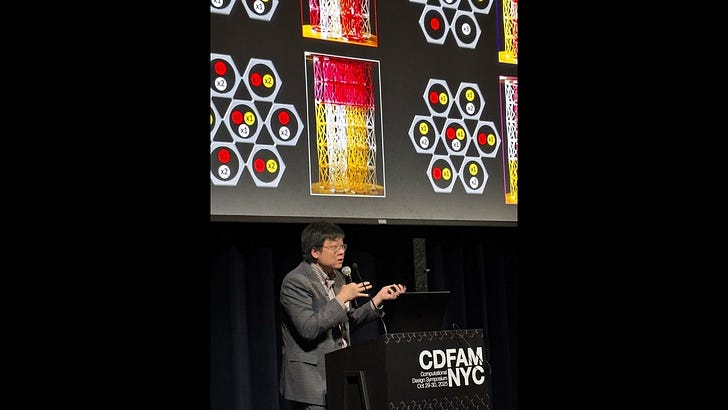
Super-Modular Chiral Origami Metamaterials
Get every episode summarized
Each time CDFAM Computational Design Symposium publishes, we email you a written briefing from the transcript — the topics, who appeared, and any specific claims, with the ad reads skipped.
Email me new episodesFree for 3 shows. No card needed.
About this episode
Recorded at CDFAM Computational Design Symposium, NYC, October 29-30, 2025https://cdfam.com/nyc-2025/
OrganizationPrinceton UniversityPresenter:Tuo ZhaoSuper-Modular Chiral Origami MetamaterialsPresentation AbstractMetamaterials with multimodal deformation mechanisms resemble machines, especially when endowed with autonomous functionality. A representative architected assembly, with tunable chirality, converts linear motion into rotation (1). These chiral metamaterials with a machine-like dual modality have potential use in areas such as wave manipulation, optical activity related to circular polarization and chiral active fluids. However, the dual motions are essentially coupled and cannot be independently controlled. Moreover, they are restricted to small deformation, that is, strain ≤2%, which limits their applications. Here we establish modular chiral metamaterials (2), consisting of auxetic planar tessellations and origami-inspired columnar arrays, with decoupled actuation. Under single-degree-of-freedom actuation, the assembly twists between 0° and 90°, contracts in-plane up to 25% and shrinks out-of-plane more than 50%. Using experiments and simulations, we show that the deformation of the assembly involves in-plane twist and contraction dominated by the rotating-square tessellations and out-of-plane shrinkage dominated by the tubular Kresling origami arrays. Moreover, we demonstrate two distinct actuation conditions: twist with free translation and linear displacement with free rotation. Our metamaterial is built on a highly modular assembly, which enables reprogrammable instability, local chirality control, tunable loading capacity and scalability. Our concept provides routes towards multimodal, multistable and reprogrammable machines, with applications in robotic transformers, thermoregulation, mechanical memories in hysteresis loops, non-commutative state transition and plug-and-play functional assemblies for energy absorption and information encryption.References:(1) Frenzel, T., Kadic, M. & Wegener, M. Three-dimensional mechanical metamaterials with a twist. Science 358, 1072–1074 (2017).(2) Zhao, Tuo (presenter), Dang, X., Manos, K., Zang, S., Mandal, J., Chen, M., & Paulino, G. H. Modular chiral origami metamaterials. Nature, 640(8060), 931-940 (2025).Speaker BioTuo Zhao is a postdoctoral research associate at Princeton University. His expertise is in computational mechanics, nonlinear topology optimization, soft robotics, and mechanical metamaterials. Tuo is currently addressing the scalability challenge for developing useful metamaterials. By integrating an untethered actuation scheme (e.g., three-dimensional magnetic fields and micro-magnetic responsive materials), he designs micro-robotic machines with tunable properties on demand.
This is a public episode. If you would like to discuss this with other subscribers or get access to bonus episodes, visit www.designforam.com
Get every episode summarized
Each time CDFAM Computational Design Symposium publishes, we email you a written briefing from the transcript — the topics, who appeared, and any specific claims, with the ad reads skipped.
Email me new episodesFree for 3 shows. No card needed.
Know when Tuo Zhao turns up
Follow Tuo Zhao and once a week we email you every new episode they appeared on — including guest spots the show notes never mention, because we read the transcript.
Follow Tuo ZhaoFree. Pick your own day and time.
Hosts & guests
No transcript yet
This episode has not been transcribed. Request it and it moves to the front of the queue.
More episodes
More from CDFAM Computational Design Symposium
The Era of Living Machines: How Biology Will Build the Next Generation of Buildi...
CDFAM Computational Design Symposium

From Horns to Armor: Biomimicry, Computational Design, and the Future of Impact...
CDFAM Computational Design Symposium

Before the Model: Aurora as AI-Grounded Climate Intelligence for Early-Stage Des...
CDFAM Computational Design Symposium

Bridging the CAD-to-Simulation Gap: Integrating Meshing-free Isogeometric Analys...
CDFAM Computational Design Symposium