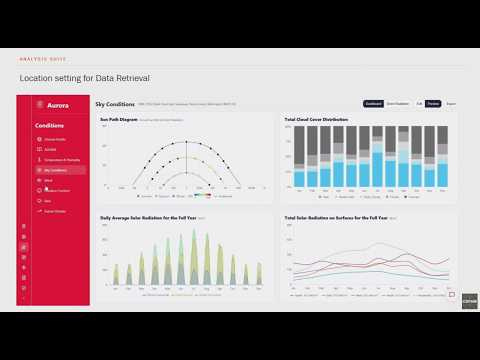
Before the Model: Aurora as AI-Grounded Climate Intelligence for Early-Stage Design
Get every episode summarized
Each time CDFAM Computational Design Symposium publishes, we email you a written briefing from the transcript — the topics, who appeared, and any specific claims, with the ad reads skipped.
Email me new episodesFree for 3 shows. No card needed.
About this episode
CDFAM Computational Design Symposium — DC 2026
Damola Michael; Elliot Glassman · CannonDesign
The environmental design conversation typically begins too late, after massing is committed and geometry is locked. Aurora repositions that conversation to day one, giving architects and engineers an immediate, evidence-based picture of any site before a design tool is opened.
The platform synthesises EPW weather files, CMIP6 climate projections, ASHRAE design conditions, NOAA historical records for US sites, and seismic hazard data into a unified analysis environment, covering temperature and humidity distributions, wind roses, solar radiation by facade orientation, thermal comfort (UTCI, PET, SET), rainfall, carbon intensity, and future projections to 2050. Every analysis is immediately exportable as a formatted PDF or PowerPoint report, ready to present to a client or design team without additional preparation.
Two integrated AI layers surface this data as design insight. A streaming conversational assistant powered by Google Gemini is grounded in the actual EPW and CMIP6 data for the active location. It explains what site climate means for design decisions, renders specific charts inside the conversation, and adjusts application settings through natural language. A second layer generates AI-written summary cards for ASHRAE design conditions and 2050 climate outlooks, automatically scoped to the site.
Aurora does not generate or evaluate geometry. This is intentional: it is a pre-design climate intelligence layer, not a replacement for tools like Autodesk Forma. It provides the environmental literacy that should inform every decision made in those tools, a shared language between architect, engineer, and client before a single wall is drawn.
Links
Talk page with full transcript
This is a public episode. If you would like to discuss this with other subscribers or get access to bonus episodes, visit www.designforam.com
Get every episode summarized
Each time CDFAM Computational Design Symposium publishes, we email you a written briefing from the transcript — the topics, who appeared, and any specific claims, with the ad reads skipped.
Email me new episodesFree for 3 shows. No card needed.
Hosts & guests
No transcript yet
This episode has not been transcribed. Request it and it moves to the front of the queue.
More episodes
More from CDFAM Computational Design Symposium
The Era of Living Machines: How Biology Will Build the Next Generation of Buildi...
CDFAM Computational Design Symposium

From Horns to Armor: Biomimicry, Computational Design, and the Future of Impact...
CDFAM Computational Design Symposium

Bridging the CAD-to-Simulation Gap: Integrating Meshing-free Isogeometric Analys...
CDFAM Computational Design Symposium

AI-Native, Simulation-Driven Insight with End-to-End Traceability
CDFAM Computational Design Symposium