Get every episode summarized
Each time Tea Biz publishes, we email you a written briefing from the transcript — the topics, who appeared, and any specific claims, with the ad reads skipped.
Email me new episodesFree for 3 shows. No card needed.
About this episode
“Do you seek adventure and want to serve your country? The Central Intelligence Agency's Directorate of Operations is hiring. We are looking for individuals with a can-do attitude and a collaborative mindset.”From the transcript
Tea producers seeking higher returns are often advised to add value through improved processing, certification, packaging, or branding. Independent recognition of the finished tea’s quality is another part of that conversation.
AVPA, the Paris-based organization behind the international Teas of the World competition, evaluates entries through blind sensory assessment. For producers moving beyond bulk sales, that recognition can help convey what makes a particular tea distinctive.
In this SPOTLIGHT, we explore how producers can connect quality to the market, what French consumers value, and where recognition fits alongside the commercial work of building a brand.
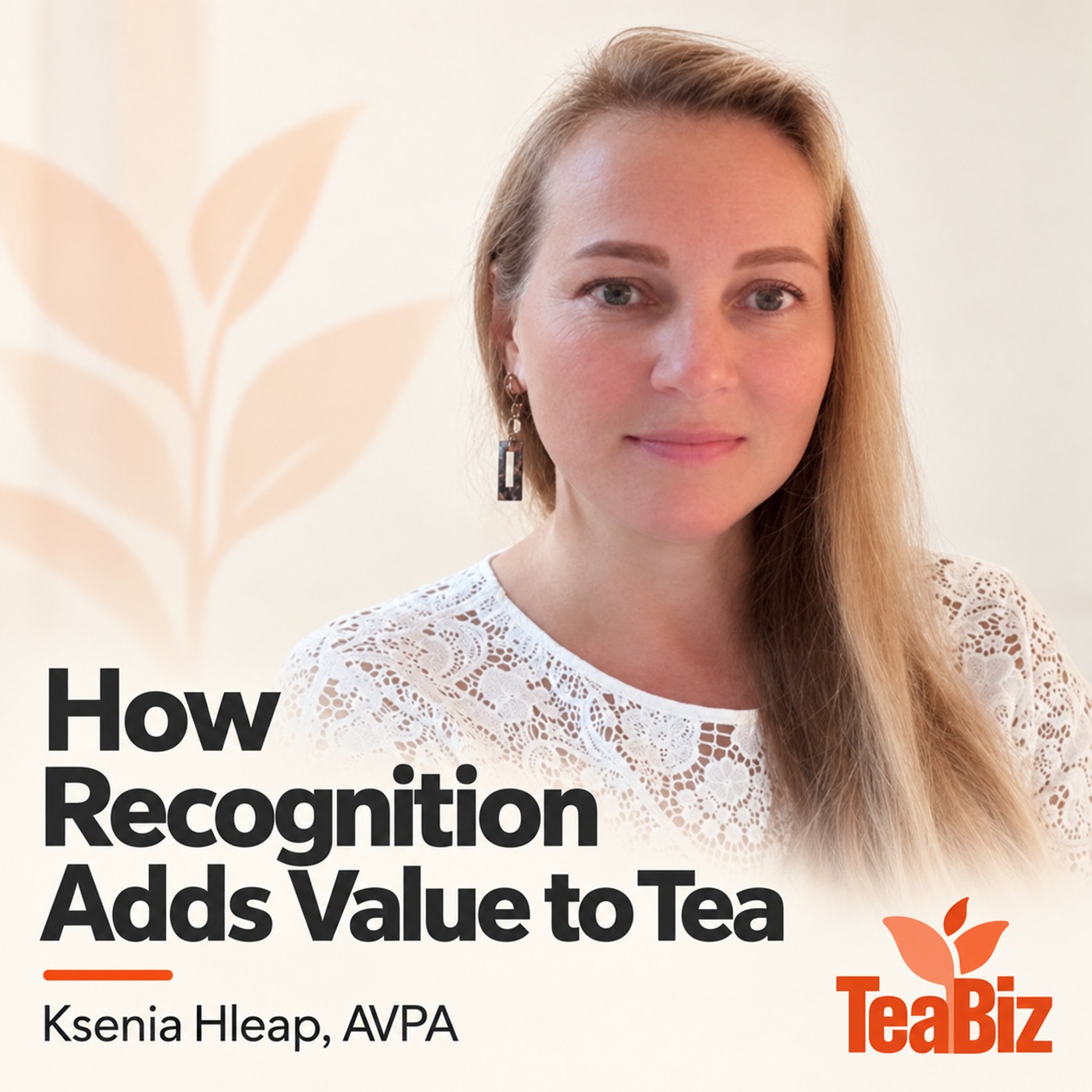
Our guest today is Ksenia Hleap, Chief Operating Officer of AVPA — Agence pour la Valorization des Produits Agricoles, the Paris-based organization that conducts international competitions recognizing the gastronomic quality of agricultural products.
Ksenia joined AVPA in October 2017 as Director of Communications and Business Development and was named Chief Operating Officer in July 2026. She is closely involved in AVPA’s international Teas of the World competition, which welcomes producers from established and emerging tea origins and evaluates entries through blind sensory assessment. She earned a master's degree in business development from UPEC Université Paris.
Her work at AVPA focuses on producer recognition, product quality, and market development—particularly helping agricultural producers communicate their products' identity, quality, and added value. | Podlink sign-up: https://pod.link/1549975153
Advertising Inquiries: https://redcircle.com/brands
Privacy & Opt-Out: https://redcircle.com/privacy
Get every episode summarized
Each time Tea Biz publishes, we email you a written briefing from the transcript — the topics, who appeared, and any specific claims, with the ad reads skipped.
Email me new episodesFree for 3 shows. No card needed.
Hosts & guests

Transcript ready
108 searchable segments. Every word is indexed and playable.
Full transcript
Tea Biz — Spotlight | How Recognition Adds Value to Tea. Machine-transcribed; use the interactive transcript above to jump the player to any line.
Do you seek adventure and want to serve your country? The Central Intelligence Agency's Directorate of Operations is hiring. We are looking for individuals with a can-do attitude and a collaborative mindset. If you are looking for a challenge, apply online at CIA.gov slash careers. Our guest today is Senior Leap, Chief Operating Officer of AVPA, which is the Agency for the Valorization of Agricultural Products, a parents-based organization that conducts international competitions, recognizing the gastronomic quality of agricultural products. She joined AVPA in October 27th as Director of Communications and Business Development and was named Chief Operating Officer in July 2026. She is closely involved in AVPA's International Teas of the World Competition, which welcomes producers from established and emergency origins and evaluates entries through Brian Sensory Assessment.
She earned a Master's degree in Business Development from UPEC University in Paris. Her work at AVPA focuses on producer recognition, product quality, and market development, particularly helping agricultural producers communicate their product's identity, quality, and added value. Ms. Nia, thank you for joining us on the TVIS podcast. With this year's Competition Deadline approaching, let's discuss what producers should know about Teas of the World. Thank you, Dan. Thank you for your invitation and being with us with me today. This is the ninth edition of AVPA's Tea of the World Competition. What's new for 2026 and what remains fundamental to how AVPA evaluates tea? In 2026 edition is the ninth International AVPA Teas of the World Competition, and the fundamental philosophy of the competition remains unchanged.
We want to recognize the gastronomic quality of tea and above all the producers behind the exceptional products. What 2026, we have continued to make the competition more relevant to the diversity of the tea world. We distinguish clearly between modern variator Camilla's San Francisco's classified according to their methods of preparation and herbal infusion, glance, and flavor tea. This is important because we don't want to compare fundamentally different products under the definition of a tea. So we are also seeing a very interesting geographical diversity. One of the strengths of AVPA is that we do not limit the competition to the traditional
major origin such as China, India, and Sri Lanka. We actively welcome producers from Africa, Latin America, South Asia, and Europe, including emerging origins, and producers who are developing new approach to tea, including tea from Europe and from. This year, the Dutch Blinds for Sanples are the third September. With the jewelry tasting place in Paris, and they want ceremony this year will be held the 10th of December in a very special beautiful place, but I cannot tell you for the moment. So it will be a very beautiful surprise for everybody, and it's just couple of peaks to continue. For an African tea garden producing certified teas and seeking better
than both prices, what's the strongest reason to enter AVPA's competition? And how can that recognition help an emerging brand? I think that certification fills the market something very important about how a tea is produced, whether in terms of festibility, social standards, or traceability. But certification alone does not necessarily tell the consumer how good the tea actually tastes. That is where an independent censor recognition, such as AVPA, can add another dimension. The producer can say, this is a certified tea from a particular origin, and a VPA distinguish allows them to add, and this particular tea has been indincidentally evaluated and recognized for its gastronomic quality.
My French tea professional and gastronoms. My producer trying to move from bulk into high quality and branded tea, that distinction can be very valuable, very valuable. It gives the producer a credible story around the product itself rather than only around the production system. This is especially relevant for African tea. In the markets such as Kenya or Ronda, the majority of teas is still sold into the bulk system. Where a region and producer identity can disappear for the dull supply chain. The key in the tea industry is actively looking at a orthodox and high quality production, as the way of moving towards the value addition. AVPA cannot replace a brand, packaging,
distribution, or commercial strategy. But it can provide an independent recognition that helps a producer differentiate a particular tea and being in conversation with the buyer's potential buyers, distributors, distributors, chefs, and consumers. So for an emerging brand, predictability can be particularly important because it is difficult to build a recognition from zero. What types of tea perform well and what patterns of the observed in the French palette? This question is about understanding the market rather than tips on winning. Thank you for this question. But what is interesting for us is that there is no one's single winning style. So I don't encourage this or this type of tea to enter to the competition.
Because the French palette generally appreciate balance, aromatic complexity, your systems, and elegance. And in my opinion, each tea, blind, or infusion can have all this. There is an interesting teeth that have been clear, identified, and a strong connection between aroma, taste, and origin. For the traditional Camelian sensibilities, we see the teeth which clarity of characters and well-defined aroma profile can perform very well. That might be delicate and throw floral tea and tea with more structure, vegetal or mineral notes, or a beautiful balanced oxidized tea. It is not about only about intensity, but it's really about the whole balance of the product. We are always very curious about new origin and new expression of tea.
Keep in mind, but all the teas are tasted blinded. So it's about the expression of each product. I encourage all type of tea, all blends and infusion to enter in the competition. If I can speak about the trends in Europe, what is interesting in you, as you know, the matcha is doing something well in Europe globally. But this year, for my childhood, I visited Spain and I was impressed by the quantity of people who is drinking and who like matcha. So I just I thought about it and I decided I wrote a small article about the diversity of teas of different teas in Europe. And if you're interested in, you can read it on the blog. So for me, the diversity, this is the strategy that each producer can choose and
the producer can enter whatever tea he wants. Why are French consumers willing to pay more for better tea, certified, traceable, origin, identifiable products in mainstream channels? Very nice question. And I don't think it's similar in all European countries. But as for the French market, this is true. The France is growing a lot in a specialty and in high quality tea. And I think it's really linked to the French culture. They think French people globally that it's better to eat or to drink less, but better quality. Because we can afford to the excellence, we can afford the excellent product for ourselves. We live one time. So why drink something that is not good? And it's they're looking for the new taste for the different
origin. It is very important for them to know the flexibility and the production method. So they want to give their impact on the field in general. So it is important to drink the high quality and to be sure that the whole process of production was with the respect to the terroir, to the farmer, and globally to this planet. I think it comes really from the culture of the consuming, verified agricultural products in general when I speak about French wine or French cheese. And they respect very strong the region, the regions, and the agricultural people who are working on the terroir. Value addition includes production, certification, packaging, and branding.
What is AVPA's independent recognition fit into turning a tea's quality and identity into value? This is really a thought of what AVPA does. You are completely right. We don't not buy tea. We do not sell tea. We do not determinate a commercial price or a producer product. Our role is different. We create the recognition around the quality. So value addition is not only about putting tea into more expensive packaging. It begins much earlier. Recognition, the terroir, the consumer, the processing, the producer work, and the sensory identity of the final product. And then communicating that value to the consumer. That's what we are trying to do from our sites.
And we are trying to learn, especially the small farmers, those who sell bulk before, how they could communicate all this, all the balance of their product to the consumer. That is where the TAs is its role. Help it move the conversation from commodity to product, from product to identity, and from identity to value. Is there anything you want to add that I haven't asked? I think globally all the questions are there. Please, for all the producers, you have still time to enter, to register, and to sell your samples to Paris. And I really hope to see you all to be worth ceremony in December in France in Paris.
More episodes
More from Tea Biz

Tea Price Report | Week 37 | Ending 11 September, 2026
Tea Biz

Tea News Recap | Africa Pushes Value Over Volume | Europe Pays More for Better T...
Tea Biz

Ep 246 | Africa Adds Value | Europe Buys Better Tea | ISO Sets Standards
Tea Biz

Tea Price Report | Week 35 | Ending 28 August 2026
Tea Biz