Get every episode summarized
Each time Tea Biz publishes, we email you a written briefing from the transcript — the topics, who appeared, and any specific claims, with the ad reads skipped.
Email me new episodesFree for 3 shows. No card needed.
About this episode
“Do you seek adventure and want to serve your country? The Central Intelligence Agency's Directorate of Operations is hiring. As a member of our team, you'll work on high-impact operations around the world, safeguarding our nation and making a difference.”From the transcript
Can the Pacific Northwest grow exceptional matcha at commercial scale?
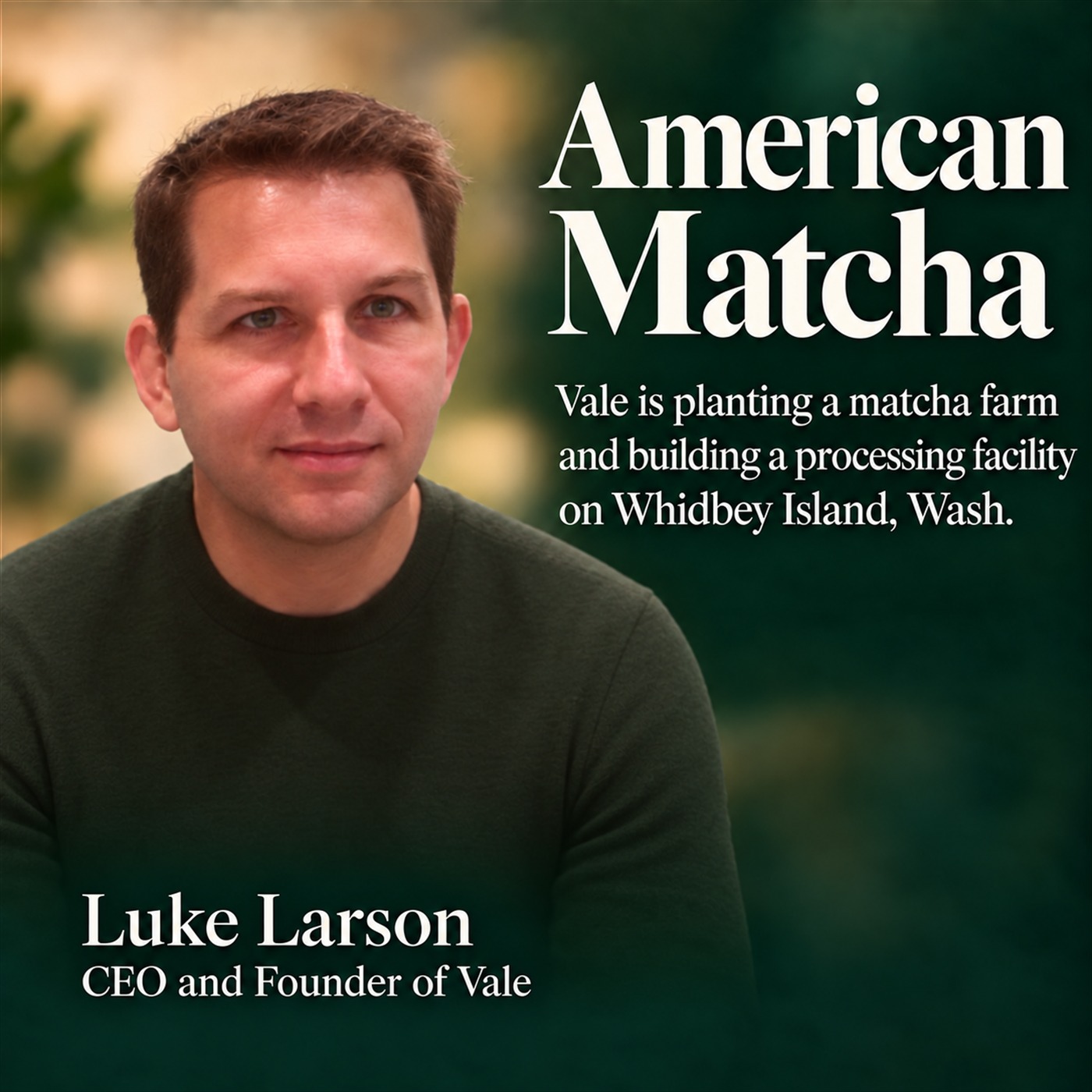
Seattle-based Vale is putting that question to the test. Founder and CEO Luke Larson says Vale Farms has planted twelve thousand tea plants on what will eventually grow to two hundred acres on Whidbey Island, Washington. Plans include a greenhouse and a thirty-thousand-square-foot processing facility in nearby Oak Harbor.
The first harvest is still about five years away. In the meantime, Vale will continue sourcing tea from Japan while developing its growing and processing operations.
But Larson’s ambition extends beyond one farm. Inspired by Napa Valley and Oregon’s Willamette wine region, he hopes other growers will help build a regional tea industry.
Tea Biz correspondent Jessica Natale Woollard explores the plans—and the patience required—in this week’s SPOTLIGHT. BIO: Our guest is Luke Larson, founder and CEO of Vale, the Seattle-based matcha business developing Vale Farms on Whidbey Island, Washington. Larson grew up on a farm on the Olympic Peninsula. His interest in matcha became a business venture with Chef Jeffrey Hayden, Vale’s head of Craft. Working with agricultural specialists and tea-growing partners, Larson is pursuing commercial tea cultivation, matcha production, and a hospitality experience centered on tea education. | Podlink signup: https://pod.link/1549975153
Advertising Inquiries: https://redcircle.com/brands
Privacy & Opt-Out: https://redcircle.com/privacy
Get every episode summarized
Each time Tea Biz publishes, we email you a written briefing from the transcript — the topics, who appeared, and any specific claims, with the ad reads skipped.
Email me new episodesFree for 3 shows. No card needed.
Hosts & guests

Transcript ready
127 searchable segments. Every word is indexed and playable.
Full transcript
Tea Biz — Spotlight | American Matcha. Machine-transcribed; use the interactive transcript above to jump the player to any line.
Do you seek adventure and want to serve your country? The Central Intelligence Agency's Directorate of Operations is hiring. As a member of our team, you'll work on high-impact operations around the world, safeguarding our nation and making a difference. We are looking for individuals with a can-do attitude and a collaborative mindset if you are looking for a challenging and rewarding role. Explore available opportunities and apply online at CIA.gov slash careers. Global demand for premium ceremonial grade matcha has been increasing faster than Japan's tea farmers and wholesalers can produce. Forward-thinking purveyors of the vibrant green beverage are asking themselves, where might new matcha production come from? Seattle-based Vale matcha is pursuing one of the most ambitious answers to the question. In August, they launched Vale Farms, a 365-acre property in Washington State,
which will eventually be home to 1 million tea plants. Their concept includes a fully integrated commercial-scale operation that will see matcha production through, from tea cultivation to tench of production to milling. And there's more. In this spotlight, Vale founder and CEO, Luke Larson spills the tea on Vale Farms, as well as his vision for the Pacific Northwest of the United States, a vision in which the region becomes a tea-growing hotbed known around the world for producing exceptional matcha. Congratulations, Luke, on this exciting announcement, the planting of the first 12,000 tea plants on would-be island and the announcement of what is to come. Thousands of more plants on 200 acres and a 30,000 square foot processing facility to prepare tench for milling at your Seattle location. So tell me and tell our listeners, how did you go from opening your first Vale matcha cafe
just 17 months ago to this bold vision, which is, as I understand it, a first in the United States, an integrated commercial-scale matcha-growing and production operation? In early 2025, me and my business partner, Chef Jeffrey Hayden, we're looking to open a cafe in Seattle, South Lake Union area, and we couldn't get any matcha. The world's fallen in love with matcha, and there's not enough. And that led us to a question that kind of kicked off Vale Farms, and that is, could we grow tea in the Pacific Northwest? And that question set us off on an incredible adventure. So this operation is future-focused, and not just for being able to sip Vale Farms matcha in a cafe, you have a vision for the potential of the Pacific Northwest, as you say, and the whole tea industry. Can you tell us about that? First and foremost, our goal is to become a commercially viable tea farm, grow exceptional
tea and make great matcha. We also have a secondary goal, and that is to create world-class hospitality experience. We are really, really big fans of Roderow Mandavi and the wine culture that happened in Napa Valley in the 70s. And so we want to be a pioneer in saying we can grow great tea in the Pacific Northwest, and not only great tea, we want to be known for making tea that makes great matcha. And so we are encouraging other people to join us in this movement. Given what I know about Vale Macha, and you mentioned it already, that you have a commitment to exceptional premium high-quality teas from Japan, how did you select the tea plants that would be grown on the farm? That's a great question, and our goal isn't to try to recreate Japan. We really are students, and we're learning a lot from our Japanese partners and also
other tea farmers that have been doing this a lot longer than us. One of our partners is Evilie, who runs the tea and Hawaii company on the big island in Hawaii with her husband, Chu Liang. They've been growing tea for 25 years. They're fantastic people. They're just really awesome. The first tea plants that we have from Vale Farms are going to come from the volcano village tea farm that they have on the big island. And we specifically wanted to work with them because those tea plants can trace their origins to Japan, and they're the story cultivars of Yabunkeita and other Japanese cultivars, which are great to make matcha. And finally, why matcha? What is it about matcha that has captured both your heart, your taste buds, and also your business sense? I really got into matcha after a health scare in 2022. I've an identical twin brother. He was diagnosed with cancer in late 2021.
A few months later, I got diagnosed with an earlier stage prognosis, and at that time I'm healthy now. It was treatable, but it was a really big deal for me and my family. So I started thinking about what I want to put in my body and how I take care of myself and my wife really encouraged me to drink matcha. And I became really interested in the health benefits. And then later, Chef Jeffrey is really the one that introduced me to really great, high quality matcha. We're very lucky to have him on the team because he creates these amazing flavor profiles where we match the matcha with specific natural sweeteners, which is essentially like fruits or maple syrup or honey. And it just creates this thing that tastes delicious, but also makes you feel good. Exciting. And I'm glad that you're doing well. And yes, of course, the health benefits of tea are so valuable and we're so lucky we
have this amazing plant. Absolutely. And now I suppose it's about the art of patience right now as you're waiting for these first tea plants to be cultivated. What's your timeline for cultivation and production? Yeah, so we planted three acres, like you said, 12,000 tea plants were building a one-acre greenhouse on the farm. And we're also building a 30,000 square foot processing facility just up the road in Ocarver. But Camilla's sentences, the tea shrub, takes about five years before you can do that first harvest. So in that five years, we are going to be sourcing tea from Japan. We're working with our great partners and equipment manufacturer that makes the post processing equipment and that's how you turn the raw harvest into Macha.
And so during that time, we hope to bring people up to the farm. We want this to be something where we're doing tea education and really encourage people to follow us on this process. Well, thank you for sharing it and I'm sure we'll check in again as your production develops and definitely would love to keep in touch and be part of those first tastings too. Amazing, yeah. And for anyone listening, we really, again, Jessica mentioned it earlier, but our vision is we want Cascadia, we want the Pacific Northwest to be the Napa of tea. And I really love this analogy of a nightingale where one nightingale starts to sing and then a few others chime in with that same melody and eventually you have a chorus. And that's what we want to create an environment where we're doing some trailblazing with getting these cultivars setting up a greenhouse that can propagate the plants, doing the production
facility and all of that infrastructure. We want to open up to other people that are interested and hopefully create that chorus of people that are growing tea, great exceptional tea in the Pacific Northwest. Thank you, Luke, for taking the time to speak with tea biz. We will be following Vale Macha and Vale Farms very closely. It's important to note too that Luke and Vale's vision is backed by research. Vale has consulted propagation research and tea growing trials of a team from Washington State University's Horticulture Department. The findings to date indicate that multiple tea varieties are thriving in Washington, suggesting the state is a compelling location to grow Camillea Sinensis as an agricultural crop. There will certainly be Mordekam on Vale Macha and Vale Farms.
Sarah Hernandez fights for working families. As a teacher, Sarah Hernandez helped students go to college and when I attacked her community, Sarah Hernandez provided free legal help to immigrant families. Sarah Hernandez will fight for more housing, solutions to homelessness and a more affordable California. Vote Sarah Hernandez for Senet. Add paid for by Gro California, Add Committee's top funders Christian Larson and Timothy Draper, not authorized by a candidate or committee controlled by a candidate.
More episodes
More from Tea Biz

Ep 247 | Darjeeling Exports | Kenya Tea Bonuses | India Bans Paraquat
Tea Biz

Tea Price Report | Week 39 | Ending 25 September
Tea Biz

Tea News Recap | Rebuilding Darjeeling Exports | Kenya Tea Bonuses Squeezed | In...
Tea Biz

Tea Price Report | Week 37 | Ending 11 September, 2026
Tea Biz