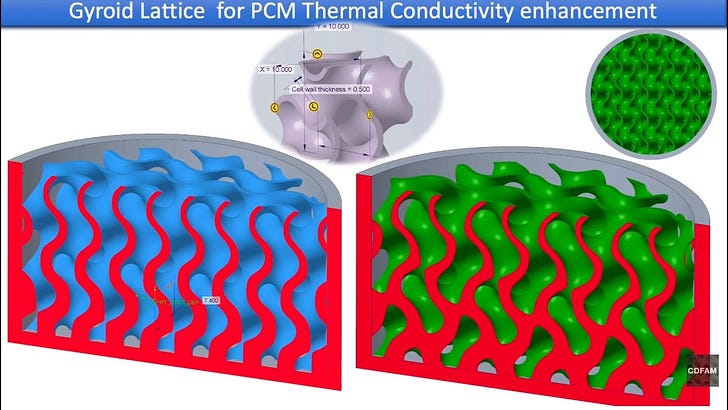
Optimal Lattice Selection for PCM Thermal Management
Get every episode summarized
Each time CDFAM Computational Design Symposium publishes, we email you a written briefing from the transcript — the topics, who appeared, and any specific claims, with the ad reads skipped.
Email me new episodesFree for 3 shows. No card needed.
About this episode
CDFAM Computational Design Symposium — DC 2026
Andreas Vlahinos · Advanced Engineering Solutions
PCMs provide cooling without requiring an extra power source, unlike fans or active liquid cooling systems. They absorb peak energy loads during operation and release that heat when the ambient temperature drops, acting as a buffer against rapid temperature changes. This allows for more compact thermal management systems. Because most PCMs have inherently low thermal conductivity, they often fail to absorb or release heat quickly enough for high-demand applications. Designers can significantly improve the thermal performance of Phase Change Materials (PCM) by embedding lattice structures. Embedding a highly conductive lattice, such as aluminum or copper, forms a “thermal skeleton” that functions as a heat highway, dissipating heat more quickly and evenly through the PCM.
Adding a 3D-printed metal lattice can increase the effective thermal conductivity of a PCM system by an order of magnitude compared to pure PCM. The internal structure provides a continuous path for heat conduction, which can double the melting speed. Beyond thermal benefits, the lattice provides mechanical support to the PCM, preventing leakage and helping it maintain its shape during the liquid phase.
Simulating PCMs’ thermal behavior is difficult due to the highly nonlinear nature of latent heat release, the shifting phase-change boundaries, and the significant differences in physical properties between the solid and liquid states. This presentation demonstrates simulation techniques and showcases the process of optimal lattice selection.
Links
Talk page with full transcript
This is a public episode. If you would like to discuss this with other subscribers or get access to bonus episodes, visit www.designforam.com
Get every episode summarized
Each time CDFAM Computational Design Symposium publishes, we email you a written briefing from the transcript — the topics, who appeared, and any specific claims, with the ad reads skipped.
Email me new episodesFree for 3 shows. No card needed.
Hosts & guests
No transcript yet
This episode has not been transcribed. Request it and it moves to the front of the queue.
More episodes
More from CDFAM Computational Design Symposium
The Era of Living Machines: How Biology Will Build the Next Generation of Buildi...
CDFAM Computational Design Symposium

From Horns to Armor: Biomimicry, Computational Design, and the Future of Impact...
CDFAM Computational Design Symposium

Before the Model: Aurora as AI-Grounded Climate Intelligence for Early-Stage Des...
CDFAM Computational Design Symposium

Bridging the CAD-to-Simulation Gap: Integrating Meshing-free Isogeometric Analys...
CDFAM Computational Design Symposium