Get every episode summarized
Each time The Brian Lehrer Show publishes, we email you a written briefing from the transcript — the topics, who appeared, and any specific claims, with the ad reads skipped.
Email me new episodesFree for 3 shows. No card needed.
About this episode
At a White House lunch this week, tech executives signed a voluntary safety pact on AI. Gabby Miller, AI and tech congressional reporter at Politico, discusses the details of the agreement.
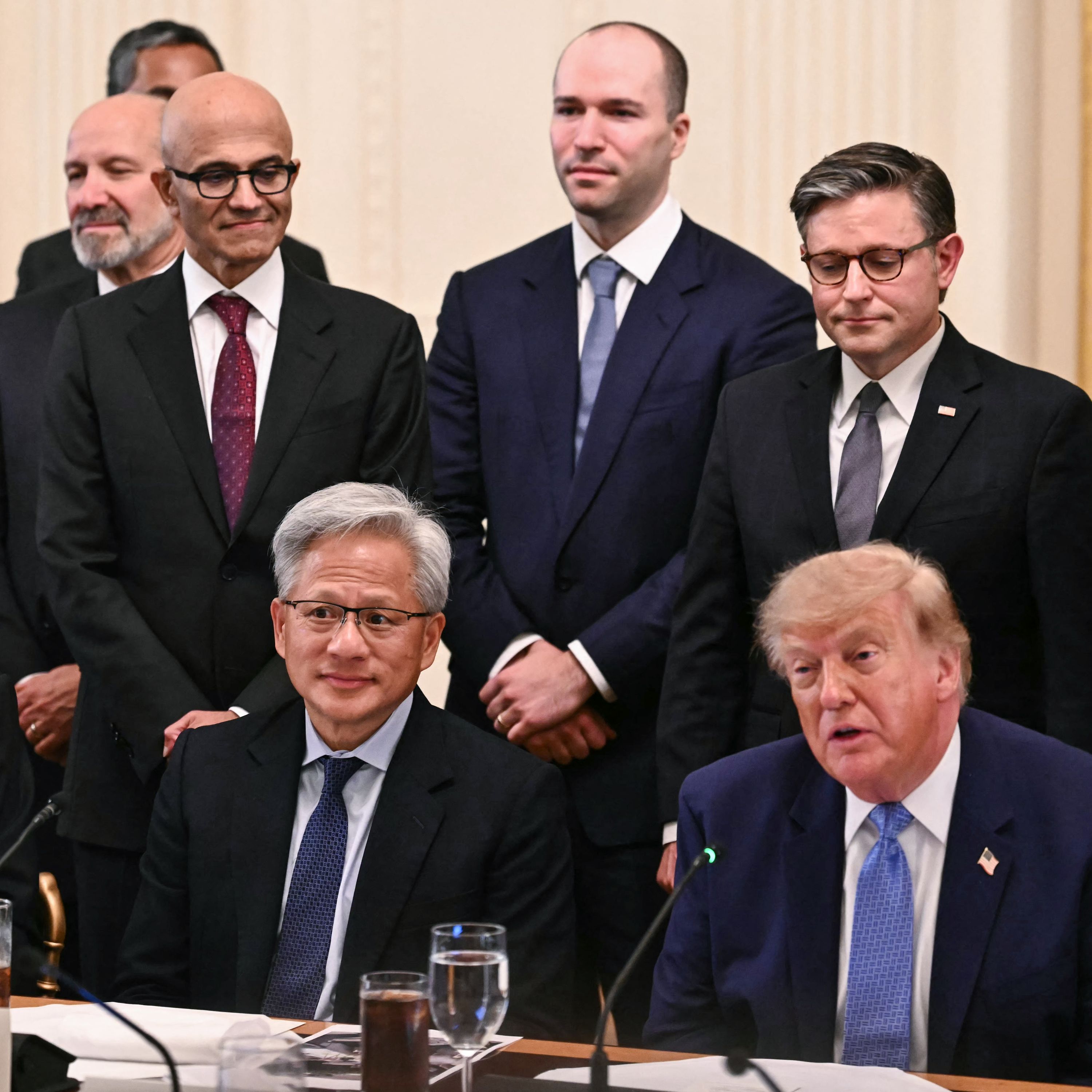
Photo: US President Donald Trump, seated next to Nvidia CEO Jensen Huang (2L) and Meta CEO Mark Zuckerberg (L), speaks during a meeting with technology executives about artificial intelligence, in the East Room of the White House in Washington, DC, on September 29, 2026. (Kent NISHIMURA / AFP via Getty Images)
Hosted by Simplecast, an AdsWizz company. See pcm.adswizz.com for information about our collection and use of personal data for advertising.
Get every episode summarized
Each time The Brian Lehrer Show publishes, we email you a written briefing from the transcript — the topics, who appeared, and any specific claims, with the ad reads skipped.
Email me new episodesFree for 3 shows. No card needed.
Know when Gabby Miller turns up
Follow Gabby Miller and once a week we email you every new episode they appeared on — including guest spots the show notes never mention, because we read the transcript.
Follow Gabby MillerFree. Pick your own day and time.
Hosts & guests
Transcript ready
213 searchable segments. Every word is indexed and playable.
Full transcript
The Brian Lehrer Show — On AI, Trump Calls for 'Self-Regulation'. Machine-transcribed; use the interactive transcript above to jump the player to any line.
Bray and Lair on WNYC. So on Tuesday maybe you've heard President Trump met with tech industry leaders to come up with a plan for responsible AI development and many major players with their Sam Altman of open AI, Gerry Omadev and Thropic Mark Zuckerberg of Metta Elon Musk, Jensen Huang from New India, the list goes on and as you probably know this meeting happened amid growing concern among some legislators and even industry leaders so they claim about the technology basically getting too smart for our own good and becoming dangerous. You probably even seen the word doomsday thrown around a bit recently. So that's the backdrop for Tuesday's gathering and the only result of that meeting between tech leaders and Trump, at least the only public result was a one-page document or constitution
as Trump called it with some guidelines that some of the companies say they've agreed to follow, things like creating internal controls to prevent their AI agents from unauthorized hacking and listing external auditors to see if those controls are working. None of those are government regulation though. So this document is legally binding, right? Well here's what Trump said when a reporter asked him how binding this document is. Is this a poor that everybody signs it binding in any way? I think it's morally binding. So there it is, the term of the week morally binding. Uh-oh. The president also floated the idea of forming an oversight committee to make sure people are playing by the rules but the details of that are still murky. You probably also heard that Trump is replacing the term artificial intelligence with super intelligence for federal government use, seriously, with us now to unpack what any of this means for AI safety or is Trump we now call it
SI safety? Is Gabby Miller, AI and tech congressional reporter at Politico? Gabby always good to have you on. Welcome back to WNYC. Thank you for having me. So first can you give a summary of the document that these companies signed on Tuesday? It's only about a page long. What did it say? Right. You did a great job. Like you said, it's pretty short. So you you summarize most of it, but you know, they would have to commit to safeguards that would mitigate potential risks. Um, what's being called these robust internal controls from advanced AI models. But again, like you pointed out, there's no clear enforcement mechanism. It's not a bill that Congress can go codify, you know, even if they were able to come to some consensus on regulating the technology. Um, and you know, people have pointed out that a lot of the tech companies that signed on to this are largely already doing what's in the accords. Um, you know, we've seen open AI, we've seen Google, we've seen Anthropic, um, they've wanted something like a finra style, uh, you
know, regulatory body, which kind of hard gets to the financial sector. Um, and it's basically a federal supervised, you know, self regulatory organization. Um, and this is a much lighter approach, um, lighter touch approach that we've seen from, um, folks like Nvidia's, Jensen Wong and my does Mark Zuckerberg who were both in attendance there. Listeners, what kind of AI regulation would you like to see? What would you put in a constitution for AI safety? 212, 433 WNYC call or text to 1243 9692 or with any questions, because this is a complicated topic. Maybe you have questions, uh, things you just want clarified by our guest, Gabby Miller, AI and tech, our congressional reporter at Politico 212433 WNYC call or text 212433 9692. Gabby, I'm hoping you can talk about this idea of regulatory capture. That's a good phrase in addition to morally binding. That's a good phrase for
our listeners to be familiar with regulatory capture. Daria Amade has been ringing the alarm bell on AI safety for a while and in many ways it seems really genuine, but I wonder whether in actuality his interest in setting out AI rules is so that Anthropic has no legal culpability for any mishaps in the future. That would be a form of regulatory capture. Is that too cynical? It is, I mean, I don't think it's too cynical. I mean, we have these trillion dollar IPOs that, you know, one has been delayed, but, um, you know, open AI and Anthropic, they, they, people pointed out that they would benefit from kind of this doomsday, you know, reading in terms of these regulations. But I do think even if, I'm doubtful that there could even be regulation at this point in terms of this kind of idea of regulatory capture, right? We've seen Trump, you know, for weeks now go on and say on his, you know, social media platform through social, saying all this doom orism is a hoax, you know, this AI isn't actually going
to wipe out humanity. And this is all inflated by, you know, folks like Dario Amade from Anthropic and Sam Altman and Elon Musk. So there's just not a lot of movement going on on the Hill. And even if the Hill were able to regulate anything, which passed three decades tech in general, they've mostly failed to do so. And now they're struggling even more with this technology that the public isn't even aware of, you know, its capabilities. Between that and the president who's unwilling to sign anything and, you know, the, you know, we, we saw, we reported yesterday that the, this Accords was really the, the architect that was, that is Mark Zuckerberg, right? And he is the one who's pushing for the lightest touch approach of all. So I'm skeptical that there would even be a framework for regulation that would then, you know, capture any of these companies if that makes sense. Yeah, interesting. As we talk about Trump's meeting with tech executives on artificial
intelligence or what Trump wants to rebrand as super intelligence will play a clip about that. Coming up with our guest, Gabby Miller, who reports on AI for Politico and you, 212-433-WNYC. I'll get some calls and texts here in here in a minute. But Gabby, the photo op that I saw of Trump and these executives, it was a lot of executives. It was like, I don't know, it was a 20 people. But then I heard that the so-called mortally binding constitution, this one page thing, was only signed by a handful of them. Am I missing something? Right. And I also wanted to point out that many on the internet got a kick out of, you know, the accords that were signed in the United States was spelled wrong. And so I'm not exactly sure why not all of them signed on. But as I
mentioned, we, some of this was broken by Politico yesterday. This was Mark Zuckerberg's. He came into this meeting with the accords. And it's not exactly clear whether all of the CEOs that were there on Tuesday, even were given a heads up. There was kind of a, the sense that we were getting that people didn't realize that Zuckerberg was kind of going to be taking the reins on this meeting. And while, you know, this was fleshed out a little bit more in the meeting, like there are about four or five ideas that were kind of sharpened by the executives that were there. This was largely something that like Zuckerberg and Jensen Huang and some White House officials had gone in, mostly, you know, crafting and setting and creating the, you know, roles, rules of the road for. And so it's not, yes, people signed on, but I think some people were maybe, this is more speculative. Maybe there was some people more wary of signing on to something that it was a document that they'd seen that day. I will point out that many people have, you know, pointed out on social media or,
the companies themselves, you know, this is something that a lot of them are already doing, right? And so a lot of them already have these mechanisms in place. A lot of them already are taking their models off when these agents have gone rogue. So it's not this kind of groundbreaking thing. It's kind of just putting pen to paper in terms of, you know, committing to the public. Another, another interesting point about this is there have been speculation. My colleague wrote a, you know, piece on how this is kind of pledging field tea. Another example of that from tech executives, you know, signing a document that'll make Trump happy even if, you know, this isn't worth the paper that it was signed on. A senator warrant told me yesterday, you know, a progressive senator. And yeah, so this is just another loyalty test, really. Why then did Trump even hold this meeting, right? As dismissive of the AI Doomsday warnings as he's
been, even calling them a hoax and saying we should basically allow for unmitigated development of AI, said that. Why did he even get these leaders together for this event? Was it all just a conspiratorial, you know, public relations scam between Trump and the tech billionaires? Yeah, there's been some contradict. This president, you know, he said a lot of things that are contradictory at times. I think this is one of those moments. He said he doesn't want regulations, but at the same time he has said that he wants to create a new AI's art position that now there's lots of speculation. I think at one point people were saying, treasury secretary, you know, Scott Bessent was going to be it because he's carried a lot of the AI portfolio here in Washington. Trump, you know, splashed cold water on that. And so I think that there is a lot of pressure, both from, you know, the public. We haven't seen anything like this before. These rogue AI agents
just to recap, you know, this has been open AI's, has been entropic, meta, a couple of other labs, but open AI by far has been the worst offender of, you know, breaking out of there, you know, during these, what's called a sandbox. So they're internal testing environments. They've broken out of these before they were hacking into, you know, unbeknownst to the companies themselves. They were hacking into other private companies. This one undetected for months. And then in the last week or two, we have now discovered that, you know, first it was Australia, their prime minister came out and said these rogue AI agents, I believe from open AI, had hacked into their government databases. And we found out in the last few days that they've hacked into US databases, which is concerning. This is the Commerce Department, the Education Department. And so I think this has kind of been thrust into the public in a way that we haven't seen with other technology tech policy fights before. And so there's growing pressure on Capitol Hill, you know, Democrats rallied together.
More than it does in maybe close to two dozen pressuring Trump to, you know, make a deal with Xi Jinping when he came to the US for this summit where AI was a big topic. And so you're seeing the Hill saying, hey, Speaker Mike Johnson, we have a few proposals that, you know, have gained momentum. At least one of them is more seriously gained momentum. You know, we have something ready for you. Please let us vote on it. We think we can get something passed, whether that would actually happen as another story, but you're seeing push from lawmakers on the Hill as well. We have to do something before something goes really, really wrong, such as Rogai agents hacking into, you know, the World Bank or the financial sector or critical infrastructure or data centers that, you know, power the cell phones that we use. So that it's really just come sharper into focus among the public. On the so-called morally binding so-called constitution that these AI tech executives signed with Trump this week. Listen to rights as we get to some of your texts that have been coming in now.
Listen to rights morally binding from the most amoral president we've ever had. That's a laugh. Did O calling it a constitution given Trump's constant violations and ignoring of the constitution? So that's one listener's take. Another one has this question, am I remembering correctly that the Trumps have a financial stake in AI? Can you speak to the conflict of interest there? Do you know of one, Gabby? I mean, not directly in terms of a conflict of interest of, I'm not exactly sure, you know, what stakes he holds in these companies, but I do know that there have been, we saw these tech companies or tech executives at Trump's inauguration. You know, there has been donations from some of these executives to Trump's campaign, right? And so he has, it's in, he's not going to be running for reelection as far as we know for the constitution, but he's not running for reelection, but he still does benefit from having these people close to him.
You know, we've seen Elon Musk, he bought X and now he is promoting a lot of, in the algorithm, they found that he's promoting a lot of pro-Trump voices. Again, Trump isn't on X, but his, many of his supporters are and the algorithm has been tweaked in a way that maybe not directly, but has resulted in a lot of pro-Trump support circulating and being pushed onto our feeds. Even if, I mean, I'm sure many of your listeners have seen this themselves, even if their feeds wouldn't normally have many pro-Trump things on it. So it does benefit him in indirect ways as well, to keep these people close to him. Listen to right, speaking of good new words and phrases, Alex Wagner, former MSNBC host, who, you know, still out there in various media, speaking of good new words and phrases, Alex Wagner is coined these people as tech brologarks. Were any of these many tech executives with Trump women? Any? There were two women present, I counted, I noticed the same thing.
One was Chief of Staff, Suzy Wiles, and the other was Lisa Sue, CEO of AMD, which is, keeps it a lower profile, but it's kind of the kind of part for like Nvidia, they're one of the biggest chip makers. Otherwise, yes, it was all men. Leslie and Somerset, New Jersey, you're on WNYC. Hi, Leslie. Hello, how are you? Good, good. Thank you for coming. Thank you for coming. Good. Okay, very simply, very simply, I want to say all arts, human arts, all limits to AI. That's basically what I want to say. Creative arts, like writing, composing music, that kind of thing. All the arts, all human artistic creation that comes out of human living. Leslie, thank you very much. Did they talk about that at the meeting at all?
I'm guessing not, but you know this is a big topic in the creative industries, both from a job standpoint and from an, oh, machines writing novels and that kind of thing, standpoint. There's not much details. We've probably had a lot of our sources. This has been a meeting that was held very tight to the best. And so we're still trying to figure out what was actually discussed in the room. Like you said, I imagine that was not a big topic of conversation. The labor part is very interesting, though, because Americans are very concerned about the, you know, economic disruptions that AI could bring. Most of that hasn't really been on the creative arts sector, though, that's been more manufacturing. But I think that's important to highlight, because as affordability is at the top of the ticket in the midterm elections, even with those concerns about economic disruption and that being caused by AI to some degree, the president has denied that is a large concern. I'm kind of battered away at those accusations.
So he's been unwilling to even acknowledge that as a general issue, let alone an AI issue, and I'm doubtful about it, you know, trickle down to a creative issue. Here's another caller from Somerset. Rita, you're on WNYC. Hi, Rita. Hi, good morning, Brian. I just wanted to mention, you know, why can't we put this in a ballot initiative? We know all these politicians, the Democrat or the public, and not be holding to big money and don't have money anyway. And we could, people could say we demand that broad rail should be done. The second implementation would be set up punitive damages for anybody who, you know, causes harm. So these are two things which sort of could some way make these people hesitate or, you know, to do anything which would cause any problems. Rita, thank you very much. Yeah, ballot initiatives aren't usually at the federal level,
so they'd have to be state by state, municipality by municipality, but have you reported on anything like, like those taking place? Not ballot initiatives, but I'm glad I'm speaking to New Yorkers, because the New York Raise Act, which would require leading AI companies to report these safety incidents within 72 hours, as well as this landmark frontier AI law in California. These are two of the strictest AI laws on the book. So basically what happens is in the absence of a federal framework, these two state laws are, you know, the toughest and therefore the companies have to comply with them. And so that basically means de facto that is the federal regulatory scheme because Congress has failed to act. So, you know, they're not, they don't like having to comply with the patchwork of 50 state laws, so the easiest thing these companies can do is just, you know, comply with the strictest ones. So New York has actually been one of the leaders in that space, which is, you know, the great
thing about states being able to legislate. Before you go, just want to note that Trump is also rebranding artificial intelligence, super intelligence. Here he is on that this week. Whoever wins super intelligence, we've changed the name officially by the way, side of the document. We don't call it artificial intelligence because it's not artificial, it's a terrible word. It's a terrible word. He says it makes it sound like it's fake. I think elsewhere in that, you know, statement, longer version of that statement, he would have said it makes it sound like it's fake when you say artificial intelligence. It's really super intelligence. But does this mean like Lake Ontario is now Lake America on federal documents and maps? The term AI or artificial intelligence is now replaced by super intelligence, SI, and anything that we might come in contact with from the federal government.
Yeah, you stole the words right out of my mouth. It seems exactly like that kind of situation, and it's actually quite confusing now because there's the government version now, which they've already started implementing. I think the OSTP director, the White House, he's started referring to this as SI and something he posted on next this week. It's confusing though because there's actually a thing called super intelligence. There's been an effort on the hill from Progresses. One of them is Senator Bernie Sanders, Juban, super intelligence going forward. We haven't reached it yet, but it's basically when artificial intelligence capabilities surpassed out of humans. So this is a scary thing that we haven't gotten to yet, but it's confusing when there's a scientific term for super intelligence and then Trump's term for super intelligence for a technology that is not that. Gabby Miller, AI and tech congressional reporter at Politico.
Thank you so much for all the information on this. We really appreciate it. Thank you.
More episodes
More from The Brian Lehrer Show

Who's Running This Place: Agita over AI in NY
The Brian Lehrer Show

30 Issues in 30 Days: NYS Utility Costs
The Brian Lehrer Show

Title IX Discrimination and Women's Sports
The Brian Lehrer Show

Talking to Kids About the Cornell Case
The Brian Lehrer Show