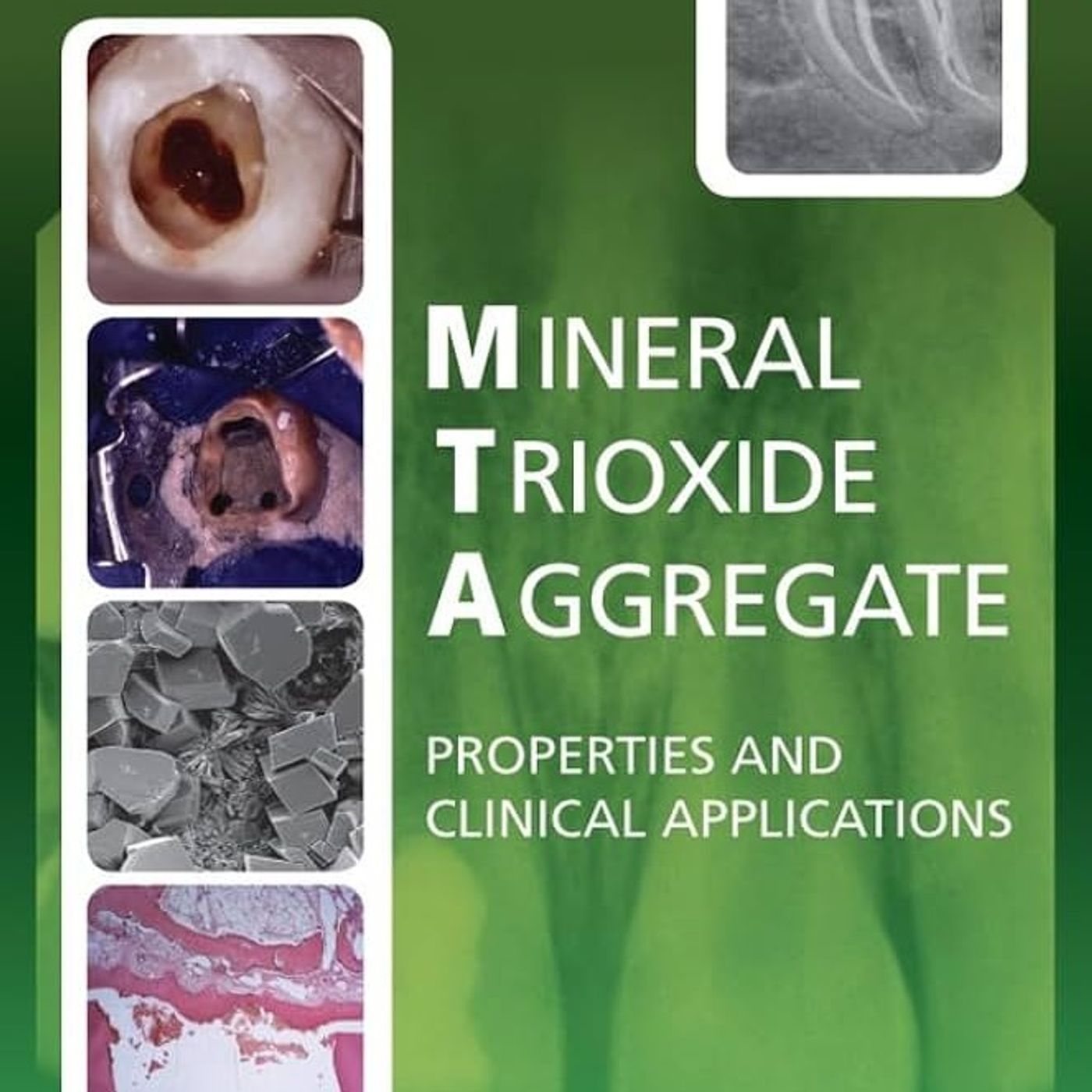
Mineral Trioxide Aggregate: Properties and Clinical Applications
Get every episode summarized
Each time Dentistry Made Simple publishes, we email you a written briefing from the transcript — the topics, who appeared, and any specific claims, with the ad reads skipped.
Email me new episodesFree for 3 shows. No card needed.
About this episode
“So, imagine you're working in an operative field that is just perpetually wet, like constantly subjected to hydrostatic pressure. Oh, and immediately adjacent to one of the most bacteria dense environments in the human body.”From the transcript
Get the Book now from Amazon:
https://www.amazon.com/dp/111840128X?lv=shuf&channelId=500&plpRedirect=mhFallback&linkCode=ll2&tag=cvthunderx-20&linkId=351b2ee03bbb86dfbc8c78b9414f82c3&language=en_US&gaOptInStatus=true&ref_=as_li_ss_tl
You can listen and download our episodes for free on more than 10 different platforms:
https://linktr.ee/dentistry_made_simple
Produced by:
https://www.podcaistudio.com/
Get every episode summarized
Each time Dentistry Made Simple publishes, we email you a written briefing from the transcript — the topics, who appeared, and any specific claims, with the ad reads skipped.
Email me new episodesFree for 3 shows. No card needed.
Hosts & guests
Transcript ready
355 searchable segments. Every word is indexed and playable.
Full transcript
Dentistry Made Simple — Mineral Trioxide Aggregate: Properties and Clinical Applications. Machine-transcribed; use the interactive transcript above to jump the player to any line.
So, imagine you're working in an operative field that is just perpetually wet, like constantly subjected to hydrostatic pressure. Oh, and immediately adjacent to one of the most bacteria dense environments in the human body. Right. And you are tasked with achieving a perfect hermetic seal in that exact space. Which is wild because the stakes are so high. I mean, a microscopic failure inevitably leads to bacterial microleafage. And then periapical pathology and ultimately bone resorption. Yeah. And traditional dental materials just, well, they weren't built for that reality. They demand a completely dry, isolated field to get any sort of marginal integrity at all. Exactly. But today we're looking at a material that fundamentally flips that entire paradigm on its head. It really does. It's a material that doesn't just tolerate moisture, but biologically requires it. And it actually borrows its primary chemistry from industrial constructions, specifically like Portland cement, and applies it to regenerating vital tissue in the human tooth. It's honestly a profound shift in how we approach endodontic therapy.
So today, we're doing a deep dive directly into Dr. Mahmoud Torbina-Jaz, definitive textbook, mineral trioxide aggregate, properties and clinical applications. Yeah, we're going to break down the molecular chemistry, look at the clinical data, and walk through the highly specific protocols for vital pulp therapy, perforation repair, and even full canal observation. Our mission is to synthesize the clinical realities of using MTA for you. We want to look at the biological mechanisms that make it work, and the handling characteristics that can, frankly, make or break your procedure. Right. Because when you're in the chair, knowing the chemistry is what actually saves the tooth. So let's start with the anatomical and pathological realities of the tooth itself. I mean, the pulp space is essentially a complex, highly porous network. Yeah, you're dealing with the apical forum and the lateral and accessory canals, and like millions of dent and ultubillum. It's basically a complex, leaky plumbing network. Add in pathological or Iatrogenic pathways, like deep carries, strip perforations during aggressive shaping or vertical root fractures,
and sealing the system becomes monumental. Historically, the field relied on materials like amalgam, IRM, or super EB to repair those defects. And the literature consistently showed their shortcomings, right? Oh, absolutely. They were cytotoxic to varying degrees. They failed to prevent microleakage when tissue fluid was present, and they definitely didn't promote new cement and deposition. Which is exactly what drove the development of MTA, first described in the literature back in 1993. So when we look at the formulation, it's primarily tricalcium silicate, tricalcium illuminate, and tricalcium oxide. Well, and it also includes bismuth oxide, because Portland cement on its own is radiolucent, which is totally clinically useless if you need to verify your placement or apical plug on a radiograph. So the bismuth oxide provides that necessary radioplasticity. Oh, and there's a specific ratio of gypsum added too, right? Yeah, to modifying control the setting time of that tricalcium illuminate phase. Got it. So that original 1993 formulation is what we know is gray MTA.
But anyone who's used it knows it contains tetra-calcium aluminum ferrite, which is an iron oxide compound. And that iron oxide is highly problematic in the aesthetic zone. Blood contamination mixing with those iron compounds frequently resulted in pretty significant coronal discoloration. Which is a nightmare for anterior teeth. So that prompted the introduction of white MTA in 2002. They eliminated the iron oxide completely. Exactly. Allowing clinicians to use it confidently without worrying about a dark shadow showing up under the cervical margin later on. But understanding how either formulation behaves in different biological environments is where the data gets incredibly specific. Like the push out strength and micro hardness of MTA are heavily influenced by the ambient pH. Yeah, and the data from the text highlights how dramatic that really is. Because push out strength gives us a direct look at the materials retention to the dental walls. Right. While micro hardness correlates with its overall compressive and flexural strength. Right. So if you place MTA in a healthy, neutral tissue environment with a pH of 7.4,
it's push out strength that four days is approximately 7.28 mega-pass gals. But if there's an acute infection, the inflammatory response drops the pH to an acidic 4.4. And then what happens? That push out strength just plummets to 2.47 mega-pass gals. Wow. That is a huge drop. It's a critical consideration for you as the clinician. The acidic environment fundamentally interferes with the hydration reaction of the calcium silicate. So the crystallization of the hydrate gel is inhibited? Exactly. Resulting in a porous, mechanically weak set. If you're attempting a perforation repair in a highly inflamed, separating field, you really have to account for that severely compromised retention. The data on white MTA also reveals an interesting curve. At three days in that same neutral 7.4 pH, it sits at 7.68 mega-pass gals. But it actually reaches a peak push out strength of 9.46 mega-pass gals if the environment is slightly alkaline around an 8.4 pH. That's fascinating. So, buffering the environment or just
thoroughly managing the acute infection to let the pH normalize can significantly enhance the seal. Yep, completely changes the physical properties. Which brings up a big question. If MTA is essentially highly refined Portland cement, how does it survive and cure in a living, bleeding tissue environment? Without just washing away. That is the perfect question. Because MTA doesn't just survive moisture, it actually requires it to trigger a biological reaction with the tooth. Okay, let's look at the actual molecular interaction between the MTA and the dentin then. So, when the tricalcium silicate comes into contact with tissue fluid or blood, it kicks off a hydration reaction. The material starts releasing calcium and hydroxyl ions. And that does two things, right? It rapidly raises the local pH, creating a highly antibacterial alkaline environment. And those released ions interact with the phosphate that's already present in the tissue fluids. Precipitating hydroxyapatite crystals directly on the surface of the MTA. Yes, exactly.
It creates what the literature calls the interstitial layer. You're essentially seeing a layer of carbonated abatite form at the interface between the synthetic cement and the natural dentin. So, it's not just mechanically plugging a hole. It's chemically bonding and biologically integrating with the tooth structure. Right, and it provides a bioactive scaffold, which is huge when we talk about vital pulp therapy. We have to compare this to calcium hydroxide, which was the gold standard for direct pulp capping for decades. Yeah, calcium hydroxide stimulates a dentin bridge, but it does it by creating a superficial layer of coagulation necrosis, right? Exactly. The tissue right next to the calcium hydroxide dies. And the deeper vital pulp tissue responds to that irritation by forming a reparative barrier. But that dentin bridge is often porous. It's got those tunnel defects, but MTA bypasses that necrotic phase entirely. Because of that hydroxyapatite interstitial layer, it serves as a completely biocompatible substrate. Odontoblasts and osteoblasts actively attach to the MTA surface, proliferate,
and predictably lay down a solid, continuous layer of mineralized tissue. It even upregulates specific markers like alkaline phosphatase, so it's guiding the cells to regenerate, not just react to an insult. Right, so let's apply that biology to the clinical protocol. Say you're doing a direct pulp cap on a tooth diagnosed with reversible pulpitus. The textbook is super clear on this eight-step clinical procedure. Step one, definitive vitality testing, specifically utilizing a cold stimulus. Yep, and once vitality is confirmed, step two is absolute isolation with a dental dam. Plus, disinfection of the field with 6.0% sodium hypochlorate or chlorhexidine. It's non-negotiable. Step three is carry's removal. The protocol dictates using a detector die, slow-speed round burs, and optical magnification. Because you are navigating that transition from infected to affected dentin, and you need precise visual control over the exposure site. Then step four, which is probably the biggest hurdle hemostasis, you absolutely cannot place MTA onto a hemorrhaging pulp.
No, you place a cotton pellet, soaked in 1.25 to 6.0% sodium hypochlorate directly against the exposure until the bleeding is totally controlled. Step five, the MTA is mixed and placed over the exposure. The text specifies a minimum thickness of 1.5 millimeters for structural integrity. But, and this is key, you have to leave at least 1.0 millimeter of circumferential dentin for the final restoration. Because MTA doesn't bond to composite resin the way dentin does, you need that clean dentin margin for your bonding agent. Now step six or seven depends on your restorative approach. In the one step protocol, you place a flowable component directly over the unsaid MTA, light cure it, and immediately follow with the bonded composite. But the two-step method step seven involves placing a wet cotton pellet over the unsaid MTA, sealing the tooth with an unbonded provisional, a clear fill photocore, and sending the patient home. Okay, wait. I have to push back on step seven. If the tooth is already full of tissue fluid and blood, why do you specifically need to add a wet cotton pellet coronally?
Yeah. Wouldn't the pulp provide enough moisture? It's a fair question. The pinpoint exposure site gives you moisture, but only at the immediate interface. To fully hydrate a 1.5 millimeter bulk mass of calcium silicate, you need a sustained volumetric source of water throughout the whole initial curing phase. Which takes several hours, right? Exactly. The tissue fluid alone just can't penetrate the full thickness. So the wet cotton pellet acts as a coronal reservoir. It ensures uniform hydration from both sides, so the outer layer doesn't desiccate and crumble. Okay, that dual hydration dynamic makes perfect sense. Then step eight, the patient returns five to 10 days later. You confirm vitality, check the hard set, and place the permanent restoration. And the predictability of that on vital tissue is amazing. But MTA really shines when the biological conditions are heavily compromised. Right, which moves us into chapters five and seven necrotic pulps, open apesies, and perforations. Like treating a necrotic immature tooth with a wide open apex.
The traditional apexification technique for that was rough. You had to pack the canal with calcium hydroxide, replace it periodically for six to 18 months, and just pray an apical heart tissue barrier formed. It was a compliance nightmare for the patient, and it severely weakened the root. So the field shifted to the MTA apical plug. Yeah, instead of inducing a natural barrier over months, you intentionally create an artificial one right away. You do your debridement, and then ortho-gradally condense a four to five millimeter plug of MTA into the apical portion. Once it sets, you can opt for it against it. And the clinical data is robust. The text sites at 2009 retrospective study by mentee showing an 84% healing rate. And with this means 2008 data is even better. 94% healing for one visit treatments, and 89% for two visits. Overall, looking at the broader literature in the textbook, across 345 cases of MTA apical plugs, the success rate is around 91%. That's incredible. And it's paved the way for regenerative endodontics too. Utilizing dental pulps stem cells and stem cells of the apical papilla
to revitalize the canal space. Right, where the clinician purposefully lacerates the apical tissue to induce bleeding into the canal. The blood clot becomes a natural biological scaffold. And then MTA is placed coronally over the clot, providing a tightly sealed biocompatible barrier so those stem cells can differentiate and resume root maturation. It really is a remarkable application of the materials bioactivity. But if we transition from regeneration to acute salvage, we have to talk about perforation repair. Yes, chapter seven. Whether it's a vacation perforation during access or a lateral root perforation during post space prep, time is the critical variable. The textbook is unequivocal. Immediate repair offers the highest prognosis. The longer it's open, the more bacteria infiltrate the periodontium causing rapid attachment loss. But the handling is tricky. If you have a large perforation where the bone is compromised, congencing MTA directly could just push massive amounts of it into the periodontium. Right, you cannot condense calcium silicate into a void.
You need a matrix. The protocol uses a resorbable collagen material, like colotape, packed through the perforation to establish an internal barrier. It sounds exactly like putting a wire mesh backboard behind a hole in your drywall. You need a physical barrier. So the heavy MTA plaster doesn't just fall straight through into the bone. That is brilliant analogy. It controls the extrusion, gives you tactile resistance, and the moisture in the collagen helps initial hydration. But mixing the MTA for this is highly technique sensitive too. Yeah. You mix the powder with sterile water, but the text explicitly warns against a mixture that's shiny. Yeah, if it's shiny, it has excess free water that severely compromises the compressive strength and increases the setting time. It should look like wet sand, right? If it's too wet, you actually have to blot it with sterile gauze. Exactly. And delivering it into the middle or apical third is tough. You rely on microcarriers, a malgum carriers, and endodontic pluggers to adapt it. And again, you often leave a wet cotton pellet against it for bowl hydration.
So we've used it to cap the top, plug the bottom, and fix lateral holes. The logical extension is full root canal obturation, which is chapter eight. Replacing good-up perchia entirely. The rationale comes from biomechanics. Chemo-mechanical prep weakens the root and long-term calcium hydroxide, D-natures, dentinol collagen, weakening it further. But MTA actually increases fracture resistance over time, in vivo. And the textbook attributes this to a highly specific mechanism. MTA actively inhibits metallic proteinase too. MMP2. Right. It's an endogenous enzyme that degrades the collagen matrix in dentin. By inhibiting MMP2, MTA preserves the collagen network, keeping the root tough and elastic. Plus, the ceiling ability is driven by its expansion during setting. And the data here is fascinating. When submerged in water for 24 hours, gray MTA expands linearly by 1.02 percent. But white MTA only expands by 0.08 percent. Even in Hank's balanced salt solution, which mimics tissue fluid, gray is 0.68 percent and white is 0.11 percent.
So because gray MTA expands more, it technically produces a superior seal. It drives into the microscopic irregularities of the canal. But that expansion is a massive liability if the root is compromised. If you suspect a microcrack or infraction, Graham TA is totally contraindicated. Because that 1.02 percent expansion can wedge the crack open and cause a vertical root fracture. Exactly. In those cases, white MTA is required to mitigate those forces. So let me ask you a practical, clinical question. If the seal is that incredible, the bioactivity is unmatched and it increases fracture resistance, should a modern clinician just abandon gutter perchia entirely and fill every single canal with MTA? Well, no. The limitations are practical and logistical. Full MTA observation is great for internal root resorption or when you absolutely need a biological seal. But the biggest drawback is retreatment. Ah, right. You can't just use chloroform and rotary files like you do with the daperchia. No, once it sets, it is a solid mass of synthetic stone. Removing it ortho-gradally with ultrasonic
is insanely tedious and carries a massive risk of a lateral perforation. If it fails, you're usually looking at surgical intervention like an apocouectomy and retrofill. Plus, the material cost is way higher and getting a dense, void-free fill in curved canals with handpluggers is really hard. So it requires strategic decision making. But MTA has definitely shifted endodontics from just plugging holes with a nut rubber to using bioactive materials that promote true tissue regeneration. It really lets you work with the biology of the tooth. So to synthesize all this data, we have a quick clinical pop quiz for you to reinforce what we've covered. Listen closely. Imagine you're repairing a mid-root perforation on a maxillary premolar. You suspect there's a minor microcrack and a dent in right next to the defect. Furthermore, the surrounding periodontal tissue is acutely inflamed with an estimated pH of about 4.4. Based on today's deep dive, which formulation of MTA should you use to prevent propagating the fracture and what do you need to know
about the pushout strength in that specific environment? Okay, analyzing those parameters, white MTA is strictly indicated. Its minimal linear expansion of 0.08 percent will prevent the internal wedging forces that could split that microcrack. And regarding the retention. Because of that acidic 4.4 pH, it's going to significantly inhibit the hydration reaction. You have to anticipate a severely reduced pushout strength, dropping to around 2.47 megapascals. You have to handle and load that repair knowing how mechanically vulnerable it is. The precision required for this stuff is intense, but the biological payoff is huge. I want to leave you with a final provocative thought on bio mimicry. Isn't it fascinating that one of the greatest leaps in saving biological human teeth came from tweaking the formula of the exact same cement used to build sidewalks and skyscrapers? It really makes you wonder what other industrial materials might hold the key to future medical breakthroughs. Absolutely. Keep evaluating the literature, keep refining your technique, and we will catch you on the next deep dive.
More episodes
More from Dentistry Made Simple

Periodontal Disease and Overall Health: A Clinician's Guide
Dentistry Made Simple

Perio-Quest: MCQS and Self-assessment Pictorial Tests in Periodontics
Dentistry Made Simple

Oral Cancer: Diagnosis, Management, and Rehabilitation
Dentistry Made Simple

Oral Complications of Cancer and its Management
Dentistry Made Simple