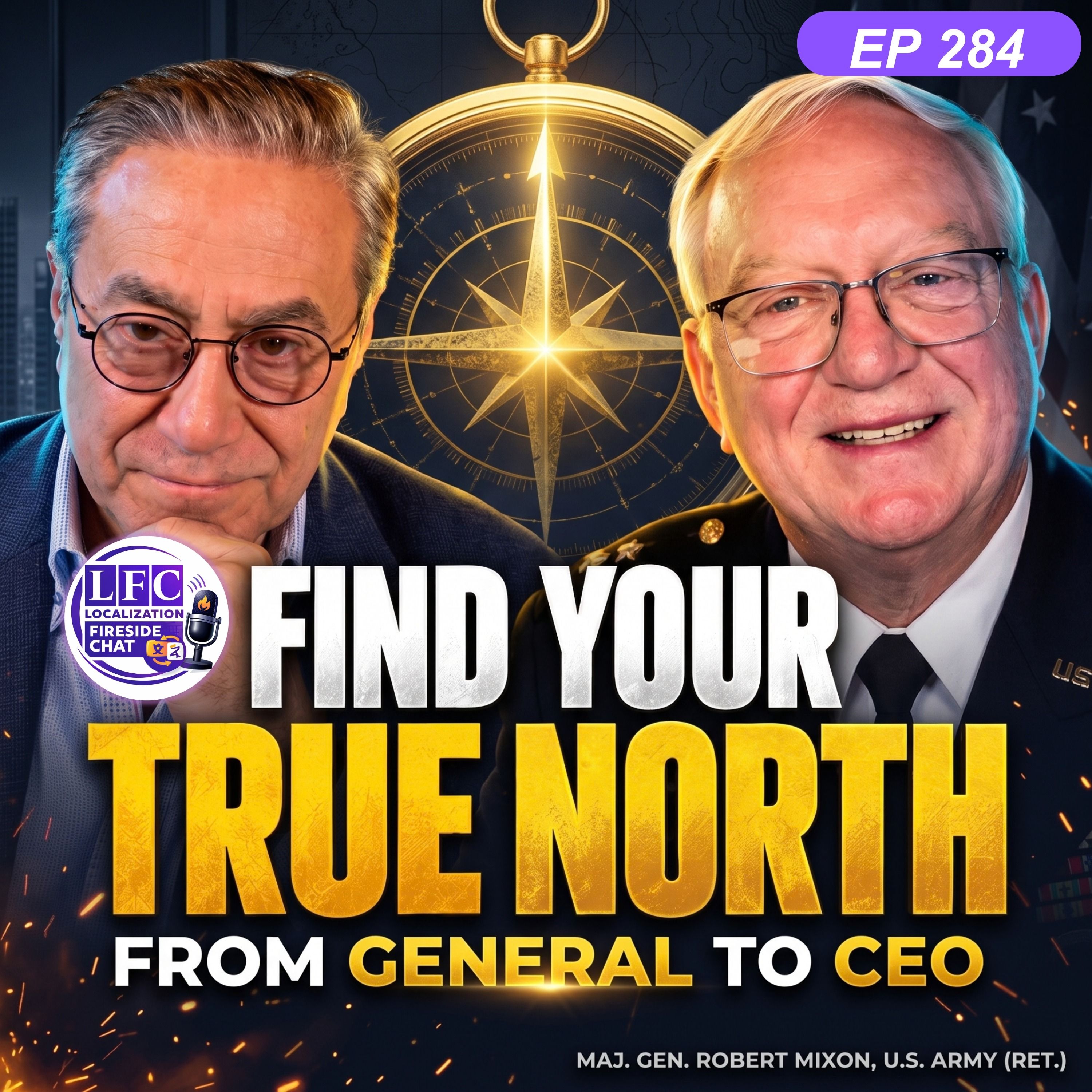
Major General Robert Mixon: From Command to Culture
Get every episode summarized
Each time Localization Fireside Chat publishes, we email you a written briefing from the transcript — the topics, who appeared, and any specific claims, with the ad reads skipped.
Email me new episodesFree for 3 shows. No card needed.
About this episode
Localization Fireside Chat is made possible by:
“Today is Friday, October 2nd, and it's been raining all the day today, but we just got the sunshine, maybe incoherence for this particular conversation that we're going to have this afternoon.”From the transcript
What happens when a two-star General walks into a corporate boardroom two weeks after taking off the uniform? Robert Mixon found out the hard way — and what he learned reshaped everything he thought he knew about leadership.
In this episode:
• Why 'setting the azimuth' is more powerful than any vision statement — and what it means in practice for civilian leaders
• The sharp difference between a culture of compliance and a culture of commitment, and how to tell which one you're actually building
• What the two-week transition from Major General to corporate president revealed about the gaps no military career prepares you for
• How Warrior Salute is returning dignity and independence to veterans living with TBI and PTSD — and why the VA alone can never solve it
Major General Robert W. Mixon (U.S. Army, Ret.) served 33 years in the U.S. Army, commanding at every level including the 7th Infantry Division and Division West of First Army. After retiring, he led corporate turnarounds before founding Level Five Associates, an executive leadership and culture advisory firm. He is the author of We're All In and The Power of Being All In, and co-founded Warrior Salute, a community-based transition program for veterans with traumatic brain injury and post-traumatic stress.
Connect with Major General Robert W. Mixon (U.S. Army, Ret.):
LinkedIn: https://www.linkedin.com/in/robertmixon
Website: https://www.levelfiveassociates.com
Substack: https://robertmixon.substack.com
Subscribe: https://localization-fireside-chat.simplecast.com/
Credits
Host: Robin Ayoub, Founder, Localization Fireside Chat
Connect and watch more
Website: www.L10NFiresideChat.com
Spotify: https://open.spotify.com/show/5OoURgc29R31XPGzOWL9iX
Be a guest: https://calendly.com/robin-ayoub/localization-fireside-chat-podcast-recording
LinkedIn: https://www.linkedin.com/in/robinayoub/
Support the show
Share the episode with a friend. Subscribe on YouTube and Spotify. Leave a short review.
Disclaimer
Views are for education and discussion. Apply judgment in your own context.
Tags
#L10NFiresideChat #localization #hiring #recruiting #leadership #ai
Hosted by Simplecast, an AdsWizz company. See pcm.adswizz.com for information about our collection and use of personal data for advertising.
Get every episode summarized
Each time Localization Fireside Chat publishes, we email you a written briefing from the transcript — the topics, who appeared, and any specific claims, with the ad reads skipped.
Email me new episodesFree for 3 shows. No card needed.
Hosts & guests
Transcript ready
620 searchable segments. Every word is indexed and playable.
Full transcript
Localization Fireside Chat — Major General Robert Mixon: From Command to Culture. Machine-transcribed; use the interactive transcript above to jump the player to any line.
Good afternoon, everyone. Robin, I you here from the localization fireside chat and welcome to another recording. Today is Friday, October 2nd, and it's been raining all the day today, but we just got the sunshine, maybe incoherence for this particular conversation that we're going to have this afternoon. Episode 284, I can't believe I'm saying that, that mean we spoke to 284 individuals, executives, influencers, thought leaders on this on this channel, and today's guest is no stranger to that, and we'll get into the introduction in a second here, but today my guest is retired from the US Army, major general, Robert Mixon, and I asked some earlier on, how would you like me to address you? I'm not used to interviewing retired army generals or army people for that matter, so I had to ask the question. So he insisted on calling him Robert. That's very humble on your side. First, I want to thank you for your service. Thanks, Robin. 30 years in the army. That's admirable,
and thanks for all your service and insurbing your country. Welcome to the channel. Robert, I really appreciate it. And for anyone who doesn't know your background, let's start with this one. What is the story here? What is your story? What got you here? If you don't mind walking us a little bit through memory lane and get us to where we are. Yeah, that's a long memory lane there, Robert, but I will tell you that I was not born in the long cabin. In order to walk up hill to school, to snow every day. But I was born in Atlanta, Georgia, grew up in Georgia, in North Carolina. As the oldest of six kids, my father was some marine veteran from the Korean warrior, and we didn't have a whole lot, but we had a solid family. And what I wanted to do was my dream was to be a college football player. I wanted to play basketball, but I liked a little of the skill abilities there. But football, I enjoyed,
when we played on Friday nights at high school stadiums in Atlanta, like Friday night lights, if you've ever seen the movie or the television show. 10 or 15,000 people would come to a high school football game. And then I worked all night at the gas station after that to have enough money to have any form of social life. But I was coming home one night pretty well taped up in Bruce after Friday night game. And up in my driveway there in Northeast Atlanta, I noticed a strange car. And you know, 10 o'clock at night, and I went walking up to the living room, and I noticed that the car, the two people in the living room by day were army football coaches. And I had not been recruited by a lot of other schools, you know, certainly major schools. Everybody my conference was, but I had not been in any case, met these two gentlemen and went from there to an opportunity to go to West Point, my dream was to be an army football player quarterback. When I started Summer Trial, it's coach, coach looked at me for a few minutes and then said, hey Robert, don't you like defense? And I said, well, that kind of tells you something about my quarterback skills. So I get that said coach, I guess I do.
So I became a free safety after that. Like freshman year a little bit of sophomore year and then got hurt and that dream ended. But I stayed on with my West Point class mates with a true band of brothers, Robin in many ways. And despite the divisiveness of the world at that point in time, and people say now, you know, now the world's divisive, it never was before this. Well, that's not true. And you know, we got, we got through that graduated from West Point, went into an army that was not in good shape. There was a lot of social and political turmoil. And so we went from a draft army to a volunteer army. So you had half the soldiers that were in your unit didn't want to be in the army. The other half, you weren't real sure you weren't. So somehow we managed to get through all of that. And what became my term of service became a career. I was mentored by some of the best and brightest men and women I could ever dream of meeting. And somehow they invested in me and my underwrote my mistakes. And I think I made 99% of all your mistakes you can make and carried that on in my corporate life. But became a general law officer and division commander, whether it was just a great privilege
of being with soldiers and learning and leading them. And I was humbled by the experience. And then I went into corporate world, present for a couple of companies there in sorry, my own company level 5 associates 11 years ago. And I really wanted to give back, Rob. And I really wanted to give back to other leaders that maybe didn't make 99%. Maybe I could get it down the low 80s in the percentage of mistakes. And that's the dream I've been pursuing ever since because I really believe in the purpose driven life. And I appreciate that Robert. Now, you know, I don't know if I told the story on this channel, but I'll tell you just to, you know, we're having conversation here. I'm hardly a journalist. I'd love to have conversation with people. And this is what this podcast about is you and I having conversations. And the audience appreciate that. So I was born and raised in the civil war in Beirut, Lebanon in the 70s. And I left that country in the mid 80s. And I came to Canada. So I understand the turmoil and been through that had a lot of loss and, you know, rebuilding and all that stuff.
So I don't need to dramatize it. It is not, you know, I don't look at it as drama right now. But back then it was drama to me right now. I'm just older right now. But from your perspective, that transition, and I think to some extent on the civilian side, I haven't been through what experiences that I've been through. I'm assuming you had to you commended divisions like from organizing thousands of people, enormous complexity, life and death stakes in some cases. And then I don't know what divisions you've served in on the front or in the supporting divisions. I have no idea. But you walk us through, you walk into a room today, for instance, full of leadership, advisors, you know, corporate people. Is there a connection? I certainly seek to have that connection, Robin. You know, I don't use hope as a method. I believe that what establishes the connection is authenticity. I've always respected leaders who are in the real deal. What you see is what you get. And that's what I've tried to establish when I went to a room of executives from varying companies, different professions, you know, different levels in their journey. I try to establish that connectedness based on authenticity. And I think,
as a military and corporate leader, I've had the opportunity to be involved in a multitude of cultures and in a lot of transitions. And I think I can share with them some of those experiences. And perhaps that helps us connect. It helps us relate early on. And there's transferable skills. I'm assuming, right? From what you've learned on the service side. Yes. And I developed the big six leadership principles from a compilation of both journeys, essentially not rocket science, but six principles that work. They work if you apply them persistently and you don't make it episodic like a drive by. And I can go through those briefly with you, Robin, if you'd like to hear the first one is. Yeah, I appreciate that. Yeah. First one is set the asthma. Most your corporate leaders don't know what asthma is, but learn that in the military. Your asthma is your true North. It's, you know, where are we going as an organization? What's our mission? You know, who are we? What do we do? Why do we do it? What's our leaders intent? And that is your in-state, your key tasks, the purpose, the why. That's a lot more coherent to me than vision, like
visions to draw. But mission and then leaders intent. And then what are our values? What do we believe in? And then finally, what's our behavioral culture? What behaviors do we expect and expect to it? Here too. And and translator our values into action. So that's the first principle, set the asthma. The second principle is listen. My mother, who's 93 and I love her dearly, told me repeatedly, Robert, God gave you two years and one mouth for reason. I did not pay attention to that guidance for a long, long time. And we typically don't train leaders how to listen. We just teach them how to transmit and you know, they all think that because I said it, everybody gets it. That's not true. It's the old adage, but I don't want to told you to you tell me what you heard. So listening is a skill that leaders have to nurture. And that's why it's the second of the big six. And mom, if you're listening, I love you dearly and I'm working hard at this, I promise. So the third principle is trusted in power. You know, trust and empowerment is the manifestation of trust. But trust has to be earned and it has to be again, as I said before, nurture. You've got to commit, you know, the culture of commitment that I believe in in all in adaptive leadership is characterized by leaders who
listen and also trust. And they're willing to underwrite mistakes when they're, you know, sins of commission as we used to say here, we still do. The fourth principle is do the right thing when no one's looking, you know, as we say in the Pentagon, that braves well. Okay. I get out here on the highway here in Melbourne, Florida. And I can assure you that speed limit is just a suggestion for most everybody out there because we talk about doing the right thing, but we don't always do the right thing. All in adaptive leaders have to walk the talk, even when no one's looking. The fifth principle is what in charge take charge. That doesn't mean you're allowed, profane, and abusive. I certainly encountered my set of those leaders in my journey, but I don't believe that's what right looks like. I think being in charge is being responsible and accountable and setting the standard, being the standard for others. And, you know, you can, you can delegate authority, but not responsibility. And so we seek to grow leaders who understand and implement that principle in their daily lives and what they do. The sixth principle is balanced, personal
and professional. A lot of people think it's about time management. Well, that's not true. Time is finite. You can't manage it. What balance consists of is re-estating your levels of energy, personal, professional, mental, spiritual, spiritual. They're four levels of energy in all of us. And if we nurture those physical, emotional, spiritual, and mental batteries, then we'll have balance in our lives. And we can create balance opportunities for those we leave. So those are the six principles, Robin. And what I try to do with individuals and teams is help them bring those principles to life. No, Robert, I need to ask this question when specifically for an individual such as yourself who led people and you continue advising on how to lead people in corporations, et cetera. How do you transfer that north, the true north, that we're going as a company or as a vision or as a rally, the troop inside of a corporation versus how do you rally a troop in an army, for instance? Because the officers thinking about the individual sitting behind their
desk, their project manager or their employee tasked with a few things that they need to do on a day-to-day basis, they think in transactional, right? So I need to get to work on time, leave on time, and take my pay and go home. Can you rally those individuals around a larger, more, I want to say, holistic vision or drive for the organization? Is there a possibility for that? I think that's our charter, Robin, as executive leaders is to set the asthma that I told about the four components, do it as a leadership team, transmit it throughout the organization, and then stay with it so that it becomes the drumbeat of your organization. Your mission should not just be a placard on the wall. Every member of your team, no matter what department you're in or division, or your level of responsibility, you should be able to translate what you do every day into the mission of the organization, and I believe in large organizations, every component of the organization that needs to have its own asthma. Its own mission, intent, values, and culture, but they're nested
inside the larger entity. If you can't subscribe to that asthma, with your personal beliefs, as well as your professional beliefs, then you're probably, as Jim Collins says, you're either in the wrong seat, in the wrong bus, or we need to get off the bus. Leaders have a responsibility to create alignment. Asthmoth, setting the asthma and sustaining your asthma creates the opportunity for alignment, and that's where people buy in. My latest book about the power of being all in is essentially nested in that concept that we should, if we're going to be successful, we're going to go from good to great. We've got to buy into the asthma. No, the asthma that you're talking about, I've worked with so many corporations, and I'm just having a conversation here with you, sharing with you and the audience. And it seems to be, regardless of the well-crafted vision or well-crafted mission statement that was put on a website or distributed through a memo to the employee, they all boil down to one thing, make money. And if you talk to the board of directors,
if you talk to the private equity firms that owns the company, etc. They don't care about any of the stuff, at least from my perspective. They care about, listen, I've got to make my financial objectives by the end of the year, and maybe that's the asthma. Well, it can be a component of the asthma, Rob, and I don't think it is the asthma itself. My experience, I believe great companies establish a values-based environment, a culture of commitment I mentioned earlier. Those companies that have a culture of compliance, and that is just do what you're told to do when you're told to do it shut up in color. Those companies, I think, are very temporal, and they might be profitable for a quarter or two, but at some point in time, chickens will come home to risk. I just got to say, I mean, 50% of the Fortune 500 companies that 30 years ago were, I'm doing this. When was the last time you bought a gateway computer just for you? So, if you're going to be enduring and you're going to have a culture of commitment, it's got to be values-based, and the PNL is the PNL, and I get it, but it got to keep the main thing the main thing. But it doesn't have to be the only
thing, Rob. I think it's hollow when it becomes the only thing. No, you had the idea. It's not about me, it's about us, and that about us thing when in a corporation, that is, it's not a platitude, especially coming from you, because you lived it in a variety of level of your career. It sounds like it's a hard belief from your side. Were there specific moments in your life, Robert, where you a failure, a person who made you realize it's not about me, it's about us? I think there were a number of milestones, Robert, where it just reinforced the fact that it's mission first. Mission first, people always, and it's not about me. It's about us, and it's about the power of being all in, as I mentioned earlier. I find that when it's about me and I, those leaders are normally toxic people. They tend to infect an organization with a selfish personality and a selfish methodology that is a dead end street. Again, that's after being temporal. We've all worked for toxic leaders, unfortunately, or with toxic people. What I'd
disdain the most is when we tolerate those behaviors, and we say, okay, well, she's toxic, but we need her because she's got such great technological skills or marketing skills. That's not true. We don't need toxicity. Toxicity breeds more toxicity. I've never fired anybody in an organization where somebody didn't come up the next day and say, Robert, what the hell took you so long? He was poisoned. He was poisoning the well. And yet you were just out there acting like, okay, well, we'll just underwrite those behaviors for the good, for the temporary good. There's not for the greater good, Robert. That's only for the temporary good. And that's one of the many mistakes I made in my list of 99% leadership. Robert, and for the audience, you went from major general to corporate executives in two weeks. Normally, the transition period for other people in doing this, it takes months of deep programming. What was the first thing that you generally surprised you about how civilian organizations operate? And you had to actually quickly jump into this. Yeah, I went right in the
Great Depression in 2008, 2009 in manufacturing. Right in the middle of it. 250 people. And you know, I thought that there was an inherent sense of, you know, loyalty and adherence to the standards and things like that because that was the culture I had come out of. Was that one of duty honor country? One of my managers, soon after I got on the job there as president, sent me a picture of one of the dock workers in the company was sleeping on a pallet at three o'clock in the morning said, General, this is your culture. This is what you got. And I thought to myself, okay, I don't know if I've hit bottom, but we are heading that heading that way. And you know, I've got a step back here and get back to the basic blocking and tackling of what makes what makes a culture grow. What people want to buy it. And it was a rough road to hoe. I don't think I was ready at the time, Robin. I think I moved too quickly. Part of it was because I had this, you know, I guess you would say false, false pretence that I could, you know, step from a military senior environment
into a corporate senior environment and everything, everything would fit. It doesn't fit. In many cases, you know, you find in corporations, companies of different types for profit, not for profit, not not been in both, but that there's always the meeting before the meeting and the meeting after the meeting. So in my military experience, you know, we went into a mission decision briefing and presented a course of action. And then we argued in some cases vehemently about which course of action was the best. And then the commander decided, okay, I've considered all factors, you know, as I say, in the legal defense mitigation, and I've decided this is what we're going to do. And then we went out the door and the it was the end of the conversation. It was the end of the debate. That's not true in the corporate world. And if you don't set the conditions for decision making and then reinforce the validity of that decision, then you face that meeting after meeting after the meeting and you don't really build consensus, you know, your asthma is all over the place. It's sort of like, in Allison Wonderland, you know, she goes up, Jessica, fork in the roads as well. Which way do I go?
Kat says, well, where do you want to go? She's out of no. Kat says, well, then any road will get you there. No, level five associates, that's the company or the agency of my company. It sits at the intersection of a leadership consulting and culture building and also veteran workforce, which I understand you're very involved in the on the veteran side of things, supporting helping and integrating them back into the workforce, which also had a liberal. And I love that part of your career and job and support. How do those things actually feed each other if there's such thing in the work that you do for clients right now? I think that veterans represent an element of our population that we should be extremely proud of, but we should also be very supportive of in the fact that they have a particular set of qualities and needs that, you know, industry leaders need to understand. And sometimes, you know, when you have 96% of the American adult population has never served
military. Now you have a disconnect in terms of understanding of who are these veterans? What are they, what are they represent? What do they need? I was part of program at CDS Life Transitions in Western New York in 2009. In my second part of my corporate journey, we founded a company, or an organization called Warrior Salute. And Warrior Salute was designed to provide life and job transition for men and women who had traumatic brain injury and post-traumatic stress. Yeah, I had a question on that one. I'm glad you're explaining it. Yeah, it's a community-based support element of what the VA was doing. Everybody thought the VA was going to solve all the veteran problems. That's not going to happen. There aren't any government bureaucracies that I know anywhere in any country, the USA or Canada, that where the government solves all your problems. And certainly that is not true with the VA and veterans. We had to have community-based support where these men and women had a safe, clean, decent place from which to transition, where they need a little help. And some people just need a little help. They don't
just step out the door in two weeks. And that kind of thing, like I talked about my journey. Now I'm involved still with Warrior Salute for 16 years in the making. It's grown significantly. We've had a 90% success rate of veterans coming in the program. Graduating after a period of time is all individual. And then living independently with families and paying taxes and having jobs and being part of the fabric of our society in a meaningful way. I think we need to replicate that model throughout the country. There are thousands of well-meaning people who are trying to help veterans transition, live and thrive every day. But it's a journey, not a destination. And I think all of us who have served or who want to support veterans should seek out the opportunity to really make a viable difference. And that's what Warrior Salute does. You know, it's very tactile in what you've seen in terms of the veterans that you support. You can see the results and talk to these veterans and get the feedback, which I think is powerful. I'm working now on housing opportunities for
veterans here in the state of Florida, along with the Warrior Salute program as an enterprise that's tied together. Because there are, you know, 38% of veterans in Florida are living in some type of housing emergency. And that's also replicated nationwide in some percentages. They're living with family. They're going from eviction to eviction or under a bridge somewhere. And you cannot really help people rehabilitate and transition if they don't have a decent safe place to live. No, Robert, how did you deal with the health side of the veterans, like the PTSD and the likes of other conditions? Did you support that or that's left for other organization you weren't working on the development and employment? No, we actually established a network of expertise. And, you know, Robin, that's important. We can't be all things to all people. We need to establish connections and that network of support, which is what Warrior Salute did with clinical experts with the VA. We use a lot of the VA expertise to help us with the veterans that were in our programs. So, I think
there's a, you know, it takes a village, right? And, and yeah, in veteran support, I believe we have to establish a network doing that in New York. We're doing it here in Florida so that we can give these men and women the support that they need. You know, they wrote a check, payable with their lives to the United States of America. And unfortunately, some of them had to cast up check in, but in many cases, the cast portions of it. And we can't, we can't give back enough to these men and women, to the families of the fallen who have served us and sacrificed their lives in our defense. No, one of the things is, and I look at it as well in Canada as it is in the US, is these veterans have, you know, the government has spent, you know, time, money, effort on training them, you know, doing upgrading their skills or scaling them in the, whatever, whatever they were doing inside of government. And, you know, that's an investment on the public sector, right? So when you, when you invest that much money in becoming, I don't know, you go to West Point or you become a lawyer or you become a doctor or you become a mechanic, I don't, inside of, inside of the army or inside of
whatever branch you're serving, I'm assuming there is another added, added benefit to this. Why let that investment go to waste? Why don't we take that investment, put it back into your life? I mean, just from an economic point of view. No, it makes all the sense in the world, Robin, you know, you have men and women who have a sense of discipline, a sense of duty, that they learn in the military and the armed services. You can leverage that sense of duty and responsibility in any corporate environment that I can think of. And the key is not, not coddle anybody is just to accept the fact that, you know, we may have some background differences, but let's leverage the strengths that are here, you know, let's leverage that sense of duty and responsibility. And maybe you can help with veterans provide them the opportunity to influence others in the organization as to why it's important to have we in us and not I, me as part of your framework reference about why the asthma, the mission is so important and why that greater good is much more valuable than the individual. No, I did work in my career in the past for a company that was led by an ex-military
person. And that was the only experience that I've had. And that corporation, my experience, and what I can remember, it was ran very tightly. There was no loose end in that company. Now, I worked with other companies where you have a CEO who's toxic. And, you know, that, you know, pre-meat everywhere. And, you know, you can tell from the mood of the workers or the employees, or the, you know, the executives around them that this is the case. From your experience, when you walk into a room, let's say, at your company, level five associates you up into a room with somebody who is on the corporate civilian side, do you see the difference as I see it? Or do you see like the, there were similar, but we come from different background. I don't know, I'm just trying to get your experience on it. I think there's an energy that a team, you know, a team exhibits a level of energy. And you think about it, Robin, there's body language, right? There's a contact. I think healthy executives, you know, level five, or candidates,
be level five leaders. Level five is the pinnacle, but let's say they're at level three or four leaders in the model that I use it comes from John C. Maxwell and Jim Collins and some others. You know, there's a level of energy in a room that's exhibited by body language. I contact who models curiosity. Think about this question, for example, Robin. The toxic leaders I've known when something went wrong, here's what they would say. So, Robert, what were you thinking? The leaders who were all in adaptive leaders that I've been with, military corporate, they didn't address a problem that way. They said, so Robert, what did we learn here? Those two questions are absolutely diametrically opposed. And those questions, that question architecture tells you a lot about the culture of a team and organization. Especially when I, you know, I've seen my share of episodes, I guess. One of the one of the one of the one of the episode I've seen, it was, you know, somebody goes into the boardroom and the board of directors and they have a board meeting and they
have to explain why they didn't meet their targets. And the next fundamental question, what are you going to do about it? And I say, okay, we know, no, no, no, we have we have a fix for that. We're going to fire half of the employees or one third of the employees to fix the problem. Yeah. You know, I don't know if that's taken ownership of the problem to be honest with you. This is just deflecting and just protecting their jobs. A lot of it is, Robert, you know, we, that's the committed many leaders who are at least if not toxic on the edge, right? They believe that that's where you go first, because that's the low-hungan fruit, is you know, you'll lock off percentages of the workforce and that will solve your problem because you'll have a lower number between the top end and the bottom end or the, you know, of the profit, it's profit and loss and loss. I really appreciate those who, first of all, establish clear standards for everybody on the team. And I like having members of the workforce help write their own performance objectives so that we do them together and it's not that directive framework. Secondly, I like leaders who own
the outcomes and say to the board, you know, I delegated some authority here, but I am responsible for what this company does and doesn't do. And we are diving deep into the learning process here to discover what has been, what has been our obstacles. And if there are individuals who have been part of the obstacle that chain, then we take action. But more often than not, I think the bulk of our challenges are in the mirror. And, you know, as leaders, we don't work hard enough intellectually to create the opportunity for our team members to succeed. That's where a lot of the problem lies. Now it sounds esoteric, okay? You can translate it that way if you like. But I think it's very practical. I think it's very, it's very indicative of the character of the leader when he or she accepts that responsibility and seeks to learn and not to blame. And, you know, I interviewed a lot of people on this channel. One of the episodes that I was still stuck in my mind as we have this
conversation, Robert, is the difference or the sharp distinction between a compliance and a commitment. And, you know, you want to have commitment, but many people claim they have commitment, but what they do have is compliance. People are afraid and they comply because they're afraid, not because they're committed. Can you comment on that? How do you gain commitment versus they're afraid of the outcome? Well, there are five levels of culture, Rob, and just like there are five levels of leadership. And my first book, we're all in, 2017, I explored the five levels of culture in some detail. And I think every culture is somewhere in that in that scale. And, and they're on a journey, which may be a flatline in some organizations on level one or two, which I call the name tag culture and the follower culture. The level five culture of being all in is where people are truly committed to the organization and not simply compliant. I think if you, you know, ownership, shared ownership is created when you have shared creation of the of the asmeth of the organization. If you create the asmeth in a collective way, and you don't just simply
say, here's our mission, here's my intent, here's our values in the culture. If you say it that way, if it's directed, then nobody else owns it, but you, you've got to build the asmeth collectively, and you've got to continually revisit it on a recurring basis with the key tasks that are in your intent and have ownership of those tasks. So accountability also creates piety. So it's a collective effort to create buy-in. You know, we're tribal animals. Probably we're tribal creatures. We want to belong. I very few of us want to be outliers. There are some who do, but I think most people do not. They want to belong. And if you create the opportunity, the pathway for them to belong, then I think the buy-in has a much higher chance of taking place. It may take some people a couple of years to buy-in. Some people may be on the margins for their entire careers. But if you can create enough energy inside the organization where the majority of people are willing to commit, and they see the collective good as also their personal good, then I think you can create a level four or five culture where people do feel as though they belong. But you can never take it for granted. Cultures decay very rapidly. And so you've got to come every day and bring it. You've got to be
listening to the intent to understand. You've got to trust and empower. You have to take those big six principles, which are all nested together. And you've got to weave them together as an adaptive leader and stay focused and not get tired after two weeks and go well, then. And that's hard. I'll let somebody else do it or let's just get transactional. That's a lot simpler. And I'll just call them in there and tell them what to do. You know, my just I recorded a podcast at one o'clock today. And one of the elements we're talking about is consistency in the way we deliver things. You can't just be up and down through like a graph kind of thing. You had a stake insistent to stay what they call what my previous guest called it day three, meaning you have to you got to continue on with your with your practice. You can't just be blip on the radar and drop and then come back up again. And that's the one of the hardest parts of adaptive leadership. All in that is persistence. You know, we can get that flavor of the month and going and you're good. I get idea fairy lands on your shoulder right over here. So oh, I'm going to great idea. We're going to create nasmuth and we're going to have a collective buy you know, collect it by end and then you know,
we'll have a treat on a lake and drink wine or whatever that that is. Not how you build a culture of commitment. You have to bring it every day. You have to be willing to pick each other up when things are not going well and stay with stay with it and say, look, we are going to we're going to get through this persistence is one of the hardest parts of adaptive leadership and yet as essential to your success as a culture as an organization. Robert, what do you think of servant leadership? It's a buzzword. I know people use it constantly, but what do you think of that concept? To be a leader, you have to serve, you know, the what's around you, I guess. I'm a believer in the concept Robert. I think the phrase has become a buzzword. It is a buzzword to be honest. It's usually as a cloak for something else. Yeah, I mean, I, my leadership model is called all in adaptive leadership. It's not it. No, servant's not part of that framework. And the reason I think all in adaptive leadership is more comprehensive is because it demands that we as leaders adapt to the environment that we're in and the the messages that we're conveying and what we're
receiving and and how we are nurturing the culture, the ecosystem. Part of that is servant based, part of that service based, but I don't think that's the entirety of it, Rob. I think that it's an element. It's a component of all in adaptive leadership. So we've overused the phrase and it's overused and I would say not well understood. So we need to get more clarity here on what meaningful leadership looks like. And that's been one of my missions here in level five associates is to help leaders and organizations better understand what is meaningful leadership in the world that we're in. Not the world that we were in 30 or 40 years ago because it's not there anymore. You know, I people hark into the days of your one, John's Rome year. Well, okay, that's true. You know, Napoleon said history is a trick played by the living on the day. So we can, we can harken back to the days of yesterday. But that's not going to bring them back. We have to adapt to the world that we're in. In a values based configuration, we adapt to the world that we're in
and we lead people the way they deserve to be lived. No, I want to tell you this the athletic don't early on in my career, I took a job as an IT director for large career company here in the country. And first thing on the job was to take a management course. Now that was like, I don't know 30, 40 years ago, Robert, or like you remember is this statement, your job as a manager to work your way out of a job. Now, I look around me today, that course will not apply because I feel like managers job is to protect their job. Maybe the economy, maybe the way we are as as as as Western society. I have no idea. What do you think of that? Well, I don't like the idea of the manager's job is protecting his or her job. To me, that's a that's an eye to me approach to leadership. I think that where it's our legacy going to be, Robert, I think you know, when all said and done, what's the legacy going to be? I mean, our legacy is going to be in the people that we influenced in a positive way. In the people who became better people because we do that.
I had the remarkable privilege as you probably have looked at, but I served as General Colin Powell's his personal staff when he was chairman of the Joint Chiefs of Staff. A true level five leader. And Robert, we miss it. I'll tell you right now, we miss it. He was in many ways a selfless leader who who's you know, he said many times, I don't care how much you know until I know how much you care. And that's where the essence of our legacy lives. We don't have to coddle people. We don't have to be sympathetic, sympathetic, but we can be empathetic and we can listen to the intent to understand. We can use those tools to help people grow. But I think our legacy is going to be in those that come come behind us or with us and our better people because we knew each other. Now many people listening to this channel, Robert, they are leading teams currently and their teams are distributed across countries, sometimes across languages, depends on which countries they're in, cultures, etc.
And I know when you operate in the US military or in a corporate capacity where you must have dealt with that. When you when trust is the core currency, let's say, but your team, let's you team, let's say in Manila and Berlin, it's a pile of how do you actually build that or scale it across demographics or cultures? I think you have to tailor it, Robin. And you can't, you know, one size doesn't fit all here in some in some context. There are cultures in the world which have biases that we as Americans or Canadians might find that less than admirable from our standpoint. And I mean that in a in a constructive way. We have to take that into account that sometimes there are opportunities and their interaction and their communication processes are not perhaps as open as or they're more structured in their methodologies of how they do things. But the big six principles can translate, I think, into any culture. It's a question of all in adaptive leadership and how you translate those principles into that culture. I don't think we should, you know, if
all you have is a hammer, everything looks like a nail. We can't do that. It's not going to be relevant, Rob. We're going to end up with a bunch of people out there in our audience who go, what the hell is this person thinking? You know, that doesn't apply to be or you know, that's not relevant. Why should I why should I sign up for that idea? So it's art not science. Leadership is art on science. That's correct. You know, management is the allocation of resources in time and space. Leaders have to understand that, but that's not all there is to it. And so this is one of the challenges we face in multicultural organizations. We've got to adapt. We got to adapt the principles to the culture that they're in without sacrificing them in the process. Now one of the best environments that I've operated in, it was an environment where private equity firm bought a company I was part of. And when I met, they're not from from not from the region. They were from outside the region. When I came into meet me the first time and I said, I asked, what would you like us to do? What would you like me to do? Said, look, we don't understand this territory. We don't understand you. Cult the dynamics around the market here. It's yours. You continue doing what you're doing
and we'll leave you alone. Because there are certain dynamics, they cannot impose from the outside to this region. So they need to be cognizant of that. That was a secret success recipe, I guess, if I could call it that. Now there was other things. There's many examples here in the country where outside financial investment came into big corporations in Canada and they failed failed because they imposed what was good on one side of the border. It may not be good on the other side of the border. You got to understand that entire cultural transition. I think you certainly do. The idea of venture capital and acquisitions and things like that scares the hell out a lot of people because they see it as an immediate, okay, well, we're going to come in here and cut 30% of the workforce. And that's going to be our solution because that way our profitability goes up. And if you can still make stuff or serve people, then it really doesn't matter how hard you have to work. I mean, the hours involved, we just want to take our money and get it sooner than later. I mean, target just, no, it's just the recent memory. They came into the country. They invested,
I don't know, a few billion dollars to build their network in the country, stores, etc. And they ended up closing because they did not understand the market correctly. Yeah. Well, we've seen several examples where that lack of understanding of the culture leads to failure or it certainly leads to a rough road to how I think Amazon whole foods example of where there wasn't a clear understanding of the two cultures. And they, it was a rocky road there for a while. We've seen other examples where people didn't take culture into account. They just took the P&L into account or the, you know, seven-year proven loss, glide path estimate, things like that. And they didn't realize that if you don't assimilate the cultures, you're going to, you're going to underperform and your opportunity to be profitable in a number of ways is going to be lessened because you didn't take that into account. Now, as you know, AI is now embedded in many organizations, right? So how they manage, how they measure, right? So there's something now I'm hearing is called algorithmic performance scoring and automated feedback loop remote monitoring using AI. From a leader's ship standpoint
and a culture standpoint, what does that do to the trust infrastructure? It threatens it, Robin. And your expertise in AI is far greater than mine. So I'll defer to some of your expertise here in the field. I believe that from a leadership standpoint, we have to focus on the fact that artificial intelligence or what known we're going to name we're going to give it now is a tool and not a strategy. And I've been working with a number of leaders in different organizations who are struggling with that notion, or they're simply deciding they're going to wait until the tsunami hits and figure out who survives. You know, that, that's not the kind of tactical patience going to make you successful. That's going to lead to the object failure. I think the algorithmic processes that AI represents in some cases are leadership tools that we should drive the employment of those tools. We may not know what the tools are, but you know, I get some aren't saying this. Well, you know, our AI strategy is based on what the IT folks tell us. And that scares me a lot because I don't think we default strategic leadership to the technicians.
I think we have to embrace the fact that there is change in front of us. And how do we maximize the opportunity that change represents? You know, you're back to white 2K. And of course, a lot of people in the audience probably don't want to talk about. You know, there have been moments in time when those tsunamis were all on the horizon and everybody would bring their hands in a positive manner. I think what we're seeing in AI is transformational. There is absolutely no question from this might limited knowledge perspective that this is a tsunami. But in the workshops that I'm doing with executives, I just completed one now with 10 executives called the journey team about our the executive leadership of AI. And you know, the fear factor is significant. What we have to do is embrace the uncertainty with the certainty of our principles and say that the big six principles are what's going to drive us from mass and standpoint. And we're going to employ AI where it serves our mission and the greater good. But we're not going to be prisoners of war to technology.
And I do agree with you because a lot of people are deploying AI. And that's my personal opinion and my audience can disagree if they want to in a lazy way. And what I mean by in a lazy way is because it's convenient. Now we can tell AI to do whatever we want to do and we'll do it. And that is presenting another side to the human element of leadership, meaning that if you argue taking that track, if you are deploying algorithmic performance and you did not do that before, meanwhile you're going around talking about trust. Well, that's not trust. I mean, you showed you true self. Yeah, I think so. I mean, we talk about bias in developing you know, agentec AI capabilities and other, you know, the code writers are oftentimes, you know, the the root of all evil because they input their biases into the agents, you know, characteristics or qualities. Well, we have to have leadership here. We have to establish the boundaries, the guardrails and how we're going to develop the capabilities that we need so that we
don't allow, you know, the biases to, you know, the old garbage in garbage out kind of thing. As leaders, we can't just default this either to the lowest bidder or lowest common denominator. We've got to have boundaries, guardrails and an asimuth that is coherent that we stay with. And as Jimmy Buffett says, we keep it in within the navigational begins. And we need to control it versus let the technology control us. I hear you. I'm with I'm in violent agreement with you Robin, but as leaders out there, I encourage all of you, you know, don't wait for somebody else to help you figure out what right looks like. Establish the leaders intent. Leaders intent the organization and how you can employ the tool to make you most efficient, effective and profit. Now, Robert, what is your message to the small medium enterprise entrepreneurs, young startups? There's a lot of listeners out there listening to this. A lot of, you know, young people are starting their companies or they've got an idea that they're pursuing to product technology to develop service. What I know you work with corporations and
executives, but do you have a message for the young entrepreneurs, the small medium? I sure do Robin. And my message is, you know, follow your dream, follow your dream, but build a business plan. Don't just go out there and win it. I see a lot of young entrepreneurs that are out there using hope as a method. I have tried hope as a method, but it's as my father, the marine system. It sucks. Real good. Hope sucks. You know, build a business plan, ask for some over the shoulder help. A lot of young leaders think, well, I'm, you know, I don't need coaching or advisor here because I, you know, I could I could package 500 products a day so I can certainly have a company that does that and we'll be great. You, you, all of us need some help. I would say, you know, get, get some advice in coaching. There are a number of entities out there to provide that. You know, we all need some help at points in time. Build a business plan, set your asthma, keep, keep your team focused on the asthma. And then if the reality changes, we will do a debt.
One of my biggest weaknesses early on was I was, I tend to be stubborn. Go figure. And so I would create a plan. Then we were going to execute the plan to truth be that well, you can't be that rigid. You got to adapt. You got a listen. You got to pay attention. So I would advise young entrepreneurs, follow your dream, build a plan, ask for some advice and stay with it. No, where are you now with level five associates? What, what progress are you making or what stage are you in the company? 11 years and being now, you know, it's an army of one in many ways. I, I really feel as though we have reached a point where we've achieved some brand-new recognition, both in LinkedIn and Substack and we're proud of the Substack platform. We've got it, RobertMixin.substack.com. I've got about 1300 subscribers now who joined the Legion, the all-in adaptive Legion. And so what I want to become is a thought leader in the field of adaptive leadership. And I feel like we're getting there. But for me, I would, I would like to grow maybe 10 or 20 percent over the next
few years. But I've had the opportunity to pursue a lot of my dreams. And my goal now is to help others proceed, you know, achieve their dreams. That's what I want to do is give back. So I don't want to scale to, you know, a multi-billion dollar company, Robert. But I'd like to, I'd like to help people in a genuine way and, and feel like making a difference. Robert, do you feel there's, the market is receptive to the offer of level five? I believe the market is receptive in, in the space of intermediate and executive level leaders, particularly privately held companies because they have the ability to invest in that kind of a jury. Our relationship is not temporal. I'm not, I don't do drivebys. I will do deliver keynotes, but I really want longer term relationships with industry. Most of the time, Robert, these companies, you bring a, you bring a solution to a problem, but most of the time they don't know the problem. It's true. Am I correct in characterizing it that way? I think you're right. I think a lot of people don't know what problem we're trying to solve. So you've got to do some discovery here, and I can help with that. I mean, I can help you do some discovery learning
as to, you know, where, where are, what's the headache? You need the aspirin for. In some cases, if you're flounder, because you don't know that, then, you know, let's talk. Maybe, you know, I think, like I said, I've made all the mistakes, most of 99%. I've also been exposed to a number of environments, challenging environments, but I can leverage that experience, perhaps, to your benefit. I do run a company called N49 Networks. I founded that company about a year ago. I provide a fractional go-to-market work, and I also provide fractional leadership to small to medium companies. So this is where the leader is struggling a little bit. They've had the company for many years. They don't know what to want to do with it. They don't want to sell it because it's not a seller's market right now. They just want to hang on to it. So I come in and help them run the company. I'll take care of it. The company side, the revenue side, and, you know, take all the headaches of the way from them. Good for you, Robert. That's great. And the reason I mentioned that is because I'm discovering where we were just talking about earlier. I'm discovering the problems. Now, I'm more inside of those organizations. I'm more hands-on now. And I used to run a division
here for the company I used to work for, and a few hundred people reporting. And I really had people taking care of most of these things, right? But right now, I'm hands-on. I'm seeing what you're talking about. We're getting into real problems here. And the days when we could delegate them to somebody else to get, you know, the old Azeos geter done. A lot of leaders and companies today that are faltering a little bit, they need to get rebooted and kind of get their get their fingernails dirty. Robert, correct. You know, you get your fingernails dirty as an executive, and the rent level leader, and get two levels down, three levels down. Find out what the real challenges are here, and then develop a plan in your asthma to get at those problems in a measurable way. Because if you know Robin, that which is measure gets done. Yeah, of course, if it gets measured, it gets done. You're right. Hey, we otherwise we go back to hope, you know. Well, we all know where that leads. Yeah, in there. What, so I just have a few more questions in
our cognizant at the time. I've got a few more questions for you. I hope you don't mind. All right. If we take a couple more minutes, a few more minutes. Sure. What is the question you wish someone had asked you, let's say, first six months after you left the army that no one, you know, had asked you before or accelerated everything for you. Well, I think if someone had asked me the question, do you really, you really have a grasp on what you don't know or don't understand that would have been helpful to me. But, you know, I spent 33 years in the army spending somebody else's money. I had a budget every year, and you know, you had to meet your budget, spend your money by September 30th of the fiscal year. So that's where we were, if you will, that's where some of our accountability resided was in how we spent other people's money. Then I went into a company where you had to take in more money than you spent. We had to go become capitalist. And I didn't really understand that principle, but I found out real quick that, hey, if you don't take in more money than you spend, you're not going to be a business month anymore. So although I'm a big fan of capitalism now, I didn't know what I was really ignorant at the time of some of the principles of setting the conditions to make money
instead of spend money. No, you just reminded me that there was, you know, because I spent a lot of time in business developments. So I'm on that side of revenue generation quite a bit, although my background is technical. I just, I got reminded there was an insurance company here a few years ago, they hired an executive in charge of acquisition, and they gave the guy a budget of several billion dollars to go buy other companies. So I think I, I'm on the revenue generation side. I was the guy was going to probably generate the two billion dollars. So this guy can go spend if I was in a D.R.O. generation part of it. And I'm just still not computing that. And that was years ago, when I heard that, it's still not over it. I understand. Like I said, my starting learning curve was deep and part of that was because I really did not understand some of the basic elements of of capitalism and business. And it would have helped me a lot to go get an executive MBA, for example, you know, a couple of the schools I work with now, Southern Memphis University, one of them, the Cox School of Business. Their EMBA program is awesome. I just wish I'd been able to attend it
when I really needed to go there. Now I go there and took seven hours on the big six principles. And I'm thinking these people are really fortunate to be able to do this at mid-level career stage, where they can learn some of the tools for their toolbox that will, that will help them be successful going for. If you had to leave the leader, every leader who was listening to this conversation, Robert was one thing today that they perhaps they could act on for their next team meeting, come Monday or next week sometime. What would that be? Can you advise them? Well, as you know, Robin, you've heard in the conversation, I'm a big fan of setting your asthma. And in every team or department, you can have an asthma. You can set an asthma, does it T? Mission, intent, values, culture. If you do that and establish your true North, you have a real opportunity to create alignment. And I think that's the best step one. Create alignment. Then, you know, measure that alignment and stay with it. Be persistent. Re-inforced the principles of listening to the intent to understand, trusting and empowering,
doing the right thing. But that would be, I think, first among equals Robin would be to set your asthma. I do have a team meeting coming up and I'm learning a lot from this conversation on Tuesday. So I'm going to try the asthma to boost it. The other tool I give you, Robin, is the personal leadership philosophy. I think the first person you have to lead is you. So as a leader, I work diligently to establish my personal leadership philosophy. I've helped a couple of hundred other executives do that. And it's a written statement of who you are and what you represent. And I encourage people to sign it and date it. One page long, sign and date it, and then people hold you accountable to it. So you put the personal leadership philosophy and then you set the asthma with your team. And now you've got some clarity. Robert, where can people find you? Find the book perhaps, level five associates. And if you don't mind, where are the best places for the audience to connect with you? Well, you connect with me on both LinkedIn and Substack. I like said, I'm excited about both of those platforms. You can find me at HTTPS, colon backs, last backs, last. Robert Mixen, all together,
my ex at Robert Mixen.substack.com, same with LinkedIn.com. My website, company website, is level five associates, spell out the five, oh five associates.com. There's a boy there where you can contact me. And unless I'm seriously in capacity, that will respond to you. If you reach out to me on any of those platforms and start a conversation because I do want to be part of the solution. If you need some help, I'd like to help. No, I want to tell the audience to like part of what I do on this podcast is connect people together. So if this conversation has been touching you in a certain way and you want to act on it, you want to engage with Robert. And you'll happen to be connected with me to make it easy for you. Just reach out to me and I'll be happy to make an introduction. Well, thanks, Robin. I really appreciate that. Yeah, no problem. Yeah. And did we cover everything that you wanted to cover today, Robert? Is there any other comments you'd like to add? I guess the final comment I would say is that, you know, we need to build a coalition
of the willing in our in our ranks as leaders. And there are a lot of people out there who are counting on us. They're counting on us either specifically, but certainly in their heart to be the leader that they deserve to have. And I think if you make that commitment today's the first day of the rest of your life, then you can indeed make a difference. And so I'd encourage you to do that. And on behalf of myself and the audience, Robert, I would like to thank you for being with me today. Thanks, Robert. I enjoyed the conversation. I certainly wish you and everybody out there in the audience who's leading people in these chaos that we're in. You know, God bless you. Stay with it. Absolutely. And for me and Robert, Mixett, I want to thank the audience for joining us on recording episode 283. I hope you enjoyed this conversation. If you're watching us on YouTube, thank you for watching. If you are listening to us on the podcast channels, take it easy on those treadmills as you put your headset on, don't fall, and continue listening, of course. And also, if you're reading the blog where I summarize all these conversations in our caravanable form on robinayub.blog. Thanks for engaging with the blog post. I see your comments.
And I want to thank you all. It's Friday afternoon. I think this conversation is stopping you from whatever you want to do this afternoon. So I'll let you go. And I'll see you guys at the next episode. Thanks everybody. See you next time.
More episodes
More from Localization Fireside Chat

Daniel Roth: Execution Drift & Building Teams That Deliver
Localization Fireside Chat

Dre Baldwin: Execution Consistency & Leadership Under Pressure
Localization Fireside Chat

Mentorship with Big Mike Coyle: Nobody Gets There Alone
Localization Fireside Chat

Priscilla Knoble - Adobe: Why Localization Gets You In the Door, Culturalization...
Localization Fireside Chat