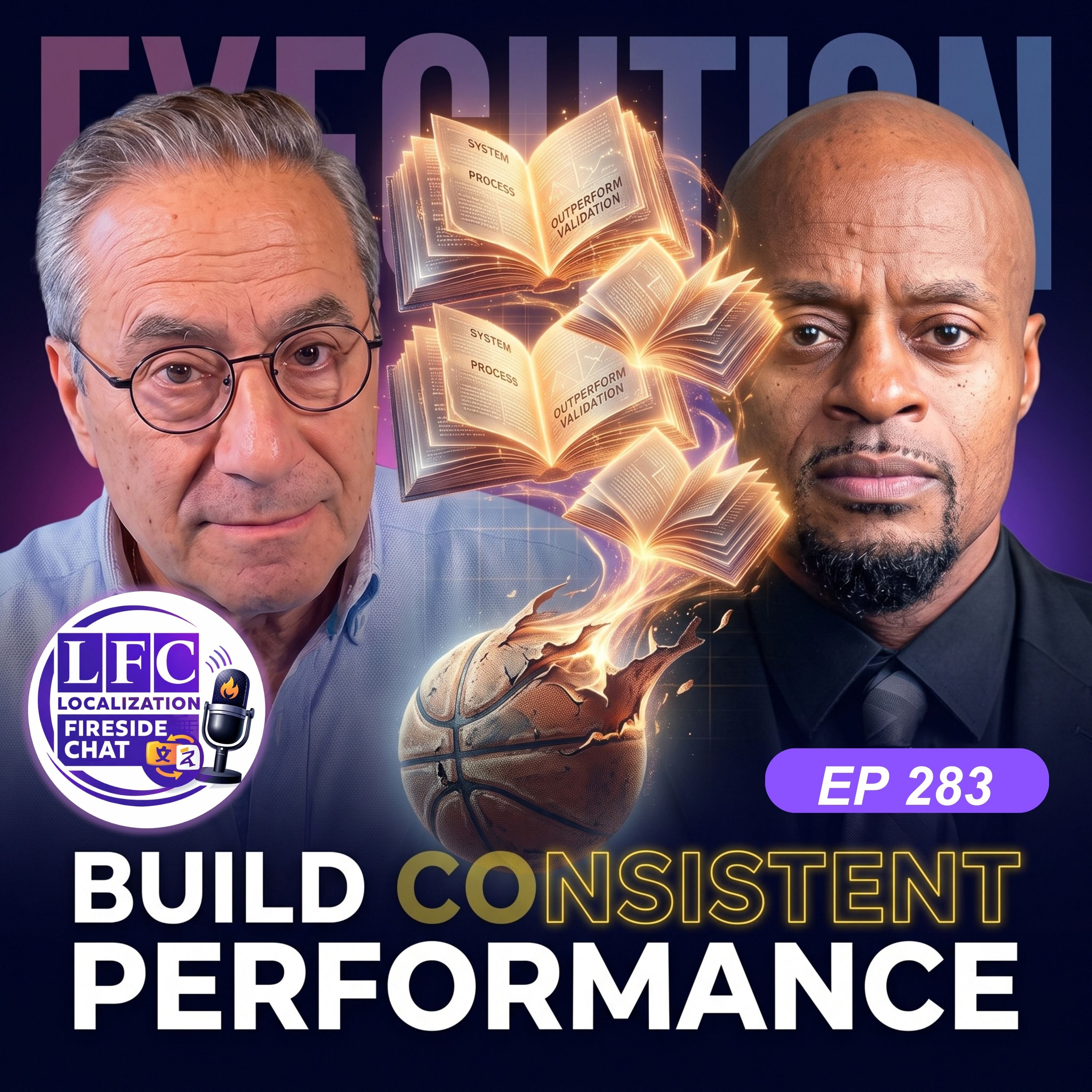
Dre Baldwin: Execution Consistency & Leadership Under Pressure
Get every episode summarized
Each time Localization Fireside Chat publishes, we email you a written briefing from the transcript — the topics, who appeared, and any specific claims, with the ad reads skipped.
Email me new episodesFree for 3 shows. No card needed.
About this episode
“This would be recording episode 283, and I'm looking forward to this conversation. This is going to be a very interesting one. This is unique, and we're going to have a fun doing this particular recording.”From the transcript
Most leaders don't fail because of bad strategy — they fail because execution breaks down under pressure. Dre Baldwin built an entire methodology around closing that gap, and in this episode he brings it straight to the localization and language services world.
In this episode:
• Why execution consistency — not strategy — is the real performance differentiator
• How the Power Presence Protocol helps leaders and teams operate at a higher standard under pressure
• The concept of "The Third Day" and the decision that separates professionals from amateurs
• How behavioral consistency and leadership presence translate into organizational performance
Dre Baldwin is the Founder & CEO of Work On Your Game Inc., a performance philosophy and coaching company built on his 15+ years of professional basketball experience across four continents. A prolific content creator with over 8,000 videos published and more than 150 books authored, Dre has coached thousands of individuals and organizations on disciplined execution, mental toughness, and leadership presence. His frameworks have been adopted by athletes, entrepreneurs, and enterprise teams worldwide.
Connect with Dre Baldwin:
LinkedIn: http://LinkedIn.com/in/DreAllDay
Website: http://www.WorkOnYourGame.com
Free Book — The Third Day: http://ThirdDayBook.com
For Leaders & Operators — Power Presence Protocol: http://www.PowerPresenceProtocol.com
For Teams: http://www.WorkOnYourGame.com/ERI
Daily Motivation Text — text DAILY to 305.384.6894 or visit: http://www.DreAllDay.com/text
X: http://X.com/DreAllDay
Instagram: http://Instagram.com/DreBaldwin
YouTube: http://YouTube.com/DreAllDay
TikTok: https://www.tiktok.com/@workonyourgame
Facebook: https://www.facebook.com/WorkOnYourGameUniversity
Subscribe: https://localization-fireside-chat.simplecast.com/
Credits
Host: Robin Ayoub, Founder, Localization Fireside Chat
Connect and watch more
Website: www.L10NFiresideChat.com
Spotify: https://open.spotify.com/show/5OoURgc29R31XPGzOWL9iX
Be a guest: https://calendly.com/robin-ayoub/localization-fireside-chat-podcast-recording
LinkedIn: https://www.linkedin.com/in/robinayoub/
Support the show
Share the episode with a friend. Subscribe on YouTube and Spotify. Leave a short review.
Disclaimer
Views are for education and discussion. Apply judgment in your own context.
Tags
#L10NFiresideChat #localization #hiring #recruiting #leadership #ai
Hosted by Simplecast, an AdsWizz company. See pcm.adswizz.com for information about our collection and use of personal data for advertising.
Get every episode summarized
Each time Localization Fireside Chat publishes, we email you a written briefing from the transcript — the topics, who appeared, and any specific claims, with the ad reads skipped.
Email me new episodesFree for 3 shows. No card needed.
Hosts & guests
Transcript ready
1,487 searchable segments. Every word is indexed and playable.
Full transcript
Localization Fireside Chat — Dre Baldwin: Execution Consistency & Leadership Under Pressure. Machine-transcribed; use the interactive transcript above to jump the player to any line.
Good afternoon, everyone. Robin, you've here from the localization fireside chat, and welcome to another recording. This would be recording episode 283, and I'm looking forward to this conversation. This is going to be a very interesting one. We've had many guests on this channel. This is unique, and we're going to have a fun doing this particular recording. My guest today is written 40 books, 4-Tet X-Talk, and nine years as a professional basketball player but was never drafted, and we'll dig into as to how that happened. Adry Baldwin didn't wait for permission to go pro. He hasn't waited for permission since. So he's been taken life into his own hands and doing things on his own terms. He built an entire performance philosophy out of that experience and turned it into a company. A body of work of a global audience, I am Robin Ayub as I mentioned earlier,
and this is the localization fireside chat. Dree Baldwin, welcome to the conversation. Glad to have you with me. Robin, I'm glad to be here. Thanks for having me. Really appreciate it. As we say on this channel, Adry, the first interesting question will throw at you is the origin question. What's your story? Well, got you here. Within the track of the season, Dree Baldwin, in Bel merak, or the I had to basically hustle my way into an opportunity, which I was able to do, starting a nearly 10-year career, playing professionally, mostly traveling through Europe, different countries
every year for almost a decade. At that same time, I started publishing content to this new platform called YouTube. I got out of college in 2004, by the way, to get people a timeline here. So 2005, I started playing pro, same year, I started putting videos on YouTube, built an audience there. Most people, they recognized me in the grocery store today, it'd be from YouTube. And those basketball videos I was making there led to me talking about mindset, particularly for sports. Professionals, outside of sports started finding that mindset content and told me it's useful for them. This is around 2010. From that time till I stopped playing in 2015, I was talking about both basketball and mindset online in my content. So I had two different verticals of audiences. Stop playing basketball in 2015. I added on pieces around strategy, structure and execution to my framework for the professionals who were following me at that point as I transitioned from athlete to entrepreneur. And for the last 10-plus years, that's pretty much what I've been doing. If we boiled it all down into one word, it would be execution.
So that's how we got here. Thank you, Dree, for the setup. I really appreciate it. I guess if I was in the audience, shoes, I'll be asking a question around as a professional basketball player. And how did that feel for you? Were you always thinking, otherwise you would have gone pro, but were you always thinking like the setup was to track the way you tracked so far, or were you hoping to do other things like NBA or something? Yeah, well, the pro basketball world expands beyond. You got the NBA, of course, what everybody knows about. You got about 500 jobs in the rest of the world at the professional level. You have about another 2, maybe 2,500 jobs, 2,000 to 2,500 jobs total. So I knew I was going from one of those 2,500 outside of the NBA because most NBA players, you're getting drafted. You're getting chosen through the draft process. So I knew once I got out of college and I wasn't on the radar for being drafted, this
is the way I'll have to get in. The challenges, you have about 10,000 players who think they are good enough to be one of those 2,000. So you have to beat out 8,000 guys on top of the fact that, remember, not every job turns over every year because some players come back and they play again the year after. They have careers, it's not just a one time thing. So you're really competing for not 2,000 jobs, but maybe 3 or 400 jobs every year. So I knew I was going to have to do something to kind of sell myself besides just play ball. Just playing alone was not enough of a show for me at that time to get the opportunity that I want or used to guarantee it. If I want to guarantee it, I was going to have to do more than just play ball because all 10,000 of us are just playing ball. So who's going to get picked and who's not? I didn't want to leave it to chance. So that's when I put the sales skills, basically taking advantage of discoverability. I took advantage of those sales skills that I was already starting to develop, used them for basketball, and then I'll use them and everything else after that. So even though Robin didn't work out the way that I dreamed, let's say when I was 15,
it actually worked to my advantage because there's a lot more life after sports than there is during sports. So the skills I developed to get into sports have served me after. No. When somebody go through what you went through, it must have some sort of an internal system that drives you, you know, to continue competing, to continue being there, to continue getting up in the morning saying, I'm going to do better. Can you talk to us a little bit about the, I don't want to, you know, for the audience would be like, sort of an emotion that you went through validating what you're doing and then driving you to the next level. Well for me, it's understanding as an athlete, you have a very short shelf life and you have very small window to get in, even to be starting. If you're just starting out at, you may be able to continue your career in your 27, but if you're just trying to get started at 27, you'll look at differently. So I knew I had a small window just to get in at a certain time. I started playing my first concert when I was 23 years of age. So for me, it was just deductive reasoning.
I know I'm going to play overseas, but I'm from America. I don't know anybody overseas. I don't speak the language. So I can't reach those teams directly. I need to find an agent. First of all, actually, when we back up, it was a three-step process. First one is I need to get good game footage, playing against other pro-gabble guys. Because I came from a division three college, Robin. So playing against those guys was not enough proof that I'm good enough to play against pro-gabble, because the three players are usually not pro-gabble. So I had to go to an exposure camp, played pretty well there. Now I have some good footage. And I got a scouting report from a non-invested third party saying, hey, here's how this guy actually is, which was a positive scouting report. So I needed that collateral. Then I said, I need an agent. They're the middlemen who know that people with jobs. So I need to go find an agent. Usually agents try to find players, but because of my pedigree, no agent was looking for me, so I went looking for them. I had a cold call at 60 agents. I spoke to 20. I sent my footage to all 20. One of them converted into saying, I will be your agent. So out of 60, I got one. That guy became my agent.
And he's the one who helped me get the job. So it was, get the collateral. Number one, number two, get the middleman representation. That was the agent. And then number three is basically a hurry up and wait. Hope that that agent is able to convert the fact that he's representing you into an opportunity and good enough for me, he was able to do that. So that's how I got started. No, you know, for, I love how you quoted the numbers. You started with 60, you had a 20 meetings, you closed one. That's a typical sales conversation. I love that. Now, sorry, on the basketball field, at some point, you must have thought, this is my laboratory for the lack of better comparison here. I'm going to try to use this as a testing ground for something bigger down the road. Did that idea started originally or did it come about during or after? That all came about during and it evolved on its own because mind you, I graduated from college in 2004. Social media, as we know it, really started to become a thing around about 2005.
You got Facebook and then you got the other platforms came in the subsequent years. So I didn't know that that stuff was even coming. Now I'm playing ball, but I had these entrepreneurial seeds in my mind already. I know I want to be an entrepreneur after basketball. The challenge is twofold rather than number one, I didn't know how to start an entrepreneurial venture despite my college degree, which is literally in business. They didn't teach you how to do that. And then number two, I didn't know when basketball was going to be over. I said, I'm going to be entrepreneur after basketball. After basketball might be six months from now. Might be six years from now. I didn't know. That's the way those careers are. The only thing that's fortunate to tell you my careers are that not very stable careers from most people, even the ones in the game, even though what we see on TV, you see the guys who have stable careers, but most people do not. So I'm just playing ball, trying to survive in my career and I'm going to the gym every day, practicing like any athlete would do, or at least I thought most athletes did. When I took the footage that I told you about from that exposure camp, I just put that footage on YouTube as a way of safekeeping the footage because it was originally on this thing robin
called a VHS tape. You remember those things? Yeah, that's a long time ago. Yeah. Yeah. So the VHS tape, I put that footage on YouTube, I got a transfer to audio visual at audio visual store until a data CD and people were even comments on that footage. It's not footage that I made for YouTube. I just made it. It was for me. I just put it up there so it would be somewhere. And then I realized, well, hey, there are people here obviously looking for help with basketball on this new website. I go to the gym every day anyway. I have this cheap with $100 camera. How about I just film my own workouts and I'll just put those on YouTube since people are asking anyway, it doesn't cost me anything. Mind you, there's no money to be made from putting videos on YouTube at this time. There's no such thing as being an influencer that we're not calling the words content. None of these things exist at this time. There's no ad revenue on YouTube. There's no followers of Iks engagement. None of that stuff exists. It's just you put stuff on the internet. That's all it is. And I just started doing it because, hey, why not? I'm already playing. And I did it sporadically. It's not like there was some content strategy.
It wasn't until about 2009 or 10, Robin, that, first of all, I found myself unemployed from basketball waiting for the phone ring. It wasn't ringing. Secondly, I'm a little bit older now. I'm in my mid-20s. I'm thinking, hey, I need to get some stability in my life here, meaning I need to know where my next paycheck's coming from. And number three, the internet was starting to become a place where it was starting to become a destination. People were remembering this time. 2004, 5, 6, 7, it was, we knew about it. You knew about blogging, but it wasn't serious. You weren't a serious person. That's what you were doing all day. But now, by this point, now we're starting to see Google buys YouTube. Okay, now we have Facebook. This is a place where people are spending time. Now people are getting jobs as bloggers. Now there's some business happening here. There's an opportunity. And I said, okay, I have basketball. There's an audience of people looking for basketball on the internet. And I'm starting to see the seeds of ways you can actually make money from this. This might become a thing. So it was in 2009 when I said, what I'm doing on the internet is going to be bigger than
what I'm doing on the basketball court. I knew it would be, but I didn't know how. I couldn't predict the next 17 years. But I knew it was going to be bigger just because I had much more control. I could do it exactly as I wanted to do it. And I could go direct to consumer, all of which you don't have when you're a professional athlete. So those started to plant the seeds. And those were all to answer your question, Robin. Based on circumstance. It wasn't based on. I was like a say, I just had this beautiful idea that I thought up in a dark basement. But that's not the way it happened. It was me responding to the circumstance in front of me. Absolutely. And most of us go through that. I mean, funny. You mentioned, you know, I have a hunch. I had a feeling, but I didn't know how big it's going to be or what is going to be the reaction from the audience. And when I started this podcast three years ago, Dree, I didn't know what was going to happen to it. I was hoping only my mother would see it. And I remember putting a app on her smart TV. They live two hour flight from me. And I connected. She doesn't know technology at all.
I connected my YouTube channel to her TV. So when I post a new episode, at least she sees her son, right? And so now what we've got is, you know, September just wrapped up the month here yesterday. I did 15 interviews in September. And August we did 18 interviews. So we're averaging about 15 to 18 interview. 20 interviews per month. And that's just a one man show. And the downloads, thank God, you know, they're all coming through here. So, but I didn't know initially I knew that I like to do something. I like to have a conversation with people such as yourself, Dree. But I didn't know any beyond that. I have no idea. Before COVID, we used to go to Starbucks, sit around and talk to people face to face. And we used to engage with a humanity like one on one. During and post, nobody wants to see anybody. So I said, okay, well, here's what I'm going to do. I'm going to create a landing page called coffee with Robin. And people can figure it out.
Like they can just drop me a link or drop me an invite and we'll have a conversation. No need to be complicated. Just drop me an invite to my calendar, 15 to 20 minute call. And we say hello. Then I started converting these calls into a podcast. So I really enjoyed it, but I do agree with you. Sometimes you get those strong feelings, but you don't know beyond that. And then it translates into something, pardon the pun here, but then it translates into something that it is meaningful. And then it takes a life of its own. I think what you went through is believing that you have something, but you haven't you haven't wrapped your arms around it yet. You couldn't quantify it. Am I correct, Dree? Yeah, that was probably around that 2008, 2009 period. That's what it was. But as I did more things than you learn more activity now, it's got from experimentation. Yeah, for sure. Dree, so you work on your game. That's the name of the company you've built. And it has, for the audience, it has five pillars,
mindset, strategy systems, accountability and execution. Would you mind walk the audience, Dree, through these five, and how do they connect together? And is there a sequence that they fit together in some sort of a sequence? Yes. And the sequence is exactly as it was laid out. So mindset is the foundation. That was what I was using as an athlete and the foundational pillars that we started with were discipline, confidence, mental toughness, and personal initiative. That's where working on your game originally began. And that's pulling straight from my athletic experience that I was giving directly to the other basketball players looking to get better. They were getting the basketball on court skills, but they realized these skills are known are not enough for me to go out there and perform Dree. What's the mental part of it? That's when I started talking about those four pieces. Mindset is still the foundation. Then as I began talking to professionals, business professionals, I realized that yes, they need mindset as well. And they appreciate it coming from an athletic perspective. It's unique to them.
At the same time in business, you can't just go out there with confidence and discipline and mental toughness and think you're going to succeed. You need a plan of action and you have to execute on it. That's where we got the strategy. That's the next piece. The third piece is the system. Once you have a plan of action that you know can work, it can produce a result. Now we have to system a tie. It's such that we can do the same things the same way every time and we can get a predictable result. This is where you get a Starbucks, you get a McDonald's. The same result over and over again, no matter where you go, it's duplicatable. That's a system. And the next piece is the accountability. The accountability is all about making sure that the system is executed properly. And if the execution is not happening, then there must be immediate correction and enforcement also known as accountability. And if it is being executed, you're still not getting the outcome, then we have to look back at the system and the strategy. Maybe one of them is all for it and not working anymore. So accountability is not just for the person, it's also for the process. And the piece that makes all of this stuff work from the mindset all the way through is the execution because having this stuff, knowing it and having access to it,
is not the same as actually applying it. And this is what I found from the beginning story that I told you here in Play and Ball, all the way up through trying to get on playing overseas. Thousands of guys get out of Division III cows just thinking they can play pro every year. They don't all do it. They don't execute on it. Once people want an agent every year, if nobody's calling them, they don't call anybody else or they make the calls, nobody answers, they don't call again. So the execution is about how do we actually turn this into a thing? In 2005, I wasn't the only person who noticed this new YouTube site, but I noticed, hey, there are people responding here. Maybe there's something else here. I was the one who kept doing it until I figured out, okay, there's something I can actually use here. So the execution is about following through on the information, on the insights, on the I-Bull-Bull-Bull-I ideas, on the bad ideas. They might not even end up going anywhere, but you learn something, a little thing from the idea that doesn't work, you take that into the next one and eventually it turns into something. So those are the pillars, mindset strategy systems, the accountability, we don't always even say that,
but since you brought it up, the accountability and then the execution. I guess, Dree, the follow up to that would be, is let's say we get to the execution and we notice something in the execution that is either flawed or maybe successful, I don't know, but let's assume negative for one second for the sake of this context. Do you have, like some sort of a feedback loop to go back to the first step because you mentioned them that they are in the sequence? Do we go back to the mindset or do we go back to any one of those above four pillars? So you're saying if you get to the execution and you don't get the outcome? Mm-hmm. If you don't get the outcome, well, the first thing is we wanna check on execution of the process. That's the first thing we check. So we have a system over here called execution reliability, which is all about managing the process and monitoring the process. So whenever that process is being run, we make sure the critical steps are all hit. If one of them is not hit, then we know. But let's assume that all the critical steps are hit. You follow the process to AT and you still did not get the desired outcome.
Well, one thing we know for sure is not because of lack of process adherence because we know the process was adhered to. So then what we do with the accountability part is we have to look at the strategy. Is this strategy still working for what we're doing? Because the one strategy can work in 2024, but it doesn't work anymore in 2026 because the market has shifted underneath our feet. The customer is asking for something different now. In 2021, then they were in 2019 because the world has changed significantly. So we have to rethink our strategy and maybe come up with a different approach. We may still have the same goal or we may need a different approach. And then also making sure the system is right. You may have a working strategy, but if you have 10 employees and each one of them is executing the strategy uniquely, now we have to look at the system adherence. Is everybody doing what they're supposed to do the way they're supposed to do it? And if there is variance, who is responsible for correcting that and enforcing that correction? So there's just basically a decision tree, if you will, of what do we check when we're not getting a desired outcome?
Dree, work on your game. What is the business model? How do you make money? Is it through coaching? Is it through development of developing some sort of a user manual for these individuals or companies that you work with? What's the business model? Well, we have multiple ways. One is coaching, and that can be individual consumer level, that can be business level and also consulting level. Let's say we're working with a company on a consulting level, information level, then we have things like speaking gigs, we have a long-term engagement where we can take, as you mentioned, you alluded to our system. So execution reliability is a system. We have a system called the power presence, which is for leadership level. That's a system we have a thing called the third day, which is operating through a challenge in chaos. That is a system. Those can be installed or licensed to organizations, smaller organizations or bigger organizations. I mentioned speaking, we have smaller, consumer level things such as books, courses,
content that can be monetized, group programs. So overall, everything that we do fits probably into one of those categories. Now, you've written 40 books. That's not a catalog. That's 40 books. What's your production system? What is the production process look like? I mean, 40 books, for somebody that's looking that's listening to this thing, is that a catalog? These are 40 individual books, Drey. How did you do it? Well, the first book was in 2010. That's the only book I'm on that's a narrative. That was just me telling my basketball stories to the basketball players who are watching. Then I have a few books that fit into grouped categories. So I've written four books about how to play basketball overseas, literally how to get a job in the overseas market. I've written a few books on leadership and communication. I have a four book bundle on mindset, discipline confidence, mental toughness, personal initiative. And other books were just one off ideas that I had. And to answer your question on a more tactical level, first of all, I'm pretty fast typing with my thumbs. I got really good.
So between 2010 and 2015, I could sit at a Starbucks on my phone and literally write several chapters of a book just typing. I can type really fast with my thumbs. Now we have, and I started doing this around 2019, you have talk to text. So now, as long as you can think in prose, in other words, think in the ways that the word would appear in a sentence, which I'm pretty good at doing after you do it for a while, because very different than how we talk conversationally, you can write out, I can write faster than I can type. So around 2019, I started writing all my writing, my articles, everything through talk to text. And then all I had to do was go in and edit, but it is a skill to talk to texts. So that's pretty much how I did it. In my overall, let me see strategically, I come up with the theme for what I want to write about, then I will flesh out what are the big picture ideas, which eventually become the chapters of the book. And then I just look at those big picture ideas and say, okay, here's what I want to say about that. Talk, talk, talk, talk. There's one chapter. Next chapter, same thing, next chapter, same thing.
Then after that, there's the hard part, which is the editing. That's where all the time is taken. For people listening, Dree, and they're thinking about writing a book, most people write a book to become a business card for them, right? So they walk into a conference and say, hey, I've written a book, check out my book. But there is a different community where people are writing books to actually make money out of them. What do you fit in that? Though out of category. So when I first started writing books, I did have that idea, yes, a book can be a business card and the mentors that I had in the Fault Leadership World said, Dree, a book is a good thing. I already have books when I met them. They said a book is a good thing because it shows that you've codified your knowledge. It's written down, it's documented, and people can hold it in their hands, not just listen to you say it. But at the same time, I've always been a student of internet business. And following internet business, I know about sales, funnels, and how to build them, use them, all those things. So I saw there's a way that you can monetize this, especially when you have multiple products. So a book can lead to a bundle of books, can lead to a course, can lead to coaching.
So that's how I've used books, more as a monetizable entry point, rather than just, hey, I have one, you can get it. But I don't, my focus these days, as when you ask me about my business model, books are at the bottom of the totem pole these days. But they have been higher up on the totem pole, generally for anybody wondering why I stop emphasizing the books is because they are smaller transactions, and you have to do a big volume of them to make the kind of money you want to make. And that means they'll follow out of different customers, a lot of transactions, a lot of shipments, bad addresses, and a lot of back and forth. It's, if you want to be Amazon, you need to see what their fulfillment process looks like. As many orders as they're taking every day, that's a lot of work, and you need a very robust system for doing that. I prefer more on the high ticket side, that makes sense. Absolutely. Yeah. Dree, when York was an organization versus individual professionals, which of the five pillar breaks down first and why?
Usually we were talking execution. So when I work with an organization, they value mindset, but usually with a big organization, the first thing they're thinking is, if they hear mindset, they're thinking, okay, maybe you can be the keynote speaker at our conference, but other than that, they're not investing in mindset. They are kind of past that. Doesn't mean mindset doesn't matter for a professional, but they are not investing in it. They may invest in strategy if you position yourself as the strategic person. Maybe in systems, but most businesses already have a system in place, and then the execution part of we have a bunch of material, we got a bunch of stuff, we got a bunch of systems yet, our people are not doing it. That's where I come in, and it's not even just that, because I want to talk about the other end of this equation. Robin, yes, I can come in on the execution angle, but it's also how you're presenting yourself, how are you presenting yourself in a marketplace? I present myself in a marketplace as I can diagnose execution issues. I can show you why you have these things in place yet they're not getting done. As I talk about those over and over again,
I come to plant my flag in that position. So when people hear me, yes, he can talk about mindset and strategy, and he used to play basketball, but the thing that I could probably get the most out from this guy is when he talks about that. So they come looking to me based on how they are seeing me, which is a big part contributed to by how I present myself. No, Dree, you talk about consistent execution when pressure and uncertainty make performance harder to sustain. What does inconsistency actually look like from the inside, and how does someone knows that this is a problem they have and identify it, put the finger on the problem kind of thing? Well, this is our... That's not the top, I guess on this one. Sure, this is our framework called the third day, which I mentioned earlier, that's one of our systems. And third day is all about how do you execute through that chaos, through that challenge, through pressure? Push through that. What did you say? You push through?
Well, that's one way of doing it. That's not sustainable. That's the challenge with people trying to get through the challenge. I came across a third day through my basketball experiences. Players who were watching my YouTube videos, because I'll put out videos every day, they said, Dree, you always seem to be in a gym by yourself. How do you have a gym to yourself? Do you own it? What do you do to your house or what is this? And I explained to them that the first day, when you were at open and gym, every basketball player in town was gonna come, because it's fun, it's new. Second day, a good amount of them will still be there. And by the third day, you'll find out who's serious about basketball, because nothing to do in there, but work. And it doesn't necessarily mean three days in a row, but proverbially what the third day is about, is finding out who is serious about doing something versus who is not. You don't find out until you have to do it over and over and over again, is boring. It becomes repetitive, it becomes mundane and tedious. The new car smell has worn off. That's what separates the pros from the amateurs. So the third day is a framework and system about, how do you show up even when you don't feel like showing up and still give a great output?
And willpower and motivation, those are not gonna be enough because they don't show up consistently and you cannot base a career around them. So what the third day is about, is one thing that I tell people on a personal level, is having an anchor. Something that you care about strongly enough that you're willing to deal with discomfort and let's say the monotony of a process in order to achieve an outcome. Like an athlete going to training every day, just for that one chance in the USA, every four years in the Olympics to go and win the gold medal. You get two minutes to win that gold medal, but you'll train for four years to get ready for it. What do you care about enough that you're willing to deal with that and or what can you put in places a system that even when you don't feel like doing the work, you can still get it done at a acceptable enough level that you're still moving the process forward. Now, this one is pretty good on the continuing on with the theme of the third day. Obviously, I've seen it in business and I used to manage Salesforce for the past 25, 26 years
and you see it all the time. You see it all close. Yeah, for sure. So there is a difference between someone who performs well once under pressure and they get a good, we used to call it lucky year or they got a good order from somebody and they landed the golden goose, I guess. And versus somebody who's actually doing this on a year to year basis or a day to day basis, it starts with the mini wins that accumulate to a larger win. What separates those two peoples in your opinion? Mentality, drive, belief, is it more internal than external? Is it habits? It's a little bit of all of those things, which all add up to one thing, rather than what's the consistency of output, consistency of how they show up. And when I say consistency of output, I don't mean they consistently close deals, not that part. What I'm saying is they are consistent in first of all, following a documented process, whatever it may be, as I'm sure as a sales manager, you've had documented process, but then not everybody's following the process.
Your top people are following the process and then the average people follow it sometimes and the people you got fired, they're not following it all. That's usually what happens. And it's also keeping the pipeline full that most businesses, if you're working with NA sales organization, the pipeline is usually filled for you or at least you're told how to do it. Then the hard part, the follow up. Are you following up with the process, prospects, making the call just supposed to make, making the touch points, sending the contracts, are you doing all the things in between the introduction, which is exciting, and the close was as exciting. The hard work is there in the middle. The 80% of the work is in the middle. How much is the person doing the work in the middle? And I would venture to guess, in your experience, managing a sales team, you tell me if it's true or not, Robin, that the best performers were the ones who mastered the middle stuff in 80%, not the intro and not the clothes, but the middle work. 100%. Oh, it's exactly. Oh, it's the third day. That stuff in the middle is the third day because if I tell you, hey, you're gonna close a deal today, you gotta get on the phone with Prospect X. Anybody will get on the phone. And if I tell you, I got 10 new leads for you
and they're all qualified, anybody will take the 10 new leads, but who's gonna do the work to bring those 10 new leads through a six month process to close the deal in six months and hit every touch point. Those are your top people because there is no excitement in the middle of the process. And you know, a point of evidence is every one of those large organization runs a CRM for their sales team and I was one of them. And, you know, typical stuff. Like you're either using HubSpod, we're using Salesforce or something similar. And I could tell you, if you've read, if any of these companies listening to me right now, they can validate this that most of your data in the CRM is garbage. And why is because the cadence that they put in place did not really filter through any of this information. And then when you back to the middle, when you ask people, you have to work through the middle part, it's not well documented. There's no tracks of it, there's no traces of it. And if there are traces of it, generally you have to week through, you know, 10 bad records to find one good record
and people give up on that stuff pretty easy. The middle stuff you I agree with you, there were companies out there that used to fire the bottom third every quarter. I won't name any name. You've got to, you know, say you have a 3000 salespeople, you know, imagine every quarter you're going to fire one third of those. And back to what you were saying earlier, is just, you don't want to be on the bottom third to get into the quarter. Everybody wants to fight to be to stay at the top at the top of the pile. It's, you've seen that, I'm assuming you've seen any of most of those things, didn't you? Absolutely, and what you're talking about there to speak to that CRM issue and to jump this into CRM. This is why we have what we call execution reliability. What execution reliability does is monitors the critical steps in the process. So let's say adding leads is a critical step and closing the deals, a critical step, obviously, but there may be eight critical steps in the middle of the process. How do we make sure that those eight touch points
in the middle of the process are actually being touched? If they are not touched, a system can alert your operations team or your managers or your leaders, hey, your salesperson number three and number 12, they didn't hit one of these critical touch points. You can go and correct that and make sure they do get it done and enforce that it needs to be done consistently so that everyone knows process wise, those touch points are being hit was raises the level of everybody on the team. So even someone who may look like a quote unquote average salesperson can still perform up to the level that the company needs so that the company overall is hitting his numbers. Now, many people in my audience are working in the industry that be in reshaped by AI and I'm assuming you guys are all over that conversation. Their skills are real though. They mean they get good skills. Their track record is real, but the ground is moving under them as you can imagine with the reshaping of many industries out there. What would your framework say to someone performing well in a context that might be not exist in the same way
in three years from now? Yeah, it's a challenging conversation depending on the industry. I work with people in a legal industry where AI is a major disruptor in that they can engage in it because there's a lot of mind work, a lot of written work, a lot of reading, but at the same time, there are laws against using AI and you better not get caught doing it in a courtroom. So there's a lot of disruption happening with AI and we don't know exactly how every industry is going to adapt and adjust usually who I'm talking to as they leader, the leader in the organization and they have an idea of what their company wants to do whether it will work or not as anyone's guess. They have an idea of what they want to do. AI can be a part of it, but you still need human oversight. You still need human checks and balances, especially in industries that are highly regulated. So insurance, housing, legal, health industries, I work with people in all of these industries, they are highly regulated. So while you can use AI, you have to be very careful because you cannot let AI make decisions
unlike in, let's say you're selling books so you have some funnels selling of course. There, you don't have the same type of regulations. So they still have a lot of checks and balances and they still have people who have to look over and watch over things. The biggest thing still, even with AI is the execution point still must be hit and AI still has some bugs. So let's just say I use AI myself and there's still some bugs in AI's system that are not completely worked out yet. So any human I say over the next five years, as long as you understand these things and you still have a high level of judgment, your career will be safe at least for now, but I would suggest you learn how AI works so you can start taking advantage of it rather than trying to compete against it. Yeah, lead versus let it lead you. You've appeared on ShowsDream that ranges from Grand Cardones, audience to psychology to day readers. Those are very different room. Does the work on your game message land differently
depending on who's in the seat? What do you think of that? Absolutely, absolutely. Because we're talking to one audience may be more interested in the mindset piece and another audience more in the execution when I'm talking to company level stuff, company level audiences, they're more on the execution stuff. When it's more of a consumer level audience, they like the mindset piece. Some of them, if it's more of a say, entertainment based, they like the fact that, oh, you used to be an athlete and now you're an entrepreneur, talk about the parallels and the differences between the two. So the good thing about me is over the last 20-ish years. I have a pretty eclectic bag of experiences so I can kind of put on different hats depending on who I'm talking to and what the host wants to get for their audience. And it's interesting because the localization fireside chat is localization meaning translation, languages. We localize content to different locations, basically. That's what localization stands for. And we'll go through the changes that we talked about earlier,
AI, et cetera, as the industry continues to shift. But everybody, like there's 19,000 companies that are about in the industry altogether, it's about $75 to $80 billion globally industry-wise. And now with the technology shifting around, so people have question marks, like is this gonna stick around? Did we, and you'd said it earlier, you know, stake at the critical thinking side of things. We did a podcast on what we call the defensible zone, meaning what are your core skills as an individual? What can you defend as an individual from a core skills and value that technology will have a hard time capturing from you? So that's your critical thinking, et cetera. So, but I love the way you've built your business tree. And, you know, for the audience who are contemplating this, you know, most of our audience probably, they went to universities, they studied linguistics, they have a linguistic degree, they started a translation company because they are translators.
And then they added a few people around and they became a small to medium size or large agency. But you've built the business where books, speaking engagement, coaching, all this content reinforced each other in a sort of like a wired framework. That's not accidental, you designed that way. And what was the strategic logic behind building in that way and what does each channel do that the others can? Great question. And I wish I had thought of it from the very beginning because I would have made it even more strategically than I did. But I started out with just making a ton of content. That's how I started. Content became the foundation. It also made me findable, discoverable, and it created a long tail for my name. So you could Google me and go back years and paces and you keep finding material. That I didn't have as a plan from the beginning nor did I know that YouTube was gonna be like one of the best search engines on internet. Again, I wish I knew I had that clairvoyance from the beginning, but I did not. It's just how it worked out. Then I started creating.
The first thing I started selling Robin was $4.99. Training programs, the basketball players. That was the first product that I actually created and I was using YouTube as my lead generation engine. Then it came, what came after that were the courses and then the books and then people started asking me for coaching. So it wasn't an idea that I wanted to start a coaching business. I used to do live streams on this app. There was that called Periscope about 10 years ago. That was pretty popular. I think it got absorbed by Twitter and then they got rid of it. But I used to do live streams on there every day and one day somebody in the comments said, the you offer coaching, I had never coached anybody in my life. But I said, of course I said yes. And he got emailed me and he became my first coaching client. I charged in 500 bucks and he became my first coaching client. And then when I stopped playing ball, the first thing I wanted to do was professional speaking. And the good thing about the speaking is I had a footprint on the internet that people could see. I had books said I had already been written and the speaking actually lent credibility to the content.
So when I would make this content I'm talking whatever I'm talking people say, well, who are you? What have you done? Well, I've spoken in these places. I've done these TEDx talks. So it actually gave credibility. And then when I'm talking to the professional audiences, this is about 2015, 16 around this time. The professional audience says they see the internet is coming. Well, look at this guy. He's got all these videos on YouTube. He's got all this content. So it actually gave me credibility with them because this guy is, he's kind of connected to where the world is shifting into this content space. And nowadays here we are, everybody's making content. So that they serve each other. And the thing is, Robin, I wish, as I said, that this was my grand plan from the beginning. It was not. It's just that certain pieces of lent themselves to other pieces and I noticed it. And as soon as I noticed it, this is the part that I do take credit for, Robin, is that when I noticed the connection, I step my foot on the gas and said, okay, now I will do more of this on purpose. I stumbled into some of this stuff by accident through high levels of activity. And through all the activity, I said, okay,
that little piece of their worked. This did not work, but there's a little thing in there that did work. I noticed that. Let me take just that part and do that again. And then I put it all together and eventually, it became a whole. It became something tangible, something real. So that's how the pieces start to serve. I think that answers your question. Was there any piece of that thought? I thought it was. But what I'm interesting in as well, because most people create content and they throw it out to the ether basically. And see if the boomerang comes back to them somehow. But you sound like you measured the content. You sound like you kept an eye on the content, try to analyze what works and what doesn't work. Did you do that rudimentary? Or did you use like other tools like Google Analytics and few other? No, it wasn't so much Google Analytics. It was really just responding to the audience because my audience. It was trying to be audience? Yeah, my content, my content heyday was the basketball days. This is probably YouTube. It started to hit critical mass of consuming consumption around 2013. But the years before that, let's say 2009 to about 2016,
2017 was my real heyday when it comes to content. These days I don't focus on, I still put out content, but I don't focus on it nearly as much as I used to. It's a much more crowded market. And I wanted to move out of me being the main course in my business because if you're the main course, well, you got to keep doing stuff. You stop doing stuff to business ends. So I was understanding, I understood that five years ago, and I knew I needed to kind of transition. And that's why these frameworks that we've been talking about here today. So looking at content back then, I was just see what people were responding to. They responded to the basketball stuff. I was just answered the questions that they asked with a new video. Then the mindset, I did the exact same thing. And then it got to the point by around 2020, Robin. I pretty much answered any question to anybody that asked me. I was already five steps ahead of my audience, answering questions they hadn't even asked yet. I still do that to this day. I just shifted it more towards a business slash professional themed audience where they're not big content consumers. They need the material. I put the content out so it exists,
but those are not people who are firing up YouTube every day. They're working. All right, so they don't have time for that. But I can still make sure my name is on a record under certain things because again, search engines still matter. No, does work on your game? Is it a, how many employees, can you give us an idea on the company? How many employees were you located? That kind of thing? Yeah, I'm based in Miami, Florida. And only two, my executive assistant and my audio guy who edits audio to our record and make sure it goes up on five. And I do hope this podcast helped you, Dree. I hopefully this showing on this podcast here, this conversation. I know you don't want to create your own content now, but I hope this content helped you out as well. So I hope it is. Wow, it's still great. My own content. That's the big, my own content. And Robin, being on shows like this is, because you brought it up, it's actually great credibility for people like myself. And I'm sure you understand this, having interviewed nearly 300 people, is that when you put out your own content,
it's as you talking, but when you get on somebody else's platform, you get the credibility of that person, respect it, whatever you represent enough to introduce you to their platform. So this absolutely helps me. 100% and I hope, positivity follows you post conversation here with me. Accountability is one of the five pillars you mentioned earlier. And in a world that we live in today, where people can curate their own information environment or opt out of feedback, for instance, they don't want to give any feedback. Or how to actually build accountability within that framework, knowing what we know today about how content is created. So how do you build accountability within the framework of which piece? The content creation that it is right now. People can curate their own, they can create any messages, put anything out there, true, not true, God knows. And they don't take feedback, like they just don't give me feedback, I'm just messaging.
What do you say to that? Well, if that's what they want to do, you can't stop them. I mean, you can't stop them. You can't stop them. The beauty of the content platforms is that they're designed so it's that you can put as much of it out there as you want for free at no cost. Yeah. And that's created this gold rush of everybody's, nowadays everybody has some form of content, whether it's a TikTok, YouTube, something, everybody's doing something. And the challenge is still, there are a ton of, well, the opportunity is still, there are a ton of consumers out there. There are a lot of people who just consume content all day. They scroll TikTok, they scroll Facebook, still, they watch YouTube videos. So if you can grab some of that attention, you can get some of the gold to kind of brush off into your wallet. If you want to play that game, the thing is you're in a competition with a whole lot of other people. So I would call it the red ocean, because it's fish all eaten each other, because it's not enough food, but they're all in there. So that is, again, a game I didn't want to play anymore, but I know a lot of people who are still in that game,
still very active in that game and the challenge, the biggest challenge is you have to keep feeding the beast. Nowadays, a lot of people put out content every day. It's a normal thing. Wasn't normal when I was doing it in 2007, but it's a normal thing now. So you have a lot of people putting out content every single minute. There was more content than there was time to consume it. You have to spend a lot of time fishing through the garbage to find the useful stuff. And I realized, okay, what I really want to do here, because I'm not going to win on entertainment. On entertainment alone, I'm not going to win. These days in the attention economy, you have to be the proverbial dancing monkey if you want to get attention, and you got to keep dancing to keep the attention coming. Because somebody else will dance if you won't. And I didn't want to be in that game. So I figured, okay, what value can I give? Who is the person who really needs to hear or see this? And how can I deliver just to that niche audience? I'm just going to deliver to that niche audience. And if I happen to catch Australia, some other people on the outside, so be it,
but I'm not targeting them, and I'm not going to do things to adjust to them. Dree, what's the future look like for your company and for yourself? What's your, I don't know if you go by that, but I'm just going to throw it out there. If you have other models, happy to listen to you. Five year goal for is this. Over the next five to 10 years at work on your game, incorporate it, Robyn. Dree Baldwin will be much less prominent. 10 years from now, I will be completely happy if I get an elevator and people don't know me, but their company is rising seeing execution reliability. They don't want you to have to know my face, but they know my frameworks. They know the third day, they know execution reliability, they know power presence, but they don't really know me. The same way that Jeff Bezos and getting an elevator and some people won't know him, but they just bought something from Amazon. I, that's what I see my business going to in the next 10 years. And how are you doing on that goal? Well, first of all, we got to get everything documented. So everything out of my head
and on paper, quote unquote, in some way, whether visually, textually and process wise. So that's a big thing that's still being worked on now. And that stuff takes, that can take years to get that stuff documented in the proper way and it has to be stress tested. It's just because you wrote it down, it doesn't mean it's accurate. Now we got to put it out there and see what somebody follows us, does it actually produce the outcome? So getting that documented, then getting our stuff into companies to where we can see, does this actually work the way that we think it does? Get it to work, get it to not work. And that's a sales job. That's getting leads in a pipeline, going through that boring 80% see what comes out at the end. So that, I still do that. Still to this day, we're still doing that. That's where the bulk of my time goes. So getting it there, and as we get things tested, improve that it works or show that it doesn't work, make more adjustments. And then when we get a solid program, which I say we're recording this in 2026, by 2030 all these frameworks will be cleanly documented, proven, we know they work. Now is this a matter of, how can we get this into a company so they can start using it?
And that is where the bulk of the revenue for work on your game is going to come from, from doing that consistently. No, if I was to ask you, since you brought up sales, and you continuously involved in business development and selling for your company, if I had to ask you, what is your ICP? I'm sure you're going to be able to answer that for me, but I'm just going to throw it out there just for fun. What is your ICP? Who's your ICP? I deal client profile, but I don't know what that means. Guess your audience does. That is the, on a business level, that's a business who understands they have a clean, documented, embedded process. They just want to make sure that process being executed on consistently. So they come to us looking for that execution reliability. And the process, they may want something else like the power of presence of the third day, but our entry is the execution reliability. On a personal level, let's say more consumer level. This is a professional or business owner who is a forward thinking, forward moving person. This is not a person who got to a position. And they're the COO or the CEO and they're happy.
This is a person who wants to keep moving, keep getting better, keep advancing regardless of their age status or previous accomplishments. They like the idea of driving and pushing themselves. And this is why they may be interested in someone who used to be an athlete, who can articulate that drive and push that is continuous. They're looking to be held accountable. They want to kind of have the proverbial foot in their butts to keep going and doing their thing. And they appreciate somebody who can keep it real with them, be honest with them and has the ability to articulate what needs to be said that is obvious, but maybe they can't see it because they're too close to it. And for those who are listening to this conversation with between myself and Dre, if this conversation sounds interesting to you and you sort of hit the nerve, it hit the nerve because the listeners who are listening to this, I think they know what the problem is. But Dre right now is really identifying it, that whole accountability, that consistency and deliverance, and we've seen it in every corporation, by the way. And if you don't believe me, go look at your financial statement,
not a single month is equal to the next month. And you can't predict what the next month is going to be, specifically on the sales funnel stuff. If you want that consistency and delivery, and I've talked about consistency and delivery, I'm a fractional CRO, that's what I do, part time job, and a fractional managing director. So when I talk about this, building that predictability, basically building the cadence, making sure you have the checks and balances in place to deliver that outcome. That's what Dre is talking about. Is putting that system in place for a business owner, instead of you becoming as a business owner, becoming the bottom-leck of your business, once you deploy the system, the system now takes care of your delivery, and you can relax and rest a little bit and prevent heart attacks early. Because stress is not good for you. So you've got to be able to put these systems in place to allow for a business to function without too much headache for the owners.
And as we know, most of our listeners are owners and entrepreneurs. They run their own companies, and they are like the HR person, the finance person, the sales person. You know, it's like any other small entrepreneur, right? So it's not unusual for small entrepreneur to be everything to everybody, but it shouldn't be the goal. It should be a phase where you come out of that on the other side, which creates some sort of an independence for yourself. As Dre was saying, he'd like to go up an elevator and nobody recognized him, better recognize the company. That's a hell of a goal, guys. I'd love for somebody to put that goal in their future after this goal. Do you think Dre any comments? That's the goal. That's what I want to do. And that is, really takes it's a lot of implementations, a lot of documentation, and you still have to get out there and get people to know that you exist. That's right. Now, just gonna ask you a personal question on my side. I've recorded 283 episodes with today's episode. That's a long execution streak. I've been consistent with it every week,
every month, and I measure all this. And on an average, I do between 10 to 20 episodes a month. So what does the number tell you about someone's relationships with consistency? As you mentioned, it's one of the pillars. And what is the biggest trap that hits people right around that kind of milestone? I want to be over. Sure. So one of the, what it tells me the number tells me that you've committed to the process and you're following through on the process. I know one thing about a guest driven show is that you probably get a ton of guest pitches and you have to filter through all the pitches and then you have the whole coordination and the scheduling and dealing with somebody's staff and their PR people and the links and the calendars and the reschedules. That's probably more work than actual recording. The recording is easy part. So the fact that you... That's the step one. Yeah, exactly. So the fact that you stay consistent with it and follow through and got this material out is great. And as you keep going and your show expands,
you're going to get 10 times more pitches than you get now. I get pitches and I don't even interview people. So I know you get a ton of them. That's one. And what was the second question? What should I watch for around this milestone that people should be aware of, you know, pothole on the road, that kind of thing? Is to just make sure you don't fall into the rut of continuing to do a thing just because you've been doing it and reminding yourself why you started it. I'm assuming that one of your biggest drivers now is serving your audience. You know who your audience is and just remembering that they're the ones who are listening to show exists because you have listeners. So keeping your ear to the street, so to speak, of what the listeners like, what they don't like. Now one of the challenges with podcasts is that there's not like YouTube where there's always a direct channel for communication between the listener and the people who are creating the show, especially if your show is heavy on audio, there's not a big commenting section in that area. So making sure that there is a venue or vehicle for your listeners to communicate with you,
let you know who they like, what they like, why they like it, what they think is missing, so that you can continue to curate, okay, I want this guess because the audience will like this for this reason, or let me ask this guess, these questions because my audience keeps asking me about these things, let me make sure I ask every person about something around that, to make sure you keep giving the audience what they want. And also, as the expert is your job to lead the audience, so thinking a few steps ahead of what they're asking for what they really need to be asking and giving it to them before they even realize they need it. Appreciate it, thank you so much for the advice, Drey. I've got a couple of quick questions and I'm cognizant at the time, so I don't want to take too much of your time. Quick one, if you don't mind, Drey, if someone's listened to the episode right now and only does one thing differently this week or early Monday, what should that be, do you recommend? Get clear on the critical steps needed for critical execution steps needed for you to achieve consistent success and the thing that matters the most for you and make sure that you're executing
on those critical steps and if you're not hold yourself accountable to fix that, such that it is easy as possible to execute on those steps. And working people find you follow the work that you do and get into work on your work on your game system, ecosystem. Sure, just go to workonyourgame.com, workonyourgame.com, that's where you'll find execution reliability, you'll find power presence as far as social media, whatever platform you like, just go cut my name, DRE, Drey Baldwin, and I'm easy to find. And also for my LinkedIn followers, I am connected, I think I am connected to Drey, I think I said to you a connection request this afternoon. If you are having a hard time or you need an introduction, just sit me up and I'll be happy to facilitate an introduction, okay? I wanna make sure that I thank you all for this Drey. As we come to a conclusion here,
any last comments, any thing that you would like to add to what we chatted about that we haven't yet covered? Everybody listens to this has a game, whether your game is managing the books, whether you're the CEO of the company, whether you're just trying to figure out what your next move is. And the reason we call it workonyourgame is because the first step is understanding what game you're in. Second step is developing the skills necessary to play at and win that game. And the third step is the execution of performance because this is a performance and results based business. So everything funnels up to performing and producing results. And that is what is required in order to do that is execution. So if you execute on a process that's in place to win the game, you have a reasonable expectation, not a guarantee, but a reasonable expectation that you will win more often than not. So thank you, Drey, for joining me. I really appreciate it. I enjoyed the conversation. Hopefully you did as well.
Absolutely. Thank you for sharing your platform and granting me the opportunity. Thank you so much. And for the audience, I want to thank you so much for joining me to record episode 283. I really appreciate your time with me and Drey Baldwin this afternoon. And I wish you all a great afternoon and hopefully enjoy the weekend. Hopefully it's not raining, hopefully it's sunshine, whatever you are. And I will see you guys at the next episode. Thank you so much, Robin A.U. signing off.
More episodes
More from Localization Fireside Chat

Daniel Roth: Execution Drift & Building Teams That Deliver
Localization Fireside Chat

Major General Robert Mixon: From Command to Culture
Localization Fireside Chat

Mentorship with Big Mike Coyle: Nobody Gets There Alone
Localization Fireside Chat

Priscilla Knoble - Adobe: Why Localization Gets You In the Door, Culturalization...
Localization Fireside Chat