Get every episode summarized
Each time Planet Money publishes, we email you a written briefing from the transcript — the topics, who appeared, and any specific claims, with the ad reads skipped.
Email me new episodesFree for 3 shows. No card needed.
About this episode
Planet Money is made possible by:
“This message comes from US Bank, simplify how you do business with business essentials, a powerful combination of no monthly maintenance fee checking and card payment processing. Deposit products are offered by US Bank National Association, member FDIC.”From the transcript
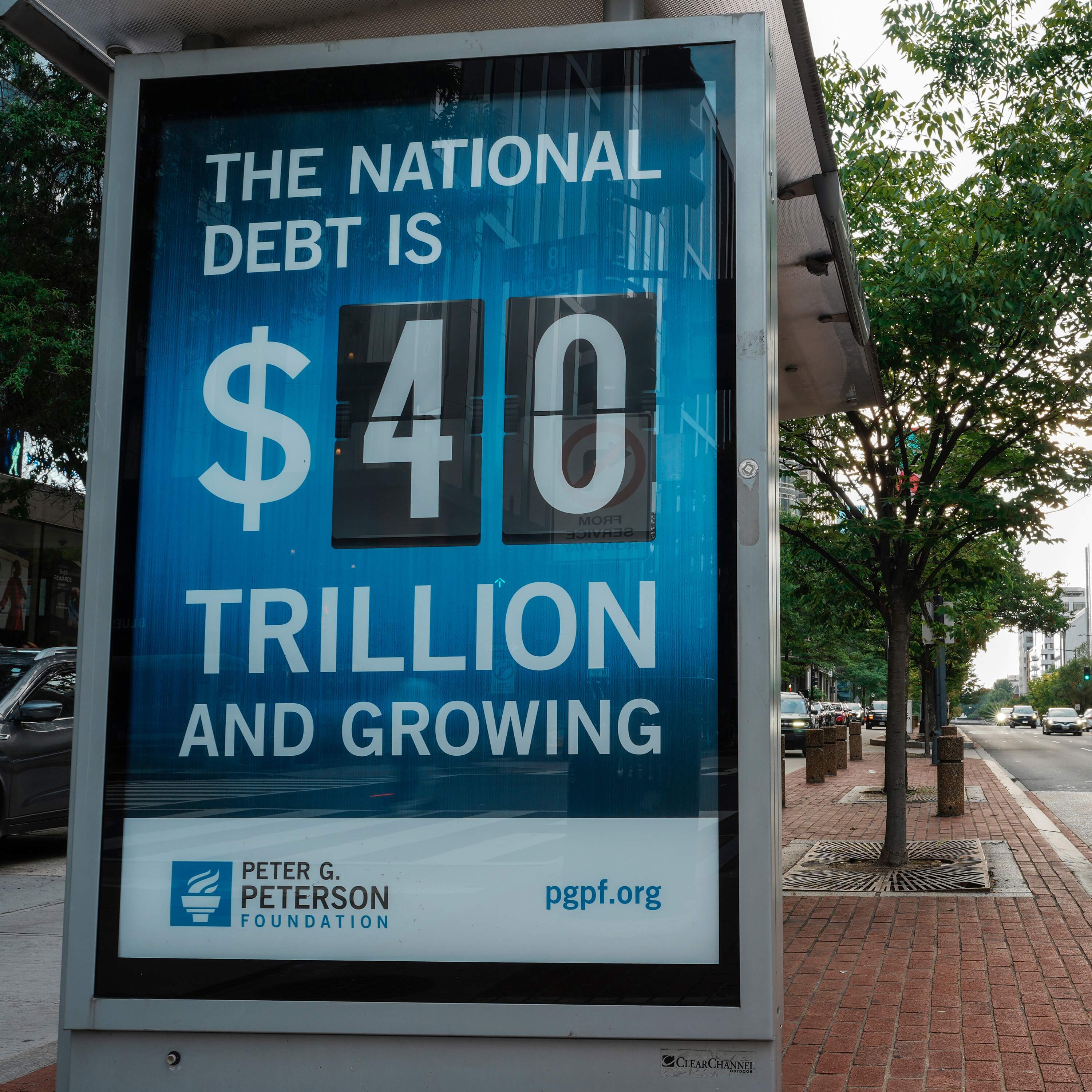
$40,000,000,000,000. Four commas. Thirteen zeroes. It’s an eye-popping, almost infinite-sounding pile of money. And every time the debt passes a big round number, almost everyone asks the same question: How much debt is too much?
It’s maybe the most important question in macroeconomics. It’s also surprisingly hard to answer. When two economists tried to answer it back in 2010, it ignited a research slugfest that lasted a decade.
We did a show on this question in 2024, outlining everything we know and don’t know about when the national debt becomes a problem. But a lot has changed. Interest rates have risen and stayed high. Spending has steamrolled ahead. Doves have become hawks.
So on today’s show, we update our 2024 episode to revisit the age-old question: Is our debt finally too much?
Read Planet Money:
- Our book: Planet Money: A Guide to the Economic Forces That Shape Your Life
- Our weekly longform Planet Money newsletter
- Our weekly Indicator round-up newsletter
Support public media with NPR+ and enjoy perks for over 25 podcasts like this one. This show’s perks include bonus episodes and sponsor-free listening. Learn more at plus.npr.org.
Our original episode was produced by Willa Rubin and edited by Molly Messick. This update was reported and produced by Vito Emanuel. It was fact checked by Sierra Juarez. It was engineered by Kwesi Lee. And it was edited by Alex Goldmark, Planet Money’s executive producer.
See pcm.adswizz.com for information about our collection and use of personal data for sponsorship and to manage your podcast sponsorship preferences.
NPR Privacy Policy
Get every episode summarized
Each time Planet Money publishes, we email you a written briefing from the transcript — the topics, who appeared, and any specific claims, with the ad reads skipped.
Email me new episodesFree for 3 shows. No card needed.
Hosts & guests

Transcript ready
319 searchable segments. Every word is indexed and playable.
Full transcript
Planet Money — Is our national debt finally too much? (update). Machine-transcribed; use the interactive transcript above to jump the player to any line.
This message comes from US Bank, simplify how you do business with business essentials, a powerful combination of no monthly maintenance fee checking and card payment processing. Deposit products are offered by US Bank National Association, member FDIC. This is Planet Money, from NPR. Okay, we are going to start today's show by jumping into the old Planet Money Time Machine. Boop boop boop boop boop boop boop boop boop. Economic Destination 2009. A time when the government was spending lots and lots of money and the national debt was shooting up. Yeah, back then the US was trying to pull itself out of the recession that followed the financial crisis. And one of the big strategies the government used was just to spend and spend and spend. We bail out some banks, we lowered taxes. There was all this money for infrastructure. Early in recession, I think a lot of people were very
supportive of the big steps the government took to increase the government spending and reduce taxes. That is Karen Dynan. She teaches at Harvard now. Earlier in her career, she worked at the Federal Reserve, did a stint as the chief economist at the Treasury Department. And Karen says it didn't take long for some people to question the wisdom of all that spending. Attitudes changed. And there were some economists and some policymakers, I think particularly people we would call deficit hawks who started to get quite concerned. Karen, she was firmly in the deficit dove camp back then. To her, it seemed obvious that the economy was not going to get back on its feet without an ongoing infusion of government spending. But she at least understood the thing the hawks were afraid of. Sure, in pure dollar terms at least, the country had never taken on so much debt so fast. In 2008, the gross public national debt was around $6 trillion. Then it was $7 trillion.
Then $9 trillion. By 2012, it was $11 trillion. These numbers sound almost quaint now. And as most e-context books will tell you, there can be real dangers in running up a big national debt. One of the classic worries is how much the debt you take on now could cost you in the future. So the scary thing about high debt is that you can get a snowballing of debt because of interest costs. And when you're paying a lot of interest and then you're running a larger deficit because you're paying a lot of interest, that adds to the debt. And then you get to the next period and you have more debt and then you have more interest. And so it just keeps compounding and getting worse and worse and worse. After the financial crisis, interest rates were low. But that didn't necessarily mean they would always be low. The markets could look at these higher and higher levels of debt and decide, you know what, maybe treasury bonds, the IOUs, the US government has to sell to spend more than it takes in. Maybe those bonds aren't such a great investment anymore.
debt becomes costly for us when investors, the people that buy our debt lose their appetite to hold our debt. Right, because to keep investors buying that debt anyways, the government would then have to pay higher and higher interest rates on those IOUs, which would make the whole thing snowball even faster. Now neither of those bad scary outcomes came to pass. In hindsight, it actually seems pretty clear that the people saying the government was right to spend all that money, that they ended up on the right side of history. If anything, a lot of economists, including Karen, actually think that the government should have spent even more than it did, that it could have shortened the Great Recession. But that's hindsight. Yeah. Karen says it could be really tricky for policymakers to make these huge decisions in real time without knowing for sure what's going to happen as a result. I mean, so the image that comes to mind is that the policymakers, I imagine sort of like inching out on the ice and then if it cracks, that's when you stop and
you hope you don't fall through. I think that's right. I mean, I think that's the ice cracking, that's when you're in real trouble. But when exactly that ice might crack when the debt will start to hurt the economy, we can't really say. It seems like we don't have a good way of knowing whether were 5% away from the ice cracking or 50% away from the ice cracking. Yeah, that's a problem. That is a, that is a real problem. We talked with Karen about this in 2024, in the wake of a sharp spike in the national debt stemming from pandemic spending. Another crisis where the government just pumped an incomprehensible amount of money into the economy and ran up the tab. But since then, the spending continued. The government never closed out on its tab. And now, Karen and others are changing their thinking about debt. Hello and welcome to Planet Money. I'm Keith Romer and I'm Nick fountain. Every time the national debt crosses a big scary
number, it sparks this debate about whether we finally crossed a red line. Last month, we hit 40 trillion dollars of debt. 40 trillion. It is a ridiculous, almost infinite sounding pile of money. And just on its face, that does sound like too much money for any country to be in debt. But is it? Today on the show, a deep dive on what we know and what we don't know about when a lot of debts turns into too much debt. Economists have been thinking about this and fighting about it for a long time now. Yeah, we're going to revisit our 2024 debt episode, starting with a brief history of all that thinking and fighting. And then we'll give an update. Because when Keith and I originally did this show, it was just before President Trump's newest round of tax cuts before the war with Iran and before all the jitters we've been seeing in the bond market. A lot has changed, including one of our economist answers.
This message comes from 11 Labs, whose AI-powered voice and chat agents can hold full conversations in over 70 languages to engage with customers and resolve issues. If you run a business or handle customer operations across support, sales or marketing, see how 11 agents can fit into your workflows and help build experiences that your customers will love. Get a demo at 11labs.io slash money. E-L-E-V-E-N-Labs.io slash money. When economists talk about the trouble, that a country can get itself in by running up too much debt,
that there are a few bad scenarios they worry about. One of them is that the country can end up so underwater that it ends up defaulting on its debt, stiffing its creditors, which tends to not go great. Sure. Or in order to escape its debt, maybe a country has to light inflation run wild and make its money worthless. Also not great. But things can also get bad without getting quite so dramatic. Sometimes having a lot of debt can just drag down the economy. Chop growth off at the knees. And this last concern was really what the fight was over in the US in the aftermath of the financial crisis. Was all this money the country was spending ultimately going to end up causing more problems than it solved. That relationship between national debt and slow growth also just so happened to be the subject of this famous paper that came out in 2010, right as US debt was really taking off. The paper's authors were these two prominent economists, Carmen Reinhart and Kenneth Rogoff. They dug up all this data about debt for 20 advanced economies
across decades. And according to the paper, history had a thing or two to teach us about what levels of debt were okay, and which levels maybe weren't okay. The paper was short. It was just six pages. It was called growth in a time of debt. And it kind of took the world by storm. In a lot of ways, it defined the terms of the argument for the next several years. In fact, this little paper had such a big impact that we are going to spend most of the rest of the show talking about it. The idea is it inspired and also the fights. Karen Dynan, the Harvard professor for before, says the paper was such a big deal in part because it seemed to offer an answer to that giant question on everyone's mind back then. At what point will the debt start to limit economic growth? The statistic that caught so much attention was that they had a result that suggested that when a country has debt that is equivalent to 90% of their GDP that their growth rate would be half of what it would be in times when debt was at a more normal level.
So just for a little context in the early 2000s, the debt to GDP ratio in the US was around 35%. Meaning the national debt was equivalent to 35% of the value of every good or service the country made for an entire year. By 2010, when the paper came out, the debt to GDP ratio had gone all the way up to 60%. And so you can kind of see why so many politicians and people in the media latched on to that paper. Yes, specifically the number 90%. A lot of people read the paper as saying if your debt goes past 90% of GDP, the wheels are just going to fall off your economy. Even though that is not exactly what the paper said. Allow me to plan it money out on the paper for a second to be precise, the paper lumped countries into low, medium, high, and very high debt groups. This very high debt group contained countries with debt above 90% of GDP, including some
countries with way higher debt levels. And so what the paper technically found is that this very high debt group on average over a very long time was associated with lower economic growth. But that nuance aside, that 90% number got some real traction. Karen remembers people talking about it as this red line. You know, it wasn't your average economist who was running around like things were on fire. It was more that the people who didn't like all this fiscal stimulus were starting to use it as a reason why the government needed to tighten its belt. If you were a debt hawk, you had a good argument for your position. Yeah, exactly. Now up to this point, we've been talking about this grand debt experiment as if the US were the only country that was running up this huge bill. But of course, lots of countries were trying to spend their way out of the great recession. Debt to GDP ratios were ballooning pretty much everywhere. And so around the world, people were
looking at that 90% red line and wondering, um, is that a plot of us too? In fact, then international monetary fund economist Andrea Perez-Biterro was just getting started in macro economics. At the time, I was an assistant professor at University of Italy, which university? University of Ancona, which is more place in the East Costa Vita by the sea. As much as the paper itself, Andrea remembers the fights about it, playing out in blogs and newspapers. I think when that paper came out, it was a big deal. Meaning it was clearly an important paper on a very important topic, very sensitive topic at the time. Yeah, these were live arguments. There were impassioned calls for austerity measures and belt tightening. And equally impassioned arguments for the other side, saying, no, don't mess up this recovery. Now is not the time to stop the paper even generated a kind of mini scandal at one point. These, shall we say, more debt-friendly economists put out a paper highlighting a pretty big mistake in the Excel spreadsheet that
Reinhardt and Rogoff had used. The last sentence of that paper reads, the fact that Reinhardt and Rogoff's findings are wrong should therefore lead us to reassess the austerity agenda itself in both Europe and the United States. So that was also added sort of to the debate. It was not just a debate, the one who were saying, oh yes, this is a good argument to push for fiscal consolidation, others saying maybe known. There was also a discussion about, yes, this is basically evidence which is flowed and based on some mistakes. And so that make I guess that the debate even more sort of strong between people. Correcting the spreadsheet mistake did weaken the claim and the paper everyone latched onto, but it didn't disprove it. Their updated paper still showed that high debt was generally correlated with slower growth, just not as deeply as before. I think that the true contribution of this paper by Reinhardt and Rogoff was to open up a very large
body of research that started from their funding and tried to dig deeper and try to expand our understanding of how debt could affect the economy. Yeah, like here is one very, very important question. Just because there's this correlation between high levels of debt and lower growth, does that necessarily mean that high debt is causing the economy to slow down? And then I guess that correlation is not causation is sentence that in planet Bane has been repeated like Zedness of Time. Space rates are motto. Yeah, yeah, we have it in Latin written over the door. Exactly. So clearly, also in this case, correlation doesn't mean causation. Now, there are good theoretical reasons for why you might think that too much debt could slow down the economy. We've talked about a couple of them already that snowball effect of all that debt compounding, the way investors can demand higher returns on government bonds. There's also this phenomenon that economists call crowding out, which works like this. To take on debt, the government has to sell
treasury bonds, basically IOUs. And if investors keep buying and buying and buying those treasury bonds, that means that money isn't going into private investment, you know, building factories or researching the next generation of microchips. And so growth, the idea goes, is going to suffer. But Andrea says that causation here could also run in the opposite direction. Low growth could be causing high debt. You can really think a situation in which your economy is underperforming and US policymaker, you want to stimulate the economy, therefore you want to do public consumption, public investment. And one way to do that is borrow money. If you borrow money, you're going to increase your debt. So what you're going to observe in the data, you have low growth and high debt. And exactly because of this example, really, we cannot conclude that higher debt is causing lower growth. If anything's the other way around. The causality question is one that Andrea worked on himself. In the end, he and his co-author concluded what pretty much everyone ended up concluding.
Based on the empirical evidence, at least you can't definitively answer this one. Andrea thinks that depending on the situation, the causation can run in either direction. Sometimes high debt causes low growth. Sometimes low growth causes high debt. Andrea and all these different economists around the world also looked into other questions. Other ways of looking at the historical data that could help identify when exactly debt might become dangerous. It's a sort of tipping point if you want. It's going to be potentially very different across country. So it could be 90% for some economies. It could be 45% for other economies. It could be 100% for some other economies. Also, it seemed to matter who held the government's debt. Was it banks? Was it investors from inside the country? From outside the country? Was it short-term debt? Long-term debt? Yeah, how much debt a country can safely take on? Turns out to depend on all these different factors. This is one where the simple-seeming result, you know, countries that have debt to GDP ratios over 90% see lower economic growth, where that result just
got more and more and more complicated, the longer people poked at it. Which, Andreas is as a good outcome. Economists, they know more now than they did when all of this started. Even if you don't get to perfection, even if you do something to the extent that you are aware of limitation of your analysis, I think you still provide a very valuable contribution. But here's the thing. After several years of this kind of scholarship, the attention of macro economics kind of drifted away from the topic. In part, this is because of how fractured the problem had become. How many tiny pieces that one big, clean, seeming idea had turned out to have been made of. But it was also because the real world itself suddenly seemed to be saying, maybe this isn't such a big important problem after all. Because the thing that makes high levels of debt destructive to an economy is not really the debt itself. It's the interest a country has to pay on that debt. And in the wake of the financial crisis, all around the world, interest rates
went down to basically zero and just kind of stayed there for years. And so for a while, a lot of macro economists were like, maybe we don't really need to worry all that much about debt after all. And then the world changed. Again, in two ways. First, the pandemic and all the spending that followed pushed that way higher. And second, and more importantly in this case, interest rates went back up. And so having a lot of debt today is going to cost the U.S. countries all over the world a lot more than it would have five or six years ago. Yeah, that question that economists put down for a bit, how much debt we can get away with, it is starting to look pretty relevant again. After the break, just how dangerous is our national debt? We put that question to the OG of debt to GDP ratio ease. It's kind of throw down. We're talking to kind of throw down. Yes.
This message comes from 11 Labs, whose AI-powered voice and chat agents can hold full conversations in over 70 languages to engage with customers and resolve issues. If you run a business or handle customer operations across support, sales or marketing, see how 11 agents can fit into your workflows and help build experiences that your customers will love. Get a demo at 11labs.io-money-el-e-v-e-n-labs.io-money. This message comes from BetterHelp. Imagine carrying a backpack every day, inside it, every conversation, every mistake, every expectation. It is easy not to notice how heavy it is until someone asks if you want to put it down. Sometimes feeling better starts exactly like that. Better isn't one
size fits all. Better is personal. It's therapy tailored to the individual to help lighten what you carry. Match with a therapist who truly understands. Visit betterhelp.com-slash-in-pr. This message comes from HomeServe, a burst pipe, a dead water heater, the AC calling it quits. Who do you call? HomeServe is an easy way to handle unexpected home repairs, with plans covering stuff basic homeowners insurance usually won't. Instead of scrambling for a contractor, you make one call to get the repair process started. Join the millions of customers who trust HomeServe right now. Go to homeServe.com-slash-podcast for 50% last year, savings compared to renewal price, void and Florida. So I will start you off with the easiest question which is, can you identify yourself? My name is Kenneth Rogoff. I'm a professor of economics at Harvard University. I realize you've reminded me of one of my other questions which is Kenneth or Ken. Oh Ken, Ken is
great. Okay, so we'll go Ken. I mean, but when I'm giving my formal name, Ken. Formerly Keneth informally Ken. If you ask Ken Rogoff about that paper he wrote with Carmen Reinhart, it is clear that he is still kind of annoyed about the way it all blew up. Back then Reinhart and Rogoff were writing off eds, warning governments of the risks of debt levels above 90%. But today he insists he never meant for people to take their groupings of countries into low debt, medium debt, high debt and very high debt to GDP countries to mean that there was some bright red debt line you couldn't cross. One of our buckets was it was our highest bucket was 90%. But we didn't say that suddenly you go to the devil when you get to 91%. That's a little bit like saying if you're driving in a car in a 55 mile an hour speed limit and you go to 56, you're going to crash the next minute. And that interpretation which was polimically used in addition to a lot of polemic misrepresentation,
I think so. It's so crazy how can they say that? Of course we didn't. And he says yes, obviously there are a lot of factors that contribute to when national debt becomes a problem for a country. And of course different countries are going to be able to tolerate more or less debt. But I do want to qualify that a little bit by saying to say therefore there's no threshold. Therefore any level of debt is fine. That's kind of nuts also. Yeah his basic intuition remains unchanged. He says a country is playing with fire if it just loads on more and more and more debt. Eventually all of that debt is going to slow down the country's ability to grow. And he thinks the US is headed in that direction right now. I think if you look at where the United States is today we're probably on a trajectory that needs to get adjusted and it's not just our debt it's our social security or medical care everything. But Ken says politicians on both sides of the aisle have gotten really resistant to either brazing taxes or cutting spending enough to balance the budget.
The tendencies when the other parties in power debts a terrible problem and when you're in power it's not. When Ken looks at all this it's not like he thinks we are headed toward some economic armageddon. You know barring something really horrible happening. I don't foresee a massive problem. But Ken says there are signs of trouble in the economy. We've seen inflation spike investors demanding higher rates on US treasuries. To him those happen partly as a result of all the debt we've taken on. Anything spikes in inflation and interest rates might keep happening. What I think is likely to happen over the next 10 years is we'll probably have another episode of that. So maybe until we've got punched in the face a couple more times we may not adjust. And adjusting finding a way to stop running such a high deficit year after year that would involve some genuinely hard tradeoffs.
Some mixture of cutting into how much we spend on programs that Americans really value or raising taxes pretty significantly. Now Ken he has been on the more debt hawker side of things for a long time now. But even some of those economists who used to feel okay about how high the debt was getting they are starting to see things differently. Like Karen Dynand the other Harvard professor we talked to at the start of the show. After the great recession she thought all the spending we were doing was worth the risk. This time around she's not so sure. Policy makers need to be honest about what's on the horizon in terms of national debt and the fact that we are on an unsustainable path. My sense is that you did not use to worry about the size of the national debt to the extent that you do today. And I wondered is it are you maybe a born again debt hawker?
Karen was not willing to go on the record as team hawk but she did make this stray kind of hawkish comment at a conference. She had been talking about all the stuff we've been talking about in the show. How big the debt is, how higher deficits have been. And she said something to the effect of you know what I know there's no magic red line for debt. But maybe we'd all be better off if there was one. Having a benchmark like that is useful because it can force action. And even though I don't think there is a magic level, I do feel like if there was some level we knew about it could then kind of be constructed politically and get people to face up to the hard decisions they're going to need to make. Like you kind of wish there was one. Yeah, yeah. So you don't want me to ask you at what percentage of GDP the national debt will cause a crisis?
No, I mean I can't tell you that number. Is it 125% of GDP? You're still asking me. Higher or lower? Sorry, we're not answering that question. Okay, so that was Karen Dynan and Ken Rogoff in 2024. It has now been two years. And we have added more than four trillion dollars more to the debt. Congress passed massive tax cuts in 2025 that ate into revenue. The debt is so high that we are paying over a trillion dollars a year just in interest, a record amount by a lot. Given all that, we check back in with Karen. Is she a hawk now in 2026? I am a debt hawk now. Given how things have evolved, we have seen things happen
in financial markets, particularly treasury barring rates that have made me think this is a bigger challenge than I thought it was a couple of years ago. Karen says it was really this summer that she started to get worried. I think it does feel a little bit like we're walking out on the ice and basically taking reassurance from the fact that it hasn't cracked yet. Barring rates on US treasuries, those IOUs we mentioned earlier, went up and have stayed up. And one explanation for this might be that investors think one of the safest investments ever is slightly less safe now. Just last week, the interest rate on the 10-year treasury hit the highest level recorded since right before the great recession. That's a big deal because first of all, it makes the debt outlook going forward. It makes it worse because it means we're going to be funding our deficits at a higher interest rate. Right. This CBO now projects that our debt will cross 120% of GDP in 2036,
which would be higher than any point in US history, including World War II. And she does think that these high interest rates are starting to hurt the economy. They drive up mortgage rates for home buyers and make it more costly to pay down credit card debt. Still, she can't give a number of what exactly is the line of too much debt. And now, she says, because of external factors like the immense AI build out in the Iran war, it is even harder to know where that line is. But yes, even doves are becoming hawks. You know who hasn't changed his mind? Ken Rogoff. I don't know, you know, people acknowledge fully as much as I would like how wrong they were. His position is basically, it was bad then. It's worse now. And interest rates are really important for determining how bad you think it is. I think the big misconception is that interest rates would be low forever. And if they were high for a while, it was just a bad dream and it was
going to go away. Yeah, there's some vindication here for him. There needs to be some reflection of how wrong everyone got it for so long and the conviction because that hasn't gone away. Leading opinion makers who thought it before, more or less, still think it. They might be right. But the question is, what kind of risk do you want to take? What kind of gambles do you want to make? Yeah, and to be clear, the gamble is that a higher debt makes it harder to respond fast enough to big shock to prevent a crisis. Something Ken thinks is pretty likely. I do think that the odds that we have a very significant problem are bigger than 50-50. Nothing under the world. And frankly, having a debt crisis is not the end of the world. But I think something very significant is going to happen and we're not we're not ready for it. And the debt to GDP ratio has crossed a somewhat arbitrary but scary line, 100%. We asked him how much that matters. And Ken's answer to that question
is basically, look at the interest rates. It's not the debt that bothers you, the country. It's how much you have to pay to service it. He says rising debt is like your cholesterol going up. High cholesterol probably won't kill you immediately, but it raises the risk of a heart attack, which leads us back to the question that started this whole saga. Have we now finally racked up too much debt? Neither Ken nor Karen can draw a sharp line of what is too much, but they agree that the solution is cutting spending, raising taxes, or both. And that seems pretty much like a non-starter. So what is the solution? If a huge bump in growth doesn't bail us out, Karen and Ken both agree. Pain. I think we need to see much more pain. We're like teenagers that think they're immortal. Other countries don't. I mean a lot of other countries realize what a crisis this is.
But we just don't have it in our DNA at the moment. As far as the red line goes, we'll probably have to cross it to know where it is. If you like stories that help you think through big, scary numbers like the National Debt, consider hitting follow on your podcast app. It helps the show a lot. It tells our algorithmic overlords that were a podcast that they should promote to other people. And of course it means that you'll see every new episode announcement from us. Thanks a trillion or maybe 40 trillion. The original episode was produced by Will of Rubin, engineered by Cinalofreito, edited by Molly Messick. Our update was reported and produced by Bito Emanuel, back-checked by C.I.W.A.D.S. and edited by our executive producer, Alex Goldberg. One final note, the economist Andrea Presbietaro, we talked to for today's show. He works at the International Monetary Fund, but the views he expressed are his and not the IMFs. It's executive board or its management. I'm Nick Fountain and I'm Keith Romer. This is NPR.
Thanks for listening. Hey what's your problem? No, seriously, are your grocery bills too high? Are you spending too much time on your phone? Maybe you're searching for a new job or you're trying to figure out how to set boundaries with your family. Whatever's on your mind, life kit has you covered with three episodes every week on health, money, mental health, and so much more. Listen to the life kit podcast in the NPR app or wherever you get your podcasts.
More episodes
More from Planet Money

Middlegarchs are the new Oligarchs
Planet Money

The Domino’s Pizza Tracker Theory of Everything
Planet Money

How investing is getting riskier (Two Indicators)
Planet Money

The loan at the heart of a new foreclosure crisis
Planet Money