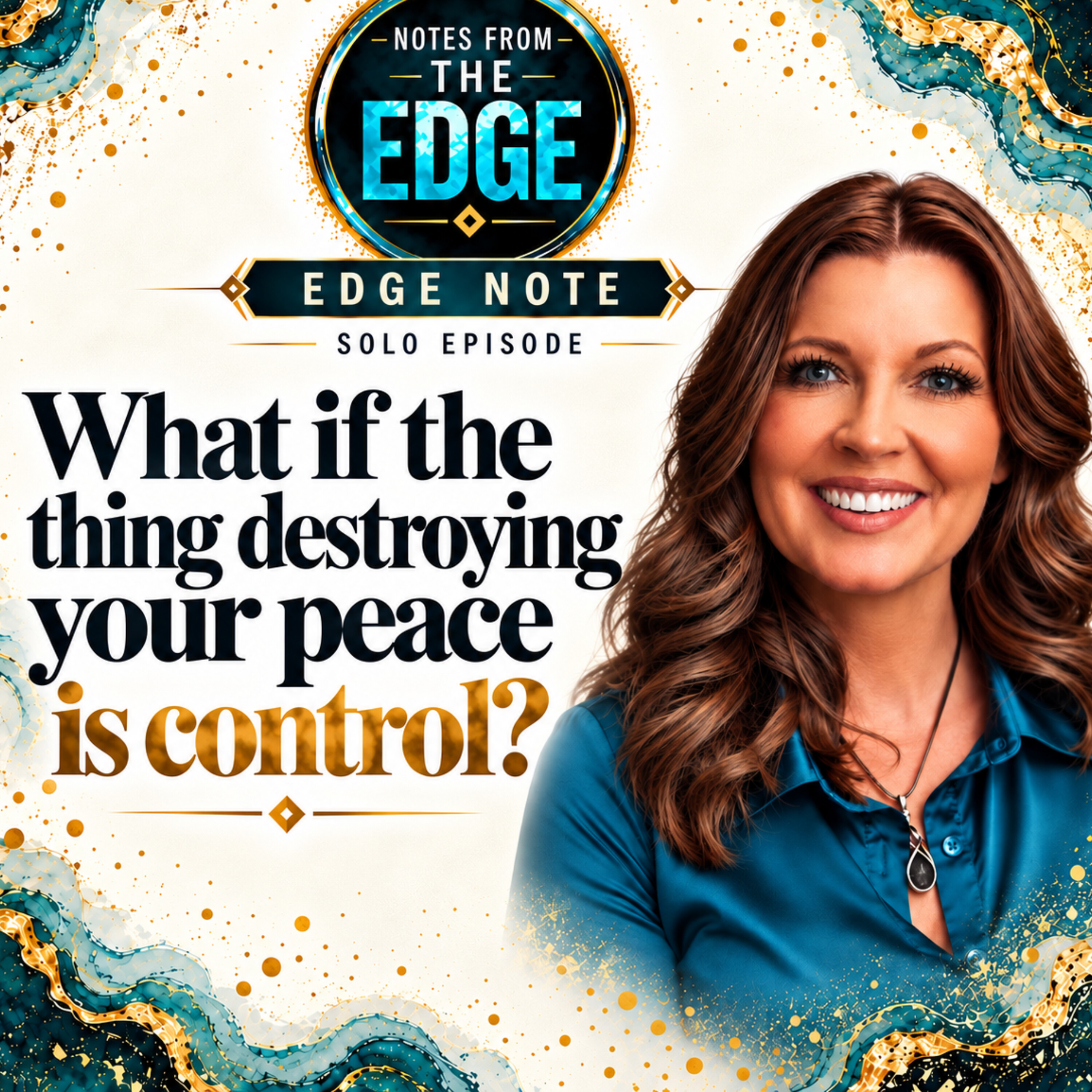
Edge Note: What if the thing destroying your peace is control?
Get every episode summarized
Each time Notes from the Edge publishes, we email you a written briefing from the transcript — the topics, who appeared, and any specific claims, with the ad reads skipped.
Email me new episodesFree for 3 shows. No card needed.
About this episode
“We talk about the things that we're not talking about. I'm your host, Lisa Lacey, writer, trauma educator, executive advisor, and author of the upcoming memoir Notes from a certified madwoman.”From the transcript
In this Edge Note solo episode of Notes From the Edge, Lisa Lacy gets personal about Bipolar I, trauma, uncertainty, and the exhausting need to control outcomes when your nervous system learned early that powerlessness could be dangerous.
This is not another “just let it go” conversation. Lisa explores what control actually looks like when you live with mental illness, why uncertainty can feel threatening even when you are clinically supported and properly medicated, and how to separate what requires action from what simply requires us to tolerate not knowing yet.
In this episode:
- Why trauma and mental illness can make uncertainty feel like danger
- The difference between taking responsible action and trying to control an outcome
- How hypervigilance can disguise itself as preparation, responsibility, and problem-solving
- How to separate facts from catastrophic predictions when your mind is activated
- Practical tools for grounding, shrinking time, regulating your body, and deciding what actually needs your attention right now
If you have ever done everything you could and still found yourself obsessing over what happens next, this conversation is for you.
The goal is not to stop caring about outcomes.
It is to trust yourself enough to know that you can survive the uncertainty between action and outcome.
Connect with Lisa Lacy Inside the Edge:
https://www.lisalacy.com/inside-the-edge
What did you perform in order to survive?
Welcome to the Edge.
See Privacy Policy at https://art19.com/privacy and California Privacy Notice at https://art19.com/privacy#do-not-sell-my-info.
Get every episode summarized
Each time Notes from the Edge publishes, we email you a written briefing from the transcript — the topics, who appeared, and any specific claims, with the ad reads skipped.
Email me new episodesFree for 3 shows. No card needed.
Transcript ready
112 searchable segments. Every word is indexed and playable.
Full transcript
Notes from the Edge — Edge Note: What if the thing destroying your peace is control?. Machine-transcribed; use the interactive transcript above to jump the player to any line.
Welcome to Notes from the Edge, where we have the conversations we should have been having all along. We talk about the things that we're not talking about. I'm your host, Lisa Lacey, writer, trauma educator, executive advisor, and author of the upcoming memoir Notes from a certified madwoman. Welcome to the Edge. Hey, my friends. Welcome to another episode of Notes from the Edge. I am your host, Lisa Lacey. And this is the place we have the conversations we should have been having all along. One of those conversations is that stuff doesn't always work out, and we have hard days. Today was one of those days where it seemed like nothing was flowing the way that it needed to go. And I don't think we hear about that enough. I want to talk directly to anybody who struggles
with their mental health, not theoretically, not as somebody standing on the other side of it with a clipboard and a list of coping skills. But as somebody who has struggled with mine for most of my life, I was a very young girl when things started going sideways for me. I had a suicide attempt at 15. I had already experienced trauma, and my family was told that I needed clinical therapeutic support. That support would not come for another 25 years. And I wasn't properly diagnosed with bipolar one, borderline personality disorder, and CPTSD until I was 40. 25 years as a long time to live inside a brain. You don't understand that's happening. What's happening? And when you've been unwell for most of your life, there is something particularly cruel about it. You don't necessarily know your unwell. You think this is just your life. You think everybody fills everything this intensely. You think everybody's mind can just turn against them. You think
everybody experiences periods where the world feels unbearable. And relationships are supposed to feel like chaos and war. And surviving is the same thing as living. You don't know what stability feels like because you don't have anything to compare it to. And I certainly didn't know what it felt like to actually like myself. Today, I've had more clinical and therapeutic support than I can probably list in one sitting name and acronym. I've done it. I take my medication. I know my diagnosis. I understand my drama. I understand my nervous system regulation. My patterns and guess what? Life can still knock the absolute shit out of me because treatment does not make you immune to be in human. Medication does not make you immune to disappointment. Therapy does not make you not fear things. Recovery does not mean you stop getting wounded.
Healing does not mean that every outcome suddenly goes your way. And this is the part I've been wrestling with today. Outcomes. Things I cannot control. I am very good in action. Give me a problem. I can solve it. I will solve the hell out of it. Give me a crisis and I'm strangely calm. Give me something to build, fix, research, fight or protect. And I know exactly what to do. But uncertainty. Give me something I care deeply about. And then tell me I have to wait. Tell me somebody else gets to make the decision. Tell me I did everything I could. And now I have absolutely no control over what happens next. That is where my body starts looking for a weapon because control is not always about being controlling. Sometimes control is a trauma response. It is what happens when your brain learned very early and that terrible things happen when you are
powerless. Sometimes hypervigilance looks like responsibility. Anxiety disguises itself as preparation obsessing over every possible outcome feels like problem solving. And we call it being proactive when what we're actually doing is desperately trying to outrun uncertainty. And here's the shitty part. You can do everything right and still not get the outcome you want. You can love somebody and they can still leave. You can apologize and they can still refuse to forgive you. You can get sober and some people will still remember you as a drunk. You can change your entire life and somebody will still tell the story of who you used to be and define you by your worst moments. And you can build something extraordinary and watch someone misunderstand all of it.
You can work harder than everyone around you and still lose the opportunity. You can take care of your body and still get sick. You can protect your children and still not be able to protect them from everything. You can tell the truth and not be believed. And you can be a good person and still experience terrible things as a human and not as terrifying. And I think a lot of mental health advice gets insulting right here. Just let it go. Choose peace. Don't worry about things you can't control. Well, thank you. I'll alert my central nervous system immediately. Because if letting go were simply an intellectual decision, none of us would be struggling with it. The real work is not convincing yourself that you don't care. The work is learning that you can care deeply and still survive than not knowing. Those are very different things. And I don't want to become
detached from outcomes because I don't care. I want to become less controlled by outcomes because I trust myself. That might be the biggest difference between the woman I was and the woman that I want to stay for most of my life. Safety meant trying to predict what everybody else was going to do, what mood are they in, who's leaving, who's abandoning me, who's angry. Did I say something wrong, replaying the conversation, what happens next? How do I stop it? How do I fix it? How do I make sure the bad things not going to happen to me again and again and again? And that is exhausting. And eventually you realize that trying to control everyone else's behavior does not create safety. It creates surveillance. You become the security camera of your own life, always scanning, calculating, waiting for impact. And sometimes nothing is even happening. Your body just remembers what happened
the last time. So what can we actually control? Not the cliche version. I don't want all that nonsense. Not your attitude because some mornings my attitude is shit. And frankly, sometimes that is an appropriate response to what is happening. What I can control is what I do next. Not what I feel all the time. Not the first thought that comes into my head. Not whether my body gets activated. Not whether somebody disappoints me. But what happens after that first wave hits, I can decide whether I send the text immediately. I can control whether I make a permanent decision during a temporary emotional state. I can control whether I feed the thought or question it. I can isolate completely or tell somebody, hey, I've been having a really hard time. Whether I sleep before I decide on
something, whether I eat something, take my medication, go outside, get off the internet, stop checking the numbers, stop reading the message, stop replaying the conversation, stop trying to solve something that cannot be solved tonight. I can control whether I ask myself one very important question. Is there an action available to me right now? If the answer is yes, I take the action. Make the call, set the boundary, go to the appointment, send the application, tell the truth, ask for help, document the problem, do the next right thing. And if the answer is no, then the work becomes tolerating the space between action and outcome. And that is the part nobody puts on a motivational poster. Sometimes healing looks like doing absolutely nothing because there is nothing left to do. Sometimes strength is refusing to interfere with an outcome. You've already done everything
you can to influence. Sometimes regulation means saying, I have done what I can do today. I do not know what happens next. I am safe in this moment. Not tomorrow, not forever, this moment. That's one of the tools I use now. I shrink time. When my brain starts catastrophizing six months from now, I ask what is actually happening in the next 10 minutes. Usually the answer is much less terrifying. I'm sitting in my house, talking to you. I feed her on the floor. Nobody is yelling or attacking me. The email has been sent. The decision has not been made. There is nothing I need to solve in the next 10 minutes. That is reality. My brain may be somewhere else entirely, but reality is usually much smaller than the catastrophe my brain is making up. Another thing I do is try to separate facts from prediction. Fact. Something happened. Prediction. This will ruin everything. Fact.
Somebody hasn't responded. Prediction. They hate me. They're leaving me. I'm abandoned. Fact. I lost an opportunity. Prediction. I'll never get another one. Fact. I'm struggling today. Prediction. I'm going backwards. I'm going to lose my mind. And they're not the same thing. Middle illness can make predictions feel like facts. Trauma can make beer feel prophetic and it isn't. And when I absolutely cannot get out of my head, go to my body, cold water, feed on the ground, long exhale, a walk, music, nature, touch something real. Name five things in the room. Not because these things magically picture life. They freaking don't. They remind your body that your thoughts are happening inside a present moment. And the present moment is often very survivable. I spend a very long time believing stability meant I would eventually become a person who never struggled. I don't believe that anymore. Stability is knowing
what to do when I struggle. And that is different. And frankly, it is much more hopeful because I don't need life to stop being unpredictable. I don't need everybody to behave a certain way or have a certain outcome to come my way. I don't even need my brain to cooperate every single day. I need to know that when life gets dark, I have learned how to find myself in it. And if you're struggling today, maybe that's enough for you too. You don't have to solve your entire life today or tonight. Find the next thing that's actually yours. Do that. And let go put down everything that isn't. And if you have to pick it back up tomorrow, you can. But for today, for tonight, your only job might be to just stay here and breathe. And sometimes staying is the bravest thing we can do. Just stay. Rest is needed. One more try.
If you made me tomorrow, what are you performing in order to survive or to skip by? And what might setting that role and ask your performance down do to make your ride just a little bit easier? I am your host, Lisa Lacey. When you find the answer to that, I'll see you at the edge.
More episodes
More from Notes from the Edge

What If AI Became Your Next Employee? AI Workforce Revolution with Jon Rossiter
Notes from the Edge

The Money Monster Within: Managing Yourself Before You Manage Your Money | Part...
Notes from the Edge

What If One Bed Could Change Everything? Purpose Driven Leadership with Luke Mic...
Notes from the Edge

Edge Note: What if your mind understands the trauma, but your body is still surv...
Notes from the Edge