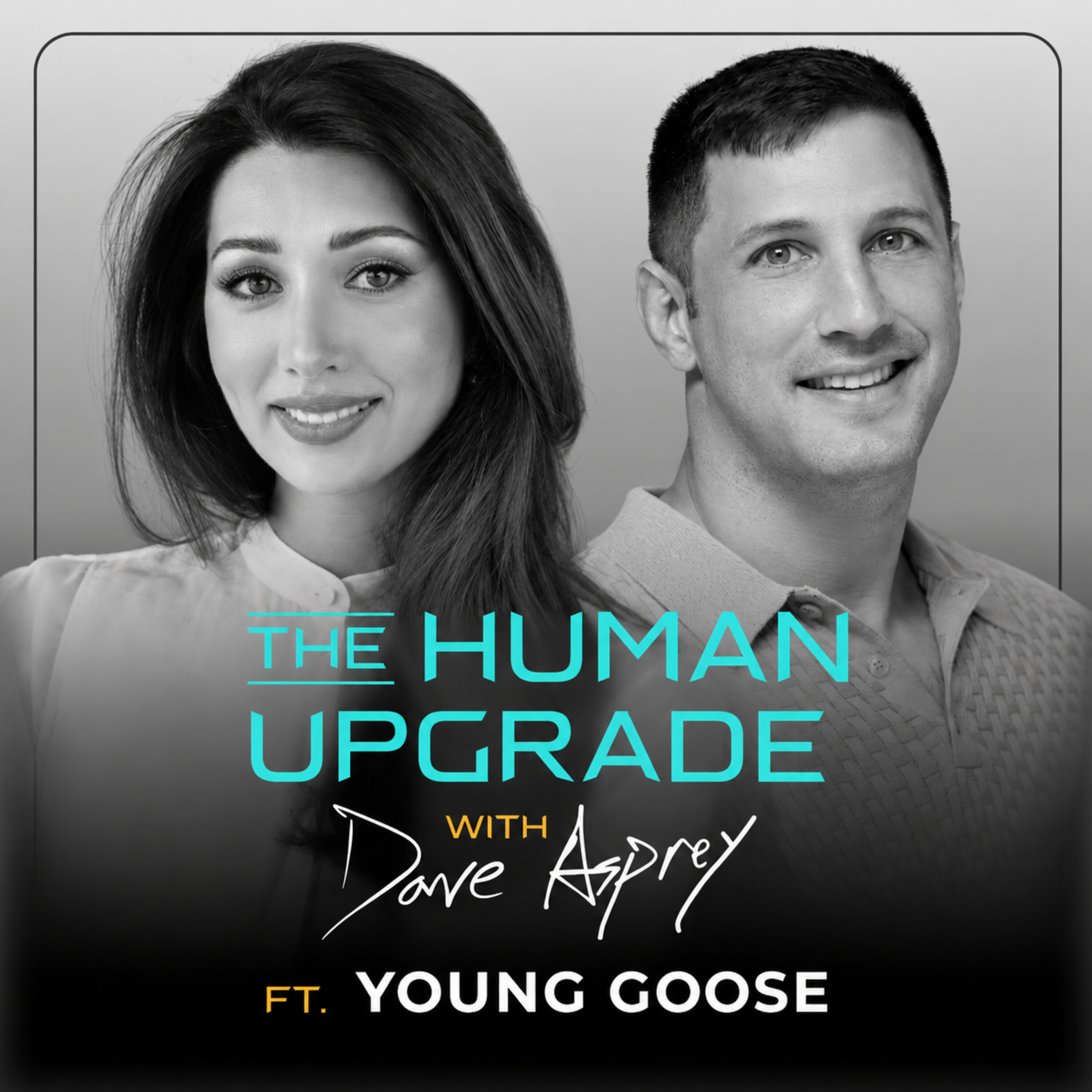
Dave’s Anti-Aging Skincare Routine: Exosomes, Methylene Blue & NAD+ : 1547
Get every episode summarized
Each time The Human Upgrade: Biohacking for Longevity & Performance publishes, we email you a written briefing from the transcript — the topics, who appeared, and any specific claims, with the ad reads skipped.
Email me new episodesFree for 3 shows. No card needed.
About this episode
“The skin to your world of the past 20 years, it was really like acid-dominates. Some of them 40s, 50s, 60s really compromise skin barrier. Much, much thinner skin as we grow older.”From the transcript
Visit https://www.younggoose.com/ and use code ASPREY10 to save on the skin longevity products discussed in this episode.
Skin Longevity, Cellular Repair, Red Light Therapy & the Biology of Younger Skin with Young Goose
Host Dave Asprey sits down with Amitay Eshel and Anastasia Khodzhaeva, co-founders of Young Goose, to explore the emerging science of skin longevity, cellular aging, mitochondrial function, exosomes, NAD+, red light therapy, and what it may take to keep skin functioning younger for longer.
Anastasia is a biologist, biohacker, and co-CEO of Young Goose who began her career in biomedical research focused on liver fibrosis and breast cancer before moving into wellness, product development, and longevity-focused skincare. Amitay is co-founder and CEO of Young Goose and host of the Biohacking Beauty podcast, with more than a decade of experience across health, wellness, beauty, and business development. Together, they focus on applying longevity science and performance optimization to skin health.
Amitay and Anastasia explain why wrinkles may be only one visible sign of a much deeper biological process involving declining cellular energy, weakened barrier function, oxidative stress, senescence, and changes in how skin cells repair themselves. They break down how newer approaches to skincare are moving beyond surface-level hydration toward targeting the cellular mechanisms associated with aging.
The conversation goes deep into testing, including a metabolomics-based approach designed to assess skin metabolic age from a small blood sample and analyze 17 different metabolites. They also discuss emerging proteomics testing that can examine thousands of proteins involved in processes such as collagen production, oxidative stress, mitochondrial function, and cellular repair.
Dave, Amitay, and Anastasia explore some of the most unusual compounds now being used in skin longevity, including methylene blue, NAD+ precursors, spermidine, ergothioneine, superoxide dismutase, copper peptides, ectoin, and gotu kola. They explain how these compounds may interact with mitochondrial energy production, oxidative stress, mitophagy, collagen signaling, and the broader hallmarks of aging.
They also break down red light therapy and why combining light with certain topical compounds may influence the response. The discussion covers methylene blue and electron transport, copper peptides and mitochondrial biogenesis, light-activated DNA repair enzymes, photodamage, reactive oxygen species, and why dose and timing may matter when using red or near-infrared light.
The episode also dives into platelet-derived “Vampire Exosomes,” how exosomes carry cellular instructions through microRNAs, why formulation and stability matter, and how these signaling particles may influence skin repair, inflammation, collagen production, and senescence. Dave and the Young Goose team also discuss growth factors, klotho, senomorphic strategies, cellular longevity, and why extending the functional life of healthy cells may become an important frontier in longevity science.
They also explore practical skincare routines, including how to layer products, what Dave uses while traveling, how airplanes and dry environments affect skin, why aggressive acids may not always fit a long-term skin longevity strategy, and how AI-based skin analysis could make skincare increasingly personalized.
This is essential listening for anyone interested in skin longevity, anti-aging skincare, exosomes, methylene blue, NAD+, red light therapy, mitochondrial health, senescent cells, collagen, peptides, cellular repair, metabolomics, proteomics, biohacking, and the future of personalized skincare.
You’ll Learn:
- Why wrinkles may be a downstream sign of deeper cellular aging
- How skin metabolic age can be assessed using metabolomics and multiple biological markers
- What methylene blue may do inside mitochondria and why it pairs with red light
- How NAD+ precursors, spermidine, copper peptides, SOD, and ergothioneine may support skin biology
- Why platelet-derived “Vampire Exosomes” are being studied for cellular signaling, repair, and senescence
- How red light therapy interacts with mitochondrial function, oxidative stress, and DNA repair
- Why some traditional acids and surface-level skincare strategies may not address long-term skin function
- How proteomics and AI could change the way skincare is measured and personalized
- What Dave and the Young Goose team use to support skin during travel and other high-stress environments
Dave Asprey is a four-time New York Times bestselling author, founder of Bulletproof Coffee, and the father of biohacking. With over 1,000 interviews and 1 million monthly listeners, The Human Upgrade brings you the knowledge to take control of your biology, extend your longevity, and optimize every system in your body and mind. Each episode delivers cutting-edge insights in health, performance, neuroscience, supplements, nutrition, biohacking, emotional intelligence, and conscious living.
New episodes are released every Tuesday, Thursday, Friday, and Sunday (BONUS). Dave asks the questions no one else will and gives you real tools to become stronger, smarter, and more resilient.
Keywords: Amitay Eshel, Anastasia Khodzhaeva, Young Goose, Biohacking Beauty, skincare, anti-aging skincare, skin longevity, skin aging, younger skin, exosomes, vampire exosomes, platelet-derived exosomes, methylene blue, NAD+, NAD precursors, red light therapy, mitochondria, mitochondrial health, mitochondrial dysfunction, cellular aging, cellular repair, senescent cells, senescence, senomorphics, collagen, copper peptides, GHK-Cu, spermidine, ergothioneine, superoxide dismutase, SOD, ectoin, gotu kola, mitophagy, metabolomics, proteomics, skin metabolic age, klotho, oxidative stress, peptides, skin barrier, DNA repair, photodamage, biohacking, longevity
Resources:
• Visit https://www.younggoose.com/ and use code ASPREY10 to save on the skin longevity products discussed in this episode.
• Get My 2026 Clean Nicotine Roadmap | Enroll for free at https://daveasprey.com/2026-clean-nicotine-roadmap/
• Dave Asprey's Latest News | Go to https://daveasprey.com/ to join Inside Track today.
• Danger Coffee: https://dangercoffee.com/discount/davetube
• My Daily Supplements: SuppGrade Labs (15% Off)
• Favorite Blue Light Blocking Glasses: TrueDark (15% Off)
Thank you to our sponsors!
- Download Dave’s Free Peptide Guide at daveasprey.com/peptide-guide.
- Neuronic | Go to www.neuronic.online Code DAVE for $100 off
- Timeline | Go to timeline.com/dave and get up to 20% off when you subscribe and save
- Kenetik | Instead of pushing your system harder, Kenetik feeds your brain the ketones it craves to fuel calm clarity and steady focus. Go to drinkkenetik.com/DAVE and use code DAVE for a discount.
Timestamps:
00:00 — Trailer
01:09 — Skin Testing & Metabolomics
04:48 — Longevity Skincare Paradigm
07:50 — Airplane Skincare Routine
11:15 — Tardigrade Juice & Antioxidants
16:00 — Mitochondrial Dysfunction
21:00 — Skincare Ingredients: Old vs New
27:20 — Vampire Exosomes
32:30 — Red Light Therapy Stacking
38:00 — Proteomics & Klotho
41:00 — Exosome Safety, Growth Factors & MicroRNAs
44:00 — Senescent Cells & Senomorphics
47:00 — Skin Longevity Takeaways
50:00 — Outro
See Privacy Policy at https://art19.com/privacy and California Privacy Notice at https://art19.com/privacy#do-not-sell-my-info.
Get every episode summarized
Each time The Human Upgrade: Biohacking for Longevity & Performance publishes, we email you a written briefing from the transcript — the topics, who appeared, and any specific claims, with the ad reads skipped.
Email me new episodesFree for 3 shows. No card needed.
Hosts & guests

Transcript ready
957 searchable segments. Every word is indexed and playable.
Full transcript
The Human Upgrade: Biohacking for Longevity & Performance — Dave’s Anti-Aging Skincare Routine: Exosomes, Methylene Blue & NAD+ : 1547. Machine-transcribed; use the interactive transcript above to jump the player to any line.
The skin to your world of the past 20 years, it was really like acid-dominates. Let's literally burn the top layer. Some of them 40s, 50s, 60s really compromise skin barrier. Much, much thinner skin as we grow older. The wrinkle is just a symptom. A lot of people buy really expensive stuff and it may or may not work for them, but you find something that works. Wow! It increases collagen thickness. I saw this says, you will really get radiant glowing skin. You're listening to the human upgrade with Dave Asprey. What if you could make your brain sharper in just 10 to 15 minutes a day? Focus comes down to how well your mitochondria are working, because that's how your brain makes energy. When your mitochondria slow down, you get brain fog, fatigue, and low motivation. Light changes how that system behaves. Scientists have been studying near infrared light for years, because of how it interacts with mitochondria, and supports energy production in your brain.
And that's why I've been using neuronic. It's a wearable light therapy device for your head that uses near infrared light to support clarity, focus, and overall brain performance at home without adding another complicated routine. It is simple to use, easy to stick with, and fits into your day in just a few minutes. If you're ready to ditch brain fog, or you just want better mental performance, this is a straightforward tool to add. Go to neuronic.online and use code Dave for $100 off. Every week someone asks me, what's the best peptide? There isn't one. Peptides are signals. Different peptides send different instructions to your body. Some affect metabolism, some are for tissue repair, others influence your brain recovery or aging pathways. The right peptide depends on what you're trying to change and what the research shows. My new peptide guide explains what the major peptides do, where the evidence is strong, and what to know if you're just getting started. Whether you're a peptide veteran or a total newbie, there's something for you. Download it free at DaveAspry.com slash peptide-guide.
What do you think about biohacking beauty? Well, actually, I'm a guy, so maybe just biohacking your skin might be the thing. I have the hosts of the biohacking beauty podcast here with me. They're also the founders of Young Goose, which is a longevity-focused skin care company that I've used for, I think, six or seven years now. They make some really good stuff. We're going to have a conversation today about skin and how skin relates to aging. These are some very interesting humans because Amate here is the CEO. He's got 10 years of working in health and wellness. Anastasia is a co-CEO with biomedical research, experienced in liver, fibrosis, and breast cancer. This is a science-based conversation about what do you do to have skin that lasts for at least 180 years, which is at least as long as I'm planning to live.
If you're thinking that I'm crazy, I'm thinking you're crazy for planning to die sooner. Let's race. Welcome to the show, guys. Thank you. Thank you. Thank you so excited to be here. What's new in scan? We all have heard of it. Maybe you can use some peptides, but they don't absorb. What's going on? I would love for you to tell them about the new testing that we've developed because I think the audience that listens to this podcast is all about measuring and testing rather than just hoping for the best. I'll start with the fact that if you ask your favorite LLM what's the next frontier in skin health, it's going to talk vaguely about personalization and maybe mention some peptides. But the reality is that we are now able to understand how an individual will react to a specific product. That's the real frontier. That's the real frontier. This is a frontier that anyone from your favorite provider to your AI scanner on your phone
is going to be able to gleam. How does that work? Is this a lab test? Is this optical? How do I know? I think a lot of people buy really expensive stuff and it may or may not work for them. Once you find something that works, you're like, wow. Tell me more about the testing of the skin. A lot of it is going to be driven through AI and visual. There's endless amount of money being spent right now. I'm trying to figure out how with your camera phone, you're going to be able to get very deep insights. By the way, that's not only as far as your skin. Obviously, you did a podcast with Thrill, which is one you put on your toilet. There are other ones that should look at different markers. As far as the skin AI right now is, I'll give it a five out of ten as far as how well it could go. Just from an iPhone. Just from an iPhone, yeah. But what we did is we partnered with four PhDs from ASU that they have a company called Therion.
And we designed a test with a dry blood spot test. The same way you'll test your ketones or anything else, you'll send it to a lab and we'll be able to assess your skin's metabolic age, really, like how well we're solved. From blood, from dry blood spots. Yeah, so you don't even need to draw like a whole via just one drop. How does that work? Like what are you measuring? You're measuring metabolites. The size is called metabolomics. Yeah. And basically what you're assessing is how well your skin cells produce things, basically. How well they interact with the food you're eating, etc. And then are able to sustain themselves and produce different things that we are all maybe familiar with, maybe not like an AD and substrates of an AD or sperm and D or different. We look at 17 different metabolites. Wow. And we can understand not only your skin's metabolic age, but also what can we do in order to affect that? Topically, like what products you would need in order to change that. And then obviously you can retest.
So it's sort of like a volume for your skin. Yeah, it can say. Yeah. Wow. Okay. That's incredible. Is this commercial available? Yeah. We have practitioners that are offering that because at the end of the day, nothing is, you know, applying something on your skin is great, but you definitely want a holistic approach. You want to approach it from the inside of it. You know, what you're eating, what you're supplementing regimen is like. So yeah. Okay. Why would I just do what the guy who invented Vaseline did? He just would smear it on his face every day and eat a tablespoon of it. And then he would just be like, I mean, apparently had good skin as a, what's the difference between like, well, first of all, something on your skin and putting the right thing on your skin? Yeah. I think having a good skin is so subjective. It can be, it can look different to people. It can feel different. And everyone also has different biology, different environment. Like, I don't know how he let his life and if it really was great. Of course. But I also think that the reason we are, if I may say, as successful as we are, is that people
kind of like, um, caught up with the math of how the current skincare paradigm in world worked until now, where it was all about just maintenance and maybe like, tweaking in spots and medical spots. So like, if you wanted to see a change in your skin, you were bound to go for aggressive treatments. And then everything that was on the market was very, very superficial. But then as the science of longevity progressed and now we are able to really look at the processes that drive aging and not only help people like hope for better looking skin, but better functions can actually understand that as we grow older, the wrinkle is just a symptom. Like what happened at the needs of it? It might be decline in cellular energy. It might be now is the barriers compromised and it has much lower resilience.
So all of these processes were able to look at them, understand them and give people protocol of how to address them. That hasn't been done until we put it brought it to market. Yeah. I'll say also, you know, what he did, maybe is the most through the mentoring, most base left, basic way to biohack your skin, right? Because losing moisture is a part of skin aging. So if you can prevent the loss of moisture to some extent, you're biohacking your skin. The question is, is it the most comprehensive or sophisticated biohacking? Probably not. And also if we talk about petroleum jelly, specifically, here, you know, you're not you're harming many other things. And that I think is the is actually the point here that what you want to do is effect as best possible, the most amount of the what we call the hallmarks of aging, which are the 12 mechanisms, the 12 names we gave, right, things that are going wrong in cells and it
applies to the skin. So if you can target as many hallmarks, either best way, you are going to have you mentioned 180. That's really the way to look at your skin. It's not I wake up in the morning after I applied something for one time and I want to see that my face is completely overhauled. No, it's what is your strategy for the long run to get the best skin tomorrow next year in 10 years and 50 years. Okay. I just got back from Switzerland a couple days ago. I was speaking at the longevity investors conference in Mischzad. That's a lot of time on airplanes. And I probably should do something other than just put on moisturizer, right, before before I fly, which I do every morning, what should you do on an airplane in order to not get old skin? Well, I think if we ideally you'll do like your full skincare routine that has a little bit more steps than the moisturizer. How many steps do I need? I think for airplane, I'll share what I do. Yeah. And then, yeah. So before the trip, I start with the mist of the blue puppet spray.
And how do you try it? The mist. I haven't gotten a mist from you guys. I don't think. I think we'll make sure to fix that. But it's one of our newest products and it has a metal in blue in it. Oh, I have not tried this. I've been wanting something to put metal in blue in skincare because it increases collagen thickness. I saw the stage of the long. I used to put it myself and stuff. Yeah. But then I put too much one time and I turned blue. Yeah. Actually, our friend Lauren from Kuala told me right before we launched the spray when she saw a launch and she's like, oh my god, I was doing it myself. Like in the kitchen, we finally don't have to do it. So yeah, we made sure it's amazing. Yeah, it took a while to formulate, not to make people look like smurfs. Right. So we had to develop like anti-stain technology. But besides metal in blue, there is also SOD there. There's GHKC. So it really is like a mitochondria, but the shader. So we missed with the spray first. It also has rehydrate your skin after the night. And as you mentioned, the skin loses moisture all the time, especially during the nights.
We want to rehydrate. Then we want to apply serum. I would recommend for the flight to use our U3 set. It's kind of a longevity stack. It has our key molecules that we brought to market. So complex of an AZ plus precursors and has spirmidine. And then it has supportive molecules like ergasine, in with very troll. Then you layer the moisturized that you mentioned. And then if you really want to be to like have the best results, you got to apply our happy-break mask. It's the good way to use them close safe. We talked about the close safe and using petroleum daily. So that's a much better way to achieve. And what does that look like? It's a pink jelly mask. And the key ingredient there is actually yeast extract that oxygenates your skin tissues. So you actually, yes, you get in. More oxygen to your skin as we grow older, we unfortunately, instead do it worse and worse.
So it reexaggerates your tissue. You really get radiant glowing skin, which is hard to get when you get off the airplane. And then last but not least, you might disagree with this one. But we recommend to use our sunscreen on the plane because it also protects from visible light. Does it, is it mineral based or on 100% mineral based? I actually agree with that, protecting yourself from indoor lighting with sunscreen makes great sense because it's just bad for you. There's another ingredient there that is becoming extremely, one of the ingredients were proud to have been the first ones to use. And it's becoming very popular right now with high end like medical, great skin care is a product called ectoin. And oh, we talked about it. It's from space that it bears. It's from hard grids. It structures water around proteins. So any type of radiation is being medicated with ectoin. You need high levels. You can't have just like it. Is this actually tardigrade juice?
It's tardigrade juice. Yeah, that's how you call it. And if you've never heard of a tardigrade, it's not something out of a doctor who, these are these incredible little, they're called water bears and microscopic creatures that survive better than anything else we know. Yeah. Other than maybe some spores, like there's some spore forming probiotics that can also survive in space like that. Yeah. So it's the fact that they have this protective protein that lets them survive in the most acidic environment and the most unlivable habitats because they keep repairing their protective barriers. So an absolute advantage. Yeah. So that's the specific protein that does that. Wow. Okay. No tardigrates were harmed during the, how do you juice them without harmed you? Yeah. You call them and you ask very nicely. You generally milk the tardigrates. Put it on a tardigrade reserve when you're done. Well, you can see the size of protein. They're, they're, they're hard to catch. Another thing. So something that I just see, another ingredient that who wants to say it is probably people are
probably going to start seeing it in other skincare products, but who are very proud to be the first ones to have used it is burglethynein, which was going to, I was going to bring that Ergothynein and SOD are really unusual, but really important. So let's go through this in order. Let's talk about Ergothynein and we have covered that on another episode using an orally. Yeah. It's like the next glutathione. But what's your take on it? Why is it important? First of all, it is the next glutathione because it's the previous glutathione. It, it, it helps your body create glutathione through NRF2, but which is a pathway, it's like a detox pathway. But the cool thing about ectoin, I'm sorry about Ergothyneinin is that it's a mitochondria, specific antioxidant. Correct. So there are some studies showing that it has better bioavailability, topically than orally. Oh, that's interesting. Okay. And that way we're able to absorb that specific amino acid, which, which, which goes directly to the mitochondria and combat oxidative stress even the mitochondria, which obviously
is in the mitochondria, well, there's a research that came out now that oxidative stress in the mitochondria is one of the largest, the biggest drivers of senescence. Yes. So what, and mice that got that enabled in them had significantly less than essence or disabled in them, got significantly less than essence. So this specific antioxidant is incredible at kind of controlling the amount of energy we're making as opposed to the amount of damage we're creating during that process, the collateral damage of energy production. And super oxide dismutase, I know a lot of people call glutathione, the bodies and innate antioxidant, but super oxide dismutase is there in the corner of crying because people forget about it because it's the together with glutathione, this is the body's innate way to defend against the antioxidants. There are specific DNA segments that are responsible to encode super oxide dismutase, dismutase
SOD. And it has been extremely difficult to have it available, by available both early and topically, but in recent years, there has been great improvement so we can get it in products. That one's really interesting because if someone has chronic inflammation, which certainly was me for a long time. Your brain uses 20% of your energy and when your energy is low, you're going to feel it because you don't make the same amount of energy every day. You lose your edge, thinking it slows down, and your brain can run on two things, glucose and ketones. Glucose is the default, but it runs out. Ketones are a cleaner energy source, especially on really long days when you have to focus, but a strict keto diet or fasting for days isn't very practical for most of us, so how you're going to solve that problem. Ketak delivers ketones directly without any keto diet required. And they ran brain scans on this. One bottle of Ketak increased alpha brain wave activity by 18% and gamma wave activity by 16%. That directly translates to more focus.
And while most Ketak drinks taste like gasoline, this is something you'll actually enjoy. I love to use Ketak before my deep work so my brain stays on, gives you clarity without overstimulation. Go to drinkkinetic.com slash day for 15% off. That's drinkkinetic. K-E-N-E-T-I-K dot com slash day. My brain scored in the 99.99% tile of ability to focus for sustained periods on kinetic. Your mitochondria never get a day off. Every second they turn food and oxygen into energy. All that work creates damage over time. Your body can remove those damaged mitochondria through my topogy, but as you age, that slows down to. And that's why I take timeline powered by mytopyra. Mytopyra supports mytoffogy and it's the only year-lithane supplement clinically validated to increase mitochondrial renewal. It's your choice. You can accept age-related decline or find a better way to spoil your biology. I've made mine and I choose mytopyra and the numbers back it up. In studies where people took mytopyra, mitochondrial renewal increased by 39% their cellular energy
improved and their muscle strength increased by 12% just from the supplement. Mytopyra comes as soft gels and gummies that are really delicious. So if you want to support your mitochondria as you age, add mytopyra to your stack. Go to timeline dot com slash day and get up to 20% off when you subscribe and save. That's timeline dot com slash day. You have too much super oxide, which is a free radical that's made from combining air and food. It's like the exhaust that comes out. Yeah. And then the body is supposed to make SOD that cancels out the exhaust. So the problem is if you're SOD productions offline, you get just masses of information. So years ago, probably the first oral form that you could take, I said, I'll take a bunch of that. And oh my god, I felt like garbage for a week. If you take too much SOD, it's bad because it's like putting out the fire and the fire is what's making things go. But boosting a little bit in high stress environments means that you're not taking the hits that
you'd otherwise take. Yeah. Okay. Especially, by the way, this is having too much super oxide in relation to super oxide, this means that part of the reason people that have mitochondrial dysfunction can't do hyperbarics like they are going to have adverse effects in hyperbaric oxygen therapy because they are creating so much exhaust as opposed to their ability to claim that exhaust. Yeah, it depends on which type of mitochondrial dysfunction you have. There are also some infections that help oxygen. If you have one of those, you probably should do hyperbaric either. Maybe ozone would work. Good. It's an interesting thing where the same therapy may not work for two different people based on why they have this mitochondrial dysfunction in unlimited life, which is the concierge VIP medical practice that I'm a part of. We have specific labs for all 12 of the hallmarks of aging. We score our people on each one. So we can figure out where do we start first on extending their lifespan. And it's pretty incredible.
Only two out of 100 people do not have mitochondrial dysfunction right now. So it is just a big deal. And these are very successful people probably who spent more time on airplanes than make sense. And I know that if I wanted to live the very longest, I would spend eight hours a day doing all the biohacking things and being very paranoid about everything except if I live 180 years but I spent half my time trying to live. Wait, then it's like I only really lived to 90. I didn't get ahead. So I get on airplanes and I do all the things that I think are making the world a better place or maybe just fun sometimes. But I want to minimize the hits and doing it on my skin makes a lot of sense. Yeah. Well, supporting mitochondrial research is a big part of our mission. We actually partners with the countdown who bring a lot of awareness to it and then raise a lot of funds and put it all in research. Yeah, it's part of our product products will aim at mitochondrial function. We contribute a part of every purchase to the nonprofit that research is mitochondrial
dysfunction. Beautiful. Do you have a favorite kind of mitochondrial dysfunction? Yeah, I think one that is not just not talked about. There was one blip that I've heard recently as far as science, the eye of soar on of science is kind of turning to it and they moved away, which is spayed state mitochondria or elongated mitochondria, which leaks electrons and happens every time we have any type of real injury. Like anytime there is damage to the tissue, some of the mitochondria is going to morph its shape and that shape is not conducive to energy production. And one of the things that are really effective, by the way, red light therapy is really good to handle spayed state mitochondria, but also methanine blouse. Very good for spayed state. Interesting. Because it can shuttle electrons. That state is very ineffective at chatteling electron between stages of the mitochondria complexes of the mitochondria.
So methanine blouse can kind of sit on the first complex, like accept the electron and have it like not leak, not go and wreak havoc outside the mitochondria and pass it to, let's say, complex three, where then it can continue its function. Now it's unlikely most people know which of their complexes are dysfunctional unless you're doing some very advanced lab testing. Probably one of the reasons I had chronic fatigue syndrome when I was young, I have also it's interesting and not optimal genetics is that my complex one was running at like 40% of what it should be. So I'm a big fan of methanine blouse for my biology, but as someone has a perfect complex one, it's going to do less for them except when they're under stressed environments. And when your skin is usually if you're indoors under crappy lighting or an airplanes or any of that, your skin is probably stressed. So it's going to be helpful there no matter what. I think my favorite form of mitochondrial dysfunction is when mitochondria don't get replaced as some of them rupture.
And mitochondria are sneaky little bastards. They are bacteria. And we like to say, oh, we harness them so that they could be our power plants. They harness us to walk them around. It's really clear and they hide from your immune system. So if mitochondria ruptures, which happens when there's stress like that, our bodies like, oh, I have a bacterial infection because they are bacteria. So they're hiding from our immune system because they're kind of foreign bodies. So when they rupture, you get systemic immune inflammation because the body says I must have bacteria somewhere in me. And the body doesn't know it's made of bacteria, right? So that's fascinating. And you get rid of that with mitophagy, so that you get rid of the ones that are weak instead of letting them just like, or if they're guts out everywhere. You know, there is a new study on one of the most common ingredients in skincare, gato cola, which is super, super common. Most skincare products use it as a kind of a caffeine alternative. And there is a research showing that it induces mitophagy, topic, which is interesting.
So molecules that we look at that, let's say, spermedine or ureletine A, we are supposing that it happens in the skin, like both of those molecules, like we fermenting other companies use ureletine A. You see positive changes in the skin, but it's not 100% clear that they cause specific mitophagy in the skin. Whereas gato cola, it actually, they prove that it can do it in the skin, which is pretty cool. And you can find it on the seonuar. And do you guys use it as well? Yeah, we use it. Now, the studies of caffeine and cellicylic acid, also known as aspirin for skin and hair, are insane. Topical caffeine actually happened to my shaving cream. But why don't you use caffeine and do you use cellicylic acid? I will say that we could, but we're just more passionate and more innovative. So with caffeine, it had a good run. I know, well, everyone will listen to this podcast. We'll know tons of companies that use it.
It's a safe ingredient, but I think it will not give people the type of results and change in the skin that the new data in you can create some of which we discuss until now would. So like gato cola would be better than caffeine. I completely believe that. I mean, these are all lying like 1970s skin enhancers. But also a new precursor, a NAD precursor that's called MN20, which is a nice and derivative. Oh, you're using that. Yeah. Okay, tell me about that. Does it work early? In general, nice and derivatives, yes, can they work early? It's a real vasodil, it's a vasodil, it's more than nice. Oh, wow. So you're going to get a flush like no one's business? Yeah, you're going to get a flush like no one's business. And it's going to be the amount that you're going to have to take is disproportionate to the couch. And we actually don't need that much. And we want some vasodilation. Yes. So it's like a win-win. And we have it as part of our NAD apex, which is our proprietary NAD acoustic complex.
Cool. But if you want to look at the nice and derivative, which I would offer as an alternative orally, it would be one MNA. Okay. Yeah. Which I don't know if it's even available commercially. I haven't seen it. That's new to me, which is unusual and pretty well read. Yeah. That's awesome. You guys are doing deep research. Yeah. And then you were asking about solid silica acid. And I think if we look at the skin to your world of the past 20 years, it was really acid dominated, like olic acid, lactic acid, solid silica acid. And it was all about affecting your skin from the outside in like let's literally sort of burn the top layer and reveal the newer fresh layer from the underneath. A lot of people that have been using the strategies, they really did hit a ceiling and they really arrived to their something 40s, 50s, 60s with really compromised skin barrier, much, much thinner skin that they need as they age. And so the downside of it is just too grand. I'm not saying it's definitely a very well studied ingredient.
It has merits. Maybe in some clinical settings with some sorts of acne. I wouldn't definitely wouldn't look at it as a longevity strategy. That makes sense. Sometimes peptides are effective, not often, but sometimes peptides are effective topically. And we are going to launch two new peptides in the next like six months. One actually maybe next month in a new product we're launching or just trying it. It's called DBBA. Cool. It's a die peptide. Very small. Can you give it a better name? Yes. DBBA. It's like strength power. Yeah. Yeah. We're working on it. But the second one, the second one we do have a good name for, which is called lipo, lipo peptinol. Okay. That sounds like a system with fat. Okay. Yeah. So it's fat soluble. It's much easier to. Oh, need. Don't go in. Yeah. And so DBBA is going to be a part of like a vial we're going to launch. Okay.
The system are equal or the mimic what vitamin A does in the skin. Okay. Like a retinal. Yeah. DBBA is not as strong. It's like a retinal. Lipo peptinol is like tretinoine. It's like the higher irritation version of retinal, but not they both don't irritate. They are all of the good and none of the bad of wow. Vitamin A. How many different products does young goose have right now? You must have like 20. We do, but we actually are in the transition to condensing them. We started growing very good in the pro channel. So a lot of clinics, seasonal products, a lot of practices. So we are leaving all the heavy hitters, all the top sellers on D2C website. And then some of the ones that we're basically, you know, already created, better and improved or ready to face out, but they're still very much sort after by our B2B accounts will be
available in clinics. So they will have broader range. And it's also like makes sense because a practitioner can look at someone's skin and analyze everything about them and help them to choose out of six serums. Where's on our website, when I will have three, which we know is like a no brainer, either one of those, it will be easier for the customer to choose. I definitely have a hard time when I'm on the youngest website. There's a lot of stuff here and I'm a pretty good biohacker. Yeah. But there's levels of stuff with the skin. I don't know. So I like that. I also, I've got to ask this. Okay. I only have so much room in my luggage. And if I have like eight things, why can't you just mix some of them together? First of all, we have the thing that is the hardest to mix and is, you know, it even causes stockouts. It is vampire exosomes. So let's go and ask you about exosomes. Okay. That's the one. All right. So we have platelet derived exosomes. So they're the same way you're going to have PRP. Yeah. And then the strongest thing in PRP that you're re-injecting into your body are the exosomes.
So we're even distilling that aspect and we're only taking the exosomes out of our base. Are these stable? Do you have to refrigerate it? How does that work? By the way, exosomes that you will freeze like lyophilite that you're going to freeze dry, they're 90% of them are going to die. So in general, if practitioners are listening alternatives are available and you should look into them. We don't freeze dry them. We do keep them cool before we formulate. But we have a medium, not a person. A medium gel like consistency of the product that keeps them from clumping together. And that would be the main problem. The other thing is most other ingredients. So have you heard about the controversy that people are saying it's not correct, that people are saying don't have like TB 500 and BPC 157 together because they're going to cancel each other out or their acidity is not the same. It's going to damage each other. Yeah.
I had a couple experts on the show and we talked about that. Yeah. And I've just always said, you probably shouldn't mix them together in the same file, but we weren't really deep on the chemistry. And it seems like for those two at least it's okay, but I wouldn't say you can mix all the peptides that exist together. Exactly. Yeah. So exosomes almost are, they're very snobbish and almost anything you're going to put there. Any peptide, even our NAD precursors, everything destroys them immediately. Every fluctuation of pH, even by one point, we'll destroy them. Okay. So then the youngest vampire exosomes, you just put those on or by themselves, you can mix it. You cannot mix it within the bottle with other things. There are very specific things like B5 in plant extract from sunflower that raises NAD levels. That you can have there. Some firments for skin barriers. So you can have there. But basically that's it because they're at the same pH anyway. Got it. Yeah.
Like the exosomes, I always say they're very delicate ladies. So we created an environment for them that is really stabilizing them and make sure that they don't clamp up together. Like you said, and that's actually a unique medium that we created. And there is like patent being filed right now for that. And what's also unique about it is that normally the exosome product, well, if you have exosomes and you're hoping for them to improve setter communication and kind of like if you think about construction, the exosomes, they're the blueprint for your construction crew, which is the skin cells will be the construction crew. And then they still need fuel. So that's where the NAD plus comes in. So we give them fuel so they can actually go and work with the blueprint. But then and that's the most we can do in one formula. But then they also need resources that the construction crew slash skin cells. And that's where the rest of the product is coming in stack and that's the products
that will provide the NAD plus precursors permitting antioxidants that we talked about. So everyone can work together in harmony and help more than. But to your points, yeah, we are trying to cram as much as we can into that's our youth line of products, which we call the book last time. That targets the entire 12 hallmarks of aging. So if people don't want to, you know, spend an hour on the website or listen to 700 podcasts about why, you know, a Scorbic acid is not the best form of vitamin C for three hours or whatever. Just go for the youth line of products, your moisturizer, body cream, whatever. Well, we also did on the website and I hope that's helpful. We mapped out all of our products to 12 hallmarks of aging. So actually, you can see where the gap is. Not all of them will hit all 12, but let's say if you're shopping just for one or two products, you're probably better off to choose the ones that hit the most. And then as you're building out your routine, you can see where the gap is.
Or they can do the AI scan. Or you can do the I ask. No, we have an awesome. We will. It's on the website. Yeah, you could take you. It's actually the AI scan is extremely unforgiving. Like if you don't have the right lighting, it's going to have you turn around in your house. Okay, Matt person until get the right angle. And as I said, it's going to give you about like a five, like a fifth, it's pretty good to understand your skin issues and recommend products according to those. Wow. It's amazing what AI is doing. I've got a full clinical grade face scanner thing upstairs, but I have to figure out a log in to use it. We actually bring a machine like these to conferences. Yeah, we have to do that to your conference. That's right. I remember that. Yeah, so people can measure and you know, get like a deeper analysis. Yeah. So there's a bunch of companies read infrared other colors. Is there a way to stack that with specific types of products so that it works better?
Yeah, absolutely. So when you use red light therapy, there is a ceiling with the results and you're also kind of like you have to release some of the reactive oxygen species. So they will tell you know, your body to react to it. So it's like hormisys, you know, from your stressor. And what we were able to develop is a protocol ladder and it has photo sums. It's enzymes that are actually activated by the red light. And this is how they're able to go in and repair accumulated DNA damage. So for those people who, you know, maybe don't show sansphots and age spots, but maybe did some of those analysis, you know, medical scans and actually saw that there is a lot of photo damage underneath. This is a great product to use to never see those come to light. But also for those who already have existing sansphots, age spots, discoloration, we've seen an amazing improvement with using this product and the red light. This is right.
Which product? LADR. LADR, okay. It's a play lane activated something. DNA repair. Yeah. But it's also like a ladder of the DNA. So yeah, it's a very good DNA repair. So that's definitely a product that also helps you mitigate some of the extra ROS. And then what happens is that instead of like maybe a clinical recommendation would be to do the red light therapy for 30 to 40 minutes, you can actually do it for 15 to 20 minutes, which by how it seems to love that you can do it shorter period of time. And instead of using it daily, you can do it like three times a week. Yeah. So this is our kind of official stats on why this product works. But we've put stuff there that are for the real biohackers that are less conventional. So there is an algae extract there that is called spiruline apids from spirulina. And for every two photons that absorbs, it creates one more. So you get interesting. You actually get more photons than you put it in.
So it's photomine as a result. That's cool. So you increase the, yeah, you have to say, that's a LADR product. Yeah, I was so sure you were going to talk about your methylene blue mist. And what's that one called? That's blue peptide spray. And we like to start them together. So first you miss with the blue peptide spray and then you apply ladder. Yeah. Thank you. That's the correct way to do it. It's because methylene blue works really, really contemplate therapy. Yeah. And people have bladder or UTI problems. They'll actually do methylene blue intravenously and then use bright red light over the abdomen. And it works way better than either one by itself. So you can use the light to activate the methylene blue because it's allowing more electrons to come through. And you're actually adding more photons with ladder. That's pretty amazing. Yeah. And by the way, talking about mitochondria, red light therapy is definitely one of those incredible things for mitochondria. I think what people are a lot of times maybe not focusing on when they're talking about copper peptides, which we have in the blue peptide spray and all the youth products is that
some of those 4,000 genes that they're correlating with that they're increasing their expression are mitochondrial genes that are for mitochondrial biogenesis. So pretty cool ingredient to have in the in a product that you're using with red light therapy took. Wow. Yeah. I think a lot of people who are using light therapy and I started a light therapy company 14 years ago. Yeah. One of the very early ones for consumers, it works. And there's still some naysayers out there who say it doesn't work or they'll try to make fun of it. And it's like, have you not seen the thousands of papers about chromophores that are light receiving in the skin? So mitochondrial biologists, I think all know that light matters a lot. But that doesn't mean all the influencers do. Or that they know which wavelengths or stuff like that. Yeah. I love the trolls. They're my favorite. Well, my favorite is when the influencer is applying like a sheet mask, which will absolutely block any kind of light and then puts the red light on top and you know, shows her like
12 step routine that is part of it. No, my favorite is full yoga garb. It's kind of ourself to use doing yoga 700 meters away from a red light therapy device. Oh yeah. You have to be close to the long leggings and everything. Yeah, certainly infrared will penetrate. Yeah. It's not there, but the red light has a harder time. I've seen some red lasers that work through normal counseling, but probably work better without the clothing. Well, there were a couple of companies that I don't really know what happened to them that actually had clothing that when you work out, when you work in the sun would only let near and some medium infrared penetrate and you're going to get better benefits out of it. Interesting. There's a graphene compound that will convert body heat into foreign infrared, which is kind of where the came out of Japan. We make blankets for that in one of my companies. So we lay there and get foreign infrared just from doing it and there's socks you can buy. Yeah. What is the single best test we have for how you're going to do it?
I think the single best test is your eyes. Yeah. That was a look. Well, that's a good answer. I was going to say the metabolomics test that we developed just because it's the most comprehensive. Until now, a lot of the testing for your skin was connected to genetics testing. So it only tells you what your genes are, but it doesn't include epigenetics. So it doesn't include what's your lifestyle is. I don't know. You can have a twin sister. You can have the same recommendation with this genetic testing. But then you might have totally different lives, have totally different skin. So it's not going to be accurate. Whereas we measure the actual metabolites with the actual expression of your genes and you're getting like the real picture there. Yeah. I give another question because this is the best test you can have that you can act upon. But we are about to release a study on right now on the Vampire Exosomes U3 set serum
and utility moisturizer. What we're going to do to all of our products using a proteomics test, which is a lot of omics, metabolomics, proteomics, that's what the omics scientists have proteomics is the very latest. It's cool. Tell me more about it. So basically, it's the easiest test as far as the participant you just take a little sticker, like a little sticky note tape. Yeah. Yeah. It's just tape. You stick it on and then you send it in and what does it tell you? It tells you about we're looking at about 2000 different proteins, wow, which these proteins are the inheritance or if you would, that's the end results of your genes being coded. So your cells are going back to their blueprint and they're taking out whatever information they need in order to function. That's output R protein. So we can know how your genes function, what genes you're expressing and much more accurate
insight as far as can your skin actually make collagen, let's say, or can your skin handle oxidative stress or even we've now gone back to the lab and we're trying to analyze because we've had incredible results. Where by the way mitochondrial function is one of the things that we've had crazy results with. So we're going back and we're trying to analyze even clotheau, which is a protein that is very well tied with aging. Are you going to be able to get that in through the skin? No, but what we can see in what we're hypothesizing is that the vampire exosomes actually increase clotheau in the skin. I could see that. In unlimited life, we measure clotheau levels in our members in the vast majority of lower than you'd want to be in a clotheau drops. Clotheau drops with, linearly with age and clotheau also raises your IQ. We have enough of it. So I've done clotheau gene therapy.
We do that with our members to tell the body to make more clotheau, which is really super cool. Very cool. So the idea is if you want to have a working brain and youthfulness, you might want to do clotheau. But if your vampire exosomes, if your research proves that they're raising clotheau in this skin, this could be really amazing. And we know that if exosomes can get into this skin, it's good. There's the reason that it's one time I've had a vampire facial because I had a bunch of a bunch of stuff drawn for doing stem cells throughout my body. And like, we've got extra, they've smeared my face. And like, this smells gross. It smells like blood. But I prefer for your vampire exosomes. Well, I'll give you one point. We can select. You can't really do that. But you and machine to look at the exosomes running and select for specific, specific ones. Oh, wow. So we, it might surprise people who are listening and you, but we actually select for ones with very low growth factors.
I'm interesting for this. What do you do that for a couple of reasons? For safety number one, people who are using it, you know, after micro needling or something like that, some of those growth factors can create as you're arguing, yeah, scarring and nodules, which are, and we were just in a dermatology conference, they're talking a lot about the fact that they have virtually zero ability to then correct that. Oh, that's annoying. Yeah. And that's what actually, have you heard of like salons from facials? Yeah. So that's like, that's the biggest side effect of those facials that create the same nodules that is almost impossible to then dissolve. Like little fish eggs on the face. Yeah. And just burst of, you know, salons. But then, but the take it, the second thing is, is exosomes are just like an envelope. They're not, they haven't, exosomes need empty. And most of them are, if they're not empty, there are stuff there that are competing for space. And what we really want is something called microRNAs.
These are not mRNAs. That's a DNA. For RNAs, are like a masterclass in how a specific function in the cell should happen? And that's really what exosomes do in the body when you're healing. A stem cells go somewhere and they secrete exosomes that have the right microRNAs to tell the cells here's how to heal. The right microRNAs, that's the key because, and that's why that's the name. That's right. And by the way, that's why source is so important. So it's easier to find the right exosomes with the right microRNAs in your platelets. In other types of stem cells, you have a much larger spectrum, array of microRNAs. They could be because it's not a specific tissue like your fat tissue or bone marrow. It's very general. They need to do a lot of things. The platelets, they are only the first responders for injury, especially skin or soft tissue injury. So the instructions are much more common as far as instructions on again, how to make
collagen or how to create an environment that is anti-inflammatory in the skin. And by the way, study showed that these exosomes, platelet-arrived exosomes, also lower senescence. And it would make sense because when your skin needs to repair itself, a part of that increased cellular term over means more mistakes and more mistakes mean more senescence. Lowering senescence is really interesting. So senescence is basically the cells become zombie cells. They don't die. One of the things that I've seen in a few of our patients at unlimited life is that we're lowering senescence of cells, not by removing them, but we're just extending the life of cells in the blood. So normally blood cells last for about four months. We had a couple of members who are doing really well and they had low blood sugar, but their HBA1C, which is a marker of blood sugar, was going up and up.
What is going on? Their red blood cells were not becoming senescent, but they weren't dying either because they just kept working. So we extended the life so they had more time for sugar to stick to them. Because otherwise, how could you have low blood sugar all the time and have HBA1C? So it's very interesting, what you're doing when you lower senescence is you're actually extending the life of cells so that they can do more before they finally go senescent. Right. That's true life extension. There's not as health span nonsense. This is about, no, we're going to make them last longer. This is the next frontier of senescence science. It's not senolithic compounds, which kill off senescence cells. It's senomorphic compounds, which allow you to handle the load of senescent. Or minimize their effect, sold-tashe can function better longer. The oldsman goal is that cells don't become zombie cells, but you don't want cancer either. So you want healthy cells to stick around for twice as long as they normally would.
And that would be revolutionary for longevity. So we're achieving at least in red blood cells for some of our members already just with big stack of things. Well, I feel like I learned a lot. The MFLM bluemist makes me really happy because I wanted to not put MFLM bluemist off as I do. And I'm interested in the LADR, the vampire exosome. You guys are doing really cutting edge stuff at young goose and a lot of the research. And thanks for being mitochondrial nerds. I appreciate having you on the show. Thank you. Thank you. So if you'd like to save on any of these cool things we just talked about with good science backing the bio-racking behind them, you can go to younggoose.com. Use code aspre 10 if this sounds it. See you next time on the Human Upgrade Podcast. The Human Upgrade, formerly bulletproof radio, was created and is hosted by Dave Asprey. The information contained in this podcast is provided for informational purposes only and
is not intended for the purposes of diagnosing, treating, curing, or preventing any disease. Before using any products referenced on the podcast, consult with your healthcare provider, carefully read all labels and heed all directions and cautions that accompany the products. Information found or received through the podcast should not be used in place of a consultation or advice from a healthcare provider. If you suspect you have a medical problem or should you have any healthcare questions, please promptly call or see your healthcare provider. This podcast, including Dave Asprey and the producers, disclaim responsibility for any possible adverse effects from the use of information contained herein. Opinions of guests are their own and this podcast is not endorsed or accept responsibility for statements made by guests. This podcast does not make any representations or warranties about guest qualifications or credibility. This podcast may contain paid endorsements and advertisements for products or services. Individuals on this podcast may have a direct or indirect financial interest in products or services referred to herein. This podcast is owned by Bulletproof Media.
More episodes
More from The Human Upgrade: Biohacking for Longevity & Performance

It's Boring, But It Slashed ALL My Visceral Fat In My 50s : 1549
The Human Upgrade: Biohacking for Longevity & Performance

Vagus Nerve Memory, Cat Cancer Genes, Inherited Intelligence, Mulberry Microbes,...
The Human Upgrade: Biohacking for Longevity & Performance

The Silent Fatty Liver Epidemic: Why Thin, Sober People Are Still at Risk : 154...
The Human Upgrade: Biohacking for Longevity & Performance

Every Way to Melt Visceral Fat FAST In 14 Minutes : 1545
The Human Upgrade: Biohacking for Longevity & Performance