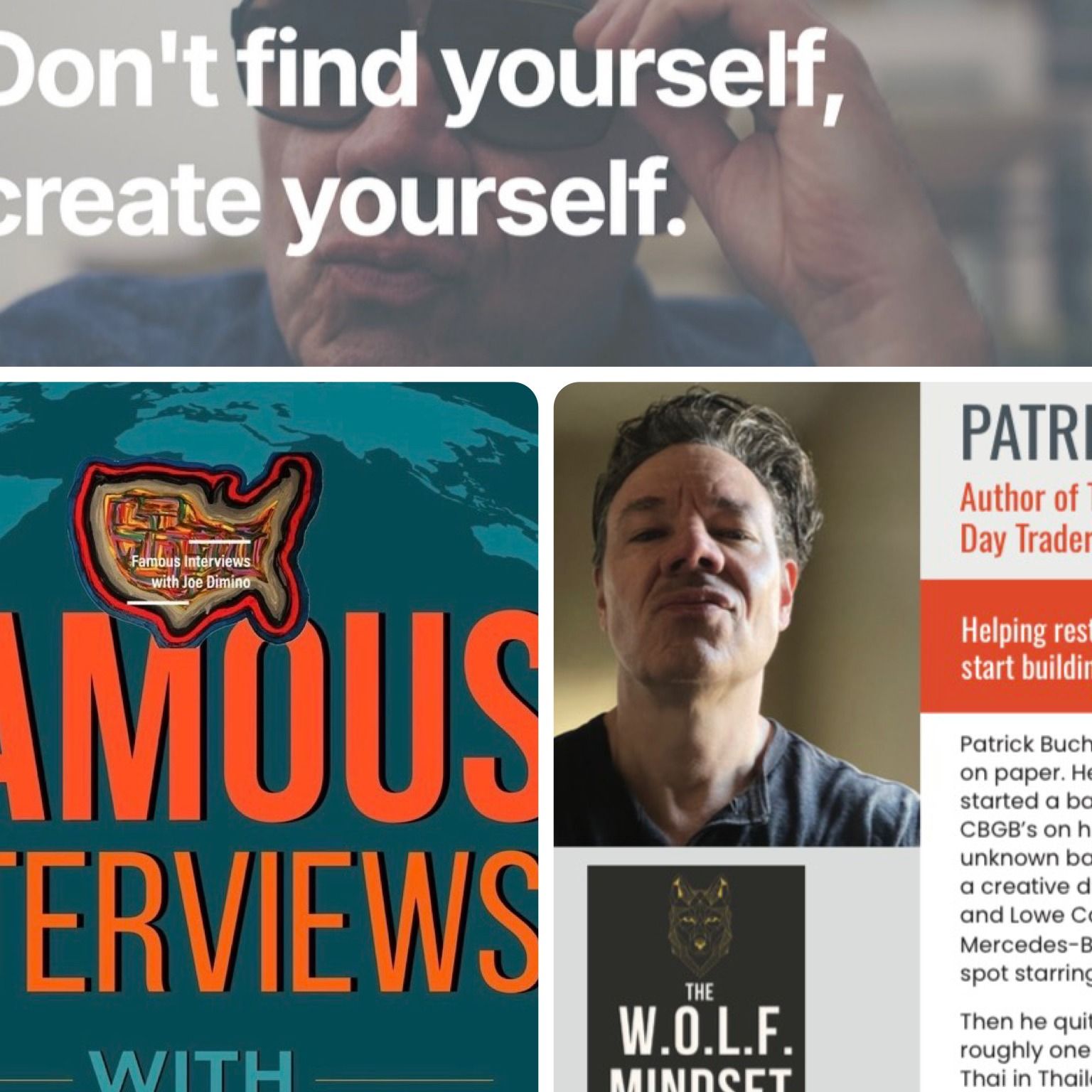
Creative Director & Author Patrick Buchanan on The W.O.L.F. Mindset, Day Trading & Thinking Differently
Get every episode summarized
Each time Famous Interviews with Joe Dimino publishes, we email you a written briefing from the transcript — the topics, who appeared, and any specific claims, with the ad reads skipped.
Email me new episodesFree for 3 shows. No card needed.
About this episode
Famous Interviews with Joe Dimino is made possible by:
“To ghost haunt houses because they have unfinished business or because you have unfinished business or because you have unfinished business or because you have unfinished business or because So let's begin our journey with this.”From the transcript
Welcome to a new edition of the Famous Interviews with Joe Dimino series. On this episode, we talk with Author, Day Trader, Creative Director and Independent Thinker Patrick Buchanan. Most self-help guests tell you to believe harder. Patrick Buchanan wrote a book that argues that might actually be the problem.
Patrick spent 18 years writing advertising campaigns for major brands including Jeep, Grey Goose and Mercedes-Benz, including a Cannes-shortlisted Super Bowl commercial starring Bob Dylan. Then he walked away from the advertising world and taught himself how to trade options.
Today, Patrick works roughly an hour a day from wherever he happens to be in the world, while exploring ideas about mindset, independence, work, creativity and the way we think about success.
In this conversation, we get into the creation of The W.O.L.F. Mindset, his journey from advertising and the day job to day trading, independent thinking, creative work, the philosophy behind his book, Kurt Cobain and much more.
From his current base in Kansas City, Patrick shares the experiences and ideas behind building a life outside the traditional definition of work and success.
More Patrick Buchanan:
The W.O.L.F. Mindset – Patrick Buchanan
For More Famous Interviews: Subscribe via Youtube - https://www.youtube.com/channel/UCgi6GpDDDrc_PgOzaERGbLQ Subscribe via iTunes/Apple - https://podcasts.apple.com/us/podcast/famous-interviews-with-joe-dimino/id1660256991
Subscribe via Spotify - https://open.spotify.com/show/7j92QDS13LXgajPt80X2dh
The Home of Famous Interviews: http://famousinterviewswithjoedimino.blogspot.com/
Contribute to Famous Interviews via PayPal:
https://www.paypal.com/donate?hosted_b
Hosted by Simplecast, an AdsWizz company. See pcm.adswizz.com for information about our collection and use of personal data for advertising.
Get every episode summarized
Each time Famous Interviews with Joe Dimino publishes, we email you a written briefing from the transcript — the topics, who appeared, and any specific claims, with the ad reads skipped.
Email me new episodesFree for 3 shows. No card needed.
Hosts & guests
Transcript ready
131 searchable segments. Every word is indexed and playable.
Full transcript
Famous Interviews with Joe Dimino — Creative Director & Author Patrick Buchanan on The W.O.L.F. Mindset, Day Trading & Thinking Differently. Machine-transcribed; use the interactive transcript above to jump the player to any line.
To ghost haunt houses because they have unfinished business or because you have unfinished business or because you have unfinished business or because you have unfinished business or because
So let's begin our journey with this. You know, I don't think we ever thought that we would live through something like the pandemic and it changed our lives, changed so much about what we did. How much of living through that has changed the way that you work and live today. Well, that's a great opening question because the pandemic was basically the reason that I have my current career. And so my current like, you know, full, I mean, I do a lot of things, but my basic full time income is generated from day trading stock options. And so the way that I kind of just fell into that is at the time when the pandemic first hit, I was living in Northwest Arkansas and I was working remotely for, you know, once everybody started doing work from home, the place where I was working was on the Pacific time zone. So there are two hours behind. And then, so, you know, I had like a big chunk of the morning where I didn't really need to do anything because by the time it was 9 a.m. for those guys when they got into the office, it's 11 a.m. for me being in central time zone.
And I just kind of stumbled on to the idea of day trading options. And I think I watched a YouTube video about it or something. It was a completely random way that I got exposed to it. And I went, wow, that's, that sounds really interesting. Let me look into that. I started learning about it. And then I started actually doing it myself. And the whole time that everybody was on lockdown and working from home, it was super easy to do because the stock market is on Eastern time zone. I'm in central time zone. The people I was working for were in Pacific time zone. So I had this giant chunk of time every single morning before I even had to do my my day job where I could just sit there in front of the computer and trade. And the first hour of the day is the most important hour of the day in the stock market to trade. And so I just I started doing it. And I realized that I could actually do it. And I became pretty good at it.
And then, you know, that eventually we got over the the lockdown and everybody started going back to work. And then I was, you know, I was living and working in Kansas City at that point when we all started going back to work. And I realized at that point that I was making more money in the first hour of the day. Then I made in my entire salary for like a 10 to 12 hour day. So I thought to myself, why keep working a day job when you can just day trade stock options for an hour every morning and basically make the same amount of money. And so I just completely leaned into that full time and you know, just quit my job and started just only doing day trading. And then I started to expand that and like turn that into a little business. And I wrote a couple of books about day trading and I created some video courses.
And right now I host a live day trading room every single day where myself and a bunch of other people that are into trading just get together and we we do it together over a YouTube stream. Wow. There's a chat chat functionality. So people will type in names into the chat. And I'm basically kind of trying to teach and then also do my own trading at the same time. And it's been really good way to live. So let's holistically get a handle on what you do on a daily basis. I'm going to put you in front of 13 year olds a career day. Yeah. The kid back in the room wants to know what you do for a living. How do you explain what you do on a daily basis to make sense to them? Oh, man. I would say what I do is I buy and sell stock options sometimes opening and closing positions within the minute, you know, minute, minute by minute, which is called scalping. And I just I make money when I'm correct on my assessment. So if I think that a certain name, let's just say apple, for example, let's say that apples about to release a new iPhone.
And I think, oh man, price of Apple is going to go through the roof. I might look at the price of Apple in the morning when the stock market opens up. Look for the right time to jump in and buy a call option, which is I'm not going to get too specific just in case, you know, people like you get really into the weeds. But basically a call option means that you think that the price is going to go up. And so I'll buy one call option contract. And then if I was correct in my assessment and the price goes up, I'll sell that very same contract after the price rises. And then the difference between the price that I bought the contract at and what I sold it at, that's my profit. So if I bought the options contract at $100 and then I sold that same contract at $200, I just made $100. And sometimes you can do that in a matter of minutes when you're correct on your assessment. Now that's a very, very stripped down kind of like streamlined version of what it is.
The technical stuff is a lot more complicated than that. But in a nutshell, that's what it is. And so I do that every single day for about an hour every morning. So what did you want to be when you were that age, when you were a kid, what was your dream gig? I wanted to be a rock star when I was a kid, you know, I, I mean, I actually in my new book called the Wolf Mindset, I talk a lot about how I basically had three separate careers over the course of my life. And the book itself is just kind of talking about the process that I, that I used like the psychological techniques that I used on myself to be able to get from one place to the other. But when I was 12 years old for my 12th birthday, I got a nylon string acoustic guitar and I immediately fell in love with it. And so then for my 13th birthday, I got my first electric guitar.
And I mean, I never looked back like I was, I was addicted to playing music. And I mean, I wanted to be a musician ever since I was a little kid. The problem was, I was into really weird chaotic noisy punk rock music. And so my early bands that I was in, those bands were all very, very underground sounding, not radio friendly at all. So I had like a bit of a dilemma because I loved playing music and I loved the music that I was playing. But I knew that the type of music that we were doing was not radio friendly music. And I knew that we weren't going to get famous and make a ton of money playing the type of music we were playing. So I just essentially just kind of spent a big chunk of my 20s making records and touring all over the country and doing like the rock and roll lifestyle type of thing.
And I had some really amazing moments during the course of that. Like, do you, I mean, I know you do like mainly jazz, but do you also ever listen to punk rock yourself? Oh, yeah, no, I'm all over the music map. Yeah. Right. So you know what CBGB is. Oh, yeah, I used to have the shirt. I loved it. Yeah. So, so I played CBGB's on my 21st birthday. Wow. So, you know, as a, as a young punk rocker, that's about the absolute, you've reached the mountain top when you played at CBGB's. And I spent my 21st birthday playing at CBGB. So, you know, that was, that was amazing. We also played with Nirvana once at a tiny little club in Omaha, Nebraska that had like 12 people in the audience because this was before Nirvana had even released Nevermind. And it was right after they put their very first record out and they still had their, their first drummer before Dave Grohl was in the band. Literally nobody knew who they were. And it was like us and Nirvana and like 12 to 15 people in the audience at a tiny little dive bar.
So, you know, I had a lot of experiences like that early on in my life. And it was incredible. But then when I reached like my late 20s and specifically like on my 30th birthday, I remember saying, I need to actually make some money, like some real money because I'm going to be an old man someday. And, you know, I just, I don't, I don't want to be the guy still trying to be a rock star at 40 years old and, you know, not, not doing it. So, I said, what can I do? That's an actual career that's still creative. And, and a thing that doesn't make me, you know, hate my life every day, but that actually pays a decent salary. And so I just transitioned into advertising copywriting because I'd always love to write. And, you know, I wrote all the lyrics to our songs and I was always writing like short stories and everything. So I thought, you know, why not try to get paid to write.
And I knew that advertising pays pretty well because you've got huge brands and, you know, lots of really, really a lot of money flowing around the advertising world. So I thought, let me do that. And I transitioned into a career as an advertising copywriter and eventually worked my way up until the point where I was a creative director at a number of different agencies. And that allowed me to do a lot of really interesting projects as well. Probably the most high profile unique one was I actually co-wrote a Super Bowl TV spot with Bob Dylan one time. So that was, that was pretty wild for the Chrysler 300 car. It was for the 2014 Super Bowl. So that was a thing that actually happened. While I was in the advertising business and so, you know, I had a bunch of wild experiences like that and just basically kept on doing advertising until I transitioned over into doing stock options day trading right now.
So it's been like this really wild thing from going from, you know, punk rock music to finance, which is about as far removed as you can get from one place to the other. But that's, you know, that makes life interesting when you do new things that seemingly have nothing to do with each other. Yeah, you're the guy I want on my trivia pursuit team. That's for sure. You're the one that knows a little, you're like, you're like the lawyer of arts and humanities and that's, that's a beautiful thing. You know, it's interesting. My, my dad was born in Brooklyn, raised in Long Island. So I had a cousin that lived up in Long Island. She was a real hipster and would talk about Joan, jet and the Ramones and all of them were always going to CBGB and in the village and doing their things. Yeah, that's definitely a part of my what was the first live concert you saw the blue you weigh. The first live concert I ever saw my dad took me, I was seven years old and it was kiss original lineup, ace freely. They still have the makeup. I think it was the dynasty tour.
That's why I might, my first one was when they took their makeup off that first time and that crowd was all over them. It was like we didn't know what to do. It was animal lives. And yeah, that's why, and then I remember seeing Motley crew, which why my folks let me go see, shout out the devil when I was 13 months old. I mean, we were air rock in the whole time. Yeah, I worked going off bras were flying. I mean, it was insane. But yeah, that was the era, man. Yeah, yeah. No, the first two Motley crew albums are amazing. I always tell all my friends. It's like the first two Motley crew albums are great. After that, they just kind of went downhill. Yeah, for sure. Once they got into like home sweet home and you know playing the piano and stuff. I was, I was over that I wanted like looks that kill and shout out the devil and stuff like that. Absolutely. So let me ask you this, who has been your consistent like muse inspiration hero that's allowed you to navigate from all these different things from music to stocks. How did how did that happen?
Yeah, I mean, I can't say that I have one particular hero. It's more like I just really, I really love when people just go off and do things that that seem kind of in Congress to what they already know. I'm inspired when there's clashes of things and I try to bring that into my life really. And I know that might sound like a really strange answer. But like for example, when you know when the Rolling Stones decided they wanted to make a disco record. You know, like and they did like some girls. Yeah, I absolutely love that record. And on the surface, you're thinking like the Rolling Stones thinking about disco. Well, that's that's crazy. That's never going to work. But it totally did. Or you think about hardcore punk rock band like the bad brains doing like reggae at the same time as they're playing hardcore.
Just the the clash of different styles and influences. That's always been kind of my my muse in a way. Although it's not like a person. It's the idea that I don't want to just do one thing forever. I want to like I want to live a really wide life. And you know, the one thing that would have been bad about it. About if if I had become famous, let's say, you know, at 20 years old. Then I'm you know, I'm here as like a middle aged guy still doing exactly the same music that I was playing when I was 20 now that would be a career. And it would probably be a nice lucrative career. And you would just say, well, I have to do this because this is what's paying the bills. But I think as far as as development, like development in life, that's not going to do as much for you as a person.
Then then maybe if you're not necessarily successful in one thing and then you have to go look for other ways to get ahead or to like expand in life. Like a great example. This is you think about like Nick cave, you know, the birthday party. Do you ever listen to the old birthday party out? Really, really noisy chaotic like the noisiest music you'll ever hear. And now he's like wearing suits and doing jazz, you know, jazz singer, crooning. And it's great. It's great music. But it's like this was the music that a young person wants to make. And then you just naturally grow older and you develop and you evolve. And when you're 50 years old, you don't want to do the same things that you wanted to do when you were 20 years old. And that's just being honest to yourself and that's allowing yourself to grow and evolve. And I think that's a beautiful thing. So well said. I mean, I even think about radio head going from the bends and okay computer to kid A house. Yeah, absolutely spectral that was and bands do that all the time. But that's such an interesting take.
I don't think I've ever heard it put that eloquently because we are all human beings and we are all on an evolutionary path. And there's all these things that we want to do. And sometimes musicians have to totally leave the biosphere to go at and do things like that. I mean, I even think about Jim Carey kind of pulled away and doesn't act. And he paints and he paints well. And he does all these crazy things. And it's like right on, you know, you live your whole spectrum of being a human being, you know, and it makes sense. Yeah, exactly. And you know, I mean, bring it back to music just to have a really wide variety of musical styles. Like I genuinely love every single genre of music, except like modern pop radio music. Like the the manufactured AI sounding songs where everything sounds like everything else. I that's I can't stand that. But everything else, you know, from like punk rock to jazz to to blues to, you know, hip hop to techno to acoustic music, got music.
Like all of it, I can find examples in all of those genres where I'm like, this is really cool. And the beauty is is finding little crossover moments where you're thinking, what if I, what if I took like a vibe of this, but just kind of did that with it. Yeah. And in creativity, like that's that gives you the light bulb moments. So if you had a dream tonight ran into the 18 year old version of you and you walked into the room, and there was a film projector and you right now click play in a 60 second highlight reel of your life came up on a screen. Is that young version of you going to believe that your life turned out this way? I don't I don't think so. No, I don't I don't think that the 18 year old me would believe any of it because I genuinely for the longest time thought that the only thing that I could do was play music. And you know, I mean, it might have been like a limiting belief for a while because I loved it. I loved it so much. It's the only thing I wanted to do. And I think when I was a lot younger, I believe that's the only thing that I could do.
You know, because being really honest, like I'm not I'm not good at math. I'm not a numbers guy. I'm not necessarily good at like business. Yet right now, I'm successful in finance. But the thing that's wild about that is that there are certain things that you can get into very very specific things where you don't really need to be a math person or a finance person, but you can still be successful at it. Yeah, so it's almost like if you can just use your imagination and your creativity to try to like find the little opening that can give you the niche, then you're good. And like with my students that I teach with day trading, I always tell them, you don't need to know everything about how the stock market works. And you don't even need to know everything about how you're trading software works. All you need to do is know a very specific set of things. And as long as you just understand those particular things, that can make you money. And that's all you have to do. And that's what I do every day now.
So in that highlight reel of your life, what are you the proudest of? What stands at the top? Oh, wow. I think probably the thing that I would be the proudest of is just simply having such a wide variety of experiences. I mean, like I've I've had experiences that a lot of people will never have just from from having not only traveled all over the world, but having so many different types of weird jobs and just strange careers and all the people that I've met over the course of my life. And you know, I think about a lot of people, they might do one thing for the entirety of their life. They just they work the same job and they go to an office every day. And if that genuinely makes you happy, then that's great because I do think that the ultimate goal is to just be happy. And if you're the type of person who is who is really happy, just going to the same office every day for 30 years, then more power to you.
Because you're happy. But for me, I always knew that that wasn't going to make me happy at all. I knew that I had to explore and I had to go out and have adventures and do all kinds of wild crazy stuff and to feel like I was getting some fulfillment out of life. And so I think that the thing that I would be the most proud of is just that I have had so many really wild, you know, life altering experiences. And I think that's that's it. So let's get to the crosshairs of your soul. Everyone has a perception of you, family, friends, clients, everyone that knows you, but you run the show we see. What's your perception of you? Who do you think you are? I mean, just in a nutshell, I think that I'm a curious, imaginative, creative individual. I'm interested in a lot of things. And I've always said that, you know, interesting people are interested.
And like, you know, in my, in my new book, there's one part where I talk about how, you know, when you see something that you don't understand, there are basically two ways that you can approach that. You can look at that, that person or that thing that you don't understand. And you can go, I don't understand them. I'm scared. Or you can look at that person and you can go, I don't understand them. I'm curious. I want to learn more about them. Or I want to learn more about that thing that I don't understand. And I've always been a person who is not scared of things I don't understand. I'm curious about things that I don't understand. And I mean, I think that that's really just it in a nutshell. So I got to know stripping away the legend and the lore and everything was Kirk O'Bane and I Sky. You know, honestly speaking, he was quiet out of the, out of the three guys.
What I do remember, and like, I was a teenager at this time. I was 15 or 16 years old. So my memory of it is really fuzzy. All I remember is that there was a moment when all six of, we had a three piece band as well. So all six of us were sitting around a table like drinking beer. And yes, I was drinking beer illegally under age. Sorry, but it happened. And, and so I remember them going, so what's the scene like in Omaha? Because we lived in Omaha at the time and we're like, it sucks. Everything in Omaha sucks real bad. And we went, what's the scene like in Seattle? And they go, it's great. There's so many bands. It's like there's all these bands and coupes. And this is right before the whole grunge movement exploded. So they were obviously telling the truth. But the one thing that I remember is that Nova Selik, the bass player, was definitely the most gregarious one out of the three.
And I don't really remember Kurt much at all. I think he was just really quiet. Yeah, I think he kept to himself more than the other guys did. Yeah, I can see it. That's what I do remember about that. Yeah. You know, I always thought the only real hope for Omaha was that maybe Barack Obama was from there. And they would rename it Obama Ha. And then they could just walk into a whole place. Yeah, yeah, that's great idea. Now, I love the fact that Marlon Brando and Malcolm X are also both from Omaha. So those are two pretty cool, cool cats to have from the city. Totally. I love that about cities. There's always somebody that is from a place that's remote that you wouldn't expect. There's always some claim to fame that exists. So if anybody wants to pick up your book, they want to reach out. Any of the good business, anything going on in your world, where's the best place to go? Well, if you like to get either one of my books, I've actually got a lot of different things going on simultaneously, which makes sense based on what we just discussed.
But my newest book is called the Wolf Mindset. It's an acronym WOLF, which stands for Willpower Order, Love and Fidelity, which is like basically the framework of how I applied it to myself to get me into the world. I'm going to give you a chance to get me up until we're out today. If you want to buy that book, that's available on Amazon.com. I've also got a couple of books about day trading. One of them's called Secrets of the Loan Wolf Trader. And that one was a best seller for a while on the finance section of Amazon. So you can get that one as well. I was really proud of this one review. It's got a lot of really good reviews, which is cool. But the one review that I was the most proud of is one guy that I totally did not know said, this is the best trading book that I've read in 10 years. So that was a really cool compliment. You can get that book on Amazon. And I've got a website about the day trading, which is called Loan Wolf Trading Club.
So you can go to Loan Wolf Trading Club.com and take a look at my video courses. I've also got a YouTube channel about trading called Loan Wolf Trading Club. And I've also started doing actual one-on-one coaching with people if they're interested in learning on a one-on-one basis what the Wolf Mindset is. And if you're interested in that, the website, it's basically just a one-pager, is called Wolf Mindset.life. So you could go on that. And it's essentially just an intake form where if you're interested in working with me directly one-on-one, you just basically fill out a little questionnaire. And I'll get in touch with you. And we can see about potentially working together on just personal development. I hate to call it like life coaching because that sounds really cheesy and corny. But essentially it's like people who are, they feel like they're stuck in life and they want a bit of a jump start. It's something that I've been doing with people.
I love it. I will put all these links in the show. It's Patrick. What a joy, man. Thank you so much. Thank you for taking a minute out. Today was great to meet you. Thank you very much, Joe. It was really great meeting you too. Thanks for tuning into another famous interview with Joe Domingo. We're becoming the World of Art, literature, business, spirituality, music, and more from around the globe. Our esteemed theme music was composed and produced by the great EE pointer of Kansas City's River Cow War District. If you want to hear more interviews, visit the famous interviews with Joe Domingo Channel on YouTube. You can also find us on Spotify and Apple Podcasts. Thanks again for listening and until next time.
More episodes
More from Famous Interviews with Joe Dimino

CEO, Author & Speaker Judy Gaman on Longevity, Healthy Aging & Living a Longer L...
Famous Interviews with Joe Dimino

Owner & Musician Chris Whittington on Christian Business, Rock Music & Faith at...
Famous Interviews with Joe Dimino

Speaker & Executive Rob Nickester on ADHD, Leadership & Overcoming Self-Doubt
Famous Interviews with Joe Dimino

Accomplished Poet & Author Lucille Lang Day on Poetry, Memoir & a Life in Writin...
Famous Interviews with Joe Dimino