Get every episode summarized
Each time Sourcery publishes, we email you a written briefing from the transcript — the topics, who appeared, and any specific claims, with the ad reads skipped.
Email me new episodesFree for 3 shows. No card needed.
About this episode
Sourcery is made possible by:
“Instead of raising for 18 months, we raised for a few years. This was very intentional because there's a big difference between starting a school and starting a AI app.”From the transcript
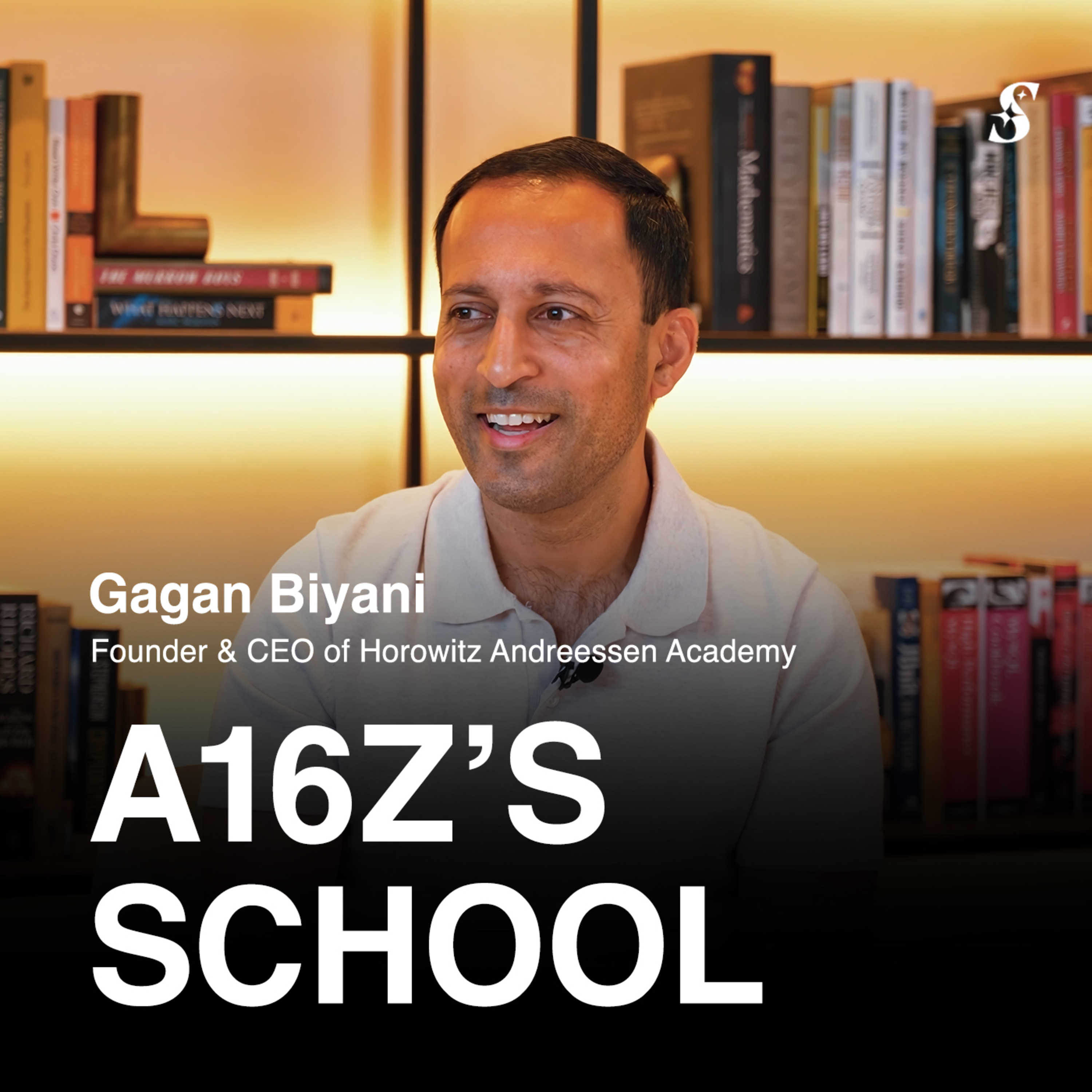
Gagan Biyani, Founder & CEO of Horowitz Andreessen Academy (fmr Co-Founder of Udemy and Maven), joins Sourcery from a16z’s San Francisco office to unveil a new kind of school built for the AI era.
Backed with $42M from a16z and investors including Adam D’Angelo, Tobi Lütke, Tony Xu, Fidji Simo and Shyam Sankar, Horowitz Andreessen Academy is an AI-native, unaccredited residential program designed for some of the world’s most ambitious young builders.
Its Founding Class will bring roughly 50 students to San Francisco in Fall 2027 for a one-year, tuition-free fellowship. Instead of optimizing for grades, tests and credits, the Academy plans to optimize for proof of work, high agency and building real projects.
Students will learn alongside a network that includes founding partners Anthropic, Anduril, Coinbase, Meta, NVIDIA, OpenAI, Palantir, Replit and Stripe, with 75–80% of their time intended for projects and building.
Gagan and I discuss why AI is forcing education to change, why he believes traditional college still makes sense for most students, the rise of the “super IC,” why young founders shouldn’t rush to raise venture capital, what it means to become an AI-native builder, the importance of failure, and why Silicon Valley itself is central to the Academy’s model.
Gagan Biyani: https://x.com/gaganbiyani
Molly O’Shea: https://x.com/MollySOShea
Sourcery: https://x.com/sourceryy
𝐄𝐏𝐈𝐒𝐎𝐃𝐄 𝐋𝐈𝐍𝐊
YouTube: https://youtu.be/5JEjv-JlYo8
𝐒𝐏𝐎𝐍𝐒𝐎𝐑𝐒
• Brex—The modern finance platform, combining the world’s smartest corporate card with integrated expense management, banking, bill pay, & travel. https://brex.com/sourcery
• Zone—develops next-generation data center campuses, partnering with AI companies, site developers and technology leaders to bring compute online faster and at scale. Visit: https://zonefrontier.com
• Turing—Turing delivers top-tier talent, data, and tools to help AI labs improve model performance—and enables enterprises to turn those models into powerful, production-ready systems. https://turing.com/sourcery
• VCX—VCX is the public ticker for private tech, allowing investors of all sizes to invest in venture capital. View The Portfolio at http://GetVCX.com
• Deel—Deel is the global people platform that helps startups hire, manage, pay, and equip anyone, anywhere. Trusted by more than 35,000 fast-growing companies, Deel is the people platform that just works, so teams can scale without the chaos. Visit: https://www.deel.com/sourcery
• Public–Investing platform Public just launched Generated Assets, which lets you turn any idea into an investable index with AI. With Generated Assets, you can build, backtest, refine, and invest in any thesis with AI. Gone are the days of one-size-fits-all ETFs. https://public.com/sourcery
Follow Sourcery for the latest updates!
Disclosure
Paid Endorsement. Brokerage services by Open to the Public Investing Inc, member FINRA & SIPC. Advisory services by Public Advisors LLC, SEC-registered adviser. Crypto trading provided by Zero Hash LLC, licensed by the NYSDFS. Generated Assets is an interactive analysis tool by Public Advisors. Output is for informational purposes only and is not an investment recommendation or advice. See disclosures at public.com/disclosures/ga. Matched funds must remain in your account for at least 5 years. Match rate and other terms are subject to change at any time.
𝐓𝐈𝐌𝐄𝐒𝐓𝐀𝐌𝐏𝐒
(00:00) Gagan Biyani, Founder & CEO of Horowitz Andreessen Academy
(01:01) Why this Academy is different from college
(04:44) Started his first company at age 13
(11:55) Raising $40M for a School
(19:08) Should young builders really start companies?
(31:33) Why schools need to embrace AI
(48:51) Why high-agency students struggle in college
(1:02:19) Why you should apply even if you don't get in
(1:08:54) What the Academy program looks like
(1:14:41) Favorite book on AI and climate change
Get every episode summarized
Each time Sourcery publishes, we email you a written briefing from the transcript — the topics, who appeared, and any specific claims, with the ad reads skipped.
Email me new episodesFree for 3 shows. No card needed.
Hosts & guests

Transcript ready
756 searchable segments. Every word is indexed and playable.
Full transcript
Sourcery — a16z Just Launched a School. Machine-transcribed; use the interactive transcript above to jump the player to any line.
Instead of raising for 18 months, we raised for a few years. This was very intentional because there's a big difference between starting a school and starting a AI app. But one of the simple reasons for raising $40 million will have crypto founders and will have robotics founders and will have AI apps and classic SaaS and will have different people coming in. And the promise that I think we can make is that you will learn how to be an AI native builder with super high agency with the people skills to understand the culture of Silicon Valley. And if we can accomplish those three things, I believe this will be the most valuable educational experience that anyone could ever have. You have all these amazing partners like Anthropic, Anderole, Coinbase, Metta, Nvidia, OpenAI, Palantir, Replet, Stripe, and so many more. These students will have direct access to what it takes to build a company. Have you thought about buying Alcatraz? I'm pretty much there. Ha ha ha ha. Gogan Bionny. Welcome to Sorcery. Thanks for having me, Molly. Well, we're here at the A16Z office. We are. We were talking beforehand how Horowitz,
on Dresan Academy, is the reverse order of that. So congratulations on the big announcement. What happened? Well, today we are announcing the most important announcement of the World's largest economy in the world. So, congratulations on the big announcement. What happened? Well, today we are announcing the launch of Horowitz and Dresan Academy. It's a new post-high school program residential in San Francisco for young builders who want to get jobs or start companies in the technology space. And personally, I just think it's like kind of a dream. I think it's a dream for the students because it's a completely new take on what you could do post-college in the AI era. I think it's a huge opportunity for the world because we're going to design a new type of institution that is going to show a positive and optimistic frame
on what college could look like if it adopted some of the principles of an AI native education. So, how is it structurally different? Yeah, I mean, there's a ton of differences between what the school will offer and what a typical college will. I'll give you a couple of examples. First of all, it's completely on accredited. So, we don't have to follow the same accreditation rules of a typical college. We do have to get regulatory approval before we launch our paid programs, but it's very different. So, the differences are first. This program is highly experiential. So, instead of focusing all of your time around class and the sort of top-down structure of a university is fundamentally how many credits you take per semester, this is a project-based experience because in the AI era, you can learn whatever you need to learn on the job. Therefore, it's much more effective for students to go and just build things.
And so, they'll get to do projects that they desire and I have three different categories of projects. I think they'll have research projects, learning projects and building projects or entrepreneurial projects. And so, like, you can imagine a research project where someone is trying to learn everything they can about the restaurant industry or about robotics or about hard manufacturing. You know, they'll go and literally travel to the big manufacturing facilities around the country or maybe even in the world and they will deeply try to understand how it works. While simultaneously, you know, maybe studying robotics, the technical side of robotics, you know, via both self-driven learning but also via online courseware or courses that we offer at the academy. And then, you can also imagine that they then decide, hey, I want to go and try and build like a new type of robotic backing
or I want to play with the new hugging-faced duck, right? And so, you can imagine a world in which this student is visiting factories in Chenzhen or maybe they're visiting factories in Austin or LA. And simultaneously, they are studying online, you know, and through our sort of diverse network of faculty robotics. And they're also building an actual robot from scratch. And this is the type of experience that we want to create for the student who comes to Harvard's and recent academy. So, how does your career in education, building companies result to partnering with Mark and Eric on this? Yeah, I mean, I think this is just a big part of my life's work is to rebuild the education system for the future.
When I start my first company, I was 13 years old. I didn't even know it was a company. Technically, it wasn't actually. Was it legal? It was legal. It was a non-profit, actually. But it made revenue and it had a profit. It's kind of like the modern non-profits that actually have a more revenue than their costs. So, it was a non-profit because all the proceeds went to my high school. And so, I didn't make the revenue. But in all intents and purposes, it was actually a business. I didn't have anyone telling me that this is a valuable endeavor. The school was mostly trying to shut it down the entire time. My mother is probably the only person in my entire life who was like, Guggen, you should keep doing this. I didn't have a single adult. I lived at Grip and Silicon Valley. I had a single adult saying, Hey, you're 13 and you're making $10,000 over the summer. That's amazing.
You should do more of that. Here's how you could do that. Here's how you could turn that into a career. And so instead, what ended up happening was I still went to college. And I didn't go to college for entrepreneurship. And I didn't know you could start startups at that time. I went to college and got a degree in economics. And I think that ever since then, that experience of being a precocious young teen who was attempting to build things but didn't have the support structure or sort of social culture that supported me. I've always been super, super passionate about how you could create a support structure for the young teenager or early 20 something who wants to go and build things and has that itch that I had when I was younger. And so when I was first approached about Harvard's Andreason Academy, I immediately, like within seconds,
I knew I wanted to do it. And the next six months was just me doing whatever I could to try to showcase what I had and to build the infrastructure necessary to get this off the ground. And so I worked with Eric Torrenberg, Mark Andreason and Ben Horowitz over multiple months to figure out how we were going to fund the economy, what the vision was gonna be, ensure that we were on the same page around the potential. We of course decided to make it a startup. So it's a for-profit venture that we hope will be successful and has investors, et cetera. And I, for me, this entire time has just been reliving what I wish I had when I was 13. And you know, candidly when I was 18, graduating and finishing up my time in high school
and thinking, I had no idea that that could be a career. And I'm here to tell the world, like one of the main goals of Horowitz and Grease and Academy is to say, not only can this be a career, but it could be the most impactful and rewarding career you could possibly have. And so through this structure, you have some incredible partnerships already. How did those tie into them and what are they? Yeah. One of the first things that I talked about with Mark Beninarek was that we felt like this needed to be Silicon Valley School. It's not enough to just have Endreason Horowitz. It was critical to us to bring in partners from every part of the tech ecosystem. And so from day one, the first thing that I did after we sort of kicked this project off was I reached out to, you know,
some of the top companies in tech. That's enthropic. It's coinbase. It's meta, you know, Repplet. And we reached out to them and said, hey, like we want to start this company with your support. And so obviously that took a few months. We had to build relationships with the right people. And we were very fortunate that a bunch of these companies have decided to become founding partners. And so that means that these companies are going to help us by providing curricular support. You know, we have an advisory group with them. So we can frequently get feedback on what types of young, what types of talent they're seeing in the market as well as what they want young people to learn. So that everything we do in the curriculum has a eye towards either starting a company or joining one of these companies. And we're also, you know,
obviously providing compute credit, which is really important. One of the most interesting things, right, today as a young person is that you have access to build things that none of us could when we were in our generation. And that access comes at a cost. It costs a lot of money to build things. And so one of the main things Horowitz and Dresden Academy is going to try and do is open the doors to ensure that you can get the money you need to do a science or research project. And the access, not just financial, but also access to network. You know, if you really want to learn what's going on at the latest models, what better place than the academy, which has a direct relationship with the people creating those models, right? And Bidia is a core partner of ours. You know, we plan to ensure that these students get access to whatever the latest knowledge and information is that Bidia has
around how these, you know, around the future of AI. And so if you're going to build an AI forward school, of course, you need the leading companies in the space. It's also interesting that the leading researchers in AI are no longer at university campuses, they are at these companies. And so the other benefit of this type of partnership is that hopefully, and of course, like each partner, we're still working with them, we're still figuring out what their contributions are going to be, right? But our belief is by setting the foundation of them being as founding partners, we will enable us to have front row seats to whatever is happening at the leading AI companies. With $40 million in funding, you raised from some really amazing investors and angel investors, like Adam DiAngelo, Toby Luki, Tony Xu, Fiji Simo, Sean St. Gar from Palantir. What does that funding go towards?
Yeah, that's a great question. I think that first, just to be clear, instead of raising for 18 months, we raised for a few years. This was very intentional because there's a big difference between starting a school and starting a AI app. And one of the biggest differences is you need longevity, right? And so as a student, you have to know that this school isn't going to run out of money. So one of the simple reasons for raising $40 million is to say, hey, we have enough money to operate. In fact, we have enough money we think to get the profitability on the school. How do you get the profitability on a school? Well, yeah, this is a big, spiky point of view, but we believe this school is going to be so valuable that we're going to charge for it. And so I think that there's a, you know, there's multiple revenue streams for Horowitz and recent Academy. One is tuition.
We think that's going to be the bulk of the revenue. On top of that, we also have these corporate partnerships. And so as we grow those, hopefully that will become a significant revenue stream. Because these companies want access to the best students on the planet, and we think that the Academy is going to track the best students. And then finally, I think over time, these students will create amazing businesses. Whether they will join businesses or start businesses, we hope to leverage the schools, you know, the fact that the schools help them along this way to monetize through, you know, equity and businesses, et cetera. And so we think that this can be a successful financial endeavor as well as a successful, you know, good for the world. And so even though it is for profit, you're looking to make a profit on it. You're really thinking multi-generational
and the long-jevy for the long term. So with that, like, you mentioned a couple of the outcomes for the students. What, what do they exactly like buy into? What are they applying for? Yeah, so just to be clear, today we're announcing the founding class fellowship. So it's kind of a unique thing. It's a one-year program, and it does not have tuition. So the first program starting in September, 2027, that you can apply for today, is actually this one-year founding class fellowship. And this program is going to be sort of a version of the eventual two-year program that will launch. But it will have some key differences, one of which is being one-year. When a student signs up for this program, they're signing up to spend a year deeply immersed in Silicon Valley. Emmerced in the principles of Silicon Valley, the Builder First mentality, high agency, and interpersonal skills that we feel like are critical to being successful in the Valley.
The second thing they're buying into is their movingness, and they're going to be amongst a pure set of students who are the best builders on the planet. Like, the big difference between going to the Academy and going to college is we are not going to prioritize your grades. We're going to prioritize proof of work. So you know as a student here that everyone who shows up has built something, and we have this funny phrase that we've been using recently. It's like, you did what? And like, I love this. You did what phrase. When I was meeting these young builders, you know, and doing research for this company, I was like, what did you do? Like, there's this kid, his name's Darshe. He's in Tennessee. He's built an LLM for biology that is beating some of the leading models. He was 16 years old when he started this, right?
It might be 17 today, but like 16 years old, he's building an LLM to design molecules. And now by the way, they pivot it into designing proteins, right? Because he's realized that's the marketing once it go after. We have another student, LL, built a massive TikTok following as a teenager, has also been super involved in building alpha school and helping alpha school turn into what today is a huge, extremely valuable school for young builders, you know, kind of a similar vibe. And so these students are doing incredible things. And what this school is, is you're going to be around other students who are as incredible as you are, and get inspired and see the benefits of the network effect on your motivation and on your thinking. That occurs when you're around these students.
And then of course there's access to the network. You know, there's a reason I didn't start this on my own. There's a reason this is not Gagan University. It's Horowitz and Dresden Academy. And one of the things, you know, I was listening to a podcast that Ben Horowitz said did 11 years ago, right? And from the beginning they had the vision that Dresden Horowitz would create a network. And let me tell you like I have seen now from the inside how powerful it is. We've gone to all these great founding partners. They're at the door in part because they believe in Dresden Horowitz and what they bring to the table and as investors, A16Z has just been phenomenal. And so our goal with the Horowitz and Dresden Academy is to create our own network, right? And create our own network of mentors and faculty and podcast hosts and various, you know, both young people.
We need some of them to be under 25, right? So we're going to find the best under 25 year old. And we're going to have them come around the school. And then we're also going to have the luminaries and people with more, you know, more experience or gray hair like I do. And between that group, our goal is to immerse these students amongst the leading minds of our generation. And so those are the types of things that these students are buying into. And the promise that I think we can make is that you will learn how to be an AI native builder with super high agency with the people skills to understand the culture of Silicon Valley. And if we can accomplish those three things, I believe this will be the most valuable educational experience that anyone could ever have. One that most of these mentors are going to be jealous of. And candidly like I'm envious of the kids who get to go and do this program. I want to talk about the state of education, but before we get to that, I feel like the biggest difficulty you're going to have is retention because people are going to immediately start.
From the quality of the students who were just mentioning, all these VCs are going to be flocking around trying to grab these founders or builders or whatever they want to be and just fund them with money. So how do you keep them focused? Yeah. Yeah, actually, you know, this points to a real challenge that these types of young builders have today. Right? These builders are getting access to VC dollars very early. And they're sort of debating between two, I think very awkward options. One option is the traditional four-year university route where the culture and the sort of environment is not designed for building. It's not designed for career readiness. It's not designed for being immersed in Silicon Valley. And then on the other hand, you have angel investors or VCs that are giving out 150, 250 K checks on a flyer, hoping that this is the next Michael Troll or something. Right? Who's the founder of Kurser?
And personally, I believe that only a very, very, very small percentage of these builders should be starting companies. Right away, like, there's something quite magical that happens in sort of your, quote-unquote, freshman and sophomore year, the first one to two years after high school, which is that you go from like a super structured environment where every hour of your day is completely scheduled. And you have parents driving you to and from, maybe you've got your own car now, but for the most part, you're still super scheduled. You've got homework, you've got tests, et cetera. And you're hanging out only with teens primarily. Right? And so, yeah, some of these young builders are on the internet and they're experiencing the digital world through adults' lens. But in the physical world, they haven't yet really experienced it. And so, we believe that, you know, eventually it'll be two years. The first program is going to be one year. But we believe that one to two years is a really good amount of time to sort of go and explore the world before you start a company.
And so, our advice is, look, if you have an incredible idea, we're going to support you, we're going to help fund it, we're going to help find investors for you. Like, we will support you and go, leave. You can leave in two months, three months, I don't care. However, for the vast majority of students, it's going to be valuable to spend one to two years deciding what you're going to do for the next decade. You know, it doesn't make, it's not actually the right thing to go after the first decent idea you have. It's, you know, startups are a 10-year slog, and most of them don't work out. So, when you go after it, you got to be sure. And so, you shouldn't just take money just because it's there. And that's what the academy, that's one of the core attendance of the academy, is actually that it's not about just investing you in from day one. Some of these people should go on and join companies, some of them should start companies, and some of them should take two or three years in industry, and then start a company.
And we're very supportive of all paths, rather than just going after the traditional four-year path, and or like, raise a bunch of money and start, and you know, who knows if you really care that much about the idea you're working on. I kind of want to discount the four-year path for a little bit, because I think this just fits much squarely. So, you know, if you're really closer to A16z Speedrun, or a Teal Fellowship, or YC, or even the Palantir Fellowship, so like, why the trade-off between those and this? Yeah, I mean, you know, those are all amazing programs. The ones that require you to start a company, and for the vast majority now of Teal Fellows, you're now in a very, very, like, most of them are basically starting a company, that's why they're getting the Teal Fellowship. And that's also true for A16z Speedrun, for example, which of course is going to be a partner of ours, and we will help students get into that when they're ready, or YC's, you know, the sort of normal YC program.
And most of these cases, they're about starting a company, and we still believe in the exploratory nature of a post-high school academic experience. Like, I still think it's valuable to have a set of peers who are your age, that you can hang out with and get to know, and that you can build lifelong relationships with. You know, we're going to be physically in San Francisco, the students are hopefully going to choose housing options that are co-located with each other, and as a result, you know, I very much hope that they build lifelong friendships. I think that time to explore is super valuable, so a lot of these programs do not really provide that. You know, you're supposed to just know what you're going to do and go forward. And by the way, that's awesome. Like, there are some 16, 17-year-olds who know what they want to do, and they're going to go and start that specific company. It's way less than the number who are currently raising rounds. I mean, raising capital for these kids is going to be easy. They should come into the academy thinking, I can raise capital whenever I want. I better, if I'm going to take someone's money, I better do it for the right reasons.
And I think that's really what makes this different. And then finally, like, there's a difference between a structured program and no structure whatsoever. Like, you know, in a situation where all you get is, you know, $150,000 or $100,000, and you just go and explore on your own, it's hard to, there's a lot of challenges. There's a lot of amazing. I'm honestly such a fan of that, that like, if that's your option, like, we'll talk one on one and we'll figure out what the better option is, because it's not, it's going to be different for different people, right? But I will say that I think there are a lot of students for which the camaraderie of a cohort, as well as the fact that they get two years where they have all these mentors coming in that are coming and explaining how their industry works, right? We'll have crypto founders and we'll have robotics founders and we'll have, you know, AI apps and classic SaaS, and we'll have different people coming in. I think that exposure and the structure we're going to provide is still going to be far more enriching than for most students than two years on their own.
This episode is brought to you by Brex, my favorite. You become what you spend on and I refuse to spend my time on work that shouldn't exist, expense reports, receipt chasing, and manual closes. The company is building what's next from Versel, OpenAI, Anthropic, Grenola, and DeepGram, all made the same call. They all run on Brex. Brex is the intelligent finance platform that combines cards, expenses, and banking into a single stack with a gentick finance built in. AI agents that handle expenses automatically enforce policy before spend happens and close your books in minutes. That's why sorcery runs on Brex so I can spend time on building and not busy work. It's time to get Brex AF. Learn more at Brex.com slash sorcery. That's B-R-E-X.com slash S-O-U-R-C-E-R-Y. Bye. Turing is training the next generation of AI with tasks that require real expertise and real world judgment. That's why companies like Nvidia, Anthropic, Salesforce, and Gemini partner with Turing.
Turing builds realistic reinforcement learning environments and data systems based on real operational traces. The kind of infrastructure frontier labs need to train superintelligence. Visit Turing.com slash S-O-U-R-C-E-R-Y. AI needs more than chips. It needs power, land, and infrastructure. Zone develops next generation data center campuses, partnering with AI companies, site developers, and technology leaders to bring compute online, faster, and at scale. Zone is building the foundation of the AI frontier. Visit zonefrontier.com to learn more. That's zonefrontier.com to learn more. We were talking about this before we started recording, but we both have similar archetype where find university, very uncomfortable, just want to start building, working, that kind of thing. I graduated early, right? I graduated early, and I was telling you, pretty sure I took UDME courses when I was in college because I was maxing out my credits. I was trying to get out of there as fast as possible.
One because I wanted to start a business ASAP, I wanted to be an entrepreneur. Also, I was uncomfortable in college. I just wanted to start life. I think this is the most part what these types of people and students will want to do. But what is the archetype that encompasses this? Yeah. I feel like we use the word build way too much, but it's young builders, right? It's young people who are constantly feeling the itch to go and produce things. And that could be producing a podcast. It could be producing a website, creating a new service for people. It could be selling shoes secondhand, which is like a huge business for young teens. It's always a good starting career for teenagers. I feel somehow like the drop shipping and reselling is a good start. Now, for some people, they find drop shipping and reselling and they want to stay in it. Those people are not going to be at the Horowitz and recent academy. We're going to encourage you to go bigger.
It's one thing to build a people call them a lifestyle business. I think a lifestyle is fantastic. I'm a huge fan of people doing whatever is the right fit for them. But the goal of the academy very much is for moonshots. We're going to teach and provide a curriculum that's going to help someone who's been building maybe they made half a million dollars over their high school career. There are actually a lot of students who do this now, which is crazy. But let's say they made half a million dollars. Well, we're going to show them that sometimes you got to go slow to go fast. And why don't you spend a couple of years thinking of an idea that has the potential to hit a billion in revenue. But may not make any revenue for the first three to five years. And so these are the types of students. And honestly, like, it's really interesting because one I was talking to a student earlier who was explaining why she was really excited about the academy and what we're doing. And one of her core statements to me, which you and I would just think this is normal, but you know, because she spends lots of time interacting with adults in her in her career, like her in her early career.
And so one of the things she said to me is like, you actually talk to the students. Yeah, you're laughing like, yeah, that's like literally the definition of customer development, right? That's like one of the first things we're going to do. Make sure every academy student does. Yeah, you need to talk to your customer, right? And as I've been talking to the customer, I'll tell you these kids know who they are. Right. I was talking to a kid at Illinois math and science academy. Right. And by the way, a lot of these kids do go to top schools, right? They go to top high schools. They have the credentials. They'll probably get into a top tier, you know, elite university. And so I'm talking to him and I'm like, hey, you know, you seem like super entrepreneurial. What are your fellow students like? And he's like, almost all my fellow students are doing extra cricklers solely for the purpose of getting into college. Yeah. And I do extra cricklers because I enjoy it. It's a subtle difference, right? Like the difference between those two types of students is not obvious on a piece of paper. But luckily the academy has the resources to interview all of our students to actually dig into what they built.
And so as a result, we plan on recruiting the students who are doing it because they love it. And that's really important. So, but okay. So here's here's some friction like this generation apparently hates AI commencement ceremonies. They're booing AI when they're starting their new year like even the school year I heard from a friend like her daughter just joined Columbia. The moment AI was brought up, they all booed. So there's so much negativity towards it. How do you then build a school around that? And do you expect backlash on that? Yeah, I mean, I think that the I'll take those as two completely different questions actually on the first one. A school that embraces AI is a school that embraces reality and the future like AI is here and it's coming. And like it's it's it's coming even stronger than it is today. And so I believe that most students who dislike AI are not going to be a fit for the academy, right? Because you know and by the way, most people most students are not going to be a fit for the academy.
I mean, we're only taking 50 students in our founding class fellowship, right? Maybe eventually we'll get to 500 maybe we'll be a thousand. I don't know. But there's only a small set of students who need to be a fit for this thing to actually work. And so it doesn't matter that most of their peers are AI doomers. We want the AI boomers. We want the folks who are looking for an AI optimistic future. And we want to show the world that there is an AI optimistic future, right? We're not just about the 50 kids that show up to our school. We're going to try and be out there talking about how this can be a force for good and education. What does AI in a positive way look like in education? Well, first of all, you have to let kids use it to build things, right? Really? You're not going to ban it like New York? You know, we could talk about New York in a second because there's good and bad with that decision actually. But yes, we are definitely not going to ban it. We are going to completely embrace it. In fact, not only we're going to embrace it, we're going to like give them more credits and money so that they can go and build with AI, right?
And of course, there will be limitations on that and they'll have to do it within. They can't just token max the moon, but you know, we're going to teach them how to leverage AI in a way that is positive for creating things because that's what AI allows you to do. It changes the dynamics at work. It used to be that it was really valuable to be a middle manager who is communicating with the executives and then orchestrating a group of humans to move in a certain direction. And now we have the rise of the super IC, right? You know, my company, Maven, is entirely built on this, right? Well, all we do at Maven is teach people how to become super ICs because they're middle managers right now and they need to shift. And so we're just using that same philosophy now for a post high school. You should come in and learn how to orchestrate 30 agents at a time, 50 agents. I don't know. Orgustrate agents that are orchestrating agents that are orchestrating agents, right? Building that architecture is hard. It's complicated. And you need to come to a school that's actually going to teach you that so that you can be in the top 1%.
We don't just want to get you a job at one of these companies. We want you to be one of the highest performers at these companies, right? So the other parts of AI Dumerism, some of it's real, right? Like there are challenges if you just allow students unfettered access to AI, the average student. And this is where we'll talk about New York, right? The average student who gets access to Instagram or TikTok as a child may not be using it in the correct way, right? Like these things are just tools, right? However, well, actually, let me let me continue on that. So I personally, for example, have a rule that if you're writing a document, the first draft should be written by you. You sit down, you write it. I don't think we're going to make that rule at the school. The school is going to be much more open. It's going to be much more results oriented. But within my company, that's how I run the company. And the reason is because I still want you to think through the problems that you're dealing with. And then of course, everything I write now, I plug it into my AI companion and I have it help me think through the problem more.
And sometimes it helps and sometimes it doesn't. But well, it always helps a little bit. It's just whether or not I use everything it says. So I'm not not using AI. AI is a critical part of every workflow. But I'm using it in a way that makes sense, right? Like I have access to a calculator today, right? It's the easiest example I know is very, very tried. But like I have access to a calculator today. But if I'm looking at a spreadsheet that my employee shows that's the projections for their new product initiative, if I cannot immediately identify how this is going to affect the bottom line of our business, because I don't have an intimate understanding of our P&L and how this, you know, 5% improvement in conversion rate is going to affect our growth rate in two years. I have no business being CEO of this company and it's the same thing with AI. If you are going to have the AI do a bunch of things for you or with you, you need to understand what it's doing. And so a co like creating a cohabitation with AI is critical for that.
And that's what we're going to try and create. And hopefully we'll show other universities how they can instead of having like an AI war at their university, they can have an AI harmony. I think the problem, and maybe this is obviously speculation, but I think the problem with most universities is they sit so far away from where their students get jobs or where their career progresses. And so if you're at a university and you have no partnership, no real connection, but job fairs and like five points of removal from the students and where they go next, I think that creates a lot of bifurcation, a lot of friction and confusion for the students. Because they're not hearing it from their future employers, they're not hearing it from like what company they could build next because they're just so far away and dislocated. It was interesting because I was I was recently walking around for the first time. I was walking around Stanford. I was like, shit, this school is beautiful. If I had no fence, if I had no agency, I would totally go here. If I didn't know everything I knew about the world and like could actually focus and sit and have a formal education.
I would absolutely go here, but sitting in a classroom and being in a time bound thing makes me very uncomfortable. I just want to go build things and do things and discover and that kind of thing. But walk around, I saw this classroom teaching coding and we were kind of joking because I think coding and kind of like software engineering now is a history class because we have these tools at AI. But the difference is like, I absolutely believe we still need education. People should go to college. They should get formal degrees to some extent. A lot of people should. Education should still exist. I don't think we should delete college at all. But there needs to be some sort of narrative change in what the after effect happens. It's like just because you get an education, like AI is not going to remove your job. AI is just a tool at work. Like the jobs will change, but like you'll need to learn the tools on the job and like learn how it can help you study more.
And so, you know, I'm going on this little bit of a tangent because I think it's really, it's really awesome how close you sit to the future job growth. Like to using AI and a functional nature and like also kind of to your point of like being a case study for future universities. You have all these like amazing partners. You have all these amazing partners like anthropocannular, coin-based meta, Nvidia, open AI, Palantir, Replet, Stripe and so many more. And like these students will have direct access to what it takes to build a company. What goes on in the inner workings of those companies. And then like direct access to, you know, having a job. And so if you build an academy around AI and your output is jobs, that kind of negates the whole AI takes away jobs narrative that is flooding the market and creating all the scare tactics around AI. Yeah. Yeah, you know, I just don't think we're seeing it. I mean, at least right now. And I'm not saying that I can predict the future.
What I can say is even if the future is a doomer future, you better be in the top 1% because that's going to be the people who, and that's, you know, the people who graduate from the academy are going to be in the top 1%. And you better be in the top 1% because those are the people who are going to be the most needed. And so if you do believe in doomerism, you know, even more of a reason to consider this. But I don't believe in the doomerism narrative. I agree with you. And we're not seeing it. I mean, my friends at the leading AI companies are all working as hard as ever. And, you know, I personally have been working as hard as ever. I believe that the, and by the way, they're all hiring, right? Like go to their jobs page. Oh, yeah. I mean, we cover all these companies. They're all hiring relentlessly and trying to find the talent that is native. And the talent war is raging in Silicon Valley. So I think the other thing that's really unique is like, there is this. Economic phenomenon that has occurred over the last couple of decades where, you know, Mark and Dresden wrote the famous essay, Silicon Valley is eating the world.
And like, I do, sorry, software is eating the world. I'm not so in value because software exists everywhere. But software is eating the world. And what I think is true about that AI will do the same. AI will eat the world. And as AI eats the world, that doesn't mean the world is not going to exist. It's incorrect interpretation. What actually will happen is that we'll just redesign things for AI. So I'm sure you through, I know you live in LA, like you might have friends who are either influencers and started a stereotype. I'm just giving you some, I love going LA. This is, this is why because it's different culture. But like you have, you might have friends who do dropshipping or influencers running lifestyle businesses in, you know, CPG or whatever. And maybe you also, I'm sure, know lots of tech folks. But my point there is that those businesses have been completely changed by AI and they were completely changed by the internet. One of our hiring partners, we have founding partners who are helping us build a curriculum and then we have like 30 plus hiring partners, one of them is Shopify. And obviously Toby and my friend Archie, who I work with at Yudami and is now at Shopify are both investors in the academy.
And you cannot start a CPG company today without using Shopify essentially. And so they're using software, software 8 CPG. But CPG still exists. Like we're still using like what is this cascade mountain from Bute Falls Oregon? Not an ad. They're not sponsoring this at all. But like, you know, this still exists. Like this is a new brand that's, that's, you know, based on the data. Based on the new world order of direct to consumer, the internet is reshaped. And I believe AI will do the same thing to the rest of the world. And so if that happens, like that doesn't mean the rest of the world's going away. What it means is the rest of the world's changing. And you know, I hope that more schools and there are some, right? There's Vanderbilt and Northeastern and ASU that are innovating like crazy and they're embracing the future. And I hope more schools do that. And as those schools do it, hopefully the academy will sort of be the beacon, like the example that's one of our goals with this thing to show what embracing AI can mean for education.
I mean, whenever you say Academy, I'm just like imagining like a very royal looking like brick building and people in, you know, uniforms. But I'm sure this is going to be Silicon Valley version of it. It's not going to be anything like that. Yeah, T-shirts and sneakers probably T-shirts and sneakers. And everyone's going to be reading the hard thing about hard things. Everyone will read the hard thing about hard things. Probably they've already read it by the time they come, honestly. So as we talk about the curriculum, like how do you envision that? Yeah, the curriculum is like one of the most fun parts. I will tell you because when you redesign something from scratch, thinking about the AI future, it kind of like blows, it blew my mind like the things that we decided to do. So one of the most important things that you want to preserve, you know, 75 to 80% time for students to do work on projects and build things. And so instead of having a curriculum where you have, you know, required number of classes every every semester or every quarter.
And you have to do problem sets for those classes and take tests and do a bunch of homework and a bunch of reading, et cetera. Our classes, it's the reverse. So we are definitely still going to have classes on topics like product sense, AI architecture, you know, negotiating, interpersonal skills, et cetera. But those classes are going to be didactic only. So you will come to class, you will learn what you learned, and then you will go build your projects. And so your projects will be applied versions of what you learned in school, but they will not be direct. And the reason that they need to be indirect is because if you ever, you know, in college, you ever get like a signed project. It's like, you know, in accounting, let's do like in business 101 class, you know, it'd be like, right, a business plan. And it's like, they will give you a direct parameter of all the things that you need in the business plan. And they will give you a list of businesses that you can create. And by the end of this, there's no creativity and there's no building. There's no agency.
So one of the most important things we need to do is design a school that creates and encourages high agency. To create high agency, you have to let students make their own decisions. This is a critical component. So how do you let students make their own decisions? But still provide some scaffolding so people don't just, you know, do nothing. Or so that people just go completely off the rails and do things that, you know, might be illegal or inappropriate, et cetera. And like, we certainly don't want that either. And so what you have to do is you create a regular check-in structure. You create a mentor structure. And then you have a class schedule that works around the idea that you're creating an environment where students feel like they always have to be doing building great things. And so every week, you know, and we might do this multiple times a week, we're going to test things out with the founding class and work with them to figure it out. And so, essentially, every week, you're going to go in front of your entire, your sort of pod, right?
Imagine you have a group of eight students. And you're going to tell them what you did the last week and what you're going to do the next week. And so that's on top of having class, you know, a couple days a week, maybe half the day. And so then, you know, you're going to have spent the rest of your time doing all these different challenges. Tell people what challenge you're going to take on. And then you're going to refer back to everyone. Here's what happened with that challenge. And so it's one of the most powerful things in the world is, and by the way, once you enter the real world, that's how the whole real world works. There is nobody telling you you have to do anything, right? You have to decide if you want to go apply to that job. You have to decide whether or not you're going to show up to work every day. And if you don't, there are consequences, but that's it. It's like very, very simple, right? And so we are designing this to both provide enough structure so that students are learning and able to apply themselves. And also that they're building a lot. And I think this sort of peer feedback with a mentor present to ensure that we're constantly pushing students is going to be a really interesting modality that will create.
And by the way, like, just to be clear, this is not new, right? This modality, like Oxford, still to this day essentially operates under this modality, right? And there are many other schools around the world that have started to operate in this way. And of course, YC and Speedrun and these other programs have similar modalities. So we're taking inspiration from those, we're taking inspiration from Alpha School, which is probably one of the best high schools in the country. We're taking inspiration from Montessori. And we're creating a builder-focused curriculum that encourages students to work on their own projects and learn the skills they need to be effective on the job. So funny, before we were talking, Chris and Katie and I, we were discussing Alpha School and we're like, well, where did those kids go after they graduate high school? They're going to be, they're going to, they're going to be bored by college. Where do they go? Yeah. I don't know if it's the first class, but a big class of Alpha students who I've now become friends with are, you know, going to college right now.
And I know one at UC Berkeley and one at Stanford and they have, they've just started. So I am going to be tracking this like a hawk. Like I'm going to be meeting with them and, you know, understanding what's going on. Because I agree, I think it's going to be very difficult to go from an environment where you had high agency, where you were building. For me, it was really hard. I found college to be, look, I was a, just to set the context, like, I think I got a 1490 on my SATs, right. I got 800s on almost all of my SATs. I was a, I got five, I got fives on every single AP. I think I might have had one for, I think it was fives on almost all my APs. I went to a three point, you know, seven on weighted student. I went to one of the top public high schools in the country, right. Like I was a good student, right. Like at the end of the day. But throughout high school, I started to focus more of my time on building, which is why I didn't get a 4.0, right. And by the way, like to get a 4.0 today at the top high schools, you have to give up building things. Because you'd spent all your time in books and all your time studying and doing all this and paying homework and stuff.
And so the smartest kids are questioning this and they're not doing that. So these builder kids, the specific type of kids that we're talking about, they don't always get into the top schools, right. Like I got rejected from every single school I applied to except for the University of California system. And so I went to UC Berkeley and it was stifling. It was very difficult for me. I realized quickly that I just had to completely design my own path. But I was doing it listlessly. I was doing it without direction or any peers even. I didn't know anyone was doing the same thing. I had seven jobs in three years. I mostly had jobs overlapping with class. So I, because I could get an A, and I got A's on those classes, right. But I knew no one doing it. So I did it poorly. And so I agree, these alpha students, they're going to come out of high school having this level of agency, having this understanding of self-directed learning, knowing that they can learn things way faster than the average, you know, and save time.
And create, you know, spend two or three hours a day if you're in honors track and then spend the rest of your time building things. And they're going to realize quickly that there's not a lot of people in college that are doing that. And that's why I think they're going to come to the Horowitz and Dresden Academy or try to get into it. And hopefully we can scale enough to accommodate all of them because I think the first class is going to be really hard to get into. But our goal obviously is to scale in enough that we can make this available to more people. And then maybe other academies will open to who knows, you know, inspired by this. And I hope that we can collectively build a sort of post alpha, you know, opportunity. But I also think that it's not just alpha school kids. There's kids all over the country who are operating the same way, who've just figured it out and they're misfits of their schools. And we want them to come to a place that embraces what they're doing. And we want their parents to be supportive of them because honestly, and I think they are, I think a lot of these parents understand this.
I think a lot of these parents understand that their kid actually has such incredible upside potential. And that it's very difficult to achieve that upside potential if you go to an environment that's stifling. And so our goal is to create this sort of enough structure that they can feel confident that their kid has a good, you know, has a good chance of a good future. A brand that people will recognize in the industry. And yet simultaneously, something that embraces who they are and what they want. Wow. I mean, I know we talked about this too, but like I resonate with your story so much because I experienced the same thing in college. I was like, maxing out my credits. I was like, how do I get out of here and start life as soon as possible? Because I just feel like everyone else wasn't doing the same thing. Like I was maxing out my credits. I had an internship at Google's incubator. I started a company. I was doing free lands on top of that. Like my entire day was blocked out scheduled. And I just like, I really wanted to start. And so I'm curious for like super high agency auto-died acts such as yourself.
How should people know they should apply? Like what, what would that look like for them? Well, can we talk about something real quick? Sure. So like many people listen to this podcast may think that you and I are like unique. And certainly, you know, you're one of a kind. I would like to think that I have my own unique traits. But I think that one thing I'm curious for you to talk about a little bit is when you entered the adult world. I'm curious how many other people like you you found. And as you interview some of the top CEOs and experts in their field. You know, I would love for you to share a little bit about what you've learned about this culture and group of people. And, you know, do the most successful people look like the straight-a-validatorian who went to, you know, a top Ivy school? Or do they look like you and me or somewhere in between? I'm curious what you've seen. I mean, there's no cookie cutter answer for that at all.
Well, when you entered the adult world, now you're really well connected. You know, tons of amazing people. Like, I guess the thing that I'm asking you to talk about is we're not the only people who are like this. Like, this is the adult world is full of people like us. So I will say like, it was really hard for me to find people in college that were like me that had the same mentality. I was taking graduate classes as a sophomore. Like, I just got into those classes. It was cool. People were opening doors for me. I was extremely ambitious, very curious. And I had a great time. Like, I went to NYU. I got in for art. But like, I wanted to get into college like for that. And then I shifted to entrepreneurship immediately and focused on business. Took a ton of business classes. Took Coursera finance classes. Like, because they wouldn't allow me like I did all this stuff and worked away like to get ahead. And then I entered the adult world very quickly. I was in New York. So it's like I was already there. But like my peer group, you know, they were all doing similar stuff.
But like, kind of more of the cookie cutter. Get the banking internship. Do this. Get in line. Start the climb in the professional world. I did not think that was going to be for me. I'm like much more of like a zigzag and like figured out I wanted to try as many things as possible to figure out what I ultimately wanted to do. But like, once I really entered the adult world, it was it was hard for me to find those peers. Like I ended up having more friends that were older than me because they experienced stuff later on. I had a lot of founder friends. Like, and so like I I had much at a much better time like finding friends that were founders than as I've interviewed some of the top founders in the world. Like, you know, so many of them. So many of them Alex Corp dyslexic. Like, you know, a lot of these people didn't graduate college. Some of them changed their careers like, you know, halfway through some of them started their billion dollar company when they were 30, 40, whatever. And some of them started like and grad or dropped out of school. Like, so there was no there's like no main archetype for like a cookie cutter example of any of these founders.
Yeah. The only thing is like high agency ambition, like perseverance, relentless curiosity. And, you know, it's just you you will meet a founder and their brain will open up because they've thought of everything. They've like they've taken every course that they can. They've talked to as many people as possible. But there's just like a totally different level and like you'll feel it and you'll see it. But I think to your point early on is like the humanness of this is is much different because you also need to know what you don't know and you should not be so naive about it. I think the issue with a lot of like early founders or like younger people is, you know, they think the one idea is the billion dollar idea. And they just want to go after that. They kind of block out the world. But in order for a lot of these people to be who they are, they were sponges. They were like no ego sponges of information. I think you get this a lot from like Mark and Dresan and how he speaks and Ben Horowitz too, not to pump the own book. But like you know, read their books. They're great. They're really great. But like it's like that real sponge kind of mentality.
Yeah. Yeah. I completely agree. I think one thing that I'm struck by is that the people who have the most job security are those who's exact. The people who I find to be who I've seen most successful are those who do that because they are these high agency individuals. You know, and we're surrounded by them, you know, in our social circles. These high agency individuals do not rely on a track. The tracks are getting blown up all the time. Right. And when a track gets blown up, the problem that occurs is that you have no control and no ability to figure out what's next. And so learning the skills of high agency actually and learning the skills of being an AI native builder actually make you kind of bulletproof. And so to me, when I got to the valley, you know, and started and by the way grew up technically in Silicon Valley in the framework, California. But I had no idea what the valley was. And so when I say I got to the valley, it's like when I moved to Palo Alto in San Francisco, eventually San Francisco. And I really started meeting people like this. And now I've had, you know, 15 plus years of watching people's careers.
I'm amazed at how much more secure their lives are than the lives of the people I know who decided to follow the classic consulting eye banking tracks actually. And the reason is because Silicon Valley has a magnet for good people always has work for good smart hardworking people who are AI native builders. You might change companies three or four times over 15 years. You might change 10 times over 15 years. But if you have high agency and you can build your essentially bulletproof. And if it's and so that is actually something that I think is under appreciated about the valley is how many different ways there are to be successful here. That was kind of what I was getting at now to answer your other question about applying, you know, anyone who's ambitious should apply.
And the reason they should apply is because they should at least take the time to think about what would I do if I were just building for the next two years. Because even if they don't get into the academy, they should, the application process will be fun. It will be extremely challenging. And that will be its own education in what you could do to optimize your college experience. So if you apply, excuse me, you apply and you don't get into the academy. The process of applying the process of, you know, creating a portfolio, which is one of the things we expect our applicants to do. The process of talking about what you want to build and what you built will encourage you to reframe your college experience. And at the very least you can have a college experience that's similar to the one you and I had. And at the best case scenario, you get in because we are not going to, you know, if you came to building at 18, but you built something really cool and you have talent, we might still let you in.
I think there will be a lot of students like that. And then there will be students that started at 13 and it won't matter. Because as you and I both know, you just mentioned this, a lot of great entrepreneurs started their first company in their 40s. You know, you don't have to start your first company at 18s, 19, 20s. You can start whenever. And as a result, our goal is going to be looking at slope and not like experience, right? So we want to know that you are constantly learning that you're a sponge, that you're someone who is who hasn't pinched for building things and has done builder like things. And we're going to be totally open-minded to the idea that maybe you were like a USA Math Olympiad. And so you were spending all your time on math and you only discovered building like in your senior year or something. That's okay. Like we're absolutely going to focus on a high IQ, high EQ. And so we plan on doing like IQ testing, personality testing and writing testing as part of the second half of the interview, the first part of the interview, the first part of the application is a lot easier.
It's just submit a portfolio and submit your information kind of similar to college, but after that, and then we'll have an in-person interview. And so the point I'm making is that I think that if you're a young person today, and any of what we're saying today resonates, if you're even curious, I think you should apply. And you should fall along because what we're doing is at least going to bleed into your life in some positive way. Today's episode is sponsored by VCX by Fundrise, the public ticker for private tech, allowing investors of all sizes to invest in venture capital. Learn more at getvcx.com. Some of you may not have heard this yet, but our sponsor public just launched something called generated assets. And it brings AI into investing in a way I've honestly never seen before. Here's how it works. You type in an idea like AI-powered supply chain companies with positive free cash flow or defense tech companies growing revenue over 25% year over year.
Publix AI then dispatches a swarm of agents that scan every single US stock, evaluates them, and instantly builds a custom index around your thesis. What really stands out is how clearly it explains why each stock is included. Before you invest, you can even back test your idea against the S&P 500, so you're making decisions with real context, not just guessing. And beyond generated assets, public lets you invest in stocks, bonds, options, crypto, all in one place. They'll even give you an uncapped 1% match when you transfer your investments over from another platform. If you want to build a portfolio that actually reflects your thesis, visit public.com slash sorcery, paid for by public investing, full disclosures in the description. Founders scale faster on deal. Set up payroll for any country in minutes, hire anyone anywhere, get visas handled fast, and get back to building. Visit deal.com slash sorcery. That's D-E-E-L dot com slash sorcery. I know we have a few minutes left, but a large component about this in the founder builder journey, journey 2, is failure.
So how are you going to be teaching the students about failure? You know, I don't have kids myself. I have lots of friends with kids, and I've been watching how what happens when a kid falls and hurts themselves for the first time, or the third time of the hundred time. One of the things that's really, really great about Silicon Valley, so I failed. I have big failures. At you to me, my co-founder and I had a falling out, so I left the company, and then, by the way, the company, he ended up leaving, so the company ended up being run by other people. I just sort of watched it on the sidelines, and we're very proud of that story, but also it was hard. And then I started Sprig, which raised a ton of money and didn't work out. And now Maven, which is obviously a success, and we're now promoting my VP product to be CEO of that company. And now, of course, I'm still raising money for Harvard's and recent Academy. One of the greatest lessons of the Valley is that it's not about your failure, it's about your success.
And so, when students fall, proverbially, like the child, the toddler, who falls on their face, you know, trips over something, or when they fail at a project, like, we are going to congratulate them and help them learn from it. I don't believe in this mentality of making failure cool. Failure is not cool. Failure sucks. Like, you should do everything you possibly can to not fail. And yet, if you fail, it's okay to get up and try again. Let's go. What's next? And the ITSOK part is also important. We need to create a positive, some supportive environment. You know, there have been multiple people who have invested in my companies. They've lost money on Sprig. They're still investing in Maven. They still invested in Harvard's and recent Academy. Right? That's one of the things that's amazing about the Valley. It's not worried about times you fail. It's worried about what you've done right.
And just to put a cap on that, culture is a critical part of schooling. It's not talked about a lot. You will not see it on most of the college websites. You won't see it. Even on our website, it's going to be hard to explain this in written word. So here in a podcast, I can kind of share. Silicon Valley has an extremely powerful culture. I've traveled all over the world. I've been to refugee camps. I've volunteered in Cartagena. I've been to Palestine. I've been to all over Sub-Saharan Africa, as well as parts of Southern, you know, all over the world, basically. Asia, India, Bangladesh, etc. And I will say that some of the best humans I've ever met in my life live here in San Francisco, in Silicon Valley. And the reason is because the culture is about people helping each other. And we plan on creating an extremely, we call it positive sum culture.
We plan on creating a very positive sum culture in the academy, where if you're on top today, you may not be on top tomorrow. So you better be nice to everybody. And if you're on top tomorrow, you think you're going to be on top eventually. You got to be nice to the people who are on top today. Don't take them down through NB or ego fights or anything else. So positive sum is a critical part of the value. It's one of the reasons I love being here, like as someone who cares about the philosopher side of school, not just the builder side, right. We want to create philosopher builders that have that positive sum mentality and the culture of Silicon Valley as part of that. I'm curious. Well, I guess before that, is there anything we didn't talk about that you want to touch upon? I think one thing is that so we're launching on the founding class fellowship and it's going to start in September 27th, it's one year. And there's no tuition. And then in 2028, well, just to be clear, there's no tuition, but you will have to pay for your room and board, right. We don't offer that.
So we will have a bunch of partners that we think are great options and we found some really good options that are more affordable in San Francisco, but there is still a cost there. And then, of course, you know, when you in 2028 pending regulatory approval, we are hoping to launch the two year program. And the two year program will have a tuition that is equal or more than the top tier public, you know, private elite private universities. And so I think it's important for us to clarify that this goal, the goal of this program is to build a high value institution, not an elite institution that delivers so much value that the students think it's absolutely worth that tuition. And I think that's really important to share, you know, as clarity for this announcement. And then the other thing is that the academy is going to be a living and breathing thing. It's going to adapt with AI. And so as AI changes and evolves, I think one of the core tenets of Silicon Valley is that companies are adaptable. We expect the company, the academy to adapt.
And so, yeah, we're putting our name on this. We're going to make it the greatest educational experience of all time, if we can, we're going to do our best. And in doing so, we are also going to adapt and evolve. And so expect this to be a situation that is evolving with the times. Have you thought about buying Alcatraz and putting this there? I'm not sure. I want to, we have like the exact opposite modes. Like a lot of real estate. Maybe Treasure Island. I've seen all these memes on X about like what if you built Treasure Island into this amazing place? You know, this has to be in San Francisco. This is going to be in the heart of San Francisco. I think that's really important. We want the students to be exposed to the city. As we close out, I have to ask you, as you've been building throughout the years, I do think performance is a measure of who you surround yourself with.
And this is definitely a testament to the school, the academy. But who were those people for you that kept you motivated? What were the biggest lessons you learned from them? Yeah. Look, I was super unique. I grew up in Fremont, California. I went to Mission San Jose High School. Anyone who knows high schools knows the school. It's like one of the top in the country. But it's weird because it's in the top, but the teachers and the administration were kind of at war with the students. And so it was not a good school. From a school standpoint academically speaking, the school did not provide a good education, and it did not have a very effective administration, I think. And so it was a really unique experience. And through that, I met some of my best friends that are still my friends to this day. And so my peer group started in the third grade. And I live like 15 minute walk from my best friends from high school. That will not be the case for the majority of the academy. But for me, my friends, Nearge and Vivek, and you know, a bunch of friends I met in speech and debate along the way.
And I've obviously met a bunch of entrepreneur friends. I remember being on San Hill Road where Marco and Jonathan at Thumbtack and Logan and John who eventually started lift were going around. And we were pitching at the same competitions. So there have been a bunch of people over my life. But the greatest gift I had is that I had a solid base of people who were my right or die since I was young. And one of the goals of the academy is to make sure that if you don't already have that, you can get that at the academy, or you can get a second win of it. So if you're like me and you already have it, you can get a second group at the academy that I like you. And so I think that's a, I love that question because personally for me, it's been so valuable to be rooted with a group of friends who believe in me and care about what I, who I am and what I do no matter what, whether I've had a great year in the business world or whether it's been a terrible year for me and I've had both. They've kind of been there for me that whole time. And so, yeah, shout out to my, my MSJ crew. It rolls really deep, but I'm sort of one of those guys. I don't know if you've ever, if you watch the NFL at all, you watch football.
Okay, so in the beginning of the NFL's of like most, you know, public broadcasts, you'll see the football player name their college or high school, they get to choose what they say. And I'm one of those kids who will always stand for my high school, Mission San Jose high school as opposed to my college. Because obviously, as I've said, I do, I did appreciate what I got from Berkeley, but I just didn't think it was, it was up to snuff. So, I think the high school was the place where I grinded, where I had the best friends, where I made the deepest connections that built me and who I am today. And I want to provide that for people in college. I want to provide that version for people who instead of college go to the Horowitz and Dresden Academy. Incredible, great answer. Thank you. I forgot to ask you, what are your favorite books?
We were geeking out about books too. And we're in this gorgeous library. You know, talking about AI Dumerism, I've been an anti-Dumer from day one, right? So, one of my favorite books that is not very well known is this book called Not the End of the World. I found it through Bill Gates actually, so it has gotten some press. It started by this researcher, from Oxford, by the way, who now runs an institute, I think it's in London, maybe it's both locations, but her name's Hannah Richey. And she wrote this absolute banger of a book that talks about climate change. And it says two things, and this is why the book did not become popular. Because being nuanced does not go viral, and it sucks, because as you can tell in this conversation, I'm very nuanced. I actually pro-college, right? Like, I believe in it. I believe in institution. I talked about colleges that I love, and at the same time, I also believe in innovation.
I believe AI is going to change the world, and I also think that that can be a good thing. And so this book is climate change is a very serious problem, and we are actually on track to it not ending the world. To hold those two truths together is very hard for people, but it's true. Do you remember when we had the ozone crisis? When we were kids, we'd get these pamphlets about how Australia is going to burn off, because the ozone layer is disappearing? You don't hear about that anymore. You ever heard about the ozone in the last 15 years? You know why? Because we solved it. We fixed the ozone layer, Molly. Like, we fixed the ozone layer. Like, it's crazy. Pollution in China is going down. Like, we have fixed so many of the world's problems, because we make a big deal about it. We do the documentaries as a society. We talk about how it's going crazy. We'll do that with AI, and then we will figure out how to integrate it into society.
And so the great thing about this book, not the end of the world, is it is both a book of realistic facing the reality of the problems, which is we were pretty close with climate change. We are pretty close, like actually even today. If we don't keep going on our trajectory, there could be major problems. And at the same time, if you follow the parabola of how societies go from no development to strong development, which, and then the peak climate sort of negative, you know, the peak carbon emissions, and then you see almost every major western society is now on a per capita basis. And on an absolute basis, reducing its global carbon emissions. America is actually polluting way less today than it did, you know, 10 to 15 years ago. And Hannah goes through all this, and says that China and India will go through the same evolution. And I believe the same thing will be true for AI.
So I believe in an optimistic future. It's why a lot of my favorite books talk about the realities of the problem and then embrace them rather than just the world's going to end. And so yeah, not the end of the world by Hannah Richie's great book. Fantastic. I'm so glad I asked that question. Well, Gagan, thank you so much. This was fantastic. Congratulations on the announcement and apply to the Horowitz, Andreessen Academy. Thank you, Molly.
More episodes
More from Sourcery

Eclipse's Lior Susan on $12.5B AUM and the Bet on Physical Industries
Sourcery

Brad Gerstner on the Largest Wealth Transfer to America’s Kids
Sourcery

Bending Spoons is Eating Silicon Valley | CEO Luca Ferrari
Sourcery
Brad Gerstner: The $100 Test That Could Save 50,000 Lives a Year
Sourcery