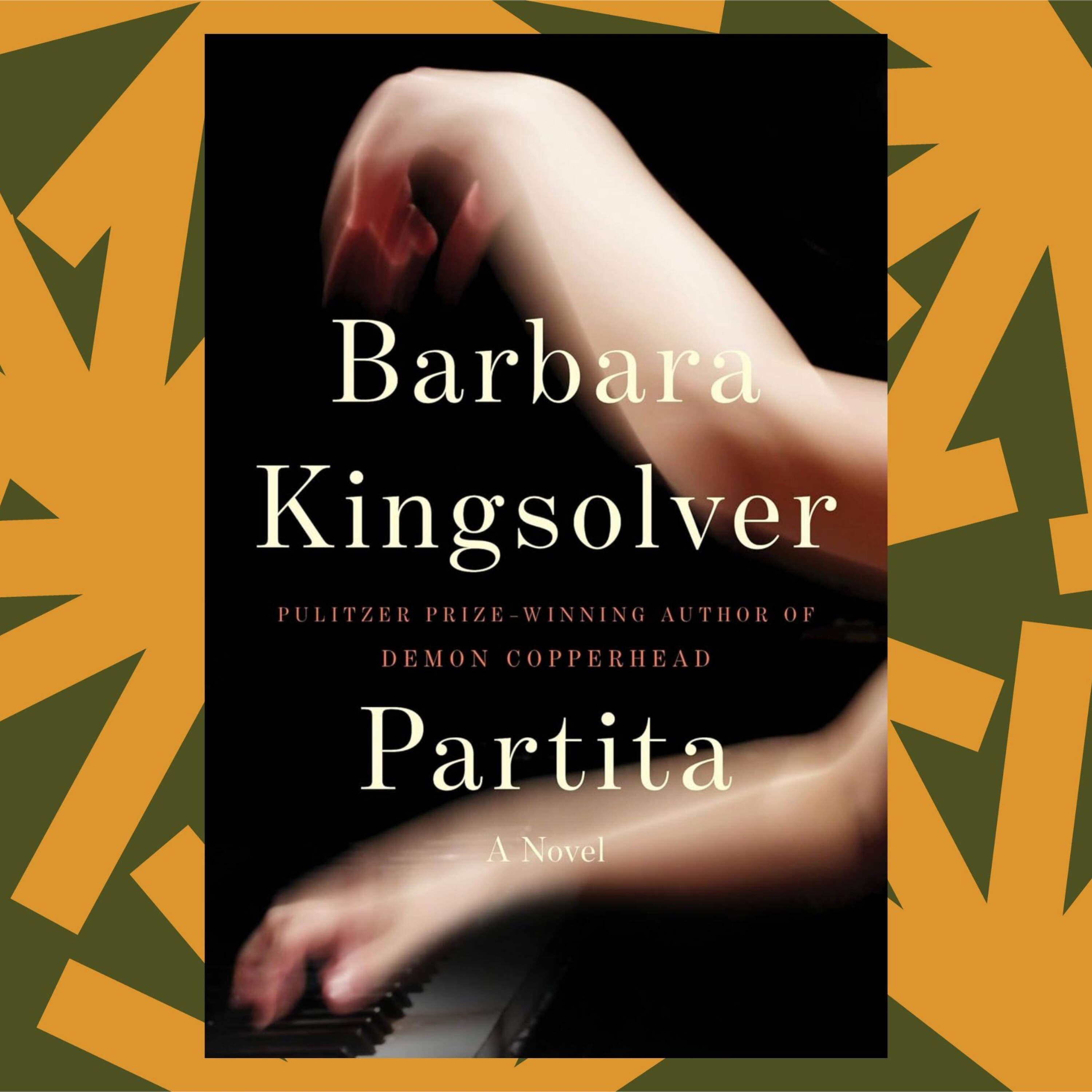
A visit with Barbara Kingsolver: We talk 'Partita,' piano, aging and Appalachia
Get every episode summarized
Each time NPR's Book of the Day publishes, we email you a written briefing from the transcript — the topics, who appeared, and any specific claims, with the ad reads skipped.
Email me new episodesFree for 3 shows. No card needed.
About this episode
NPR's Book of the Day is made possible by:
“Barbara King's solver will not play piano for you. I'll just head that one off at the past. Well, she will not play piano for me and I'm your proxy here. So by extension, she's not playing for you either.”From the transcript
Support public media with NPR+ and enjoy perks for over 25 podcasts like this one. This show’s perks include sponsor-free listening. Learn more at plus.npr.org.
See pcm.adswizz.com for information about our collection and use of personal data for sponsorship and to manage your podcast sponsorship preferences.
NPR Privacy Policy
Get every episode summarized
Each time NPR's Book of the Day publishes, we email you a written briefing from the transcript — the topics, who appeared, and any specific claims, with the ad reads skipped.
Email me new episodesFree for 3 shows. No card needed.
Hosts & guests

Transcript ready
482 searchable segments. Every word is indexed and playable.
Full transcript
NPR's Book of the Day — A visit with Barbara Kingsolver: We talk 'Partita,' piano, aging and Appalachia. Machine-transcribed; use the interactive transcript above to jump the player to any line.
Barbara King's solver will not play piano for you. Not gonna play for you. I'll just head that one off at the past. Well, she will not play piano for me and I'm your proxy here. So by extension, she's not playing for you either. I don't have anything really prepared right now because I've just been through another a hand issue so. More about that hand issue in a bit. But we're at her house in southwestern Virginia in Abalacha. She tells me in multiple times that it's Abalacha, Abalacha. And in her living room there is a piano with some of the music she's working on. She shows me her music books and she gives me just a taste. I'm working on this menu. It's just... Yeah, that's, you know, might recognize that. The Desarabond, the Corrente, the Alamonde. This is Chopin Preludes which are...
You see how worn out and tattered this book is. This is one of my most loved collections here. The Chopin Preludes are really beautiful. Here, Bach II Part inventions. This goes back to... I think I probably have had this book since I was in middle school. I think I... Yeah, I remember playing an invention in a recital. It's Emperes Book of the Day. I'm Andrew Limbong today on the pod, Barbara King's offer. The Pulitzer Prize winning author of now 19 books including the Poison Wood Bible and Demon Copperhead. As you heard, she's loved music since she was a kid. But she has never put that love into her novels until now. Her latest is titled Partita about a woman in Abalacha seemingly destined to become a star classical pianist until, well, it doesn't happen for her. There's a lot of King's offer in this one. I suppose that's true of all of her books, but this one feels especially close to her life.
I'll explain more after the break. This message comes from Wayfair, helping you create a home with quality products, great value, and trusted reviews across every style and budget. Find pieces made for real life and get even more value with Wayfair Rewards. In Wayfair Rewards today to get 5% back on every purchase, head to Wayfair.com to shop all things home. That's w-a-y-f-a-i-r.com. This message comes from BetterHelp. BetterHelp is in network with more than 125 health plans, with an average copay for eligible members of just $23 per session. Don't have eligible insurance? You can still get 10% off your first month. Visit BetterHelp.com slash NPR to explore your payment options. It's betterhelp.com slash NPR. Barbara King's Solver's new book, Partita follows Libya. Like I said at the top, she's someone at the cusp of classical music fame. She's got the piano chops, she's got the drive, and she's got the opportunity, until
her path gets derailed. It's a love letter to a type of music that Barbara King's Solver has loved all her life. So why did it take so long for it to make it into her books? I'm not sure. That's true. Music is really important to me and has been since I was really young. I played piano all the time I was growing up. piano was the thing that really got me through high school in terms of escaping a difficult adolescence, which is something most of us want to do. Music was how I got to college, just kind of on a fluke. I got a music scholarship. So I did study classical piano really intensely for one year in college, and I quickly figured out that I was not going to be one of the ten people in the United States who would make it as a concert pianist. I wasn't, you know, of that caliber. And also, the life was too narrow for me. Every elective class that I took in college, whether it was English comp or anthropology
or organic chemistry, was really exciting to me. I just always said, oh, I want a major in this. And you know, eventually found my way to the wonderful career of novelist in which we get to major in everything. Every new novel is kind of a deep dive into some whole new world of study. But music has remained really important to me. I've played in all kinds of bands. I've played in rock and roll bands and jazz bands. I play for myself. I play with my husband who's a really good guitarist. And when I began this novel, I set out to write a love story. And I had the idea of having my protagonist be a really serious musician who was in love with her art, in love with creating music. And then when she falls in love with a person, those two passions conflict.
She falls in love with someone who really kind of doesn't get how intensely she loves music. And that's, you know, there is the beginning of a series of unfortunate events that kind of break her life into pieces. But once I began really putting the experience of music and making music into words, kind of translating that into language, I loved it so much that I thought, you know, I think this is my 19th novel. And I thought, why did I wait this long? This is really a lot of fun. And I also felt it was really timely. A lot of what this novel is about is the question of why do we need art? What good is music? What does it do for us? Because right now in our culture, as people feel economically insecure, we're experiencing a withdrawal of resources from the arts at every level, from, you know, the NEH all the
way down to, you know, second grade music classes. And I think this is a dangerous trend for us to think of art as expendable. So I wanted to ask those questions and invite the reader to ask those questions. What is it good for? Why do we need it? And Libya, she goes to college for music. And there she, she feels like a fish out of water. And I'm wondering, did that comport with your experience in college? Well, I grew up in a really little town in Kentucky. I did not know anybody else who loved to play the piano as much as I did growing up. I didn't know anybody else who loved reading books as much as I did. I was a weird kid. But you know, there are kids in little towns everywhere who are like that, who for whatever reason fall in love with literature with books.
And this is, there are class barriers to pursuing a life in the arts. And that's another thing I wanted to explore in this novel is the question of class and art. And who, you know, why is it that a lot of us feel like the fine arts belong to, you know, fancy people in cities? Why is it that a lot of the people of this country might not even feel welcome in a concert hall or a museum. So this is, Olivia is a class migrant. Yeah, it's being a class. So while she's at school, Olivia needs a guy named Sigurd. Sigurd. Sigurd. Who? You know, I laughed a lot. He's the type of guy who literally read Marx's foreplay. Yeah. Which I like that. Literally, Marx's foreplay. Yeah. I'm not sure if that would work on me personally. You know, I think I'll see you in the live. He's just that sexy. He's also, he's a handful, but he's really charismatic.
He's one of those people who is kind of a born leader. And you know, I mean, we've all run into them. There's something about him that people want to follow, that people want to impress. And she's, you know, this is really the first time she's ever fallen in love. And she's mainly just overwhelmed that he's interested in her, that he seems so attentive to her and to admire her and appreciate her. And, you know, like really want to get her in bed, which is entirely mutual. But he's also really driven in his own way. I really wanted to design this dialectic to use a word Sigurd would use, in which they are both really kind of mission driven people in completely different directions. And they just don't understand each other. And also they're really pretty young. But it's one of those situations of first love, last love, for Livia, that some people are
unlucky enough to experience in which you fall in love so hard with someone the first time that you just have the feeling it's never going to happen again. At least not like that. But forever after you're going to have to settle for less. And this is where we find her at the beginning of the novel, kind of in the middle of her life, suddenly jolted by a phone call from Sigurd. She hasn't heard from him for over 20 years. And he appears out of nowhere wanting to see her again. And it kind of throws her back into a re-evaluation of this whole affair, which happens pretty quickly. It's really only a couple of months that they're together. But it changes the course of her life. Besides class, it is Livia's brother, Cyrus's suicide. That is the big, breaking point, like undergirding the entire novel.
You learn that literally in the first sentence. This is kind of a shocking opener. And we're not opening in the scene. We're not watching it happen. But she is, it is Livia, ruminating on this event, which is really the most important event of her life, is that when she was 11 years old, she lost her brother, who was the most important person in her life, kind of her only friend, the only person who really listened to her and understood her. They're kind of in league against a cold mother and a sort of helplessly distant father. It's a serious undertaking to write about suicide. And I didn't do it lightly. I've lost four friends in my life to suicide, not all at once, fortunately, but I mean, unfortunately, in different decades of my life, I've lost. So I've spent a lot of time thinking about this kind of loss, which leaves us with a whole
lot to carry, compared with other griefs, a lot of doubts, a lot of wishful thinking that there might have been something we could have done differently. So that's a part of what Livia is carrying through this story. And I hope that I've been able to put a lifetime of processing that kind of loss into some kind of wisdom on the page that might be helpful to other people, because there are a whole lot of us in the world who have lost someone to suicide. Could you read the last paragraph of that opening section? Sure. Cyrus's death broke my parents, but I had to go on being somebody, a sister and not a sister, a person on my own. I was 11 when it happened. We all know 11-year-old girls with their wide eyes and sincere belief that every terrible thing that happens is their fault, except for the carefree few who think nothing is.
Maybe for some of us, when it comes to the ties that bind us one to another, it has to be all or nothing. Maybe I've wished for the mercy of nothing. Maybe I still do. That's the end of a section titled overture. Right. The next one is prelude one, right? Yeah. By those titles. Are you mimicking the effect of classical music piece? I'm not mimicking. I'm creating. I constructed the novel. It's called partita, which is a musical form that's made up of many parts, many different parts. They're typically in the form of dances that 200 years ago people knew what these dances were. An olemond is kind of a slow opening act. Tokata is very sexy and flirty. And so forth. So all of these different parts of a partita are played by the pianist.
As a single composition and the goal is to put the very different parts together in a way that makes something complete. And that's a perfect allegory for this novel. It just made some sense to me to build this novel as a musical composition and to make it really a translation of music into words. And we've talked about some of the grim parts of the novel. And I want to make sure that your listeners understand that there's a lot of fun in this story. There's a lot of sex in this story. It's a love story. We didn't know that. Right. It's a love story. It's a very sexy story. It's also, it's more than one love story. It's a story of young love, which is that kind of passion that's somewhat insane. It just takes us completely out of our minds. But it's also the narrator is looking back at this story through layers of life she
has lived and wisdom she's gained about mature love. And everything that's gained from accommodation, from compromise, from sort of settling in and learning to appreciate what you have instead of wishing for what you don't have, all of these things that add up to a different kind of love. So it became kind of a set of nested boxes. There's a love story inside of a bigger love story. And then I realized the huge love story wrapped around all of this is that eternal longing that we have for art and beauty. We got to take a quick break here. But after King's Silver talks about getting older, the physical limitations on making art and being a voice for Appalachia. See you in a bit. This message comes from Wayfar. Helping you create a home with quality products, great value, and trusted reviews across
every style and budget. Find pieces made for real life and get even more value with Wayfar rewards. Join Wayfar rewards today to get 5% back on every purchase. Head to Wayfar.com to shop all things home. That's w-a-y-f-a-i-r.com. This message comes from Total Wine and More. Getting excited for football season? Let Total Wine and More become a part of your game day routine. Get the cooler ready with your favorite beers or ready to drink cocktails. Pick up enough for everybody and always score the lowest prices. This season make Total Wine and More part of your game day tradition. Spirits are not sold in Virginia and North Carolina. Drink responsibly. Be 21. Can you tell me a little bit about how you first really fell in love with music? I first fell in love with music because of my dad. When I was growing up, we had a pretty modest home, but one of the things my dad had was
a record player and classical records. And he would put on a record and he would lie on the floor. And he would ask, you know, he invited us to lie on the floor in the living room, along with him and listen to something like Revelle's Prelude to the Afternoon of a Fawn or Chakowski's Firebird Suite. And he would tell us, just close your eyes and look at the pictures, listen to the music and let it make pictures in your mind. And I loved doing that so much and somehow making up stories and listening to music became really intertwined in my brain from, I think from the age of four or five years old. I really loved that. And I'm sure that's why as soon as I could sit up at a piano bench and reach the keys with my hands, if not the pedals with my feet, I loved the idea of making music myself.
I felt really compelled to do that. And you realized that you weren't going to be one of the ten, right, who would like make it. You weren't going to beat the dude. Was that a tough decision or a liberating one? It was a relief. I can say that as soon as I understood that was not the life for me, I felt free to go find some other life. I felt sad that I was letting down my teachers, I think, and maybe letting down myself some kind of ambition. But it was really never for me, it was never that I wanted to be a musician. I just wanted to play music. And it's exactly the same way I've always felt about writing.
I did not grow up wanting to be a writer or believing I could be a writer. I didn't even know that books could be written by the likes of me, ordinary people. I just loved to write. And I always did. And I actually never, I didn't study writing in college. I didn't get the MFA. I studied other things in the hope of making a living, getting a job. Practical stuff. A practical stuff. I mean, because of my background, because I knew how lucky I was to go to college. I figured I should learn something useful. But all along, I loved reading so much and I loved writing. I always wrote stories and poems. And I didn't tell anybody that I did that because that seemed sort of, I don't know, I was almost embarrassed to admit it. I just did it because I loved doing it. And the first novel I wrote, I just wrote because I had to write it, not because I thought
anybody would read it. And I would say to this day, I mean, I feel very lucky that I am an author and that I get to make my living this way and support my family this way. And I'm very grateful for all those readers out there who tell me that they're excited about the next book. But really, what keeps me at this is how much I love to do it. I was reading, so you have Dupatrin's contracture? I do. For folks that don't know, can you tell us like what it is and how long have you had it? It's, well, since birth, I guess, it's an inherited condition that causes the fascia in the hands to contract. So it's the goal of Dupatrin's contracture is to make your hands into fists. It runs in my family. It's almost, I could say, common in this region because it's more common amongst scots, Irish people. It comes from Northern European ancestry. They call it the Viking disease because apparently Viking, a lot of Vikings had it.
Anyway, what it means for me is I have to have surgeries every few years to open my hands back up so that I can play the piano. It's ultimately damages some of your joints so that they can't fully straighten. But I have a great hand surgeon and a great team at the University of Virginia Hand Center who've kept my hands functional for the last 15 years. You named your doctor. Yeah, I thanked him in the acknowledgments. He actually, because I will, without saying too much, there is a serious hand injury in this novel. I asked him to vet the medical parts. He was gay. I was really delighted that he was really into it. I'm thankful for that. I'm lucky to live in an era when this is possible that I've been able to keep my hands functional so that I can write novels on a keyboard and play that piano.
Every surgery does the range of motion just max out shorter. Are you back to where you are? No, no, you can probably see this finger is not what it was. I don't have the extension in this hand, but I do, I've kept it in this hand, which is more important in the left hand. It affects your typing. I'm guessing. Yeah. Yeah. Which means is there a time limit? Are you looking down when it's like... I try not to think about that. When that right shift is not going to happen. Well, I accommodate. This finger has taken over most of the job of this one. It has limited. I can't play all the pieces. It's affected my piano playing, of course, and I can't play all the pieces that I used to play. When one of the things I wrote about in this novel is the frustration of after an injury.
This is something that people experience not just as pianist, but in sports, in all kinds of physical work. There are career-ending injuries, and there are career-limiting injuries. One of the things that we have to deal with afterward is accepting that we will never be what we once were. And I guess you could extend that to aging in general. We have to live with bodies that can't do what they used to do. And how do we handle that? I think we live in a culture that really loves to pretend that isn't true. Pretend that there are no limitations or that we shouldn't have to accept limitations. But there is also a kind of freedom to be found on the other side of realizing we are
still all of the people we have been in our lives. They're all just different. And this is something, as a writer, I'm really aware of and really grateful for, that I have had this long career and this opportunity to expand, to know more and to take more risks on the page. And to look back at all those different writers I've been in my 30s, in my 40s, and that at each decade I was giving the world something from that position that I held in the universe at that time. Speaking of your past books, so you did a ton of press for Demon Copperhead, right? Which is for people who don't know or retelling of David Copperfield said in Appalachia. And so you did the regular amount of press for that, and then it won the Pulitzer, and I saw you show up again after that in a bunch of different places.
In that process, did it seem that you were becoming the spokesperson for Appalachia? Well, it's not the first time I've felt like that. Maybe it's the first time I've felt like I was being heard. We feel invisible here. We do not see ourselves represented on any popular culture unless it's as a joke, unless it's as some kind of a condescending hillbilly joke or a poverty documentary. That's kind of what we get. I mean, just the fact that people don't even know how to say Appalachia, this huge region of the country, tells you that people are not used to hearing us represent ourselves. People are used to hearing other people talk about us if they hear any such thing at all.
I mean, this is my whole life after at least from the day I left Kentucky and went to college in Indiana, I have learned that I come from a place that people think is backward or hilarious or just, you know, not worth investigating flyover country. They call it and it's not just Appalachia. It's, you know, most of rural America. So this is something I've lived with my whole life. It took me a while to come around to embracing it as a really important part of not just my identity, but my voice as a writer, because what I have to offer comes from being true to my origins. So what are the questions? Did you ever feel subconscious about taking that mantle as like a spokesperson for Appalachia?
Well, no, because look, I'm standing on the shoulders of Harriet Arno and Robert Penn Warren and Bobby Ann Mason and Wendell Berry and so many others have done this before me and so many others are doing it now. And Silas House is a great, great Appalachian writer. He has a novel coming out. Same week is mine, The Tulip Popplers, which is a fabulous novel. Because I live here, you know, I'm in this community of Appalachian writers. I don't feel like I'm doing this alone by any means when some recognition falls to my books as it did with Demon Copperhead, which won that big, big fancy prize. What makes me happy is that people around here, people, I didn't even know if my neighbors knew what I did.
You know, I figured they figure I don't have a job because they don't see me driving out in the morning. But you know what, they all said, we won that prize. It was fireworks all the way up and down the mountain. People were so proud that that novel was considered great. So that makes me happy. Yeah. I was watching a talk that you did. There's a talk and then there's a Q&A. And this guy comes up and he has this question about, oh, why do the people there keep voting against their own self-interest? I was very moved by the appropriate arguments about the way elites and people talk about people from Appalachia, poor white trash, all that stuff. But the question is, how do you explain people voting apparently against their own best interests? That's my question. Okay. I don't know if you quite really rise, but I see you get, you camera comes to you and
you look clearly like exasperated or annoyed or something like that. I was curious after all this, what do you think it is that people still misunderstand about this place? I mean, fundamentally people think we're stupid. That's the long and short of it. People from the outside see poverty. They see under employment. They see kind of a monoculture, demographically and ethnically, which is not who we are. They see that because they're not really looking at us. They're seeing artificial representations. They're not seeing nuance. But mainly, I mean, when it comes to the poverty and the under employment and the limited
education, what they're looking at is what has been done to us by hundreds of years of exploitation by extractive industries that came in here and they took out the timber, they took out the coal, they took the tobacco and left behind a mess. A lot of the limits, the limited employment opportunities and the limited educational opportunities were deliberate because for more than a century, the coal companies literally owned these mountains. They didn't just own the mines. They owned the stores and the schools and the courthouses and the government and they kept out fiber mills, other kinds of mills, other kinds of factories that could have employed people because they wanted a population that would be miners. They deliberately suppressed education because they didn't want an educated population.
They wanted miners. Then the coal ran out and then they left and here we are. It is not the first or last case of people blaming the victims of their circumstance, but it is, you know, it's a kind of institutional, inherited lack of resources and lack of privilege that we get blamed for still. And it's shocking to me that in a time when most educated people know not to make contemptuous jokes about an entire category of people, we still get it. Barking software, thank you so much for talking. It's been such a pleasure. That's it for this week on NPR's Book of the Day. Let us know what you think. You can write to us at bookoftheday at npr.org. I'm Angelin Bong, the podcast is produced by Chloe Weiner and edited by Megan Sullivan, founding editor's Petro Mayor. So elements for this week were produced and edited by Todd Munt, Emico Tamagawa, Dave
and Miss Stitch Martin, Haitian Smosa Gray, Smith Abalban, Adriana Gallado and Margot Barreline. Thanks for listening. This message comes from Midi Health. Most women never get real answers about their hormonal health. Midi is changing that with virtual care covered by most major insurances. And your hormones. Visit joinmitty.com to book your first visit today. This message comes from Instacart. Whether you meal prep or meal panic, Instacart's new shopping assistant Clementine is here to help. You can generate a recipe in seconds, add everything you need to your card, and have it delivered in as fast as 30 minutes. Plus you can plan a menu for any occasion, get meal ideas for the week, and reorder your favorites with just a few taps. And less time figuring out what to make and more time enjoying it. Download Instacart and try Clementine today.
More episodes
More from NPR's Book of the Day

A conversation with Tomi Adeyemi on her new novel 'The Siren'
NPR's Book of the Day

In 'History by a Hair,' DNA offers answers to an old question about Thomas Jeffe...
NPR's Book of the Day

'Pachinko' author Min Jin Lee says writing 'American Hagwon' transformed her
NPR's Book of the Day

'Profiles in Cowardice' argues leaders failed to push back against President Tru...
NPR's Book of the Day