Get every episode summarized
Each time Autocrat- A Roman History Podcast publishes, we email you a written briefing from the transcript — the topics, who appeared, and any specific claims, with the ad reads skipped.
Email me new episodesFree for 3 shows. No card needed.
About this episode
“This is episode 90 plus 26, the reign of King Firehead. It's not enough that in your language 96 is 420 plus 10 plus 6, you had to do this to me. We left off with Servious Julius, the son in law of Tarquinius Priscus, becoming the sixth king of Rome.”From the transcript
Servius Tullius is on the throne! We had an exciting start last time, but today it's all a bit slower-paced with tax reform, property classes and admin. Still, let's watch the first census be conducted, discuss Roman money, and examine quite why Servius hates tortoises.
Time period: 578- 534 BCE
Relevant individuals:
- Servius Tullius, 6th King of Rome
Sources for this episode:
- Appian (1972), Appian's Roman History in Four Volumes (Volume I). London and Cambridge, Massachusetts: William Heinemann Ltd. and Harvard University Press.
- Carr, J. L., Riedle, D. J., Munscher, E., Pearson, L. S., Kessler, E. J. and Dreslik, M.J. (2025), Macrochelys temminckii. The IUCN Red List of Threatened Species2025: e.T232775771A507158.
- Casale, P. and Tucker, A. D. (2017), Caretta caretta. The IUCN Red List of Threatened Species 2017: e.T3897A119333622.
- Cassius Dio (1961), Dio's Roman History (Volume I). Translated by E. Cary. London and Cambridge, Massachusetts: William Heinemann Ltd. and Harvard University Press.
- Dionysus of Halicarnassus (1960), The Roman Antquities of Dionysus of Halicarnassus (Volume II). Translated by E. Cary. London and Cambridge, Massachusetts: William Heinemann Ltd. and Harvard University Press.
- Eutropius (1760), Eutropius: Epitome of the Roman History. London: Printed for W. Johnston et al.
- Livy (1971), The Early History of Rome. Translated by A. de Selincourt. Harmondsworth: Penguin Books Ltd.
- Luiselli, L. (2024), Testudo marginata. The IUCN Red List of Threatened Species 2024: e.T21653A2777760.
- Luiselli, L. (2024), Testudo hermanni (errata version published in 2025). The IUCN Red List of Threatened Species 2024: e.T21648A268511652.
- Luiselli, L., Capula, M., Di Vittorio, M., Marrone, F. and Vamberger, M. (2024), Emys trinacris. The IUCN Red List of Threatened Species 2024: e.T158469A778721.
- Marks, A. and Tingay, G. (date unknown), Romans. London: Usborne Publishing.
- Matyszak, P. (2008), Chronicle of the Roman Republic: The Rulers of Ancient Rome from Romulus to Augustus. London: Thames & Hudson Ltd.
- Moldowan, P. D. and van Dijk, P. P. (2025), Chelydra serpentina. The IUCN Red List of Threatened Species 2025: e.T163424A251347989.
- Orosius (1936), History Against the Pagans. Translated by I. W. Raymond. Available at Attalus.
- Sextus Aurelius Victor (1825), Galerie Romaine, ou les Hommes Illustres de Rome et les Cesars. Translated by A. Caillot. Paris.
- Tortoise & Freshwater Turtle Specialist Group (1996), Emys orbicularis. The IUCN Red List of Threatened Species 1996: e.T7717A97292665.
- Tortoise & Freshwater Turtle Specialist Group (1996), Testudo graeca. The IUCN Red List of Threatened Species 1996: e.T21646A9305693.
- van Dijk, P. P., Harding, J. and Hammerson, G. A. (2011), Trachemys scripta. The IUCN Red List of Threatened Species 2011: e.T22028A97429935.
- Wallace, B. P. and Broderick, A. C. (2025), Chelonia mydas. The IUCN Red List of Threatened Species 2025: e.T4615A285108125.
- Wallace, B. P., Tiwari, M. and Girondot, M. (2013), Dermochelys coriacea. The IUCN Red List of Threatened Species 2013: e.T6494A43526147.
- Author unknown, British Army (date unknown), Pay, Salaries & Benefits (online) (Accessed 26/07/2026).
- Author unknown, IUCN Red List of Threatened Species (online) (Accessed 15/09/2026).
- Author unknown, Wikipedia (date unknown), Solidus (online) (Accessed 15/09/2026).
Sound Effect by freesound_communityfrom Pixabay
Get every episode summarized
Each time Autocrat- A Roman History Podcast publishes, we email you a written briefing from the transcript — the topics, who appeared, and any specific claims, with the ad reads skipped.
Email me new episodesFree for 3 shows. No card needed.
Hosts & guests
Transcript ready
308 searchable segments. Every word is indexed and playable.
Full transcript
Autocrat- A Roman History Podcast — 116- The Reign of King Firehead. Machine-transcribed; use the interactive transcript above to jump the player to any line.
Hello everyone and welcome back to Autocrat. This is episode 90 plus 26, the reign of King Firehead. It's not enough that in your language 96 is 420 plus 10 plus 6, you had to do this to me. I did. We left off with Servious Julius, the son in law of Tarquinius Priscus, becoming the sixth king of Rome. Let's see how he gets on. Wait! Dianises gives us a full account on how exactly Servious Julius took power and we will deal with this first and then flesh out some more details from other sources to get a complete picture. Yeah, because we kind of touched on that last time,
but not in a lot of detail, it was all very hurried. When Julius took the throne, certain powerful men got together and big and just came in that when he appeared in the Senate for the first time, they would force him to put aside the throne. Oh dear. An inter-rex would then be appointed and someone else chosen to be king. I mean, yeah, we haven't had an inter-rex or anything. This has just been Julius saying, I'm in charge now, thanks to my mother-in-law. Julius found out about this and set about endearing himself to the poorer people of Rome, like probably the plebians, to retain power. He called an assembly of the people and gave a speech. It described himself as obligated to look after the grandchildren of Priscus to which end he had been chosen as king. Now, I'm not sure if this refers to Priscus as sound being mistakenly identified as his grandsons or else it refers to the British grandsons. Yeah, we've seen before the Tarquinian family tree is a wholeness. He also announced he had summoned the Senate to confer benefits upon the poor of Rome.
He declared that he would outlaw debtors prison and people could not lend money with the freedom of the people being loaned to as a guarantee. Yeah, in other words, you could no longer be made a slave if you didn't pay it back. Okay. He also wanted to make taxes fairer according to how much money you had and redistribute public loan to the lendless. That sounds awesome. Quite the brainwave, isn't it? What if we divided this according to how much people can pay? Yeah. The Romans probably stood around with their mouths open. Wait a minute, Marcus, why didn't we think of that? Finally, the government and the law would be made fairer with regard to income. This speech went down well with the people. I mean, it would. Yeah, he's essentially bribing, though. The Senate was sent away again. In the following days, Tullius had least made of who owed what and paid off all debts from the public purse. He then ordered those individuals using public loans for their own gain to get off them and the lendless were allowed to use them. Some laws of formulas and new laws were also brought back and new laws added, although Dionysus do not say what they were. I mean, I can tell you one of
them was like that you have to go swim in a red swimsuit on the third Wednesday of the month. Amazing. I mean, Romans had an eight-day week as far as I can tell and I don't think they had Wednesdays, but they made that up just for this law. And you have to, what other ones can we cover with? You have to have a pet turtle or in February and then you have to eat it in March. Oh, that's kind of a sad law. What a monster Tullius is. I hope something bad happens. Now, the petitions were not happy. No, they wouldn't be. I mean, the poor turtles. The new they could not depose him as then the people would oppose him. No, could they allow this nonsense to continue? I mean, it is nonsense. Yeah, no one owns red swimsuits. It's really expensive to make those. That was probably don't even exist there. I mean, they would, I, I will look that up which turtle species exist around the Italian coastline. And I'll also look up
tortoises if I remember to because I'm assuming you meant tortoises not turtles. I'll take that. Yes, dear. Yeah. Anyway, if I remember a day, if I find anything, that will be here. Just jumping in here of course, the biology podcaster had to go into this in more detail. So the IUCN red list gives me 11 turtle and tortoise species which are found in Italy. Three of these are tortoises and eight are turtles. However, the map for the snapping turtle does not show Italy as it is an introduced species. The same goes for the western alligator snapping turtle. From memory, both of these are actually based in the US in terms of their home range. Some of the species listed have global or more widespread ranges such as the green turtle, loggerhead turtle and common tortoise while others are more local. For example,
the Sicilian pond turtle is located on, well, Sicily, while the marinated tortoise is focused on Greece and the Egean and is an introduction to Italy. So the point I'm making is that tortoises and turtles are an Italian phenomenon even subtracting more modern introductions and those which wouldn't have been found in the region of Rome at the time. Anyway, back to the episode. Thank you for being very insightful. Instead, the soul to deceive the people and keep Tullius on the throne essentially softly taking power away from him. However, Tullius found out about this and had a proclamation made that the Senate were plotting to take power away from him. It probably said the Senate are a bunch of meanies. They are. Yeah, they are. He then deliberately shard up in the forum dressed chabbyly and looking sad. A companion is only by his mama, Ocretia, his mama in low, Tannacquill and the other members of the royal family.
And a very scared looking turtle. On a leash. On a leash. It's February 27th. We I don't know when in the year this has only 25 day in favouries. He then announced that he feared is he then announced that he feared his own life now, not just the children of Priskus. Yeah. By the way, here it's explicitly mentioned that it's the children rather than the grandchildren of Priskus. So I'm guessing the line Tullius is using is that he's safeguarding Priskus' descendants generally. Maybe. Now, people such as the Monylenders wanted his blood thanks to his reflux. Yeah. Oh, woe is me, everything's terrible, they want to kill me. He told the people that the plotters wanted to bring back the sons of Enkus Marshes and place them in power. If Tullius hadn't found out early, they would already have done so in the middle of the night. The family of Priskus would then have been cut down a sultan and abused. Probably not in
that order. In that order. Oh, in that order. Oh. If the citizens wanted to bring back the son of Enkus, Tullius said the royal family would accept it, but he besoughts them to share what they sought in the name of the good deeds of Priskus and Tullius' own reforms. That's a boldly move just saying fine, you can have these people, but let me know. They could very easily have said, no, we want them actually, get out. He made to step down from the podium, but the people begged him with tears in their eyes to receive the kingship properly. Tullius pounced on this announcing both his gratitude and the formal election. So now he's keen properly. Yeah, yeah. Now, let's turn to the details from the other sources. Yeah. So they say, Servius Tullius was not exactly in the ideal position. He first told the senate he was just acting as the guardian of the Tullquinii as they grew up. Again, see that nebulous family tree, it's problematic. However, he then turned to the people for support, believing they could more easily be brought over to his site than the senate
could. He gave every man land and money and made ready to free the slaves and incorporate them into the tribes of the Romans. This annoyed the patricians so that a creed was made, the freed slaves still had to work off a sort of payment to them as recompense. The senate began to accuse Tullius of holding power without any real basis of authority, and I mean they have a point. We have a system and he hasn't gone in that system. So Servius summoned the people together and essentially bribed them into staying loyal. He enrolled some in the senate and gave them presents. Does this seem like bribery to you? A little bit. Yeah, bribery. Everything except the rank of Interex and some priest the roles would from this point on be open to the new men of the senate. The only difference you could actually see would be their shoes, when it came to the old or new senators. This is because those who descended from the original 100 senators' role had shoes with fancy straps and letter designs. This letter was supposedly
C, either signifying the number 100 or else maybe the letter R for the Romans. It may come from the Greek letter Rho which has the value of 100 so they're actually the same thing but we don't need to get into it. You're probably imagining the C stands for Cassie now aren't you? I was actually. Cool. So either way Tullius established control. However he was worried the people might rebel. So he gave over most of the important functions to important city officials to keep them sweet. There were also the sons of Anx Marcius to consider. Luckily though we dealt with them in episode 115 and they'd gone into voluntary exile. How voluntary it is who knows? I do. Oh you do. I'm not telling you. Okay. However there were also his brothers-in-law Lucius and Aaron's Tarquinius to consider. Remember they're the sons of Priscus so they have kind of a fair claim to the throne. It was very possible that they would grow to hate his taking power just as the sons of Ancus have hated and then taken their revenge on Priscus. So he took a step to prevent this.
Do you remember he had two daughters Tullia and Tullia? Well he married his daughters to Lucius and Aaron's. Bear in mind that their mother was the sister of Lucius and Aaron's. So these two men are marrying their nieces. Oh boy. Yeah. Did it work? It didn't work. Resentment still grew and the palace became a very tense place. It seemed like something was about to go down. However this was stopped due to a timely war with Vei. Phew. This is because the peace deal with Rome was now over as we've seen a few times. Vei and several Etruscan regions ganged up on Rome. Servius proved himself competent in war and he won a complete victory. He fought a bit against Vei and the Etruscans but Dio says quote in the course of which nothing was done worthy of record. End quote. Ouch. We do get we do get some other sources though who say slightly more than this.
Utropius says that Tullius crushed the sardines but not sure if he's gotten them confused with Etruscans. I like to imagine that he just assumed the Sabines were involved and started punching them. The Sabines go what did we do? Orosius gives us a flavor of the war by saying that Tullius was persistent in his attacks on Vei and that he defeated them but did not conquer them. That's all he gives on Tullius though. Yeah. Then the Dionysus with more praise worthy. Tullius also fought a 20-year war against the Etruscan cities as the Etruscan cities that had submitted to Priscus refused to do the same for such a law-born man once Priscus died. Eventually the Tullius cities were forced to acknowledge him after he defeated individual cities in Etruscans as a world of murrorstimes. This would place the end of the war in... My car hose doing some maths but I'm not sure what it is. In... DLVIIBC? Nice. That's 558 to those of you who aren't fluent in Roman numerals like my
co-hostes. And definitely just ask you in your ear how it's 520s. Yeah. If you're lucky I might even edit out that really long awkward pause you left. Thank you. If you're lucky I might not. I am lucky. The agreement remains the same and it's telling me to remain for all cities except Vei. Kerry, Antaquini, the instigators. They had part of the territory in next. He came back to Rome in triumph and was now secure. Nice. So what now? So if his Tullius now set himself to governing. Oh and his reforms get enact. Roman lands were divided among wage laborers. 50 laws on tort law and private contracts were passed. Yeah. Is that wrong? That made your eyes bothered and I say something wrong about law. Well you don't say 50 laws on tort law, you say 50 law on tort. Okay well 50 laws on tort. I just realised tort is the start of tortoise.
It's the turtle thing. Yeah. We have evidence now. But dinosaurs doesn't go into detail. Well he wouldn't. That's the shame. Horrible tort as massacres in the city. Tullius also wanted to be remembered for unifying the latins just as some Greeks had done by means of games back in the day. So a temple to Diana was built which all the latins could regularly go and celebrate festivals in and sought out grievances. Nice. This temple was built in Rome to mirror the Greek having built one in Ephesus as a joy to have fought of the Greeks in Asia. Okay. This was a demonstration of cooperation in the demonstration of the latins accepting that Rome was now the capital and dominant over them after so many defeats to the city. Okay. Let's great for the latins now. Basically it's a temple common to both the latins and the Romans. It was built and dedicated to Diana to make the group more close together. Yeah. Now we do get a story actually involving this temple. It's a story of a say-byn bringing a cow to be sacrificed in the temple and a Roman swindling
him out of it by telling him he needed to purify himself in the tibet first and he took the cow and sacrificed it once the man was in the river. He'd told the man he was going to look after it for him while he was in the river but he didn't because there was a prophecy. Nice. I have a jingle again for that. An oracle had told the man to go there the moment the cow that is saying that whoever sacrificed the cow in the temple to Diana would quote exalt his country. Once the prophecy came out the latins gave over chiefdom to the Romans and recognized them as superior and yes that is because of a cow. The king was delighted. Now finally he also built two temples to fortuna one in the cattle market and one on the banks of the tibet. It's now that we get the most exciting part of his reign of all. It's the census. It's census time. Go on. He set up the census dividing people into categories based on how much they earned and
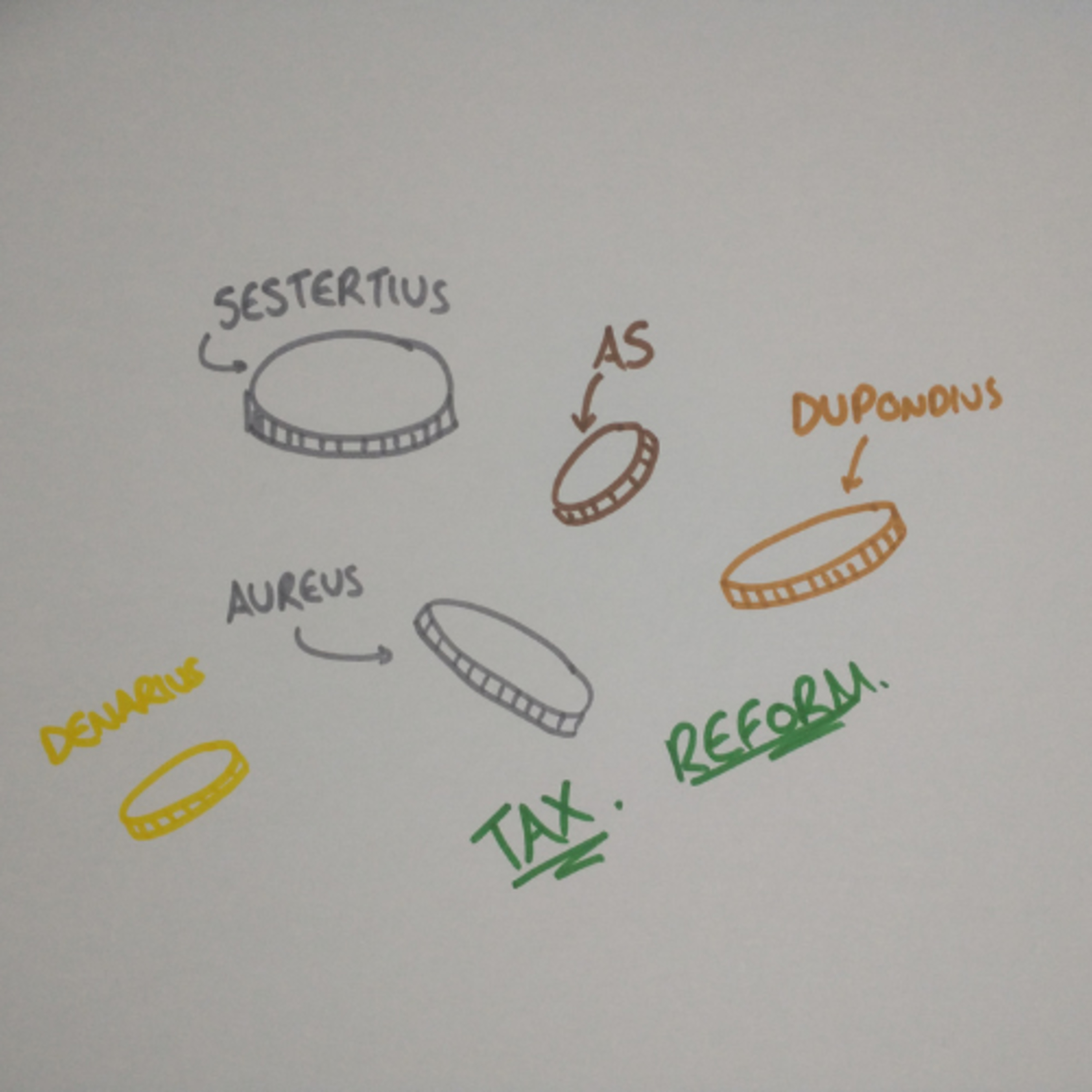
accordingly how much they had to contribute to the military. So let's deal with this shall we? Class one if you like had a property with a value of 100,000 asses or greater. I knew you were going to do that. It's a broken thing. It does not mean what you think it does does. No stop that. It's a serious podcast. Now this leads us to a diversion on the value of Roman money because we haven't actually talked about Roman money at all up to now. In real history we know that the early Roman Republic didn't use money instead using bartering. Slightly later in time people used bronze blocks to await of a Roman pound which is about 327 grams. They then began introducing coins. The first coin was bronze and yes was called an S. It's spelled A S. It doesn't refer to anything weird. It's just a bronze coin.
Get used to it. I'm going to be saying that word a lot during this episode. Lovely. The Romans brought in the Diedrachem Silver coin in 269 BCE. So about So fast you tell me it's not on purpose. It's called a death and then you bring up 69. The Romans didn't count like that. They weren't going oh it's 269 years until something happens. There was a final version of the currency in the Imperium with the values having changed since the Republic. Still I'm going to give you this finalized version so you can get an idea of what we're talking about with the money system as a whole. So one small bronze coin was worth two semis which were also bronze and each semi was worth two quadrants. Make sense so far? Sure. Asses or aces I'm not sure how you say that. It went into a Dupondius and two Dupondii were in
term the same value as a bronze sisterceus. This is the currency I remember most from Asterix by the way and so I assume everyone else will know this coin better than others. I won't have never read Asterix. Okay well that's on you. Four sisterceii then went into a silver denarius. Now this is all well and good but what about actual value? Well I did some research. Of course you did. To give you some idea in the Imperial period a Roman legionary got paid a yearly wage of 300 denarii. Okay sure why not? Now for comparison the army website for the UK indicates that the yearly salary is currently 27282 pounds so this is probably not perfect as far as a conversion goes but I'm going to be using this to try and work out how much everything is worth. I'm also going to round this to 27000 as this would mean that one denarius is roughly equal to 90 pounds in 2026 money. This is probably wild the wrong in terms of maths but it's the best approximation I
personally have. So we're going with it. A sisterceus would then be worth 22 pounds 50 a Dupondius 11 pounds 25 and an ass roughly 5 pounds 65. A semi would then have a value of 2 pounds 33 and each quadrants is then about 1 pound 16 or so. Yeah that is rough math. Yeah but make sense now. Sure. There were also 25 denarii in a so called aureus which was a gold coin with the emperor's head on it. This word based on what we've said equate to a coin value of 2,250 pounds. Following your math. Yeah following mine. Later in the empire Constantine the Great introduced a much more valuable gold coin called a solidus. I didn't have a value for this. Editing Vince again Wikipedia has been of some help here in terms of quick research. The solidus when introduced was supposedly worth 275,000 denarii. However these themselves were
worth only 5% of what they had been previously. So in practice we can divide this number by 20 to get a solidus value of 13,750 denarii. With each denarius worth 2,250 pounds according to our very rough calculation this gives the solidus a value of 30,937,500 pounds according to our maths. This probably demonstrates how flawed the idea is of comparing money a job pays out across different centuries and assuming it to be roughly equivalent. But I hope it at least demonstrates how valuable the solidus was even if it's not a perfect conversion. The point is it's worth a lot of money. Anyway back to the episode. But anyway back to class 1. They had a property value of 100,000 asses or greater, right? So then if I do the math quickly in my head by your calculation that's about 562,500 or greater
pounds. Yeah very impressive quick maths. Thank you. Members of class 1 were supposedly to supply a helmet, a shield and bronze armour, sword and a spear when it came to their equipment for fighting in the military. The military of this class also had military engineers associated with them. Now class 2 had a value between 75,000 and 100,000 asses. Oh if I do math quickly again between 421,775 and the other number I said earlier, whatever that was. 562,500. Good see. Again I've got the maths, you've got the memory. I'm fascinated by your getting all these figures from. Thank you. They were meant to buy themselves the same stuff as class 1 just without the breastplate and a long shield instead of a round one. Now class 3's value was 50,000 asses. 281,250 pounds. Thank you. They did not need to provide any armour. Class 4 had a value of 25,000 asses of their property. To the math yourself.
Oh well looking at my script here where I've written this one down that's 140,625 pounds. They only needed to supply a spear and a javelin. Class 5 had 11,000 asses worth of property or... 61,875. Yes. Apples. Not apples. That would be weird but I wouldn't be apples. They only had a sling with stones. Finally there's a sort of class 6. These people had less than 11,000 asses worth of property which is the rest of the population and I'm guessing the majority of it. Probably. They did not have to serve at all. Class 6 was also known as the Capitei Sensi as they were counted by head rather than their possessions. One, two. We've run out of people in this podcasting studio. The census is over. Thank you. I'm guessing this is because they had two few possessions to actually make it worthwhile. I'd been class 1, my love. You would? Yeah. Okay so
that explains why you have a horse spear armour and a sword in the room. I'm amongst other things. I keep telling you you don't need to provide this anymore. The cavalry was also reorganised and each century was granted 10,000 asses from the royal treasuries to buy horses. I didn't do the maths for how many that is. That's fine. I think it's something like 50,000 pounds based on what I just said. An ass is actually worth £5.65 so 10,000 of them is £56,500. Not a bad estimate past me. Rich widows were also taxed to get another fund of 2000 asses a year per century of cavalry to maintain them. Six centuries were added to the three of Romulus's day so this is quite the re-organisation of the army. In this way the rich were responsible for the funding of the military and it's kind of a
structured system. Now you might be wondering how was this census even organised in the first place? How did they know? Good. How did they know that we're going to get a true value for how many people there were for all this in order to divide the population by wealth? Well, you could be imprisoned or killed if you didn't show up in the campus masters on the appointed day to be counted. People were also commanded to assemble yearly at sacrifices so they could easily be counted for tax purposes in each region. People would pay a certain amount to pay for these sacrifices, men one amount women another and children a third, making it easy to count them. Servious Tullius also wanted to know how many people were being born and how many men made it to adulthood. Quite important in an ancient world militarised to society like this. Yes. So the same sort of thing was employed. Families paid into the treasury of Ilythia or Juno Lucchina for people who were born. Remember all the way back from the Greek mythology episode
she's the goddess of childbirth. Yes. For those who were died people paid into the treasury of Venus of the Grove or Libertina. For those men who made it into adulthood the treasury of Juventus or Juventus was used. Dianisus also gives a detailed account of the census and military obligations of each order but I'm not going to go into it a second time. Thank you. A tradition was also started that a sacrifice would be conducted after each census of a bull, a bull, a bull and a ram who would be led around the city three times before being killed. That's just mean. I'm also going to assume a lot more tortoise deaths were involved. I assume Servious Tullius got I don't know bitten by a tortoise as a child and that's the reason he loves bulls. A turtle. Oh sorry he was playing by the coast in a turtle just appeared and bitten. A turtle is a turtle it's just a general world for turtle. I'm going to probably clip that and put that in deep or to crack wisdom. So do you want another result of the census?
Is it between 50,000 and 100,000 Roman citizens? Yes, probably because that's a really generic result but yes the census found 84,700 Roman citizens. Libby says 80,000 utropius says 84,000 not just 84 people but the point is there's between 80 and 85,000. I mean if you add those two together and divide by two that gives you an average. It gives you an average of 82,000. There we go let's go with that. There might be some subtlety or vagary here. There were according to a source livid sites 80,000 men of fighting age in Rome at that time so the population might actually be bigger than number say but we can't know by how much. I mean also that's people of fighting age fighting age might be a different kind of age than our one. Yeah I mean they probably sent 13-year-old boys so fighting age were probably meant something different. That's a good point actually. We know that Lucius Tarquinius was in battle and killed an opponent at the age of 13 but I don't know
what the... If you assumed fighting age may not be only over 18 then yes that might have been more people but if you assume that's also people younger although we're too 13 that's like yeah much more people. I was also going to say women and children. The Romans might have been militaristic but I don't think they were sending babies out to the front line. To swell the populace, Tullius invited everyone no matter who into Rome. This had been the case before as well but now freed slaves who are allowed to and assuming they were horrified gasps and swoones from the Senate. The patricians were upset but Tullius slapped them down. He pointed out that people had transferred from slavery to freedom and vice versa many times throughout history and this prejudice against freed slaves was silly. They would swell the population and Rome would never suffer from a shortage of manpower again. Again Dionysus goes into a whole tangent about customs to do with slavery in Rome that I'm not going to go into. All right. He talks too much. Yes he does. Now Rome's population...
I was along this distant descendant. That's just so rude. So impolite. All right well I guess the episode stops here. No. Wow. My feeling suitably bruised let's continue. Rome's population was a lot bigger than it had been before. Yes. So Servius Tullius added the Corineal and Viminal Hills to Rome's boundaries. I mean you can just do that. Yeah well we've seen that a few times. Now Dionysus says the Esquiline and Viminal Hills but you know these hills were divided among the homeless and Tullius built a palace on the Esquiline. He also made the existing walls stronger by adding ditches and earthworks. Some places say he built a wall but I imagine this is confused with the wall that Priscus built or else he just finished it. Either that or there are now two walls which I doubt that would be a bit silly. However archaeologists at this point throw a bit of a downer on the idea that Servius actually made what's called the Servian wall. We know from archaeology that it
actually dates to the 300s BCE so a few centuries after Tullius supposedly died. It's also sometimes claimed that Servius Tullius introduced coins but that's also false according to archaeologists. They're just being a real downer this episode. He divided Rome into four regions, the Esquiline, Suburran, Colline and Palatine regions. Where troops were levied from where people lived etc. was now determined by these four regions. Chapples to heroes were also erected in every street and a law was passed that a sacrifice should be made to them every year with every family giving a honey cake at these sacrifices. Presumably not to Servius Tullius. Just everyone has to give me honey cakes. The rest of Roman territory was also divided into 26 regions, making for 30 in total with each having their own governor. Others also say 35 but the point is we get reform. He also built hilltop fortresses people could run to in times of raiding so that's nice people
aren't just dying in raiz immediately. In order to placate the protrusions Tullius transferred most of the votes in civil assemblies ratifying laws from the poor over to the rich without the poor noticing. Impressive. Yeah so he's great in some ways for the poor but in other ways. Yeah. But then again maybe they didn't care given his sweep of reforms. Those rich centuries from the military reforms were now the first to vote and the votes were divided by centuries rather than curi as before. These were also the people with the largest number of votes. If they could not agree the second set from class two would be brought in and so on. Generally speaking only the first set of centuries was ever needed. So are you getting a picture here of power slowly creeping into the hands of only the rich? Yes of course. This modifying the rich though meant they didn't mind so much they were paying more money to the state and constantly exposed to the risks of battle. So have you enjoyed that description? I really have. How long do you think all of this took?
43 years. Okay I think you looked at my script because this lasted 44 years. It doesn't sound like it when you're just raffling off things. No it doesn't. Appian by the way still completely silent when it comes to service tolius. So he rained 44 complete years and the events of next episode happen in his 45th. And we'll get to that next time. We will. So until then thank you all for listening. I apologize that this has just been monetary reform and really try policies but hey sometimes you need that instead of punching and stabbing. You do. So until next whenever next episode comes out have a great week everyone. Have a great time. Do I need water?
Thank you. Hydration break which we do really means adverse.
More episodes
More from Autocrat- A Roman History Podcast

117- Tarquin and Tullia's Excellent Conspiracy
Autocrat- A Roman History Podcast

Bonus XXII- In Other News: Cyrus the Great (feat. So You Think You Can Rule Pers...
Autocrat- A Roman History Podcast

115- Tarquinian Succession Carnage
Autocrat- A Roman History Podcast

114- The Golden Age of Priscus
Autocrat- A Roman History Podcast