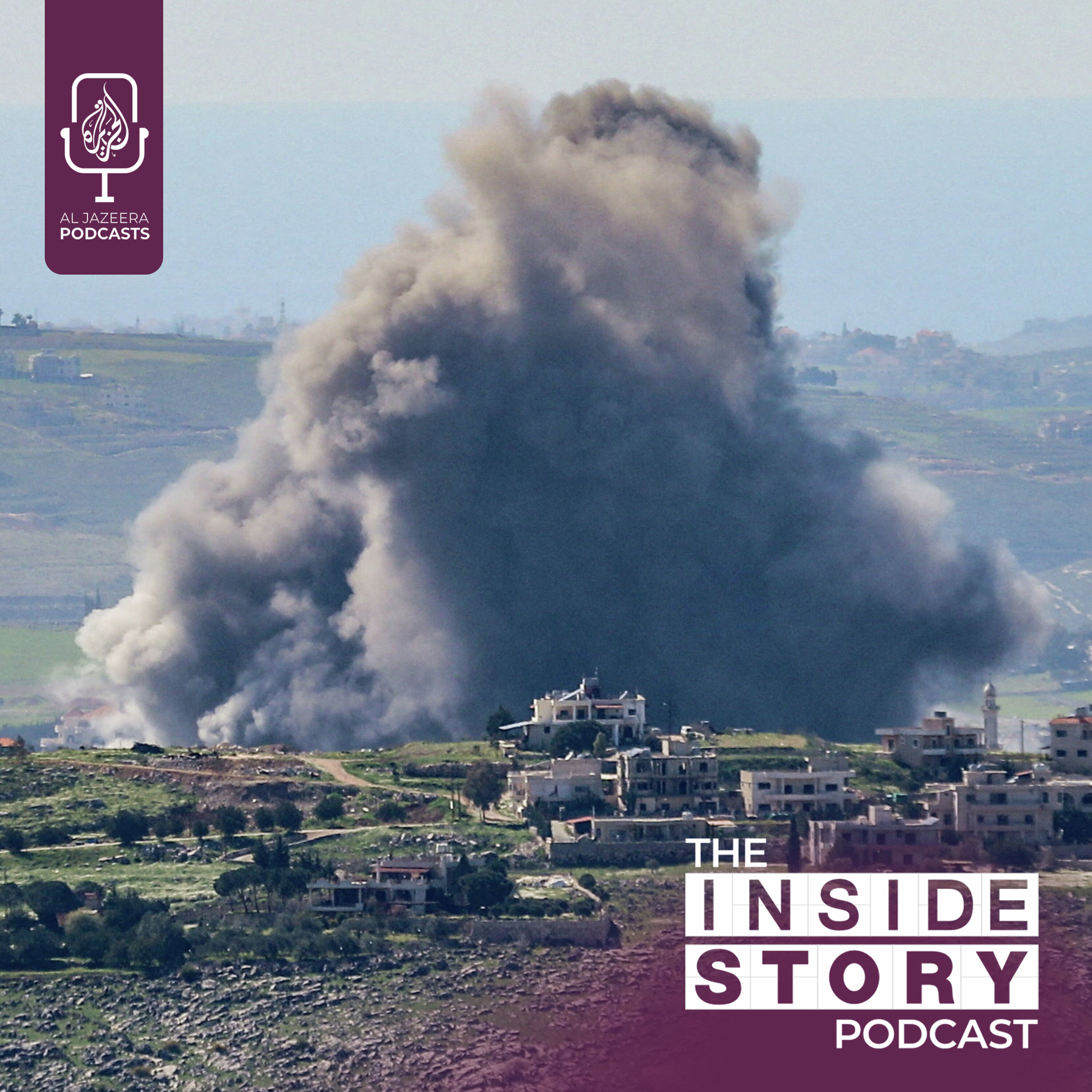
Will Hezbollah drag Lebanon into the US-Israel war on Iran?
Get every episode summarized
Each time The Inside Story Podcast publishes, we email you a written briefing from the transcript — the topics, who appeared, and any specific claims, with the ad reads skipped.
Email me new episodesFree for 3 shows. No card needed.
About this episode
“Al Jazeera Podcasts We can't but defiant his bola has been attacking Israel as eat pummel, southern Lebanon and parts of Beirut. That's despite the Lebanese government's ban on his bola's military activities what will be the fallout for Lebanon?”From the transcript
Hezbollah has been attacking Israel - as it pummels southern Lebanon and parts of Beirut.
That's despite the Lebanese government's ban on Hezbollah's military activities.
What will be the fallout for Lebanon?
In this episode:
- Heiko Wimmen, Project Director Iraq, Syria, Lebanon for the International Crisis Group
- Nimrod Novik, former Senior Policy Adviser to Shimon Peres and member of Leadership of Commanders for Israel's Security
- Nabeel Khoury, former U.S. Diplomat and non-resident fellow at the Arab Center.
Host: James Bays
Connect with us:
Get every episode summarized
Each time The Inside Story Podcast publishes, we email you a written briefing from the transcript — the topics, who appeared, and any specific claims, with the ad reads skipped.
Email me new episodesFree for 3 shows. No card needed.
Hosts & guests

Transcript ready
193 searchable segments. Every word is indexed and playable.
Full transcript
The Inside Story Podcast — Will Hezbollah drag Lebanon into the US-Israel war on Iran?. Machine-transcribed; use the interactive transcript above to jump the player to any line.
Al Jazeera Podcasts We can't but defiant his bola has been attacking Israel as eat pummel, southern Lebanon and parts of Beirut. That's despite the Lebanese government's ban on his bola's military activities what will be the fallout for Lebanon? I'm James Bayes and you're listening to the inside story podcast where we dissect, analyze and help define major global stories. Well let's discuss all of this further with our panel of guests who are joining us today on Inside Story and in Beirut we have Haiko Viman, the project director for Iraq, Syria and Lebanon at the International Crisis Group. Nimrod Novik is in Tel Aviv, a member of the leadership of commanders for Israel's security. He served as a senior policy adviser to the former Israeli Prime Minister Shimon Peris and in Washington, D.C. Nabil Curry, a former U.S. diplomat and non-resident fellow
at the Arab Centre, Washington, D.C. Thank you very much for joining us on Inside Story. Let me start with you Haiko because you are there on the ground in the place where in recent days bombs have been falling. What is your assessment of why Hasbola decided to take the action it did after the death of the Ayatollah? Well I would say I take them at their words. They said right after the attack in the first statement that this was to avenge from any and kind of tacked on at the end of that statement was and a defense of Lebanon, which I would say is a nod to the fact that burning Lebanon on the altar of Iranian interest as you could put it, is not something that is very popular in Lebanon,
including perhaps within the bases the grassroots support of Hasbola. So it was certainly that motivation, it was the motivation to join Iran, to join the, let's say, the centre of the Axis of Resistance in this fight. And then we can discuss whether that was an order from Tehran or whether the people that he had on their own accord, but this seems to be the central motivation. So Nabil, one of the reasons I'm asking that question is to rewind to last year, June of last year, during the war then, the war that lasted 12 days, Israel attacked Iran then joined in by the US. Of course we didn't know that that was going to be just 12 days at the time. It could have gone on much longer. Hasbola, on that occasion, its guns remained silent. What's the difference, do you think?
I think it's partially the assassination of Hamini, but it all goes back to Gaza. People must understand that the sentiment for the Palestinians and the mass murder that they underwent in Gaza resonates deeply with a lot of people's infertile-cressant countries, not just in Lebanon. And Hasbola took a serious beating from the two-year war. So it's been laying low and it's been very patient since the ceasefire about a year ago. They have been quiet, but Israel has been engaged in daily bombardment, all over Lebanon. So at some point, patience runs out and you put all the factors together. And therefore, they retaliate.
I want to come to Nimrod in a moment in Tel Aviv about the Israeli response. But first back to you, Haiko, because I think it's worth adding, is it not, Hasbola had, on a political level we're told, reassured other politicians, as we'd seen those forces arriving, those US forces that are murder of forces arriving, that it wasn't going to be dragged in. Does it suggest to you that perhaps there is some division within their ranks? Very good question. So we hear that they gave these guarantees, if you want to call it that. And there have been reports suggesting that there was something of rebellion, perhaps of parts of the military wing, if that's right word, against the political leadership about this, that about this stance of not engaging.
I don't think anybody is in a position to come to a judgment on that. I mean, what exactly goes on in the decision-making processes inside the party? What role perhaps Iranian goddess have at this point? It's pretty much a black box to me at least. I don't have a lamp to really shine light into that. I would also say at this point, it perhaps doesn't matter anymore. Because here we are. Here we are, Hasbola has joined the Iranian like more effort so to speak. And just to add to the question or to the answer of Nabil, you know, I think one of the one difference between June and now is June 25. And now is that in June 25, I would say that Iran was looking for calibrated response to the attack. Right now, they're hitting everything everywhere they can with everything they have.
So that perhaps is also a difference. And Hasbola is just one of the things they have. So use it. Even if it may not move the needle much. Nimrod in Tel Aviv, we saw a very quick, devastating response from the Israeli side. Was this just a response or was the Hasbola attack a pretext? A good excuse for something that Israel already planned. Because the attack on Iran by the US and Israel was done at a time of their choosing. Had they always planned when that was going to happen, they were going to hit Lebanon and hit Hisbola too. Yes, I think you're right. It was an opportunity that Hasbola provided Israel with. I think that Nabil was right in referencing Gaza in this context. But from an Israeli perspective, it's a different dimension.
Since October 7, 23, something quite substantial has changed in Israeli mindset security and otherwise. And that is a lesson learned not to wait until adversaries strike. And not to count on our appreciation, understanding of intentions. But rather focus on capabilities. And the pendulum in my judgment has swung too far in the other direction. Whereas there is a sentiment that if we can, we should. And I think that militarily, I don't think there is a doubt that we have the capabilities to deal with multiple adversaries. But what is missing in my judgment is the diplomatic leg.
What do you think Israel actually wants? Does it want a stable Lebanon or does it want a weak fragile country there? I think that since the emergence of the current government in Lebanon, the Israeli mindset on this issue has changed. And I think that the concern that Hasbola was driving everything for decades. It was replaced with an appreciation that there is a government we can work with. Even if it is reluctant to negotiate directly and it has to be via Washington or other mediators. Nonetheless, there is a great appreciation for the courage and resolve of the current government. There are doubts about capabilities. And that's where perhaps diplomacy and other instruments should kick in. But yeah, I think Israel wants a stable Lebanon where Hasbola might remain as a political force for sure.
But is not threatening neither Hasbola nor anybody else. Threatens our civilian population. Nabil, talk there of the new rulers, the new leaders in Lebanon, because you do have a new top team, a new prime minister, Nawaf Salam, who has been an international judge and an ambassador, and a new president, Joseph Owen. They have also taken a new approach, a very different approach now that conflict has broken out, saying that Hasbola needs to stop all military activities. Are you surprised by how bold their approach is and are you worried about where it could lead though? Well, I'm not surprised. There's a lot of pressure on them from Washington and from Tel Aviv. But their words have not really been translated into any kind of wise action.
And I'm thinking of diplomacy here. There are many analysts in Israel as well as in Washington who understand full well that the Lebanese state, the Lebanese army cannot, does not have the capability to disarm Hasbola and does not have the political will to do so knowing also that if they did, another civil war would break out in Lebanon. The problem is that the political appointees, the government, the decision makers in Israel and Washington don't understand or refuse to understand. And they don't care if they push Lebanon towards another civil war. So the question here is, the new government wants to have the exclusive right to decide war and peace. Fine, everybody agrees in principle to that. But the Lebanese state has historically failed to do either.
They've never defended the border of Lebanon. And they've never used diplomacy effectively enough, first of all internally, to agree on a national defense strategy that all Lebanese would agree to. And then use its contacts in the West to help bring about peace and to begin with stop the daily harassment by Israeli forces. Haiko, I mean the big question or one of the big questions here is, is what has Hasbola got now? What are their capabilities? What is their weaponry? How many missiles have they got left? And that remains a very unanswered question because we don't know how damaged they were in the last war, 2023 to 2024. What's your assessment? Well, for that, you should probably ask our friends and Israeli military intelligence or think tank that think tanks that speak on their behalf.
I don't know. I simply don't have have no way of knowing that access to this information, but I think what we see is that there are residual capacities. They can shoot missiles smaller, sell those. They can fly drones. It doesn't seem to be much compared to where they were in Africa, basically, before the big Israeli strikes were launched. But it's still enough to create a new sense, at least in the Northern Israel. It's still enough to send people to the bunkers. It's still enough to give Israel a pretext to say we have to occupy a border buffer zone up to the light and up to the hour.
I don't see how far they want to go. So that capacity is clearly there. And that is important because it's addressed that structures of command and control and logistics and communication do work, even though we still have apparently near complete intelligence penetration by the Israelis. And the way that they do pinpointed attacks on his balla personnel or Iranians clearly indicates that. And this also means if they can do that, if they can coordinate enough and efficiently to actually attack the Israelis under fire under this kind of pressure under this kind of intelligence penetration, then they surely can also mount a coherent military response. If anybody comes domestically in Lebanon with Lebanese army, for instance, comes after them and their weapons. And I think this is very important to realize and keep in mind.
I mean, I've been I've been suggestions that they're nonexistent that it's completely destroyed that there's no way of pushing back if the army would only push once. So to speak this whole this whole structure would be collapsed like a house of cards and we shown it like an impossible look like it was out of us. I think after these couple of days, I don't I don't think anybody would propose that anymore. And if he or she tells us it's reckless. Nimrod, let me ask you the same question about the strength of his baller. I know you are no longer plugged into all the secret Israeli intelligence, but you are very plugged into what's being said there in Israel. How strong do people think his baller is and let me add another part of the question also how strong is his ballers leadership because Hassan Nasrallah was killed in the last war.
Nine Kassim, many observers say is no Hassan Nasrallah. Yeah, I think the sentiment in Israel, you reflected it accurately in terms of the leadership quality, the charisma, the command and control, etc. The perception here, at least in the public domain, I have to be careful is that his baller has residual capacity to cause considerable damage. They have not used the few dozen longer, longer range missiles that they do have. They used only short term ones, short range ones and as well as a few drones in both category, in all three categories, they still have residual capacity. I believe that the Israeli security forces are capable both due to the intelligence penetration that was mentioned and due to other capabilities is capable of further eroding the capacity of his baller.
I expect that to happen in the coming days. I respectfully dispute the assumption that in Jerusalem we don't care or even wish to see a civil war in Lebanon. I believe that is not true. I think we would like to see a stable Lebanon, but in the equation between eroding further, has baller capabilities and just sitting by and expecting it to launch at will, we are not going to sit back and just watch it. Nabil, we've heard lots of talk with regard to the wider war, the US and Israel against Iran, that this is existential for Iran. Is this existential for his baller too? Do they think they're fighting their last war here? I think this is certainly one of the reasons that caused them to react when they did is that Israeli daily bombardments have been reaching, as Haikal said, sensitive areas, their intelligence has been very good.
And therefore, in addition to decimating a large part of the leadership of Hasballa, they've certainly degraded Hasballa's firepower. And at some point, the feeling in Hasballa leadership is, if we don't react now, we will lose the ability to react period. And so they jumped into the fray. And again, they're banking here on Israeli society tiring from this war and Donald Trump tiring from the economic cost, which is huge, which will ultimately affect the average consumer in the US. And therefore, the average voter, so he may stand to lose a lot of votes in the upcoming elections. So this was a gamble on Hasballa's part, but in the end, they do have a fight still in them, certainly with Israel.
But I think more importantly, internally, if there is a confrontation with the Alev, which I don't very much, that it will come to that. But if there is a kind of a mini civil war in Lebanon, different weapons, we're not talking about long-range rockets anymore. We're talking about small arms and the hand-to-hand. And in that area, Hasballa is still very strong. So they're still a factor. Haiko, you are there in Beirut. The Lebanese people have suffered so much over so long. I want to focus on them for a moment, very resilient, used to real hardship and very weak government. But we had the war from 2023 to 2024. Before that, financial collapse, the port blast. I mean, how tough is this for ordinary people there in Lebanon right now? I hear the figures of displaced have now gone up to 90,000. Yes. Look, I mean, it's very different depending on where you're with, where you sit.
Of course, I mean, it's a strain and the drain on everybody. Well, I mean, my kid is out of school. I mean, I think twice and three times where I moved yesterday, like somebody was coming and she was lucky. But an hour after she reached home, like someone a relative of mine, four people were killed on the airport road. That affects everybody. But we really need to talk about the displaced, you know, so the displaced, it's not 90,000. There have been displacement orders for all of all Lebanon, southern light of the light turning, which includes sure tire city of about 200,000, you know, I mean, you know, if you take these orders literally, you all have to leave. Today, there was a displacement order for all of that, which is half of the metropolitan population of Beirut, a million people perhaps.
If only 20% of these people flee, there's going to be complete chaos and may have, you know, and these people have no shelters. There is no government. The government is completely, I mean, cannot respond to this. I mean, before this to blame them, nobody can respond to this. These people are, many of them are displaced for the second time now, you know, and as well as for all we know, no, no capabilities to help these people at this point, it's, it's going to be, I mean, a disaster, humanitarian disaster of. I think for this country, unprecedented, unprecedented size. Okay, let me just bring in Nimrod if I may one last time. I mean, for Israel, this isn't a second front in the war, for much of the rest of the world though, this is not the key venue. This is seen as a bit of a side show. Does that mean in Israel they think they can take the gloves off right now?
Well, I agree with you that for the world, it is a side show, which is a said commentary in and of itself. But no, I don't think that that's the context in which Israel is operating. As a matter of fact, I really hope that if Mr. Hori is right in his assessment of the leadership calculations in in his, that's another evidence of how weak that leadership is. Because if they thought that Israel will tire as a result of a few salvos of Hasbara missiles, they really misjudged just not for the first time. I mean, two and a half years of war, controversial war in Gaza didn't tire Israeli society. So now I mean, the resilience of the Israeli society is not in question. Also, I somehow doubt that they reached a conclusion that if they don't fire now tomorrow, they will not be able to, because if that was the case, they would not just confine themselves to a few missiles here and there and a few drones here and there.
I think they were have heartedly responding to Iranian urges. Thank you very much, Nimrod Novik, Haiko Viman and Nabil Kori. This episode was produced by Muhammad al-Ayeshi, Imajin Kimber, the more Peter, Gemma Harries and Nikhidudah. Studio Sound was by Central Marammu too. The program was edited by Saroon Morali, Catherine Nurhan and Judith Frias. As fast moving events continue across the Middle East, make sure you catch every episode of the Insight Story podcast. Hit the subscribe or follow button on your podcast app of choice. That way, we will automatically deliver to you every day of the year. Leave us a comment too. We'd love to hear from you. Thanks for being with us. Join me again on Friday when I'll have our next edition. Coming up on the take, we've told you what's unfolding in the Middle East. Now we turn to Washington DC, where the green light is coming from.
That's the take by Al Jazeera. Find it wherever you get your podcasts.
More episodes
More from The Inside Story Podcast

How will Saudi Arabia deal with the Houthis?
The Inside Story Podcast

Can a warming Arctic become an important commercial highway?
The Inside Story Podcast

Will the Houthis seizing the Red Sea coast give Iran leverage in the war?
The Inside Story Podcast

How will the far-right AfD's electoral rise impact Germany?
The Inside Story Podcast