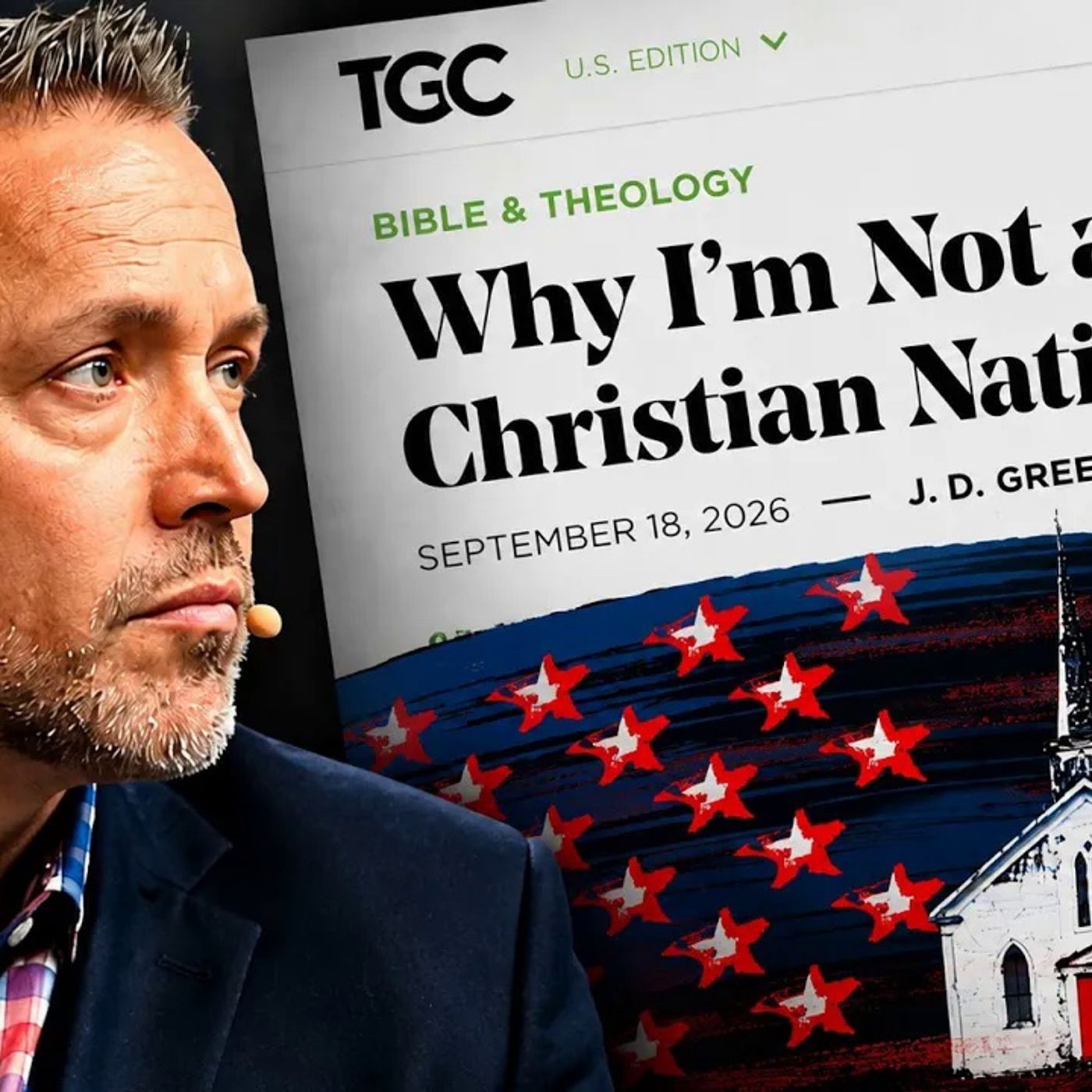
"Why I’m Not a Christian Nationalist": Responding to J.D. Greear
Get every episode summarized
Each time Eschatology Matters publishes, we email you a written briefing from the transcript — the topics, who appeared, and any specific claims, with the ad reads skipped.
Email me new episodesFree for 3 shows. No card needed.
About this episode
“Crest for Albertsons, Vaughan's and Pavilion's.”From the transcript
Is civil government actually capable of moral neutrality?
Should nations recognize the Lordship of Christ?
And how should Christians distinguish religious liberty from the idea that government can operate without reference to an ultimate standard of justice?
Josh and George interact with Greear’s arguments while drawing from historic Protestant political theology, Romans 13, the Ten Commandments, the Great Commission, and the Lordship of Christ.
They also address Andrew Walker’s recent contribution to the discussion and consider how Christians can reject both political idolatry and political retreat.
Watch all of our videos and subscribe to our channel for the latest content >Here<
For blog entries, articles, and much more, visit our website >Here<
Get every episode summarized
Each time Eschatology Matters publishes, we email you a written briefing from the transcript — the topics, who appeared, and any specific claims, with the ad reads skipped.
Email me new episodesFree for 3 shows. No card needed.
Know when George Sayour turns up
Follow George Sayour and once a week we email you every new episode they appeared on — including guest spots the show notes never mention, because we read the transcript.
Follow George SayourFree. Pick your own day and time.
Hosts & guests

Transcript ready
913 searchable segments. Every word is indexed and playable.
Full transcript
Eschatology Matters — "Why I’m Not a Christian Nationalist": Responding to J.D. Greear. Machine-transcribed; use the interactive transcript above to jump the player to any line.
Hey, it's Ryan C. Crest for Albertsons, Vaughan's and Pavilion's. It's stock up sale time, which means you can save big by stocking up on all your personal care favorites now through November 3rd shop in store and online and save $10 when you spend $25 or more participating products like Shick Razer, head and shoulders, anti-dandruff shampoo, hello deodorant, just for men hair color, Listerine, mouthwash, gold, bond hand cream and Irish spring bodywash. Offer ends November 3rd, restrictions apply. Offers May vary. Visit Albertsons, vans or pavilions dot com for more details. Is the Christian nationalism conversation over? Have we had this conversation enough? Are we done talking about the responsibility of governance's states, nations, those in authority to recognize Christ as Lord? Or is there perhaps more to say about this conversation? So the topic we're going to be engaging today on the magistrate. I'm Josh Howard and I'm joined today by my good friend and colleague, George Sayer. George, it's good to be talking with you again, brother. Yeah, Josh, it's been a while. So thanks for having me. Am I filling in for James? Is that's what this is?
You're filling in for James. He's he took a paternity leave and now he's taking a vacation leave. It's we're going to cut his salary. He's notoriously hard to hard to pin down. No, this is a good one. And I think this is a great one for you and I to discuss. George, you have I would I would think of you having a very vested interest in matters of church and state and how how the church might relate to that. I don't know if you want to share a little bit about what you've got going on out in Florida, but I've been very appreciative of your work and how you're trying to invest in those that are in authority. Well, thanks. Yeah, that's great. So I'm the state capital minister to Florida through ministry to state, which is an organization under the PCA's mission, arm mission in North America. So I'm like a chaplain to Florida's government to the legislators, to the executive branch, to the judicial branch, wherever, wherever the Lord kind of places me and he's just opening doors left and right. Yeah, there's God. There's God. Yeah, Florida must be a fun place to do that in them.
I'm frequently jealous of our brothers down in Florida. You and James are down in Florida. There's a theme going on there. Yes. Yeah, Florida is a great place. We are blessed. And you know, just want to do be faithful Christians because a lot of weird Christianity, the government attracts a lot of weird Christianity. And so to have a reform guy in there, I hope is viewed as a benefit. And I've been asked, like, does it hurt or help my witness in the government that I'm reformed a Presbyterian? And I said, in some sense, it's on the minority in that there's a lot of dispensational prosperity, gospel Christians, not that dispensational or prosperity, but you get to mean like the kind of narrows into that. And so, um, but reform Christians have the categories that people need to be able to think through these things. We're actually the ones with the categories. And I just find it's been hugely beneficial, especially when I talk to
lawyers in the house in the Senate. Uh, there's tons and tons of lawyers working in the government. They're the ones that write the bills draft, uh, the bills and the bill summaries and analysis. And so you talk to lawyers and you, you talk to them about the three uses of law or general equity of the law or, um, grace and nature, like categories matter to these guys. And so they actually kind of eat it up. Yeah. Yeah. Yeah. I watched the video on how bill becomes a bill. So I'm, I'm tracking with you, George. Yeah. No. So okay. So let's jump into this one. George and I have have the ambitious task. Uh, we'll see how far we get this morning, but we're looking at two articles. The, the first one that came out was an article by JD Greer. Um, JD Greer is with the Southern Baptist Convention. He's a very, very well known figure. Um, once upon a time when I was in the SBC, he was the, uh, president of the, uh, convention for, I can't remember if it was, I think it was three terms because I think it was during the COVID years.
In any case, he's a prominent SBC figure and he wrote a, wrote an article for TGC, um, which was titled Why I'm Not a Christian Nationalist. So I thought that was an interesting article. We'll try to tackle that one first. The second article was by, um, Andrew Walker. So Andrew Walker is a professor at Southern Seminary. Again in the SBC, um, I think Andrew Walker just got a promotion. I cannot remember what his title is. I think he's dean of the school of theology if I'm not mistaken. Um, I could be wrong on that. In any case, he's very prominent theologian, very, very notable figure there at Southern. He wrote one in the world, uh, WNG world opinions article, uh, called Michael Scott's Christian nationalism. We're going to try to tackle both of those again. This is kind of an ambitious bite to chew on. But both of these were getting shared around online. One of the things that I immediately noticed, um, was number one, just the, the speed with which somebody has an opinion on these and, you know, it's, it's posted within 30 seconds. Somebody has a full opinion on it, um, which we want to take a little bit of time and,
and George and I have some time to, to kind of talk through this. But also it was interesting. It's always, it's always discouraging. I'll be honest, to, to know beforehand when I see the article come out, I already know who's going to hate it and who's going to love it. And, uh, to me, this is a little bit of the, not to, not to put the cart before the horse and get too far down the road. The article by, by Andrew Walker talks a little bit about factionalism within our circles. I think that's one of the indicators though is when you know ahead of time who's going to like it and who's going to not like it. It's almost like it's independent of what the article actually says. And that's not to demean, uh, Andrew Walker's article by any stretch, but it is to just point out that there has to be more conversation on these things. And that's one of the things that I'm hoping things like this conversation with George and I, although, obviously we're going to be coming from one perspective, but I hope it can move that conversation along a little bit. Anything you wanted to add on that, George, before I jump into JD Greer's article. Only that it just does seem like the last month has seen a series of the, it's almost
like I'm like, is there a coordinated effort to all say the same thing and all misrepresent the Christian nationalist movement in the same way? And you know, I know you guys covered that sermon last week or the week before by Phil Johnson. Right. Yep. You know, and I just couldn't believe that the same kind of arguments are just constantly regurgitated and repeated without actually addressing any of the actual arguments. And so I don't know what's going on. I don't know what's kind of in the water around this, but it is kind of frustrating. Yeah. Yeah. Okay. So let's jump into JD Greer's article a little bit. So JD Greer wrote this article called, why I'm not a Christian nationalist. Any points out several things and we'll try to put a link to the articles in the show notes. And you can read them and evaluate them on your own and get, you know, draw your own conclusions from this. But there are several things that jumped out to me. I think I've got eight or nine possible observations from JD Greer's article.
So I'm just going to walk through these a little bit, kind of pitch them to George as we go through and we'll have a little bit of conversation. But one of the things that JD Greer did in this article. And I think this is one of the foundational issues. One of the problems with how he sets the article up is that he defines the problem largely in terms of terms of the government controlling Christianity. So when JD Greer is addressing this, you know, he's coming at this from a pastor's perspective, you could say maybe a public theologian's perspective to an extent. But in any case, his conception of Christian nationalism is that the government controls Christianity. And he frames it around the question of who gets to decide what counts as good Christianity. So again, any broad definition of Christian nationalism, which, you know, I've said on the show enough times that I don't feel like we need to repeat this at nauseam. But I'm not necessarily championing the label of Christian nationalism. What I am championing is that Christ is Lord. He's Lord over the government as well as over the church. It is good for governments to recognize Christ as Lord.
It's good for public piety and virtue for the government to submit to Christ as Lord and those those ventures, just very, very just general pan, pan Protestant to an extent, political conception of governance. But JD Greer's article is specifically asking what denomination gets to define Orthodoxy. And the way the argument goes is he starts talking about, you know, various ways in which these things can be misused. He talks about blasphemy laws, religious tests for office, which again are, are, are the state, are not the state of Pennsylvania, but the state is in the US government and the individual states have had such laws explicitly in the, in the individual states. I know Pennsylvania where I am has had very recently, religious tests for office and certain blasphemy laws that were enforced at various times. But JD Greer is assessing these things and he's saying the government is determining what Christians get to count as Orthodox. So this is, this is a problem. Now I want to, I want to point this out, pitch it to you a little bit because I think
what he's doing is making a category error here. So much of this conversation and George, I've heard you talk about this quite a bit. So I know that you're thinking along the same lines, at least in the way this goes a lot of the time. So much of this conversation around Christian governance, Christian nationalism, Christian influence in, in, in the state, it starts to have category error breakdowns almost off the bat. The way it happens here is JD Greer is raising some, I think, legitimate questions. We can talk about blasphemy laws. We can, we can talk about religious tests for office. I don't think those things are off the table. What he is saying though, and this is the category error, that does not establish a Christian political order that requires the state to become the arbiter of ecclesiastical orthodoxy. I want to say that again. In other words, if you were to think how ought the state do things in keeping with Christ as Lord over the state, that does not necessitate any sort of Christian political order. It does not necessitate that the state then becomes the arbiter of what is orthodox over
the church. And that's a very, that's a very crucial, I think, point to bring up because if you're thinking about Protestant political theology in general, there are certain things that you can affirm without going down that route, that category error that JD Greer is making. For example, you can say that the magistrate is under Christ. Moral law is authoritative for civil governance. Christianity is the true religion. And in fact, the only true religion Christianity should receive public recognition or support. And I know those terms become very difficult, but in some form or fashion, Christian institutions should receive legal protection from persecution. Christian virtue and piety should be encouraged. That's actually good for the commonwealth. Christian worship should be protected. People should be able to come together and worship the Lord under the true religion. Public law should conform to religious principles, moral principles of Christianity, murder, for example, you can, you can affirm all of those categories and not say that the magistrate should then wield the keys to the kingdom.
These are two very different categories and to conflate them over it. Number one, it misses the entire argument that we're having in the entire case that we're trying to make. And number two, it's just very confusing, especially because by the time we get to the end of his article, I'm going to point out he recognizes that there's no religious neutrality. There's no moral ethical neutrality and governance. That's going to be a huge category issue. But George, what are your thoughts on this just thus far? Hey, it's Ryan C. Crest for Albert Sins, Vaughn's and Pavilion. It's stock up sale time, which means you can save big by stocking up on all your personal care favorites now through November, third shop in store and online and save $10 when you spend $25 or more participating products like Dove, shampoo and anti-perspirant skin to mint razors, Lari Al conditioner, Q tips, cotton swabs, trace to May hairspray and Jurgen's moisturizer, off runs November, third restrictions apply, offers May vary. Visit Albert Sins, Vaughn's or pavilions dot com for more details. This is Steve Covino from Covino and Rich. All right, quick round of trivia before we get back into the show, but we're doing it
differently this time. Every guy listening right now, you're contestant. No buzzers, no calling in. Just answer honestly to yourself. Here we go. You got a belly and a little chest that won't go away no matter what you try. Gast by the middle of the afternoon, no drive left in the tank. And lastly, you lack that confidence in mental edge. Fellas, here's the thing. Those are classic signs that your testosterone's been sliding and nothing drags it down faster than extra weight. The good news, emerging research suggests that getting rid of it may actually be more effective than TRT. So why not take matters into your own hands? Strip off the weight that tanks your testosterone with Bioma GLP1 booster. Every serving is packed with science back and third party tested ingredients that crank up your natural GLP1 production. So you can enjoy a leaner physique, surging energy and increased drive. Visit bioma.health slash GLP1 and use code CR show to get 15% off your first order. That's bioma.health slash GLP1 code CR show for 15% off.
With the Amit's gold card, you can earn four times points at US supermarkets because the best nights in start with the grocery run that makes it happen. Apply for the gold card at American Express dot com slash explore dash gold terms and points cap apply. Kitchen and bathroom professionals know what goes behind the tile matters. That's why trade pros trust fiber cement party backer board to keep tile firmly in place, resist cracking and help block moisture. Chosen over 40 million kitchens and bathrooms party backer board. What the best build on shop now at participating home depot, lows and floor into core stores. For more information, visit James Hardy dot com slash Hardy backer. With the Amit's gold card, you can earn four times points at US supermarkets because the best nights in start with the grocery run that makes it happen. Apply for the gold card at American Express dot com slash explore dash gold terms and points cap apply.
Yeah, it's like the whole conversation seems like he and others want to have their cake and eat it too. They want things to be just for them. I mean, he starts the article off, you know, maybe like a he is a pastor. So, you know, with an opening illustration as it were about his, his own church not being able to have a facility they wanted or build a certain place. That truth is like it was. Yeah. And I don't even know the details of that enough to know if I'm not, I wouldn't ever suggest he's not being honest, but I do know there's always multiple sides to a thing. And I don't know why, you know, that is a mega church. And I've seen a lot of Christians claim religious persecution over things that are not necessarily religious persecution. So I don't know what was going on there, but he creates this scenario whereby he, they were persecuted against and uses that to justify why he doesn't want a Christian nation. And I'm like, well, you have what you, you're, then you have what you want.
You know, so it's just appears to me like that. Like there's this, once again, this idea of this neutral space that we can all argue from. And without the basis of a Christian world view, Christian presuppositions that undergird our common understanding of why things are just or unjust, it's always going to be a political battle. And in that sense, then he becomes a very political Christian, because even at the end of the article, not to jump to his main point or anything, but even at the end, he says, I'm not looking for, you know, a, a judge to share our theological convictions. I'm just looking for, you know, a resolution of this based on natural law. Those are my words. Not his. I don't remember the exact quote. You know, and so at the end of the day, it becomes a political fight rather than one based on what's true and what's right. Yeah. And the quote, the quote from the article, I think this is, I think I pulled this verbatim
from the article. So this is your pair. Hopefully this is not a paraphrase. I think I pulled this directly from the article, but he said the greatest protection for our church isn't the right Christians being in power, but rather that our government has denied the authority to decide whether my church is sufficiently Christian. And this is that throughout the article. Yeah. Yeah. And this is, this is, I think exactly what you're talking about, George, is essentially and this is the, to me, this is a knee jerk reaction of the government can abuse authority. Therefore, we cannot grant the government any authority that would have any sort of distinctly Christian purpose. And again, when we talk about category errors, just think about the way this plays out. So judges can and do make very unjust rulings. Should we then deny judges the ability to rule fathers and mothers frequently abuse their role in the home and do sinful things? Should they not have the right to parent? Like this is not what we're talking about. You know, James, who's usually usually on the magistrate with me, you know, he
frequently will, will, will text out that, you know, improper use does not invalidate proper use. And I think it's a very important, just political point to, to, to make. Yeah, they have a, they have a great fear when I say they, like people of this persuasion have a great fear of misuse. Yeah. And so they want to limit proper use because, because that can become abuse. And it's, it's like, for me, it's like, what is, what is true? And then you have to see how, how is that truth? Like what's the prudence of applying it in our context today? But the answer is it like, well, we're not going to do what's true and right and, and mandated in some sense, because that can be abused. Again, every time I read these articles, you just referenced it, this one or, or the Walker one, it's like, apply what you just said to the family. Right. You know, to my role as dad or husband or, or whatever.
And so there's this great fear that, well, if we create this standard, that standard will be used against us. So let's have some neutral standard, but that's other, that neutral standard is never neutral. And the, and the proof of it is, his church was denied the ability to have a building where they wanted it. Right. He has what he wants actually. Yeah. Like he has the government system he's advocating for. Um, now, of course, he's saying, well, no, we want some neutral. It's, they should not be discriminated against us based on our faith. And again, I don't know the facts to know that that's actually even what happened. Right. And this is where I know somebody listening to this is going to cry foul at this point, because I use the example of the family. And you know, we spoke about the state and we spoke about the family. And I know somebody's going to raise a red flag and say, well, those are different jurist dictions. Those are different spheres of authority. However, you want to frame that. And I would agree.
However, that's part of the problem of JD Gris article. So one of the things that he says in here that I saw several, several citations of this, I think it might have been one of the little tweet button parts of his article, was giving the government religious power doesn't guarantee a Christian government. It merely guarantees a more powerful government. I think this resonates home with a lot of us who probably look at the government and say, you know, in general, um, you know, I would, I would be in favor of a more scaled back federal government. I think a lot of people fall into that camp and how we navigate those things. But this is the problem with what JD Gris saying. It conflates all authority into the same bucket. There's no distinction in realms of authority or spheres of authority. And quite frankly, this is where it becomes frustrating because so much of the Protestant political project. And when I say that, I don't mean just the last 10 years. I'm, we're thinking the last 400 years plus, right? Christian political theory has frequently talked about different spheres of authority. So when we talk about granting the government power, I mean, are we talking about a
ecclesiastical power, the ability to administer word sacrament, the ability to, to wield the keys of the kingdom to establish orthodoxy? Are you talking about civil power concerning religious matters? In other words, regulating public institutions, protecting places of worship, maybe recognizing religious holidays, those sort of things? Are you talking about civil power that's grounded in religious morality? In other words, murder ought to be wrong, not just because we agree it's wrong, but because God has said it's wrong. Like, what sort of power is JD Gris talking about here? Because as that, as that statement is given, it seems to indicate that any sort of, any sort of yielding of authority or power to the government necessarily means they all belong within one category. And that quite frankly has never been the case. So that's a strange point for me to make. Yeah. He said, so he said to, to a lot of the point you've been making on this conversation already, he says the state should uphold justice, but it should not attempt to define Christianity, arbitrate doctrine, or compel or impede conscience.
Those simply aren't roles given to human government. And when a government takes those roles on, it ends disastrously for believers. Now, he starts off by talking about like the Baptist forebears, called freedom of conscience. So there is a sense that I thought like it was a little bit of a bait and switch, because he's talking about Christian nationalism, but then he talks about this Baptist political theology as if that's like, is that, are you saying that's what's happening or not happening? And then he does say that's the part of the Christian national system conversation that concerns me most. So he's now he is saying it is happening. It's not simply like part of their Baptist. So what does he then implying is happening? That the state is attempting to define Christianity, arbitrate doctrine, and compel or impede conscience. And what I think under guards this is, you know, you hear TG Hart say this all the time, well, how can you have a Christian like government without the church telling them what is Christian?
And, you know, the church, the use of the church there is the institutional church. And then the question they want to say is, well, which one? And again, you know, you've argued for like a pan Protestantism, I think, Wilson has said like a mere Christian dome or something. Like the idea that Christians don't know the basics and we have the apostles creed like we there are foundational. So I will agree. I will stand with JD and DG and these guys and say, like, I don't want a government in America, you know, choosing between Baptist and Presbyterians. I personally agree. I agree. Okay. And you're agreeing. And okay, so good. We've agreed on that. Now the idea that we can't as individual Christians actually know core Christianity, mere Christianity, pan Protestant beliefs without the church. Like this is an issue of epistemology. It's almost like I don't know if it's an application of
contour, humor. I don't know what they're doing here. This idea that we can't we just can't know. We don't know. We don't we don't have we don't know. Thank God the church institutional church is there to tell us. Well, how do we know that the institutional church is right? I mean, the the spirit applies the word and reveals the word to us. And yes, the church is the gatekeeper of that. But that doesn't mean that Christian serving in government have no idea what the Ten Commandments are as it relates to Christianity. So this argumentation, I just I know why they're using it, but I think it falls apart. I don't know in my home. Well, how I'm supposed to lead my home. How will I know? Like, yeah, I think it falls apart. And I also, I don't know everyone. And I don't keep up with everything. But I keep up with a lot. I don't know of a single person that's advocating for some of those things. And that again, this is one of the just be honest with the opposition. Nobody is asking for the the federal government to legislate nuances of orthodox
faith within the churches. I don't know of a single person that's advocating for that in the west. But no, it says Arbit, he says arbitrate doctrine. Yeah, I just don't tell or impede conscience. Yeah. Well, the government does impeller compete impede conscience. Oh, that's what every law is doing. But like as it relates to religious belief, it's not nobody is saying that because nobody is saying you can compel faith or even practice, but ordering a society toward those things is what government does. Right. And it inherently, if you want to do something that government is saying you can't do or must do in this way, then that is compelling or impeding conscience. But that's not simply a religious thing. That's everything government is legislating. It's legislating morality, which we've been told for years. The government doesn't do, but obviously it does. It's all we are all beneficiaries of that. Hey, it's Ryan Seacrest for Albertsons, Vaughn's and Pavilion's. It's stock up sale time, which means you can save big by stocking up on all your personal care favorites.
Now through November 3rd, shop in store and online and save $10 when you spend $25 or more participating products like shick razor, head and shoulders, anti-dandruff shampoo, hello deodorant, just for men hair color, Listerine, mouthwash, gold bond hand cream and Irish spring body wash, off runs November 3rd, restrictions apply, offers may vary. Visit Albertsons, vans or pavilions.com for more details. This is Steve Kavino from Kavino and Rich. All right, quick round of trivia before we get back into the show. But we're doing it differently this time. Every guy listening right now, you're contestant. No buzzers, no calling in. Just answer honestly to yourself. Here we go. You got a belly and a little chest that won't go away no matter what you try. Gast by the middle of the afternoon, no drive left in the tank, and lastly you lack that confidence and mental edge. Fellowes, here's the thing. Those are classic signs that your testosterone has been sliding and nothing drags it down faster than extra weight. The good news, emerging research suggests that getting rid of it may actually be more effective than TRT. So why not take
matters into your own hands? Strip off the weight that tanks your testosterone with Bioma GLP1 booster. Every serving is packed with science back and third party tested ingredients that crank up your natural GLP1 production. So you can enjoy a leaner physique, surging energy, and increased drive. Visit bioma.health slash GLP1 and use code CR Show to get 15% off your first order. That's bioma.health slash GLP1 code CR Show for 15% off. Kitchen and bathroom professionals know what goes behind the tile matters. That's why trade pros trust Fiber cement party backer board to keep tile firmly in place, resist cracking, and help block moisture. Chosen in over 40 million kitchens and bathrooms, party backer board, what the best build on. Shop now at participating Home Depot, Lowe's, and floor into core stores. For more information, visit jameshardy.com slashhardybacker.
So Greer then brings up the Chinese or the the the church in China example illustration. I'm going to just mention it but just move on because I think this is just very clearly a slippery slope argument. It's very compelling. It's very it's just very compelling and very good for an illustration to use because he points out the church in China and he says, look, they have this governmental reward system and they have the social credit experiment that they're doing in China therefore if we give the government the ability to do, you know, if we give the government any sort of authority that in in JD Gurus mind and fringes upon religious freedoms, then then we'll get China. This is one of those things where not everything is a slippery slope fallacy like some slippery slopes are actually slippery slopes like you should not start you should not start abdicating biblical sexuality within the church because that will inevitably lead to other things. That's not a slippery slope fallacy. That's a slippery slope theological argument certain beliefs will then
lead to other beliefs and practices within the church. The fallacy comes in when could does all the heavy lifting. So if you do this, then this could happen, then this could happen, then this could happen. If I give my you know, if I asked my son to help me with the the shed out back, I could give him a hammer. He could use that hammer to wield it against me and I could break my leg. It was a very weird illustration but you know what I mean? Like the could starts doing all of the very heavy lifting in this and quite quite frankly, the conclusion just doesn't follow the premise. That's at the hard of a slippery slope fallacy. So if the government legislates certain objective civil goods, certain things that promote piety within a culture and within a state, but they lack jurisdiction over the private conscience and over the ecclesiastical membership and over orthodoxy within the church, I just don't see where this illustration really fits. It's compelling. It doesn't it doesn't quite fit. I don't know if you had anything to say on that one, brother. No, but just in general like I mean
history is good to we need to look at history and look at where things have worked and not worked, but you know the idea that if because it either works in a nation or doesn't work in a nation or historically it doesn't it quote unquote, it has never worked like maybe you know, that's what you'll hear. You know, this is never question. It's like well because families, kids and families leave the faith, then there's no point in catacizing your kids because it doesn't work. I mean like because things fail, that's not the reason we do or don't do things. Most churches are not 400 years old. Right. Yes. Because churches close, we shouldn't form churches or plant churches. Right. Because every mainline denomination has gone liberal, we shouldn't have churches. Yeah, at least denominations. Right. Yeah. It's and this is this is what I'd kind of I'd posted something about this, but just
about creational odds, there are certain things that ought to be and that's what we're talking about here. This is not pie in the sky thinking. I hope it's not in any case. We're saying what ought be the case? Ought the government recognized Christ as Lord ought the government legislate in ways that conform to biblical morality, those sort of things. This is this is where I want to get into the meat of the matter because we're going to try to tackle both of these articles, but the meat of the matter to me is when JD Greer says in his article that there is no such thing as a morally neutral state. And again, if you would just read this this article and just grapple with the conclusions of this, Greer acknowledges things like laws against murder, theft, fraud, exploitation, that these reflect Christian judgments about what is right and wrong. Some of these are are more diff or I don't know, if you bring up murder, then people can argue that even from like a natural perspective that you can view murders wrong. What about exploitation? Like why is it wrong for me to exploit my neighbor if it furthers my family, myself, my benefits? Why is exploitation wrong or even theft? If I can get
one over on George, like what prohibits me from doing those things? And this is where again, Greer comes in and says there's no such thing as a morally neutral state. The state must in some form of fashion legislate in moral categories. Then the question then becomes what morality? This is the old, this is the old not weather, but which argument if the state cannot avoid making moral judgments, which JD Greer recognizes and which we would affirm, then the argument has shifted. It's no longer should the government have a moral worldview. Now the question for Greer and anybody agreeing with his article has to be what moral worldview should govern the government? That has to be the question. It has a moral worldview, which one and by what standard? And they would act and they would say I guess natural law determines that. So when it says no one governs from a morally neutral worldview, he says, but that's where the government's authority and activity should stop. I don't even know what he means by that. But magistrates should rule according
to the dictates of justice and protect our freedoms, whose concept of justice? Right now that's the big divide in our country is what is actual justice? We can't as a nation decide that. So to left-leaning people, the right to an abortion is justice because that's the right to a woman's body. You are defiling and and taking removing her freedoms. And without a Christian worldview, without a Christian understanding of the Amago Day and of the creator, creature distinction, why can't our land determine that life begins at birth? Why can't it determine that life actually begins at brain function or heartbeat or whatever else? We don't agree on what justice is. So in Massachusetts, they think it's fine for a woman to premeditate
and orchestrate the murder of her three kids. That's their justice there. So only one juror objected to that. And you have apparently a lot of the nation agrees with that. So it is a justice in our nation that emotional anguish trumps what would traditionally be called as justice. So who's determining the justice is my point? Who's it? Yeah. I think this is probably one of the biggest the biggest hurdles that quite frankly, Greer never answers as his article. And I think it undoes much of the argument from his article. He also mentions coercion. And I've got like five more points on this, George. I don't know how much more I want to walk through Greer's article. So I might try to taper this off a little bit so we can get to work. We can just stick with, we don't have to do walkers. I mean, you sure? Yeah. Okay. We'll keep walking. We'll keep walking through this. Right. Like the quote I read where he says, magistrates should rule a quarter of
the dictates of justice and protect our freedoms, which I've already just like question. But then he says, but they should leave the job of defining and spreading Christianity to the church. It's like, well, who's who's doing that? Right. Who thinks the government is doing the job of spreading Christianity or even defining it? And this is where this is where I think what what Greer is getting into with that is that he's he's trying to say that any sort of recognition or promotion of Christianity must entail coercion. So this is kind of the this is kind of the underlying assumption. The kind of implicit assumption that he has within this article is that if the government in any way recognizes or promotes the true religion that they will inevitably have to coerce the true religion, the argument kind of flows that if the government recognizes the true faith or promotes or privileges the true faith that it has to by definition be able to define the true faith and
then to coerce the true faith. Each one of those little steps, I think, I think is a non-sequitur, but you could think of again, the examples to this are just are just so many. The government should promote the family. I mean, I'm quite fascinated by what the world may look like 40 years down the road. I'm thinking of my kids and grandkids and I'm just again, we can't prognosticate past a certain point, but just looking around at birth rates and declining populations and you're thinking, okay, so in general, it seems that even even the world is beginning to recognize that the family should be promoted in some form or fashion. So if we said, for example, we want the state, the federal government of the U.S. to promote the family, to recognize it and also promote it. Does that mean the government then gets the ability to wholesale define what the family is or even coerce the family? Does the government start to get to demand that you be married and bear
children? Like, is that within the government's purview? It starts to turn this entire argument into essentially like a theocratic model. There either has to be the state with no religious involvement or the state is the theocracy, which then gets to not only define, but adjudicate all matters of orthodoxy and doctrine. And quite frankly, again, this is so out of step with so many centuries of good Protestant political theory. It's just it's hard to navigate this in my head. Yes. Thoughts George? No, exactly. I agree with everything you just said. I just said it. Yeah. Yeah. They can't conceive of the twofold kingdom as Calvin would see it. Right. That the state has a role and the church has a role. And of course, the family within that. But the family within both, honestly. But the state has a role and a church has a role. And just because they have they have roles, it doesn't mean that one is one you serps it from the other. Now, I do agree that staying within their roles
and boundaries are admittedly tough, but that's that's life. Life is tough. And so the state order society, the church orders worship and the covenant commune, the rhythms of the covenant community, the state punishes crime and the church disciplines sin. Like the so that but they're they have a different focus or a different facet to many of the same the many of the same things. And again, it's just they can't they can't kind of conceive of it. They can't keep it straight in their minds. They're worried about abuses. And I wish I wish the debate were just to go there. So we can actually have a constructive debate. But they basically use the fact that because abuse can happen. And I don't know if it was the Walker article or the Greer article because they're blending together my mind. But the idea like it's this it's this unappreciation for the fallen of man or something like, you know, it's an over realized eschatology. I think that was the Walker article. Yeah. Yeah. So good. No, go ahead, George. Hey, it's Ryan Seacrest for Albertsons,
Vaughn's and Pavilion. It's stock up sale time, which means you can save big by stocking up on all your personal care favorites. Now through November, third shop in store and online and save $10 when you spend $25 or more participating products like Dove, shampoo and anti-perspirant skin to mint razors, Lari Al conditioner, Q tips cotton swabs, trace to May hairspray and Jürgen's moisturizer off runs November, third restrictions apply offers May vary visit Albertsons vans or pavilions dot com for more details. This is Steve Kavino from Kavino and Rich. All right, quick round of trivia before we get back into the show. But we're doing it differently this time. Every guy listening right now, you're contestant. No buzzers, no calling in. Just answer honestly to yourself. Here we go. You got a belly and a little chest that won't go away no matter what you try. Gast by the middle of the afternoon, no drive left in the tank. And lastly, you lack that confidence and mental edge. Fellowes, here's the thing. Those are classic signs that your testosterone has been sliding and nothing drags it down faster than extra weight. The good news emerging
research suggests that getting rid of it may actually be more effective than TRT. So why not take matters into your own hands? Strip off the weight that tanks your testosterone with Bioma GLP1 booster. Every serving is packed with science back and third party tested ingredients that crank up your natural GLP1 production. So you can enjoy a leaner physique, surging energy, and increased drive. Visit bioma.health slash GLP1 and use code CR show to get 15% off your first order. That's bioma.health slash GLP1 code CR show for 15% off. Well, so, so Greer also says in this vein and this says note the distinction the American government needs a moral people, but that does not mean it should be entrusted to guard the beliefs that make a people moral. That's a catchy line for a sermon or something, but who says, if you can't guard the beliefs by which a society operates, then by what basis can you uphold the
laws that are based on those very beliefs? It's also it's also seeming to indicate that the morality of a nation is based on the kind of raw democratic populace vote on what counts as moral. And I would just ask JD Greer, like, do you really want that? I mean, goodness gracious, we're preaching through judges right now in our church. Do you really want just the the standard opinion of the majority of the people at any given time and history to actually dictate what is good and moral? And if that is your if that is your litmus test, you have to look back at certain points, you know, you could look back to the Greek and Roman times, you could even look, you could even look to Germany in the late 1930s and say whatever the mass public conception of the moral good was must have been right and true because that's what most people were okay with going along with it. I mean, is that what we really want to establish as morality? This comes in by the way with his argument about religious tests for office, which is kind of a it's kind of a hot button sort of
example for him to bring up, but I think it plays into George what you're bringing up right here, because he asks, okay, you know, who would get the right religious tests for office? He worries about, you know, Roman Catholics or liberal Protestants or Mormons, which, you know, he kind of groups all these in and together. As if the problem of navigating religious tests for office somehow invalidates a Christian political order, which again, seem like a category issue problem or at least a non-sequitor issue, right? The one does not follow from the other. A state or a nation could acknowledge God, a pulled Christian moral principles, governed for the common good and the common piety according to the Christian truth and not fall into these pitfalls that he's suggesting. It's actually been done in history. I mean, yes. You know what I mean? This is, it's just a strange argument, I think. Well, it can't because they constantly can't keep it straight and he can't keep it straight. He just, he says America doesn't need the government to create Christians.
Right. Who's saying that in this conversation? No one was saying that we, we want a Christian government so that the government can create Christians. Nobody, nobody saying that. That's not what it is. It's nobody's saying you can compel faith. Nobody's saying, so what the government does is order society. I think the Sabbath laws are a perfect sort of example of this. Now, there may be some in the discussion that are saying, you know, there were the government could punish people for not going to church. I don't personally believe that. I wouldn't want that. I would argue against that. That does not mean that I don't think the government has the right to order society and regulate commerce on the Lord's Day for the facilitation of enabling Christians to be able to worship on that day. Right. That doesn't mean that they would go into their homes necessarily. Again, there may be somebody, I don't know what Wolf says on that. I don't remember. I
mean, like, so that's like, I don't, I don't believe the government should be punishing blasphemy and I'm I differ with you on this or punish people for not Sabbath observing, but I do think it can order society such that the normative Christian view on this is encoded in law such that if facilitates Christians to be able to do those things out of the freedom of their conscience. And if you're not, there's no penalty for that. But that like he automatically assumes that because the government recognizes Christian truth, that would in and of itself mean the government means the government would then be in trying to enforce that upon individuals. And I just I'm not hearing any voice in the in the conversation saying that that doesn't mean out of millions of people. Somebody's not saying that, but nobody in the in the actual, you know, conversation is
and I grew up I grew up in the South and it was not all that long ago. And I remember stores being closed on Sundays sports leagues that didn't play on Sundays. Again, this and most of that by the way was just kind of a cultural conception of we know there are so many Christians. It's good for us to regulate it in this way. It was almost like a self-regulation, right? Sports leagues new, three force of our team are not going to show up on a Sunday morning. Let's let's organize the outside of those. That's that is the civil society promoting in a former fashion. The governance, one of the things that that frustrated me with Greer's article is there's frequently not a positive position advanced. There's a critique of in my opinion in his article, a straw man of what Christian nationalism is, but there's no positive vision advanced. So if you're looking to, for example, morality within the governance, then you're saying, okay, we don't we don't want any sort of, excuse me, we don't want any sort of like, you know, religious tests in office, we don't want any
sort of, you know, the government coming in and dicing between different denominations, you know, we don't want Baptists whipped in the public square, those sort of things that are very poignant and very illustrative and yet don't really get at the heart of what we're actually talking about. So much of that obviously depends on a already existing Christian consensus within a culture, which is rapidly fading and waning, but it's still there to a measure. I think what Greer needs to grapple with or anybody that views that article favorably is what about if you were to have a predominantly pagan nation and their governance was passing predominantly pagan laws, which are against the moral code of God, against the natural order of creation, is that good? And not just good for people, is it good before God? So would God look down on a nation that is passing laws that are contrary to his revealed will in the Ten Commandments as well as the natural code that is written on all hearts? Would God look at that nation and say, it's a wash, you know, it's the same as the next nation, or would God actually not like that nation? Would you look with
disfavor upon that nation? This is the conception again of if we don't want some sort of some sort of Christian promotion within a country, okay, what is the other, what was the other option? What are we, what are we pushing forward? Because I would hope that most Christians could, could at least come to the consensus of God will not look favorably upon a people that rebel against him. I would hope that we could still agree on that to whatever form or fashion you reckon with a people. So what's the other positive vision? This is again, one of my frustrations with the article, if not this, then what? Because he's already recognized there is no religious neutrality, there is no, there is no morally neutral public square or morally neutral governance is what he's addressing in his article. So what do we do with that? Tell me George, answer for J. E. Yeah, no, I mean, you bring up a good point. What is their, their positive vision? I don't, I think they just want the status, I think they just want equality.
Some view of equality and freedom. You know, like I always hear the argument, where has it ever worked? You know, the Christian nation thing and I, and well, where has democracy ever worked? I mean, honestly, like look at where we're at now. We don't know what a man and a woman are. We don't know what marriage is. We don't know what murder is. We don't know what justice is. And so don't get me wrong. I think our American political system is the bad. I mean, I don't want, I don't want to trade this for something else going on in the world somewhere else. But my point is like if the argument is like we still don't know if this American experiment has worked. I mean, 250 years is nothing. Yeah. It's, it's, it's, it's nothing. If this planet goes on for, you know, 10,000 more years, this American experiment might be a footnote in history. I hope not.
You know, so I don't know what their, their positive vision is, but going back to the idea that government's not there to preserve the morality of a people. Well, life, liberty and the pursuit of happiness are, is a moral, are moral categories. Yeah. I mean, if you don't, if you don't have ethics, sorry, I didn't interrupt you, George. Yeah. If you're looking at this, I mean, like if you're thinking toward what is the positive vision, it's not liberalism, like raw liberalism, because Greer rejects that. And he recognizes that morality is inherent in governance and that there is no religiously neutral morality. So if that's true, you can't have just some sort of raw, liberty and liberalism, you know, like some French, French revolution conception of that. So the only other, and again, I'm not trying to ascribe something to Greer that he's not advocating. I'm just thinking out loud. If that's the conception, then all I can think is polytheism.
I mean, it would have to be, okay, we understand that there is some sort of religious element morality. We understand morality is inevitable in the governance. There's no morally neutral government. There must be some sort of religious moral standard that is being advocated. Christianity is good, and yet we don't want it enforced on anybody who might disagree. Therefore, every religion on the table that that's polytheism, is it not? Which again, doesn't typically work well within a governmental structure, because if you have a religious moral conviction that the government should promote something evil, and I have the conviction that we ought not, Hey, it's Ryan C. Crest for Albertsons, Vaughn's, and Pavilion. It's stock up sale time, which means you can save big by stocking up on all your personal care favorites. Now through November 3rd, shop in store and online and save $10 when you spend $25 or more on participating products like Dove, shampoo, and anti-perspirant, skin-to-mit razors, LaRielle conditioner, Qtips cotton swabs, Trace Simeha hairspray, and Jurgens moisturizer, Offer ends November 3rd, restrictions apply, offers May vary.
Visit Albertsons, Vaughn's or Pavilions.com for more details. This is Steve Covino from Covino and Rich. All right, quick round of trivia before we get back into the show. But we're doing it differently this time. Every guy listening right now, you're contesting. No buzzers, no calling in. Just answer honestly to yourself. Here we go. You got a belly and a little chest that won't go away no matter what you try. Gasped by the middle of the afternoon, no drive left in the tank, and lastly you lack that confidence and mental edge. Fellowes, here's the thing. Those are classic signs that your testosterone's been sliding, and nothing drags it down faster than extra weight. The good news? Emerging research suggests that getting rid of it may actually be more effective than TRT. So why not take matters into your own hands? Strip off the weight that tanks your testosterone with Bioma GLP1 booster. Every serving is packed with science-backed and third-party tested ingredients that crank up your natural GLP1 production. So you can enjoy a leaner physique, surging energy, and increased drive. Visit bioma.health slash GLP1 and use code CRShow to get 15% off your first order.
That's bioma.health slash GLP1 code CRShow for 15% off. Those things typically don't go very well within a governance, which is typically why you do see a little bit of a monolithic moral structure to any sort of governmental system. You have to agree on things that are good and things that are wrong to a certain extent. There's always a little bit of deviation in the details, but do you understand what I'm saying? I don't know where you go other than that. No, that actually is a insightful thing. The United States as a government, as an entity, as a moral entity is polytheistic. And I tweeted this before, like the Bible treats nations as moral entities. I don't know, you've spoken about it. It's like, what is the United States where polytheistic entity? Absolutely. The US acknowledges every God that anybody wants.
You know, and that's not what it was at our founding. When it's when it said we are endowed by our creator with certain unalienable rights, no, that's the declaration, that's our constitution, but that's the mindset of the people that were founding this nation. That is not a morally neutral statement. And this is not a polytheistic statement. That is we are endowed by our creator that the constitution then will say, you know, call God the sovereign. You know, that is a Christian statement that maybe Muslims can affirm. Certainly Jewish people could affirm, but that is not a Hindu statement. That's not a Buddhist statement. That's not an atheist statement. And so, but now we are polytheistic nation. And this is what I want to push in on. And I'm going to summarize like four points that I had in our outline just for the sake of pushing this point
home, because this is my question. Does God view that positively? Does God look down from heaven and say that is good? If there is a polytheistic nation or if we're a polytheistic nation, would God look down with favor upon that? So then the question for the believer has to be what ought be ought a nation be polytheistic? A nation serve God. And this is this is one of the big complaints that I have. And here I'll kind of lump in. We might have to return to Walker's article for a future episode. I'd love to talk with you about that one, George. But in Walker's article, one of his big contentions is we are simply not going to pull off what you guys are advocating for. What you guys are asking for with a promotion of the true religion in government, it's not going to happen. There's no political will for it. You need to stop talking about it. JD Greer's article actually takes an eschatological approach to this. He goes into the book of Revelation. He takes a view of Revelation that I would not take. But he essentially says, well, the beast is always the beast. The
government will always be the beast. It's going to always be there. And we always have to oppose it and be wary of the beast. Therefore, because of again, his eschatological perspective on Revelation, he says, we can never actually hope for the government to promote Christianity because it's a beast. And it's always going to be growing and persecuting the church. Again, I would not take that interpretation of Revelation in that regard that he is. But the point behind both of those perspectives, very different perspectives. Walker is looking to the what can be and what is actionable. Greer is kind of taking an eschatological approach. But both of them aren't addressing the fact that Christians for thousands of years have written, have talked, have preached, have taught, not what is possible. They've taught what ought to be. Again, I hope someone can grapple with this. The Christian proclamation is not simply what can we pull off. It has to be what would please God and how should that look? And if we're in a day and an age where it's never going to happen,
ought we not be promoting the true good and beautiful? ought we not be saying this is how piety and godliness should flourish within a nation? Yes. Words escaping words. No, exact. This has been my biggest issue and argument with the PCA's partial report. This is why people call me a Christian nationalist and I'm not. And I know I have a lot of friends, obviously a lot of friends, but like friends in the PCA who say, well, I've never called myself a Christian nationalist and they're clearly Christian nationalists because they actually agree with every all the like, I'm actually not for some of the reasons I've already said. Like I think it's within the government's purview to have Sabbath laws, but I'm not saying we have to have them, you know, but like I come out defending Christian nationalists and Christian nationalism because the arguments against it are trying to tell me and others that these things are not biblically or theologically permissible.
And that's not how we do theology. And so like some of the feedback I gave to the art, the PCA's committee is some of this report I will grant and agree given our constitutional order in the United States is a right application of our doctrinal statement on the magistrate for our country, but that this report goes beyond that. This report tells us that theologically what we currently have in our country is the theological position. That's not how we do doctrine in theology. And so to bring it back to your point and is it may be impossible. Like that's again, kind of the argument in Walker's article. And quite frankly, Walker does talk about and overreelize the scatology and a post mill eschatology in his piece also, which is what Greer is kind of fighting against. Like so there are scatologies informing as much of their view of like it's a, again, it's the Babylon mentality, the exiled mentality, which I grant the Bible.
You know, there's always going to be a sense that that exists, but then that's not the final word on it. But because they can't conceive of this happening or like in deep in in their hearts, where he says, there's not a snowball chance of hell of this happening. So what are you guys doing? Hey, it's Ryan C. Crest for Albertsons, Vaughan's and Pavilion's. It's stock up sale time, which means you can save big by stocking up on all your personal care favorites now through November 3rd shop in store and online and save $10 when you spend $25 or more on participating products. Shick Razer, head and shoulders, anti-dandruff shampoo, hello deodorant, just for men hair color, Listerine, mouthwash, gold, bonhand cream, and Irish spring body wash. Offer ends November 3rd restrictions apply offers May vary. Visit Albertsons, vans or pavilions.com for more details. This is Steve Covino from Covino and Rich. All right, quick round of trivia before we get back into the show, but we're doing it differently this time. Every guy listening right now, you're contestant. No buzzers, no calling in. Just answer honestly to yourself. Here we go. You got a
belly and a little chest that won't go away no matter what you try. Gasped by the middle of the afternoon, no drive left in the tank, and lastly, you lacked that confidence and mental edge. Fellowes, here's the thing. Those are classic signs that your testosterone has been sliding, and nothing drags it down faster than extra weight. The good news, emerging research suggests that getting rid of it may actually be more effective than TRT. So why not take matters into your own hands? Strip off the weight that tanks your testosterone with Bioma GLP1 booster. Every serving is packed with science, back, and third party tested ingredients that crank up your natural GLP1 production. So you can enjoy a leaner physique, surging energy, and increased drive. Visit bioma.health slash GLP1 and use code CRShow to get 15% off your first order. That's bioma.health slash GLP1 code CRShow for 15% off. You made the clearest point. The question is not what is pragmatic or prudent, but what is ultimately true? And then if it is true, yet seems impossible
here, and now we still ought to be pursuing what is true, it just ought to inform given, again, through prudence what that looks like today. And this is where, oddly, I'm going to kind of see a little bit of Walker's point. I know we didn't do his article, but it is a lot of the debate is very disruptive to Christian witness. Yeah, and I agree with your sympathy on that one. I understand some of what he's pushing on there. Yeah, because it is it is disruptive. It is subversive. Like I do think people in the Christian nationalist movement have to recognize and realize like Romans 13 is still a thing. So we have a certain constitutional order. That doesn't mean we can't seek to reform it, but like in as much as that becomes the mission of Christians,
is a concern to me and why I'm not a Christian nationalist. Like I'm okay with saying the government can do these things. And I would, you know, I kind of like Doug Wilson is, you know, depending on who you are, you think he's a modern extremist, but he's taken a 500 year view. You know, it's he's playing the long game where, you know, some omelennials, omelennialists are taking more of a like, what could we do now? And this is where, if I can just interject with the with the Walker article, this is one of one of the reasons because again, you can become imbalanced. You can become hyper fixated on a certain issue like political theology and lead to an imbalance, but it matters how you get there with the argument that you make against that sort of thing. Like we always talk about this within theology. Is it really matters how you get there to your conclusion? If your conclusion is, so you shouldn't be involved in political theology because it's not going to happen. That's not number one, that's not going to land well. But number
two, I don't think it's going to do what you hope it's going to do because you know what really doesn't look like it's going to happen is that you were going to baptize or that we're going to disciple all of the nations baptizing them in the father's son in the Holy Spirit teaching them to observe all the crisis command to them. Like the evangelization of sinners in this world does not look very probable right now. People turning to Christ does not look very probable in our own country right now. That is not the way you want to get to this because again our encouragement to everybody is a hope with evangelism. It's quite simply it's not about what looks probable do as you can with what God has given you share the gospel frequently and faithfully, but then trust God for the results. It may not you may not see a revival in your day, but you might, but that's not really the point. You're to do what ought to be done, which is to share the gospel of Jesus Christ. I worry we cut our legs out from under us when we take then political theology and say the opposite and say this doesn't look like it can happen and it's probably distracting you. You should probably just put
that to the side. Well, know what ought be don't let it imbalance you don't let it skew your view of evangelism or the task of the church. Keep the main things the main things in all regards and yet the same time what ought be should then should the government recognize Christ as Lord or should the government promote the true faith right to to the things by the way. Oh, go ahead. Go ahead, George. Yeah, I mean, I think in general people are unable to hold things intention priorities, intention ideas intention and so they navigate from one to the other and and the problem with that is then it negates in navigating to one it negates the other. So like if if we were able to hold intention that the government ought to be godly and Christians particularly if Christians are the makeup of a nation they have they have absolutely the right to let their laws reflect their beliefs and yet hold that intention with the fact that well, we're probably only 30% of this country actually
agrees with what we believe in and so at what point are we giving the impression that Christianity is a political a distinctly political movement as opposed to a spiritual one that affects political things. That's that's a good point. And and so I like that's why I get concerned with it but I'm also concerned with these types of articles because they're catacizing people to not care about politics. They don't give the hat tip. Yeah, go ahead and vote and and and and try to pursue godliness in government and and just Christians, Biosmosis are going to kind of affect things but what we've had for the last 100 years, 150 years maybe is this idea that Christianity the levens the world and is saw in light just Biosmosis like like just it just sort of happens it kind of
no, crisis don't put your light under a bushel in other words that the light is there but you can you can act in ways and behave in ways such that as that is actually influencing real change in the world. Right. But like all these pastors are encouraging people actually to not be engaged by what they're saying rather than to be balanced in their in how they engage and that's why I often like again, I have differences with Stephen Wolf of Hadam on my my own show and I I like the guy and I think he's actually reasonable but I have differences with him but I want his views actually hit represented as his views and typically they're not and so let's let's address what he actually says and believes as opposed to straw men about that just so you can shut him up. Yeah. Yeah. I'm trying to think of a good place to land the plane and I'm going to land it I think here George and and again I hope we can do a follow up on walkers a little more but this is what
all this is what I'll agree with JD Greer's article on so JD Greer says two statements that I do want to agree with he said that every government by definition legislates someone's morality. I agree and I'm grateful for that for that statement from him he also agrees in the article or he states in the article there's no such thing as a morally neutral state again I agree and I'm grateful for that that recognition so the question then becomes if a government by definition legislates someone's morality and there is no such thing as a neutrally moral state the question has to be whose morality what morality are we going to then by definition inescapably legislate with an impossibility of neutrality as he has stated what morality do we want and quite simply I just want Christ's I want Christ's morality enforced I want the one true God his morality to be enforced by the state so that I think is the question that I would love to hear Greer have answered
from his article is what conception then with those understandings of the government that he is advocated that I've agreed with just now that the government by definition legislates morality what morality does he want and how does he see that going about this is the this is the positive vision that I think that we get into a lot of trouble with if we deny the fact that the Christian morality is actually good for a society yeah it's George no I was not going to add anything to that but I guess I'll since you were able to agree with him on a point I'll agree with his last sentence I don't want to be all negative George I mean I'm from the side of you know gotta I never pictured you as a Southern oh you didn't even mention you didn't even mention that Greer mentioned you guys mentioned us I mean a whole heading of his one chapter one section of the article was eschatology matters you know little tip of the cap I don't know I'm not but we'll take it thank you take it yeah thank you for the shout out no but his last sentence is so to paraphrase Roger Williams
give me as much Christianity as possible in our government and as little government authority as possible over my Christianity yes and amen yeah so yeah the so I think the fallacy is I thinking that you can have as much Christianity as possible in our government and it not actually be a distinctly Christian government and yet still not have authority over institutional Christianity yeah yep well George thrilled that you you joined me for this if if the listener all my word we forgot to do our ad read my apologies to our sponsors let me real quickly throw out rockwellbibles.com very very faithful sponsors of our show at you can reach out to Adam they are a family owned business in the Ozarks they do magnificent work on binds and rebinds really appreciate those brothers use the code EM 10 and your checkout you can get a little discount on that we also want to mention steadfast cigars do I see breaking one out there there it is steadfast cigars they have been
with with our channel for quite some time and they're truly top notch really good work that they put out through steadfast cigars so reach out to them as well but if you have any questions or thoughts on this particular show please reach out to us you can you can find us if you if you reach out through comments I think I think typically somebody will forward those comments to to Georgia to me from this episode but you can also reach out to us at eschatology matters one gmail.com or through any of our other other channels or venues but in the meantime George appreciate you joining me today brother yeah thanks for being by Josh our sponsors steadfast cigars.com promo code eschatology 10 rock wall bibles.com bonaface media grace and truth press grace and truth records hey it's Ryan C. Crest for Albertsons Vaughn's and Pavilion it's stock up sale time which means you can save big by stocking up on all your personal care favorites now through November 3rd
shopping store and online and save $10 when you spend $25 or more participating products like Dove shampoo and anti-perspirant skin to mint razors larial conditioner q tips cotton swabs trace m a hairspray and jurgens moisturizer offerings November 3rd restrictions apply offers may vary visit Albertsons vans or pavilions.com for more details this is Steve Kovino from Kovino and rich quick trivia fellas every guy listening contestant answer honestly to yourself you got a belly in a little chest gasped by the afternoon no drive left in the tank you lack that confidence and mental edge those are classic signs that your testosterone has been sliding and nothing drags it down faster than extra weight so why not take matters into your own hands trip off the weight that tanks your testosterone with bioma glp1 booster every serving is packed with science packed ingredients that crank up your natural glp1 production visit bioma dot health slash glp1 and use code cr show for 15% off your first order
More episodes
More from Eschatology Matters

Stop Living Like the Gospel Loses | Habakkuk 2:14
Eschatology Matters

The Seven Churches Were Standing at Ground Zero
Eschatology Matters

Why Ingratitude Is More Dangerous Than You Think
Eschatology Matters

New Book Should Steve Lawson Return to Ministry Richard Reacts
Eschatology Matters