Get every episode summarized
Each time Bits + Bips publishes, we email you a written briefing from the transcript — the topics, who appeared, and any specific claims, with the ad reads skipped.
Email me new episodesFree for 3 shows. No card needed.
About this episode
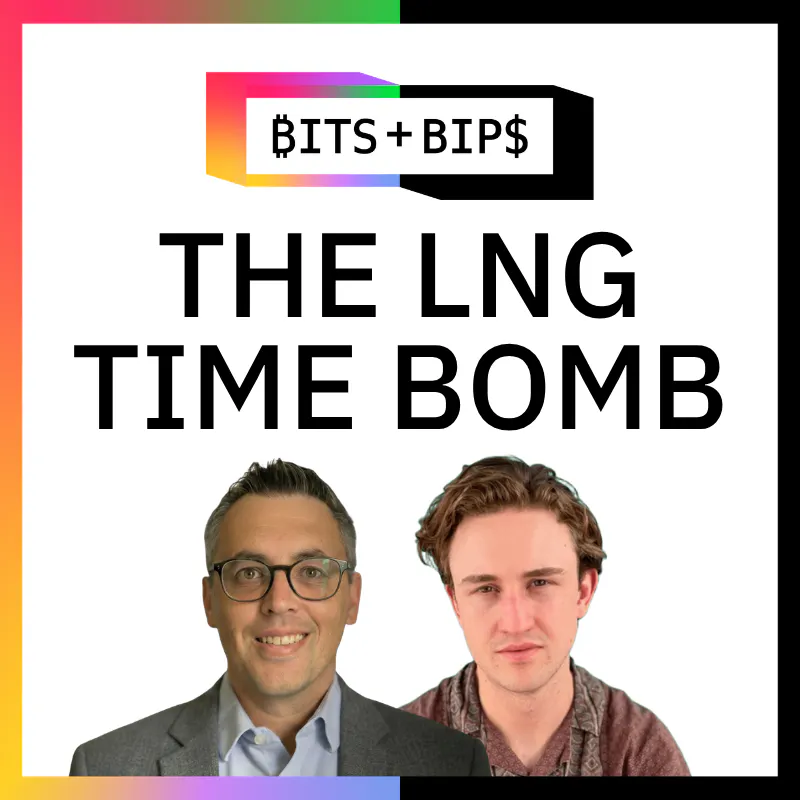
“But first, I really want to talk about what's happening in energy markets today. I don't have to tell anyone listening or watching their volatile oil is still about above $100.”From the transcript
Get every episode summarized
Each time Bits + Bips publishes, we email you a written briefing from the transcript — the topics, who appeared, and any specific claims, with the ad reads skipped.
Email me new episodesFree for 3 shows. No card needed.
Hosts & guests
Transcript ready
92 searchable segments. Every word is indexed and playable.
Full transcript
Bits + Bips — Why Gas Prices, Not Oil, Determine What You Pay for Electricity. Machine-transcribed; use the interactive transcript above to jump the player to any line.
But first, I really want to talk about what's happening in energy markets today. I don't have to tell anyone listening or watching their volatile oil is still about above $100. And given, I think some of the sea-solving statements from President Trump and U.S. and responses from the Iranians, it's very unclear what's going to happen next. How is this impacting the energy markets in Europe versus the U.S., which I believe is a little more self-reliant? And what are some of the big changes or how is this impacting your business? Yeah, a great, very obviously topical question. The kind of differences between the UK and Europe and the U.S. are pretty stark, which you can kind of see and manifest itself on the charts right now. And I think one of the big things that we look at broadly is if you think about oil and gas prices, obviously they're incredibly, you know, the price of oil and gas on markets is incredibly ready to supply. And you know, most of that comes through the Gulf for Europe especially.
In the U.S., naturally, you know, with the kind of recent sale revolution, the U.S. is somewhat self-sufficient, especially when it comes to gas. But I think, you know, one of the big things that we look at is when we're looking at and how it's kind of affecting our business, is that the price of oil actually doesn't really affect into the price that ultimately people pay for their energy, that homes, businesses, data centers, etc. pay for their energy. And, you know, obviously it affects what people pay at the pump, but it's more through secondary effects that oil has these knock on effects and the kind of energy economy. And you know, it's loosely correlated with gas and that's typically due to, you know, it's kind of a replacement in some industrial applications and obviously oil and gas are sourced, near one another, but the main effect of oil on kind of power markets and energy markets in general is secondary due to, you know, inflationary effects on logistics. And obviously that's been hugely impacted with the recent developments in the Middle East and the kind of more kind of pertinent thing
around energy markets, you know, for us in our business is the price of gas. And it's a totally different story because gas directly influences the price of electricity that people pay. It's the kind of primary fuel that goes into your combine gas turbines, which makes up a third of the fuel mix in both the UK and the US. And the way that energy markets are structured and the kind of crisis recovery mechanism on energy markets is very heavily indexed towards the gas price. So what that means is when there's supply disruptions to and the LNG around the world, what you see is a direct impact immediately almost on the price of on power markets. And in terms of the kind of US versus Europe, UK comparison, the Europe is a heavy importer of gas. And typically what happens is that you have seasons where there's injections into gas storage facilities that typically happens over the summer. And then you've got seasons
of withdrawal from those storage facilities. And obviously naturally during the injection season, which is now coming off, the price kind of worldwide of gas and heavily influences, you know, ultimately the costs that Europe is paying. On the flip side, US is with the recent shale revolution fairly insulated as we've kind of seen a little bit on the gas side of things. And that is going to be something to watch over the next few years, though. And the reason for that is when you look at there, there's a certain decoupling between the Henry hub price, which is the price, the kind of standard price of gas in the US and the kind of the price of GCF, which is the kind of European UK index. Those are somewhat decoupled because the US, because it's such a recent market, is slowly still ramping up its export capacity, which means that right now there's this decoupling, but we do expect that decoupling to actually
decrease over time. And the kind of consequence that that is right now there's quite a quite a lot of insulation for the US market. But not at all for the UK market, but that decoupling, as I said, will look to compare it over time. But ultimately, when it comes down to our business, it's the price of gas and the flows and the kind of status of the storage facilities around Europe, because that's where we're operating right now, is what really influences what we're paying, and then ultimately what customers are paying the other one. Gotcha. And maybe just to bring the picture for everyone watching and listening, $100 barrel for oil sounds moderately scary. $150 is very worrisome. $200 is downright terrifying, and that could lead to synthesization territory. Could you sort of put natural gas prices in in those terms? And I know, I mean, just I'm not an energy expert, but it's easy to remember,
especially during the Russian invasion of Ukraine from 2020 to on sanctions put on on Russian energy exports. And nowadays, people are talking about the closure of the Strait of Kormuz, and while some oil processing plants have been shut down, it might take months for them to start up, if and when this conflict ends, the Strait could reopen immediately, theoretically. Whereas Iran's attack on guitars, like big processing and export facility, I believe knocked off 20% of its total capacity, and Qatar is a huge LNG exporter, that could have much more permanent effects from what I could tell. So how does that like, again, put a pick kind of a long question, but like, what are the prices right now, and how is that actually directly impacting customers? And and then again, like, because of this like big attack on the infrastructure, what challenges will that present like moving into the future? Yeah, so I mean, right now the price of gas are basically about and 50% above 50 to 70% above
the kind of usual price that was kind of we would expect and around this kind of here. And you know, ultimately that is down to, you know, obviously the disruption to the Strait of Kormuz. And, you know, when we kind of look at it, like, beyond just crude and LNG, you've got like disruption further to, you know, not just gas prices, but a bunch of other prices as well, right? So, for instance, 30%, 34% of global fertilizers come through the Strait, right? There's also effects. So that's how it ultimately affects food. And then also, you know, kerosene is mostly sourced out of guitar and straight as well. So that obviously influences the price we pay for, yet fuel. And further effects on that is like, there's about a quarter of the world's sulfuric acid comes through the gulf. That is needed for things like explosives, which is obviously very hot and topical right now. And also, you know, we're finding things like copper, which is essential to many things, including a lot of inputs in the energy industry.
So as a consequence, essentially right now, what we're looking at is gas prices are, you know, quite like fairly elevated, probably not as aggressively elevated as what we've seen with oil. And not quite as aggressively elevated as what we've seen through the Russia Ukraine crisis. And that is in part because, you know, especially in Europe, there's been a lot of measures taken since the 2021 crisis to kind of, you know, obviously mitigate the serious effects that that crisis had and causing, you know, the disruption to the energy markets back in 2021. And so that said, like, essentially what we're seeing is right now, we've seen an increase. But not as aggressive as what we've seen in the past. But however, one of the big issues that, you know, that probably a lot of our listeners have seen is that, you know, this, this disruption and its attack on the facilities themselves, these are multi-billion dollar facilities that take decades to build at a very long time to repair. So the long term disruption
is something that I feel like isn't fully being factored in right now. And people, you know, view that, okay, look, this is a short-term thing. We'll see a taco and then, you know, prices will return to normal. But in fact, you know, what we, what we're not really recognizing, and I kind of think that, you know, a lot of markets aren't really recognizing is that do these really severe long-term effects on global support, you know, that they're growing to percolate in the last for quite a few years.
More episodes
More from Bits + Bips

OpenAI Says It Cracked a Millennium Prize Problem. Why Is Anthropic Hitting the...
Bits + Bips

Robinhood's Tokenized AMC Shares Spark a Fight Over What Stock Tokens Really Are
Bits + Bips

Why the Kalshi-Nevada Ruling Could Land at the Supreme Court
Bits + Bips

CME vs. Kalshi. Is Washington Picking a Winner in Prediction Markets?
Bits + Bips