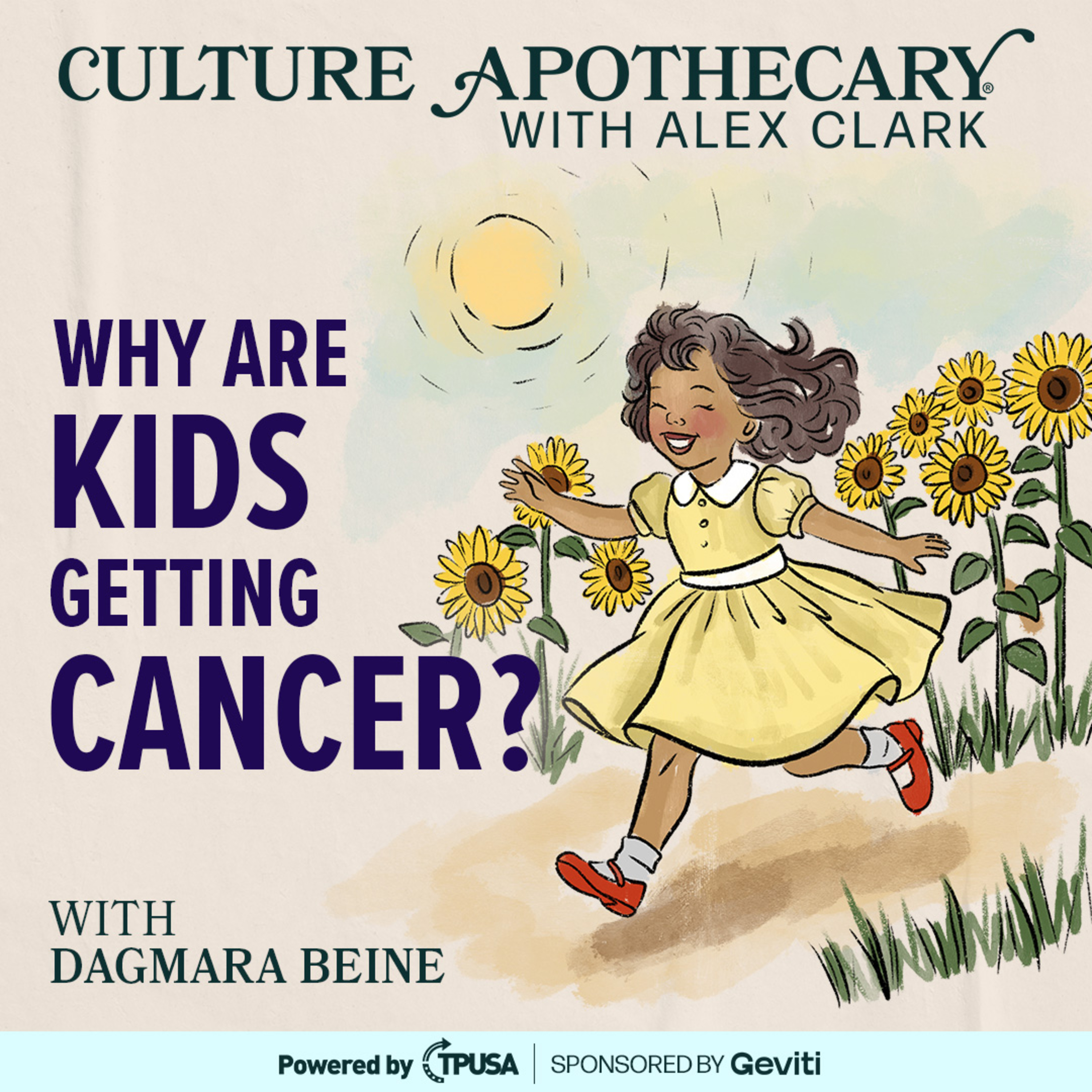
Why Are Kids Getting Cancer? | Dagmara Beine
Get every episode summarized
Each time Culture Apothecary with Alex Clark publishes, we email you a written briefing from the transcript — the topics, who appeared, and any specific claims, with the ad reads skipped.
Email me new episodesFree for 3 shows. No card needed.
About this episode
Culture Apothecary with Alex Clark is made possible by:
“My OB, who I liked very much, said, oh, just take this drug, clomad, no big deal. I was trying to explain why did Zooza get cancer?”From the transcript
What if cancer isn't just bad luck?
Today's guest is Dr. Dagmara Beine, an integrative oncology clinician, physician assistant, and PhD. After losing her fourteen-year-old daughter to an aggressive form of leukemia, she turned unimaginable heartbreak into a mission to help patients understand their risk and advocate for themselves. We're talking about what may actually raise your risk, how to use your labs to catch dysfunction before it becomes disease, and how epigenetic testing can help you make changes before your environment and lifestyle pull the trigger.
Thank you to our sponsors!
SAVA: Use code "ALEXCLARK" for 15% off
CROWDHEALTH: Use code “CULTURE” to get your first three months for only $99/month
A'DEL NATURAL COSMETICS: Use code "ALEX" for 25% off first time orders
Q FOR QUINN: Use code "ALEX" for 15% off your non-toxic clothing today
BRANCH BASICS: Use code "ALEX15" for 15% off Starter Kits
BIRTHRIGHT: Use code "ALEX" for 15% off your first order
Our Guest:
Dagmara Beine PA-C
Dagmara's Links:
FOLLOW ALEX:
Culture Apothecary's Instagram
🌿 Culture Apothecary WEBSITE/NEWSLETTER
Join the Cuteservatives Facebook group to connect with like minded friends who love America and all things health and wellness!
New episodes drop 6pm PST/ 9pm EST every Monday and Thursday.
DISCLAIMER: This content is for informational purposes only and is not medical advice. Always talk to a qualified healthcare professional for any health-related questions or decisions.
Get every episode summarized
Each time Culture Apothecary with Alex Clark publishes, we email you a written briefing from the transcript — the topics, who appeared, and any specific claims, with the ad reads skipped.
Email me new episodesFree for 3 shows. No card needed.
Know when Dagmara Beine turns up
Follow Dagmara Beine and once a week we email you every new episode they appeared on — including guest spots the show notes never mention, because we read the transcript.
Follow Dagmara BeineFree. Pick your own day and time.
Hosts & guests

Transcript ready
1,214 searchable segments. Every word is indexed and playable.
Full transcript
Culture Apothecary with Alex Clark — Why Are Kids Getting Cancer? | Dagmara Beine. Machine-transcribed; use the interactive transcript above to jump the player to any line.
I had two miscarriages in a row. My OB, who I liked very much, said, oh, just take this drug, clomad, no big deal. And then you'll get pregnant. Just try this first. Got pregnant with Zooza. I was trying to explain why did Zooza get cancer? And I found a study that's really hard to find anymore that showed women who took clomad, their kids had up to 50% increased risk of leukemia. It's always a perfect storm. It's always multiple things. We followed the vaccine schedule for Zooza when she was young. We gave her Tylenol and Ibuprofen more than I would have ever looking back. We moved to a house that had a ton of glyphosate childhood cancer is not random. It's through the environmental factors of their parents. So we now have multiple studies that show us what the mom did dramatically impacts the child. There's always hope. You are not a statistic. What if cancer isn't just bad luck?
Today we're talking about what may actually increase your risk, how to use your labs to catch dysfunction before it becomes a disease and how epigenetic testing can reveal what your body may be susceptible to so you can make changes before your environment and lifestyle pull the trigger. Today's guest is Dagmarah Biny, an integrative oncology clinician, physician assistant and PhD, who transformed unimaginable personal tragedy into a life's mission. After losing her daughter to an aggressive form of leukemia, she dedicated her career to helping patients understand cancer risk, navigate the medical system and advocate for themselves. Watch this one on the Real Alex Clark YouTube channel or Culture Apothecary on Spotify. If you've never left a five-star review for the show, it takes 10 seconds on Spotify or Apple to do it and it tremendously helps us out. Please welcome integrative oncology clinician, Dagmarah Biny, to Culture Apothecary. You spent over a decade working in the ER. Is that right? Yes. So when I came out of school, I was a physician assistant, 23 years old.
I looked young. They made me wear a white coat. So people would believe that somebody actually came in the room because there was complaints that nobody actually came in the room. And I was at the tail end of medicine. So that's when people would get diagnosed with their heart attacks or their cancer. And I would hear over and over again, but my labs were just normal. But back then, that's what I did. I was learning how to save lives. And then my daughter, who was three and a half, was diagnosed with cancer. And that kind of flipped my whole world upside down. And I left the ER because I wanted to leave no rock unturned for her, as you would for your child who gets diagnosed. She was diagnosed with a really rare form of leukemia. So most kids that you hear of get diagnosed with leukemia, it's the number one cancer in kids. It's very, the prognosis is very good. Zuzza got a really bad type of leukemia, AML.
And so her prognosis was very poor. And what sorts of options were you given by conventional medicine doctors for her leukemia? So the only thing that they do for leukemia for kids is chemotherapy. And they said that she would have had to have a bone marrow transplant because it was such an aggressive leukemia. Both my husband and I were working in the emergency department. We knew what we knew, but there was a lot we didn't know. I wasn't in the holistic alternative integrative medicine space yet. But right away when they told me that I should be feeding her formula, which had high fructose corn syrup and seed oils in it, this light bulb went on. And I was like, oh, they know their chemotherapy, but they don't know how to take care of like the whole Zuzza. And so I went out to look for an integrative pediatric oncology expert and I couldn't find one. I'm surprised with all of your background conventional medicine that you kind of had this thought of they're not looking at the whole person. I need to find somebody else.
Like that seems shocking to me that you would even think to do that. Yeah, well, when you, I mean, we know nutrition matters or we're not taught that through anybody, especially primary care. But when you and our household that nutrition mattered and so when I knew that like the formulary at the hospital was giving such horrible nutritional options, like it was such a light bulb and then it just snowballed. And since I couldn't find somebody to take care of her because a pediatric oncology integrative expert didn't exist, I left the ER to become that expert because I needed to save my daughter. When a three year old gets cancer, a lot of people think, you know, this just, this has to be random. How does a three year old get cancer? Do you believe that? Do you believe that childhood cancer is just random? Childhood cancer is not random. So childhood cancer has been on the rise by 40% over the last 30 decades. Childhood cancer is now the number one cause of death by disease in kids. When I was in school, it didn't used to be.
It was like asthma and now it's cancer. And childhood cancer exists in such staggering numbers because we live in such a toxic world with the stuff we're putting in our body, the stuff we're putting on our body and the stuff that, you know, kids are forced through their pediatricians to do. How do you explain cancer diagnoses in children or even babies who haven't even had a chance to live an unhealthy lifestyle? It's through the environmental factors of their parents. So we now have multiple studies that show us what the mom did dramatically impacts the child. And with all my pediatric cancer patients because I opened my own practice and started taking care of kids with cancer, just like I started taking care of Zooza, you can look back on labs, the story, you can look at a child's epigenetics and you can actually put together why did this child get cancer? So I have a really great idea of why my daughter was diagnosed with cancer. Do you think that we rely to heavily on the explanation
that cancer is just bad luck? Absolutely. Cancer is a metabolic disease. It is not random. And so the explanation that we're given is that you just have a mutation. You just have a random mutation. Well, it's our environmental factors that caused that mutation, right? So like glyphosate, I think was a big part of why my daughter got cancer. We moved to our dream home. And behind our dream home was cornfield that got sprayed. And I think that was a big part, not V-caused, but a big part of why she got leukemia. This might seem like a dumb question, but I just like to break things down for people because sometimes you just, the stuff doesn't click. Even though you weren't spraying it in your yard, why would that contribute potentially to your daughter's diagnosis, you think? Because there's overspray, right? So the same reason we can't trust certain organic flowers who are in a field next to non-organic farms.
Overspray went into our yard. We had a garden. We had chickens. And we ate glyphosate. And when my daughter was diagnosed, because I was a practitioner, I was able to do glyphosate testing on her. And her levels came back at 900%. Where a normal human being right now is 30 to 40%. So nobody's zero. So you had actual data that showed that she had exceptional glyphosate exposure levels. Yes. That's interesting. I took that test too. My levels were even high. And I mean, I live in a city. I don't live near any fields or anything. And I am doing my best to always eat organic. And they're still exposure. And I think this is why the glyphosate conversation is so important to me. Because you really can be doing all the right things. And you still have exposure for what they're spraying around you, what's being drifting, what's on fruits and vegetables. It's like you cannot get away from it. And so I think that is why it's so important for American citizens to have informed consent on this issue, as well as the ability to sue if you are made sick from these
products, which of course, these chemical companies right now are trying to make it so we can't. Yeah. And I mean, none of us are at zero percent. Like, we literally, if we lived in a bubble, you're right. It's absolutely everywhere. And the best I see on my patients who are well. I see also women who just come to me to optimize their health. And they're doing all the right things. And everybody's at 30% to 40%. Wow. That's really illuminating. We've spent billions of dollars at this point on cancer research all over the world, but also in the United States. And you believe young people are getting cancer for a reason. Is donating money to these different causes that are looking to find a cure for cancer? Is it helping? Is it a waste of money? Should we be doing it? Should we do something else? That's hard. I would say most of my answer is it's a waste of money, because a lot of the research that we're donating to goes towards the somatic theory of cancer, which is that it's just a mutation.
So all the money goes towards research that it's just a bad mutation. And so they're just looking to make drugs to target mutations, which is not the solution. I would say it's better to donate money to organizations that are actually going to start to look at the root cause or help patients with integrative oncology care. That's always interesting to me. You go to the Susan G. Coleman walks and stuff. And they're literally handing out body products with endocrine disruptors. And they're handing out processed packaged processed food kebler cookies and things like that. But it has the breast cancer sign on their ribbit on there. I mean, that's bizarre to me. It's infuriating. It's infuriating because it makes patients on a cancer journey never realize that the stuff they're putting in their body or on their body contributed to their disease. Or it helps determine how they're going to do through treatment. And they're giving away cookies while you're getting your chemotherapy.
I mean, it's wild. So you go on this journey with your daughter, Zooza, and you're experimenting with some integrative cancer care options. What were some of those things? We literally left no rock unturned for Zooza. And I mean, we did everything. So and a lot of the things helped. So Zooza's prognosis was so poor. She lived 11 years off and on with the disease, which is unheard of. She, what normally kids would get like one to two years with her diagnosis. So it did help her both live longer, but more importantly, have amazing quality of life where she was able to do some awesome things with her life. We did things like ketosis through IV chemotherapy, because it helps protect your healthy cells. We did things like mistletoe therapy and high dose vitamin C IVs. Every September, pumpkin spice stages a hostile take over of this country. You walk into a store looking for toothpaste.
And suddenly, there are pumpkin spice candles, pumpkin spice cereal, pumpkin spice dog treats. And yeah, maybe pumpkin spice toothpaste. At some point, you're like, does my Labrador need to experience autumn? But I will absolutely participate when it involves protein. I don't know about you. Sovagislonch, they're seasonal pumpkin spice protein. So you can have your fall personality without your breakfast becoming dessert. Here's what I would make. With Sova's new pumpkin spice protein powder, pumpkin spice protein muffins, okay? Mixed mash banana, eggs, a scoop of Sova pumpkin spice protein, a little almond flour, baking powder and cinnamon, bake until set done. Sova's everyday protein is made with 100% grass-fed bone broth with 20 grams of collagen rich protein. It's dairy-free, gluten-free, soy-free, and has zero added sugar, totally organic. It's formulated around clean, quality nutrition by a functional medicine practitioner, my friend Taylor Dukes. So yes, surrender to pumpkin spice, just make it productive. Go to Sova Nutrition, use code Alex Clarke for 15% off. Sovanutrition.com code Alex Clarke for 15% off.
Health insurance is the only product where you can pay them every month for years, finally need the thing that you've been paying for, and then they can essentially go, no, there was an actual case where a guy had a heart procedure pre-approved by his insurer, right? And then after he had it, they denied payment. That is incredible. Imagine doing that anywhere else. You finish dinner and visa calls, oh, you know what? We reviewed the steak dinner. Unfortunately, the steak dinner was not medically necessary. This is why I looked into crowd health, and now I use it, Vance uses it, and so does my mom. Crowd health is not health insurance. It's a community of members who help fund each other's large healthcare expenses, and you get a care advocate who can help navigate bills and care. They're doing a webinar explaining how the whole thing works, because obviously you should understand something before changing how you pay for healthcare. And I know for me personally, anytime I talk about this, I get a hundred questions. Well, what about this? Do they cover this? How does this work? What about this? And this webinar is gonna answer all of your questions. So check out the webinar, learn about crowd health for yourself.
And if you decide to join, you can use code culture to get started for $99 for your first three months at join crowdhealth.com. That's join crowdhealth.com, code culture for $99 for the first three months. Crowd health is not insurance, but it is very sexy. So mistletoe therapy, can we talk about this? This is one of those big new things, an integrative cancer treatment that people are seeing amazing results with. And I don't ever have anyone on the show talking about it. Yeah, so mistletoe therapy is actually one of the oldest integrative treatments that came out of Europe. So in countries like Germany, it's actually used alongside in conventional medicine. It's only very alternative in America. It is a fungus that grows on a tree. We always think of mistletoe as just around Christmas time, but there's different types of mistletoe. And there's companies that make an extract out of it. We actually have, in Wisconsin, the only pharmacy in the United States that makes it.
The only way to give it is injection through an IV or an injection that you give yourself. So we teach most of our patients how to do an injection because it's easy, they don't need to be in our clinic. We can teach them how to do it at home. And it just makes your immune system smarter. So everybody who gets diagnosed with cancer, their immune system failed them, right? Because the whole job of our immune system is to go around and see what's going on. If there's any invaders, we all make cancer cells all the time. But our immune system recognizes them and gobbles them up and we keep going. So when somebody gets diagnosed with cancer, their immune system failed them, right? There's B cells and T cells. I always explain to patients that mistletoe therapy just goes in there and makes your immune system smarter. So it doesn't directly kill cancer. It makes your immune system smarter so that you can do better on your journey. So for some cancers, like I would say colon cancer, it can contribute to remission. But for other cancers like leukemia,
I've never seen it contribute to remission, but I have seen it help the immune system just do so much better through treatment. So better quality of life. So where do you find places that offer this? So you have to work with your practitioner, like me who's been trained in mistletoe therapy. We have amazing training in the United States. I went through training like a decade ago, learned how to do mistletoe therapy. You have to be a prescriber. So I'm like a physician associate or an nurse practitioner or a doctor and you want to work with somebody who knows what they're doing. And I'm probably one of the only practitioners who prescribes mistletoe therapy for kids. Because nobody wants to work with kids with cancer. And you're only working with kids. I'm working with adults and kids. Okay, okay, cool. So if anyone listening, knows an adult as well that has just gotten diagnosed with cancer. And what types of cancer are you doing mistletoe therapy on? I mean, it really depends on the patient in their immune system, not so much the cancer. Okay, yeah. So it's very, I think that's the big thing with cancer
is people think everything's going to be a protocol, even an integrative medicine. People think, oh, what's your colon cancer protocol? There's no protocols. We want to like look at the individual. We want to look at their labs. We want to look at their epigenetic testing, which I love. And then we want to hear their story and then think, okay, what helped contribute to this? Oh, okay. You have glyphosate toxicity. You had severe trauma when you were young that you never dealt with. And you know, you're severely malnourished because you need gut healing. Part of cancer treatment is what contributed to the cancer. So we need to heal your gut. We need to detox you from glyphosate and we need to work on your immune system and your trauma. So you're going through like a detective investigation to look at everything this person has done in their life that could be contributing to their toxic load. Is that what the epigenetic testing is? So yes, epigenetic testing is a cheek swab. So we were always taught, we have bad genes, right? You hear people say that all the time, oh, I have bad genes or my mom had diabetes.
So I'm going to have diabetes. And so that's not true. Only about five to 10% of cancers are genetic. The rest is environmental. And that has a lot to do with your epigenetics. So a lot of times people will say, well, why did she get cancer when she was a marathon runner and so healthy, you know, but like he didn't. Like people compare like I eat McDonald's every day and I never got cancer. A lot of the answers in our epigenetics. So epigenetics, you do a cheek swab test and you get this beautiful report of all your strengths and your vulnerabilities that you got from mom and dad. Can you do this if you don't have cancer? Yes, I do this on all my patients. Wait, I'm dying to do this. Yes. So I do this on all my patients. Cancer or not cancer. I work with cancer patients and I work in women's health and then all the husbands that the women bring in to see me. So you get this report from mom and dad, you got weaknesses or vulnerabilities and strengths. And it's like a loaded gun, but the environment is the trigger.
So we learn all these strengths that you have that you can plan and we learn all these vulnerabilities that you have. Give me an example of what vulnerabilities might look on somebody's test. So I'm going to give you Zooza's example. Okay. So Zooza had an epigenetic hiccup of vulnerability. It's called PAN-1. They're called SNPs. So that was her SNP. That was her vulnerability. People who have PAN-1 can't detox glyphosate. So when they get exposed to glyphosate, it just stays in their body. And when a toxin like glyphosate stays in your body for so long, what does it do? It changes your cells and mutates them and can contribute to cancers. So let's say you're somebody that takes this test, you don't have cancer yet, tells you you have PAN-1. Yep. And so you know now I can't detox glyphosate well, but we just got done saying, you can't really control your exposure to glyphosate. So if you know that you have that vulnerability, what should that person be doing to set them up for the best success? Yep. So then if that's why everybody should have epigenetic testing, done it like two years old, you only ever need to get the test done once
because you can raise your kids knowing what are their strengths and what are their vulnerabilities. You can't live in a bubble. You can't freak out about everything in life. Yes. So you then know yourself. And I'm obsessed with this. How much is a test? 350 I think? This is great. That is way more affordable than I thought it would be. For one time ever to know. Like the piece of mind that would give me as a parent to know what's going on and for myself. So I have all my, I have so many families in my practice and parents who do this test for other kids. So back to the glyphosate. So let's say you know you're being exposed to glyphosate and then you have this pan-1 gene, right? So we know from studies, if you just take a supplement called Corsitan, it can help that vulnerability. So then you are able to detox it better. You would then teach your child and your daughter, for example. Like you can't eat non-organic stuff. You can't put crappy makeup on your face. You can't do all these things to expose yourself to toxins. And we're all still going to be exposed.
So then you need to do sauna four times a week. So you can sweat the stuff out. Man, I wish I could have done this with my dad. So my dad's dad died of glioblastoma, brain cancer. And then my dad died of glioblastoma, brain cancer. I'm sorry. Yeah. So here's what's interesting. Now, my dad's doctor says to my brother and I, you got to go get this special test on to see if you guys are likely to get brain cancer. And I was like, I don't need to take that test because I totally believe in avogedetics. My dad and my grandpa, both primarily eight ultra-processed food, very sedentary lifestyles. My dad, I bet my dad had the lowest vitamin D levels known to man, was always inside or always under fluorescent lights, barely ever, ever outside or in nature. So many things I could go on and on. My audience kind of knows the spiel. But when the doctor said that, I wasn't afraid, or people asked me like, well, are you afraid that you're going to get that? And I'm not because I've just totally changed my life,
how I live my life, my diet, all those things, in comparison to my dad. Yeah. And so I'm not afraid of that. And I think some people do walk around with that fear. What is your opinion on people that say, well, my mom, my grandma, they've all had breast cancer. So I should see if I have that gene. This is I'm susceptible to breast cancer and then get my breast removed, like what's your opinion? Yeah, I think it's good to know the information, just like we want to know our epigenetics. But then there's so much power and beauty in knowing that we can modify those risks, right? With exactly what you're talking about. We can modify that risk with our lifestyle choices. Those everyday choices we make on what we're going to eat, how we're going to breathe, how much time we're going to spend in nature, and epigenetics allow you to individualize that to yourself versus trying to like stay away from everything bad in the world because there's so much these days. Yeah. So I know my audience, you, I hope you're prepared for the amount that are going to want this test. Anybody can get this test on their own.
OK. OK. So there's a couple of companies that do it. There's probably a lot of companies that do it. The company that I like, and I'm not getting paid for this, is three by four genetics. That's my favorite. And so you can get this done on your own. You can go to their website, order it, and you'll get like a patient report. Now, if I order it as a practitioner, I get what's called a blueprint report, which is like a thousand times better and more information. And then I take that information because I trained in reading epigenetics. That was part of why I went back to school. And then I take that and apply it to the person's life. And then I write out my own report of like, this is how you should be eating. This is how you should be moving. I mean, it's down to the strengths. Like, I know that strength training for me is much better for my body than endurance training. So it's like a little fun. It tells you that. Yeah. Really? A little fun things too, right? So like, I spend more time doing weights
than I would like long distance running because that's actually better for my epigenetics. So if they are like, OK, I order it, but I really want to hear your... So they would just have to work with me. OK. Yeah. Well, I do want people to know they can get it on their own. And they will get like a patient friendly report. It's just that they can read. That they can read. OK. It's just not... It's a little bit obviously different than me taking it, looking at it, getting to know the person and then creating a report for them. No, that's super cool. And look, I didn't even know any of this. I didn't know she was going to say this. It's not like, you know, we're just promoting this. No, no. I think it's interesting. I am... I love having guests on and learning about these different tools that give us hope and peace of mind to help us live healthier, better lives. And honestly, just again, what I hate is this idea of like, throw a supplement at anything and everything. Yes. I would rather, like, before ever spending money on supplements, I'd rather spend the money on tests so that I know exactly if there is a supplement I need to take.
I'm only spending money on that because there was a time where I'm not joking. I knew I was spending like $1,400 a month on supplements. Oh my gosh. It was, I mean, it's not sustainable. I was like, hemorrhaging money. And I was like, there has to be a better way. There's no way. Yes. And so just doing testing and finding out exactly based on my bio markers, whatever. Now I want to do this test for the epigenetics. But that has helped so much with my budget and what I spent in plus. You know, people have health savings accounts that can buy you a lot of these tests and things too. And I believe these companies do take HSA. And like I said, I do this test on all my patients because I am all about individualized care. If we've gotten such better testing, that we can really individualize patients care. I can look at and say, you have MTHFR. You need a methylated B vitamin. Your receptors of your vitamin D are poor. You need more vitamin D, right? So it's like so individualized. I saw a woman recently who had contoured her face
to the point where she looked like she was entering witness protection. New cheekbones, new jaw, this woman had information on the cartel. We've gone too far. Makeup should not require architectural blueprints and a federal permit. That's why I like Adele Natural Cosmetics. Adele is a Christian family owned company in comfort, Texas, making cleaner makeup in skincare since 2014. How cute. But they live at a town called comfort. I can't. Their philosophy is very simple. Beauty should enhance what God already created, not bury it under six pounds of drywall, right? Their bronzing cream gives you soft natural dimension and warmth. This is the bronzing cream. I am wearing it to right now. Look at those. See, it's beautiful. Looks hydrating, blends easily. You can use it to warm up your face or add a settle contour without looking like you've been digitally reconstructed by the FBI. Very natural looking. You still look like yourself. What a concept. Go to AdeleNaturalCosmetics.com. Use code Alex for 25% off your first order. That's AdeleNaturalCosmetics.com. Use code Alex for 25% off your first order. I think we've accepted too many things as normal,
simply because nobody wants to ask questions. You go to a hotel and there's this decorative pillow on the bed that cannot be washed. Why is it there? How many human beings have touched this pillow? Nobody knows. We just accept it and then we continue living. That's kind of how I recently started feeling about my socks. So most conventional socks are made with synthetic materials, dies and treatments. And I'm wearing those things against my skin all day while my feet are essentially being slow-cooked inside a shoe, right heating up. All of that's being absorbed through the soles of my feet. That is why I like Q for Quinn. They're luxuriously soft. Marino wool socks are made with natural fibers, including GOTS certified organic cotton in marino wool. And marino wool naturally breathes and regulates temperatures. So your feet stay warm without overheating, which is perfect now that sweater weather is here. They have new colors and styles for adults and even kids. There's also options for winter sports. Your feet have suffered enough. Use code Alex for 10% off at qforquin.com. That's code Alex at qforquin.com.
Your qforquin marino wool socks aren't needing your feet. I think most people hear your story. You're a mom who's in the medical field. Your daughter gets cancer. She passes away from cancer. And they would understand if you wanted to walk away. But you didn't. You doubled down. Why? My journey with Zuzat taught me more about medicine than any program I ever did. That little girl, I mean, she wasn't so little. She was 14 when she died. That magical girl showed me what strength is. And she showed me that you can have suffering and joy at the same time, which is what my apprenticeship and grief right now is. My brother, my younger brother unexpectedly, dramatically died a week before my daughter. So my mom lost her child unexpectedly. Then Zuzat died a week later, almost at the same time. Oh my gosh.
And through Zuzat's journey, I had to learn all these tools as a caregiver to continue to breathe and be the best that I could be for her. So I learned how to take care of myself on the journey that helped carry me into grief. And grief strips a lot away, right? So I don't care what people think about me anymore. And I'm kind of sick of how mistreated people are through primary care. I mean, I want to say conventional medicine, but there's a lot good in conventional medicine. But let's just say primary care. And I went to sub-stack to start to write about it because I couldn't get all of it out on Instagram. And I just started writing. Everything that is wrong with our health care system and what people need to know. And it surprised me so much that an article that was literally like, print these labs, bring them to your doctor because your doctor's not
checking them, went viral. And it made me realize how hungry people are for the most basic information. But they're not, it's not that they want to know more health information, right? Well, there's all these influencers and do this. Do that. It's so confusing. They're hungry to know how to use the information they already have. Absolutely. So I'm teaching people what labs do you need that your primary care doctor should do? And how to work within the system? Because it's really easy to say, come see me, but not everybody can invest in working with somebody like me. But everybody has, most people have insurance. And a lot of people are stuck having to see their primary care practitioner once a year or 15 minutes. I want to teach them how to utilize that, how to become advocates so they can partner with those doctors versus just be lost in the world of like your primary care doctor is not teaching you anything about lifestyle. And then you have all these influencers online, most of which are teaching you the wrong things about, right?
I mean, there's so much misinformation right now. So personal question, do you pay for traditional health insurance? I do. Really? Yeah. How do you utilize that? Because I know you like to use a lot of these natural things. So in functional medicine and all that. So how does that work? Yeah. So I think we just have conventional insurance in case of like an emergency. OK. And we don't go to a primary care doctor. And so then you just pay cash otherwise. Yeah. And I mean, it obviously helps. Like I have my own practice. So right, you don't have to go to a lot of health. That makes sense. I'm always curious. Tell us also, you had a massive epiphany about fertility drugs. Oh, yes. I want to hear this whole story. So how did you have Zooza? So I got married and we're married for a couple of years. And then we decided we wanted to get pregnant. And I had two miscarriages in a row, early miscarriages in a row.
And went to my OB. And this is like me and my like non-integrative, like conventional era. And my OB, who I liked very much, said, oh, just take this drug, clomid, and no big deal. And then you'll get pregnant. Just try this first. And little needs. And it read anything about it. Just took it. Got pregnant with Zooza. You know, fast forward, Zooza ends it up getting cancer. And I ended up writing the first integrative oncology pediatric book. It's called the Parents Guide to Pediatric Cancer. And in my research for that, I was trying to explain why did Zooza get cancer? And I started looking up clomid, because it was part of her. It's how she was conceived. And I found a study that's really hard to find anymore. But I do have it cited in the book that showed that women who took clomid, their kids
had up to 50% increased risk of leukemia. So that was like the seed that was part of the reason. Did your jaw just drop? Yeah. Wow. And now if you look at other fertility drugs, there's always an increased risk for both the woman and the child. If somebody listening conceived with clomid, should they be worried or? Yep. So I get this question all the time. And it's not just going to be people writing to you that used clomid. It's going to be women who use any fertility drugs that are going to, and I don't want them to freak out. Stuff like associated with IVF and stuff. Yeah. And so the answer is, don't freak out. It's OK. What's done is done. Because there's so many other modifiable factors. So Zooza didn't just get cancer because I used clomid. It's always a perfect storm. It's always multiple things. So we followed the vaccine schedule for Zooza when she was young. We gave her Tylenol and ibuprofen more
than I would have ever looking back. We moved to a house that had a ton of glyphosate. So there's all these other things that you can control. So if you conceived a baby with fertility drugs, do all the other things well. There's so many things, feed them good food. I would say don't follow the full schedule. There's so many things that they can do that are modifiable. Why now are you starting to question how much you use Tylenol and ibuprofen with your baby? Because I now know, so there's also studies that link Tylenol to leukemia. I would choose now, if I had a baby, to use Tylenol and ibuprofen only if I absolutely needed to, not when my child got a fever. Why not when your child gets a fever? Because fevers are good. Now this isn't for infants. So anybody under six months old don't listen to me. But fevers are good. It's our immune system. It's an immune system upgrade. And I was taught in school, if a child gets a fever,
alternate Tylenol with ibuprofen, Dagmara, that's what we were taught. So that's what we did. So I had to unlearn so much of what I learned. Oh, I'm sure. So then before six months old, because I don't have kids yet, so I'm asking for myself. So then before six months old, your kid is a very, very, very high fever. Then what are you doing? So a lot of times, so if you have a good pediatrician, which I think are hard to find, fevers under six months old, and especially I don't even remember anymore at the cutoff is because I haven't been in the ER and so long. And I don't take care of babies anymore. I don't remember if it's like 12 weeks or six weeks. If a child gets a fever, you have to go to the emergency department. And then up until six months old, it can just be dangerous for them to have such a high fever. But I don't take care of babies anymore. I just know that I did things so conventionally when Zuzo was little. And a lot of parents who have kids with cancer will say I'm blaming parents. And there's such a big difference. Like it's education. Like I wish I would have known better.
And I wish I could take every young woman who's about to have a baby and teach her all this stuff. Because we're all always going to do our best for our babies. And I just, I didn't know any better. But I do now. And so I try to educate parents. Because nobody thinks their kids going to get cancer. I mean, understandably, when it comes to the fertility conversation, it's very sensitive. It's very touchy. And you know, you even saying, taking a clone that I believe contributed to my daughter's leukemia is very triggering for a lot of people. Because it instantly puts a mother in a position or a parent in a position of, well, using X, Y, and Z is why I was able to get pregnant with my amazing, beautiful, blessed child in the first place. So I can't admit that that was taking that may not have been the best idea, because that's how I got my child. Yeah. So how do you reconcile those two things? Yeah. Just like looking back, you know, Zuzah had an 11-year journey with cancer. And I knew that glyphosate and those things contributed to it. But what's done is done. What can I do now for my daughter?
So it's like, what can you do now for your child? Because admitting that clone could have contributed to your daughter's cancer is not saying your daughter was never born. Absolutely not. Right. Right. Your shoes travel through parking lots, public bathrooms, locker rooms, picking up dirt and potentially bacteria, poo-poo do-do, and residues like pesticides and herbicides. And then we just walk into the kitchen, oh, come on in, keep your shoes on. Why? You were just in a shell gas station, bathroom Britney Spears. This isn't Downton Abbey. Remove the loafers. And here's another horrifying little nugget. Carpets can harbor huge amounts of bacteria, because they're basically giant upholstered landing pads for everything we drag inside. I love branch basics. This is one plant in mineral-based concentrate that gets diluted into different solutions for floors, countertops, bathrooms, stain remover, glass, and more. And branch basics, oxygen boost, tackles, stains, and brightens whites without chlorine bleach. This is what I use in all my whites. It's human safe. It's fragrance-free and safe around kids and pets. Branch basics is available at target.com
and branch basics.com and Amazon. New customers, though, will get 15% off site-wide at branch basics.com. It could Alex 15. Yeah, you can buy it at target, but don't you want to discount? Go to branch basics.com. Use code Alex 15. You'll get 15% off site-wide. Use their oxygen boost, try their wool dryer balls. They are excellent. They're the best wool dryer balls. Yes, those can also be toxic in these aren't. And when they ask, where'd you hear about us? Tell them, culture apothecary. Nobody prepares for an important event after it happens. You don't buy a fire extinguisher, while the kitchen is on fire. You don't start training for a marathon at mile six. You don't arrive at the airport and say, OK, you know what? Maybe now we should look into past ports. Although, spirit airlines would probably allow that. Well, now that I'm married, we are working on trying to conceive, which means that I've entered an exciting new phase of life where everybody suddenly has questions about my reproductive system. But one thing I learned, you're supposed to start taking a prenatal before you get pregnant. I always assumed you don't positive test by prenatal. Nope, the time beforehand is preparation time.
And that's what I'm doing now. I'm taking bloom from birthright, a whole food prenatal made with grass-fed beef liver, hokey row, oyster, and bone marrow with nutrients, including folate and heme iron from food-based sources. So while we're trying, I'm preparing. Join me and do the same thing. Go to birthright.co, use code Alex for 15% off. That's birthright.co, code Alex for 15% off. If somebody's own family is currently living next to fields that are spraying, or they are considering moving into a house that's near fields that are spraying, should they move? Yes. And this is the hardest thing for me to tell people. We moved. So we moved from that cornfield. Because telling somebody to move is nobody wants to hear that. But especially if you live in a state like Wisconsin or Iowa, it's really hard to move somewhere where there is in a cornfield. But I believe that glyphosate is linked to so many things.
And it's more than just glyphosate, but glyphosate's the big one. It's just not worth it. Our health is everything. And I have patients living in the middle of those fields. And their tests are always bad. And I don't know, it's not worth it. No amount of sauna is going to keep your body clean to a point where I don't think it's going to affect your health. It may not be cancer, but we have Alzheimer's linked to it now. I just saw a new study linking anxiety to glyphosate. I mean, I really infertility. Oh, yeah, that's a big one. It's a big one. So it's not worth it. If somebody can't afford to buy all organic, where should they start? Clean 15 and dirty doesn't. So you want to look up your EWG, Clean 15, dirty doesn't, and start there. What is one thing a family can do tomorrow to meaningfully reduce pesticide exposure without turning their whole life upside down? You know, I do things a little bit backwards. So I think every family should invest in a sauna.
That's great. Yeah. And you think it's OK for kids to be in sauna? 100%. I have little kids, because I have, I work with kids with cancer. And so I'm getting them in there all the time. What do you think about pregnant women in sauna? Is they do it in Finland? Yeah. I give that advice to my patients, but I don't, you know, between a patient and I, I would give them advice like that, but I would never tell somebody I don't know. Sure. Yeah. How do health care providers like yourself reconcile changing evidence with what they were trained to believe? Ah. You know, I think it takes like a personal story. I don't know that I would have ever, everything I am as a human, but professionally is because my daughter was diagnosed with cancer. And I was able to see the system from the other side. I was a patient with her. I was in that chair seeing how she was not treated as a whole person.
Her leukemia was treated with chemotherapy, and that was it. And there's so much more on a health journey. And it's not just cancer. It's, you could like, there's so much more on a blank journey. Anything you're diagnosed with, there's so much more on any auto immune journey, Hashimoto's journey, Ulcerative Colitis journey. There's just so much more that we need to be doing. And conventional medicine just isn't doing it. After everything that you've lived through, what is a common household product that you think completely different about? Ah, candles, scented candles. Oh gosh, what did we do so many things wrong? Any kind of food that you can get with a coupon? What do you mean food that you can get with a coupon? So most bad foods are the ones that you can get coupons for. I mean, have you ever seen like a coupon for like grass fed beef or something at the store? No, it's always like the big general mills companies that you can like, cut coupons for and get like ultra processed crap in your home. I never even thought about that. Yeah.
You are so right. Anything you can get it with a coupon stay away. Unless they really do say a sale on broccoli or whatever. Whether it's your child or it's you, you hear the words, you have cancer. What is the first thing that you tell people to do? Take a breath. So what happens in our conventional oncology world is you find out you have cancer. And most days, the next day you start chemotherapy, cheese. And it, like, there's nothing worse. I always tell people the worst thing you could do on a cancer journey is just do conventional medicine. You need to take a breath and you need to think about how do I want to approach this? So if you're an adult in the United States, you get to choose how you want to approach it. If you're a child in the United States, you have to do conventional medicine. But you can, as a family, decide to find somebody like me or somebody else to help prepare your child for chemotherapy.
Because there's so much we can do through chemotherapy to make it more effective and less toxic. What is the biggest mistake that families make in the first few weeks of a diagnosis? They rush into treatment. They rush into treatment and they don't listen to their intuition. How do you become an advocate for yourself without feeling overwhelmed? You have to pause. There's, we have so many good books. We have so many good mentors talking about how to do cancer right. You have to educate yourself. I love working with other mama bears. But I get a lot of most families who come to me are overwhelmed. And I help them become brave. And it's all through education. What sorts of books do you like to recommend? A metabolic approach to cancer by Dr. Nacia Winters is a phenomenal one. One of my other really wonderful mentors is Dr. Paul Anderson. I mean, these are the people talking about how this is a metabolic disease and all the other wonderful things we can do.
Not saying not to do treatment, but what can we do alongside treatment and what treatment do you really need? What is one question that every cancer patient should ask their oncologist before saying yes to a treatment plan? They need to ask what the real statistics look like, what the real prognosis is. Because a lot of times, this happens all the time. On colleges, it's almost like they're afraid to tell the truth. Like they don't want to hurt the person. And so they'll say, this shrunk the tumor. But sometimes shrinking the tumor does not give you a better prognosis. So they need to get really real about the statistics. How is this really going to help me? How does this look long term? Do I have to do this? What if I don't do this? I mean, there's I have, I think in my book, like 15 questions that you should ask your oncologist. What is something that cancer patients have a right to ask for, but they don't even realize they can? A lot of places at this point actually have integrative oncology practitioners
in the hospital. And nobody even knows about it. So I mean, they are very limited to what they can do, but at least they can use things like acupressure and essential oils and some of like the milder integrative support. I love Dr. Cannelli in Irvine, California. She's one of my favorite doctors. If you have basically any type of cancer, she's like my go-to, I always recommend for people. But I understand some people can't or don't want to pack up and then go hang out in California and pay to stay there temporarily to get treatment from her and stuff. So when it comes to finding a really solid doctor, when it comes to cancer that's going to have a more integrative approach, how do people go about finding that person in their state? So I really like research done and a practitioner that are trained in the metabolic approach to cancer. So just Google that. Like metabolic approach to cancer Wisconsin and find people. Yeah. After everything that you've been through, are you hopeful that we'll find a cure? I don't think we'll ever find a cure.
Why? Because cancer is a complex disease and cancer is hundreds of different disease processes. So Gleeoblastoma has nothing to do with leukemia, right? And I don't, there won't be a cure, but there definitely is so much hope in trying to approach it without the only kind of sometimes successful barbaric tools that we have of chemotherapy and radiation. If somebody listening is terrified because they were just diagnosed or their child or loved one was just diagnosed with cancer, what do you want to say to them? There's always hope. I have so many miracle stories in my practice. You are not a statistic. So don't go googling what you have and then thinking that you have a 20% chance to live in the next five years. It has so much to do with how you approach it. And it honestly has so much to do with working on the emotional aspect
of what contributed to your cancer, the nervous system, the traumas. I think that's the hardest stuff to work on. Where can people follow you on social media? At Dagmarabaini on Instagram. And then what about Substach? Dagmarabaini on Substach. So Vance actually interviewed her on running on butter on his Substach. You guys can go and read that. It's really great. I know he appreciated you being willing to do that so much. If you could offer one remedy to heal a sick culture, it could be physically, emotionally or spiritually, what would your remedy be? I'd be emotionally. I used to think that coming from conventional medicine, doing integrative medicine, I used to think everybody needs gut healing or everybody, but or everybody needs detox. Everybody needs emotional support. Everybody needs to work on their nervous system. Everybody needs to address all their traumas. And we think, oh, I never had a trauma. Everybody's had a little T trauma. So breath work, being authentic, speaking our truths,
being in safe relationships, those things affect our physical health so much more than people realize. So that's number one. Thank you so much for coming on Culture Pathakiri. Thank you for having me. I think the epigenetic testing and info about moving away from farms using Roundup was great advice. New episodes come out every Monday and Thursday at 6 p.m. Pacific 9 p.m. Eastern anywhere you get your podcast. Please leave us a five star review on Apple or Spotify to support the show. This episode is really crucial to share to your Instagram story. This content is for informational purposes only and it's not intended to be taken as medical advice. Always consult with a qualified healthcare professional regarding any questions or decisions related to your health or medical care. I'm Alex Clark and this is Culture Pathakiri.
More episodes
More from Culture Apothecary with Alex Clark

He Was Gay, Then Everything Changed | The Christopher Yuan Story
Culture Apothecary with Alex Clark

A Routine Procedure Nearly Destroyed His Health—How Dr. Josh Axe Recovered
Culture Apothecary with Alex Clark

After 2 Years of Interviewing Health Experts, Here’s What I Actually Believe
Culture Apothecary with Alex Clark

Why Comfortable Americans Are So Miserable | Dirty Jobs' Mike Rowe
Culture Apothecary with Alex Clark