Get every episode summarized
Each time The American Idea publishes, we email you a written briefing from the transcript — the topics, who appeared, and any specific claims, with the ad reads skipped.
Email me new episodesFree for 3 shows. No card needed.
About this episode
“Hi, I'm Jeff Sikhinga, Executive Director of the Ashbrook Center, and this is the American idea where we discuss the ideas, people, and events that have made America what it is today.”From the transcript
Typical civics and American Government courses teach that the Supreme Court has the final say in interpreting the Constitution - that is, determining its meaning and limits. Judicial Review, and other accepted powers of the court, are also taught as if the Founders built them that way.
But what if that’s not the case? What if the court’s powers and norms are the current state of a centuries-long evolution, one that isn’t necessarily, or supposed to ever be, complete?
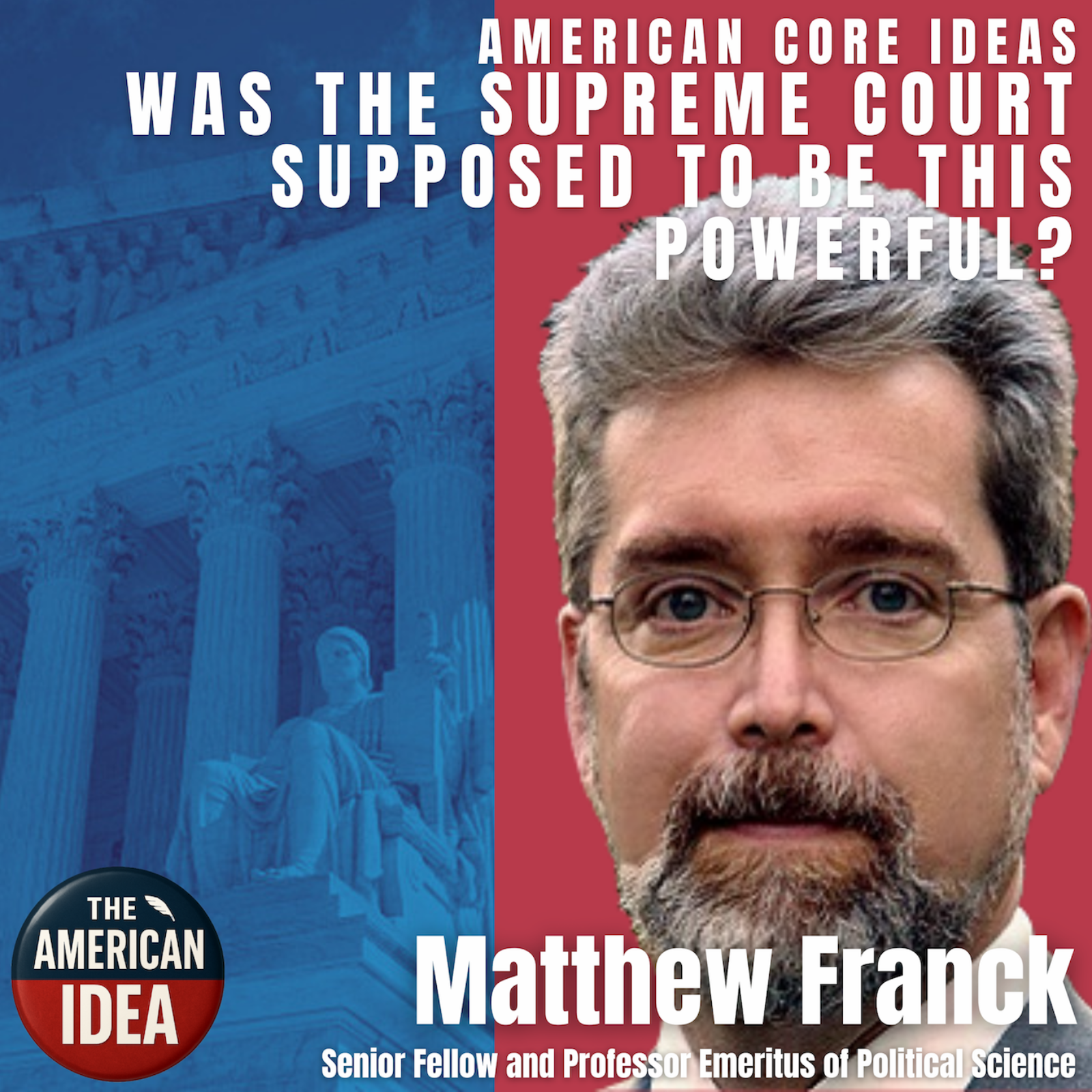
Constitutional scholar Matthew Franck joins Jeff to discuss the evolution of the court’s powers, particularly that of judicial review, and how the view that they are a settled issue may not serve our republic well.
Read Federalist 78, mentioned in the episode: https://teachingamericanhistory.org/document/federalist-78/
Read Federalist 81: https://teachingamericanhistory.org/document/federalist-no-81/
Find Matt’s articles at the Public Discourse: https://www.thepublicdiscourse.com/
Host: Jeff Sikkenga
Executive Producer: Jeremy Gypton
Subscribe: https://linktr.ee/theamericanidea
Homepage: https://ashbrook.org/the-american-idea-podcast/
Thank you for being part of The American Idea community.
Follow on Twitter https://x.com/amideapodcast
Follow on Facebook https://www.facebook.com/ashbrookcenter/
Get every episode summarized
Each time The American Idea publishes, we email you a written briefing from the transcript — the topics, who appeared, and any specific claims, with the ad reads skipped.
Email me new episodesFree for 3 shows. No card needed.
Know when Matthew Franck turns up
Follow Matthew Franck and once a week we email you every new episode they appeared on — including guest spots the show notes never mention, because we read the transcript.
Follow Matthew FranckFree. Pick your own day and time.
Hosts & guests
Transcript ready
379 searchable segments. Every word is indexed and playable.
Full transcript
The American Idea — Was the Supreme Court Supposed to Have This Much Power?. Machine-transcribed; use the interactive transcript above to jump the player to any line.
Hi, I'm Jeff Sikhinga, Executive Director of the Ashbrook Center, and this is the American idea where we discuss the ideas, people, and events that have made America what it is today. We believe that by understanding our history and our principles, we can better live up to the promise of the American family and preserve our ongoing experiment, consult government. Welcome to the American idea. And welcome everyone to this episode of the American idea. Today we're going to be talking about an institution that's always in the news, making controversial, making controversy in American contemporary public life one way or another, but in fact this institution has been controversial, creating questions, creating public discourse on its proper role, its proper place in American
public life, and its proper place in the American constitutional order. And of course that institution is the United States Supreme Court. We're going to be talking about that institution today with one of the nation's leading experts on the US Supreme Court. A person, a scholar from whom I personally have learned a lot, have benefited from his writings and his deep scholarly insight into the court, into its decisions, into its history, and its role in our public life. And that is our guest today, Professor Matthew Frank. Matt is Senior Fellow at the Witherspoon Institute. He's also a visiting lecturer at Princeton University. Matt was Professor Emeritus at Radford University in the common wealth of Virginia. And he is also a senior contributing editor to public discourse, the publication of the Witherspoon Institute, where he writes a monthly column. The bookshelf. It jumps from
topic to topic, whatever interests me, but centered strongly around questions of American politics and the constitution. Yeah. So I want to encourage our listeners to go check that out, public discourse and Matt's column there. It's a terrific publication. It combines deep scholarly knowledge with sort of application to contemporary public affairs. The sort of thing we try to do here on the American idea. We have a great guest today. Matt Frank, welcome to the American idea. Thanks Jeff. It's going to be with you. Good to see you again. The anti-federalist brutists looked at Article 3 of the Constitution, claimed that the Supreme Court would be the most powerful institution in the country, where the Constitution ratified. And he claimed it would be independent. Eventually, the justices would think themselves independent of heaven itself, I think his phrase is. That's an early powerful criticism of the
Supreme Court. Take us back to the early Supreme Court before we move on to the contemporary times. Yeah. Who did the Federalists try to respond to that criticism and defend what Article 3 gave us? Well, that's a great place to start because brutists is of all the anti-federalists, the most articulate critic of this feature of the Constitution. He's worried in particular about the jurisdiction of the Supreme Court, which extends in Article 3 to questions of interpreting the Constitution itself. And he's concerned about the judges' life tenure. And as you say, he thinks at least as to vital questions of the meaning of the Constitution, this is going to be an uncontrollable bench of judges. Those essays of brutists appeared in around March, I think, of 1788, within a month or two Hamilton responds to them with his series
of essays, numbers 78 through 83 in the Federalist Papers. And it's very interesting. You know, Hamilton could have simply poopood, brutists' complaints. He could have actively denied, for instance, that the Supreme Court would have the power to declare acts of Congress unconstitutional. But he doesn't do that. He affirms what brutists fears in certain respects. He says, yes, you know, this under a limited Constitution, which authorizes the Congress, for instance, to do some things, but not others. And explicitly forbids certain things like bills of a tinder and expo-specter laws. We do expect the judges will exercise that judgment that refuses to enforce laws that Congress has not authorized to make, or is actually forbidden to make. Hamilton comes out swinging. He says,
he says, yes, this power will exist. It is proper that it should exist. It is valuable that it should exist. But worry not at all, he says, in Federalist 78, this is the least dangerous branch of the Federal Government. They have neither forced nor will, but merely judgment. They don't have, they don't have the purse, they don't have the sword. They depend for the efficacy of their judgments, he says, on the executive branch. And later, in a little noticed passage in in Federalist 81, which gets assigned in classes less often than 78, he even says, if the judges persist in a course of usurping legislative authority, they can actually be impeached and removed from their offices. We've never done that. There's only ever in our history been one impeachment trial of Supreme Court Justice Samuel Chase in 1805, and he was acquitted.
But I think it's very interesting that the debate takes this shape at the very beginning. The other thing that's worth noticing, though, about Brutus and its curious feature of his argument is, as an anti-Federalist, he's worried about the sovereignty of the states under the new constitution. That's a theme through many of his essays, not just about the judiciary. With respect to the judiciary, what he fears the most about this uncontrollable bench of judges is that they will interpret the constitution to permit Congress to do all sorts of things on the basis of dubious readings of congressional authority. In other words, he's afraid that they won't act often enough to limit congressional authority. So, why are we replying to Brutus
is to say, well, it sounds, man, like what you really want is a bench of judges who have the power to say now off to the Congress in the name of rescuing the states from expanding federal authority. So, there's a deep problem in Brutus' own argument. And this is echoed in later reactions that you hear from Thomas Jefferson, for instance, to some of John Marshall's decisions in the first few decades of the 19th century. What Jefferson typically complains about is Marshall saying yes to exercises of congressional authority that Jefferson wishes his court had struck down. So, the irony is that some of the critics, the strongest critics of the early court were concerned that the court was not acting powerfully enough in its authority to exercise judicial
review. So, there's a plenty in the whole story. And it's fascinating to me what you said, though. And I think some of our listeners may not realize this because about the idea that Alexander Hamilton already in 1788 is defending the Supreme Court's power to declare laws unconstitutional or void because I think a lot of people have been taught if they remember their high school civics at all or high school American history, they say, oh, well, wait a minute, I thought Marbury versus Madison created this power judicial. Yeah, that's an unfortunate. Oh, it's about that famous case in that early, sure, that idea that that that's what happened. Sure. Marbury versus Madison, most people are introduced to it at some point in high school or college government classes. Marbury versus Madison, 1803, decision, early decision by John Marshall's court. He became Chief Justice in 01. That is rightly described as the first case in which
the Supreme Court held unconstitutional a provision of federal law. And so it's often, you know, pinpointed as the origin of judicial review, by the way, a phrase that Marshall never used and was not in common usage until the 20th century. So that's another story. But and we can circle back to it if you want later. But Marbury versus Madison was a case in which the court held that its own authority had been inadvertently expanded without authority, proper authority, by the Congress in the First Judiciary Act of 1789. The act that organized the first courts in the United States that identified how many justices the Supreme Court would have. It gave it all sorts of jurisdictional boundaries to decide certain cases and not others. And the court had, according to Marbury, the Congress had aired in
authorizing the Supreme Court issue, Ritz of Mandamus, to government officials, Ritz that command government officials to conform their actions to certain claims of right or to perform certain duties that the law prescribes for them. Marshall said, no, that doesn't fall under the Supreme Court's jurisdiction. It might belong to a lower court issue, such a Ritz. And for us here at the Supreme Court to affirm or reverse a lower court's decision on a rid of Mandamus. But it's an unconstitutional expansion of the court's original jurisdiction. It's right to sit as a court or first resort. It's an unconstitutional expansion of the court's original jurisdiction to give us this authority. Mr. Marbury has to go to some other court. Unfortunately for him, there really wasn't one available. So is Marbury, is Marbury the beginning of it all? It's not.
Back in the 1790s when John J. I believe it was still J, not yet L's worth, was Chief Justice. The court heard a challenge to a carriage tax in the District of Columbia in a case called Hilton versus United States. Hilton with a Y, not an I. So it directly confronted the question whether the Supreme Court would strike down this tax. So there, the question was all teed up for a court seven years before Marbury versus Madison to decide whether to strike down the law. What the court decided was that the carriage tax was valid under the taxing power of Congress. And so the law was upheld. But it was assumed throughout the case that if the judges determined that Congress had enacted a tax and didn't have authority to tax to enact, the court would strike
it down. Hamilton writes Federal 78. As I said before, he doesn't deny Brutus's observation that the court will have the power. We now call it Judicial Review. He affirms it. Why does he affirm it? Because it's actually a pretty clear inference from the language of the Constitution itself. If you join together the reference in Article 3 to the court's power to decide cases arising under the Constitution and laws of the United States, with its implied duty under Article 6 to treat the Constitution as the Supreme Law of the Land. And Federal laws of Supreme also, if they are in conformity with it, made in pursuance thereof, it's pretty clear from the conjunction of Article 3 and 6 that's something like a judicial power to decline the application of invalid Federal laws. Federal laws that are not authorized or are forbidden by the Constitution. It's clearly there
in the text. So that's interesting to me because what you're saying is, so one of the kind of common myths we've had about the Supreme Court is that Marbury versus Madison, this famous case, created this power to Judicial Review. And you're saying no. The court had been exercising it and it had been assumed to exercise it. One of the other things though is we also here have heard this is that the Supreme Court, its job, sometimes people will say its job is to tell everybody what the Constitution means. This idea that Supreme Court is really supreme in interpreting the Constitution. It seems like in the early days of the Republic, there were people who disagreed with that idea that it's almost an article of faith among us today, at least among many people, early presidents, for example, I'm thinking of Thomas Jefferson or Andrew Jackson, maybe even Abraham Lincoln, who said, I'm not so sure that the Supreme Court is automatically the final authoritative interpreter of the Constitution in all circumstances. Tell what kind of controversy was there
in the 19th century about the Supreme Court's ultimate authority? Yeah, and there in the trio of Presidency just mentioned are all provide prominent examples of this persistent questioning or refusal to assume that the Supreme Court has the authoritative last word on every question under the Constitution. Jefferson, Andrew Jackson, Abraham Lincoln, they all call this into question. Jefferson, as I suggested earlier, is actually a figure of some contradictions or ironies in this position because he would actually like John Marshall's Court to be striking down more federal laws than it does. And to be clear, while Jefferson was angry about Marbury versus Madison, he was not angry about Marshall's assertion that the court had the power of judicial
review. He was angry at his administration having been scolded for withholding William Marbury's commission to be adjusted to peace. So a sort of a personal political dispute between Thomas Jefferson and John Mark. Yeah, but in response to later decisions of the Supreme Court, like McCulloch versus Maryland on the Bank of the United States in 1819, Jefferson reacted angrily to, and could we grudest really, he reacted angrily to the ideas he saw it, the Supreme Court giving an unduly expansive reading to congressional authority, which made inroads in the view of Jefferson's party on state sovereignty. Andrew Jackson, there's a famous but apocryphal and not, you know, unattested remark of Andrew Jackson's after Wester versus Georgia in 1832 case in which
Marshall's court held for the sovereign control by the Cherokee nation of their treaty accorded territory in the state of Georgia. And Jackson, who was on the brink of, of gining up the trail of tears, of course, he is said to have said, but we don't have any attestation of it. John Marshall has made his decision now let him enforce it. He also, in another well-known instance, vetoed rechartering of the Bank of the United States, also in 1832, same year, and said he was not bound by Marshall's decision 13 years earlier in the McCulloch case. He was not bound to regard the bank as constitutional. Now this is interesting. If you look at Marshall's
reaction to that at the time, and we have his correspondence, Marshall reacts to Jackson's veto of the bank by saying to a friend of his, you know, in fact, well, it's too bad he did that because the bank is a useful institution. He does not complain about Jackson's assertion that a president has his own independent authority to interpret the constitution differently from what the Supreme Court says. That's fascinating to me because what that means is that Andrew Jackson said, John Marshall has said the Bank of the United States is constitutional, but me as president, I say it's unconstitutional, and I'm going to veto that. And John Marshall may have been accepting of that idea. I think he was. In fact, if you read his McCulloch decision on the bank closely, he seems to be saying that in the last analysis within the bounds of plausibly
necessary and proper exercises of legislative authority, it is Congress and the president who have the final word on the policy choices that the Constitution leaves open to them. And that entails constitutional judgment on their part. So he did not have a problem with. I read Marshall, and I'm maybe a deus and critic in this, but I read Marshall as fundamentally a kind of departmentalist himself. That is someone who regards each of the departments or branches of the federal government as having its own purview for the interpretation of the Constitution with decisive effect in their own field of action. What what concerned Marshall was the defense of individual rights from from unauthorized injury. And he saw the role of courts was to provide
remedies for those injuries to our rights. Hi, I'm Jason Stevens, chair, the master of arts in American history and government program at Ashton University. If you are an educator who teaches US history, government or politics, our program may be just what you've been looking for. Our approach is to emphasize primary sources. Since we think the best way to study the past is to read the words of those who lived in. We have a distinguished faculty made up of professors from both Ashton University and from colleges and universities across the country. And they're not there to lecture to you. We think it's better to learn through conversation about the documents. ours is a hybrid program with two different types of seminar. The first are our week long intensive in-person courses during the summers on the beautiful campus of Ashton University. The second are our live synchronous online seminars offered throughout the year. If you're a social studies teacher
and you're looking to deepen your understanding of America's past and its politics, please check out the master of arts in American history and government program. You can do that by visiting tah.org slash programs. Because then you have a really famous maybe the most infamous case the Supreme Court's ever handed down the Dred Scott decision. Which is what 1857 and essentially saying, solving a solving in quotes the slavery issue by saying there's a constitutional right to slavery in the Western territories. Too bad Abraham Lincoln, too bad Republican party. Your whole platform was against that. But now you're wrong, you're fundamentally wrong. So Abraham Lincoln had to respond to that. Yes. And you handed this idea that the Supreme Court has said it. Now we all have to obey it. And that's the way it is. Yeah, he rejected that. And it's quite clear in a famous speech than Lincoln gives on June 26th 1857. It's sometimes just called the Dred Scott speech. And it's
a lengthy rebuttal to Chief Justice Roger Tony's Dred Scott opinion. And in the course of that that speech, he says, look, you know, we just don't have to accept this interpretation of the constitution on on the citizenship of free blacks in this country or on the power of Congress to prohibit slavery in the Western territories. We don't have to accept those rulings as blinding us in other offices of government in which we might serve any. And this becomes a recurring point of contestation between him and Stephen Douglas in the Lincoln Douglas debates over the Illinois Senate race in 1858. They recur repeatedly to Dred Scott and Lincoln holds his ground. He says over and over again, if I am sent to the US Senate, I will do my utmost to reenact the Missouri Compromise Prohibition on slavery in the Western territories because I
do not regard that decision as right. And I want to keep knocking on that door until we get a better decision from the Supreme Court. When he becomes president in 1861, he instructs his administration, the State Department, for instance, to grant passports to free black Americans, a privilege of citizenship, the thing that the attorney court had denied. And Congress in 1862, in the midst of the Civil War, did reenact a prohibition on all slavery in the Western territories. In advance of the Emancipation Proclamation or the 13th Amendment, they reenact a ban on slavery in the Western territories. It was never challenged in the court. The circumstances of the Civil War ongoing at the time really made that sort of off the table. But what you see in Lincoln's Republican Party, under his leadership, is the Congress saying, we don't have to take that know for an answer. It's really interesting. That is fascinating to me because then you think,
well, about 80 years or so later, you think of another, I'm thinking of another challenge to the courts authority by another president, Franklin Roosevelt. Yes. Different party, Lincoln a Republican, Roosevelt a Democrat. This idea that the Supreme Court has the final word on the Constitution and you just have to accept it seemed to provoke FDR a lot in feud with the Supreme Court during the Great Depression and the New Deal. Yes. And I think what you have in mind there, Jeff, is, and it's what next year, and it will be the 90th anniversary of Franklin Roosevelt's so-called court-packing plan. I'm actually planning to devote my August column to that very subject at public discourse. I've recently been reading up some very interesting books on the court-packing plan. And Roosevelt, it's hard to say that he foresquare rejects judicial supremacy, but there's
no question that he's agitated by. Decisions he thinks are profoundly wrong in the limitations they impose on congressional authority and presidential authority for his New Deal. The trouble is that he at first comes out in February with a disingenuous argument for his court-packing proposal. He says, well, you know, these aging justices on the Supreme Court need help from younger, fresher blood to handle their docket, to handle their workload. And so what I propose is that for every judge on the Supreme Court whose 70-year-older that if he doesn't retire within six months, I get to put another justice on the Supreme Court up to a maximum of 15. Well, there were six members of the Supreme Court in 1937 who were 70-year-older. He would have overnight have gotten exactly six
appointments to make and would have happened to just turn the Supreme Court in his favor. Yeah, and if you think about it, if that if that plan had passed, he'd have gotten six appointments no matter how you slice it. Because if the six elderly justices retire, they get replaced by him. If if any one, two, three, four, five or six of them refuse to retire, he gets to add a justice for each of those. So no matter how you do the math, you know, by the end of 1937 had the had the plan passed. By the end of 1937, Franklin Roosevelt would have had six appointments to make to the Supreme Court. Well, it's it's a it's a very involved and complicated political struggle as I as I know now better than I ever have having having recently read a lot about it and it fails. But you know, he did get to reshape the Supreme Court and it it changed its direction
on key issues like the like the question of substantive due process and liberty of contract, like the the extent of Congress's power over commerce and related subjects. So but but what's going on, I think in the in the earlier 20th century is is the is the beginning of a new historiography of judicial review. As I said earlier and I do want to come back to it, judicial review was not an expression used by the founders by John Marshall by the Supreme Court throughout the 19th century. In the late 19th century, the phrase judicial review originates in the field of administrative law to refer to the power of judges to review whether administrative agencies are properly authorized to issue decisions and regulations under statutes that that create and
authorize their activities. It gets borrowed into constitutional law just a little bit in the early 19th century and then here at Princeton, where I am, Edward Corwin, the great constitutional law professor at Princeton for many years. He seizes on this phrase, he doesn't coin it, but he seizes on this phrase judicial review. In 1914, he popularizes it with a seminal article later to reappear in a book of his in 1914, the doctrine of judicial review. And and what's fascinating about it is that at this stage, still relatively early stage of Corwin's career, he equates judicial review with judicial supremacy. He essentially refers to them, refers to judicial review throughout that article and for years to come. He refers to it in terms that seem to give it the most sweeping
scope and definition to dictate the meaning of the constitution with binding effect on all the branches of government. And he treats this as as having been Marshall's project. He's one of the myth makers about about Marshall pulling this off. I see. Yeah, because it does seem to me like by the time you get to the mid 20th century and Franklin Roosevelt, even though he's pushing back on the Supreme Court, he's pushing back politically. I don't like their decisions, their wrong of Congress. We should have be able to enact this new deal legislation. And if they don't change their ways, we're going to change the law so we get judges that I like and that will support this. Not really challenging the ultimate authority of the court to decide cases or even interpret the constitution. He just says, we need better interpreters. Yeah. And I think that's exactly right. And by the mid 20th century, the idea that the Supreme Court has a binding final authority on all
institutions of our political order to fix the meaning of the constitution in ways that cannot be gained said by other institutions, the idea that that's the extent of the Supreme Court's authority that it runs to everything with binding effect on the meaning of the constitution. That's not deeply challenged by Franklin Roosevelt. He just wants different outcomes. That rules with binding effect in ways he likes. But the court itself was, I think, starting to get bigger in its pitches as it were in the first half of the 20th century. Doesn't it get its new home? The beautiful It does. It does. It can 1935 or something 19, yeah, around then. Yeah, around 30. It looks like a
temple for Greek gods. Yes. Yes. Previously, they almost like what Brutus said would happen. Previously, they had met in in Humbler digs in the in the Capitol building in a fairly small chamber. And then when the Senate grew and moved to a larger Senate chamber, they got the old Senate chamber. Nice, but still not, you know, a distinct marble temple. William Howard Taft, who was president between Teddy Roosevelt and Woodrow Wilson for a term. But then is appointed by Warren Harding to be Chief Justice himself, the only president who's ever served on the Supreme Court. He's the one who he does two things that elevate the Supreme Court. One is that building. It's Taft's idea, although he doesn't live to see the Supreme Court move into the finished structure. But that's Taft's monument. The other thing that Taft is responsible for is the design of the 1925 Judiciary Act,
often called the Judges Bill because Taft and other judges largely crafted the legislation for Congress themselves. And that's the law that gives the Supreme Court near total control over its own docket. So they decide what cases they will hear on appeal. They deny hundreds of cases every year, you know, rites of surgery, applications for surgery. They deny those petitions. They take a small handful of cases that to them represent issues of sort of great regime level legal problems. And they decide only those. I think it's been observed by a number of people, Felix Frankfurter observed it before he joined the Supreme Court. The 1925 Act was the law that did much to transform the court from a court hearing routine matters of law day in and day out
to a sort of concentrated and focused political tribunal that limits itself to the most important politically most important legal and constitutional questions. Yeah, that's very, that to me, that's very interesting because after that, as you say with a conflict with FDR, there is a kind of acceptance of this notion that the Supreme Court has control. The case is it's going to hear it's going to put really important cases that define the meaning of the Constitution. At the same time, though, there is, if I'm right, there is a kind of persistent criticism of the court, even from presidents. So you get Ronald Reagan comes into office and he says the war on court under Earl Warren, the Supreme Court was too activist. We need a new, we need the court to rethink it the way it interprets the Constitution, pull back, restrain itself, let Congress, let the president let the states do their business. Then you even get someone like Barack Obama
at the state of the Union address faced a face explicitly criticizing the Supreme Court, right looking right at them and telling them one of their decisions was wrong. And certainly after the the Roe v. Wade case, there was controversy over and many other decisions the court made. Even though people have accepted, seem to have accepted the court is the final interpreter of the Constitution, they have not accepted the notion that you can't criticize the court and citizens do it and high public officials, including presidents, continue to do it. Yes, they do. And some of the justices regard this as lamentable under certain circumstances. They, you know, Justice Scalia, for instance, notably said in the KC ruling on abortion in 1992, plain paranoid versus KC, which, which affirmed Roe v. Wade 19 years after the initial decision. Scalia dissenting from that, that reaffirmation of Roe v. Wade said,
you know, every year the March for Life comes out and gathers on our doorstep to say, you know, we shouldn't have done this. And then, you know, we, we're also inundated with the protests of people who deeply interested in preserving abortion rights under the Roe v. Wade president. They're, they're dedicated to preserving that precedent. Why are all those people here? He said, because we did something we shouldn't have done. We, we intervened in a matter that is properly left to the elected branches of government. In this case, the elected branches of state governments, you know, when the Supreme Court becomes a forum that is besieged by letter writing campaigns nowadays, you know, it would be email or social media campaigns trying to influence us and and marchers and demonstrators and protesters trying to influence us. When that happens,
it should be assigned to us that something's gone sideways. That, that was Scalia's argument. I think he was, he was largely right. You know, every so often, members of the court themselves say things that show an awareness on their part that, that there's something deeply troubling about judicial supremacy. John Roberts, Chief Justice, said this directly in the gay marriage decision of Obergefell versus Hodges in 2015. He said, this case represents an amazing assertion of judicial supremacy to decide a matter that is none of our business. Who do we think we are? He said, he said, I mean, in a published decision, you know, it's interesting. As I said, you know, as a, as a historical matter and as a, as a matter of practice on the Supreme Court, the belief in the court's peculiar authority to interpret the constitution grew in the 20th century, but it was
not until 1958 under the pressure of the desecrigation controversy following Brown versus Board of Education that the court ever explicitly asserted the doctrine of judicial supremacy as, as, it's largely accepted today. This was in a case called Cooper versus Aaron, where they constructed the following syllogism. Major premise, Article 6 makes the constitution, the Supreme Law of the Land, minor premise. Ever since Marbury versus Madison, it's been understood by the whole country that, that the Supreme Court authoritatively interprets the constitution. Conclusion, whatever we say the constitution means, is the constitution. That's an awesome assertion. I mean, like it should fill us with a kind of, it should make a stagger backwards with a kind of awe at the, at the presumption of it.
And the trouble with the syllogism is not that there's anything fallacious about it. There's no logical difficulty with the syllogism at all. The trouble is that the minor premise is a falsehood. It's just historically false that Marbury versus Madison asserted that the Supreme Court is the authoritative interpreter on all constitutional questions. That's not in Marbury at all. It's, it depends upon a tendentious reading of a half dozen words in one sentence of Marbury opinion. But that's the life, that's the sort of disproportion that it has, that it has taken on. It is interesting to me then because the Supreme Court has sort of taken on or been given that authority by other political branches by the public. And you know, when the Supreme Court was making decisions that some people regarded as liberal, you heard a lot of criticism of the Supreme Court by conservatives. Yeah. Calling it rain back its power, rethink itself, who do they
think they are? When the Supreme Court has been in more hands of more conservative justices as they're usually understood. Now you've heard people on the progressive side of the spectrum saying, who does the Supreme Court think it is? You know, it needs to roll back its authority. It needs to restrain itself. Stop making these activists kind of decisions. Looking forward for the Supreme Court, if it's fair to ask this question, will it remain a center of controversy over its authority itself? Will we continue to hear criticisms from all sides of the political spectrum? I think so and I fear so. You know, notwithstanding Chief Justice Roberts' remark in the same sex marriage case about judicial supremacy, I don't think there's any member of today's Supreme Court or any prominent figures in the circuit courts who might become the next several Supreme Court
justices. I don't think there's anyone prominent in the federal judiciary today who deeply questions the idea that the Supreme Court has a binding final authority on every species of constitutional question, question about the Constitution's meaning that might come before it. They all seem to embrace that. They all seem to insist that what they say goes and they only criticize one another for the particulars of individual decisions or doctrines. So out of a single term of the Supreme Court, we seem to get today decisions that anger somebody on either the left or the right, the really contentious cases. But we don't get
too many people in our political life who let alone on the court itself who take a step back and say, should the court even be deciding these things? Should it really have the final say on, for instance, of President's removal power over officers like Rebecca Slutter or the Federal Reserve Governor Cook? Should the Supreme Court be granting a president's immunity granted Donald Trump and all future presidents in 2024 from criminal prosecution after they leave office? On the other hand, decisions that come out the other way are equally criticized. The decisions that went against Donald Trump should the court be intervening in that terrif dispute, for instance.
Although that was largely a matter of statutory interpretation rather than constitutional. I think we're stuck in sometimes frustrating and unproductive bog of a high degree of politicization of the court because of its assertion of its own authority over every species of question. Well, it means that the next Supreme Court vacancies are going to continue to be very highly charged politically, very carefully watched, probably very partisan in the Senate hearings and the debates and the discussions and the votes. But it certainly means the Supreme Court is going to continue to be important for all of us to watch and to have a little bit of historical perspective on it, which you have helped to give us today. A fascinating conversation about the origins of the Supreme Court's authority all the way back to the Constitution of Marbury Madison until today. Our guest today is Professor Matt Frank, an expert on the US
Constitution. You can read his work at public discourse, the publication of the Wither Spoon Institute. Let me highly recommend it to our listeners. Matt, thanks for being with us today on the American idea. Thanks so much, Jeff. I enjoyed the conversation. Thank you for listening to this episode of The American Idea. If you enjoyed this episode, remember to subscribe at Apple Podcasts, Spotify, or wherever you get your podcasts and leave a five-star review. If you want to learn more or get involved in an Ashbrook's Vital work, visit our website, ashbrook.org.
More episodes
More from The American Idea

Rage and the Republic: The Unfinished Story of the American Revolution
The American Idea

The Last Adieu: Lafayette and Early America
The American Idea

Completing the Founding: The Northwest Ordinance of 1787
The American Idea

Fact or Fiction? Historians Discuss Young Washington
The American Idea