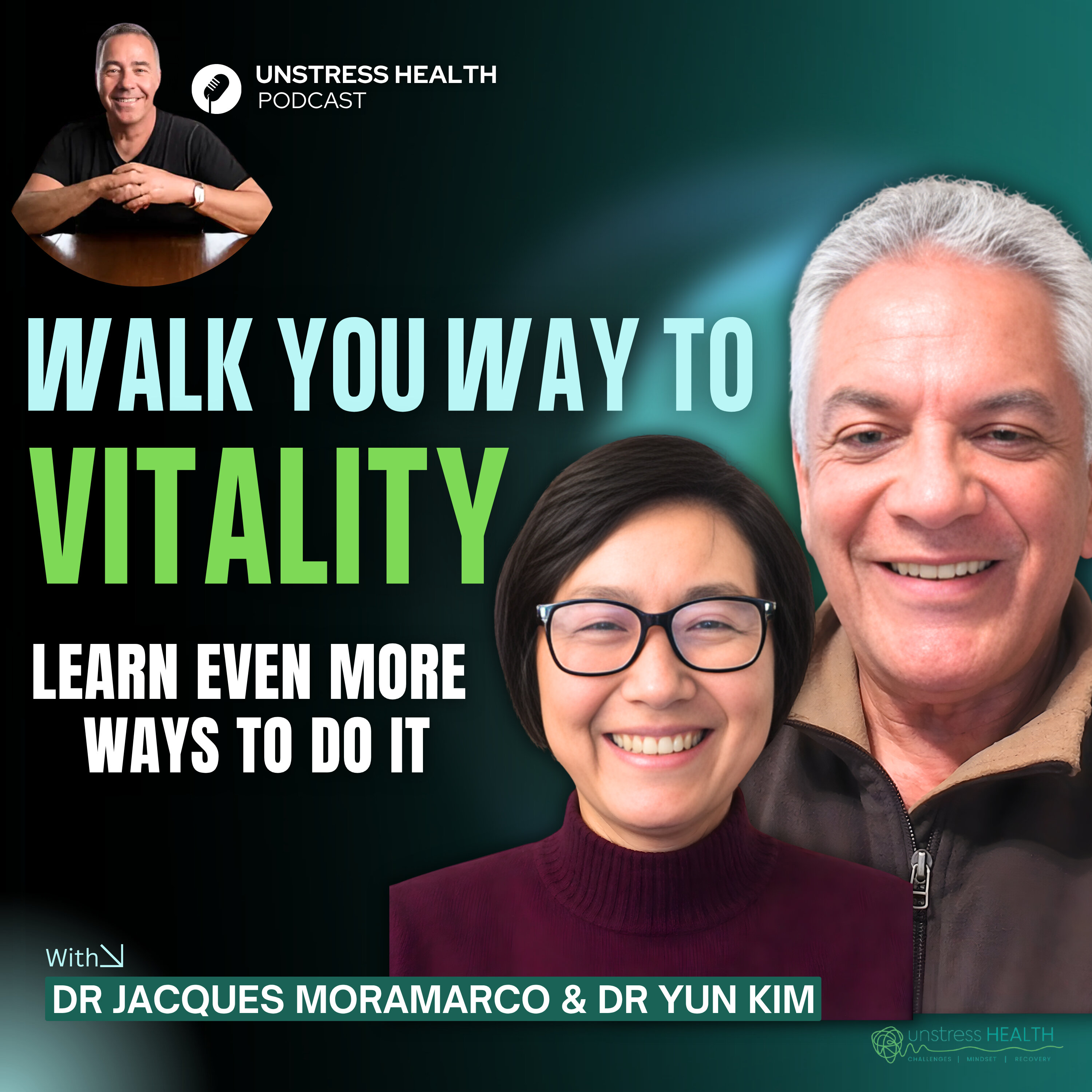
Walking Your Way to Vitality with Dr. Jacques MoraMarco & Dr. Yun Kim
Get every episode summarized
Each time Unstress with Dr Ron Ehrlich publishes, we email you a written briefing from the transcript — the topics, who appeared, and any specific claims, with the ad reads skipped.
Email me new episodesFree for 3 shows. No card needed.
About this episode
“Well, today we are talking about one of the most accessible, sustainable, effective, enjoyable, cheapest, gosh, it's so many wins there, form of exercise that you can do and give you a whole new perspective on it.”From the transcript
This episode explores walking as a multidimensional practice that goes beyond physical movement. Drawing from Eastern medicine, mindfulness, and ancient traditions, Dr. MoraMarco and Dr. Kim share practical walking techniques designed to improve balance, boost immunity, enhance mental clarity, and support overall well-being.
Listeners will discover how integrating breathwork, posture, and awareness into walking can transform it into a powerful daily ritual for health and vitality.
◉ 𝐀𝐛𝐨𝐮𝐭 𝐨𝐮𝐫 𝐆𝐮𝐞𝐬𝐭:
𝗗𝗿. 𝗝𝗮𝗰𝗾𝘂𝗲𝘀 𝗠𝗼𝗿𝗮𝗠𝗮𝗿𝗰𝗼
- Doctor of East Asian Medicine
- 50+ years in martial arts (Tai Chi, Qigong)
- Former acupuncture board pioneer (California, 1977)
- Studied in China for over a decade
- Author of Walking Your Way to Vitality
𝗗𝗿. 𝗬𝘂𝗻 𝗞𝗶𝗺
- Doctor of Acupuncture & East Asian Medicine
- Specialist in mindfulness and walking meditation
- Trained with Thich Nhat Hanh at Deer Park Monastery
- Passionate advocate for accessible, holistic health practices
Book: 𝘞𝘢𝘭𝘬𝘪𝘯𝘨 𝘠𝘰𝘶𝘳 𝘞𝘢𝘺 𝘵𝘰 𝘝𝘪𝘵𝘢𝘭𝘪𝘵𝘺 https://www.amazon.com/dp/1510784713?&tag=skyhorsepub-20
◉ 𝗪𝗵𝗮𝘁 𝗬𝗼𝘂’𝗹𝗹 𝗟𝗲𝗮𝗿𝗻 𝗶𝗻 𝗧𝗵𝗶𝘀 𝗘𝗽𝗶𝘀𝗼𝗱𝗲
✔️ Why walking is one of the most underrated health tools
✔️ How breathwork transforms simple walking into a healing practice
✔️ The science behind balance, longevity, and movement
✔️ How mindfulness during walking improves mental clarity
✔️ Ancient techniques adapted for modern lifestyles
✍️ 𝗔𝗱𝗱𝗶𝘁𝗶𝗼𝗻𝗮𝗹 𝗥𝗲𝘀𝗼𝘂𝗿𝗰𝗲𝘀 & 𝗛𝗼𝘄 𝘁𝗼 𝗖𝗼𝗻𝗻𝗲𝗰𝘁
Explore More Health & Wellness Solutions:
- Visit Dr. Ron Ehrlich’s Website: https://drronehrlich.com/
- Podcast Archives, Q&As, and Expert Resources
📱 𝗙𝗼𝗹𝗹𝗼𝘄 𝗗𝗿。 𝗥𝗼𝗻 𝗘𝗵𝗿𝗹𝗶𝗰𝗵
🌐 Website: (drronehrlich.com)
📘 Facebook: (facebook.com/Doctor.Ron.Ehrlich)
📸 Instagram: (@drronehrlich)
🐦 Twitter: (/doctor.ron.ehrlich)
📶 LinkedIn: (/dr-ron-ehrlich/)
▶️ YouTube: (@doctorronehrlich)
🎥 TikTok: (@drronehrlich)
🎧 Spotify: (https://shorturl.at/JqK9h)
💽 Omny: (https://omny.fm/shows/unstress-with-dr-ron-ehrlich)
📗 𝗙𝗲𝗮𝘁𝘂𝗿𝗲𝗱 𝗕𝗼𝗼𝗸: 𝘈 𝘓𝘪𝘧𝘦 𝘓𝘦𝘴𝘴 𝘚𝘵𝘳𝘦𝘴𝘴𝘦𝘥
◐ Australia (https://amzn.to/3Ug4iCK)
◐ US (https://amzn.to/3Nlx3vR)
◐ UK (https://amzn.to/3WgPUMx)
🔒 𝗝𝗼𝗶𝗻 𝘁𝗵𝗲 𝗨𝗻𝘀𝘁𝗿𝗲𝘀𝘀 𝗛𝗲𝗮𝗹𝘁𝗵 𝗠𝗲𝗺𝗯𝗲𝗿𝘀𝗵𝗶𝗽
◑ Join Here (https://bit.ly/3epjFcO)
◑ More Info (https://bit.ly/3RIubcN)
🎧 𝗖𝗮𝘁𝗰𝗵 𝗔𝗹𝗹 𝗘𝗽𝗶𝘀𝗼𝗱𝗲𝘀:
❏ Apple Podcasts: (https://podcasts.apple.com/au/podcast/unstress-with-dr-ron-ehrlich/id13337959190)
❏ All Episodes: ( https://drronehrlich.com/podcasts/)
◉ 𝗖𝗮𝗹𝗹 𝘁𝗼 𝗔𝗰𝘁𝗶𝗼𝗻:
👉 Join the 𝘜𝘯𝘴𝘵𝘳𝘦𝘴𝘴 𝘏𝘦𝘢𝘭𝘵𝘩 community and transform stress into strength. Access expert-led courses, curated podcasts, live Q&As, and more. Visit unstresshealth.com to start your journey today.
🎧 Listen, reflect, and share this episode with someone who may be struggling.
𝗗𝗜𝗦𝗖𝗟𝗔𝗜𝗠𝗘𝗥: This podcast provides general information and discussion about medicine, health and related subjects. This content is not intended and should not be construed as medical advice or as a substitute for care by a qualified medical practitioner. If you or any other person has a medical concern, he or she should consult with an appropriately qualified medical practitioner. Guests who speak in this podcast express their own opinions, experiences and conclusions.
#WalkingForHealth #MindfulWalking #Breathwork #Longevity #HolisticHealth #UnstressHealth #WellnessPodcast #NaturalHealing #TaiChi #Qigong
See omnystudio.com/listener for privacy information.
Get every episode summarized
Each time Unstress with Dr Ron Ehrlich publishes, we email you a written briefing from the transcript — the topics, who appeared, and any specific claims, with the ad reads skipped.
Email me new episodesFree for 3 shows. No card needed.
Hosts & guests
Transcript ready
374 searchable segments. Every word is indexed and playable.
Full transcript
Unstress with Dr Ron Ehrlich — Walking Your Way to Vitality with Dr. Jacques MoraMarco & Dr. Yun Kim. Machine-transcribed; use the interactive transcript above to jump the player to any line.
Hello and welcome to Unstress Health, my name is Dr. Ron Ehrlich. Well, today we are talking about one of the most accessible, sustainable, effective, enjoyable, cheapest, gosh, it's so many wins there, form of exercise that you can do and give you a whole new perspective on it. It's about walking. And if you thought this was just about putting one foot in front of the other, well, today's episode is a real eye opener. I mean, I've been walking for almost 70 years and been walked, I've walked across Spain, I've walked through France and Italy and through Central Australia and the Lara Pinter walk. I've done lots of walking, but today's episode is a total revelation to me and got me extremely excited. You can probably tell. Today I'm joined by Dr. Jacques Moramaka and Dr. Yun Kim to thoughtful advocates of the
most powerful and most overlooked form of human movement. Walking, now through their work, through their writing and lived experience, they explore walking, not simply as an exercise, but as a pathway to mental clarity, resilience, connection and even transformation. In a fast-paced technology-driven world, which we live in, they invite us to do something deeply human, the simple act of putting one foot in front of the other and rediscovering health in the process. This is not just about that. You'll be learning about a retro walk, a vitality walk, a cat walk, a bear walk, a dragon walk, a tiger walk, and immunity walk and a circle walk. Yes, it's a really wonderful and empowering episode. I hope you enjoy this conversation I had with Dr. Jacques Moramaka and Dr. Yun Kim. Welcome to the show, Jacques. Welcome to the show, Yun. Thank you for having us. Thank you for having us. Well, this is when I got information about
your book and the opportunity for us to be talking, I jumped at it very enthusiastically because walking is very much part of my life, both my daily life and my recreational life holidays, and it's very unusual for me, as I said before, we came on to have two guests at once, but I wondered if you might each share with us your own background. What led you to write this book? Jacques, perhaps you first. Well, about 25 years ago, I wrote a book called The We're Walking, which was a really cutting edge book with time, and it was also based on a lot of my experience with AIDS patients from the 80s, where these AIDS patients were only given 18 months, life expectancy, and by doing some of these techniques, some of these very specific walks, coordinating walking and breeding, they were able to extend their lifespan until the proper
medication came around, which was about the mid-90s. But your background is in medicine? In Eastern medicine, yes, I took the very first acupuncture examining board test here in California in 1977, so I did that, and then I've had a 50-year background in martial arts, including Tai Chi and Chigong, and the Chinese arts, so I was very lucky to have studied that also in China for about 10 years from 1994 to 2004. So soon Tai Chi, there's five different styles of Tai Chi, so I studied with the granddaughter or the founder of the style, so I was very lucky to do that. Wow, and your background? I am also a doctor of acupuncture in East Asian medicine. I don't have half a century of experience as Dr. Moran Marco does, but about 20 years ago, I started a practice in mindful meditation, and I was very honored to do some retreats at
Deer Park, Monastery here in California, with the great Vietnamese monk and peace activist Tiktok Hanh, and his emphasis was, he since passed, on walking, walking meditation, and I participated in walking meditation with him and with the retreat participants, and it was an incredibly inspirational, memorable life-changing experience, and since then, I really have incorporated mindful walking into my practice, and really love it, and want everyone to practice it, because I'm so passionate about this particular form of walking and mindful practice. Well, I'm looking forward to hearing more about this, because walking is arguably the most evolutionary, consistent form of movement we have, so from your perspective, what is it about
walking physiologically, psychologically, and even spiritually, that makes it so transformative? Well, I think the one thing that our book features is the regular walking, or what we know as traditional walking, but what we have is this very specific stance of walking, so not only the traditional walking, which includes like retro walking or backwards walking, something quite interesting is that I first saw that practicing the parks in China about 30 years ago, I never saw anybody practicing this versatile retro walking here, which affects all this balance, the proprioceptor, it really affects your calves, your quadriceps, and all the balanced mechanism, and it saves on the knees. So now, when I go to the park here in the LA, there's a very big park that has some hills, I see quite a number of people doing retro walking, that's part of the traditional style. Well, I mean, I have not heard of retro walking,
I mean, psychologically, one could say many people do walk backwards, but to physically do that, now, you mentioned there are different styles of walking, and you've just given us, well, the one that we know all about is what takes us from point A to point B every single day of our lives, but here we are already with retro walking, and that's one, I mean, let's go on, I mean, this is just so... Yeah, so the one interesting clue on that retro walking, yes, it's knocking you, in 1915, there was a gentleman named Harmon, who had a bet, and he won $5,000, and he walked from San Francisco to New York, and the bet retro was to be able to do it under one year, and he did it in 260 days, well, he had a mirror, of course, to be able to see what he was doing, so that's a fun fact. Yeah, but you know, you've mentioned its impact on physiology, on the musculature, but I mean, you really must be using a different, because walking
is such a reflex activity for us all, but walking backwards elevates it to a whole new level, what's going on there? Yeah, absolutely, you know, I mean, the amount of engagement for the proper sectors, which is your ability to see yourself is based, like a GPS that we have with you, it's at a much higher level, and just make it very simple, you know, you have those abilities by placing your foot in a different position, where you instead of landing heel toes, here you're going with the ball of the foot backwards, you're not stepping with the heel, so just a little bit of an insight on the retro walking, we have it in the traditional walk, so we have many different walks, so that's just one idea. Well, let's get going on this journey that you're taking us on now. Obviously, we're going to have links to this book, and people will be able to flesh this out, but this is part of this conversation I'm just in
tree. Let's go on to another area of walking that we should discuss or be aware of. That's brilliant. I briefly mentioned mindful walking, which is my passion, and you know, everyone talks about mindfulness these days, it's such a prevalent word, and what does it really mean? And I really want to make it very simple for our audience and our readers. Mindfulness, really just means being in the present moment, and feeling the feelings you are feeling right here right now, the sensation through the body, any tightness or any tension, bringing our whole attention to the body as we walk, instead of rooming and eating about the past, worrying about the future, being here now, and that can bring great health benefits. We've looked at the research, about the benefits of Tai Chi and Chi Gong, and some of these movement exercises, and really the
key ingredient is the mindful awareness of the present moment, feeling the breath, feeling the feet on the ground, feeling the temperature, all of these awareness activities bring us to the present moment, where we can really, truly be happy, where we can be really living our lives in the present moment. Well, I mean, the any activity or anything that makes us feel present in the moment, where we physically are actually present, not half around the world with all our friends and followers, is clearly something we need more of. Exactly, exactly, and so once you train your mind and your body to do this while walking, we can bring it to other areas of our
lives, washing to the dishes, doing the laundry, getting your children ready for work. We can do it with a lot of joy and fulfillment, because we're right here right now, and really living our lives fully present. Did you want to add anything, Jacques? I kind of... Well, you know, I was saying that that was one chapter, the mindfulness walk, which also has some other components, such as even hand position, or called mudrazin, in the yogic term. So another chapter that we have is called actual vitality walk. And this is a walk that is derived from some of the tradition in the in Malay and region in the Hunza Valley, and that part of the world, which I experienced, where you actually walk and you coordinate some dynamic breath, which the stepping. So it's not just breathing in, breathing out, but you actually learn how to do a dynamic breath. What do I mean by
dynamic breath, I will demonstrate. It's a very dynamic inhalation. And then you will do another one. And then you will exhale out, and then you will count certain steps. So it's a five step pattern, which is amazing. I've used this for the last 40 years, also on my AIDS patients were back in the 80s, and it really was a life changing technique to be used on a regular basis. This vitality, you are really oxygenating your body. You bring so much oxygen, and it affects all those components that are linked with your hormones, with your oxygen, with all the mechanism that deal with the breath, which is core, practicing yogic tradition, the Pranayama, and in the Chinese medical traditions, we have those. Shigang, it's called shigang, which is the practice of breath. And the vitality walk is just wonderful, it's actually one of my favorite walks. It's very simple,
very powerful. We've done it as a class at Emperors College, where we both worked previously, and what's wonderful about this walk is that it's a concentration practice, because you're stepping, you're also doing a particular kind of breath work. And so after the walk, we ask the students, how did you feel, and everyone said that they felt so concentrated, that the mind wasn't elsewhere. They were right here right now in the park, doing the breathing, doing the stepping, doing the hand movements, and so it's, again, is a very powerful, minus mindfulness practice, with the added benefits of the breath work, and the hand mood, it's wonderful. And you can do it anywhere. You can do it going to the park. You can do it in the park, do not go into your car. It's not something that requires special equipment, or anything like that. Almost anybody can do this.
It's so interesting, isn't it, because that type of breath that into inhale, like that, is being coined by a very famous podcaster at the moment from one of the universities in America, as the physiological sigh, a great way of relieving anxiety quickly. And there's nothing particularly new or revolutionary about it. It's just the new, the rebranding of a very ancient practice. Another one that he has introduced was the conscious resting, where you, the physiological resting, where you literally just rest for 20 minutes, consciously scanning the body. Well, we used to call that Yoganidra for many, many years, but this is apparently a new breakdown, a new breakthrough way of resting. So it's interesting to see these ancient practices. You talk also about hand position or hand movement. Can we talk a little
bit, because, you know, we generally swing our hands from side to side as we walk, but of course, there could be much more in it than that. Well, yeah, for the vitality walk, it's a very simple mudra. And what you do, you place your thumb inside and you have a loose fist. So that is the mudra. It's a very basic mudra, which in Chinese medicine, the thumb correlates with the long meridian, the long energy. So this is also, in terms of primordial, you see a lot of the babies, they have this position. It kind of keeps the energy within. So it kind of gives you that sense of closure and strength. So that's that's the key mudra for the vitality walk. Different walks position, but this is the key mudra. So you will see it also as our book has some QR codes, they can see the reader can actually see a video, not only see the position in the in the book,
but I also see a video. And the point in the middle of the the palm, it's called a labong. It's a very important after puncher point that we ask students to concentrate on when you are doing Qi Gong. And so you're not only activating the long channel, but this specific point on the palm couple labong. And so I've actually a patient of mine already got the book and is doing the exercises and she told me that she can walk further just with the mudra, just with the hand position. And she's a professor of kinesiology and she's someone who's very, very knowledgeable about movement and it's a delight that she's finding something new in there that she can apply right away. Now you've both mentioned Qi Gong and Tai Chi and of course these are terms that many of us are familiar with and some of us may have seen people moving very purposefully in the park
and thought oh well that's Tai Chi or Qi Gong. I want let's come back to some basics here because it is a movement Tai Chi and Qi Gong and so is walking just for reminders of the difference between Tai Chi and Qi Gong. Yeah so generally when you do Tai Chi form a form it has maybe 108 movements or 98 movements where you actually do a very slow motion of your hands and you're actually moving to space. The Qi Gong mostly is more static and you might be doing some sounds or some breathing exercises but there's not as much physical movement. So Qi Gong and Tai Chi sometimes are interchange however. In our book we do use the Tai Chi walking method and the one specific component of that Tai Chi chapter is you're not learning the form which is quite complicated to learn but you actually are taking three specific walking methods one of them is called the cat walk walking just as a cat
would do with a very gentle supple awareness being able to lift your leg and place it softly heel to toes and be able to move in a very gentle fashion. Then the second one it's the golden rooster that's part of the Sun Tai Chi style this this actual motion is found in the different schools of Tai Chi where you actually doing a one leg posture so it's like you know the flamingo stance that is actually one of the great predictors for longevity and they found out that after the age of 60 your ability to stand on one leg for 10 second diminishes at 70 if you can stand for 10 seconds of one leg then you have a good prospect of longevity. So we like try right now. Well I'm tempted to I'm tempted to you know it is interesting that you're talking about predictability of longevity because I remember when I wrote my own book Life Less Stress 10 years ago
I was exploring a UK study which said walking speed was an excellent predictor of longevity for the next five of five year predictor you know so that's not that's not surprising when you think about it because if you see someone struggling at one or two kilometers per hour kind of thing they're not well so you don't have to be a rocket science to know that but that's an interesting one and now we're talking about balancing on one leg as being another predictor okay so we've got Hi Dr Ron here and I want to invite you to join our unstressed health community now like this podcast it's independent of industry and focuses on taking a holistic approach to human health and to the health of the planet the two are inseparable there are so many resources available with membership including regular live Q&As on specific topics with special guests including many with our amazing unstressed health advisory panel now we've done hundreds of
podcasts or listening to with some amazing experts on a wide range of topics many are world leaders but with membership we have our unstressed lab podcast series where we take the best of several guests and carefully curate specific topics for episodes which are jam packed full of valuable insights so join the unstressed health community if you're watching this on our YouTube channel click on the link below or just visit unstressedhealth.com to see what's on offer and join now I look forward to connecting with you the retro walk which I love that I'm going to be doing this when I go to pick up my grandchildren this afternoon a toe to war toe to heel we have the vitality walk with its mudra and breath work dynamic breath dynamic dynamic breath work that's important and I love the mudra with its connection to the lung meridian and and then we have the cat walk
which is just this very gentle walk and I'm guessing the rooster walk is a kind of a strut a strutting one leg of it I'm kind of something like that you know of course you know there has martial arts implication because all the Tai Chi moves were used as a martial art so you can think of it like a knee strike or a toe strike so it does have some martial component and of course the last one which is a little bit more advanced is called the bear spirit walk and that requires you to move more in a zigzag pattern and you create a bear shoulder where your shoulder around it and you have some more pressure in that interest capitol area so that's also a very powerful walk that you can do just as well yeah so that's in that chapter okay but that but now is that the I mean other I must be more walks than that I'm guessing because my mind is just boggling when you're drawing all these analogies with different movements in Tai Chi Chi Gong martial arts
you know animals of different ways of walking I mean is there a how many more walks have we got here in your book we have two more two more chapters so okay okay immunity walk for to nourish our immunity and as cancer support and then the circle walk and I'll have our expert Dr. Moore Marco talk about them yeah so yeah the the circle walk is called Bagua which is a Bagua in Chinese translates as eight program or eight directions so that's if you have ever seen a specific sometimes you see them in Chinese restaurants or stores where you see a mirror with this triagram this straight line and broken lines and those are a specific style of walking that you walk in a circular pattern and you have two types of walk that we teach in our book one of them is called the Tiger Walk
and the other one is the Dragon Walk this is in a circle walk shark yes so the tiger walk and the dragon walk yeah so the tiger walk is very basic again you're walking around the pattern maybe start with 16 feet 16 step but eventually you will narrow down the circle to 1.5 meter which is eight steps so you walk in a circle and you're holding your hand in a very specific position for the tiger walk the dragon walk requires you to hold your hands more stretched out in the air and you know that is kind of a like almost like an isometric exercise so you are strengthening up your shoulder girdle and of course you strengthen up the intrascapula area so that's one of the walks that we show in that one of the two walks and then there is a stretching method yeah and it's very unusual because we normally don't in the western society walk in that way do the circle walk and because there's a spiritual component to the circle walk as well
and also it really works on the lymphatics we're like squeezing the limbs in the ingrown area and to really work working flushing out the limbs and there aren't many exercises that people do that work in that way and so it's very unusual but it's it's wonderful for for our health yeah that's a side effect of side benefit from that and in terms of Dr. Yin you mentioned the spiritual attributes that that's called circumbulation so you see it done you know around you know some very specific spiritual sites and all the way to the very famous college mountain in Tibet where the people would actually walk around the whole mountain as a spiritual practice or in many different Catholic traditions you know they're different mazes where you work in a walk in a circular way okay okay so circle yeah please go on John
yeah and Dr. Yin you might want to as you are the actual individual in that QR code for the immunity walk yes immunity walk this is again to support the immunity and especially as an adjunct treatment for cancer for cancer patients so this is a type of walk that's very very recognized and well-known in in China and people get into groups and practice this walk to support the immunity it's sort of a Qi Gong it's a Qi Gong walk and what what can give us a bit of a clues to what what that is I mean I'm trying to visualize so that that walk requires you to move in a very specific pattern where you're actually are planting your heel your inhaling your inhaling two times again two dynamic inhale and an exhale and you do this pattern one two three she she her which means inhale inhale exhale in Chinese so it's a she she her pattern
done very often as a cancer support group and you will go any park in China in the morning you'll have the group of cancer patients that will be doing this that was originally developed by a very famous artist called Wollin and she was diagnosed as terminal cancer we're back in in the sixties and then she incorporated this walk and she went into a remission so it became very popular and now it's prescribed for cancer support wow I mean I love this integration of of breath of movement not just the movement of one foot in front of the other but the movement of the body you mentioned lymphatic drainage and and they talked to me a little bit more about how that works I mean I mean I mean movement improves lymphatic drainage but this is also so so what what I wanted to see is the ba gua is you know through my you know 50 years of martial arts practice and
observing different teachers and different styles of martial arts what was really interesting that in the 1930s when this mean or this became part of the health therapeutic system in China the Tai Chi the Chi Gang the ba gua all those were taken away from the actual martial combat but used as a health preservation or how to enhance your own health and well-being so in terms of the lymphatic is something that we have observed that when you actually are walking in this pattern with this in China it's called ko bu it's called in like a pigeon toe but you're going in a circle and then you open it up you are actually stimulating and squeezing those limbs and in a daily walk or you know even if you do some basic exercise you have a great exercise there in salute to the son you do a many you do the 12 different parts but you don't have that actual rotation of the hip
so it is very interesting and also the ability to move the axilla and to open up that that key area under the armpit is very interesting now the longevity factor is some of these teachers in the 1930 were the average age in China was around 30 years of age as you know you know during the Roman Empire the average age was 19 years old age you know that's that's like what these teachers from that generation that was the first generation were able to live in their 80s that is tremendous longevity factor and because they were all well. Do you like to mention cinsamiao we close we start the book with a quote from cinsamiao go ahead doctor yeah do you want to do I say yeah absolutely with with bighted brythian please so the first chapter we we quote this quote from the great Chinese physician cinsamiao from 9th century and he says running water is never stale and a door hinge never gets warm
thus it is with a man's a person's vital energy and physique and so this idea of movement is is so important so vital to our health and cinsamiao lived for how many how many years Dr. Moore Murphy he lived a hundred and one years of age which is we we markable we markable in the 9th century I imagine that was very unusual you know this is not well you mentioned salute to the sun jack and I'm pleased to say that when I was at university I did yoga and the yoga teacher said to me if there's one exercise you should continue to do for the rest of your life do salute to the sun and that's exactly that's exactly what I have done for the last 30 or 40 years and I believe it's been a good part of keeping my back in reasonable condition considering my background in dentistry not very good you know salute to the sun a wonderful exercise yeah great
exercise and you know tradition year in India when I spent time there traveling and visiting India they would do it 49 repetition wow okay okay I think I'm doing well when I do 10 reps in the more fantastic 10 is fantastic yeah yeah yeah well five on each leg type thing you know kicking back anyway let's not go into that into the detail but but this walking now you know pilgrimages have been a very interesting part of people's life in history the only way we get around was walking but pilgrimages were a particularly important thing how you know that long sustained walk what what are you how do you view that physiologically spiritually psychologically do you talk about long walks in your book we I don't think we approach the you know the different walks that you maybe you did the the walking spain from the northern yeah yeah I've done a lot of those kind of walks but
I think in try what they're all different but but what's similar is you set out at the beginning of a day with a certain mindset and you finish the day in a very different mindset and whether it's a pilgrimage to a religious site or not it is a pilgrimage of some sort in your own head yes sustained walking it does for you absolutely now here in California because we're in California I can speak of the missions they have this the Spanish missions that were you know before California separated and it became you know part of the state so the the missions are at a 18 miles distance so every 18 miles there's a mission and that they found out that that was a good test for once faith for once ability to walk 18 miles so they would start in the morning he had one mission and then 18 miles later they would be the next mission and they could rest and be there so that's how they would go from you know what we consider now the Mexican border
all the way up to San Francisco from mission to mission correct yes interesting because in my experience I've come to realize that about 26 kilometers which is about 18 miles is in a days my comfortable level so I'd have gone quite well on that but it's it's kind of walking what I also love about walking is its accessibility it's really not part of a public health initiative visit why why is it why isn't it to being championed I mean your book will go some way to addressing this but how do we get it out there into the world apart from your book we we need to encourage people yeah I think what's happened of course with the advent of the automobile and you can see in different cities where I actually observe people let's say in Paris if you're in Paris and you see the individuals taking the metro the subway you will notice that they have
to actually walk about 20 to 30 minutes to get to the subway there's at least possibly one train exchange that's another 20 minutes and then another 20 minutes the other way so you already got the one hour there and one hour back so they're already walking the two hours a day but you know unless you're in I'm talking for United States in cities like New York or maybe San Francisco in Los Angeles there's not much walking going on unless you specifically do it you know a lot of sitting and we know as clinicians that they're just it's sitting as detrimental to your health it's it's no neck pain back pain terrible sciatica and you're right it really needs to be part of a public health campaign we need people to walk you don't need expensive equipment you don't need to join the gym it's so simple almost everyone can do it you don't have to be athletic I myself am not but I totally enjoy walking and again you know when patients come in we've I've never had a
patient come in because of an injury from walking certainly pickle bottle you know lifting lifting lots of lifting injuries yoga Pilates lots of injuries but never from walking so it's safety is number one and as patients come in and they don't they don't know what to do we can't just say we need to exercise we need we need to give them a whole program that's one of the reasons why we we wrote this book we issue this book to give a handbook to a patient and they can start where they are they can just start with the mudra you know start with the mudra walking to your car start with one block around the house that's fine and you you build up you build up yeah yeah no no I mean and I love this integration of the breath work you talk about nutrients and hand positions we've done so many programs on the breath and I identified as one of my pillars of health obviously life is in the breast but just to incorporate breathing
into these different movements added adds another dimension absolutely and going back into time the great physician Chinese physician Nemwato he's actually in the second century was able to observe some specific animals like a bear like a tiger like a crane like a monkey and he was able to absorb their energy in other words what made them so special and integrate those movements and that's is what we talk about shigan but some of them have very specific breaths so nothing new this is nothing new this is something that is part of ancient medicine that's one of the you know they do have the acupuncture they do have the herb they have the trinama which is the medical massage but one of the key thing is the medical movements you know tai chi chi gong walking breath work all those martial practices are part of that and going back to the shawl in temple in
in china where the great patriarch of bodidharma he actually noticed that the monks were just sitting in meditation and they were getting weak so he developed series of exercises somewhat similar to some of the yogic practices and they have changed and improved and were able to leave much longer healthier lives and I do want to highlight the veteran administration the VA it's the largest healthcare program in the United States for veterans for veterans and at the west LA VA they offer acupuncture suddenly and tai chi teach breath work mindfulness it's incredible so it's really integrated here in Los Angeles and so we're really really proud that these ancient practices are part of the VA system and off offered to our veterans who are so deserving
Dr. Moore Marko and I have been volunteering at the PTSD clinic at the west Los Angeles VA for combat veterans I do have to say that from that standpoint the the key thing here is that you have to realize that these techniques are so powerful and so important in making those changes you know even a little bit at the time so you know in terms of we were talking about walking most people heard the 10,000 steps you have to do that that that was from the little step counter mangkopai is Japanese step counter that had 10,000 so it went around and then you have the 10,000 next time I should have it to ensure it to you however you know even adding 500 to a thousand steps a day can be drastically improving your health and longevity in your cardiovascular you know the diabetes all the cancer prevention all those factors just a little bit at the time and of course
longevity factors hmm well I think you know it's accessibility it's safety it's uh you know it's longevity as an exercise through life being outdoors in nature being able to talk socially while you're doing it I mean there is just there's so many wins in this and this is and in your book as you've talked about so many different walks you've really wetted my appetite the the book has actual demonstrations of this through QR codes or links for that to be demonstrated so I mean this is so empowering so wonderful I really want to thank you both for this wonderful kind of bringing it together and and and making it so interesting and exciting and empowering thank you for sharing your wisdom and knowledge with us here today and in your book which I look forward to reading thank you Ryan thank you so much for all the work you've done over the years thank you very
much doctor one well I received many suggestions about her potential guests on my podcast but when I got this invitation I jumped at it because as I said at the intro I walking is not just a part of my everyday life I do try and do 10,000 steps at least a day but I for two weeks every year I go on walking holiday and I have done for the last 12 or 13 years and this year I'm walking in the Dolomites in Europe but what I love about it is it's such a mentally it's a way of slowing down it's a way of taking the time to smell the roses to see to smell to hear nature as we walk along as we see something in the distance and walk towards it and walk through it a village usually or a town or a street wherever it is just to be mindful about what we are approaching and what we are
doing but this book takes us on a journey that is just so transformative the book is called walking your way to vitality integrated walking breathwork and mindfulness into your daily exercise and we have talked about movement we have talked about breathwork we have talked about mindfulness we have talked about the importance of being out in nature the sociability of being together the taking the time to literally smell the roses this has it all and we will of course have links to that book walking your way to vitality and I would recommend it very highly there are demonstrations of each of those walks we have discussed in the book well I would also encourage you to join unstressed health community where we can discuss this and many other aspects of work and health that are empowering and good for your health and well-being until next time this is Dr. Ron
Erlich be well feeling stressed overwhelmed it's time to unstress your life join the unstressed health community and transform stress into strength build mental fitness from self sabotage to self mastery and together let's not just survive but thrive expert lead causes curated podcasts like-minded community and support and much more visit unstressedhealth.com today this podcast provides general information and discussion about medicine health and related subjects the content is not intended and it should not be construed as medical advisor as a substitute for care by qualified medical practitioner if you or any other person has a medical concern he or she should consult with an appropriately qualified medical practitioner guests who speak in this podcast express their own opinions experiences and conclusions
More episodes
More from Unstress with Dr Ron Ehrlich

Understand Your True Identity: Breaking Free From Negative Self-Talk | Dr Jeremy...
Unstress with Dr Ron Ehrlich

Happiness Is a Skill: The 5 Skills to Create It | Declan Edwards
Unstress with Dr Ron Ehrlich

Can Infections Cause Depression, Anxiety & Brain Fog? | Dr Marty Ross
Unstress with Dr Ron Ehrlich

Digital Wellbeing & Raising Resilient Kids with Dr Sajita Setia
Unstress with Dr Ron Ehrlich