Get every episode summarized
Each time The Morning Brief publishes, we email you a written briefing from the transcript — the topics, who appeared, and any specific claims, with the ad reads skipped.
Email me new episodesFree for 3 shows. No card needed.
About this episode
“With what's underweighs a game is a foot. There's a short answer, the tactical reset. My view has been happening in Washington. This actually reminds me of a Sunsu playbook which says that you know, subdue your enemy without actually fighting.”From the transcript
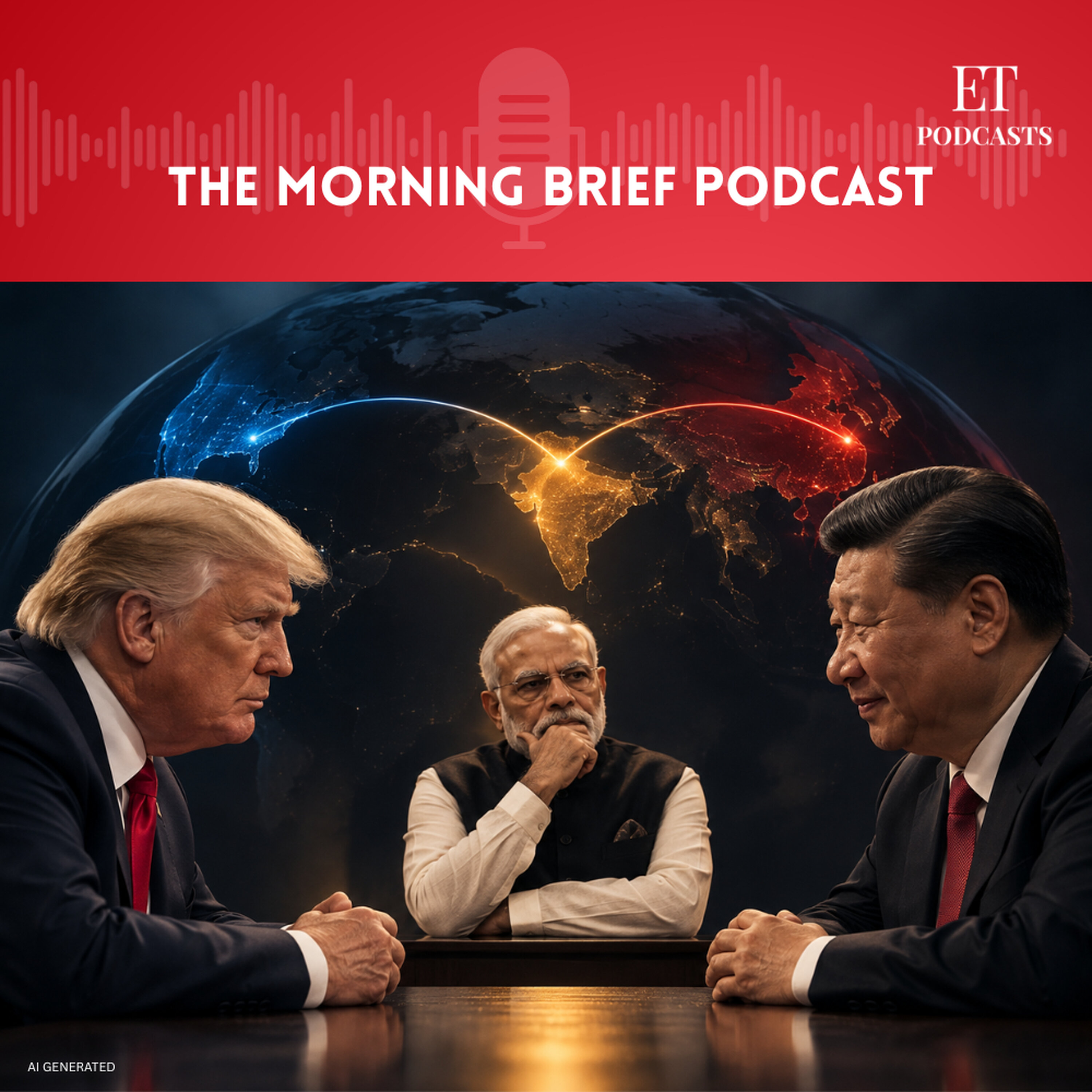
Xi Jinping has sat across the table from both Narendra Modi and Donald Trump within two weeks. For years, a more assertive China pushed India closer to Washington. But what happens if the US and China learn to manage their rivalry?
On this episode of Morning Brief Decode, Pranab Dhal Samanta, National Editor (Politics) at The Economic Times explains to Anirban Chowdhury whether the reset is really happening in Washington, what the summit's optics signal, and how India should balance China, the US and BRICS. He also flags what to watch in the next six months: the India-EU relationship, Eurasian trade access, and possible exemptions in the US trade deal.
You can follow Anirban Chowdhury on his social media: X and Linkedin
Check out other interesting episodes like - Cognizant’s Surya Gummadi on How AI Can Deliver Returns, The Future of Insurance in India | Sarbvir Singh of PB Fintech, Groww’s ₹6,600 Cr Leap - Fintech’s Big Market Test Begins , OML CEO on the Creator Economy’s Next Wave & much more.
Catch the latest episode of ‘The Morning Brief’ on The Economic Times Online, Spotify, Apple Podcasts, JioSaavn, Amazon Music and Youtube.
See omnystudio.com/listener for privacy information.
Get every episode summarized
Each time The Morning Brief publishes, we email you a written briefing from the transcript — the topics, who appeared, and any specific claims, with the ad reads skipped.
Email me new episodesFree for 3 shows. No card needed.
Hosts & guests

Transcript ready
206 searchable segments. Every word is indexed and playable.
Full transcript
The Morning Brief — US-China Thaw and India's Leverage:. Machine-transcribed; use the interactive transcript above to jump the player to any line.
With what's underweighs a game is a foot. There's a short answer, the tactical reset. My view has been happening in Washington. This actually reminds me of a Sunsu playbook which says that you know, subdue your enemy without actually fighting. At this point in time, India needs to create its own leverage. There we are lacking and that's what we need time for. So in that broader context, India has to manage China. Something unusual is happening around what has become one of the world's most consequential strategic triangles. Within two weeks, Xi Jinping has sat across the table from both Narendra Modi and Donald Trump. With India, Beijing is talking about stabilizing a relationship that has long been disrupted by border disputes and years of mistrust. With the US, China is testing whether confrontation can be contained.
In other words, whether the world's two most powerful economies can compete with each other without necessarily colliding. Now, this doesn't lead to a grand reset immediately, but it does raise some critical questions for India. You see, for years, one of New Delhi's strategic advantages was straightforward. The more powerful and assertive China became the closer Delhi got to Washington. But what happens if the US and China find a way to manage their rivalry? Does India become less important to America? In other words, is the geopolitical geometry around India actually shifting? To break this down, I have with me today the economic times national editor politics, Pranup Dhalsamanta. It's Friday, the second of October. I'm Anirban Chaudhary. This is the morning brief.
Hi Pranup, welcome to the podcast. Thank you, Anirban. Thanks for having me over again with you. Absolutely. Okay, two weeks apart, Modi Ji in the Brick Summit, Trump She in the China US Summit, are we looking at a tactical reset? Tactical reset over here would be actually more at the Washington end. I think India has its own reasons. India has been engaging China. That's not the issue. The point is that the Trump She engagement, which has gone through lots of, you know, iterations. It's not delivered much, substantively as far as Washington is concerned, but is definitely the optics of the whole event and also the articulation of terms like G2, etc. Are making countries wonder as to what does Washington have in mind?
What does Donald Trump have in mind? As far as India is concerned, you know, this meeting happened in the ages of the Bricks. And the Bricks Summit have been held regularly. And there is very little bilateral summit level meetings which happen between Trump and Modi these days. Bricks is one forum where this happens. The other forum is SEO. So it allows you to engage bilaterally. And if you look at it, many of our border tensions do sort of pipe down before a Bricks meet. And we saw that with Docklam. We saw that even with the Galwan crisis. And many others in the past. So it is a basic engagement which is needed. And I think that engagement is Bricks allows that. But in the light of what Trump has been doing, it also conveys a message that, you know,
there is a de-resking angle which has come in over the last year or two, vis-a-vis the US. And we saw that famous picture from the SCO in the past between Putin, Xi Jinping and Modi. So it also serves that duality of purpose. But just a short answer, the tactical reset. My view has been happening in Washington. Right. So now, you know, just to zoom out a little. China's rise, if I read it correctly, has always made India more valuable to Washington. Now, if we look at this whole, you know, the China US summit as Washington and Beijing settling into some sort of quote-unquote managed competition, should India fear that its value will strategically be lower to the US? What's underway is a game is a foot. And, you know, it reminds me the last time when Trump and Xi met,
Xi said that we should not fall into a Thucydidis trap. And, you know, this actually reminds me of a Sunsu playbook, which says that, you know, subdue your enemies without actually fighting him. And if you take a longer view, that's what China has been doing. It got first the Soviet Union to do its fighting and bidding with the United States. Then it struck a deal with the United States. All that gave it an interval of, say, through the 70s and the 80s. Then it struck, it created a whole front of, you know, countries like North Korea, Iran, Libya. There was proliferation of nuclear technology, which happened. And these countries then became the rogue states from the US fought. But China got its interval of growth again. So what China does is essentially tries to create some kind of a manageable,
what it's calling now manageable scenario, so that it gets intervals of growth. And in my view, that's exactly what Mr. Xi Jinping is doing now, is trying to create another interval of growth, because he knows that now, US and China can be seen on equal footing. Now he wants to race ahead. So this is a country which is not fought any war. Remember, and yet is very close to that, you know, great superpower status number two in the country. So that's where I think the whole game is going. And as far as India is concerned, it will have to, you know, the lesson is that administrations and governments will change in the US. But somewhere, India will have to keep connected with the system in the US because systems normally in democracies don't react in such extremes.
And so maybe their own system you can see is trying to manage Trump. Right. Now, Pranup, going back to your first answer and double-clicking on the word optics, so how should India read this symbolism? It is very important symbolism. And the message which basically the US is saying that I can do business with China. And regardless of what the substantive movement is, doesn't want to essentially land up in a confrontational spot with China. So these are two very vital points. And third is that open to a deal with China. Okay, whether it's on specific business issues, export import items, you know, transactional deals. So these are very clear messages of intent. And India will have to respond to them accordingly. So this intent though is coming from Trump himself.
How he will be able to execute it even through his own system will be a big challenge. And there will be issues and we have seen those issues come across. And as we head to the congressional polls, we'll see how the public mood over there goes. But that said, this optics cannot be taken lightly. Optics by itself can be substantive. Right. Now, Pranup, let's come to India and China. Both sides have been talking about putting their relationship on the longer term footing. But then there are very different things, obviously, that India and China want from each other. But there are also different lenses through which both parties seem to see the same set of things, like the border dispute or participation in each other's business environments or industries. Basic question, what do India and China want from each other?
You know, good you asked that. When you talk to the Americans nowadays, they come and say to you that, look, you also have to do business with China. You also have business to business relationship dependencies. You have to manage. So that's exactly what we are doing. So try and understand each other's position. And there is a fair point being made over there. Because when you come to the India-China equation, the border has not gone away. At the same time, we know that neither side, at least for now, wants any conflagration. The thing is that what Galwan showed that India will respond, unlike many of the other Southeast Asian countries or the kind of dramatized which goes on. In case of India, there is a clash, India will respond.
And China knows that. And as I said earlier, China does not want a confrontation, a military confrontation. And definitely, it's not a question of who wins. It's a question of what is the damages caused. So those are the outer limits. And within those outer limits, what work can be done is important. As far as India is concerned, India is looking for its own interval. And that's important because we need this whole period of where India is at this point in time, demographically, economically. It needs a period of growth not hampered by any kind of a military conflict kind of situation. At the same time, reducing dependencies or diversifying supply chains so that it doesn't become a victim of weaponized tariffs or weaponized supply chains in the future.
At this point in time, India needs to create its own leverage. There we are lacking and that's what we need time for. So in that broader context, India has to manage China. Right. Pranup, let's talk about Pricks. Now this is a constantly changing, evolving, rather expanding structure. Another question is, does India still gain leverage by being inside of Pricks? Let's turn the question around. It's better to be in the tent than out. When you're in the tent, you can actually limit the influence. You can actually find other partners and make sure that it does not become a China-driven body alone. So to that extent, it's important to be there and to be able to influence the agenda. Number one, number two, it is very important even from a Chinese perspective
that as it aspires for larger leadership role, that it has more stakeholders with it, not less. And that is why each time when there is a brick summit, it does not want to be the spoiler. Hence, it agrees to bilateral issues, like even the boundary or some clash over here or there. It agrees to bring down the tensions so that it's larger purpose of showing itself as somebody who can take on a larger leadership role, is not affected by some bilateral dispute. So Bricks from that point of view is very important to China. From an Indian standpoint, whether or not it heads anywhere, it should not just be an imprint of one country. It should have a coalition of interests, though it is becoming unwieldy in my view, too many countries are joining.
It is very difficult to have one sort of common position on things. But I think what came out well in the brick summit in Delhi is that despite all those differences, India was able to produce as a host a joint community. And the joint community, I remember, had Iran and UAE on it, despite what's going on in West Asia. So this kind of role only gives you a little bit of heft in a time and age where everybody is sort of at each other. And finally, for six months out, what signs do we read to understand if India's strategic position vis-a-vis China, US and also US China has changed? I would like to say one thing that there is the India-Europe relationship which will matter the most.
I know it's not something which is there in your question, but remember there are three economic powerhouses in this in the world. One is the US, North American system, the other is the China ecosystem, and the third is actually the EU. And in such a situation, what we see is the EU block and some of the other partner countries around like Canada or Australia, some of the Pacific nations like Japan are all coming under pressure because of whatever is happening, or whatever is being done in bibeging or whatever is being done by Washington. So the EU relationship, the India-Europe relationship, that will actually determine a lot in terms of economic progress because you almost is like the US as far as India is concerned.
Second, it will also allow India, you talked about Bricks earlier, we have to see how India can use Bricks to enter into the Eurasian economy sphere that is basically Russia, and that's mostly you're talking about commodities. And the trade deal with the US, if it goes through, what we need to look at is exemptions which India can get from the Linsigrah Ambil for instance, already we saw some development on Pharma. If we can play this space in a manner that we get the best deal from all three, it will show that you will have leverage again one against the other and at the same time not be in conflict with any one of them. Pranup, thank you so much for joining us. Thank you, thank you so much. That's it for today, you were listening to this episode in the morning brief, it was produced by Radhas Naik, sound designed by Amrit Regi.
Keep following our podcasts on your favorite platforms, stay tuned.
More episodes
More from The Morning Brief

ECI: Who controls India's voter list?
The Morning Brief

Sahil Wakode and IIT: Status, Strictures and Shortcuts”
The Morning Brief

McKinsey’s Cheryl Lim on Asia’s New Leadership Model, AI and Talent
The Morning Brief

India’s Great IPO Rush: How Much Is Too Much?
The Morning Brief