Get every episode summarized
Each time EU-Startups Podcast publishes, we email you a written briefing from the transcript — the topics, who appeared, and any specific claims, with the ad reads skipped.
Email me new episodesFree for 3 shows. No card needed.
About this episode
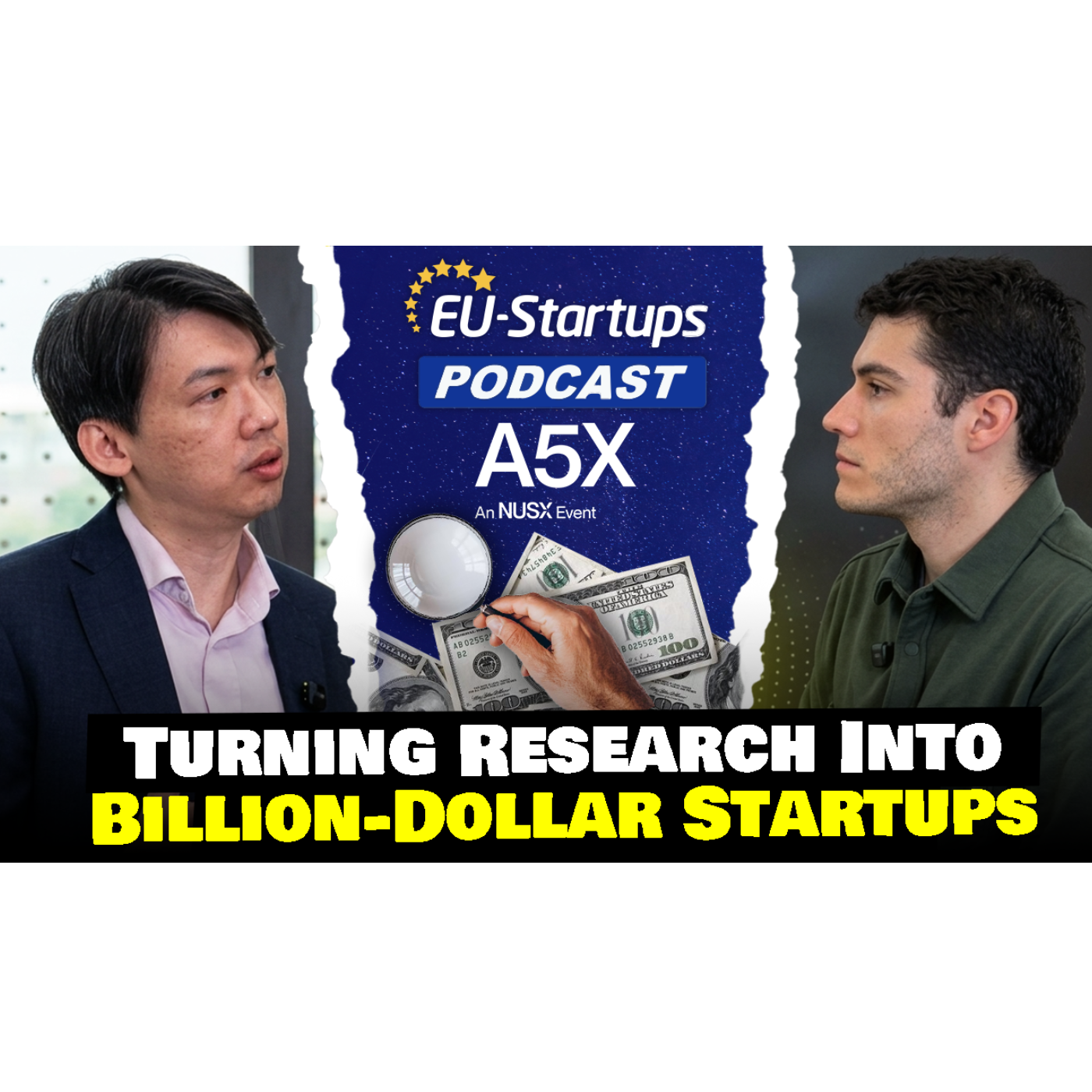
“You are now listening to the EU Start-ups Podcast. We're here at the A5X conference in Singapore by Mutation, the National University of Singapore.”From the transcript
Get every episode summarized
Each time EU-Startups Podcast publishes, we email you a written briefing from the transcript — the topics, who appeared, and any specific claims, with the ad reads skipped.
Email me new episodesFree for 3 shows. No card needed.
Hosts & guests
Transcript ready
397 searchable segments. Every word is indexed and playable.
Full transcript
EU-Startups Podcast — Turning Research Into Billion-Dollar Startups. Machine-transcribed; use the interactive transcript above to jump the player to any line.
You are now listening to the EU Start-ups Podcast. Hello and welcome to the special episode of the EU Start-ups Podcast. We're here at the A5X conference in Singapore by Mutation, the National University of Singapore. Throughout this next few days we're going to be chatting about innovation, funding, and the developing bridge between Southeast Asia and Europe. Not to mention, they sing in port defense tech hackathon, whose winner is going to show up at our very end of the series in a special episode. So I hope you're looking forward to hear us talking about the challenges, the innovation, and how we're all comparing when it comes to localized markets such as Asia, Southeast Asia, and Europe, and even the global challenges. Not to mention, the lessons we can learn from each other. Okay, well thank you very much Benjamin for joining me here at the EU Start-ups Podcast. It's a pleasure to have you on.
That guy is great to be here. Great, great. I'm very excited to chat with you today because just having a look at your profile, you have such a great balance between academic, researcher, and entrepreneur. So that's something that I think is going to resonate with our audience because of well, we have people that watch us that are strict entrepreneurs and investors, but many who are involved in the academic system as well. So personally I think it's going to be a very good episode. And if that in mind, maybe you can just give us a little bit of background as to who you are and what you have to do with the event. Sure, so I'm Benjamin T. I'm the vice president of ecosystem building at the National University of Singapore. And I'm zero entrepreneur. I've started now coming to my fourth company, raised over 20 million US dollars and manages a lot more in terms of grant funding and it comes to research. And I've been part of the academic community for a long time and really wanted to bring the research papers to transform them into products, which let me down this rabbit hole of being an entrepreneur.
It must, I must say that you imagine balance, right? I think it's actually hard to strike a balance and very often you're pulling multiple directions. But the way I think about it is if you are able to create an impact from your ideas, that's what motivates me. And the journey of being an entrepreneur is extremely challenging because you are faced with extreme uncertainty. You're basically going from zero to one. Research gets you the minus one to zero if you want to use the analogy. And then after that, if you really want maximum impact, you need to bring that one to a million million million, at least having the products reproduced and so and used a million times over. Now this is a big challenge for most research focused training that typically economics come from. And what is happening today, I feel, is that there's a massive change in how we think about
research and its impact. Many agencies today are looking at impact both commercially as well as social. The way to bring impact to people is really to take the next step. Going out of your lab, talking to potential people, potential users and seeing how your technology can fit into their workflow, into their lives. Of course, if it's a life saving drive, it's very obvious. But many times the technology where you're so used to is so highly integrated. And as researchers, we are often able to contribute, you know, a part of that assembly, or a new process to make that widget. And that should also be considered, rather than just purely thinking about, I have to build a drug that's a, I have to create a drug that saves lives. And along the way, even in building a drug, you have so many supporting technologies that we all as a research community can contribute to, that could end up helping save lives.
So there are multiple second or third order effects that often people don't appreciate when trying to translate. And looking into your own personal background here, what do you feel that you've brought from your backgrounds and entrepreneur and developer into academia? Because I read that you had a, you developed an electronic skin, right? Right. So, let's hear a little bit about that and just kind of what that whole experience taught you and that you brought back into it. Right. The truth is, I actually started as an entrepreneur. So I did full time a span of a company, taking my research from the lab into a product. And the reason I did that was because I realized that filing patterns and having them on shelves just didn't really motivate me. Even having a fantastic publication was great. But the feeling of satisfaction didn't last too long for me. Right. I mean, it's great that people cite the work, but in the end, I hope to see people use the technology, which is why I decided that, hey, the only way I can learn,
how to be an entrepreneur is actually be an entrepreneur. So I took about a year off, found a work to be a team that, you know, we got to know each other for over a year under this program called Stanford by Design, where we found 400 problems and we need to choose one to work on. Now, I brought that up because my research in electronic skin has already spent 15 years. Right. And when you think about, for me, I really want to take technology into the market, that kid is a little too long. Right. But just being on the journey of trying to bring a product to market in a short span of a year or two, we got a product that have declared. And then first, we had a lot of different learnings from strategy. How do you productize? And how do you talk to regulators? What really goes into building a product? Few people appreciate that. And less so research academics. Okay. And I think that being that full-time entrepreneur actually building a product that could be put on shelves for people to buy, you know, was critical in my, you know, say how
I formulate my research program at the National University of Singapore. And as a result, now is in addition to falling patents, many of them are now being licensed much quicker, right? We've been in the span of a PhD student career, right. And that was actually what motivated me to go on this Stanford-Bud Zen program to find problems. Is that realized by the time I graduated, the patents were still kind of found in some digital database, right? There was no action to build into products that people use. And just wanted to short circuit that. And this one year, founder journey really taught me what it takes to build a company, from fundraising, from technology development, from standards, and so on. So I think that was super informative in then how I think about my career as an academic. And in some sense, I like to do things a bit faster because I don't feel like I have
them in years left, you know, I really want to leave an impact. And if you think about my career, I've actually really benefited also from the environment that I was in. Some people when I came back to Singapore, I asked me, hey, why do you come back to Singapore, right? I had a job offers in the States and really good ones. I felt that I wanted to be in place where there was going to be growth, right? And I guess in some way, I think Asia, Southeast Asia, Singapore had really tremendous growth opportunities back then when I saw it. When I came back 2014, my first check, my first angel investment took about a year for us to actually get the money. And in my second company, after I nearly existed my first one, the first check came in a week. And now the third company, the first check came in a day. And on my phone, my fourth company, people asking me to please start the company. So I think there's definitely tremendous growth in terms of risk appetite.
We've been Singapore and the broader regional ecosystem. And the nice thing in Singapore has always been a place where people intermingle. People have a melting pot effect of merging ideas from different places. And I would say the environment has been very supportive, right? Multiple levels. You have government, you have society, you have education institutes like National University of Singapore. We are strong proponent of diversity. We have a very diverse student population. So we've always been able to trade the best talent, ideas. And now we bring technology into the mix. And finally, the productization capability. That is somewhat more challenging because Singapore is small and we don't have an immediate market within our shores. But there is changing, especially in very high value deep technology products and companies.
Examples. Singapore makes one in ten semiconductor chips for the world. Their massive investments now in semiconductor industry because of AI requirements. This will continue to drive a lot of research dollars and a lot of translation efforts. And I think that Singapore has a country and the National University and the rest of the ecosystem here is able to capitalize on our investments over the last 20 over years. Singapore started doing research seriously about 20, 25 years ago. We always had a five year plan. We call research innovation and enterprise plan, RIE. Right. And so now we are in the RIE 2030. So there's 36 billion Singapore dollars. We have 30 billion US dollars allocated in these five years. Currently 20% will be spent on innovation and enterprise type of efforts.
And that, considering the fact that we have also been able to attract very high quality research talent at multiple levels, full professors, associate professors, assistant professors, postdocs and PhD students, master students. I think that there's a lot of layers now that we have built, they are foundational for our efforts to help research become products. In many ways, what I'll work at NUSX now is to speed up that capability and the transformation. So we hope that every academic that we can support will get that check in less than a week. If the idea is worth doing and if that's the right technology and the right product market fit. However, to get to product market fit takes time. So we will have to help our research community understand how to do that effectively. And over the last six, seven years, NUS has actually invested to help create entrepreneurship
programs around deep technology translation. We call graduate research innovation program. We have trained more than 600 to 700 postdoctoral research level teams. Three persons, 600 over persons, probably teams with about 200 that go into this program to figure out what's product market fit. I took a year for my first company to figure out even whether there's even a need for the product. And then we spend the next year figuring out what is the technology to be able to meet that need. And we hope to compress all that and with the help of tools such as you know, gender with AI and some of the agents, agent workflow, I think we can help teams effectively compress that timeline to test products in the market. So this is how we are thinking about translation. I think we have to bring in the talent. We have to bring in the facilities.
And we, I must say, have some of the best research facilities in the world. And we must bring in the capital. So to that end, we have added many, many layers to strengthen the capacity for technology being developed from a research environment like the university. And if you think about it, we are not exactly too far off. In terms of our growth trajectory, we are actually far, faster and in terms of capital, we are also much faster than what you have seen in parts of the US. I think that we can do it if we continue to build a framework and allow the talent to flourish when, if and when they want to translate. It's a choice. Being entrepreneurial is a choice. You have to choose to embrace highly uncertain environments. You have to choose to know that there is no right answers. And I think sometimes the culture has to adapt to allow that to happen.
Most Asian societies tend to frown upon risk, go for a standard job and then follow a crowd. So it's something that is not straightforward and easy for a culture that we grew up, I grew up in, to change. And that takes people they are willing and daring enough to try. Okay. So you covered pretty completely the NUS kind of thesis and vision. But there has to be then, I wonder, the explanation for what about ideas that aren't fit for market, right? Because an academic institution, there's a lot of ideas and could this work, could this not work? How do you then, as somebody who's had experience being entrepreneur, getting things to market? How do you address an idea that maybe isn't fit for market? Right. I think that's a great question. And I think there's been some studies done actually on how and why companies succeed or fail.
Most people think the number one failure is the team or the product. It turns out that the number one failure is actually timing. And being a research university with very long time horizons, we can absorb their risk. The question is whether it's the right time for the technology. In a research setting, we answer the question, can you do it? Does the science, the physics, the chemistry, and the engineering allow you to prove that you can do it? This is covered by our research community. The next question is, are you able to repeat it? Not do it once, but can you do it 10 times, 100 times? And then the third phase is, can you scale it? Can you make a million of this at the right cost? And is the timing right for the market to absorb? So I think that these are the questions that we don't have all the answers to, and we
provide the environment for research community for our talent to figure that out. We provide them a framework to ask these kind of questions so that when they translate, they can try to find success. Because what we hope to do is the iterations that become scalable. Iterations on products and technology that become scalable. Because that will give us the lasting impact. And I think that the diversity of research here in Singapore and NUS is truly phenomenal. I think that there's so many pockets of excellence across healthcare, across quantum, across engineering and AI and many others. That I think the next phase is, are we able to build a product as brings in the best of a few of these categories where we have peaks of excellence in, can you do it?
And what we hope to do is, can you repeat it? And then we bring in the right capital to say, can you scale it? So it's multifaceted. There's no real answer. I think as a country and as a university, we're able to figure it out. We can look at reference points, but you never step into the same river twice. And this river happens to be time. So we will have to quickly determine what's best and what works for our country, given our constraints. I think that we have to play to our strengths. We have many strengths going for us. Stable, consistent investment in developing education, research talent. That is the core and the foundation of what NUS is about. Bring the best talent in developing them so that in the end they can choose whatever career they choose. They don't have to be entrepreneur. They could support an entrepreneur. But they get to realize the impact that they desire.
And because here you're talking about your hopes for not only the academic system, but the national system and how you see Singapore shaping up. That makes me kind of want to ask you a bit before you mentioned, you came back to Singapore in 2014, right? Yes. Right. So because to us in Europe, that actually matters a lot. And we are seeing this same thing. I think you're explaining Singapore. And we've had a lot of talent go to the US, develop themselves, get a lot of funding. And then many have returned to Europe to kind of develop their localized markets and build up what they can. So how have you seen Singapore evolve in that time? Whether it's innovation, whether it's the amount of funding available, because that's also a large question for us, Europeans as well. Right. Well, I think Europeans have at least European, I think in terms of the research and the investment is definitely having a Renaissance period of sorts, right? There's massive need now in various parts of society, aging, security, and also obviously
AI. I think what we are in a very well, we are in a part of the world is obviously geographically very different. We do see some of the heterogeneity in culture and language that, I think Europe also have. But Europe has a long history of innovation, right? And I think that there are, and European countries now can absolutely capitalize on the massive reinvestment back into their research community and translate. The question in the end is, do you want many different companies with different approaches to solve the problem? And I can see that in the next decade or so, the problem is, how do you get intelligence at a fraction of the cost? First, how do I get connected to someone at a fraction of the cost? Yeah. Don't want to pass it.
Questioning about, okay. Right. Coffee machines is a good need. Coffee is a good innovation. Yeah. So, I think we share similarities, but yeah, we are so different. I cannot exactly comment. What I can tell you is what I have learned in the past three years as a vice president of ecosystem building, of entrepreneurship building, ecosystem building is that there's really three key factors. One is talent. The other one is facilities and then the last is capital. And you can, as these are big buckets, and then you kind of have to drill down, well, depending on which stakeholder you are, as investor, are you a political stakeholder, are you a research performer? Right. What you need. And we had, I think you had said in the brief where you asked about friction points. I think that it's very simple. The more you want of something, the less friction you have to get that to allow that to happen,
you get more of that faster. So we have to find in each of these three buckets where key friction points, every ecosystem has different challenges. So I wouldn't say exactly because I was not involved in the European ecosystem, although I'm a big fan of what small countries like Denmark, Netherlands have done in advancing themselves and focusing on certain critical paths in the technology development of modern systems. Right. Obviously, SML is one very clear example that had the, I would say the risk appetite and the persistence to say, no, we'll make it work. And now they power, they basically are in every single modern fact today. And they've created very high value jobs, high quality jobs, engineering jobs, difficult
jobs that cannot easily be replaced. So I think in some way we have to learn from European countries, but we also have our constraints. As a ecosystem, we face the lack of a, I would say, deep capital market, lack of bigger countries, I would say companies, for example, Midestand in Germany, right, where there's a very large SME community. However, I see science that is changing and I see that there's no interest in different companies of different sizes setting up around our region, not just in Singapore, but around our region. I think we can benefit from that. Now, since Singapore has the most powerful passport in the world, so if you're a Singapore passport, you can travel anywhere, pretty much without visa delays. So that helps us, right? So in one way that reduced the friction of us creating products and export, then we have
to figure out how do we do that and how do you get sales in an external market that we might know, know the key players and the decision makers. So these are many things that we, as a community, as ecosystem, we are trying to figure that out through repeated testing. The final product that gets sold on the shelf goes through probably tens of thousands, sometimes even millions of hours of testing, like your phone, before it's shipped, right? Before the technical process is implemented. So in some way, developing an ecosystem much, much like the same, except they're not making a physical product. Your product is the brand and the people that goes into making that brand happen, because the brand would have things that you need to, that people are willing to pay for. So I think at the abstract level, that's how you see it. I think that the growth around our region will continue, and I'm glad I decided to come
back 2014, right? I could have chosen a very different path. It's a lot harder, right? I will say compared to if I had stayed in a well-developed ecosystem, but I would have learned less. And that's what brings me back to why I came back to university. Is that in the end, I'm not going to be able to carry another hundred years, it's the Dink's generation. So my job now is to picture the Dink's generation, it's prepared to meet the even greater uncertainty of technology progress, and how jobs will be like. I sometimes drew that, probably the best job you have is the one that you create yourself. And surprisingly, this now seems to be the likelihood of that happening is actually much, much higher now, right? Given the destructive potential of the ability to serve intelligence. In the end, we have to answer the question, are humans going to be smarter or less intelligent
because of tools we use, and we have to choose the former, which is we have to be better and use the tools to augment ourselves and not have them replace us? To do that, I think you need to build products. You need to be on top of the curve, of the learning curve, you need to be on top of the frontier. There are so many exciting frontiers now, right? I think if you think about it, quantum is obviously on the next near horizon. A Singapore has invested in quantum before anybody have put in that kind of investments, right? The Center for Quantum Technologies, more than 20 years after. Started at Singapore and actually one of the earlier centers was in NUS, Center for Quantum Technologies. And then now we have the quantum engineering program. So I think we realized that deep technology takes time and we are willing to take certain concerted beds. And like I said, timing. So as long as you can last the long haul, you have the chance to meet that timing and
find products that in that era people want and is willing to pay a lot of money for. And they have that wealth if I recycle back into the ecosystem and have more people willing and able to take risks. If you look at mature ecosystems, the GDP per capita, right, tends to, higher GDP per capita, tends to create very large, technologically and trenched companies or companies that make very deep technology. Right? And I think that in some way, Singapore we are lucky. Fortunately, we are definitely top three in terms of GDP per capita. So now it's up to us as a university to choose to help talents that might want to go down this path of going from zero to one and one to a million. Okay. I think that's a good place to wrap up. Thank you very much Benjamin. It's a pleasure to have you on.
And yeah, it's been very insightful. Thank you. Thank you. Yes.
More episodes
More from EU-Startups Podcast

Inside the New DefenceTech Race
EU-Startups Podcast

What Europe Can Learn from Asia
EU-Startups Podcast

From Google Glass to Dementia Care
EU-Startups Podcast

How to Win the Global AI Race
EU-Startups Podcast