Get every episode summarized
Each time On Point with Meghna Chakrabarti publishes, we email you a written briefing from the transcript — the topics, who appeared, and any specific claims, with the ad reads skipped.
Email me new episodesFree for 3 shows. No card needed.
About this episode
On Point with Meghna Chakrabarti is made possible by:
“Like ukulele strings, boy band members, Oh yeah! No fees, no interest, no impact on your credit score, just the flexibility to pay the way that works for you. On any journey using Uber, it helps to know you're getting into the right car.”From the transcript
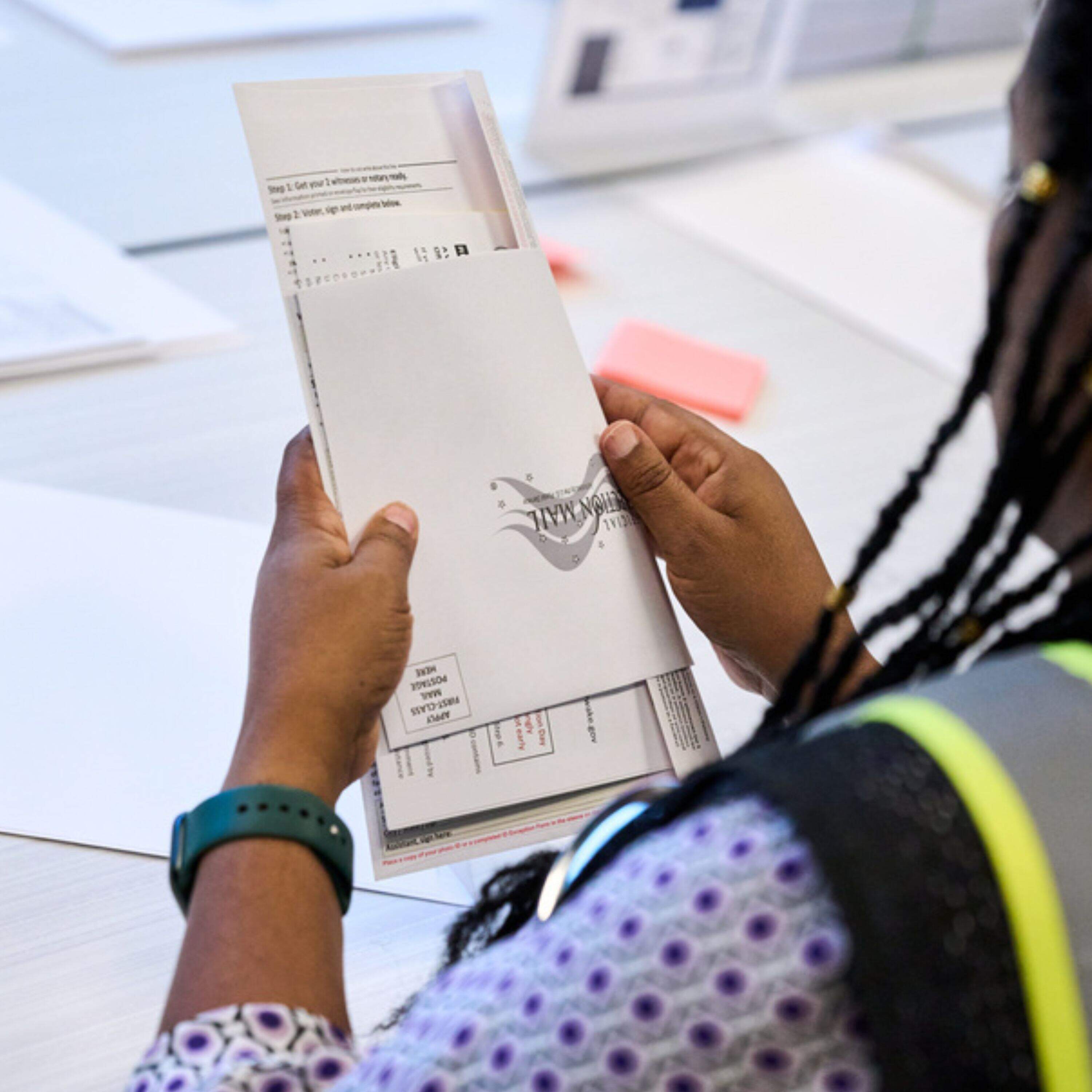
The Supreme Court has rejected President Trump’s plan to control how ballots get sent in the mail. But that does not mark the end of the President's efforts to undermine mail-in voting, and change who votes and how.
*** Thank you for listening. Help power On Point by making a donation here: wbur.org/giveonpoint
Get every episode summarized
Each time On Point with Meghna Chakrabarti publishes, we email you a written briefing from the transcript — the topics, who appeared, and any specific claims, with the ad reads skipped.
Email me new episodesFree for 3 shows. No card needed.
Hosts & guests

Transcript ready
856 searchable segments. Every word is indexed and playable.
Full transcript
On Point with Meghna Chakrabarti — Trump's war on mail-in ballots. Machine-transcribed; use the interactive transcript above to jump the player to any line.
Good things come in force. Like ukulele strings, boy band members, Oh yeah! And PayPal Pay-In-Four. No fees, no interest, no impact on your credit score, just the flexibility to pay the way that works for you. Strument, hum it, pay it in four. Download the PayPal app to get started. Subject to approval. Learn more at paypal.com-pay-in-four. Pay-paling, NMLS 910457. On any journey using Uber, it helps to know you're getting into the right car. Pin verification adds an extra step to make sure your ride is your ride. Before the trip begins, your app gives you a unique pin. Just tell it to your driver and they'll enter it in their app before the ride can start. Hey, what's your pin? Mm-hmm. 2538. That way you know you're in the right car taking the right trip and your driver knows you're the right passenger. Make sure your ride is your ride with pin verification from Uber. One more way Uber is putting safety at every turn. Learn more on the Uber app. Parenting unlocks some pretty impressive skills.
Like carrying grocery bags, a soccer ball, and a sleepy kid all at once. Good thing the newly designed Chrysler Pacifica has a few tricks of its own. Hands-free power sliding doors and lift gate, rear seat entertainment, and still-en-go seating and storage that adapts faster than your family's weekend plans. Visit Chrysler.com to learn more. Chrysler is a registered trademark of FCAUS LLC. Hey, it's Magna Chakrabardi. Before we get to today's episode, I want to just take a second to encourage you to join the new on-point club. For just $7 a month, you get first access to the jackpot every week, other exclusive content like behind the scenes with our producers, and you'll be the first to know about special live events. And we have got some great ones coming up. That's all just for $7 a month. This is like a couple of cups of coffee these days. So to join, just click on the link in the episode description you're looking at,
and it'll only take a minute to sign up. Okay, here's today's show. WBWR Podcasts, Boston. This is on point. I'm Magna Chakrabardi. Nearly a third of American voters use mail-in ballots, including the president of the United States. You may not use the mail-in ballot, you probably said, yeah, I did. You know what? Because I'm president of the United States. And because of the fact that I'm president of the United States, I did a mail-in ballot for elections that took place in Florida, because I felt I should be here instead of being in the beautiful sunshine. That was President Donald Trump at a briefing on March 16th, 2026. Days before he issued an executive order, exercising unprecedented federal control over mail-in ballots. The order directs the U.S. Postal Service
to establish, quote, uniform mailing standards for ballots and limits who would receive ballots to voters on a newly established state citizens list. Multiple states sued the Trump administration, saying that the order interfered with elections that have been traditionally run by the states. Twice federal judges found the order to be illegal. The Trump administration then took its case to the Supreme Court. Well, the court issued its emergency ruling just yesterday, and it effectively blocked the president's plan to control how ballots get sent in the mail. However, the loss is unlikely to stimey Trump's overall efforts to change who votes and how. The president said earlier this year that he wants to, quote, take over and nationalize American elections. So let's take a look at all of this and everything that's happened in just the past couple of days and we'll start with Jen Feifield. She's a reporter for a pro-publica who has been covering elections voting and mail-in voting. Jen, welcome to on point.
Hello, happy to be here. Okay, so even though the court has actually kind of put an end to this question over the U.S. Postal Service and mail-in ballots, I would actually like to go into what the Trump administration was attempting to do in detail, because I think it tells us a lot about their approach to elections overall. So take us back, Jen, to this executive order from March of this year. What exactly was the president trying to achieve by saying that there were certain changes to be made by the U.S. Postal Service in terms of how it handles ballots? The Trump administration in this executive order clearly said that they believe the U.S. government, specifically the Postal Service, can regulate what happens in the mail. That includes ballots who they are sent to. They should only be sent to eligible voters and the federal government should have a role in deciding who they get sent to. So that required states to come up with lists of voters that they were about to send these mail ballots to
and tell the Postal Service who those people were, put barcodes on their ballots so that once the mailings went out, the Postal Service could check those lists of voters. And so it was for the first time the Postal Service would be serving in this gatekeeping role. Barcodes on the ballots. Okay, so tell me how does this differentiate from how the Postal Service handles ballots now? I mean, or does it, or is that all, were all these things new? Or they could have been new? All of these things would be absolutely new. Right now the Postal Service takes extraordinary measures just to get you your ballot as fast as they can. They're actually under a court order from 2020 to do this. And so they're used to operating under circumstances where they're shuffling ballots along very quickly and they have certain rules they have to follow. And now they're being told, well, actually instead of that, you're gonna take more time with these ballots and you're going to be scanning, sampling, you know, the ballots to make sure that they are going
to who the states say they should go to. You had a story, I believe, that said that there were people within the Postal Service itself who were concerned that if indeed this rule were to go through and they would have to handle ballots in a new way, that the USPS wasn't even ready to do that. They had to create a nearly a hundred page rule on how they would make this possible. The executive order didn't outline how they would do this. So while they were working on that, there was great concern in the room during the rulemaking that they would be somehow limiting batches of eligible voters all at a time in Maricopa County on the first day of early voting in Arizona, they send out two million ballots at a time. So the question was raised to them at one point in this committee of election officials that were talking to the Postal Service. They said, what if those two million ballots came out and there was just one questionable ballot or barcode? What would you do? And, you know, I think the answer at the time was, well, it could be that that does get delayed.
Two million ballots could potentially get delayed? That's at the time, that's what that was the answer. And a lot of the court, the answers to make clear were coming from these Postal Service workers who were clearly just doing their job. I actually heard that phrase a few times, talking to people who would talk to the Postal Service workers that we are just following the plan here. Okay. So again, this didn't come to pass because of the Supreme Court's emergency docket ruling. Yesterday, what were states who sued the Trump administration? What were they arguing about why they did not want the rulemaking process for the USPS to go through? So the Democratic states that sued said that, first of all, the Postal Service does not have the authority to make these decisions for ballots, states control who votes and how in their states. And so that was the first argument. The second argument was it came in emergency appeals, saying we do not have the time to do this. We do not even have these barcodes right now.
We don't even have know how to give you these lists. We don't have directions on that. So this can't be done for November, but overall they also said it can't be done period. Okay. So at this point in time, does that mean that states and counties will be using the mail-in ballot systems that they had been previously using? Yes. So yesterday was a huge deal for election administrators who have been holding their breath. In fact, I saw one say when this ruling came out yesterday, this ruling represents a sigh of collective relief that now we don't have to figure this out so quickly or we don't have to worry that our voters will be disenfranchised. And so voters should be assured that this is not going in place for November. In some states, at least two North Carolina, Alabama, there may be more, they've already been sending out mail-in ballots anyway, so this would have been quite disruptive. But Jen, this isn't the only, the mail-in part wasn't the only aspect of this executive order. I mentioned a little bit earlier that there's also a section two of the order
says calls for the establishment and transmission of state citizenship lists. Right. So this order directed the Department of Homeland Security to create a list in every state of the citizens that were eligible to vote. As you know, there have been dramatic attempts by the federal government to try to find non-citizens that are on the voter rolls and are voting. This has been for the last year. They've put all sorts of resources across the federal government to this effort. This is just one more step in that where they want to create these lists. Now, the DOJ has said in these court arguments that the states would not have to use these lists. So it's a bit confusing as to what the list would be intended to do. It might dovetail into what they were asking the Postal Service to do, but that's very unclear. The Postal Service was going to have lists from states. Could they then compare the list from DHS to the list to states? It's very complex and it wasn't explained at the time.
It still hasn't been explained, but that part of the order is still out there. If it still hasn't been explained, do we know if this kind of list is being or lists are being made? There's been rumblings that there's activity within the federal government to combine all sorts of data, social security numbers, voter names, addresses into this master list that will be created. We haven't seen signs of that yet, but there is a lawsuit from voting rights groups trying to stop that as well. All of this will become more clear as those lawsuits work themselves out. But like we said, the election ballots are already out. I don't see the Supreme Court saying yes, that part of the rule can move forward while the other part cannot, but again, I'm not a lawyer. We should say that this executive order overall is once again and attempt by the administration. They're saying that they want to prevent voter fraud. That's the alleged reason for these attempts at rulemaking changes.
But Jen, as far as I can see, every analysis of decades of voting, and decades of even years of mail-in voting, has found that over billions of votes cast, the amount of actual fraudulent votes is so diminishingly small, it's like 0.00, whatever percent, right? Correct. I was reading some very smart legal minds on these rulings in this issue who said that the government should be saying in all of these briefings that there is fraud. If they really want to make their case, that the Postal Service needs to regulate this, they should be showing all of the mail-voting fraud that they know about. That hasn't been the case. Well, Jen Fyfeeld is with us today. She's a pro-publica reporter covering all things election and voting related. We'll be right back. This is on point. Good things come in force, like ukulele strings, boy band members, oh yeah!
And PayPal payin' for. No fees, no interest, no impact on your credit score, just the flexibility to pay the way that works for you. Strument, hum it, pay it in for. Download the PayPal app to get started. Subject to approval. Learn more at paypal.com-payin-for, paypalling, NMLS 910457. On any journey using Uber, it helps to know you're getting into the right car. Pin verification adds an extra step to make sure your ride is your ride. Before the trip begins, your app gives you a unique pin. Just tell it to your driver, and they'll enter it in their app before the ride can start. Hey, what's your pin? Mm-hmm, 2538. That way you know you're in the right car taking the right trip, and your driver knows you're the right passenger. Make sure your ride is your ride, with pin verification from Uber. One more way Uber is putting safety at every turn. Learn more on the Uber app. Parenting unlocks some pretty impressive skills, like carrying grocery bags, a soccer ball, and a sleepy kid all at once. Good thing the newly designed Chrysler Pacifica
has a few tricks of its own. Hands-free power-sliding doors and lift gate, rear seat entertainment, and stone-go seating and storage that adapts faster than your family's weekend plans. Visit Chrysler.com to learn more. Chrysler is a registered trademark of FCAUS LLC. As you heard Jen say earlier, mail-in voting is extraordinarily important across this country, but especially in many Western states. For example, in 2024's general election in Nevada, some 47% of the votes there were cast by mail and all registered voters in Nevada get sent a mail in ballot. So we're gonna hear from Francisco Aguilar. He is Nevada's Secretary of State. He's held that position since January of 2023. Which makes him the state's chief election official. Secretary Aguilar, welcome to On Point. Hello, Magnet. Thank you for having me. All right, be here. It's great to have you. And especially since every time we have local elections officials on this show,
I first want to thank them for being the people on the ground who are holding up the American democracy. Do you feel relief as far as the Supreme Court's emergency ruling yesterday? Absolutely. It was a great day for Nevada voters, but voters across the country because we can continue to run elections as we've run elections in the past. We have universal mail ballot, which means our 2.1 million registered voters received that mail ballot in their mailbox. It was part of an effort prior to COVID and during COVID that we were able to get to this place. You know, Nevada is a unique state and it's kind of a microcosm of the rest of the country. We're extremely diverse from an ethnicity standpoint, from a geographic standpoint, but from even an economic standpoint, we have a 24-7 economy in Las Vegas. We have the same type of economy in Northeastern Nevada with our minors, but again, this is giving Nevada its accessibility and giving them access to the ballot box that normally they may not have had in the past. Well, clearly they use it, right?
That 47% of votes is quite astonishing being transmitted to you by mail. I think there actually may be, well, there are a lot of listeners out there who do have concerns if they don't use regular mail in voting because, look, fraud can happen. Not that it happens all often with voting. We know that it almost never does, but tell me, Secretary Aguilar, what are the steps that Nevada takes? Walk me through them in order to assure that fraudulent votes are not cast by mail there. Absolutely, but I think it's important to note during our recent primary election in June, 60% of Nevada's used a mail ballot. And since 22, 86% of registered voters in Nevada have used a mail ballot at some point in an election. And that's important to ensure that we continue to run some of the safest, most secure and accessible elections of a country. And we do that because we have different security measures put in place. First, there are division duties between the state and the Secretary of State Office
and our 17 clerks across the state. That division of duty creates security within itself. But then again, we make sure that we are mailing registered voters the ballot. When that ballot is received by that voter, they use their signature as a security measure. That signature gets scanned when it's received by the county. And about 30% of those ballots move forward into processing from that initial scan. 70% then go to a bipartisan review between a Democrat and Republican. They look at the signature on the envelope. They look at the signature from the voter registration form. They look at the signature from DNV. And signatures from previous election cycles. Both those individuals have to agree that that signature matches. If it does, it goes into processing. If it doesn't, it goes into signature here, where then the voter has to identify themselves and prove that they voted that election cycle. But prior to the 24 election, we implemented a brand new voter registration election management system,
which created a top-down system. We used to be a bottom-up, which created a lot of issues because he had 17 counties with 17 different processes, 17 different systems. But now with our top-down, it's real time. So somebody votes a mail ballot. It gets received by the county and they try to attempt to vote in person. They immediately get flagged and vice versa. We also, every Nevada can file an election integrity violation report with the Secretary of State's office. That report goes immediately to an investigator. That investigator is responsible for immediately responding to that citizen and then doing the investigation on the issue that that voter raises. I mean, how confident do you feel, actually, Secretary Aguilar, that signatures are enough to verify that the person is who they say they are? They are significant in the process. Again, we do have a ballot in a measure on the ballot this November for the second time to approve a voter ID measure. I think it's a solution to a problem that doesn't exist. We don't have widespread fraud in Nevada.
We have very committed, diligent county clerks who are also part of this process. Every mail ballot in Nevada has an individual bar code. That bar code is critical to the security measure of the overall process and the system. It also helps with transparency. It lets voters know where their ballot is in the process. People know more sometimes about a pizza than they do their ballot and we've been working really hard to build that transparency in the process. Okay, so let's talk a little bit more, Secretary, about the parts of the president's executive order that are still active, that the United States Supreme Court did not actually block. And I'm coming back to that state citizenship list. That's section two of the executive order. Now, the order says DHS would compile information from citizenship data, immigration services, social security numbers, and transmit to you the chief election official in Nevada a list of individuals confirmed
by the United States federal government to be citizens at or above the age of 18. Would you find such a list useful? So I laugh because I've been through this exercise somewhat with DHS. They made this accusation on national TV that we had a significant number of non-citizens on our voter rolls. And they even threatened prison time against us. We just kind of looked at each other like, what are they talking about? Do they not understand how elections are run? Do they not understand how the voter registration process works? Conservative organizations out there have rated our voter roll maintenance five out of five. Why are they trying to engage in something they don't understand? But again, it's not about the security and the integrity of the election. What it's really about is putting fear into a certain population of voters that's very large in Nevada. We have a 30% Latino voter base. And Latinos are fed up with this administration's failure to deliver on the promises from the previous election cycle. And they're going to hold them accountable.
And the fact that Nevada is the road to the White House and this population of voters, my community, which I'm a part of, is going to have a say who the president of the United States is in 2028. We asked them when we met with them after they made their significant claim and said, show us the data, help us understand where we can improve our processes and our systems. What they sent us was a complete joke. It was like the work of a third grader. We required third graders to show their work on a math problem. What did they send you specifically? So they actually sent me an Excel spreadsheet that was pretty basic and it had four columns. The first column was a voter case number. It wasn't even the voter ID number, which is public and our voter rolls that we can give to everybody. The second was like the state, which of course was Nevada. The question was, are they a citizen or not a citizen, a wire, an N? And the fourth column was, had DHS researched it. Well, they only looked at 185 of those individuals. We thought, yeah, this is not conclusive about anything.
We have a high, look, you're talking about a constitutional fundamental right. The standard of proof and the standard of responsibility to just show is much greater than anything else we're talking about. And we have some share additional information with us. And they wrote back and said, no, that's all we're going to give you. Then we said, well, we can't help you. And so this was from the Department of Homeland Security because they had concerns about potential voter fraud in Nevada. Right. And it was a combination of Homeland Security, customs and immigration services. And it was a collaboration that they were claiming they were doing together. And we just thought, wow, this is the work product that these individuals are producing. This is pretty unfortunate. And it's really not fair to Nevada voters. Like it or not, the president's constant talk about voter fraud has actually increased uncertainty amongst Americans in general about the integrity of our elections. I mean, polling does indicate that. And so if a state citizenship list
from the Department of Homeland Security would not be of use to you, can you just describe to us briefly, Secretary, how Nevada goes about ensuring that only citizens are voting there? First of all, when you get a voter registration for the very first question is, are you a US citizen? Yes or no? We also have automatic voter registration. So when an individual shows up at the DMV, that's the first thing they have to ask. And then it's sent into two different processes. This is self attestation by that voter. And it is a felony to lie. And let's be honest about this. A non-citizen who is going through the immigration process is not going to jeopardize their status or the status of their family to participate in our elections. There are greater responsibilities on that individual to do than worry about participating in our elections. I think it's a bit of an arrogance in our part to think that all these non-citizens actually want to participate to the detriment of their future. Then it goes into the DMV actually doing identification
and proving that identity of that individual. You have to show photo ID. You have to prove who you are. And then there are some checks behind the scenes that are done to ensure that it is that person, that ID is real. Then it goes to the local county clerk for another verification and review. But then it also goes into our voter role maintenance on pretty calendar process to ensure that we are making sure that we remove inactive voters when the time comes and when the law says we can. Now that is a very transient state. For example, when I was on the ballot four years ago and I'm on the ballot again today, the difference of voters is about 30%. Wow, okay. And so we have to make sure that we are completely accurate and who our voters are. Well, Francisco Aguilar is Nevada's secretary of state. Secretary Aguilar, thank you so much for joining us today. Thank you and I appreciate it. Jen Fryfield, thank you so much for listening
rather patiently there to what Secretary Aguilar said. We're gonna go to Arizona in just a couple of minutes. But I'm wondering if you could reflect on what you heard the secretary say there and if it sort of matches with your reporting on the security of assuring that only citizens are voting in places like Nevada. Well, first I'm just so glad that he outlined all the security measures that he takes because they do mirror what happens across the country to try to ensure that male voters are going to the right place and the right person is voting on them. I think that's important because voters, there is a lot of lack of voter trust on male voting in particular because people are not showing IDs at the time they vote is debate over whether you should have a signature or ID number on your ballot envelope. But I think that that should reassure people that there are measures taking place on the Department of Homeland Security lists. We found in our reporting earlier this year
that the Department of Homeland Security was warned that the system that they were using to develop those lists that he was talking about to accuse people of being non-citizens would produce an ungodly number, ungodly number of false positives. We saw them continue to do it and continue to make these false claims about large numbers of non-citizens in particularly in democratic states when they hadn't even looked into whether that was true or not. Were you able to find out why the system may have yet such a risk of producing false positives? Yes, so part of this is that democratic states were not sharing their full voter roles with the federal government. The full voter roles would contain an identifier like a social security number that makes this matching and this work really easy. You can then take that number and say, okay, well, what does it say about their citizenship in our records? Without that, you're just taking, you know, their last name, first name, their date of birth,
maybe their address, I'm not really sure how they're doing the matching and they're just trying to kind of mash all of this data together from across government systems and it's not working. Good things come in force, like ukulele strings, boy band members, and PayPal paying for. No fees, no interest, no impact on your credit score, just the flexibility to pay the way that works for you. Strum it, hum it, pay it in for, download the PayPal app to get started, subject to approval, learn more about it, and then pay the money, and then pay the money you have to pay the money for the money you have to pay the money for the approval, learn more at paypal.com-paying-for Paypal Inc, NMLS 910457. On any journey using Uber, it helps to know you're getting into the right car. Pin verification adds an extra step to make sure your ride is your ride. Before the trip begins, your app gives you a unique pin. Just tell it to your driver and they'll enter it in their app before the ride can start. Hey, what's your pin?
2538. That way you know you're in the right car taking the right trip and your driver knows you're the right passenger. Make sure your ride is your ride with pin verification from Uber. One more way Uber is putting safety at every turn. Learn more on the Uber app. Parenting unlocks some pretty impressive skills, like carrying grocery bags, a soccer ball, and a sleepy kid all at once. Good thing the newly designed Chrysler Pacifica has a few tricks of its own, hands-free power-sliding doors and lift gate, rear seat entertainment, and stone-go seating and storage that adapts faster than your family's weekend plans. Visit Chrysler.com to learn more. Chrysler is a registered trademark of FCAUS LLC. When it comes to challenging voting roles and who's on them, it's not just those challenges aren't just coming from the federal level. Many of them are happening right down at the level of the state. So let's bring Sasha Hupka into the conversation now.
She covers voting access for vote-beat Arizona. That's a nonprofit newsroom that covers elections and voting in that state. Sasha, welcome to OnPoint. Hi, Mackna. Thanks for having me. It's really great to have you. I love the fact that we have two Western states on the show today. Give me the quick overview of how votes are cast in Arizona. It's not all automatic mail-in voting. Is it? Or am I wrong? It is not. That is very common in some Western states. But that's not how we do it here. Here are voters have to opt in to what's called our early voting list. And by doing so, they consent to receiving a mail ballot. Typically, they'll do that when they register to vote. And then what we do see here, though, is that mail voting is wildly popular. The vast majority of Arizona's over 75% typically vote by mail in every election cycle. Wow. All right. So take us back to 2022.
There was an important Arizona law that was signed by former governor Doug Ducey. What was that? Sure. So I think that it helps to have a little bit of context, right? Yes. As to why Arizona looked like post 2020 election. You had Donald Trump's very narrow loss here to former president Joe Biden in 2020. And then you had an effort to overturn the results of that election. And you know, part of that became this really controversial audit of election results in Maricopa County. And so when you had lawmakers entering that 2021 and 2022 legislative sessions, they really wanted to sort of overhaul the election system. In Arizona, the legislature was at the time and currently still is controlled by Republicans. And at the time, former governor Doug Ducey was also a Republican. And so he saw many, many, many efforts to completely change the election system.
How votes were counted, the voter registration, right? He saw all of that coming to his desk. And some he vetoed, but some he signed. And one of the laws that he signed was this law that would change how Arizona's mail ballot list worked. It used to be called the permanent early voting list. Because once you got on it, unless you requested to get off or you died, there wasn't really much of a way of you just being sort of yanked off. Now with this new law that's going into a fact starting next year, there will be automatic removals of some Arizona's from that list. It's been renamed the active early voting list. And the idea is if you don't vote with a mail ballot, so either by returning it by mail or dropping it off in a drop box, if you don't vote with that mail ballot within two election cycles, two consecutive election cycles, so four years, you could be removed from the list.
And does that mean federal elections or can it be too consecutive, like even just local elections? Yeah, let's dig into that. Yeah, because it's all confusing. Yeah, absolutely. So I think that, you know, the idea of this is any election. Oh, first off. But essentially what this means, just to sort of put it in like very plain language. If I'm a voter in Arizona and in 2023 and 2024 through the local elections and then through the federal election cycle, I got my mail ballot, but I just never cast by mail. I went, I voted in person maybe, or maybe I just chose not to vote at all in some of these elections, right? But I didn't vote in that 2024 cycle by mail with a mail ballot. And then in this 2026 cycle that we're currently in, I also don't do that. I opt to vote in person. That means that in January, I'm going to be at risk of getting removed from this list. And I think it's very important to also note, these people will still be able to vote. This isn't removing them from the voter role. But it means that if they don't, you know, respond to that letter
that's coming in January, when maybe they're not expecting election mail, they'll be removed from the list. And then, you know, they just might not get their mail ballot that they're expecting. And that's sort of a big deal here because mail ballots are so popular and so many voters are signed up for that early voting list. Okay. So then can you tell me from people that you've talked to, what are their concerns? Because if the only requirement is just to vote in two consecutive elections and if you fail to do that and you get removed from the list, you can opt to rejoin the list. I mean, what is the concern about what potential disenfranchisement, but how? So I think there's sort of two ways of looking at this law. If you're looking at it from the perspective of, you know, Republicans who championed this through the state legislature, they're going to tell you this is a housekeeping bill, you know. This is just maintenance. This is making sure that the early voting list is clean. If you look at it from the perspective of Democrats who are very opposed to this, and some, you know, voting rights advocacy organizations,
they're going to tell you this is voter suppression plain and simple. I think what I can tell you is that the research around how similar sort of measures to this have played out in other states suggests that while voters can rejoin the list and can opt to stay on, and many of them certainly will, there does tend to be a bit of an effect of this in that voters, once they're kicked off, they're not very likely to sign back up. There's been a lot of research that suggests this either sort of shifts them to other methods of voting, which is something Arizona may have to contend with, because like I said, 75 plus percent of our voters every cycle vote by mail, potentially a lot more people coming to vote in person than we're used to, or it causes a voter to maybe not vote at all. They're expecting not mail ballot, and then they don't get it, and you know, they're sort of not sure what to do.
Okay, Jen, again, once again, thank you so much for your patience in listening here. Have you seen other efforts or similar efforts in other states at the state level, Jen, in terms of changing how people vote by mail? Well, absolutely. I mean, since 2020, this has been a big push by Republicans across the country to somehow limit mail voting. In Arizona, specifically, it was Republicans that championed this system 20 years ago. In Utah, last year, the governor signed a lot eliminating universal vote by mail. And, you know, during these conversations, like you said, there's no talk of, you know, immense fraud. There's, you know, the reasoning is to better secure elections, but this is just something that Republicans in their state legislatures have faced immense pressure to do. It's interesting to me, and maybe Sasha, you have a take on this, because people of all political persuasions vote by mail. I mean, in Arizona, if we got 80% of people voting by mail,
that it has to include Republicans, Democrats, Independents, and yet is there sort of equal fear between members of either party about the potential for fraud by mail? Well, I think you make a really good point that, yeah, you know, a lot of different types of Arizona's, including across the party spectrum, do take advantage of this system. And in fact, we see that some of the most popular areas for vote by mail are at times also the most conservative. Yavapai County, which is located north of Phoenix, and is a very red county. They were the ones who, you know, sort of created vote by mail way, way back in the day. And it was because it's a more rural county, a more rural place, where it's just a little bit harder for people to get to the polls as easily. And so, you know, we do see that. You know, there's sort of, particularly amongst people in the more rural areas of the state, I think that there's this, a little bit of cognitive dissonance in that,
what I often hear is, you know, well, it's not happening in my county. It's the other county that's the problem. And usually they're pointing at Maricopa or Pima, which is home to Tucson and is our second largest county. So we see a lot of that. That seems very human, right? It's not me. It's them. But Sasha, there's one more thing that's actually on the ballot this November in Arizona that has to do with voter ID. Can you tell me about that? Yes, I believe you are talking about proposition 144, which is a legislative, Lee referred ballot measure that would require voter ID to vote by mail. And I think that this is, you know, just for some context here, Arizona already requires voter ID. Like when you, you know, show up to register to vote, you not only have to show ID, you also actually have to show proof of citizenship, which is a stricter standard than what most states have. If you go to the polls in person here, you also have to show ID to vote.
And if you vote by mail, we use a signature verification process that's very similar to what Secretary Aguilar was describing in Nevada. This would essentially replace that signature verification process if voters approve it. But it's unclear with what. And I think that makes Arizona and this measure a little bit unique. There's other states that have tried and have similar measures on the ballot, but all of them sort of prescribe a way of doing this, right? It's like, okay, well, if you're going to do this, you're going to, you know, have to write your driver's license number on the back of the ballot instead of a signature. And here on Arizona, it does not say how this would work. It's essentially a blank check of voters saying, well, we want there to be some form of voter ID for vote by mail. Someone's going to have to figure out what that looks like if we pass this. Well, Sasha Hupka with vote beat Arizona, a nonprofit newsroom that covers elections and voting. Thank you so much for joining us today. Thank you.
All right, Jen, you get the last couple of words here. I suppose a lot of people listening to this who do vote by mail may now suddenly be wondering, or maybe they already were, about the sanctity of their vote. I mean, overall, should people still have confidence in their ability to vote by mail, whatever state they're in? I think people need to research the laws in their state. A lot has changed just in the last two years to see how they can vote by mail when they should send their ballot in hint very early. And also look at other options too. If they don't feel comfortable with the post office, sometimes they have drop boxes they can use. But really all of this goes to confuse voters right before an election, which is never good. And that's why I encourage voter education on it. And it also sets up for future challenges. All of the bills and laws we've been talking about are just more ways to when a ballot comes in, it doesn't have the proper signature or doesn't have the proper ID,
then there can be challenges to that voter's eligibility. And so I think there's definite lack of voter awareness about changes that are concerning to many election officials right now. We even have election officials who very much believe in the security of vote by mail, encouraging voters to take their ballot to a drop box or to the election center or a voting location just in case. Well, Jen Fyfield reports for pro-publica on elections, voting rights, and threats to democracy. We have links to Jen's reporting at onpointradio.org. Jen, thank you so much for joining us today. Thanks for having me. This is Onpoint. Virginia Mom let her five-year-old son take a walk alone, half a mile in her gated community. A security officer brought her son back, and then the mom was prosecuted for contributing to the delinquency of a minor.
She was convicted and is now on Virginia's child abuse and neglect registry. I'm Megna Chokrabardi, free-range parenting versus the zero risk state. That's on the next Onpoint. On any journey using Uber, it helps to know you're getting into the right car. Pin verification adds an extra step to make sure your ride is your ride. Before the trip begins, your app gives you a unique pin. Just tell it to your driver, and they'll enter it in their app before the ride can start. Hey, what's your pin? Mm-hmm, 2538. That way you know you're in the right car taking the right trip, and your driver knows you're the right passenger. Make sure your ride is your ride, with pin verification from Uber. One more way Uber is putting safety at every turn. Learn more on the Uber app.
More episodes
More from On Point with Meghna Chakrabarti

The secret lives of snow leopards
On Point with Meghna Chakrabarti

What's at stake in the race for AI dominance
On Point with Meghna Chakrabarti

Free range parenting vs. the zero-risk state
On Point with Meghna Chakrabarti

'A climate of fear' at the Pentagon
On Point with Meghna Chakrabarti