Get every episode summarized
Each time On the Media publishes, we email you a written briefing from the transcript — the topics, who appeared, and any specific claims, with the ad reads skipped.
Email me new episodesFree for 3 shows. No card needed.
About this episode
“The big question we continue to ask, what is the president planning? The media walk a tightrope between covering potential election interference and making voters so despondent that they avoid the ballot box altogether.”From the transcript
The Supreme Court has denied a bid by the Trump administration to restrict mail-in voting. On this week’s On the Media, hear about the attempts, successful and not, to turn election conspiracies into policy. Plus, the case for literary gatekeepers.
[01:00] Micah Loewinger speaks with Rick Hasen, law professor and director of the Safeguarding Democracy Project at UCLA, about the state of our election systems heading into midterm season, and what headlines should hold our attention.
[20:07] Brooke Gladstone speaks with Mark Krotov, the publisher and coeditor of the literary magazine n+1, about how old books are enjoying renewed popularity thanks to the flourishing “reissue” book market, and TikTokers’ penchant for hidden gems in the backlist. But what does the trend tell us about the health of the publishing industry?
[35:41] Brooke also sits down with Laura McGrath, an assistant professor of English at Temple University and the author of the book, Middlemen: Literary Agents and the Making of American Fiction, to discuss the little-known history of literary agents, the unseen tastemakers choosing your favorite novels.
Further reading:
- “Exorcising Justice Alito’s Voter Fraud Boogeyman,” by Richard L. Hasen
- “A Judicial Guide to Search Warrants Seeking Election Materials,” by Richard L. Hasen and Shelby Wayment
- “Old Directions: Reviving the spirit of revival,” by Mark Krotov and Lisa Borst
- Middlemen: Literary Agents and the Making of American Fiction, by Laura McGrath
On the Media is supported by listeners like you. Support OTM by donating today (https://pledge.wnyc.org/support/otm). Follow our show on Instagram, Bluesky, TikTok and Facebook @onthemedia, and share your thoughts with us by emailing [email protected].
Hosted by Simplecast, an AdsWizz company. See pcm.adswizz.com for information about our collection and use of personal data for advertising.
Get every episode summarized
Each time On the Media publishes, we email you a written briefing from the transcript — the topics, who appeared, and any specific claims, with the ad reads skipped.
Email me new episodesFree for 3 shows. No card needed.
Transcript ready
849 searchable segments. Every word is indexed and playable.
Full transcript
On the Media — Trump's Guide to Stealing an Election. Machine-transcribed; use the interactive transcript above to jump the player to any line.
The big question we continue to ask, what is the president planning? We do not know. The media walk a tightrope between covering potential election interference and making voters so despondent that they avoid the ballot box altogether. We need to prepare, but we need to keep our heads on straight and recognize that even Donald Trump is subject to certain political rules. For MWNYC in New York, this is on the media, I'm Michael O'Neill. Also on this week's show, why publishers seem to be reissuing old books. I mean, for one thing, but for writers dead, you really don't have to pay them very much for the most part. Plus, if literary agents are so crucial to getting novels published, why don't we hear more about them? No one likes a sellout. Writers are not necessarily doing things only for the money, but often even the suggestion that a writer might be interested in the commercial value of their work. Containt it. This is all coming up after this. Hey, it's Mike at Before we get into the show, just a quick message.
When we're talking about what we want to cover on on the media each week, we ask ourselves as a team, what will help our listeners understand what's happening in the world? That means separating the important stories from the noise, digging beneath the headlines, getting past the hype, going deep to talk through thorny issues. Like we did last week on the show when we discussed President Trump's ban on news organizations from the White House briefing room and the resulting boycott by the TV press pool. We were excited to see that brief moment of solidarity between news outlets because it demonstrated that standing together really is an effective way to fight for journalism in the First Amendment. On the media also counts on solidarity. Solidarity with you. Donations from listeners have always been crucial to the show, allowing us to remain free of influence or commercial considerations that are central to so many corporate news outlets. It's the time of year when we ask for your support and that's why I'm coming to you right
now to ask you to donate to this program. And to sweeten the deal, we have something really cool, a brand new on the media mug. It's been years since we've had a new mug. This one is White and features a beautiful line drawing of Brooke and me in front of our microphones on one side and the on the media logo on the other. And you can get yours with a donation of $12 per month or more today. I'll be honest, at first I was sort of horrified by the idea of having my face on a mug, but it's actually pretty cute. And snagging one is a great way to support our show. To see the mug and make your donation, go to on the media dot org slash donate or text OTM to 83763. That's on the media dot org slash donate. Thank you so much for your support and onto the show. From WNYC in New York, this is on the media. I'm Brooke Gladstone.
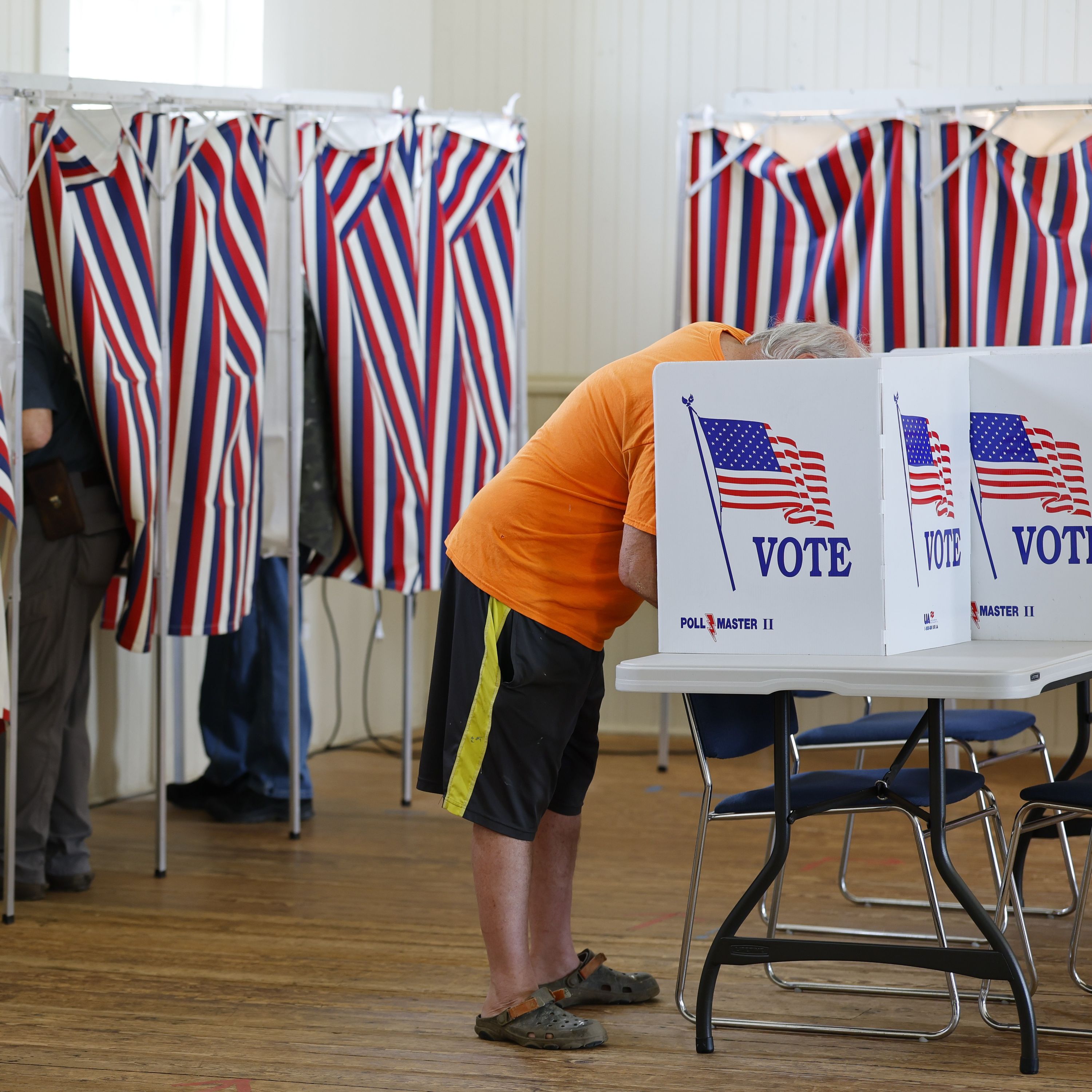
And I'm Mike Lowinger. Election day is now just one month away, but fears about November have been building all year. It's absolutely insane that the biggest potential threat to our elections this fall is not Russian interference or terrorists, butter on federal government. So my advice to state local colleagues is think of the craziest scenario you can imagine and then think even crazier. The big question we continue to ask, what is the president planning? In February, he told podcaster and former FBI co deputie Dan Bongino that the Republicans should say we want to take over, we should take over the voting in at least many 15 places, the Republicans ought to nationalize the voting. Which is we all know blatantly unconstitutional. That was just a few weeks after he told the New York Times that he wished the National Guard had stepped in after the 2020 election. So Secretary Hegseth. Democratic Senator Alyssa Slotkin of Michigan grilling Pete Hegseth in April.
Is the president who regrets not signing that executive order to the then-sector in 2020 asks you to seize ballots or voting machines in states during the 2026 election? Will you stand up for the Constitution and say no or will you salute and do his bidding? It's yet another gotcha hypothetical, which is your specialty. It's not that we have executive order under the Biden administration. It's hard to predict exactly what brazenry will befall us on November 3rd, but it's also not hypothetical. Considering just how much time and energy our government has spent trying to turn election denial conspiracy theories into policy. In May, news broke that the administration had spent months trying to ban dominion voting machines. Trump has begged and begged Republicans in Congress to nix the filibuster so that they could pass the SAVE Act, a voter ID law to combat the phantom menace of voter fraud.
And as we'll discuss shortly, he tried to get the U.S. Postal Service to screw with mail-in ballots. So far, all three efforts have largely failed, leaving his most extreme supporters chafing for even more extreme interventions. According to New Reporting from the Atlantic, a group of Trump's outside advisors have been pushing Trump to declare martial law in order to take over the midterm elections. We've got to take a quick break. Apparently, MAGA has recreated the logic from the 2004 Nicholas Cage film National Treasure. We're going to steal the declaration in the finance. The theory being that the only way to save the midterms from being stolen is to steal them first. Please raise your right hand. I pledge. Trump at the Republican National Convention last month. That I will go out with my family, my friends. I'll do it anyway. I don't care if I'm registered or not. I'm going to try and cheat like hell like they do. The challenge for the press has been that keeping an eye on all these stories also gives
more oxygen to the lies and conspiracy theories. And the challenge for us news consumers, well speaking for myself here, I struggle to know which of these election interference schemes are empty cortisol and which are actually worth my attention. Like the brigade of so-called election watchers who may be shipped out to polling sites around the country. The Justice Department announced plans to send more than a thousand monitors to observe polling places on election day. The monitors are... Well, first of all, we don't know that there actually be an increased presence. Rick Hassan, a law professor at the University of California, Los Angeles and director of the Seafeguarding Democracy Project. I called him up to sort the plausible election threats from the fear-mongering. In California, we had DOJ say they were going to send monitors to observe the proposition 50 ballot measure election involving the question of partisan gerrymandering and a total of two people from the Justice Department showed up to Los Angeles County, which is the
largest electoral jurisdiction in the country. And it was no big deal. So I'm hoping it would be something similar. Of course, this feeds into fears that ICE agents will be at the polls to intimidate people. What do you make of these kinds of fears? The government has had many opportunities to say, no, absolutely not. Of course, we're not sending ICE agents to the polls. It's against federal law. But they haven't done that. So we have to be cautious about anything that the government might do. But the reality is, politically, what would it mean if you saw armed federal agents trying to stop people from voting? I think we would end up seeing something much like what we saw in Minneapolis. You would see a large street presence. People would crawl over glass to vote under those circumstances. And I think it would backfire politically. It's interesting you say that because I was reading about reporting on internal Republican polling that seemed to suggest that pushing too hard to pass the SAVE Act might have
backfired because it would increase enthusiasm according to right-wing pollsters among Democratic voters. So I guess a similar logic there. Well, and I'd go even beyond that. The logic that it seems that many Democratic and Republican operatives still seem to be implicitly embracing is the idea that if you make voting harder, it's going to hurt Democrats and help Republicans because those occasional voters, those voters who have maybe less voting experience, they're younger. They're the ones that are going to be most affected by laws that make it harder to register a voter or intimidation at the polls. But the composition of political parties are changing. And Donald Trump really was able to succeed in about 2016 and 2024 by mobilizing less frequent voters, mobilizing with the campaign itself sometimes referred to as low information voters. These are the voters who are most likely to be intimidated or discouraged from voting. So I think if the SAVE Act would have passed, it would have just enfranchised a whole bunch
of people and so it would have had that effect. And the same thing with the mail-in-balloting order. Yes, let's talk about the roadblocks that the Trump administration has attempted to put in place to change and potentially harm the ability of Americans to vote by mail. In September, a whistleblower at the U.S. Postal Service made public a complex new system, which would essentially allow the Postal Service to verify which voters should receive mail-in-ballots. That was an attempt to comply with an executive order that Trump had signed in March and would probably create an enormous amount of chaos for election officials and probably disenfranchise some voters. But then the Supreme Court stepped in last month. Can you break down the ruling? The executive order that came out in March told the Postal Service to set up this rule with a whole bunch of new hoops that states had to jump through from the design of ballots to creating a list of citizens that would be uploaded to a U.S. PS portal.
Now, until the U.S. PS could match the names against the portal, it could not accept any ballots for mailing. At the time that the U.S. PS and really the Trump Justice Department ghost the Supreme Court and says, we want to put this rule into effect for 2026, there was no working portal. This story got kind of lost in the media, but if you have a rule that says no mail-in-ballots go out until they can upload into the portal and the portal doesn't exist, then no mail-in-ballots go out at all. And the Supreme Court on what appears to be a seven to two vote said not only is the U.S. PS likely exceeding its authority in this rule, but the equities of these emergency circumstances counsel against allowing the rule to go into effect for 2026, leaving the question for future elections to further litigation. The elections happening too soon, you can't be overhauling the entire system in the very last minute. At the time that the Department of Justice went to the Supreme Court, the state of North Carolina had already started mailing out mail ballots.
Elections take months of preparation. And the idea that the government was trying to rush this rule when it wasn't ready and forced it on election administrators who are already pulling out their hair trying to run a successful election to me was unconscionable. You mentioned the two dissenting justices, Samuel Alito and Clarence Thomas. What did you make of their votes? I was very disappointed to see that this was not a unanimous decision. When we're talking about these kind of emergency cases at the Supreme Court, not only does the Court have to look at how likely is the party seeking emergency relief to succeed, but they also have to balance the equities. Look at the harms to each side. What I found that was really troubling in Justice Alito's dissent was that when he was doing that balancing, he did not mention the uncontested fact that this would have disenfranchised millions of voters. And also the government, as the trial court found, had put forward no evidence that its rule in 2026 would stop any appreciable amount of fraud, which was the purported reason for
it. This was about as lopsided of a balance as I've ever seen in an emergency case before the Supreme Court, looking at these cases over 30 years. This is just an unconscionable claim by the government that unfortunately got the vote of two of the courts' justices who seemed to have never found a way of disenfranchising voters they don't like. Should we be worried about voter fraud at all? The Department of Homeland Security issued a press release about a month ago, and they said there are about a quarter of a million noncitizens on the voting roles in four states. Some of those states were in Nevada, and Nevada officials asked for the list, and eventually they got it. The list had 16,000 people on it for the state in Nevada. That number got whittled down to 185, and when those 185 were investigated, the total number of noncitizens on the roles was zero. Most of the time that we see noncitizens registering to voter voting, it's because of an administrative mistake. It's worth pointing out, these are real problems, and we need to fix them.
What we saw recently in New Jersey was that when people go to the Department of Motor Vehicles there, under federal law, they have to be offered an opportunity to register to vote. If you're not a citizen, you don't get offered that opportunity. Well, about 6,000 people who are not citizens, but who are eligible to get drivers licenses in New Jersey, were incorrectly coded as citizens and registered to vote because of a software error by the vendor that the Department of Motor Vehicles in New Jersey used. 400 of those people ended up voting over the last few elections. Someone might be a permanent resident. They might not understand the voting rules that well, but when the government says, hey, you're registered, here's your ballot, or here's where you can go to vote, people think, oh, I must be able to do that. So, we do have circumstances where noncitizens have voted. But in terms of finding modern examples of some kind of broad scheme, it's just not something that we see. Let's talk about another narrative that I think has caused some fear in the media.
Recently, the Atlantic ran a piece about a group of election denier activists who've been lobbying the president to seize control of the elections on or before November 3rd. In an August interview with the president, Maga Pundit, Wayne Allen Roo said this to Trump. You have the right to declare a national security emergency for elections. And the Supreme Court ruled in 1983 under Reagan that I and S versus Chata, that if you declare a national security emergency as the president of the United States, they can't challenge it. It can only be overturned by a two-thirds vote of both houses of Congress. To which Trump replied, let me just say that stranger things have happened. Okay, I'll leave it at that. Rick, something tells me that the National Emergency Act does not work this way at all. No, it doesn't, but this has been a long-standing crusade by the most extreme of the elections
and ires. Why doesn't that work? First of all, Trump's already declared a national emergency. He declared one to southern border. Declaring an emergency doesn't make you into a dictator. It unlocks certain powers. None of these statutes give the president any power over elections. The Constitution gives the president no power over elections. This thing about Chata is just weird. So Chata's case that says that Congress can't set up a system where it passes a law, the president signs it, and if one house of the Congress doesn't like it, they can kind of overrule it. What's called a legislative veto. And so the theory seems to be, if President Trump declares an emergency, Congress can't undeclare the emergency unless both houses of Congress agree, and the president agrees to or you get a veto-proof majority. Or that still doesn't give the president the power over elections. You haven't gotten to the scenario that I'm actually worried about, even though we've talked about a lot of things that I'm not so worried about. I think you're going to say it's seizing ballots. That's the one. Listeners have probably heard that in California, Riverside County Sheriff Chad Bianca
impounded nearly 650,000 ballots after the November 2024 elections on the grounds of suspected fraud. But when I think of all the things that Donald Trump and his government might do to try to interfere with the election, the thing that worries me the most is potentially trying to seize ballots or voting machines in a live election. Back over the summer, Chelsea Gabbard, the former Director of National Intelligence, had the Department of Homeland Security seize Dominion voting machines in Puerto Rico. We also had the Department of Justice get a search warrant and seize ballots in Fulton County, Georgia, ballots related to the 2020 election. And we did see this Chad Bianca local sheriff getting a search warrant to seize ballots in the state race over Proposition 50. In both of those search warrant cases, the affidavits showing probable evidence of a crime were based on discredited conspiracy theories about how elections are run. Yeah.
But that didn't stop a judge from issuing it because judges typically are pretty solicitous of law enforcement. And if law enforcement says this probable cause, they're apt to believe it. So this is a real danger. And as a safeguarding democracy project, we wrote a white paper for judges to tell them what it means to break the chain of electoral custody. Once ballots in a live election would be taken out of the hands of election officials, there's no way to know if ballots are added to or subtracted from or altered. And so there are ways that judges can deal with legitimate law enforcement objectives and preventing crimes and investigating crimes without breaking that electoral chain of custody. The good news is, in modern times, we don't have any examples of a court allowing the seizure of ballots or voting machines in a live election. So this is not a likely scenario, but it's something Trump could do without thousands of members of ICE. It's something Trump could do if he finds a sympathetic judge somewhere. I want to ask you about another scenario that has been covered quite dramatically in the
press. The new republic described it as, quote, the final battle for America's democracy. This involves the day of January 3, 2027. Can you explain this scenario and what you think of it? The idea behind this concern is that somehow Mike Johnson would engineer a coup in which Democrats would win control of the House of Representatives. But his hand picked clerk, who's an administrator, would not seat Democrats who perhaps won in close races, allowing there to be a smaller house with a Republican majority that would then pick a new speaker of the House, presumably again, Mike Johnson, and they would say that actually Republicans have won the election. This requires a lot of moving parts. It would be profoundly anti-democratic. If it happened, first you'd have to have a willing clerk of the Congress.
You would have to say that courts wouldn't get involved. There's good reason to think that courts would get involved because this is not Congress acting. This is a civil servant. The court would step in. But more directly, if Democrats have won control of the House of Representatives and somehow on January 3, somebody tries this kind of maneuver, it's going to provoke such a massive public reaction. This just seems very farfetched. I'm so glad you said that because David French of the New York Times described this scenario in a piece from July titled, This is What Teeps Me Up At Night. Obviously we want the media to shine a light on the president's ongoing efforts to interfere with our elections, but the line between dogged coverage and fear mongering can blur sometimes. We need to walk the place between complacency and panic, which is a place of resilience. We need to prepare, but we need to keep our heads on straight and recognize that even Donald
Trump is subject to certain political rules. He's been mostly obeying at least the Supreme Court. Let David go to sleep or let him read our report about balance seizures and maybe that'll keep him up instead. Do you think overall the press has done a good job sorting what's worth worrying about from what's not? I would say for the most part, the press isn't paying sufficient attention to any of this. In Texas, because of an administrator verer, 200,000 people who tried to register to vote did not have their registrations timely sent from the state to the counties to actually process their registrations. There's now a mad rush to get as many of those people registered as possible. Covering election malfeasance. It's a sexier story than covering election administrator snaffos. Take another point about Texas. Texas is one of eight states that does not have online voter registration. There's no good reason for that. These are stories about the administration of elections that affect real people that
I think should be told more. Rick, thank you very much. Thank you. Rick Hassan is a law professor and director at the Safe Guarding Democracy Project at the University of California, Los Angeles. Coming up, everything old is new again. At least when it comes to the world of book publishing. This is On the Media. On the media is supported by home serve. You protect your health, your car, even your phone. But what about your home? It's probably your biggest investment and when things go wrong, the costs can hit hard and fast. That's where home serve comes in. Regular homeowners insurance usually doesn't cover a lot of the day-to-day wear and tear. Plumbing failures, HVAC breakdowns, electrical issues. You're off and on your own for those. Home serve is like a subscription for your home. For as little as $4.99 a month, it's super simple. Choose a plan for your needs and budget and when something on your plan goes wrong, just
call their hotline 24-7 to start the repair process. If I needed this, home serve is the type of service I'd use. Home-served home owners for over 20 years with a trusted national network of over 2600 local contractors. Join the millions of customers who trust home serve. For 50% less, your first year, go to homeserve.com slash OTM. That's homeserve.com slash OTM for 50% less. Savings compared to renewal price, void in Florida. On radio lab, nobody can do this. It makes my brain hurt. The magical musical mind. Mind boggling to think about. One man that amazes scientists. Congress actually called him a national treasure. And pushes the boundaries of impossibility. God listening to music for this guy must be like an acid trip. A four-track mind from radio lab. Listen wherever you get podcasts. This is on the media. I'm Michael Onger. And I'm Brooke Gladstone.
We've been led to believe that readers crave what's hot off the press, scalding with urgency, blistering with revelations. But when it comes to the publishing industry, the data tell a different story. According to Serkana Book Scan, around 70% of books sold were published more than a year ago. A figure that's crept up nearly 10% since 2019. The LA review of books launched a column this year called Second Impressions, dedicated to reissued or second hand fiction. Meanwhile, book talkers love to an earth at home buried in the backlist. Like I, who have never known men by the Belgian author Jacqueline Hartman, who died in 2012. This is a French language novel from the 1990s. It went out of print eventually. Most books do. Serk Krootov is the publisher and co-editor of the Literary magazine N-plus-1. It was reissued in 2022 by the Small Press Transit, which is a fantastic independent press
out of the Bay Area. And this book that had already existed for almost 30 years suddenly really took off. Somewhere along the way, Hartman's novel became a favorite on TikTok. And by the summer, the book had sold more than 800,000 copies. Let's talk about an extremely popular book, I Who Have Never Known Men by Jacqueline Hartman. This is a translation from French and I would consider it dystopian fiction. Welcome back bitches, we have another book of you for today. I, who have never known men, which is a little ironic that a man is going to give her a view on this but hey, what the hell. For N-plus-1, Mark and his co-editor, Lisa Borsd, examined the new old book trend. What it reveals about the challenges facing literary novelists today and what kind of books seem to benefit. You know, I think part of what we're talking about with this reissue phenomenon is some sense of resonance between the content of these books and the lives of the younger readers
who were excited about them. How do you account for the Penguin Classics edition of Dust, Dioffsky's White Nights about a lonely young man in St. Petersburg? As you say, it's an even more left field candidate for virality. I saw one tweet that said, you think you know love and then you read Dust, Dioffsky's White Nights. Now it's available as an audiobook narrated by a guy from Bridgerton. It was a wonderful night. The kind of night, dear reader, which is only possible when we're young. The sky was so starry, it was such a bright sky that looking at it, you could not help but ask yourself, is it really possible for bad tempered and capricious people to live under such a sky? One way to account for it is that it's not quite as short as a TikTok video, but you can definitely read it in one sitting and be moved. I don't mean to discount the literary merits at all, but that just is a fact. I think that Russian literature and to some extent Soviet literature still carries this
imprimeter of literaryness. You can be 18 years old and understand what a quote-unquote Russian novel means and can use that as a stand-in for a certain kind of seriousness. So we've been talking about this vibe shift among readers, but obviously a trend is taking shape in the publishing world. The New York Review of Books is a stalwart of the new old book world. I've gone ape when they have their big sales. They're such pretty additions. You've noticed a new group of imprints following the New York Review of Books trail and indie houses that are dedicated into breathing life into older works. This is a bookfish which you say focuses on spiky and offbeat novels by women. Double day is part of the publishing conglomerate Penguin Random House. It just debuted its first collection. That was this past July from its new imprint, outsider additions.
Does that have a certain consistent flavor? There's clearly a particular interest on the part of outsider additions in representing writers who are not white, not necessarily American. I don't mean to totally generalize, but a lot of the kind of reissue trends do tend toward dead white people. One of the first couple titles they published was a really beautiful and intense memoir by the writer Jean-Side MacDeeCee called Beirut Fragments. How can I collect it all into one volume? The years of pain, of watching a world collapse while trying to stave off that collapse. The layers of memories and hopes, of tragedy and even sometimes comedy, of violence and kindness, of courage and fear. Above all, how can I express my strange love for this mutilated city? The other thing that I think is really exciting about outsider in particular is that some of the books are newer, books from the 21st century. That's always been something that I felt is really missing.
A lot of exciting stuff falls out of circulation very quickly and deserves to be revisited not like 60 years from now. I don't know, maybe much sooner. I mean, I felt as a book editor myself, you published something amazing and hope it gets an audience and sometimes it does and most times it doesn't because that's the way of the world. But why not give readers an opportunity to come back to that book maybe a decade or two from when it was first published and maybe that's enough time to create a whole new audience? Why is it so hard right now for a new writer to publish a literary novel? Books, unlike other creative industries that have seen the systematic race to the bottom, books are still just like such a variegated product. It is very hard to scale and replicate book publishing in a way that one can kind of replicate other industries. That's not to say that every book is its own special snowflake, but it is to say that when you're doing publishing right, you have to develop new audiences every time. You have to kind of create new strategies, kind of build the thing from scratch.
Now of course, in kind of genre publishing and publishing where each book is a little more iterative, where the audience is built in, that's less the case. But in literary publishing, which is really what we're talking about, I think, you still run into this kind of interesting and lovely challenge of variegation. And so even in these companies that are more profit oriented, more concerned with the bottom line, they can't quite reduce the effort to zero either. So I'm wondering why publishers are investing in the reissue, is the reissue taking the place of the mid-list author, the author that used to get a contract because the publishing house knew that they could make their profit from their blockbusters? It's not a one-to-one substitution. The reissue tendency, I think it's pretty distinct. I mean, for one thing, if a writer is dead, you really don't have to pay them very much
for the most part. And I don't mean that glibly, it just simply is the case. For reissue publishing, the investment is for the most part really going to be pretty small. And it means that you can kind of try more stuff out. And if it works great, but if it doesn't, you know, it just doesn't affect the bottom line that much. The expectations for commercial success for these reissues are going to be pretty modest across the board. It's less risky, and publishers are more risk-averse. Yeah, unfortunately, as the publishers become more risk-averse, they become less eager to give a writer three, four, five novels to try out before the six-one hits. That did used to be the model in a lot of cases. Yeah. And it bore incredible fruit. The publishers do not help their own case by oftentimes throwing huge advances at first-time writers. That's a tendency that's clearly grown over time. And it doesn't really make sense. That's it. They lose money on what they're hoping might be a blockbuster.
It seems like that business to me. I think that sometimes a large advance is seen as its own kind of signal. We're paying this writer a lot of money because we think this book is going to be really big. And so that tells everyone within the publishing house that it's going to be big. And they have to act accordingly. You might even tell a feature writer. The big advance can become part of the story. And that gamble makes its way down to the reader and people are like, oh, this is the hot new thing. How cool. But for the most part, that doesn't happen. You pay a big advance, and then you hope for the best. But the same way you would if you had paid a much smaller advance. In your editorial, you wrote that, quote, reissues and older literature in general are weatherized against a climate so hostile to criticism that the coverage of books as we once knew it has gone from endangered to functionally extinct. And we've seen that. The standalone book reviews are all gone except for, I guess, the New York Times in newspapers.
How do reissues sidestepped the challenges that face new novels? Reissue work does not depend on criticism in the same way that new work does. It needs less contextualization because already some of that contextualization is right there in the introduction and in the back cover and in old reviews that can be quoted. It also needs less of a kind of quality marker because you assume that if it's being reissued then it's probably pretty good. And with a reissue, the story seems less evaluative and more almost sociological or at least more engaged with the backstory. So like, what is this world that this writer is revealing? What was their life like when they were writing it? Those are the central questions that emerge when you're finding out about these books. You say the mechanisms for discovering new fiction have corroded. Ron Charles noted on NPR that there are more people who have walked on the moon than write reviews for a living.
Even as recently as when I got into the industry, which is around 20 years ago, you could just expect, I don't know, a debut novel a novel by a writer who maybe had not been hugely well received but who was on the way up. That book would get a lot of critical attention. You'd open the paper back and there'd be pages and pages of quotes, not only from the bigger coastal papers but from the Cleveland Plain Dealer from the Atlanta Journal Constitution. And those newspapers, they had their readers but crucially they had the Samplifying effect. It's not that all these reviews were amazing that the newspapers were full of like generationally talented book critics though some of them were. It's just that you had a density of this stuff. That attrition has been incredibly rapid and incredibly powerful. It has not, I think, been meaningfully filled by any alternative. We have a sub-stack ecosystem, TikTok, Instagram book clubs. But it doesn't really match the scale. I really miss the Washington Post's book world, their standalone review section.
The book world over the past few years until it was murdered by Jeff Bezos, the book world under the leadership of John Williams, that was by far the most exciting book review in the country. There's no question. They did a tremendous job hiring interesting writers as critics, which is to say practitioner critics. Also published great work by their longtime contributors like Michael Durda. And that had a kind of vibrancy that I think, frankly, I think it was completely criminal to let that go, but ultimately not surprising under the reign of Bezos. The New York Times recently invented a new job, canon editor, to compile definitive catalogs of culture. A deteriorating industry is entitled to its viral listicles, you wrote. But the new gig points to a critical culture more equipped to repackage and consecrate than to keep new talents warm.
That's right. What we're really talking around, I think, is the vitality and the context for new fiction. I think you do hear, or at least I hear, people saying, well, yeah, actually literature in the past was better. Look at these titans and compare that to the kind of smallness of contemporary literature. And there's your answer. I take offense at this. I refuse to abide by it. I don't believe it. I just, I think that it's actually like hard enough to find greatness in any era that I bristle at the idea that sort of greatness has vanished from ours. That said, this stuff needs help. It needs a kind of infrastructure to support it and to bring it out into the world. You hear something like canon editor and it implies the past and it's very designation, right? Culture endures not by kind of endless recapitulation of things that have come before. Even if some of those things are super interesting and haven't been attended to, it endures
through new work, through new work that kind of reflects new social and cultural and political realities. I genuinely worry that we're kind of at a moment where it's just so much easier and so much more appealing to look backwards and to look at the present that the opportunities for new work to emerge are just shrinking. So is a new author today's best chance of success really decades from now? Maybe when they're dead? That's such a depressing question. The problem is that if their best chance at success is two decades from now or more, then that just means that they're unlikely to actually have a career to begin with, right? I mean, maybe they write one book and then I don't know, are they supported to write five or six or seven or eight more? One hopes that they are. But I don't know. I'm very interested in sort of like doing what I can, what we can and to really making sure that contemporary literature has a place in an audience and that it just generates the same sort of enthusiasm that literature from the past does.
We don't want to end up in a situation where we're giving the present short shrift. A healthy publishing industry would have room for both the reissue and new authors, but how to make the publishing industry healthy is an entirely different interview. That's true. I think the kind of broad tendency toward conglomerations is the wrong direction, very clearly. Mark, thank you very much. Thank you so much, Brooke. It's been a pleasure. Mark Krootov is the publisher and co-editor of the Literary Magazine N Plus 1. Coming up, if you're a new author looking to get published, there's one person you can't do without. This is On The Media. This week on the New Yorker Radio Hour, Jeremy Strong stars in a new film about the tech mogul, Mark Zuckerberg. Part of my job in sort of fighting his fight is, and this is going to be an unpopular
thing to say, trying to have an empathetic understanding of this person's struggle. Jeremy Strong on the social reckoning. That's the New Yorker Radio Hour from WNYC. Listen, wherever you get your podcasts. This is On The Media. I'm Michael Langer. And I'm Brooke Gladstone. If you want to publish your great American literary novel while you're still alive, you'll need an agent. An elusive figure that is the gatekeeper of the literary world. Without an agent, an author can rarely sell their books to a big publisher. If you talk to any writer, if you spend any time on message boards or private Facebook groups or go to conferences, it seems like all writers talk about. Is there agent? Doramograph is an assistant professor of English at Temple University in the author of the book, Middlemen, literary agents and the making of American fiction.
The agent is a source of gossip and fascination and obsession and sour grapes. And I was so fascinated by this mismatch. How could this person who was so important to the life of the author by their own admission also have escaped notice of literary historians? Well, certainly if agents are as important as authors make them out to be, then they should have had some impact on the way that books have been published and bought and sold and consequently the books we read. So why don't we know more about them? No one likes a sellout, Brooke. No one is interested in a writer who is only doing things for the money. And of course, writers are not necessarily doing things only for the money. But often even the suggestion that a writer might be interested in the commercial value of their work, contain it, or can make it appear as though they are somehow being impacted or affected by anything other than just the value of their art for arts sake.
And if we do pay any attention to the people working behind the scenes with those writers, we often have other male romantic genius heroes. And those are editors. People like Max Perkins. People like Bob Gottlieb. People like Gordon Lish. And very rarely do we pay attention to the people who are working even further back behind the scenes. And those are literary agents and those are very often women. And the agent's work is, as you say, entirely relational. It's about ideas, but also, and especially lunches, parties, networks. It's no wonder that so many literary agents have been women historically, because so much of their work relies on soft power, relies on whisper networks and gossip. All of these things that women have historically used to their advantage when they have been shut out of networks of male-dominated power. And so things like the lunch that are these informal ways of getting to know one another
and to plant seeds or ideas about maybe a change that a writer is going to make in the future. Maybe to suggest that a writer might be unhappy at their current publisher, that they might be trying to do something big or new with their career. Those things can happen softly when you are sharing a martini or a cobsalad, and in a way that is ultimately untraceable. What problem were literary agents created to solve? Literary agents came into being in the UK in the 1870s and in the United States in the 1890s. And both of these roles were designed to solve a simple problem, which is that the author's interests were not being protected by traditional publishing deals. Publishers were interested in acquiring books for as little money as possible so that they could sell it for as much profit as possible. And they were in a position of power, which is they were the ones who could print and distribute and sell a book. And that's a position of power that they occupied and really still do in the eyes of many writers
who are just so desperate to see their works in print. It's a lifelong dream to see a book with your name on it and publishers know that. And they could exploit writers. They could make outrageous demands of writers that they had to often pay for printing services themselves. Writers were often edited without their permission. There was no one who was really aware of the rights that should be held by and protected for a writer. And that brings us to the book auction. Now a core feature of mainstream publishing. It was invented in the 60s by agents ostensibly trying to win their authors the best possible deal. This is the custom of sending out a manuscript multiple publishers soliciting offers from all of them at the same time. And there's one literary agent you focused on, Scott Meredith, who takes credit for inventing the book auction. And every single obituary around Scott Meredith's death is happy to give him that credit, but I was not able to fully substantiate whether this is just industry lore or whether Meredith
really is the initiator here. But early issues of publishers weekly do credit him as being among the few and the brave who were willing to cross that rubicon of simultaneous submissions into an auction. Scott Meredith recognized that he in fact controlled supply and that without these writers, without the writers that he represented and without the writers that he was finding, publishers would have nothing to publish. They would have no product to sell. And he didn't care if he was characterized as a grubby low class rule breaker. No, Scott Meredith did not care about his reputation in that way at all. And he was something of a petty scammer on the side as well. He was involved in this manuscript slash pile scheme. Yeah, describe that. I found it appalling. Yes. One of the ironclad rules of literary agenting is that you do not ever ask a writer to pay for anything. An agent does not make money unless and until a writer makes money.
The American Association of Literary Agents, formerly the Association of Authors Representatives, had very strict rules about reading fees. And this was forbidden for literary agents to do. And Scott Meredith charged reading fees. He would take out advertisements. He would send out mailers in hopes of getting aspiring writers to send their manuscripts to his agency where he had a small army of readers who would read through these manuscripts and send back Scott Meredith's personalized feedback. But of course, Scott Meredith's personalized feedback at all. But in fact, the work of these struggling writers themselves who were reading dozens of these any given day. Just to make some coin waiting for their big break. Exactly. And the writer would be given just enough encouragement. But if they sent back another, I don't know, $100, then maybe Scott Meredith would give it another read or be interested in signing them as a client. And of course, he wouldn't. And so all of these writers were strung along in what was essentially a huge slash pile money making scheme.
But even though he got a bunch of manuscripts, he didn't always see the winners, right? No. Scott Meredith represented a number of very reputable, very excellent clients who he found through traditional means. People like Carl Sagan and Norman Mailer, Philip K. Dick, who were writers that he represented faithfully and honestly and who really valued his work as an agent. But when it came to the slush pile scam, there were many writers who he just didn't think much of. And those are people like Stephen King and Raymond Carver, who were attracted to the idea of working with Norman Mailer's agent. And yet the slush pile scam did not turn Stephen King or Raymond Carver into a Scott Meredith Literary Agency client. Literary agents, of course, have shaped the business of book publishing. But I wonder how the tastes of agents influenced which books got published and which didn't.
One of the agents that I find most fascinating, who I think has had one of the most dramatic impacts on what we think of today as the American literary canon, is a woman named Candida DiNodio. She was born in Brooklyn. She was the daughter of immigrants. By some accounts, she never even graduated from high school. And no one knows how she found her way into publishing. She's the sort of mythic figure that people loved to speculate about, but that few people really know. And she found her way into the job of an assistant at the McIntosh and Otis Literary Agency. And while she was there, she picked up a manuscript from the slush pile. That was her responsibility as the sort of Girl Friday in the office. And she liked it. No one else in the office liked it, but she did. She read it and she said, there's something here. And I know that I want to represent this writer. And she called the writer and asked if he would be represented by her. And she fought for years and years to try to get this manuscript published. And that was Catch 22 by Joseph Heller. He was her very first client.
And from there, her taste only solidified. Her reputation only went up. She also was the first agent to recognize the genius of Thomas Pinchin. Wow. Also writers like William Gattis and Bernard Malamud and Philip Roth and John Chiever, a number of writers who we now associate with high postmodernism. But was she good at the lunch? Canada was amazing at the lunch. Canada, it's an audio superpower, was her ability to gossip. And nowhere is gossip more important than the publishing lunch. She made the Italian Pavilion her court. Everyone would come in to talk to Canada. This is a restaurant in New York, I assume. It is the Italian Pavilion. It's Michaels now. Yes. Oh my God. Yes. I know it as Michaels. Nora Efron wrote this wonderful piece, lampooning the publishing lunch and the way that it had become an institution. And the person that Nora Efron nameshacks as being important to have had lunch with is Canada's an audio.
And in terms of taste makers who is standing out today? To my mind, the most important literary taste maker of the 21st century is an agent named Nicole Aragim. She got her start in the 1990s, really committed to representing work that in her words straddles cultures. So some of her earliest clients were people like Juno Diaz and Edweege Dancacat and Colson Whitehead. It's hard to imagine now when someone like Colson Whitehead wasn't this literary titan that we know him to be, but she represented him very early on in his career before his first novel sold. And she's changed the idea of what could be possible and what could be saleable for publishers who have, I think, long been very hesitant to represent or to sign writers who are not white. At the time that I was writing my book, there was no agent whose clients had been nominated or had one more literary prizes than Nicole Aragim, save for one.
The outsized impact of her taste whether we're talking about literary prizes or we're talking about sales or we're talking about simply a cultural conversation cannot be measured. Some critics point to self-publishing as a way to open up book writing and reading to more kinds of people and some big hits have emerged from that market. You've had 50 shades of gray, the Martian, your skeptical of the idea that self-publishing can solve the issues that plague traditional publishing. Self-publishing has provided some really helpful opportunities for communities of writers and readers to find each other outside of traditional systems and outside of traditional publishing that might not believe that there is an audience for a particular book. Self-publishing on-line has allowed a lot of writers to make a claim to say, like, actually no, there are readers for this book and I have found them and I have reached them. You see more writers moving from the self-publishing world into the traditional publishing world
because they are able to bring a lot of readers with them. However, there is a big caveat to this, which is that the majority of self-publishing now takes place on Amazon's Kindle Direct platform. And what we've found is that self-publishing is not, in fact, this gatekeeper lists Haven or, in fact, this space where authors have some sort of techno-utopia. In fact, the gatekeepers aren't humans, they're not literary agents, they're just algorithms. We don't know how algorithms are choosing to platform certain books. And every time that writers figure out what an algorithm privileges, whether that is shorter chapters or longer chapters or cliffhangers or seriality, very long books, every time writers figure that out, books change to write toward that algorithmic privilege and then the algorithm changes again. And so so much of what self-publishing is doing is still trying to appeal to gatekeepers. It's just that those gatekeepers are behind the scenes written in code at Amazon Kindle Direct Publishing rather than a literary agent sitting in an office, maybe talking to
you, her assistant. Right. And you prefer your literary gatekeepers to be human. I want a literary gatekeeper who is interested in my taste and my time. People tend to think of gatekeeping as this really dirty word on the internet. It's become a way of signaling, keeping secrets or keeping people out. But I think what the case of candidates in audio shows us when Nicole Laraji and so many of the agents that I profile is that gatekeeping is not simply a matter of closing some doors, but it's a matter of opening others. It's a matter of advocating for the work that you believe in and showing someone not only how to get in the gate, but also what path they should take once they get there. And that work of advocacy that helps a book go from an idea or a manuscript to a product is really important. And when I think about gatekeeping, I think about advocacy. I think about all of the time and work that agents spend, fighting for a book and fighting for their writers, which is ultimately another way of fighting for readers and another way of fighting for readership.
Laura, thank you so much. Thank you. This was such a pleasure. Laura McGrath is the author of the book, Middle Men, Literary Agents and the Making of American Fiction. That's it for this week's show. On the media is produced by Molly Rosen, Rebecca Clark Calendar, and Candace Wong. Travis Mannin is our video producer. Our technical director is Jennifer Monsim with Engineering from Greg Ripon. Eloise Blondeo is our senior producer and our executive producer is Kat Herodgers. On the media is produced by WNYC, I'm Berk Gladstone. And I'm Michael Owen Gertz.
More episodes


