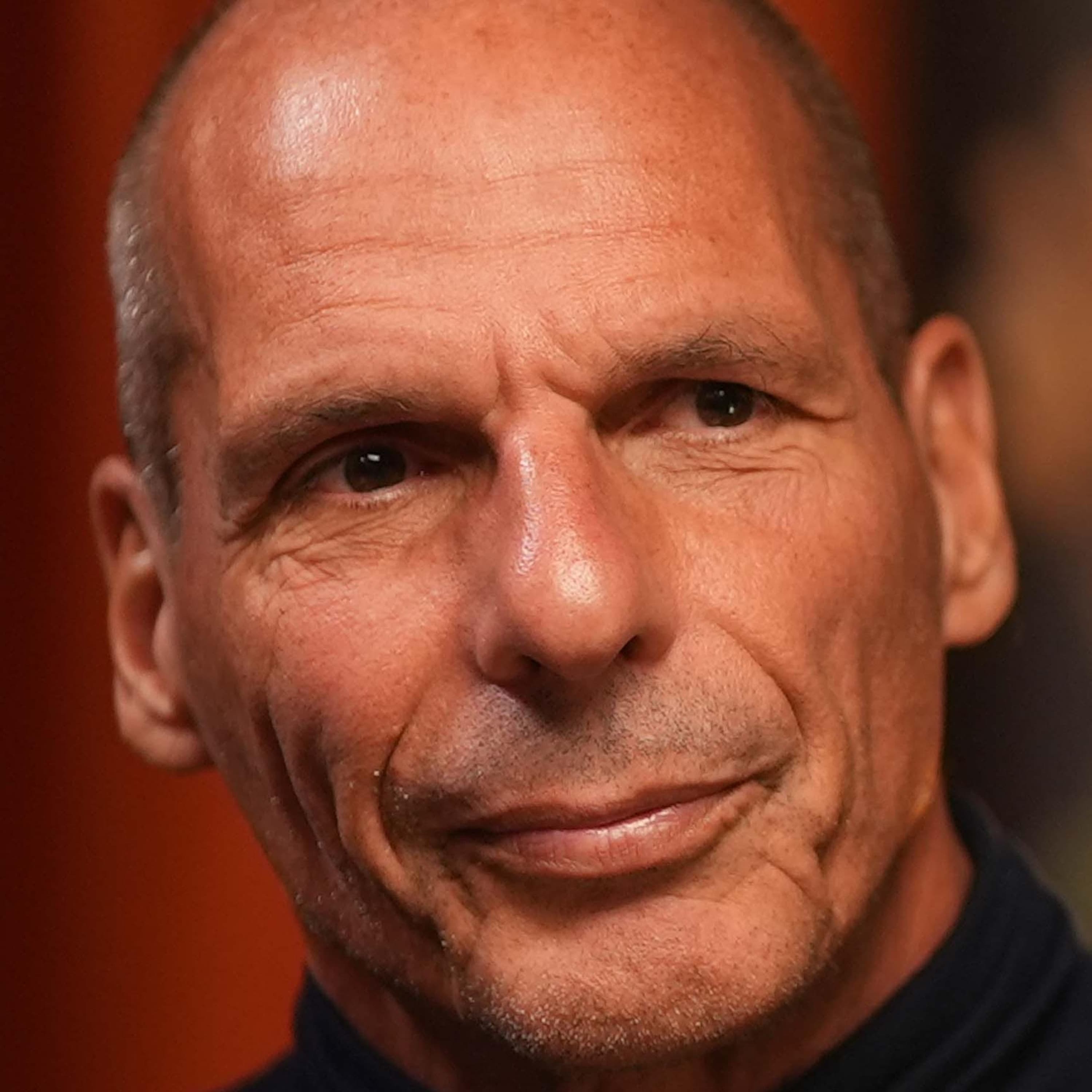
‘There’s no such thing as democracy’: Yanis Varoufakis | Radical Thinking with Aditya Chakrabortty
Get every episode summarized
Each time Today in Focus publishes, we email you a written briefing from the transcript — the topics, who appeared, and any specific claims, with the ad reads skipped.
Email me new episodesFree for 3 shows. No card needed.
About this episode
Today in Focus is made possible by:
“When I was listening to you, I had the terrible feeling gone. You and me, the voters, or the bomb markets. Pretty much every centre left politician across the west from Annie Burnham to Zora Mamdani has a version of this question hanging over them.”From the transcript
Get every episode summarized
Each time Today in Focus publishes, we email you a written briefing from the transcript — the topics, who appeared, and any specific claims, with the ad reads skipped.
Email me new episodesFree for 3 shows. No card needed.
Hosts & guests

Transcript ready
532 searchable segments. Every word is indexed and playable.
Full transcript
Today in Focus — ‘There’s no such thing as democracy’: Yanis Varoufakis | Radical Thinking with Aditya Chakrabortty. Machine-transcribed; use the interactive transcript above to jump the player to any line.
This is The Guardian.
When I was listening to you, I had the terrible feeling gone. I missed that. Who's really in charge? You and me, the voters, or the bomb markets. Pretty much every centre left politician across the west from Annie Burnham to Zora Mamdani has a version of this question hanging over them. How long do you think it would be before Andy Burnham is pushed aside for someone else? You know, this is the tragedy of Andy Burnham. And I'll guess today Janis Varifakis found out the answer the whole way. That to me was the end of my life as a unit. I acquired the two things that I hated. Fans? And then Emma's. In 2015 he became Minister of Finance for Greece. Five and a half months later, he was out of a job in Unizzo. There's no such thing as democracy in our liberal democracies. What there is as a performance.
This is Radical Thinking with me, a bit chakraborty. A new series from The Guardian which aims to get in some of the bigger questions in politics today. We've got some great guests coming up and I hope you join us. Janis. Welcome. I'd like to start with a story that you tell about your time in government. It's 2015 and you're the newly installed Minister of Finance for Greece, you're in Washington and you're summoned to a hotel bar. It's a dark rainy night, you step inside and then I wasn't exactly summoned. I was about to meet at that midnight. And what did whom I had referred to in a previous book which you kindly commented on many many years ago as the Prince of Darkness. That's Larry Summers. The former Finance Minister, Treasury Secretary of Bill Clinton. The man who is responsible primarily for unleashing
and shackling the Wall Street bankers. 2008 was the result. The reason why I'm saying that was not summoned was because he was there to meet with me, to help me. There was some common way in business. Not business. He offered his help in reducing, in hair cutting, the public debt of Greece. I was chuffed that somebody very powerful, a senior figure in Washington, wanted to help reduce the public debt burden on the Greek people and very curious as to why he cared because he was the Prince of Darkness. So it was a very interesting conversation that followed. He asked you a particularly telling question. I wonder if you would tell us the question and how you answered. Well, before you ask me that question, we went down to the business of discussing the matter and I think this is important as a prelude to the pivotal question. He explained to me very clearly as to why he wanted to help the Greek people. He didn't give it down about the Greek people
but he believed that American he Germany was being jeopardized by Europe's austerity programs which were another way of exporting deflation from Germany to the United States. That was his perspective. Putting some limits on austerity beginning with Greece which was the champion of austerity at the time, was being imposed on us massively, was his way of stabilizing American Germany. So having had that conversation for two hours and a couple of whiskey sessions at the ad, then at the end of it when he said he was going to help that he didn't like my government, he didn't like me, he didn't like leftist but you know we had a common purpose. Then he said in a very friendly manner, he said, Jens, I have a question for you. I said, yes, sure, Larry, go ahead. He said, are you an insider or an outsider? And then he hasn't to explain himself. He said, if you're an outsider, you know those people that stands in a soap box and speaks his mind and
in the end, he's irrelevant because insiders would never take him seriously. If you're an insider, you enter the free, you go behind the closed doors, I'm not sure if he used exactly those words but that was the meaning. And you know you try to make marginal changes within the system and you respect one fundamental profound rule. You never, never cross other insiders. So what are you an insider or an outsider? And what I said was, the only reason why I'm in politics, Larry, is because people in the streets of Athens, of Patra, of roads, of the Saraneke in my country, eating out of rubbish bins. We have a great question. So personally, I don't want to be a minister, I don't want to be a politician like you. And therefore, my answer is very simple. I would be an insider, an outsider, whatever it takes in order to get our people back on their feet again. But I will
always, always remain prone to jumping ship if I need to not compromise because compromise is important to end up compromised. So I tell him and I'll show him I have my letter of resignation from the government in my pocket, a card with me. It's not daters. I would date it a moment, I can't make that change, right? And he turned around and he said, I very much fear that they have it in for you. You're facing one of the most powerful men in American politics, like a real king making a Democrat party. And that was at the time of the Obama administration. Absolutely. He was supreme at that point. How do you view the significance of his question? Oh, I think it really confirms everything we have known and then adds a bit to it. What is it that we have known that behind closed doors, anybody who reaches that point of being allowed in, of being admitted into the room is going to have to make a choice. A choice between
serving the interests of the majority that voted for her or him. And the other option, of course, is to be copeted. And he put it to me in the most nuanced and even poetic manner. And I appreciate that. You're saying to him at this point, I'm a natural outsider, but I'm willing to play the part of insider. If it makes a difference, a real difference, not a marginal difference, because I wasn't going to sign up to policies that would extend and pretend the bankruptcy of the vast majority of my people. And not just maybe more of the Europeans, because if Germany's dean does realize him today, I did, yeah, this is not just about Greece, it's about the whole Europe. It is because of the policies that were enacted in Greece, because Greece was just a lab a laboratory in which they tried out their steady policies that led to the island, Portugal, Spain, Italy, France, and eventually to Germany. And the result was that, you know, after many years of austerity, which depressed demand, then they had to bring in money printing in order to
elevate the economy. The money went all to big business, big business didn't invest, because if they're little people can't buy the stuff, they're not going to produce the stuff. So they took the money that the central bank minted and they bought back their own shares. And then you had asset price inflation in the quality, and now you have fascism. So, you know, so I lasted five and a half months within the corridors of power. Well, draw that out a great level in a second. I just want to dig in a bit into your personal biography before going there. When I was looking into your past for this episode, I was reading some of your books and it seems to me that looking into your family history, there is a natural history of being at a stance, which is having to confront power. You're only a little boy of six when the generals take over Greece. And they imprison your father and your uncle. Tell us about that. Well, it was a fascist dictatorship. On the 23rd of
April 1967, the tanks are rolled onto the streets of Athens. And we, that was the end of our bourgeois liberal democracy and we ended up in a fascist dictatorship. So people ask me why are you so political? Because how can you not be political when, you know, the secret police breaks the front door down at four and a half in the morning and abduct your dyes with your grandmother chasing them with a broomstick? There's a comedy aspect to this. And for me, existence was utterly intertwined with resistance. Right. So, you know, this Palestinian slogan, existence or resistance is existence. I knew it before. I knew what Palestine was. I lived it. My father had been back in the 90s and oldies a long time before I was born. He had been incarcerated in the concentration camp for four years. For not signing a piece of paper, denouncing communism, although he wasn't a communist. He was a liberal as a young man. He was a
communist sympathizer. Not really. Not even at the beginning. He became a communist because the the shoved him into a concentration camp with communists for four years. Then he joined the communist party. And as an adult, you go into academia and you become, in your own words, just another economic professor writing obscure papers and esoteric books that only a few hundred nutcases, nutcases, Janis, around the world would ever read terribly satisfied in my own academic cocoon. Now, when I read that, I have to say, do you think that was a bit heavy on self-deprecation? No, I meant every word. I mean, when we first met, I was reporting on Greek crisis. I came to visit you at your flat overlooking the Acropolis. And I was very well. I was part of a stream of journalist and film crews going in and out of your all apartment. But nevertheless, it's true. You go within weeks from being a professor in Texas to being the Minister of Finance in Athens. That's
that is correct. But my shift away from academia towards political economy and then politics begins at it here around 2003. Because I, you know, I did quantitative work as well. And so I was quite good with numbers and statistics. I could see that to put it bluntly, Wall Street was heading for a crash. And that's when I started worrying and bringing back to my heart and soul and memory, the experiences went from my mother, of my father, of my grandparents, with a great depression, with a war, with Nazism and so on. Why? Because I knew that if Wall Street crashes and burns in the way that it did in 1929, we would be facing a post-modern version of the 1930s and 1940s. When 2008 happens, and I can see that lethal combination of austerity for the many and socialism for the bankers, the bailouts, I call them social justice for the bankers and austerity
for the many. That's it. I thought, okay, we are now going to start watching the Nazis and the fascists and the racists coming out of the woodwork. In the same way that they started coming out of the woodwork after 1929, don't forget that Hitler was not the result as many erroneously believe of hyperinflation in the 1920s. He was the result of austerity after her brooding introduced it in 1932. At least also that thought. Maybe I was wrong, maybe I was wrong. That's not just explaining to you why I started becoming more practical and why I started talking to CNN, to BBC, here in the garden, so on. The more I talked and I put forward alternative policies to the ones that were being introduced, the deeper I sunk without realizing it into a trajectory that led me to becoming finance minister because at some point a young man who was going to be prime minister in 2015, Alexis C. Press. Alexis C. Press, with whom I was talking, like I was talking to
many different politicians and warning them about the rise of fascism, about how austerity works, how it doesn't work, how it's sausage for the bankers and all that. He said to me, well, you know, we agree on your prognosis and on your remedies, but I don't have anybody to implement them. I want you to be the finance minister. At that point I thought, oops. What does it change about your life to move from being an outsider to being an insider, from being an academic to being a politician? Well, I acquired the two things that I hated. Fans and enemies, that to me was the end of my life as I knew it. If you are serious about being an academic, you challenge everything you ever say and you are very happy to see other people challenging what you say and they are very happy to listen to you and and have their views challenged. That's a beautiful academia. I had that and I lost it all. When you start in 2015, as the minister finds, would you say you had more fans and enemies or do you have a way around?
Oh, in Greece I was, if you look at the opinion polls, I had 75, 80% of the pro-otheraids. Huge fans. Huge. Okay. Which I knew was going to end up being the trick of the tale that stings you. We're coming to that. I knew from the beginning that I would pay for it. Yeah. Well, okay. So let's talk for it up. You're minister of finance for a bankrupt country. That's correct. That's correct. Okay. It's very, very serious. Like young people are leaving that country, leaving Greece in droves. One million had left already out of ten. Huge numbers. There's a raft of stories about older men, family men committing suicide. I think in one year, some of like a hundred thousand businesses go pop. Go bankrupt. Probably more. Right. Probably more. It was a complete collapse. It was a great depression. So it's an urgent situation and as I'm just going to summarize what I, as I remember, your plan, which was basically to give debt release to Greece and other countries to underwrite
the loans made by direct banks and then to have a kind of martial plan of investment across peripheral Europe, across Europe. Is that a vibe roughly for a while? Across the whole of Europe. Across the whole. Not just, you know, the peripheral Europe. The amazing thing about this plan is that there are tons of economists, even right-wing economists who say the guys got a point. Yeah. I don't like him. The Adam Smith Institute for goodness sake came out in my support. Normal. I'll never leave this down amongst my leftist Marxist friends. You know, the Adam Smith Institute. Yeah. That's his favorite thing to you. Normal Le Mans proved a very decent man and a very good friend. You know, he said to me that you and I come from completely different political backgrounds, but you know, you have a point because you see, I did yet, it wasn't just that I wanted debt relief. Right. I wanted something much more fundamental than that. What happened was in 2009, 2010, the Greek state, like the banks, had gone bankrupt. Now, how did the great and the good deal
with that? They gave the Greek government credit cards from which to withdraw money at very high interest rates to pretend that they're not bankrupt. And if your friend of yours cannot repay, you know, his or her mortgage and they come to you and say, I did yet, you know, something about economic. What do you think? That you know, Lloyd's bank is offering me a credit card at a high interest rate from which I can draw money and repay, you know, for a year or so, my mortgage repayments, you'd be a very bad friend if you said, take it. Yes. That's right. Our country got a credit card in May of 2010. The largest loan in the history of humanity, not in relative terms, but in absolute terms. Of course, that money went all to the to our creditors. Nothing went to the Greeks. Huge austerity crushed, but the incomes there were. And then they got a second credit card in 2012. And, you know, that ran out and that's why we were elected. We were elected because the Greek people had a very simple choice. Either say no to more credit cards, accept the pain of the
bankruptcy and start again, or to take another credit card. And I was elected to say no to the third credit card. This is the system. This is the story. This is the story. Somebody like normal and understanding. Yeah. Yeah. I don't smithy. You see, do you understand? Every banker in the world understood that. Yeah. Except those who were going to take a cut out of the money from the third credit card. Okay. Your plan has a lot of logic behind it. It's not actually particularly Marxist or no, not at all. Right. You can even think of it as libertarian. A lot of economists in banks across the world say the guy is basically right. But the amazing thing is that people have really against your plan are the politicians, including lots of politicians who would call themselves leftists, especially them. How come before I became finance minister, all these politicians had lied to their own parliaments. This is important to understand because, you know, Merkel who didn't really know what had gone down in 2009, nothing to do with Greece. In 2009,
April, she received a phone call from Frankfurt and they told her that all the German banks were about to go belly up. She said, what? They would have been making trillion sub-antig yesterday. Oh, no, no, no, no. Well, they didn't even understand why. The sub-prime markets in Wall Street Collapsion, so on. And she was forced at gunpoint almost to give 600 billion euros to the bankers of Germany. Right. And then six months later, they came back for more because Greece was going to go bankrupt and Deutsche Bank needed more money. So she said, no, no, no, find another way of justifying that. And the other way they found to justify more money for Deutsche Bank, finance bank, society as general and so on was to say, this is a bailout for Greeks. We don't like the Greeks. They are the grasshoppers of the European Union. We are the ants, but you know, European solidarity means we need to help them. Of course, it was another bailout for Deutsche Bank, which they met a more-fossized into the disguised as a bailout for the Greeks. What she promised them was, look,
let's do this to keep Europe together. Right. But we're going to crush the Greeks. We're going to step on their throat and make sure that they pay the price for it. We have to make sure that no one else will ever want this. That's right. Exactly. Exactly. So the clusters. Now, her finance minister said to me very clearly that this was not a bad thing. He liked the idea because by pushing your study down the Greek throat, he could push it down the German throat because he said to me, we cannot have high wages in this country anymore in Germany. So you can see that it was an attempt effectively to crush the German working class. They cast the Greek working class. The minister of finance, Wolfgang Scheuble, in Germany, one of my colleagues in his office, which by the way used to be a goering's office. I'm just adding that for good matter. Just a fill in a theme. He says to you that he feels that German workers are getting paid too much. Yes. He said that with globalization, with two billion workers coming into the global capital
system from China, from India, from Bangladesh and so on, our workers have to have at least a 20% to 30% wage reduction in order for Germany to remain competitive. So we start with the Greeks. And then we take it to the Irish and then we take it to the Portuguese. He didn't say the last bit, but that's what he meant. And this is exactly what they did. They suppressed the wage bill in Germany. And the result is the industrialization of Germany today. But going back to your original question, once they had settled all these phibs to their own parliamentarians, and I come into the scene and I say, hunger guys, no third credit card. What does this mean? If you don't take a new credit card, then you are going to have to effectively go bankrupt to default on a part of your loans of your debt, which is what I wanted. But then they would have to tell their members of parliament, no, we're not getting our money back. And that money was supposed to have gone to the Greek people.
So they were compelled effectively to tell their own people the lies that the Greeks don't want to repair their debts. When in reality, they wanted to force down my throat more debt, which they knew can never be repaid and will never be repaid. Not today, not in 50 years, not in 100 years. In your writing about that time in your life, you have these stories of how Christine Lagarde, Mario Draghi, the head of the IMF, the head of the ECB, are sideling up to in conference rooms and in hotel lobbies to say, you know, you've got a point. And then in public, they turn around and they wallop you like, what was the rest of us meant to think about politics from those stories? Well, there's no such thing as democracy in our liberal democracies. What there is is a performance of democracy. It's performative democracy. It's no substantial democracy. But let me
highlight the points you're making. Christine Lagarde went further than that. She just didn't just say I had a point in my first meeting with her. I was elated at it here because I went in there. I was very well prepared. I knew I had half an hour to change my mind. Right? Before the Eurogroup meeting. I had just become minister. I had half an hour with her before moving into the room with all the 20 finance ministers, you're being central bank president and so on and so forth. And I spoke for judiciously for eight minutes telling the story. More or less the one that I'm telling you, but a bit more technically and dispassionately. And she stops me. And she says, Janis, you're being too moderate because I was not proposing an outright haircut of her debt. I was proposing financial engineering techniques for reducing her debt without actually saying so to make it easier for them to sell it
to their own parliaments. She's no, no, no, we need to take 55. No, actually, 53. She actually mentioned a very specific number, 53 billion of your debt and just completely wiped out. Well, that's music to my ears, Christine. Then she added something that was absolutely devastatingly toxic for me. She said, Janis, look, we know that the program, this is the austerity program, that we are imposing on your country, cannot work. She didn't say it is difficult to make it work. She said it cannot work. But you've got to understand that we have put so much political capital into it that for the purposes of your career, you should join us. Become like the other politicians before us, the ones we defeated to go into government, who were adopting the IMF, adopting the ECB, adopting the European Commission policy, the people we defeated in 2015 to become the government,
where the ones who were saying that this program, the one that Christine Lagarde said to me, cannot work, was the best growth plan for Greece. So you're going into her office to negotiate a financial settlement on behalf of your country and her responses to give you a job offer to join your IMF. Not that I am an IMF. She meant that whole... The Troika, the side. Yeah, they have many different jobs. But she wanted to see that. No, no, no, no. What effect she was saying is that my political career depended on my not being to contrarian by going along with them. That's what she said. She was contrarian. And she was contrarian. And you know, I've done a round that said, you're confusing with somebody who cares about his political career. I have only one commitment to the people who are suffering out there and who voted me. And of course, I knew that that would not go down well. Okay, well, that's still had a very good relationship with Christine, even after I was checked out of that system. You are from the birthplace of democracy. And the lesson you're
being taught over and over again is that democracy doesn't really exist. That as Shoei Blur, the German Finance Minister says elections cannot determine economic policy. What are the rest of us meant to take from now? That elections do not determine economic policy. I mean, local was happening in this country. Whoever gets elected, whoever, you know, you have these revolving doors attending street. It does matter who is residing in there. You know, you've got the bank of England, you've got the treasury, you have the various quangos and they decide everything. And whether it's racial grieves or the current chancellor, they are effectively in a straight jacket. Being told that there's nothing you can do to afford the basic public goods, which are essential for this country, to move ahead. That you can't afford to invest in green energy. That you can't afford to revive the National Health Service. That you're doing everything you can, but you can't
do anything more. In the end, you know what the Chinese Communist Party folks are saying? It's not wrong. They're saying that, oh, the difference between China and the West is that in the West, you could change your governments, but you don't change your policies. In China, we change our policies, but we don't change our governments. Since you talked about the British government, let's just talk about our new Prime Minister, Andy Burnham. Yes. He's coming to power. He says he wants to turn back 40 years of neoliberalism, deregulation, privatization. What lessons should he learn from your experience? Well, before he learns any lessons, the question is does he mean any of this? Because you can't possibly be serious about reversing austerity while accepting the fiscal rules of the previous lot. The fiscal rules of the previous lot are austerity. So you can't say austerity has been one of the horsemen of the apocalypse, and I'm going to change that, but I'm going to accept the fiscal rules. You can't say that you are going to accept the so-called independence of the central bank, when the Bank of England is costing the treasury 100 billion
through quantitative tightening, and you have no plan to change that. I mean, why can't you take that, silly idea of central bank independence bank? It wasn't independent for hundreds of years. Why should it be independent? It's never independent. It is totally dependent on the city of London, and it will always do whatever it is that enriches the city of London, and therefore it will perpetuate austerity. Before we talk about what lessons can be drawn from the Greek experience, we have to know whether Andy Burnham means what he says. Well, let's do your fiscal rules. Last year, the same man says we should not be in hope to the bond markets. This year, as Prime Minister, he says, I'm all about fiscal responsibility. You can't have both. Which version is that? I'm all in favor of responsibility. All in favor of responsibility, but there's nothing irresponsible about having a situation where the government is hamstrung and doesn't take the steps necessary
in order to use its physical capacities to invest in productive activity that will generate the incomes in the future, that will repay those loans. So let me be very specific here. Even Rachel Reeves was saying that we need to invest. We need not to borrow in order to spend on social policy and so on, but we should borrow to invest and she didn't borrow to invest. How could you do that? Well, there are a couple of ways you can do it. You can create a public investment bank which used to exist in this country. It was a post office savings bank. You can reconstitute it. You can give it an independent board. Lots of different constituencies can be presented on it. You can give it the power to issue its own bonds separately from the government, separate from builds, and you can ask the central bank, the Bank of England, to have the back of those bonds. And those go straight into investment. You can invest into green energy doing that. You
can invest into steel because now British steel is about to shut down again from what I've been reading in your paper. So you can do that. Then you're not a hostage of the bond markets. The thing is, Janice, but what you're not doing that. But the thing is, Janice, is that you can have all of these ideas. All of these ideas are technically absolutely possible to implement. A lot of people listen to you, they say, these are great ideas. Why aren't we doing them? The problem that you have is that you've got a generation of leaders on the centre left, including the new guy, Andy Burnham, who brought up to believe that if they went too far left, well, they'd get the same punishment beating that you and your colleagues got in Greece. Well, they're going to get this punishment now by sitting on their hands and simply relying on vibes. How long do you think it will be before Andy Burnham is pushed aside for someone else? God forbid, for us. There is no way he's going to maintain this optimism that he brought to British politics
by doing exactly the same things that the previous Lord were doing. And by the way, what I just suggested is not necessarily left wing. And it's not terribly stupid. But, frankly, Roosevelt introduced that. He will recall that frankly, Roosevelt was not a lefty. He was a patrition. He was a democrat. He was a democrat, you know. So what? I mean, the democrats were in favour of slavery once. You know the headlines as well as I do. As soon as he does anything which goes a millimeter to the left, do news papers say the bond markets won't like this, you'll find some obliging fall in the bond markets. He says, oh, yeah, I don't like this. And on it goes, right? I mean, the ex chief economist at the Bank of England has said quite recently that it's a socially, it's not the other day. It's a socially scuffman with better tick-tock videos, right? The bigger point is this, if you want to run for prime minister of this country on an anti-osteoretic ticket, as anti-burnum did, then you're going to have to do something
to remove the need for austerity. If you do nothing with fiscal rules, if you don't create a new funding mechanisms for investment, then you're going to be doing exactly the same thing that Rishi Sunaik was doing, exactly the same thing that Kierstamberg was doing. And in the end, people will laugh at you and you're going to have to fall on your soul again. So, you know, this is a tragedy of anti-burnum. You can see that's already. You think that is what the future lies ahead of you in the next few weeks. Tell me more. Well, I mean, you know, the budget's coming up. I don't know what's going to be in it, but I can't see an investment plan. I can't see how they're going to fund more defense spending without reducing social security. Anti-burnum says, I don't want to improve our national security at the expense of our social security. Well, it's a zero-sum game if you continue to be beholden to these fiscal rules without an investment plan. In the end, the public out there are going to turn against you. I mean,
I think the public watching this will have quite a lot to say about the future you just held out for anti-burnum, right? I mean, you were saying literally he's going to go from being our Andy, the hero, King of the North, to being a laughing stock within weeks. Well, I don't look. I can never predict how long the unsustainable can be sustained. But to me, the next budget, if it is as it seems to be, you know, percolating, is really not going to be human, any favors. And look, Aditya, Britain is a very rich country. Yes. There's a lot of money around. Yes. The problem that Britain has had since the 1980s is all this money has been wasted. It is chasing after itself, like a stupid cat chasing its own tail. And it's getting dizzy. It's all going into assets and to asset inflation and, you know, housing and financial derivatives. At the same time,
you have the privatization program that essentially meant that the, you know, the public has a bond, the gigantic cost of enriching some very few shareholders, you know, with the raw water companies, electricity companies and so on. So all this money is by being siphoned away from the things that can train people in apprenticeships that can fund small businesses, larger businesses, you know, British steel, other now, you know, Jagger, your prime minister needs to answer a very simple question. How is he going to shift a substantial chunk of this wealth onto productive uses? The market is never going to do that because when you've got the manufacturing sector delivering a 2% return and real estate or, you know, financial engineering delivering 11%, the money is going to go to
unproductive uses. And society is going to be torn apart the way it is. Racism is going to get worse and worse and worse because the young cannot see good quality jobs appearing on the horizon because investment is not taking place. So, mate, how are you going to do it? Okay. I have an idea. Yeah. You know, the liberal party manifest of 2017 had the same idea. Yeah. It was a very good idea. Tell us why you're not implementing it. Okay. But I hear that the sun is going to go after you. No, no, but I do want this badge of honor to have the sun and the delegate of going after you. Remember, is that kind of talk that landed you in trouble in the first place? No, no, but I didn't have a prime minister to support me. But hold on, because there is one more question I want to ask you out Britain before we move on to other things. There are so many people who would listen to what you say and say, I 100% agree with what this guy is saying, right? Problem is the situation that we're describing Britain is a social settlement, a social
political settlement, which we've had for decades. And with that go voters, I agree. You can't run an economy on nail bars and bond traders alone. I totally agree with you, right? But the problem is we've got a bunch of voters, very well-defined voters who say, well, if you touch my interest on that then I am really going to lose it with you, not. And the kind of new political constituency you're talking about needs to be created. And that is something that the Labour Party is as I've lived under it for all of these years has never really done. So how do you expect the guy who's just come in on some of his ticket mind you? He's a replacement prime minister. How do you expect him to recreate the toilet? That's why I support the Greens. But if you wanted, if Andy wanted to make a break and change the mind of people like me, then he could have. And what you are saying is that he's simply not interested in doing it. Or he doesn't have enough courage to do it. Look, you know what,
when I was listening to you, I had a terrible feeling. Terrible feeling. I missed that. No, but I'll tell you why. Because think of when that became leader of the Tories, right? I mean, what you were saying to me now about the Labour Party, people were telling her about the Tories. He created her own voters. But I've never seen a central authority do that. Well, Harold Wilson was pretty good at doing that for my time. Yeah, for my time too. But we read and Harold Wilson did come up with a brand new narrative for the Labour Party in the 1960s, the white heat of progress and so on. Now, the Labour Party has done this in the past. It could do it again. Maybe it could. Look, I think that was Tony Blair and Kierstammer damaged the fabric of the Labour Party and its ethos so savagely that maybe you're right, maybe the Labour Party can no longer do it. I don't expect them to do it. But, you know, when people ask me like you do, what could Andy Burnham do to prevent his own trajectory from being very similar to Kierstammer?
Then the answer is, well, do these things. These things will work. And you could create. I mean, you're never going to make everybody happy. And you shouldn't even try. That's populism. Only the populist promise everything to everyone. But, you know, go for the vast majority of people who are going to benefit from, you know, 700,000 apprenticeships in this country over the next five years that you could fund if you forced the Bank of England to back the bonds of a public investment bank. These things have happened elsewhere. They are already happening to much smaller scale in, for example, the European investment bank. I'm not reinventing the wheel. No, no, you know, but you're saying it. You're saying it. If you're in a country like Ghana, yeah, right, Ghana doesn't have enough money to invest, to channel into productive investments. This country does. Yeah. And since thatcher, well, even before thatcher, it hasn't flowed into investment. The humanist said that I missed thatcher is because she turned around and said to
the gondis back in the 70s that yes, we've had 40 years of consensus, the social democratic, you know, mixed economy consensus, I'm going to break it. Well, we did not be great if we on the progressive side of politics. We had, you know, the anti-thatcher who said we're going to break this consensus, which continues to, you know, solve piles of money into non-productive asset inflationary dynamics. I mean, this is what the guy says. It's just whether he has the party. Yeah, but you know, you need to explain how he's going to do it. I'm coming up with particular ideas. There are techniques that you can use. Yeah, there are people who know how to do it. Yeah, let's just move on for a little bit. I want to return to the question of the far right, which you've talked about throughout this conversation and you're right to because they're on the march everywhere across Europe. Germany has the AFD, France has the national front. In Britain, we have a variety of parties which are filling that void to the right of the Tories.
It's strange talking to you in this moment because in 2008, you remind me of this, the banking crash. In 2008, the left said, this is our moment. In 2026, it's cleared the rights moment. How did the left lose it so badly? Every time there is financial crisis followed by austerity and the slump, that confirms the Marxist analysis of capitalism and boosts fascism in practical politics. It happened after 1929. Remember, 1929, Europe was unionized. The left was very powerful. Both the Social Democratic left and the Communist left. And yet, we missed out and the only ones who dominated in the end, even more or less in this country, with Oswald Mosley, almost he almost made it, were the fascists. They're the ones that rode the wave with
this content of the working class and particularly the Petit Boujouzzi. So that happened after 1929. It happened after 2008. I have a very, very simple, maybe reductionist, macroeconomic, macro political theory. Deflationary times, breed fascism and racism. Inflationary times can be bad for the wallet of the working class, but they are not prone to be get fascism. And after 2008, we are leaving through deflationary times. We may have heard about inflation recently, but still wages are being deflated. The working class, public goods are shrinking. So when that happens, you know, think of May 1968, great explosion of left-wing uv and optimism. That was the slump. It was a pretty good time in terms of the macroeconomy of Europe, of the United Kingdom, of the United States. I mean, there was a huge,
there was a huge burst of rearmament, which boosted the economy. Nevertheless, it wasn't a time, a deflationary time. And you're saying that this time is worse in the 1930s. I'm saying that it is a post-modern version of it. I mean, history doesn't exactly repeat itself, but it runs. And here I will disagree with Marx. It's not going to be a farce-cali version of the 1930s. It may be an even more tragic one, because we can see what's happening now in Ukraine, in Gaza, in Iran, the tensions over the Pacific. And that is all related, because when capitalism is failing, then all these malignancies are coming to the fore. And it's very, very difficult, you know, for sensible voices, progressive voices, to be heard, because it's so much easier to blame the Jew, the Muslim, you know, the small boats.
I mean, I don't believe it that in this country people have in this conversation about small boats. I mean, let's say that suddenly, you had a magic wand, and no small boats ever came to Britain. And you even got rid of, let's say, you know, 500,000 people that arrived here in the last 10 years. What would change? It would be even worse. Or the same. And yet, you know, we wasted our energy and our breath discussing about, you know, bloody small boats. But how did we get to worrying about small boats when, as I recall back in 2008, nine, we were talking about breaking up the banks, perhaps having our own public banking system in this country. How was that shift happened? Very simple. Caught on the ground, saved the bankers. You know, the party of the center left introduced socialism for the bankers, understood it for everybody else. And then Osborne permitted something very similar. Yeah, far worse. And then Osborne comes in. The reason why he
won was because the previous lot worked on behalf of the city of London before the crash. And during the crash and a bit after the crash, Osborne comes in. And effectively, it takes the same policies and terrible charges. So, and what does the label party do with Ed Millibund? And then, you know, it was only when Jeremy Corbyn came in that Saddamid was hope. But that was snuffed out by the establishment within the label party, which exactly like the establishment within the Democratic Party, who preferred Donald Trump in the White House to Bernie Sanders, you know, effectively demonized and wiped Jeremy out. Today's markets move fast. Get the insights you need in 10 minutes with the Barclays Brief, a new podcast from Barclays Investment Bank. Through sharp dialogue and scenario-based analysis,
our leading experts analyze key market themes each week. So, whether you're managing a portfolio, or leading a business, the Barclays Brief podcast can help you make smarter decisions today. Stay sharp. Stay brief. Find Barclays Brief wherever you get your podcasts. 500 orders a month was manageable. 5000 is madness. Embrace intelligent order fulfillment with shipstation. The only platform combining order management, warehouse workflows, inventory, returns, and analytics in one place. What used to take five separate tools, shipstation does in one. Automate fulfillment and rate shopping to ship up to 15 times more with up to 90% savings. Go to shipstation.com and use code audio to try shipstation free for 60 days. When ever you have a really promising left-wing leader, Jeremy Corbyn, Bernie Sanders, you mentioned them. You maybe, we could put you in that category. Every time there's failure,
and every time people say, see, it was a wrong guy. Corbyn 2.0, 2.0 techy, Bernie Sanders, he's been saying the same thing forever. You, as you know, they always said, the lever jacket and the motorbike and you never really fitted. We need someone who's grey. What's your take on that? Well, I don't believe that any of us failed. Bernie Sanders was robbed. We now know, thanks to Julian Assange and WikiLeaks, we know that the NDC, effectively robbed him of the primary victory because they prefer Donald Trump to Bernie Sanders, because Bernie Sanders was the only person who could have beaten him in 2016. I mean, Jeremy Corbyn did go into two elections in Lothpoth. Yes, but in both elections, who was the worst enemy of Jeremy Corbyn? You know, the parliamentary labor party, the labor party establishment. They were plotting on a daily basis. I experienced character as a nation because, you know, once my own party, my own prime minister, got a deal with Angela Merkel,
a personal deal. The problem was, what are we going to do with our faxina? So, the league started, and the demonization started. And then they shut down the banks, which was a financial, an act of financial terrorism. They've closed down our ATMs in order to blackmail the Greek people, not vote against the Troika, and they blamed it on me when it was the European central bank that shut down our banks. So, you know, of course, I was a failure. There's no doubt I was a failure, but that's because, you know, the left, the center left in particular, or large left wing parties that come close to power. At some point, fragment, the dominant part defects to the other side. And then the left seems to have failed when the left wing policies were never enacted. So, if this success, I'd all be successful.
I think I first met you in 2011. So, let's make 15 years in which I've unknown you, and been speaking to you on and off since then. And I have a grand unified theory of Janice Verifalkis. It's very simple, but I want to run it by you. Please, then I want you to give me your assessment. Please. I think that the Janice Verifalkis I met in 2011 was basically a nice and very, very clever political economist who was trying to convince the political system, trying to convince the orthodoxy through speaking to commentators, through doing those interviews. You were trying to convince them of a certain kind logic. And now the Janice that I'm speaking to now in 2026, he's had enough of all that. Your experience in power and afterwards is basically taught you that you shouldn't really be bothered with any of that. Power is actually radicalized you. I think you are spot on. It's exactly how it is.
It is true when we first met in 2011. I had this very naive belief in the power of reason that if you sit down with them and you show them the numbers and the possibilities that you could win over enough of them. And then I realized that they knew the numbers. They knew exactly what the possibilities were, but they don't give it down. They really don't give it down, did you? And they will crush anyone who stops them from serving very specific interests that put them there. And they are far more interested in the revolving doors, going from the IMF to the European Central Bank, from the European Central Bank to some position in NATO, from NATO back to government, then to get a consultancy, then to work with McKinsey. What John Dalbraith referred to as the techno structure back in his 1966 book The Industrial State. So I saw that and I saw
something that upset me even more. The manner in which central left parties are easily copped to this whole thing. We used to say that didn't we, but now I've seen it with my own eyes how socialists in government change themselves not society. Therefore, yes, I've been radicalized. I just don't believe that it is possible to serve the majority, the many, through negotiations with the parties that be based entirely on the part of vision. You need to have leverage and you need to be able to say no and to accept a large short-term cost for long-term communal benefits. One last thing, okay. Tomorrow you wake up and you're a billionaire for a day, just one day. What do you do with that money and that power?
Well, one billion is not that much money these days. Look at the Elon Musk's and the Jeff Bezos of the world. I knew you'd say that as well. It's not a lot of money. I would give it to the children of Gaza tomorrow. And they wouldn't do much to change their life for the better. But that's what I would, you know, off the top of them, I had this what I would do. They wouldn't change the world. I would need a trillion to change the world. What would you do with Trilley? Oh, then we would invest, invest seriously in the global south. Janis Varefakis, thank you so much. Thank you. Janis Varefakis spent just five and a half months in power, but my goodness, this picture he paints of it is really, really damning. On the one hand, there are these people on the inside, Larry Summers, Chris and Lagarde, who are saying, come on in, join us, the water's lovely. And that's fine if you're a careerist, which Janis Varefakis is clear that he wasn't.
What he wants to do, he says, is achieve change, real change for his country at a critical point. And he can't do anything. Politics, democracy, he says, is just pretence, it's a facade. I don't think anyone could listen seriously to that interview with him and come away with a gloomy picture of what democracy means in Europe, which is where these things are meant to be given the most open hearing of all. And yet there is a strand of hope that you can take out of our conversation, which is in and around the ideas for making the economy more democratic. Listen to what Varefakis has to say about directing more investment into the economy, creating more productive jobs away from the city and high end services. I think there's a lot in there that people, even in the lab party in this country, will listen to and go, yep, the guy's got a point. The question is, are they going to do anything about it?
Thanks for listening to Radical Thinking. I'm sure you've got tons of thoughts about what Janis and I discussed, so do put them in the comments, we'd love to read them. And I'll see you next time. This is The Guardian. Business is booming. Is your fulfillment ready for peak season? Switch to shipstation now and handle more volume with confidence when accounts. Shipstation connects Shopify, Amazon, TikTok Shop, and over 200 more integrations with one platform that does it all. You can manage orders, sink inventory, track returns, all automatically. Everything your operation needs, all in one place. Right now, qualified shippers get a real dedicated person to get you set up and switched over for free. So when peak season hits, you're ready to go. Switch today at shipstation.com, code audio. Have you found yourself confessing personal things to chat GPT, Gemini, or Claude? You're not alone. Something huge is underway that we haven't really found the words for you.
A new voice in our ear, guiding what we think and feel and do. But should we trust it? I just thought what has this thing done to him? Black box, the chatbots, a new podcast series from The Guardian Investigates. Listen now, wherever you get your podcasts.
More episodes
More from Today in Focus

Celebrity Traitors: have we seen the wildest move ever? – The Latest
Today in Focus

The Bolsonaros … they’re back! Brazil heads to the polls
Today in Focus

Tennessee woman survives two lethal injections - The Latest
Today in Focus

Billionaire Sheiks and ‘sham’ contracts: the Manchester City scandal
Today in Focus