Get every episode summarized
Each time Lost Women of Science publishes, we email you a written briefing from the transcript — the topics, who appeared, and any specific claims, with the ad reads skipped.
Email me new episodesFree for 3 shows. No card needed.
About this episode
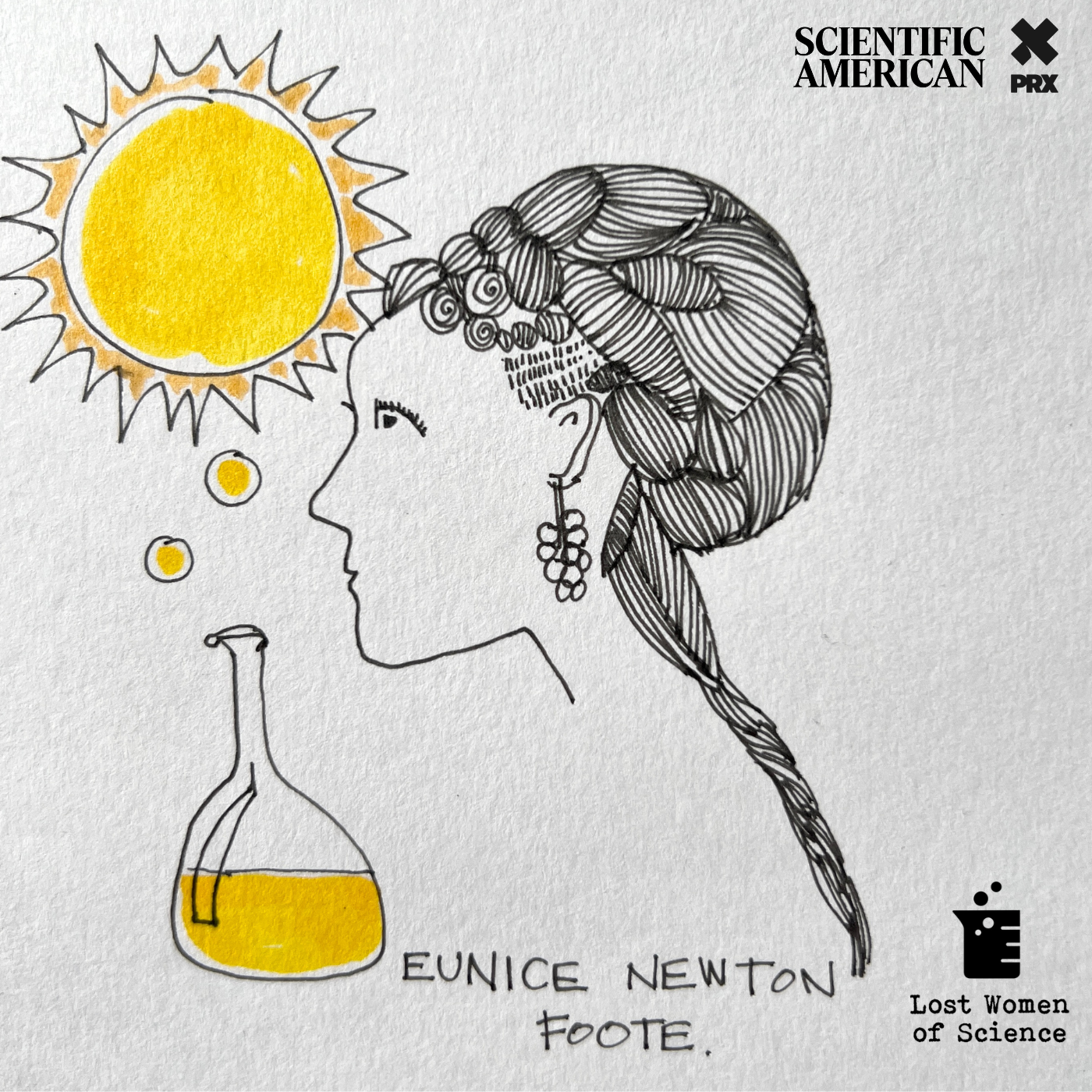
In 1856, decades before the term “greenhouse gas” was coined, Eunice Newton Foote demonstrated the greenhouse effect in her home laboratory. She placed a glass cylinder full of carbon dioxide in the sun, and found that it heated up much faster than a cylinder of ordinary air. Her conclusion: more carbon dioxide in the atmosphere results in a warmer planet. Several years later, a British scientist named John Tyndall conducted a far more complicated experiment that demonstrated the same effect and revealed how it worked. Today, he’s widely known as the man who discovered the greenhouse gas effect. There’s even a crater on the moon named for him! Eunice Newton Foote, meanwhile, was lost to history—until an amateur historian stumbled on her story.
Learn about your ad choices: dovetail.prx.org/ad-choicesGet every episode summarized
Each time Lost Women of Science publishes, we email you a written briefing from the transcript — the topics, who appeared, and any specific claims, with the ad reads skipped.
Email me new episodesFree for 3 shows. No card needed.
Hosts & guests
No transcript yet
This episode has not been transcribed. Request it and it moves to the front of the queue.
More episodes
More from Lost Women of Science

Profesora de química y caza criminales: La extraordinaria vida de Mary Louisa Wi...
Lost Women of Science

Best Of: Chemistry Professor and Crime Buster: The Remarkable Life of Mary Louis...
Lost Women of Science

Elizabeth Roboz Einstein: The Determined Genius Behind a Multiple Sclerosis Brea...
Lost Women of Science

Conversation: If I Am Right, and I Know I Am: Inge Lehmann, the Woman Who Discov...
Lost Women of Science