Get every episode summarized
Each time Moments with Marianne publishes, we email you a written briefing from the transcript — the topics, who appeared, and any specific claims, with the ad reads skipped.
Email me new episodesFree for 3 shows. No card needed.
About this episode
“This is your host, Mary Ampestana, and I am so excited to be celebrating 10 years of meaningful conversations with you. As we step into our new primetime hour, it's such an honor to share this exciting new chapter with you.”From the transcript
Moments with Marianne airs in the Southern California area on KMET1490AM & 98.1 FM, an ABC Talk News Radio Affiliate! https://www.kmet1490am.com
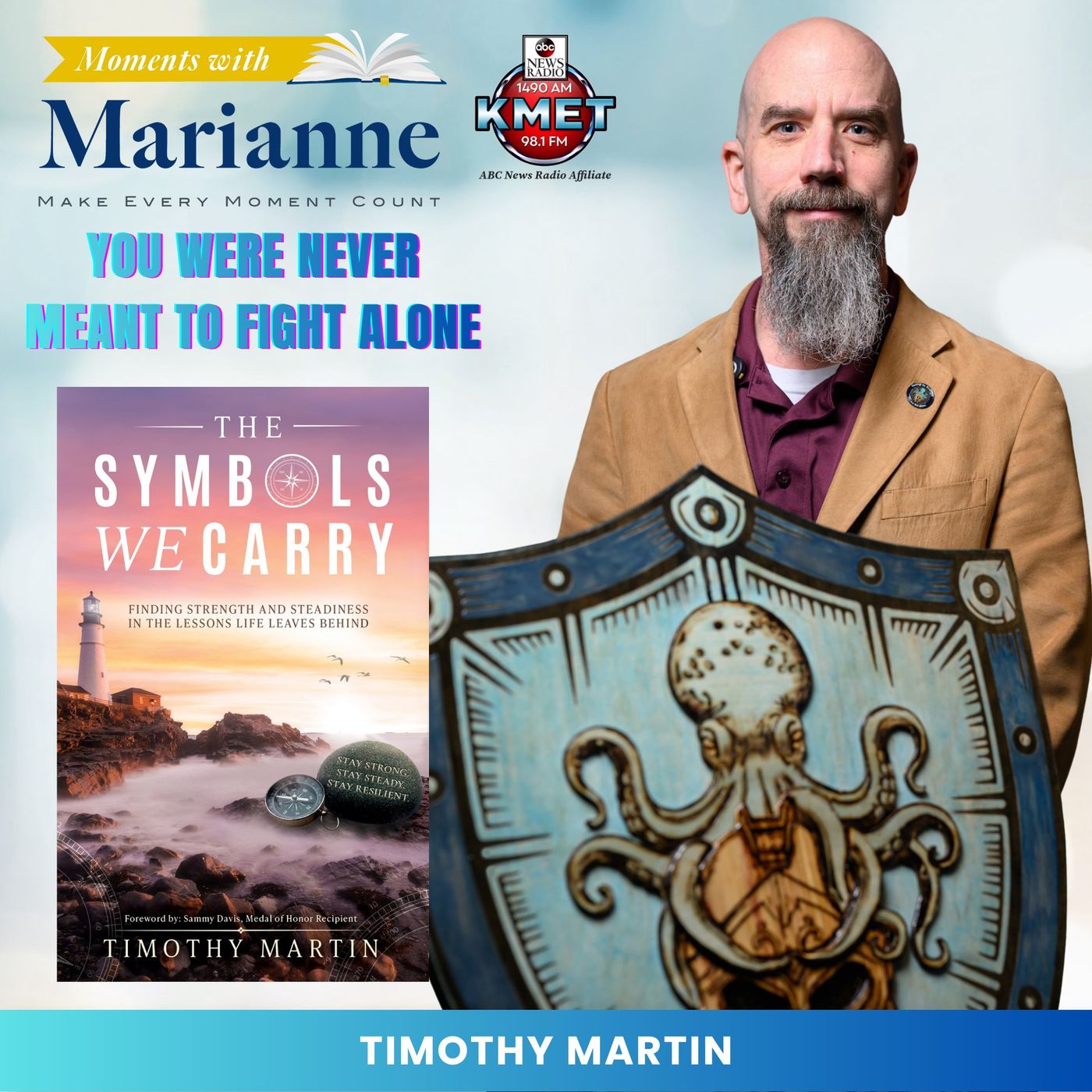
Timothy Martin is a proud father, resilience advocate, and the author of The Symbols We Carry: Finding Strength, Steadiness, and Resilience in the Lessons Life Leaves Behind, a deeply personal book inspired by his own experiences with trauma, loss, healing, and the unexpected symbols that helped guide him along the way. Tim grew up around the world, as the son of the United States Marine, experiences which shaped his perspective on service, resilience, and connection. That perspective was further shaped through the privilege of working alongside Medal of Honor recipient Hershel “Woody” Williams, whose example of service and commitment to others left a lasting impression on him. Tim’s own journey eventually led him to create the Coin of Resilience, a tangible reminder to keep fighting, reach out, and remember that you are not alone. What began with a single coin grew into Symbolisms for Resilience, the nonprofit he founded to carry that message forward. https://thesymbolswecarry.com
Discover inspiring conversations with today's leading authors, celebrities, thought leaders, and change makers. To learn more about the Moments with Marianne Radio Show, explore guest interview opportunities, connect with Marianne, and follow her on social media, visit https://www.mariannepestana.com
Explore the Moments with Marianne Book Club and find your next great read: https://www.mariannepestana.com/book-club/
Listen to the Moments with Marianne Radio Show on KMET 1490AM & 98.1FM, an ABC News Radio Affiliate, weekdays at 8:06 AM PT / 11:06 AM ET and Sundays at 10:06 AM PT / 1:06 PM ET. Learn more at: https://www.kmet1490am.com/moments-with-marianne
Get every episode summarized
Each time Moments with Marianne publishes, we email you a written briefing from the transcript — the topics, who appeared, and any specific claims, with the ad reads skipped.
Email me new episodesFree for 3 shows. No card needed.
Hosts & guests
Transcript ready
392 searchable segments. Every word is indexed and playable.
Full transcript
Moments with Marianne — The Symbols We Carry with Timothy Martin. Machine-transcribed; use the interactive transcript above to jump the player to any line.
Welcome to Moments with Marianne. This is your host, Mary Ampestana, and I am so excited to be celebrating 10 years of meaningful conversations with you. As we step into our new primetime hour, it's such an honor to share this exciting new chapter with you. So whether you're starting your day out, headed to work, or listening from wherever you are, this hour is designed to bring you thoughtful dialogue, fresh insight, and inspiring stories, so you can make every moment count. So thank you for being here with me today, and let's dive in. We're here today with special guest, Timothy Martin, who's here to share with us his new book, The Symbols We Carry, Finding Strength, Steadyness, and Resilience in the
lessons life leaves behind. So what if the things you see every day could remind you of the strength you already carry? Well, today's guest is here to share with us just that. Timothy Martin is a proud father, resilience advocate, and the author of The Symbols We Carry, a deeply personal book inspired by his own experiences with trauma, loss, healing, and the unexpected symbols that helped guide him along the way. Tim's own journey eventually led him to create The Coins of Resilience, a tangible reminder to keep fighting, reaching out and remember that you're not alone. What began with a single coin grew into symbols of resilience, the nonprofit he founded to carry that message forward. So welcome to the show,
Timothy Martin. I appreciate it. Thank you very much. Oh my goodness. What an honor it is to have you here and to talk about this book. So what inspired you to write this? So through my day job, as I like to call it, is as a government contractor is I've had the pleasure of supporting our veterans first responders, but also our Gold Star families. And in doing so, I managed a nationwide contract that supported Gold Star families throughout the United States, to include Puerto Rico and Guam. And I also got to work very closely alongside Woody Williams, Warworth, two metal honorees, Sypience. And in doing so, I noticed the power of symbols. And as I went through my own life traumas over the time around COVID and post-COVID, I grabbed on to a challenge coin for those who may not understand those, is in the military, they give out coins for recognition or for congratulations. While I had one that kind of reminded me
to press forward and really remember the strength I have inside me. So as I came out of that period in my life, I realized how strong symbols were and how different individuals have symbols. So I wanted to take that thought of symbolism and apply it to a book where hopefully it helps others who might be struggling or somebody who knows somebody who's struggling to find a symbol that when they're in kind of those dark times, whether it's trauma or PTSD is kind of knocking out that back door, that symbol kind of reminds them one that's not alone and two of their own inner strength. How empowering is that? And why do we talk about the objects that you chose in the symbols? Can you share those with us? Absolutely. So the first object I chose and it was intentional was the mirror because how often have we looked at a friend, a loved one and said, I really wish you could see yourself the way I see you. And when we're in our dark times, a lot of times when we look at that
mirror, we see a snippet in time, we don't see our full biography. And that's kind of how I started off to kind of level set everyone up. Let's take a pause and look at ourselves. And then as we progressed through the book, one of them of course is a river. And the reason the river is there is because rivers themselves navigate and adjust to whatever challenges are there. There might be a rock in the water, but the river slowly flows past it, showing that resilience regardless of what might come in the way. Another one I utilized was a fishing line or fishing in general, is I'm an avid fisherman as a self-care activity. I'm one who goes out for self-care, all fish and let the fish go back in the water. But if you look at it from either the fish is perspective, fighting against that line, against that bait, or if you look at the amount of
patience it takes to fish because you sit there and you're just waiting for something to happen. But you're also in that line hits. It's that stress that goes across the line, across the pole, across the body as the fish is fighting resilience on its end. And you're fighting resilience on yours. And it allows you to kind of see that navigation there. One of the other symbols I use, and it came out of the book that the Metal Honor Museum came out with with all the different Metal Honor recipients. There's a picture of Woody Williams kneeling. That's the picture he chose with Marines on each side. But for me, that kneeling figure of when that weight gets heavy, you kind of pause and you kneel and you do some inward thinking. And that's why we've focused very much on, let's look at how when we kneel for that moment and pause to breathe, how we can move forward and make a better impact. The other symbols we use throughout the book is the candle. And whether it's one candle or it's
multiple, that candle when it's dark, when there's trauma, trauma is surrounding you and you feel alone, that candle kind of helps light it. Well, the other part of that though is with your friends around you, your support structure, your tribe is the more candles, the brighter the path, further you can move forward. And that's the whole idea of as you go through this book, you're not alone. Each symbol talks about how it reflects to you, but also how it reflects as a collective with your tribe or your support structure. The one which it carries throughout the book and actually goes to the coin I showed earlier, which generated everything called the coin of resilience is the octopus. Is the octopus is very deep symbol to myself for multiple reasons. One, it is this very resilient creature that lives under deep pressure. But also it has the eight tentacles. And if you look at those eight tentacles,
stick them as the eight tentacles of support, that support structure that's around you to help you be there for you. The book ends with a very powerful story of a dear friend of mine called Rick Gibbons, and that story is dealing with a knot. And if you look at a knot, you think it's really simple. But not only is it, I talk about how Rick, through my times I was fighting with my own trauma demons, how he was there to support me, but I also talk about how in me going to visit Senator Justice to talk about the coin of resilience, that Rick paused to kind of mentor me, give me some advice as a friend. And that shows that knot is more than a knot. It has all these individual threads that are there to help hold it together, just like the friendships we have around us, whether it's one or multiple. And the last symbol that we talk about really in there is the
the shield that you see over my shoulder. That is the nonprofit that I founded last year to help those who are battling trauma and PTSD. And the whole idea that shield is talking about how we give back is, you know, I give all the advice of these different symbols that can help people hopefully identify one that speaks to them. But I leave them with the thought of how are you going, we do all of this for others, we do things for ourselves, but how are we going to leave the world a better place? And that, you know, we talk about in that chapter how founding a nonprofit to support those battling trauma and PTSD and through the book as well is that's my way of kind of leaving that legacy to make the world a better place outside of the amazing impact my own children are going to make. Well, there's a quote in your book that really stuck with me and it had me really kind of pause and says while you may see only the weight that you carry, others often see something entirely different,
not the burden, but the resilience beneath it. They see survival, they see strength. And how often do we not even consider the perception that other people have while maybe we're going through difficult times? And that spot on is, you know, I can tell you plenty of friends, both who are domestic violence survivors, but who are also veterans from the wars, who when you see them, they are this positive energy, you can't tell if they've ever had a bad day. You know, I talk about in the book, how it's like Facebook or Instagram, where any one of the social media is where you see the happy side of it. But what you don't see is the battles they're fighting and the weight they're carrying behind it. And that's kind of where we as a community really need to do better, even if we see somebody that looks like they are doing the best in their life is, you know, if they're a dear friend to you is kind of pull them, make them feel safe. So hopefully they open up a little
bit, maybe in my about what's truly bothering them, but opening up a little to show some vulnerability so they can get some of that weight that they might be carrying off. So how would you define trauma and PTSD? So, and I separated intentionally is, I am a military brat. My father and my brother were our United States Marines and I've served and I've been around the military all my life, but I am not a veteran. I have not gone to war and my brother and my father of course have their own PTSD as well as multiple veterans throughout the world. And I actually had a long back and forth of I'll agree to disagree with my own therapist for the longest time for almost two years. Every time you should look at me and go, Tim, you're dealing with PTSD. You have PTSD. And I would push back and go, no, I don't. And it wasn't until a huge event happened that kind of caused me to self-reflect and I went, I went back to I said, okay,
well splitting hairs here, but I will agree I have trauma. And trauma being, I have this emotional toll and these scars that don't go away. They may not bleed anymore, but when that weather changes, you feel it, is I have the scars of trauma, but because I haven't served, whether as a first responder as a veteran, personally, my own personal ethics says I can never classify myself in the same category of what they've gone through. So that's why for me, trauma is that how I identify the demons I battle throughout life, because to me PTSD personally is those veterans, those first responders that have truly been the thick of it. How can someone begin to recognize their own strength, that strength within themselves, especially after going through a very difficult experience?
Self-reflection is always a slippery slope and it's always challenging. And the first stage is to pause and give yourself grace and acknowledge that, you know what, I've been through some things. And that's okay. It's not okay that I had to go through them, but it's okay to acknowledge that, you know what, I've gone through some things and you know what, they're still weighing me down. And that's really the first part of, you know, kind of working through that is having that conversation with yourself. The other part of that is having that, what I call it in the book in octopus, which is kind of that tribe that person you connect with, being there as your support structure to kind of say, hey, let's talk, let's work through this. And having that therapist is, it's amazing how working with a therapist and identifying that self-care activities that really help you heal the way you can and having someone to trust and talk with. And also giving yourself grace to go,
you know what, it's okay that if when fireworks go off that I get, you know, edgy or if I'm in a confined space, I get really, it's okay. It's not weakness. And that's the key thing. It's not weakness. You're not weak is you're just, you're going, you're different than you were before, you know. And the analogy I use is if you were a kid and you fell off the, you know, fell out of the tree as you goofing off and you broke a bone and it heals. Well, the bone is healed. But I guarantee you that when the weather changes and that pressure drops, you're going to feel it. It, the bones heal, but you still feel the pain and trauma is the same way. You heal from it. But there will be events, there will be things that will make you still feel that it's there. It may not be as bad as it used to be, but it still kind of be there and you have to just give yourself grace and go, you know what? That's okay. Can you share with us a difference between
bending and breaking? Great question. So, bending is where you give yourself that moment to feel weak. When I was going through a lot of my stuff, to me, that bending was when my children were asleep or at least in their rooms, I would, you know, go in my room, I close my door and I sit on the floor next to my bed and I just cry. Because I didn't want to show them the weakness. I don't want to show them whatever I was dealing with because they got that happy go lucky. We were just talking about earlier is, you know, I didn't want them to see that part of dad that was some people would say breaking down. I say, I was feeling my feelings. I wasn't breaking down. I was feeling the emotions, everything else were in me and I was letting them out a little bit. So, that way they weren't continued to build up to where they explode. And to me, that's that bending is giving yourself that grace where you're going, okay, it's okay to feel my feelings. It's okay to
have those triggers that, you know, cause you anxiety or stress. That breaking point is when you're not giving yourself the grace, you're not giving yourself self-care and you truly either explode emotionally at those around you. That you end up causing yourself self-harm or, you know, and God forbid, and, you know, we talk about it in the very beginning of the book about 22 a day with veterans and the suicide rate. You know, God forbid you take your life and that's that breaking point is when you're either lashing out or you're starting to cause harm to yourself or others. And that's what the whole idea of finding that support structure and also giving yourself grace and self-care so you don't reach that breaking point and causing those around you physical or emotional harm through your actions. So, I liked it touch on this a little bit. How
did becoming more present with your children? How did that teach you about resilience or what did it teach about resilience? So, being a military brat is my work ethic has always been, you know, there was no such thing as an eight-hour job. I've always, you know, worked the hours needed and there could be a 50-hour work week, it could be a 60-hour. And starting just before COVID and leading into COVID and as I was dealing with all the things going on in my life and their lives, I started to be, and I say more present, it wasn't that I wasn't present before because, you know, I was there for the birthing parties, I was there for the little celebrations, but I didn't have those silly moments. And nowadays, you know, being there for my kids is having those silly moments. It's a lot, you know, you know, coming up those, you know, silly dad jokes or, you know, my daughter will leave her hair clip around and I'll put it in my beard and take a picture and send it to her just a mess with her. And that's where it shows that resilience because the one
thing I learned as I was going through everything is it's amazing how powerful a life can do to help ease some of the edge of that stress and that trauma is one way I was going through it is those funny Instagrams, you know, you see all those things on social media is my octopus and I would send each other funny Instagrams back and forth. And when she knew I was really kind of in my in my feelings and, you know, what was battling some of those demons, she'd send me a couple really funny, you know, sometimes dark humor, sometimes silly humor Instagrams just to make me laugh. And that's where with my kids, I have really realized how resilient it is just having fun and, you know, it's one thing to be a father and a dad and you know, at times you have to, you know, of course, set the left and right limits, schoolwork, you know, behavior, but you don't have to do it all the time because sit there and you can laugh, you can joke, you can, you know, play video games, you know, you don't have to always be that parental figure that provides guidance and direction.
Sometimes you can just be that adult who's goofing off with them. I'm sure they appreciate that having that fun with their father and being in that moment. I think they do. Sometimes they roll their eyes at me when I pop off a dad joke or two, but you know, I take that as a compliment. So I would like to touch on, because I know you talk about this in your book, is the shame element. Can you share that with us? So, and you'll see this a lot in the, the Mesc Violence community, you see it in the Veterans Community, in the first responder community, where they put the blame, they say, you know, they put the blame on themselves for everything, you know, if you're talking to the Mesc Violence survivor, they're talking about how it was their own actions, their own words, their own behavior, and that's why this all happened to them. It's that, you know, and that shame around, you know, that builds that trauma around them that says,
you know, that person, you know, my partner, he always told me how, you know, done my was, or they would hit me, but that was my fault. I did something wrong. And that's the shame talking because they don't want to acknowledge that the behavior on the other side was what truly was the factor, and it was not themselves. And normally they want to speak up to say, by the way, I'm a victim of the Mesc Violence, you know, because when you say that, you feel like your life is getting ripped open. And the same thing when it relates to, you know, when we talk about the Veteran First Responders is thankfully nowadays we're doing a better job of normalizing the conversation over the last few years, but earlier in time when you talk about PTSD and talk about Veterans, they don't want to talk about it because one, they don't want, they don't want to appear weak. They want to, you know, if they're males, they want to, you know, strong, I have control, I, you know, but it's also the fact that, you know, I was just talking about with my own children is, you know, for the very big first part of it is I had shame that I was,
I couldn't handle, in my words, I couldn't handle what I was going through. And the way I should have is, you know, I'm a father, I'm, you know, I'm a man, you know, what I should be able to push through all the things that's going on. And it shouldn't bother me. But I was ashamed and I was bothered that, you know, I would fall on the floor and cry when I wasn't around them is, or when I had serious nightmares and, you know, my wonderful dog would, you know, kneltzopla gets me, you know, lay her head on my chest to kind of help suit my emotions, is, acknowledging, you know, what, again, going back to that, giving myself grace, saying it's okay, and it's not, there's nothing wrong with it. There's nothing to be ashamed about. It's just as if the pressure changed and that bone you broke as a young rage hurts, you know what, the same thing relates to trauma. It's just so impactful. And one of the symbols in your book that really stuck with me too was the umbrella. Why is that such an important symbol for you? So I picked that one, you know, so all of them have reasons why I picked them. The umbrella was,
one of my, was the last one I added. And I sat back and I was thinking through all the different symbols that are out there, but I also was thinking about the audience of who I'm hoping this book would help. And, you know, when you talk about river, you talk about fishing, you talk about knots, you know what, that may not relate to, you know, half of the population. And it was raining out one day and I looked out and I went, you know, that umbrella, would be a fabulous symbol because everyone can relate to an umbrella. When you go out in the rain, the last thing you want to do is just get soaked when it is downpouring. So, and more likely, everyone has an umbrella in the house. So my hope is when they see that and they see the umbrella, they're able to tie the idea of rain, being that when times get tough around you and you start feeling the stress, the anxiety and the triggers of PTSD and trauma starts almost drowning you
like rain wood in a downpour. That umbrella itself becomes that support, that friendship, you know, that octopus that tribe around you. If there's another umbrella that kind of help, it doesn't keep you dry. I mean, I'm sure you've walked out in the rain numerous times, your feet get wet. Sometimes the shins get splashed, you know, sometimes you get a little rain on the back, but you stay mostly dry and that's the whole idea of the umbrella is it's not the umbrella itself won't protect you from everything that you might be dealing with, but it provides you support and enough protection for you to get through to a place you can do self-care, to a place you feel safe, to a friend that you can talk about whatever you're truly battling to hopefully give yourself grace and also allow yourself to heal. Well, the quote in your book about that protecting your peace doesn't mean avoiding storms. It means choosing not to be drenched by them. I thought that that was so impactful.
And the reason for that is it kind of goes back to that shame factor is a lot of times we avoid the conversation, you know, and just like I talked about, you know, with my therapist, as I mentioned, you know, she would look at me and goes, Tim, you have PTSD and I go, nope, and we go back and forth and I agree to this degree is that same thought process of, you know, going, okay, let's split the hair here, we'll say trauma, but it's that same thought process goes into the umbrella. So when do you know it's time to keep fighting and maybe when it's time to change directions? So it isn't that the million dollar question. I mean, it is, right? Whether you're dealing with trauma, whether you're dealing with parenting, you know, or whether you're dealing with work, it's that same concept of, you know, when do you keep pushing forward and when do you pause? And I phrase that in that way is when you look at yourself as a parent, you know, when do you push forward and you're saying, okay, you need to do this,
you need to do this, you need to do this, to when you pause to go, okay, let's reevaluate how I'm approaching my child and whether it's doing homework, whether it's cleaning their room, or whether you're dealing with work is if, you know, you're all, you're going down this rabbit hole, trying to fix this problem, it's having that mindset, okay, take a breath, pause, maybe calling it, you know, call in, you know, that friend is okay, let's reevaluate this. You know, trauma is the same thing and that's one thing I want people to really understand is, you know, people go, well, trauma PTSD, well, if you compare it to other things in life, like parenting or work, is that same lessons you've learned in leadership, you can, or in parenting, you can apply to trauma, and that's really going through when you're, when you know how to do it is when you start feeling like you're turning your wheels and you're not making progress, is it's okay, giving yourself grace, you know what, I'm going to pause for a moment, I'm going to breathe, and I'm going to think about okay, this is what I'm dealing with, how can I best deal with it, and sometimes that's
picking up the phone and calling that friend, or you're talking to that therapist, okay, I've been spitting my wheels on this and it's not helping me, you know, help me find another way to do this, and you know, I apply that same logic to parenting that I apply to trauma, I look at someone says, when you feel like you're stuck and you're just spinning your wheels, pause and bringing that outside eyes that can offer a second opinion on how you might be able to do a little different. Is that mostly because they get a different perspective of what's happening? It may not be a different perspective, it may be that going to the very beginning of our conversation of they see something, you're seeing that, you know, if you're looking at me or you're seeing that little, that one snippet in time where, you know, you're worn, you're stressed, you're, you're, you're inside, you're, you're fighting, whatever you're fighting, but you can't see the full biography. And that friend can look at you and go, hey, you just dealt with this like two months ago, remember how you did this? And we mind of your own strength, they may not be providing a different
perspective, they're just allowing you to pause and maybe helping guide you to something you've already done in the past, or something that you, the advice and what's happened to me more than once is, you know, my friend goes, remember the advice you gave me when I was dealing with something, and they ramble off and you're going, yeah, well, do you think you might want to do that? You said they can go probably, you know, because it's not a different perspective, but it, it allows, it allows you to talk it out, because sometimes just talking out with bothering you provides that solution too. Yeah, definitely provides a lot of comfort. So in, in your book, you talk about finding your true Northern Courage readers to go ahead and do that, can you share on that with us? So, and my hope is that readers see this and that chapter, because that that symbol is a compass, is, you know, I, my hope is that they see that as, you know, your true North is the direction you are destined to head in life. And it's not in, and I use the compass intentionally because whether
you're a Girl Scout, whether you're a Boy Scout, Girl, you know, Cub Scout, whether, you know, you actually look at your iPhone, there's a compass on the iPhone, and I'm sure there's one on the Android is there's always a compass there. And the whole idea is true North doesn't change. It's always there. So the, where we want to end up in life and the direction we want to head, it's always there. And sometimes we veer off in that path, you know, and sometimes, you know, you know, in that battle that we're dealing with, whether, you know, it's trauma, whether it's parenting, we start to veer off the path. But if we pause and remember where that true North is for us, where we want to be as a person, as a parent, and how we want to show up, that helps slowly guiding us back towards that, that, that direction of self help, self, you know, self care, giving ourselves grace, but also supporting those around us. Because while we talk about what we're doing for ourselves, if that flip as well is doing the same for others because
providing support for others around you who are also battling it is also healing for yourself because you're able to see that there is a path forward and it is the healthy path. So how can someone reconnect with their values, especially when life has left them feeling very lost? For everyone, it's different. And I would say that the first part is to find something that brings you peace. And when I say by that, for me, it was going away to read Ville Virginia. And it's, you know, for those who don't know, it's truly in the middle of nowhere. The town next door, I think, has a population of like 50. But for me, it allowed me to kind of pause, look at nature and really self reflect on that direction. As a parent, as a adult, as somebody in work, as in what my legacy would be, and be able to get back,
is for me, that's what it took for me, is going away and doing it intentionally to have that. And then just not going, okay, well, I went away, this is why I like, no, there's a lot more discussions and connections with friends and work that went from there. But that was that cornerstone moment that helped point my compass to that north. For some people, it is, you know, sitting down and going and painting is, you know, and just starting to draw out and losing themselves in that moment and allowing themselves that self-care moment to really reflect on what they want for themselves. And the other thing I tell people, if you are a parent, or, you know, if you had one amazing parent like I did, is they would always look at you and go, what do you want to do when you go up? And, you know, they weren't asking about job wise, they want to see what you want, kind of impact you want to make is, you know, take that same advice you would give your child,
that same advice your parents gave you when you were young, and kind of reflect on that, because that's truly that first part is having that conversation with yourself and then bringing others in to help nurture that conversation. Because this isn't a lone fight, you know, this isn't a lone by my true north, it is a community effort of those around you to support you, you to support them as you feed that from the bottom up. And that I think is so empowering for people, because a lot of times when we're going through our own stuff, we could feel very alone. And you do, and I can tell you there have been multiple nights, I felt very alone. I, you know, there was a part in the book I talk about where I had a horrendous nightmare, that I, when I described nightmares, I had some that knocked me off center a little bit, but I can roll over and go back to sleep. And then I have some that knocked me off so far, a center that, you know, I'm crying is I had one of those a few years ago that knocking
way off center, it was far too real. And even though my logical mind is I am a logical person by nature, my logical mind was saying, Hey Tim, this is a dream, this was a nightmare, go back to sleep, you're good, it was just emotionally I could accept that. And it took a, you know, late night phone call to a friend, I was in tears, I'm not quite sure how she understood half what I said, but took her talking to me going, you know what, you know, and allowing me to feel my emotions. And she also kind of, and it wasn't that, you know, her asking me questions, it was her listening. And on occasion, she might slip in some advice or a question, but it was just that person to talk to. And that, you know, and that goes back to that question you're asking is, you know, it's okay to have those moments, it's just bringing that tribe to help you do those really dark times. In your book, you have a chapter that talks about the flame. And what does that
represent in the healing process? Or how does that work with the healing process? So if you want to go to the mythical side, you know, the whole idea of the phoenix, you know, the phoenix re, you know, reburt, rebirths itself every, you know, as a giant ball of fire, and then the phoenix is reborn. But also if you look at the flame itself is, it grows, is if you take, you know, and we talk about the candle and how that's that support to light the way, is well, if you take a whole bunch of taper candles and you start leading them together, and your friends start putting them, that flame gets bigger and brighter and stronger. And that same concept of that support structure and you're giving all the different self-care, because if you look at yourself care is whether it's reading a book, painting, drawing, building, legos, all those little bits of self-care are also those individual flames. And the more you do
to include therapy as that flame, it becomes brighter and helps guide that way to your north, and also helps remind you that you're not in darkness. You are truly stronger than you believe, and there is a path forward. So whether you're talking self-care or whether you're talking that friendship, that's where that flame comes in. So how can someone recognize progress, especially when it feels painfully slow? And boy does it feel slow. Sometimes I felt like I was going backwards when I thought I was going forwards. And that progress, you know, is hard to see yourself. And that is where your friends, your octopus, your tribe come into play is, they'll look at you and go, hey, you know, look at all the great things and they kind of provide you that support, that little cheerleader, if you want to use that analogy, to remind you of the progress you're making, because going back to that mirror is a lot of times we don't see it, you know, because we're still
in the thick of it, we're still battling it. So those five steps we took forward, we don't see those, because well, there's still another hundred steps in front of us, but those are friends, are therapists, those are those cheerleaders who remind us of that progress. And that's really the whole idea. We're trying to find progress. It's not a lone battle is have those around you. For me, it took, you know, writing this book is, I realized the amount of progress I made just as I was writing the book itself and we're talking years that, you know, me dealing with the things I've been battling me and for me, it was a lot of times those friends telling me, hey, great job. And being that cheerleader reminded me that, you know, I might have tripped and fell forward, at least I move forward cheerleaders. And that's what they're there for. And that's what, that the self-carriers are for as well. Such an important piece. What do you hope readers and our
listeners take away from your book, The Symbols We Carry? I'd like to take away two things. The first is I would like for them to find a symbol in their life, whether it's one I talk about in my book, or whether it's one that they already have, that they just haven't connected the strength that we zone it within that symbol. I want them to find that symbol. So when they're fighting something, it's there to provide them that strength and reminder that they're not alone and how strong they are. The second thing I like them to do is realize that we go back to that whole idea of community is I talk about have your tribe, your octopus, your support structure around you. Well, make sure that you're also part of that support structure for others. And that's the other part I want people to take out of this is, hey, you may not, the book may not be for you, but you may be getting the book for Marianne down the street, because you know that Marianne, you know, you've seen Marianne battle some things. And I want to remind Marianne is I want them to realize that that community is
supporting those around us, because you may see that happy face, but sometimes a little token or symbol can really help people move forward. And those are the two things I love for people to take from the book. Well, Timothy, I felt your book was such a profound read. Where can our listeners connect with you and be part of your community? So the first place, of course, is we talk to social media is you can reach me on Instagram, Facebook, and TikTok at Coin of Resilience. And the book is on our website called The SymbolsRecarry.com. And you can reach me either one of those. And if I would love for people to share on our social media, what symbols that they carry and what what it sport it provides them. Well, Timothy, thank you so much for taking the time to be on the show with us here today. Thank you. And I truly hope that this conversation will connect with
somebody to allow them to heal and move forward with resilience. Well, thank you, Timothy. It's been such an honor to spend this time with you and to talk about your book The SymbolsRecarry. The symbols we carry is available directly on his website, The SymbolsRecarry.com. And you can order your signed copy today. Make sure to connect with Timothy Martin on his website at The SymbolsRecarry.com. Well, we're at the end of our time today. I'd like to thank everyone for tuning in. You're listening to Moments with Marianne, where we make every moment count. In a single moment, your life can change. Moments with Marianne is a transformative hour that
covers an endless array of topics with the best of the best. Her guests are leaders in their fields ranging from inspirational authors, top industry leaders, and business and spiritual entrepreneurs. Each guest is gifted and a true visionary, a recognized leader in her own work, and while teaching others to develop, refocus and grow, Marianne will bring the best guest and sometimes a special surprise. Don't miss this. You never know just which moment will change your life forever. Make sure to tune in and visit MomentsWithMarianne.com for more information.
More episodes
More from Moments with Marianne

The Hidden Rules of Success with Emilio J. Castilla
Moments with Marianne

Tips to Stay Healthy this Flu Season with Dr. Amy Lynn Valentine
Moments with Marianne

Layered Leadership with Lawrence R. Armstrong
Moments with Marianne

Ash and Honor with Jeffrey Robinson
Moments with Marianne