Get every episode summarized
Each time No One Saw It Coming publishes, we email you a written briefing from the transcript — the topics, who appeared, and any specific claims, with the ad reads skipped.
Email me new episodesFree for 3 shows. No card needed.
About this episode
“ABC Listen, podcasts, radio, news, music and more. These are the pages to which Australia returns. The ABC Radio National Top 100 Australian Books Countdown. You don't have long ABC.net.au slash top 100 books.”From the transcript
A pig trots over an invisible border, wandering into a potato farmer's garden. It's not the first time it's trespassed but it is the last. The farmer takes his gun off the wall and shoots it dead.
But what the farmer didn't realise was that by pulling that trigger, he set off one of the tensest military stand-offs in history.
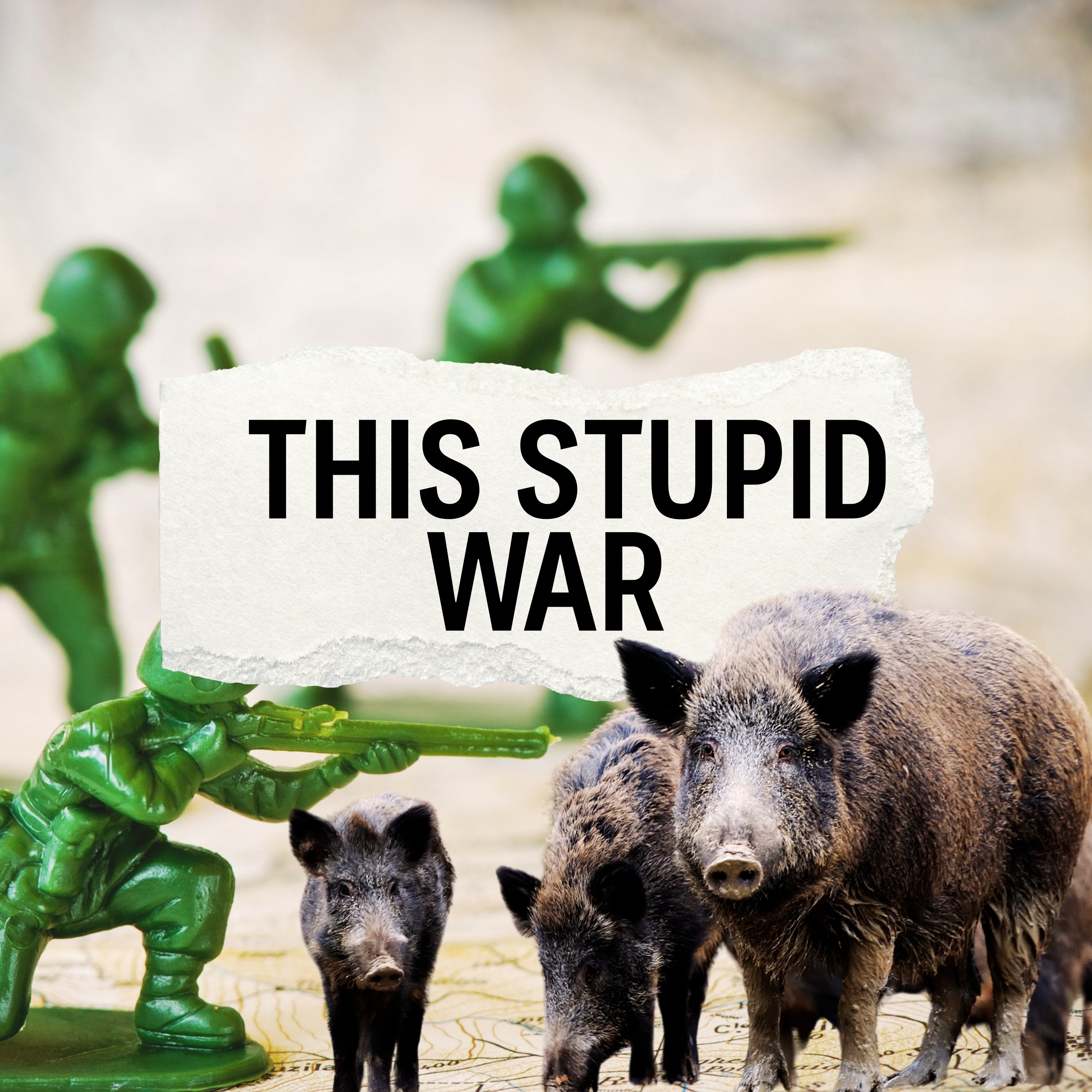
Mike Vouri (former Historian for San Juan Island National Historic Park) takes Marc Fennell (Stuff The British Stole) to San Juan Island where the US and Great Britain came dangerously close to war... all over a pig.
This is the third episode in the special series This Stupid War. Listen to the full series in the No One Saw It Coming podcast feed on ABC listen (Australia) or wherever you get your podcasts.
Get in touch:
Got a story for us? We'd love to hear from you! Email us at [email protected]
Get every episode summarized
Each time No One Saw It Coming publishes, we email you a written briefing from the transcript — the topics, who appeared, and any specific claims, with the ad reads skipped.
Email me new episodesFree for 3 shows. No card needed.
Hosts & guests
Transcript ready
332 searchable segments. Every word is indexed and playable.
Full transcript
No One Saw It Coming — The Pig War: Hogging the border. Machine-transcribed; use the interactive transcript above to jump the player to any line.
ABC Listen, podcasts, radio, news, music and more. Written from us. Written into us. These are the pages to which Australia returns. The ABC Radio National Top 100 Australian Books Countdown. Boding closes October 1st. You don't have long ABC.net.au slash top 100 books. Vote now. On an island just off Washington State in America, there is a pig. It's snuffling around, looking for food and it trots across an invisible border. Right into a farmer's garden. And not it has to be said for the first time. So this rooting pig, a Berkshire bore, had been disrupting root crops mainly potatoes.
But on this day, the trespassing pig just sends this farmer over the edge. So he takes his rifle off the wall, goes outside, chases the pig to the end of the edge of the woods and shoots it, kills it. But what that farmer didn't realize was that by killing that pig, he would strike a match, igniting a tinderbox of tensions between Great Britain and the United States of America. So you've got 64 guns pointed at you. You've got probably about 400 royal marines. Pretty soon there's 500 soldiers on the island. And yet, the last thing they wanted was to go to war with each other. Especially over a pig. But why does this pig trigger a geopolitical nightmare? Well, I'm Mark Vannell and strap yourself in for a wild ride. When more than a century ago, yes, a dead pig brought two superpowers to the brink of war. And no one got at least I hope no one.
Surret coming. My favorite view is from American camp. And from that height, which is barely a hundred feet above the sea. If you turn your head to the right, you can see the mountains. If you turn your head to the left, you can see a 10,000 foot strato volcano. It's probably one of the best sea level views in the National Park Service. So they guy with a very nice view. That would be Mike Vorry. I'm a retired National Park Ranger historian. I live here on Salmon Island right in the middle of the island. I love the scenery. I love the fact that you can drive around the periphery of the island,
which is 54 square miles, 60 miles long, seven miles, stand to stern. And you see these magnificent vistas. So for people that aren't familiar with Salmon Island, where exactly are you right now? Okay, so look up into the northwest corner of the United States of America right at the border. And you see Washington State. And we're talking like the very tippy top right of America here, which is where sort of Washington State borders with modern day Canada. I want you to do it like zooming. Zoom into the next squid. There's a big island there. Now that's Vancouver Island. We're not talking about that. Keep zooming, keep zooming. There. You see a tiny cluster of islands. That is where San Juan Island is. Right in the middle of the straight of Georgia, which separates Vancouver Island from the North American mainland. Sandwiched right in there, aren't you?
That's correct. The bottom for you to know that the ownership of this particular island is a messy one. So back in 1792, when the British first ventured into this particular part of the Americas, and laid claim to the Oregon country, which sort of stretches from the coast, the Pacific coast, all the way to the Rocky Mountains. So like where modern day, Oregon, Washington, actually most of Canada's British Columbia are today. However, the United States of America also laid claim of it by virtue of a treaty that they'd signed with Spain, which put the Oregon country into their orbit. And so the two countries agreed that they would mutually explore and occupy this vast wash of land until effective occupation could be demonstrated. For almost 30 years, the United States and Great Britain were sort of like house mites in the Pacific Northwest, living amongst each other, but with neither really laying claim to fully owning the place,
until that is a proper treaty was signed. The Treaty of Oregon. In 1846, as part of the treaty, they drew a line vaguely along the 49th parallel, which is that line of latitude that runs around the globe. Now this line would become the border between the Americans in the South and the British in the North in what would eventually become Canada. The United States rattled its saber for a while and said 54 or 40 or fight. They wanted the whole thing all the way up to the border of Russian America, but you know, cooler heads prevailed and the 49th parallel was arrived upon as a compromise, a good compromise really. While drawing that borderline on the 49th parallel, there was an area that sort of got forgotten about. A cluster of teeny tiny dots on a map where Mike Vorry is right now. That's right. They forgot that the San Juan Archipelago is right in the middle. So since this cluster of islands sort of fell outside the treaty, Great Britain and the US decided to
well, both claim the islands. They figured it was on the far side of the world, you know, who's going to care? Well, the people that lived out here cared a great deal. So they had a good couple of years with that gray area seemed to almost work, right? There was always a bit of intrigue going on and it accelerated when the British established the sheep farm on the island, on the southern end, the Hudson's Bay Company. In case that name rings a bell for you, here is why. The Hudson's Bay Company grew into one of Canada's most iconic retail brands. It actually started in 1670 as a fur trading business in North America and was backed by royal charter from King Charles II. Prince Rupert of the Palantine, who was the first cousin of King Charles II, was one of the founders of the company. And they founded it on Hudson's Bay in Eastern Canada and the Hudson's Bay Company developed the fur trade initially.
But by 1824, they pretty much trapped out all the sea otters that were on the Northern coast. And they found that if they expanded into timber, fishing, farming and mining, that they could sustain a profit in the company and continue to do well, which is what they did. And so when essentially Britain's Hudson's Bay Company expanded to San Juan Island, they brought over a thousand sheep to the island, and the Americans got well, pretty territorial. The Americans, when they saw that the sheep farm had been established, weren't happy about it. The Americans said, you owe us tax for those sheep, 80 bucks. And if you don't pay it, we're going to come over and have a share of sale and we're going to a pound, 80 dollars worth of sheep. So they came over. It was about two o'clock in the morning and they absconded with 35 breeding ramps.
These are large animals, a couple of hundred pounds of peace. And they wrestled them into row boats. They stalled some Hudson's Bay Company canoes, which were quite large. And they made off with the sheep and the canoes for the mainland. And that was an international incident. It went all the way up to the prime minister of Great Britain and the president of the United States. And so a letter went out to US officials saying, do not harass the British over a salmon island. We're not saying the island is theirs, but don't irritate them. You know, stay cool. Stay cool. Stay cool. And they wrote a letter and every British official had this letter from the president of the United States and his vest pocket. Any time an American would agitate, he'd pull out the letter and say, see, see, see. Your president says I'm protecting the sea.
That's right. Your president says, leave me alone. I want a note that says your president says, leave me alone. That's right. So it's all a bit tense on the island. You've got the American farmers on one side and a British sheep branch on the other run by the Hudson's Bay Company. Now there's a particular British character here who I need to introduce you to at this point. Now his name is Charles Griffin and he works for the Hudson's Bay Company. Who was given the task of developing Bellevue sheep farm on the southern end of salmon island. His father had been an employee of the Hudson's Bay Company. So to use a modern parlance, he was a nipo kid. Nipo baby, nipo baby. And he rose up in the company and was given this job to come over to San Juan and expand the flock. So his role was to ensure that British interests were maintained on the island.
How do you pigs too, didn't he? He had a few, not that many. But of those pigs, Charles Griffin was very protective. By the time we hit 1859, the Hudson's Bay Company, they're done well. Like they're chugging along nicely, the turnin' a pretty coin. They have expanding flocks, they've got a good operation going. The Americans see this. It looks lucrative, right? It looked particularly profitable to the men who had tried to get rich from gold mining and failed. They were attracted to San Juan islands for to land and decided to try their luck by becoming farmers and planting crops. One of them was this guy named Lyman Cutler. He was from Kentucky. And he established a little hut with a garden just north of the Hudson's Bay Company home establishment. In his garden, Cutler was growing mainly potatoes. And from time to time, he would have an unwelcome visitor.
So this rooting pig, a Berkshire bore, had been wandering into Lyman Cutler's garden. And had been disrupting his root crops. And so Cutler went down to Griffin and said, you've got to keep that pig out of my potatoes. And Griffin said, well, you're a scruffy little man to keep your potatoes out of my pig. You're nothing but a trespasser. And so Griffin goes home, he's irritated. So the next morning, he wakes up, there was that pig up to his old business. So he takes his rifle off the wall, goes outside, chases the pig to the end of the woods and shoots it, kills it. And just like that, the Americans had a problem on their hands. You have killed somebody else's livestock on the frontier, which is a no-no. The American farmer, Lyman Cutler, eventually comes down and he goes to Charles Griffin and he apologizes. He said, I shot your pig, I'm sorry, I'll tell you what I'm going to do. I'll find any three guys. I'll have them look at the carcass and I'll pay whatever they say that pig is worth.
Now Griffin turns in down, he said, it's a valuable pig, it's worth $100. And if you don't pay, you know, I'll go to the authorities and they'll put you in ires. You're nothing but a trespasser. And Cutler says, well, $100, I ain't going to pay $100 for a pig than $8 worth 10. If I see you in my place, I'll shoot you too. Oh, there he goes, he lost his temper again. So he goes back to his cabin and of course, he's mulling all this over anything. Oh, no, what have I done? And it's underscored the next day when three officials from the Hudson Speed Company come by his cabin and say, you've got to pay for that pig. And so that's when the crisis really starts. So we've had this pig and essentially in any other moment in history, this would be a dispute between two rural neighbors, which you know would be a thing for sure. But because of the nature of these islands, it kind of blows up, doesn't it? It does. You hit the nail right on the head. I mean, the islands were in dispute.
Nobody was supposed to be there. That's in spake up and he got there first. Now suddenly the Americans are there and you got trouble. You got a heap of trouble. Suddenly the pig with a bullet in it becomes a symbol for a much larger skirmish between Britain and America in the mid 19th century. On both sides, emotions are running high. On my side, dreams of bacon are running high. But it's not because of this dead pig anymore. No, no, this is about respect. It's about ownership. And pretty soon it escalates to the point that Cutler's story makes its way to the commander of the US Army Department of Oregon. He says, what's going on? He said, well, you know, that in Lame a Cutler shot this pig that was rooting in his garden, the Hudson Speed Company threatening with arrest. Well, right of petition and ask for help. Ask for help from the Army and I'll take care of you essentially. I'm paraphrasing out regency here. So that's what they said. So they write out the petition.
The British court wind of the Americans asking for backup and the governor of British Columbia, James Douglas, decided to send three British warships to the island as a show of force. Governor Douglas's beside himself about the shooting of the pig and these Americans on the island, they don't belong there. The next thing that's going to happen is the Americans are just going to overrun us and we're going to lose the whole province. I mean, that's what was going through his mind. And so he sends a stipendiary magistrate, a magistrate like a sheriff, a board of British warship, HMS satellite, 21 gun, steam corvette. The biggest one in the Royal Navy, steamer. And they send him over to arrest Lyman Cutler, the pig killer, and he vect all 18 Americans that are on the island to evict them, kick them off. Enter the American captain, George Pickett, who I am reliably informed was quote, swashbuckling.
He arrives on San Juan Island before the British get there and he sets up on the beach. And he's got three pieces of artillery, two mountain houndsters and an Napoleon gun and 64 men. Then the British arrive and they graded by Pickett's army. And they think they're just coming to arrest Lyman Cutler and he vect these 18 civilians. There's a company of armed infantry with artillery. So the Americans have sent more than 60 infantry men to kind of parked on the beach. The British, what is now Canada, they have sent warships, like solid warships to this island and then they get there and they realize, oh no, this is much bigger than we expected. This is his right, the Americans are already there. Sorry, this is a good part. So the magistrate goes ashore, approaches Pickett and he says, I order you off this island.
You're here illegally. If you don't leave, I'm going to place you under arrest. You know, this is very saucy. So Pickett, of course, says I'm not going anywhere. And so he stays. The British stay back to their own territory, which is just sort of southwest of San Juan Island and they tell the governor, hey, the Americans are not backing down. The governor's sputtering, you know, these damned Americans, you know, they're they're at it again. So what he does is he sends another warship over HMS Tribune, which is a 31 gun steam frigate. So orders are you will order the American army off the island. And if they don't leave to take whatever measures necessary to ensure that they do. And so ensues a back and forth of finger pointing and threats befitting of, great man, both sides believe that the other shouldn't be on the island and should back down.
They play this game. You got to leave here illegally. Not going to leave. I can't be responsible for whatever trouble is going to. Well, if there's any trouble that's going to ensue, you're the one that's going to start. No, no, you're the one that's going to start. They go on like this for a while. Until finally, the US commander George Pickett asked for reinforcements. He says help, help. He says there's three British warships now in the Bay facing me. So you got 64 guns pointed at you. You've got probably about 400 royal Marines that can be landed. So he says help. And so this general sends reinforcements pretty soon. There's 500 soldiers on the island and they offload eight thirty two pounder naval guns, which will cover both beaches. And not only that can reach out a couple of miles into the bay. So the British are pretty alarmed by this. Amongst the sea of hotheads in charge here, there is at least one person remaining cool.
And that would be a British captain by the name of Jeffrey Hornby. This desired attack action against the Americans. It doesn't seem to affect him. It just sort of slides off him. The Royal Navy's policy was not to start wars. It was to maintain the free flow of commerce on the high seas. And to take care of pirates and to protect British interests. Not to start war. So he sits tight. Eventually, word gets back to Washington DC and London about this whole debacle. And both Great Britain and America are frankly horrified at the news. They are both understandably shocked that it is spewed over a pig has grown into a standoff that now involves as many as three warships, more than 80 guns and over 2000 men. The last thing they wanted was to go to war with each other. So they set out the commanding general of the United States Army, Winfield Scott.
So Winfield Scott was known as the Great Pacifier. He'd recently just resolved two diplomatic nightmares on the Canadian border. Without it has to be said, a single shot being fired. So yeah, he's the guy they need. But it's not easy for him to get to San Juan Island because the Great Pacifier was nodding great shape. He weighs over 300 pounds. And he's got all kinds of physical ailments. They have to put him in a basket and crane him aboard each ship. Ship, short a ship, ship the shore. He's got to be crane to board. He's so huge. Oh my God. And so it takes him six weeks to get out here. And of course, he's not in a very good mood. Yeah, six weeks for the man to arrive for the man to arrive during which time the British and the Americans are just standing off on the island. But when he does arrive, he gets to work. It only takes him a week to negotiate a stand down with governor Douglas, just a week.
And all of the reinforcements leave. The Royal Navy takes its ships out of the harbor. And the two nations agree to a joint military occupation of the island. And so they come to an agreement. But there is some fine print. Neither company will have more than a hundred men in arms and no artillery. And it's supposed to be temporary. So finally in 1871, the two nations signed the Treaty of Washington which addressed the boundary dispute. And they sent the boundary dispute question to the emperor of Germany that Kaiser Wilhelm I. Why the emperor of Germany? Why is he getting involved in this? It's interesting. They had just recently defeated France and the Franco-Pression War. And they were the preeminent power on the continent. And of course the United States, freshly out of the Civil War, was a burgeoning military force itself.
And then you had Great Britain. So who better to resolve between these two other giants than another giant? And so abiding by the binding arbitration, the British marched peacefully out on November 22nd, 1872. And the islands came into the possession of the United States. So how did it end up going to the Americans? Well, in the original treaty, there's a very vague sentence that caused all these problems. It said the border would run through the middle of the channel. It's just that the treaty did not specify which channel. Because there's the Harrow Strait on the west. And there's the Rosario Strait on the east. In the end, the arbitrators just ruled that it was the Harrow Strait, which meant it went to the Americans. Binding arbitration is kind of ironic because that's what Lyman Cutler offered Charles Griffin after he shot the pig. If only he'd called the Emperor of Germany after the pig was died. Maybe we could have avoided all of this. That's right. Yeah, of course it. You know, during my time in the park, whenever we get the German citizens in, they were always floored that they played a long lost emperor had played a role in the islands coming in.
And they were always floored to the possession of the United States. So could I ask just like when we look back at this particularly weird Japanese history, you've got a standoff that involved warships, guns, thousands of men, apart from the shot that killed the poor pig. Was anyone hurt in the pig wall? No. The only living being that died was a pig. So it was the perfect wars, as far as I'm concerned, I'm a Vietnam vet. And you know, the park was created to commemorate the peaceful resolution of conflict. That's the San Juan Island National Historical Park. Where Mike used to work. The park would interpret the peaceful resolution of conflict, the settlement of the San Juan boundary dispute, and the peaceful joint occupation of the island. That's why the park was created.
Peaceful resolution of conflict. So there was a moment in time when the United States and Britain nearly came to war over conflict over some tiny islands that were in the grey area of a border drawing and triggered by the shooting of a pig. You've got it. Perfect. What do you think the pig wall tells you about conflict? What does it tell you about how wars start? Sometimes wars start through total ignorance, ignorance of the stakes, lack of imagination, prejudice, chauvinism on the parts of the two leaders. And I think that's when the Admiral came in and said, hey, you guys shut up and stand down. You know, this is uncool. What do you think the best lesson is from the pig wall? Count to ten and use your words.
That's just good advice for life, that is. There you go. How good is Mike Rory there for my historian and yet indeed Ranger at the San Juan Island National Historical Park? Hey, next week is the fourth and final episode of our mini series of this stupid war. Here is a taste of it. Mexico are in a mess. They cannot be dealing with some petty little man that's had his cake stolen. That's how they see it. This is the least of our worries. That is next week on No Unsortcoming. This particular episode was produced by Zoe Ferguson. The sound engineer was Matthew Siegley. It's produced on Gadigal Land in Sydney, Australia for ABC Radio National. I'm Mark Fnil. I'll be back next week. You've been listening to an ABC podcast. Discover more great ABC podcasts, live radio and exclusives on the ABC Listen app.
More episodes


