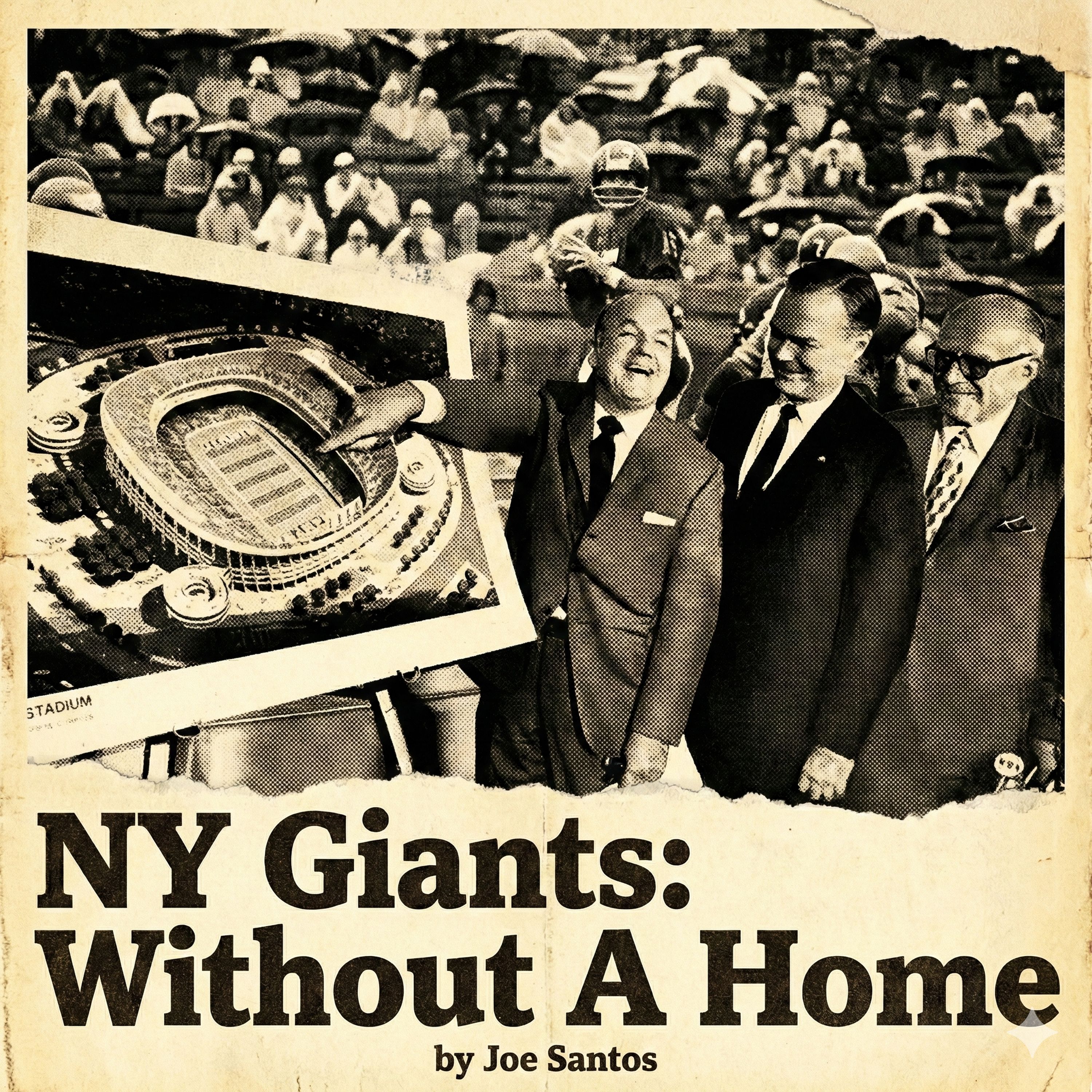
The NY Giants: A Team Without A Home (w/ Joe Santos) - Part 1
Get every episode summarized
Each time Sports History Network publishes, we email you a written briefing from the transcript — the topics, who appeared, and any specific claims, with the ad reads skipped.
Email me new episodesFree for 3 shows. No card needed.
About this episode
“And that's the end of the first half, as the team said to the locker room, the Spartans lead the Bulldogs by a score. Jeez, Coach, we're only down a couple of points. And here, I got every one of you new bars of soap from the Sterling soap company.”From the transcript
Yesterday's Sports is part of the Sports History Network - The Headquarters For Sports Yesteryear.
EPISODE SUMMARY
LISTEN TO THE NY GIANTS: A TEAM WITHOUT A HOME
Relive the "forgotten years" of Big Blue in this deep dive into one of the most tumultuous eras in New York Giants history. Joe Santos, creator of the documentary podcast The NY Giants: A Team Without a Home, joins Mark Morthier and Dave DePaola to recount the bizarre saga of 1973 through 1975.
From being "evicted" by Mayor John Lindsay to playing home games 80 miles away at the Yale Bowl in New Haven, the guys explore how a promising 1972 squad collapsed into a 2-11-1 disaster. You’ll hear about the logistical nightmares of practicing in Jersey City while playing in Connecticut, and the political friction that left the Giants feeling like second-class citizens in their own backyard.
The conversation is packed with "I was there" nostalgia, covering the infamous 1974 regular-season overtime loss to Joe Namath and the Jets, where Broadway Joe famously "walked" into the end zone. The trio reminisces about the rugged conditions of the Yale Bowl—from the splinter-filled wooden benches and the absence of stadium lights to the tiny "snow fence" that served as the only barrier between fans and the gridiron.
They also break down the personnel moves that defined the era, including the ill-fated Fran Tarkenton trade, the decline of workhorse Ron Johnson, and the defensive core of Brad Van Pelt and Jack Gregory that tried to hold it all together during the lean years before the Ray Perkins/George Young revolution.
Beyond the stats, this episode captures the unique fan experience of the 1970s—the all-day bus and train pilgrimages to New Haven, the freezing rain of the 1974 finale against the Vikings, and the eventual move to Shea Stadium in 1975.
Whether you remember shivering in the Yale Bowl stands or watching the highlights on NFL Game of the Week, this trip down memory lane explores the grit, the frustration, and the enduring loyalty of Giants fans during a decade of displacement. Stick around for part two as the guys continue to unravel the history of the team that eventually found its soul (and its trophies) in the Meadowlands.
YESTERDAY'S SPORTS BACKGROUND
Host Mark Morthier grew up in New Jersey just across the river from New York City during the 1970s, a great time for sports in the area. He relives great moments from this time and beyond, focusing on football, baseball, basketball, and boxing. You may even see a little Olympic Weightlifting in the mix, as Mark competed for eight years. See Mark's book below.
No Nonsense, Old School Weight Training: A Guide For People With Limited Time
Get every episode summarized
Each time Sports History Network publishes, we email you a written briefing from the transcript — the topics, who appeared, and any specific claims, with the ad reads skipped.
Email me new episodesFree for 3 shows. No card needed.
Know when John Lindsay turns up
Follow John Lindsay and once a week we email you every new episode they appeared on — including guest spots the show notes never mention, because we read the transcript.
Follow John LindsayFree. Pick your own day and time.
Hosts & guests


Transcript ready
928 searchable segments. Every word is indexed and playable.
Full transcript
Sports History Network — The NY Giants: A Team Without A Home (w/ Joe Santos) - Part 1. Machine-transcribed; use the interactive transcript above to jump the player to any line.
And that's the end of the first half, as the team said to the locker room, the Spartans lead the Bulldogs by a score. You guys stink. Jeez, Coach, we're only down a couple of points. No, I mean, you guys really smell. You need to hit the showers. And here, I got every one of you new bars of soap from the Sterling soap company. Each bar is artisan crafted using natural ingredients and essential oils. They also have shaved soaps, cologne, beard balm, and a whole lot more. Now get in there. But Coach, we have another half to play. I don't care. I can't stand to be around you a few minutes later. All right, bring it in tight. You guys are still playing terrible, but you're smelling great out there. Now listen, you're going to need to stock up for the rest of the season. We got a lot of tough games left. So go to sterlingsoap.com after the game. That's STIRL-I-N-G-Sope.com. You got that? Yes, Coach? Great. SterlingSope.com on three. One, two, three. SterlingSope.com. This podcast is part of the sports history network.
Your headquarters for the yesterday year of your favorite sport. You can learn more at sportshistorynetwork.com. Dave Tupalo, who's been on with me many times. My other guest is Joe Santos, who recently released a two-part podcast titled The New York Giants, a team without a home. So welcome to the show, Joe. Thank you. It's great to be here. All right. So Joe, what inspired you to talk about this particular topic? Yes. So, you know, born and raised the Massachusetts back in the day, back in the 70s, you know, the Giants were the sort of the facto home team back then in the early 70s. My older brother was a Giants fan. So the Giants were around a lot longer than the Patriots. So it was watching Giants games, you know, all the games were on TV. And the earliest year that I can remember watching him was 72.
And they had a pretty good year in 72. They went 86. Norm Sneed was made the pro bowl, Ron Johnson, Thousand Yard R Usher. Had some pretty good players on that team. So there's a lot of, and they beat the 49ers and the Cowboys, both playoff teams on the road. So there's a lot of optimism going into 73 that they're going to have a really good year in 73. So starting three comes along, they go six known to preseason when they're first home game. And then tie the Eagles, the nominous sign, they tie the Eagles on the last game, play the English stadium. The team made a beat the year before, 62 to 10. And after that, the wheels completely fall off the wagon and they finished two 11 and one. And it wasn't like nine years old at the time, I always wondered, I always wondered what happened to 73? Why did they fall flat on their face? So I thought it might go pretty fun to kind of go back in time and figure out why. And as I did this documentary podcast and realized that this is one of the reasons why you know, having to play their games, home games, 80 miles away from New York City.
Not the reason why, but one of the reasons why. So I thought that was fun. And that's kind of was the inspiration for doing the podcast. Okay. Well, I have one question. I'll ask this question and then after that, Dave, you could ask whatever you want. So I just want to make sure, you know, I did a little research on this. And I grew up, I grew up only about 20 miles away from Yankee Stadium. So I always remember as a kid, the Giants played at Yankee Stadium. So the one thing that I wanted to ask you and correct me if I'm wrong, but it sounds like the Giants were supposed to be able to finish their 1973 season at Yankee Stadium before they started the work on the reconstruction of the stadium. But the New York City Mayor, John Lindsay, was so mad at the Giants for their announcement
to leave to go to a new stadium in New Jersey that he basically kicked them out. He kicked them out of the stadium, Yankee Stadium. Is that my correct about that? Yeah. That's right, Mark. You know, when the 1973 season came around, Yankee Stadium was in dire need of repair. I mean, there were chunks of the stadium falling off during the games was unsafe. And that gave the city the mayor a perfect reason to kick them out. So they said, well, we need to make these renovations to the stadium. So after the second game, you guys need to find a new home. And the initial lease was to play through 74. And the understanding was they're going to play the Yankee Stadium through 74. And then New Jersey in 75. Well, because the stadium was deteriorating, things changed. And the team found itself scrambling to find a new home.
Right. Right. Okay. That's, that's good information. Yeah. I never really, you know, I was only a kid at the time. So I never really quite, I knew that they were going to reconstruct Yankee Stadium. So I thought that was, you know, the main reason the Giants were leaving. But I didn't know there was all that turmoil with the mayor. The mayor was furious that they were going to leave. So Dave, you got any questions you'd like to ask? I'm sure you can. Yeah. Joe, you know, I found a couple of articles believing in an online about this. It's one of the few good things about the end. Well, there's a lot of good things, but this, you can really find stuff. What was with the new Haven register? And the other one was with the Yankee Institute. And they talked about that opening game where the Giants, there was, you know, 70,000 people were there at the Yale Ball.
And it was, I guess it was the first time that they were able to sell beer legally, you know, and a football game. And that was 70,000 was pretty close to capacity, I believe, correct or no? That's right. More than the stadium held. So yeah, so it was actually had more people there than what the stadium actually held. And you can actually watch that first game on YouTube somewhere. Someone recorded it. It's kind of like in tech to color, but the whole game is on here, kind of excited. And, you know, they played the Packers in that first game, close game, you know, they lost in the last second field goal by Chester Markle, which was sort of become, you know, foreshadowing for the rest of the season. But yeah, Alex Webster kind of said after the game, they said, you know what? It kind of felt like a road game, even though they were the home team, just kind of sent them in. A lot of the players felt there was, even though they were the home team, it kind of felt like a home game because they had to travel, you know, 80 miles or 90 miles from New York
City to get there. And then all the other logistical challenges to get there. So yeah, yeah, funny you say that because, you know, I read after the second season, they played the Yale Bowl. They were well, the Yale was open to the idea of them coming back. And a lot of the giant players were saying, you know, it just doesn't feel like home games and that the, you know, the particulars, the locker room, and I needed a lot of work. They were kind of archaic. And they didn't, they ended up going playing the Shay Stadium after that, you know, that's the same. That's 75 season, but it was very interesting to stuff with, and I didn't watch some of that game in fact, because they were saying it after a while because they only played 12 games there. And they only won one game out of the 12. And so the norm of Sneed, he was being booed mercifully, they said, terrible. Well, they were terrible, I mean, it was horrible, you know, Sneed had a bad year that year. The year before 72, he makes the Pro Bowl, and then 73 terrible, I think he had seven
touchdowns, 22 interceptions. And just not a good year for him, big reason why they didn't perform well. But I think the other reason too, why the team decided to leave the Yovol, you know, the fan stopped showing up. I mean, that first game you mentioned, it's 73,000 plus, second year, you know, that last game they played against the Eagles, which was in a downpour. I remember watching that game, there was 20,000 people at the game. So obviously I had sure I had a lot to do with why they decided to move out of New Haven and even the fans came up to Wellington, Mara, they said, you know what, we're going to still work for support the team, but you can't make the trip. I mean, logistical challenges to get to New Haven from New Jersey was just too much. And then to see a team that was losing all the time, as you mentioned, they won one game playing there. They beat the Cardinals who were down their third string quarterback, Jim Hark didn't play. And then the starters were out. So just wasn't worth it for the fans to make that long trip and you'll see a bad football
team. Yeah, listen, part of the, part of the reason, go ahead, Mark, go ahead, I was just going to mention, because stay if you mentioned that in 1975, they went to Shay Stadium, but part of the reason for that was, it was a different mayor now, right? Abe? What was his name? Abe Beam. Yeah. Abe Beam. Yeah. He was, he was a little more, he wasn't quite as vindictive as Lindsay was. So he gave the Chinese permission to play in Shay Stadium in 1975, but that was, that had to be quite a, quite a year because the giants were playing there, the mets were playing there and the Yankees were playing there. So I don't know how they sorted all that out, but they managed to get through the year. Yeah. I mean, even then they were second-class citizens because as you mentioned, they had all those, all the New York outdoor teams were playing at Shay.
So they had to play most of their games on Saturday instead of Sunday because you had the jets and the mets and Yankees. So a lot of those games were played on Saturday, but they did have a better year that year. They went five games, which was more than what they had won the prior two years combined. That's right. Yeah. I forgot the jets, so there was two baseball teams and two football teams all using the same stadium. Yeah. Oh, man. What a mess. Yeah. According to this article, Joe, they, they struck a deal with the Yale struck a deal with the giants and one of the, one of the stipulations was they dropped the blackout coverage. That was a 75-mile radius from the city where the game was being played. And I guess the parts of the people in New Haven, the businesses, love the idea of the giants coming. But some of the other people involved in making the deal were a little cool at the beginning,
I guess. That's sort of according to this article here. That's right. Yeah. And some of them playing at the Yale Balls that the commissioner stepped in and decided to drop the blackout rules so that everyone could see the games that year. But I think it's 74. None of the games sold out. And I don't think any of the home games were shown in the New York area because of that because the team had done so poorly. But yeah. And you're right. I think the city joined having that professional team there, but I don't know the rest of the folks that are living in New Haven, it's a college town. Yeah. It's the Yale University College. They're not used to having a pro team. Although the giants did play the jets there on an annual basis, the preseason game for a while. So they were kind of familiar with playing there, but not on a regular season basis, like they did in every preseason. Yeah. Listen. The funny thing is, I don't go on panel to any social media, but somebody had posted a bunch
of posts from Facebook in particular about the NFL, the giants playing at the Yale ball and they've reached out to all the people. What are your memories? And one guy's writing one of the most famous games in NFL history. He goes that far as to label as that was the giants losing to the jets 26 to 20 in the first regular season overtime game decided with the new overtime rules. Because Emerson Boozer called it touchdown, Joe Neymeth, he goglack, Mr. 42. And that game there got a lot of play on this site, but a lot of people were commenting on that one particular game. That was a big game. I think that was the first touchdown Joe Neymeth had scored running in like five years. Yeah. I mean, he went into the end so he could barely walk in two bad knees and he could barely walk and walked in for the winning score. But giant should have probably won that game because Pete Goglack didn't miss a chip shot
field goal that would have won the game. He contends that the kick was good. If you're asking today, he'd tell you the kick was good. The kick was no good. They talked about that in here. And if you remember, I remember that. I remember it vividly, not one out so far. I mean, it's been, look, Neymeth, he sticks out his hand and I'm like, don't touch me. I'm walking in. You know what I mean? That's what it looks like when you watch it. I remember watching that game on the NFL game of the week and specifically, you remember him. Yeah, just kind of walking in. Guys, don't touch me. Don't touch me. He sticks his arm out. His hand like, OK, like he's directed traffic. That was good. Yeah. Yeah. Well, listen, the amount of comments, the amount of comments and the stuff that people are talking about, you know, if you scrolled down, they just kept loading and loading and loading. And there was a guy that played for the Jets who was actually from where I live. I don't live far from the Elbow. I live about 30 minutes.
And there was a guy that got drafted in the first round by the Jets Carl Bars-Alauskis. He was a big defensive lineman and he played right here in Waterbury for Kennedy. He played for Kennedy High School, you know, where I'm from. And I studied up on him a little just for this podcast because I'm thinking to myself, jeez, I knew that he played, but he ended up getting injured and stuff. But yeah, he went out of pretty good. He was a pretty much, he was a force. They were saying he was a big six foot six about 285 pounds. They had him listed at 245, but the guys that played against him said, no way. He's a lot bigger than that. But it's interesting. He played in that game. And he had a good game, too. Mm-hmm. That was a pretty good game. I mean, it was the battle of the, I remember the NFL films, advertises the Battle of New York being played 80 miles away in New Haven. Imagine that? Yeah, yeah. Did you go to the end of the game? Yeah. I was telling Mark before we came on, I went to one game, 20.
I think it was 28 or 26 to 20. The New England Patriots beat the Giants. That was a first football game ever attended in person from professional. Okay. Yeah, it was 74. Yeah. The Pat's went to, yeah, the Patriots and the funny thing about that game was ironically, the Patriots played their home games in 70, the year before they moved to Foxboro. They played their home games in Harvard. So as ironically, in 74, you had the Giants and the Patriots playing at the Yobal. And yeah, the Pat's won that game. So that wasn't actually a pretty good game, interesting game. No, listen, I pulled up the box score for it earlier before we got on. And I remember I was telling Mark Mac here and a little short guy, he was tiny. He actually scored two touchdowns in that game. I think he caught a pass and he ran one in. Yes, he did. I think my Taha caught a touchdown pass. Yes, he did. And Ron Johnson scored two touchdowns, I think. I remember Ron Johnson, he had a big rookie year, correct, but the Giants are no.
Well, he was actually rookie with the brass. Okay. He started his career with Cleveland Browns and then he was traded to the Giants and the Homer Jones trade. So he came over 70, the Giants were at Homer Jones to get him. And he was the first giant to brush for over a thousand yards and 70. Yeah, I mean, 72, 72 he runs for over a thousand yards. 73 is bad. They were. They actually he were actually rushed for like 900 yards, almost broke a thousand again, but you know, bad at team, but yeah, he was a good, good offensive player. He could catch the ball on the back field, a good pass catching. And that Norm Steed that that year, he went, he made the pro ball. That was a big reason for his success. He had a lot of swing passes to Johnson coming on the back field, short passes to Tucker. So yes, both of those seasons, both of those seasons that the Giants had the winning record in 1970 and 1972, they had a winning record and both of those seasons, Ron Johnson had
over a thousand yards rushing. That's right. So he was a big part of that team, very big part of the team. You asked, you were asking about if we got to go to any of the games, the Yelbal, but I was not close, I was 93 miles away from the Yelbal, so I never saw any games at the Yelbal. I was only about 20 miles away from Yankee Stadium, but I never got to see a Giants game at Yankee Stadium. I saw a few, the original Yankee Stadium, I mean, I saw a few of the Yankee games at the original stadium, but I always regret that I never got to go. I was only a kid, so you know, there wasn't much I could do about it if somebody, if I didn't have any money, and even if I had money, how was I going to get there? So unfortunately, I never got to see the Giants play there. But I did get to see the Yankee's play there.
Did either of you get to see him play at Chase Denny, even 75? No. No. I saw a, I looked for that ticket. I think that ticket was eight to the second season at 74. It was, my uncle got, my father was a big Giants fan job, very big, and we used to make fun of him, even though we were kids, because they were having lousy seasons, even when Tarkington came back, he was under the gun, and let me ask you this, prior to Ron Johnson, was Joe Morrison or main back or no, to try, uh, Joe Morrison and Tucker Fredrickson. Yep. Yep. I remember Joe Morrison, he was a guy, he has football card or one of his cards, and he was a guy that he was a younger guy, but he looked like he was 40, you know, he just had an older look to him, you know, I mean, yeah, and he wore number 40. That's right. Yeah. It was a decent, decent run-in back, I mean, it never broke a thousand yards or anything,
but it was a tough run-in back as long as, well as Tucker Fredrickson, was another good running back, but, you know, his career was cut short by the knee injuries, unfortunately. That's right. And sadly, Joe Morrison died, uh, young, he died at a very young age. I think he went on to coach a number of South Carolina, that was his alma mater. Yeah, I'd get pretty good here too. I think he brought him like to 10 wins one year, um, and, uh, yeah, I think he died, I think he died of a heart attack, actually. Yeah, I think it was a heart attack. Yeah. Yeah. So I had a question for you guys, um, so, um, I mean, do you think, how much, in fact, do you think, uh, playing at the elbow was in terms of them falling flat on their faces at 73? I actually did a lot of research on this back in the day, actually, I wrote a letter to the norm's needs. Um, that's great. My ex-wife found, my ex-wife found his address to this day. She still won't tell me how she found his address, but I wrote him a letter and, um, say,
norm. What happened to you guys in 73? And I said, what was the logistics of fact to having to play at the elbow? How much of that was a factor? And all he said was a lot, um, so that was wonderful. Yeah. That was his comment a lot, um, uh, that's pretty good one thing. Yeah, I said, I wonder if they did play at Yankee Stadium, if they played at another stadium in New York, say, uh, Shay Stadium or someplace else, um, in 73, do you think they might have been a little bit better, um, maybe not, you know, playoff material, but better than tool 11 and one. Yeah, listen, I definitely don't think I think it had a lot to do with it. We, uh, we, I think it had a lot to do with it. It had to have a kind of, quite a big hand in it. The red skins played the giant. I think I'm not sure both of those years that, um, the elbow just won, but one of the years that they played, they stayed right here in Waterbury. There was a place called the Red Bull Inn. It was up on a hill and, uh, I still live in Waterbury, Joan, and I was, I was a cop here
for 27 years. So all these places are very familiar to it. It's not there anymore. It's been overtaken by housing, but my buddy Rick Hubbard, he was so excited. He went up there one night. It was like Saturday night before that game or whenever with night, they were, they, before the night they were playing the next day. And he said they were coming off the bus, Kilmer. All these guys we, we watched, you know, on TV, even though he didn't have the exposure to football back then that they do today, they still, the guys that you didn't see that he, that made a big impact on you when you were that age. So, you know, he had guys like Brundage and all these guys, Talbird, them, you know, Kilmer was there and Larry Brown, uh, it was, he, he went up that, he, we still talk about it to stay the Red Bull in. Things been going probably 50 years, but yet, you know, we still, we still talk about that. Yeah, the Ritzkins, I mean, they had the giants numbers for years. I mean, George Allen used to beat them every single year. Um, he remember when he was coach for the Rams, you know, that 70 season, I already, uh,
Mark mentioned the 70 season when he went nine and five, when it made the playoffs, and they beat the Rams and that last, uh, game of the season and the Rams came in and blew him out 31 to three with, uh, George Allen was the coach for the Rams, and I don't think they beat the giants every year until I think 76, um, and when they beat, when the giants finally beat the, uh, the Rams, uh, the Redskins at, uh, giants that the giant state of the 76 12 to 9 and Norm Sneen was actually the quarterback. Yeah. Wow. Uh, another big factor in that what you asked, Joe, about, uh, did it have an impact? It certainly, I think it had an impact. And the other thing is, which I didn't really, I didn't really remember this. They not only had to play at the elbow, but they were practicing in Jersey City, New Jersey. And, uh, I believe they were practicing at Roosevelt Stadium, right? And Dave, you were just talking, me and Dave were just talking about Roosevelt Stadium,
uh, the job that I used to have I worked in Jersey City, and I would drive past, uh, Roosevelt, well, it wasn't there anymore, uh, by time I started working there, Roosevelt Stadium had been torn down, but I, I used to drive right past there every day on my way to work. And I don't think I ever realized that the giant's practice there. So I'm sure that had a lot, uh, you know, because that, that's not really close to, uh, Yankee Stadium either, not as far as the elbow, but, uh, Jersey City's not that close to, to Yankee Stadium either. Was that, was that like a high school stadium, bro, the high school football team played? Uh, they had all kinds of events there, and they had concerts, they had boxing, it was a very old stadium, that's why they eventually had a tarot down because they fell apart. But they, yeah, the high school played there, everybody, uh, they had the Negro leagues played there, uh, boxing concerts, everything.
So the stadium got used a lot. Yeah, I did, yeah, and the research in the podcast, I saw that, uh, Vince Lombardi, the Packers actually played a game, I would accidentally, I'm preseason game there. So yeah, you think about it, they're playing, they're, they're practicing during the week in Jersey City at this high school football stadium. The administrative offices for the team were still in Manhattan, um, yet their home games were in, uh, New Haven, Connecticut. So, um, I mean, it was doomed to fail. I mean, yeah. I was, uh, sure, the team had to go, if they had to do it all over again, they probably wouldn't have chosen to play in New Haven, but I'm not sure where else they could have played because with the political situation at the time, they were kind of, uh, boxed in it to terms of where they could play. Unbelievable. Well, I saw that one of the, I saw, uh, reading your, uh, article that, um, one of the places they considered was in Princeton, New Jersey, and that was Palmer Stadium. And they actually did play some, uh, from 1965 to 1975, they played, um, preseason games
there. Correct. That's right. Yeah. I think you have to get, um, so I'm not sure why they didn't, um, the way they didn't pick that stadium, but, um, I think they, they, they, well, that was just the floor. I think they settled on New Haven because they had familiar already playing there because like I said, they did play there on an annual basis in the preseason games and, and they felt that there was still a bit close enough to the New York metropolitan area that, um, they could still attract the fans to get there and then think it was going to be that much of a factor. But, um, you know, I'm going back, uh, looking at the fans and the comments that they wrote about what it was like going to a game with the yoke all, um, yeah, man, it was, it's a, interesting, uh, feedback in terms of what, uh, uh, that it took to get there, right? They had to take the, people from New Jersey had to take the train to get to, uh, from New Jersey to get the Penn station and then a long train from, uh, train ride from Penn station to, uh, you know, to get to, uh, to the, to Hartford, I don't know what that's like, a 90 minute ride, at least.
Yeah. It's like an all day event. Yeah. Just get to the game. Yeah. And then I talk about my podcast that, uh, the last game there, um, that, um, Alex Webster coached in the against the Vikings snowstorm and, um, um, uh, all things going on there with, uh, the weather and, um, there's a, there's a, there's a story about, uh, John Mara, who was, uh, on the sidelines back then. He was willing, concerned, and now he's the current owner. Um, he's on the sideline and, um, the, the, the giants are getting killed by the Vikings. Um, and a lot of players were, and he's, didn't, uh, one was going on the field. They were held around, held around these, uh, portable heaters. So Alex Webster is saying to the, uh, John Mara said, Hey, um, I don't want these guys to hold around the heaters. I want, I want to go down with a fight here, go and plug those heaters. So Chad Moore goes on. He's just a little bit this time. He's a young kid. He unplugged the heaters. It's the, the players started yelling obscenities at him and, um, he said it was off.
Yeah. And he said, uh, he was really, you know, he was really emotional because, uh, he felt bad that, um, he wasn't able to deliver the team of winner. He said he had tears in his eyes and, John, I feel bad. I'm not able to, you know, deliver a winner. But he just didn't have the players, um, you know, they, they traded, they gave up Tarkinton and what they get for Tarkinton. And in turn, they got Norms need Bob Graham, Vince Clemens and some other players that, that they were, they were gone, you know, a couple of years later. And what did Tarkin do? He went to three Super Bowls. They didn't win, but still, I mean, the Vikings were one of the best teams to lead after that. So yes, that's right. There's a guy that made a comment about that giant Viking game on this, one of these, uh, hot, uh, things I was reading here and he was talking on how long it took him to get to the giant. He took a bus to a New Jersey train station, right? And then the train to Penn station and then on the train to New Haven, it was a long trip. And he said to stadium, when they watched an awful giant scene, this is the act that
he was saying, thoroughly outplayed by Fran Tarkinton, my recollection, it was a cold, drizzly day. Very cool. He said, and we moved from our end zone seats to the 50 yardlands because nobody was there. He said, we're great. He said, but he remembered it being, he said, I got sick. I got caught a cold and I was sick for a week. That's what he said. That's right. And, you know, Yale, Yale, and that was very little. I'm sorry, Mark. The Rose Bowl was patterned after the Yale Bowl, they claim. And they used to say that, uh, I don't know if it's true that they buried a lot of this big equipment. They couldn't get it out of the stadium, the, the portals were too narrow and they ended up bearing it under the field. I don't know if that's true story because people still talk about that to this day. Wow. Interesting. Wow. I don't know. Yeah. There's stuff. Yeah. There was another funny story. Mark. Yep. I was just wanted to mention, uh, the very limited, uh, security there at the Yale Bowl.
And I saw that, uh, little piece of road about Bob Tucker, they're tied in. He was, uh, he's standing on the sideline. And, uh, some teenager just manages to make his way down onto the field from the stands. And he goes over to the, no, you know, nobody even questioned them or anything. He walks over to the sideline and he stands next to Bob Tucker and he, he looks up at Bob Tucker and he says, can I have your chin strap? Well, the, well, the games going on. And Bob Tucker says, yeah, yeah, I got to wait until the games over. I'm going to need this. I thought that was hysterical. It's amazing. It's amazing. It's amazing. The teenager just walks up. Yeah. Yeah. During the NFL game. It's a regular season game, not a preseason game. We're a regular season game. The guys asking them to strap during the game. Yeah. Yeah. You know. Yeah.
Just strolled onto the field. One of the biggest things that you would always recognize those games. And I don't know if it was set up year round or just for later in the year, but they had that like small snow fence going around the whole field. It was maybe three feet high. You know, some you'd see in somebody's yard and it went around giant and guys sometimes have run into it. That's, that's the most vivid thing I actually recall from the yellow ball. Believe it or not. It's crazy. It sounds. Anytime you see a highlight, you go, there's the yellow ball. When you see that little fence. Right. Yeah. One of the many terms of the stadium. The other thing was that they didn't have any stadium lights back then. I don't know if they do now, but back then they didn't have any stadium lights there. So that's where all the games had to be played at one o'clock. Yeah. That's right. That's right. I forgot about that. That's correct. There's, I think there's lights there now. There's lights. I've gone by at night. And they spruced it all up since then. Just like everything else. But it really was. It was. It didn't have a great reputation back then when the giants were playing there.
I could tell you that. It really didn't. It was very old, you know what I mean? Well, the stadium was 1914, right? Yes. The stadium was built in 1914. Well, yeah. So by time the giants started playing there, it was. It was a pretty old stadium. One guy commented on this site that his brother. He said we went down by half them and roiged. It was a roigeperson marked with the receiver for the reskins. Yeah. He, he, he says in a roigeperson was just standing there near this thing. And he bummed the cigarette off of my brother. That's right. Yeah. It's unreal. No, you know, that's the thing. You get on to some of these things. And you actually start. There's people that have either might even have worked for the franchise at one. And you, they come out with stuff. You're like, you would never be able to, you know, hear anything like this. If you, you know, it's, there's a couple of guys.
They played, you know, in Yale ball. And, and one guy was saying it was the largest stadium he ever played in. And he used to go back for games there. He said when the giants played, he would try to get the tickets. And he was saying he had a fiat and he would travel on the merit parkway in the fall. It was beautiful. And, but the giants weren't so good. He said, but we had fun going to the games. And it's amazing what people remember. You know, to me, I always, I always look for stuff like that. It's a summary individuals specific memory of something. It's very, very unique. One, one person commented his, his comment was praisesync. He said, my memories of the Yale ball are pulling splinters out of my ass. This is a bench is we're not smooth. I can tell you that. They're lazy seats. They were just, it was just a bench. That's it. That's it. You know, I don't know if it's still like that, but my brother some years ago went to a game
up in Lambo field. And a lot of that still benches there. He's claiming. I don't know if that's changed now, but it wasn't that long ago. It was in the last 10 years. I know that. Sounds crazy. I mean, a lot of it's, but there was a section of it that were still bench seats. Unbelievable. Wow. I didn't know that. Foxboro Stadium, when a Patriot's built, I think the time was called Shafer Stadium at 71. They didn't have any seats. It was all benches. It was a woman of benches. And they built that on the cheap, like for $7 million. So maybe they modeled it after the Yale ball. Yeah. I remember, I remember Matt Millen whacking the general manager, I think of the Patriot team. I mean, there's a few you could see it online. It's crazy. He didn't know. Yes, exactly. That was the owner's son of the Patrick Sullivan, Billy Sullivan's son. Yeah, there's the 85, the Pats Raiders playoff game. That's right.
Exactly. And there was still some hard, there was still some hard feelings over the 76 when they called the Pats for the roughing the passer against Kenny Stable. So I think the paper still had that. When they beat the Raiders, I think there was still some bad blood all those years after it. So I think that's probably what led to that old vacation. That's right. That was good. Sugar, sugar bear hammocks. Sugar bear hammocks. Yeah. He talked about it on a, they had a football life. I'm at Millen, you know, that's special. They had on the NFL network. And he spends the time walking. He was like, I don't know who the guy was. I thought he was just causing problems. He took the swipers. You know, he was almost trying to make it. Listen to that guy. Well, looks like he was 170 pounds. So good. He's not going to hurt any of these guys. But of course, that gives him the reason to go and lay the guy out. I'm not milling. He was kind of crazy about. Yeah. Yeah.
Hey, one to ask you guys to about, you know, Webster, obviously, he was gone after 73 and then 74 comes along. They bring in Bill Ansburger. What are your memories of Bill Ansburg as a coach? Good coach. Just caught in a bad situation. What do you think? Yeah, he never really got another chance after that. I know he was a great defensive. He was the defensive coordinator for the dolphins, right? That's right. And. Yeah, I think I don't know if it partly. Maybe partly he was just not a head coach materially. He was more defensive minded coach. But I'm sure, you know, getting caught up in the situation didn't help a team. You know, like you say, a team that didn't even have a home. That certainly doesn't help the situation. But he was, I don't know if he, I think maybe he went back to the dolphins.
He did. He did. Yeah. Was Joe would know. Did they still have that pretty good core of defense? Joe, did they have like Van Pelt and Mendenhall and Spider Lockhart? Was he still there? Was he gone by then? Lockhart. Oh, no. Yeah. Lockhart played till 75. He didn't play in a giant state. But his last year was 75. But yeah. I mean, they had. Yes. Lockhart, Brian Kelly, Brad Van Pelt. Yes. Mendenhall, Jack Gregory. Yeah. So they did have a pretty good defensive core. And then when Archburger came, and of course he was a defensive, you know, as Mark mentioned, he was defensive architect of the famous no name defense. So he came to New York. They actually had a pretty decent defense. The problem was their offense was terrible. I mean, they, they traded for Craig Morton. Oh. Was turned out to be a terrible trade because they passed up when they missed out on getting Randy. Yes. Yes. The system. It was. Yeah. He was there for two years. And he was gone.
76. And he goes. Goes to Denver and brings him to the Super Bowl. But he was terrible in New York. But they didn't have any weapons of another Ron Johnson and Bob Tucker. Maybe Bob Brim. They had nothing offensively. So I think that's was. That was on. Archburger's undoing. And I remember when he got fired. I remember watching Monday night football. 76 because they fired midway through the 76 season because they started out like oh and sick or something. Yeah, I'm quite disappointed. But the hard console said in the Giants. Let go of Bill onsparter. That's too bad. Because that guy can coach. Well, maybe as a defensive coordinator. Like, Mark said, but not as a head coach. Yeah. I didn't even go to coach. You can coach. You let her on his head coach. Um, um. I also remember that. Ron Johnson. His knees went like a lot of running back. in the 1970s. He had those few good seasons and then he had some bad injuries and the knees went on them. And you know, towards the end of his career, he was really just hanging
on. He wasn't of the effect of running back he had been. So like he said, they just really, they didn't have any offensive weapons at all for Arnold's burger to work with. They didn't. I mean, no, sorry, go ahead Dave. No, go ahead, go ahead. So I'm going to say, I mean, I placed a lot of that on the ownership, you know, trading for, they let Target to go. They didn't really get much back from the enormous need. I mean, it had one decent year. And Target then goes on, you know, goes, goes on a Minnesota and does great things there. So they didn't get much back from that trade. They trade for Craig Morden, didn't get much out of that. So I think, you know, from the ownership perspective, they really, they were kind of behind the times. Well, I mean, they didn't really have a general manager. I think Williamson Marrow was still calling all the shots. And I think it had that handicap the team to a great, to a great degree. And I think it took, you know, everyone talks about that fumble, the fumble, in the metal lands of 78, the, with the, you know,
a sharp chip, a sergeant. I think that's the best thing that that happened to the team, because that forced them to clean house. They brought in Ray Perkins, brought in George Young, drafted Phil Sims, Lawrence Taylor, the rest of his history. But at that, that play not happened, they could have kept on going on with mediocrity because the team was selling out the games. And I don't think there was really any incentive for a married player to really feel the winning team. That's my opinion. But, you know, it was, let me ask it, Joe, was, was Pete Atheist there in 75 or didn't he lead right around there? I think he was, I think, yeah, he didn't leave in 75. He went to the Saints. Okay. Yeah. Yeah. Because I know he, I think he played one year in Cleveland and, and Jack Gregory actually played with Cleveland. Gregory and Mendenhall, they didn't have like a lot of accolades like throw a ball. But they were very solid players, both of those guys. Very. Yeah. I mean, those the two best players in the team for a long time. I mean, Gregory
was an all pro in 72 Mendenhall's or rookie in 72. But, and those guys played for a while. They were there. They played in that game through 78, the Fumil of the Metal lands. They were there for that game. They're actually on the field. That was part of that team. They played for a long time. Van Pelt was a rookie in 73. Yeah. He played for a long time. Brian Kelly was a rookie in three. He played for a long time. So, yeah, they did like I said, they did have pretty good defensive guys on a defensive fight the ball, but just not enough, not a lot of talent, otherwise. Yeah. No. My father was a big listen. He's suffering for three years. We actually, you know, we would actually kind of break his stones. My friends, we were, we were all loved football. And my uncle Jerry, who wasn't even on my father's side of the family, he came, he was a huge bear's fan. So, here I am. I was a young guy I'm watching. I was a big cowboy's fan. They lost in the packers twice and, you know, they had the star and then they had Bob Hayes. And I'm watching when Uncle Jerry, my father, giant fan and a bear's fan. And I remember my father vividly of a lot of things he was saying,
but the most vivid one, he couldn't stand Ali Sherman. He said, that guy ruined this team. That's all he used to say. That guy ruined this team. Well, yeah, they used to chant, um, Ali must go. Ali must go in the late 60s. And, um, it was the pre, a matter of fact, it was a preseason game against the Jets in 69. Um, the Jets had just won the Super Bowl, and they were playing the Giants in the preseason game. It was only a preseason game, but the media built it up was a big to do. Jets won convincingly. And the fans were getting all over Ali Sherman. And, um, fire, Ali's chairman, fire, Ali's chairman, and willing to marry. It's okay. Ali's chairman, you got and they go and they hire, they bring on Alex Webster. We had no experiences ahead coach. I think he was the assistant coach or offensive coordinator or something, but had no experiences being a coach. Um, hired Alex Webster. They, they had at least in year six and eight, and then 70, um, those marks, they went nine and five, and he was NFC coach of the year. Um,
71, they fell off, uh, Braun Johnson actually got injured, uh, playing basketball on off, uh, they're on the offseason. So his, his knees are out. So bad year 71. And, um, but I think some, some of the things I read about, uh, Alex Webster that he was really, I mean, he was the coach, but willing tomorrow was still calling the shots from the, from the owners booth. He was still very much involved in the day-to-day operations. And even sometimes during the game, he would, hey, put, uh, put Larry Jacobson in. I wouldn't put him in. See what he can do it. Um, you know, not unlike some other owners of today from the Cowbells. Yes, I shall. Supposedly yes. You know, I don't know how much of that's still going on, but sure. But even behind the scenes, where a, where a player doesn't have to go to report, you know, it doesn't have to, he can go over the coach and go talk to the owner. It's kind of, it's crazy to me. That's part of a culture that this is one of the reasons why they haven't been back to a, uh, a game in 30 years, a championship game. So I mean, I think it is. I mean, he get, there's good talent there. They get good players, but they
just, there's a, there's something wrong there that they just, they don't, uh, it doesn't pan out. I mean, I've been, Mark doesn't watch as much as I, as I still do, but it's very, very frustrating. And you know, even though we made fun of my dad, it kind of like that, you said the same thing could have been going on back then and all the seasons he suffered through. We were, I never forget it. And then I'm 86. I'll never forget it. We, he went to bed and we went downstairs at the time, uh, I just didn't move out of the house. So I met my brothers and we decorated the whole cellar while he was asleep. But we set up a fake grass field, you know, with the little fake astute and we put up a turn style for tickets when they were going to play the Bronco and the Super Bowl. And he was already asleep. And by the time he woke up, and we had the, we had parking signs on the driveway. I mean, we did everything. We were there for hours to and stuff. We didn't wake him up. I know how we didn't wake him up. But, uh, it was really, it was good because we really, he went through a lot in the 70s with the Giants. Well, you remember that, that team that won
the Super Bowl, um, they wore a commemorative patch on their Jersey's spider. That's right. I forgot about that. Yeah. And Mayor Koch, Mayor Koch did not allow the Giants to have the victory parade in New York City. I remember that. Wouldn't let them, yeah. And that brings me back to, Mayor Lindsay too. Mayor Lindsay was so furious and vindictive. And really, uh, I mean, he hurt the players more than anybody. He didn't even want the Giants, uh, once as soon as the Giants signed the contract with, uh, with New Jersey that they were going to have the stadium there. He wanted to evict them from the state. He wanted to evict them from Yankee Stadium right, right then and there, right? That's right. Yeah. I mean, yeah, he wanted them out. Um, he wanted,
he called the commissioner of Pete Rosal, which had, hey, bringing an expansion team. We want the Giants out of here. He wanted them to remove the NY from the logo. Um, yeah, he was pissed. And you gotta remember, I think a lot of that had to do with the fact that, um, it wasn't too long ago that the Dodgers had left and the Brooklyn, the Giants had left, the baseball Giants had left, um, to come forward. So he didn't want to be the guy to lose another team, um, another team at leaving New York City. So I think that had a lot to do with the, you know, how upset that the Mayor was. But yeah, the commissioner had to step in and, um, he said, you know what, hey, everything's gonna be okay. I mean, yeah, they may be moving across the Hudson River, but there's, you know, Yankee Stadium is, I think he said 6.3 miles, 6.3 miles from, uh, time square, the Giants stadium is going to be 6.6 miles from time square. The same fans are gonna have seats, um, more parking, better sightlines, because Yankee Stadium was a baseball stadium. It wasn't built for football. Um, so what bad
sightlines and, um, and it wasn't their stadium. And the Yankees don't it. So the Giants were second, even in the Yankee Stadium, they were second class citizens. They had to play a lot of their, beginning the game games at the start of season away games. Um, they were, you know, I have to fall what the Yankees were doing. So it made all the sense in the world from them to get the wrong stadium. I mean, you can't, um, and hindsight, you can't blame the Giants for making that move. I mean, maybe they could have given that the city a heads up, but better, you know, kind of been handled better. Um, and maybe they wouldn't have been as vindictive as they were, but, uh, you know, that's, I guess that was, that was the, uh, politics at the time. But yeah, well, it was pretty, uh, it was pretty exciting for us, uh, for us New Jersey residents, because, uh, my, the house that I grew up in, uh, was only eight miles from Giants Stadium. And then, uh, my grandparents house, my grandparents lived in Linhurst, New Jersey. That was only three miles from Giants Stadium. So as they were building, uh, as they were building Giants
Stadium, we could see from, from my grandparents' street that they lived on. We could see them, you know, every week or every two weeks we go visit my grandparents. And me and my brother would go down the street, because you could see them building the stadium from there. And every week, we would see it, you know, it would get a little higher and a little higher. And we watched the, the progress. We were watching the progress for, but actually, uh, the first four games of 1976, they had to play on the road, because I don't think the, the stadium was ready yet, right? But, uh, did you, uh, get to see Jimmy Hoffa getting buried in the end of the construction? Yeah. Yeah. They always said that. They always said that one of the, uh, they always used to joke that one of the gold posts was a little bit difficult, because Jimmy Hoffa was buried there.
I was, uh, I was listening to, uh, believe it or not, and I can pick up a station out of Chicago when I go to bed at night, like a portable radio in the room. And, uh, I could get Chicago in Detroit late at night, like one, two in the morning, they come and clear. And there was a, they were talking about the bears moving to a supper of Indiana, not too far from the, like 10 miles in from the, from the line. And there was a player from the Giants, I think, who came on. And it was saying, you know, that will conclude part one of our discussion on the 1973 to 1975 New York Giants, the team without a own. We hope that you enjoyed it. Join us again next week for part two. Thank you. And God bless. This podcast is part of the Sports History Network. Your headquarters for the yesterday year of your favorite sport. You can learn more at sportshistorynetwork.com. Hey there, Sports History Fan. This is Arnie Chapman, aka the football history dude. And I hope
that you enjoyed this recent episode presented by the Sports History Network. And we're able to learn some good old fashioned sports history knowledge nuggets. I started Sports History Network back in 2020 with the mission to help podcasts. There's found a community of like-minded sports history nerds as well as helping aspiring podcasts to start their own shows. We have a little bit over 30 shows on the network right now covering all sorts of sports history. But as far as I'm concerned, we're just at the toothpick in the ocean moment. You know that can't even figure it out because there's so much more coming. We wanted to create the ultimate headquarters for Sports History year starting with podcast network and our website. But we're going to continue to move into other mediums as well. And here's the cool part because we want you to be part of our team. So if you're interested in starting your own podcast or maybe being a guest on one of our shows or who knows, maybe even writing an article for us over on the website. Seriously, all you got to do is reach out to us on the contact page of sports history network.com. You can be as technologically savvy as an angel thought tapping out a stone trying to figure out
this whole higher-agglifix thing back in the day. Again, it doesn't matter because even if you don't understand the whole podcast base, we have a production team that can pretty much help you out with doing everything. All you got to do head over to sports history network.com, head to the contact page, fill it out. That message goes right to me and I'll reach out to you as soon as I can. But for now, dude, I have to refure it through.
More episodes
More from Sports History Network

A Thriller in Lubbock, Last second dramatics in LA, and Jim Furyk's bargain bin...
Sports History Network

We Remember the Underdog 1976 Pitt Panthers & the Sugar Bowl Triumph
Sports History Network
Beavers shock the Trojans, Marshall's miracle win, and Sonny Liston won the Heav...
Sports History Network

We Chronicle the Oilers' Rise, Falls, and Enduring Legacy
Sports History Network