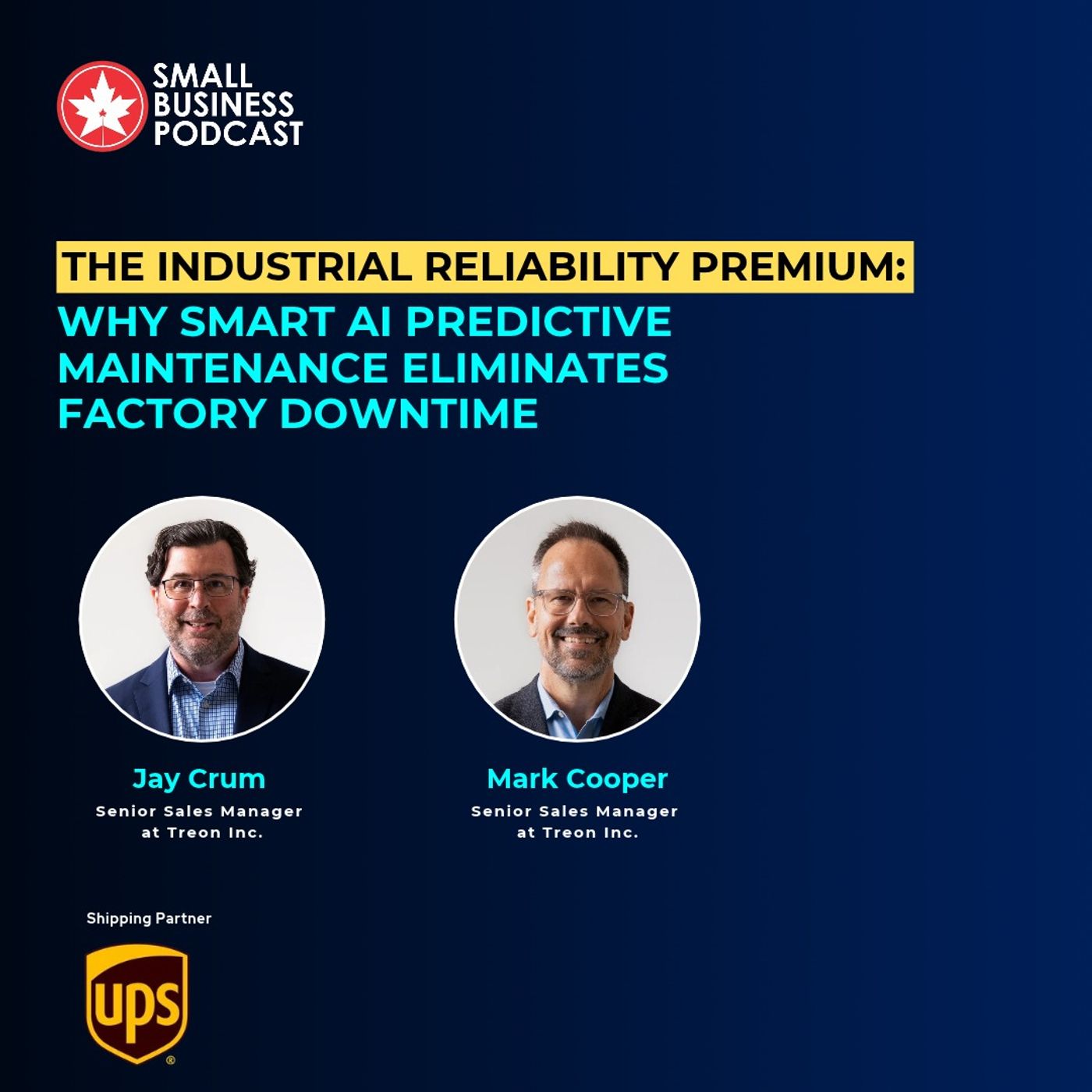
The Industrial Reliability Premium: Why Smart AI Predictive Maintenance Eliminates Factory Downtime
Get every episode summarized
Each time CanadianSME Small Business Podcast publishes, we email you a written briefing from the transcript — the topics, who appeared, and any specific claims, with the ad reads skipped.
Email me new episodesFree for 3 shows. No card needed.
About this episode
“We interview Canadian experts and entrepreneurs to provide expert insight into marketing, innovation, business leadership, technology, and trends that impact small businesses.”From the transcript
Welcome to the CanadianSME Small Business Podcast, hosted by Maheen Bari. A machine rarely announces its failure before it happens, but the right data can. Today, we explore how wireless sensing and AI are helping industrial teams spot problems earlier and keep critical operations moving.
Joining us are Jay Crum and Mark Cooper, Senior Sales Managers at Treon. Together, they bring hands-on expertise in predictive maintenance and industrial digital transformation, helping companies turn equipment data into smarter maintenance decisions.
Key Highlights
- Maintenance Reset: Why traditional equipment checks are struggling to keep pace with modern operations.
- AI on the Floor: How intelligent tools can give technicians better visibility without replacing their expertise.
- Predictive Advantage: Using equipment data to catch issues early and reduce costly downtime.
- Migration Made Easier: How Treon is helping industrial teams transition from Amazon Monitron.
- Reliability First: A practical starting point for leaders looking to strengthen equipment performance.
Special Thanks to Our Partners:
- UPS: https://solutions.ups.com/ca-beunstoppable.html?WT.mc_id=BUSMEWA
- ADP Canada: https://www.adp.ca/en.aspx
For more expert insights, visit https://canadiansme.ca/ and subscribe to the CanadianSME Small Business Magazine. Stay innovative, stay informed, and thrive in the digital age!
To learn more about how we are supporting the ecosystem, please visit the CanadianSME Small Business Foundation at https://smbfoundation.ca/.
Disclaimer: The information shared in this podcast is for general informational purposes only and should not be considered as direct financial or business advice. Always consult with a qualified professional for advice specific to your situation.
Get every episode summarized
Each time CanadianSME Small Business Podcast publishes, we email you a written briefing from the transcript — the topics, who appeared, and any specific claims, with the ad reads skipped.
Email me new episodesFree for 3 shows. No card needed.
Hosts & guests
Transcript ready
214 searchable segments. Every word is indexed and playable.
Full transcript
CanadianSME Small Business Podcast — The Industrial Reliability Premium: Why Smart AI Predictive Maintenance Eliminates Factory Downtime. Machine-transcribed; use the interactive transcript above to jump the player to any line.
Welcome to the Canadian SME Small Business Podcast, a podcast for Canadian Small Businesses. We interview Canadian experts and entrepreneurs to provide expert insight into marketing, innovation, business leadership, technology, and trends that impact small businesses. Whether you're just getting started or already established, UPS is here to help you make the most of your time. Their services, tools, expertise, and team of UPS small business ambassadors can help businesses with all sizes, simplify processes, improve customer experience, and guide you on the path to growth. My name's Elaine Tank-Komo, founder of Easy Dazies, the Elevator Schedules for Kids, and I want to invite you to visit UPS.com to learn more and save up to 52% or more on shipping. This is a paid advertisement. Hi everyone, this is Mahin and welcome to today's episode of the Canadian SME Small Business Podcast.
In this episode, we unpack industrial digital transformation, wireless asset monitoring, and how AI is solving persistent operational bottlenecks across manufacturing, energy, and process sectors. Because in 2026, protecting a production plan, logistics facility, or energy operation from sudden machine roof laborers, labor shortages, and expensive downtime requires shifting from manual root checks to automated AI analytics and wireless sensing. Following us today, our Jay Kraman Mark Cooper, senior sales managers at TREON, Together Jay and Mark brings deep expertise in helping industrial companies accelerate digital transformation, improve operational reliability, and scale predictive maintenance. Alperating across North America, Europe, and global markets, TREON serves over 200 international clients with AI driven smart industry solutions, recently winning the 2026 Red Dot Product Design Award for its industrial, Nordic sensor, and providing seamless migration pathways
for Amazon monitoring platform users. So let's dive straight into our conversation and welcome Jay and Mark. Jay and Mark, it's an absolute privilege to have you both join us on today's show. Welcome to the podcast. How are you? Fantastic. Thanks for the opportunity. We're looking forward to it. Yeah, nice to meet you. I'm looking forward to it as well. I'm very excited to delve into these exciting things I mentioned in my intro as well. And yeah, on that note, we'd love to open our discussion by understanding the Industrial Triple Challenge, which are aging workforces and operational inefficiencies. You know, a lot of industrial producers across Canada and worldwide, they're grappling with a triple threat, which is, as I mentioned, an aging technical workforce, rising operational inefficiencies. You know, catastrophic cost of unexpected equipment downtime. Please tell us why our traditional maintenance strategies failing today.
Yeah, thanks, ma'am. Don't want you to get me wrong. I don't think the traditional maintenance strategies are necessarily failing because maintenance teams are doing something wrong. I think the challenge is that the man's placed on these teams have changed. And today, plants have more assets to maintain and experienced technicians are retiring at the same time. And the people who remain are being asked to cover increasingly larger operations. And I do a lot of work on LinkedIn. This is kind of a real world scenario. I have, I can see at first hand where some of my older connections throughout the years, are now, and probably in the past two years, are posting retired next to their profile. So it's a clear reminder about quickly experienced maintenance and reliability professionals are leaving the workforce. And how much of that knowledge is actually just leaving with them.
So many facilities are still, they still rely on these scheduled maintenance or manual inspection routes, or they're simply running equipment until it fails, which is never good. And then scheduled maintenance can result in servicing equipment that's still healthy. So they're diverting their attention for no reason to that equipment. And then at the same time, a developing problem may be going undetected between these inspections if you're running around. And when equipment is allowed to run until failure, you can imagine the consequences can be much more expensive. So don't want to do that. And unexpected breakdown can stop production. It could damage related equipment or even create safety factors for your employees. And I think really, I think really the limitation is the visibility across the plant. If you expect an asset periodically, you know it's conditioned for that particular moment
and time. But you're missing a mountain of information in between. So that's where continuous and wireless monitoring like Trian comes in and provides a much clearer picture of how that equipment's health is changing over time. Yeah, go ahead. Yeah, I was just going to say, don't get me wrong that the goal is not to replace the technicians. It's the goal is to give those technicians better information. And then they can spend less time collecting that data. And a little more time solving problems that actually require their expertise. Right. That perspective really provides a crucial reality check for modern plant operators, really facing severe skill labor shortages. Now let's look closely at practical AI applications on the shop floor and explore how smart algorithms support boots on the ground technicians. How does AI support industrial maintenance technicians?
Well, you know, the big idea behind predictive maintenance technology is that we're going to get rid of the surprises, right? No more unplanned downtime. We're going to operate more efficiently. We're going to fix things right the first time because we know what to do. That's the aspirational goal and that's the big problem that we as an industry are trying to solve. Where the rubber meets the road on the shop floor is that in order to solve that problem, we actually have to create three more problems for the technician. And that's the unspoken part of this. And it's why a lot of technicians are not always trusting of new ways of doing things. Because in this case, we're sending signals about something that actually hasn't happened yet. Now the problems we create in this process are number one, a validation problem. I'm sending you an anomaly. Is it a true anomaly or is it a false alarm? Number two is a diagnostic problem. Okay, what's the root cause of the anomaly? And then number three, it's an action problem. How urgent is it? How imminent is it? Can we wait? Like do we have bigger fish to fry?
So anyway, if we can solve the first two in part of the third with data and AI, then we really are delivering on the promise of predictive maintenance, making technicians a lot more efficient, a lot happier with their jobs. In fact, it's like we're giving them a super power and they don't have to come in for the surprise third shift three and shut down, right? And that offers that offers a brilliant perspective on deploying human centric technology across industrial environments. So thank you so much for sharing this this this technology mark. Now let's transition into business economics and analyze how wireless condition monitoring all draws the financial cost of reliability. We sell us how does predictive maintenance reduce costs and downtime? Yeah, sorry, I mean, I think predictive maintenance allows an organization to make maintenance decisions based on actual condition of its equipment.
And this is instead of reacting after something fails or maintaining equipment simply because the calendar says it's time to do it. And the maintenance team can respond to real changes and equipment and the real health in that current time. So wireless sensors can continuously monitor those most important indicators like vibration and temperature among others, but now the system detects a meaningful meaningful change. And the maintenance team can investigate that issue and schedule the work before it becomes a production stopping failure, which we all know is not a good situation. And being able to do that can create savings in several areas. I mean, it can reduce emergency labor requirements. And it can also help prevent secondary equipment damage. And they can reduce unnecessarily replacing parts and utilizing that inventory that you shouldn't even have to do. So I think the most important thing is it can help avoid the high cost
of unemployed unplanned production interruptions. Otherwise known as downtime. So in a whole predictive maintenance also helps teams prioritize their limited resources that we're talking about. And instead of treating every asset the same, they can focus first on the equipment that is showing signs of degradation. And the past continuous monitoring was reserved pretty much for the plant's most critical and expensive machines. What I think and I see especially it can be seen in our node C and node X sensors. What we're looking at is that today is a changing of the economics of the deployment process. So today, scalable wireless technology like Trian makes a practical to monitor many more assets that balance of the plant asset. These are motors, small pumps,
fans, conveyors, and even gearboxes. And these are the assets that may previously not have been monitored just strictly out of budget concerns, but they can cause problems nonetheless. And really, I think the greatest benefit comes from identifying those small problems while the plant can still have choices rather than stubborn after the equipment has already failed. And really that's go ahead, Mahi. Those insights to deliver a very magnificent blueprint for demonstrating smart industry technology across facilities of pretty much all sizes. And it gives us a good opportunity to see how changing the economics of maintenance can help decouple the reliability from the headcon perspective. Now let me steer our conversation towards migration pathways and examine how plants, transitions smoothly from legacy platforms. How does Trian simplify industrial platform migration?
Yeah, that's a good question. Mahi, I think, you know, first off, I'll say that people, this is usually a new technology that people are adopting. So there's nothing to migrate from. They're migrating from doing nothing. They're migrating from not watching it. However, there is a case, a special case with Amazon monotron. If somebody's using that platform that has been discontinued, it's actually quite simple. Our platform is actually built on the same fundamental tools in AWS as monotron. So the data exchange back and forth is quite easy. What we want to do is get somebody onto a fully supported current hardware and networking platform where you get replacements, when the battery goes out and you get new sensors, you get new batteries. And then what we end up doing is if they're running a legacy platform that is no longer supported, we actually would run both in parallel for a baseline period. And that's where the sensors do most of the learning about what the machine is doing. Once that's done, then they're fully operational,
they're fully onto the new platform. We actually have created a bit of an incentive package that allows that offsets the cost of the new hardware to onboard onto the assets. Very much like putting on a like imagine you using a cell phone, you want to go to a new carrier, then will give you the phone for free for renewing the contract. There's something very similar like that in our case with the the urswile monotron users out there. Well, that provides a remarkable model for preserving existing hardware investments while upgrading intelligence. Now, let me go your sales strategies, both of yours, background and industrial transformation expertise into an immediate practical takeaway for our listeners as we wrap up. Please tell us what step can fund leaders take to improve equipment reliability and how can industries build resilience smart operations? Yeah, I think a strong first step would be for those teams to take it straightforward,
asset criticality and monitoring gap assessment. So look at those critical assets and the gap in the monitoring that's going on. Then plant leaders should really ask themselves three basic questions. I think which assets could disrupt production if they failed would be a critical one. And in which assets are currently monitoring only through periodic inspections would be a second one. And which reoccurring failures out there in your facility are creating most of the maintenance time and money problems. So those are the three questions I take a look at. And then just remember, a company does not need to begin monitoring everything in the facility. Really, it's a good idea to start with just clearly defined group of assets where an unexpected failure would have a measurable operational consequence and then establish a baseline. Then monitor those assets continuously
through a platform like Trian and agree in advance on who will review those alerts and what the actions going to follow afterwards with that data. So I believe technology alone will not create the reliability. I think a successful program from what I've seen requires management's ownership. It really takes buy-in and engagement from the technicians and then a repeatable workflow that would come out of that returning that information into action. That's critical. So once the organization demonstrates value in that one area of the plant, they can easily expand that program and based on the actual results that they're seeing. Right, right. Why did you want to add something to that? I would just say, I mean, we're talking about high-level practical steps. I would just say, you know, get really curious about your machine health data, but as an operational category, you know what I mean? Not just as it's, you know, mental knowledge that a technician has that
note just from being there being close to the equipment, you know, just but understanding as an asset, as an operational asset, that the machine health data itself, because without that knowledge, without that machine health data, you really can't say you have true operational awareness. And without operational awareness, you really can't drive the kinds of improvements that you want to drive without introducing some form of risk into the process. You know, and there's nothing like hard-driving equipment over time to meet some demand or some spike in demand, only to go down because something broke that you didn't know was degrading. You know what I'm saying? Right, right. So that is such a spectacular final thought, reminding us that industrial success, it really relies on combining smart edge sensing, accessible AI analytics and empowering technicians on the shop floor. So thank you to the both of you for joining us to share your mastery today and for your sharing such great expertise in your insights. Thank you.
Yep, thank you. And I would just say, I'd treat on here to assist if you need help with your organization. So we'd be happy to talk. And thank you, me and. Thank you so much to the both of you again. And this is, that brings us to the end of our conversation with Jay and Mark, the delivered such a practical masterclass on eliminating unplanned factory downtime, deploying scalable wireless sensors and leveraging AI analytics to secure manufacturing reliability in 2026. Thank you for spending time with us on the podcast. Please be sure to check out our website for more practical business strategies and to discover how we're supporting the ecosystem. Check out smfoundation.ca. A big thank you to our partner and PSA for their continued commitment to empowering SMBs. Keep innovating, save guard your uptime and join us again for an next episode. Thank you for listening to the Canadian SME podcast. Please visit Canadian SME.ca to subscribe and join us next again as we share more expert advice
from Canadian business leaders.
More episodes
More from CanadianSME Small Business Podcast

The SAP Concur Engine: How Global Survey Benchmarks, Best Flights for Me, and Au...
CanadianSME Small Business Podcast

The Teqare Engine: How AI Scam Protection, Cyber Education, and Financial Litera...
CanadianSME Small Business Podcast

Polar Proven: Pushing Technical Footwear Engineering Into Earth's Most Extreme C...
CanadianSME Small Business Podcast

Technology Should Adapt to the Business: Building Resilient Organizations Throug...
CanadianSME Small Business Podcast