Get every episode summarized
Each time The Pete Quiñones Show publishes, we email you a written briefing from the transcript — the topics, who appeared, and any specific claims, with the ad reads skipped.
Email me new episodesFree for 3 shows. No card needed.
About this episode
“I want to welcome everyone back to the Pekiniana show. Gonna take another little break from the World War I series, what's on the 7777. And we concentrate a little bit on something from my lifetime.”From the transcript
PG-13
Thomas777 is a revisionist historian and a fiction writer.
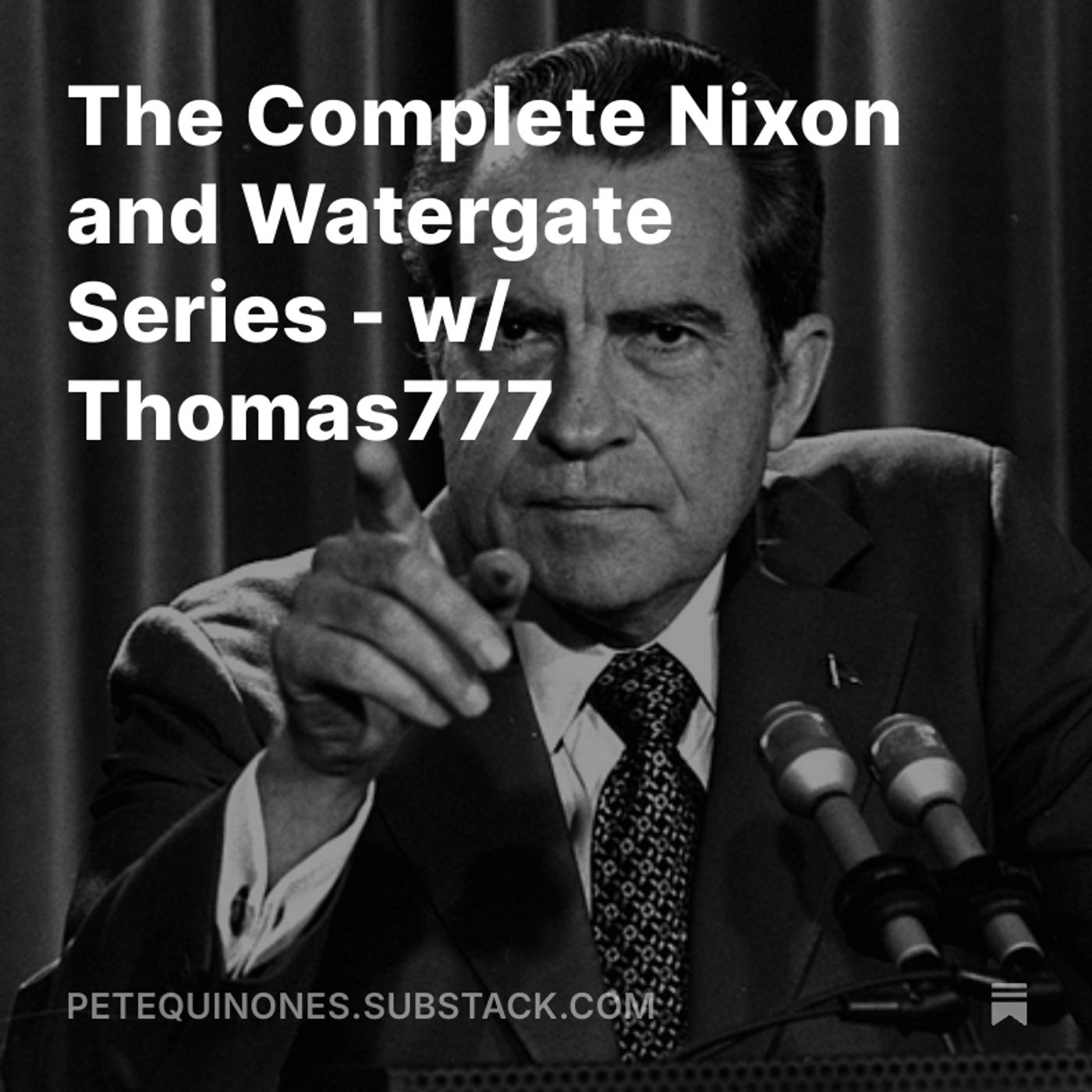
Here, in one file, are the 3 episodes Thomas777 did with Pete covering the Watergate scandal.
Episode 1: Nixon and Watergate - Pt 1 of 3 w/ Thomas777
Episode 2: Nixon and Watergate - Pt 2 of 3 w/ Thomas777
Episode 3: Nixon and Watergate - The Break-in and Aftermath - Pt 3 of 3 w/ Thomas777
Thomas' Substack
Thomas777 Merchandise
Thomas' Book "Steelstorm Pt. 1"
Thomas' Book "Steelstorm Pt. 2"
Thomas on Twitter
Thomas' CashApp - $7homas777
Pete and Thomas777 'At the Movies'
Support Pete on His Website
Pete's Patreon
Pete's Substack
Pete's Subscribestar
Pete's GUMROAD
Pete's Venmo
Pete's Buy Me a Coffee
Pete on Facebook
Pete on Twitter
Become a supporter of this podcast: https://www.spreaker.com/podcast/the-pete-quinones-show--6071361/support.
Get every episode summarized
Each time The Pete Quiñones Show publishes, we email you a written briefing from the transcript — the topics, who appeared, and any specific claims, with the ad reads skipped.
Email me new episodesFree for 3 shows. No card needed.
Hosts & guests
Transcript ready
2,288 searchable segments. Every word is indexed and playable.
Full transcript
The Pete Quiñones Show — The Complete Nixon and Watergate Series - w/ Thomas777. Machine-transcribed; use the interactive transcript above to jump the player to any line.
I want to welcome everyone back to the Pekiniana show. Gonna take another little break from the World War I series, what's on the 7777. And we concentrate a little bit on something from my lifetime. That, you know, this might be one of the first political things I remember my parents talking about. You know, I mean, I was real little, but I think this may have been it. But Watergate, Richard Nixon, 1973. So, um, what's up? The issue with Watergate, there's a historical aspect to it. Like, it profoundly a historical aspect, as well as a political one. And it's particularly timely today on grounds of what's underway with Mr. Trump and what has been underway with him. And the degree to which Trump really is the error to Mr. Nixon can't be overstated. People misunderstand when I say that. I'm not saying that Trump is anything approaching the intellect and Nixon
or that his significance in historical capacities is analogous. But what he, he really, he truly is the error to the silent majority coalition. What remains of it. And the manner in which the deep state works, I don't think anybody denies any more that the deep state is an actual feature of government. That's basically a kind of shorthand, polemical or colloquial way of talking about, I mean, you know, Burnham's managerial state. It shouldn't be controversial if people let it exist, okay? But institutions at scale, particularly institutions at government, they behave in predictable ways, okay? And the forces that are raiding as Mr. Trump as it were, basically identical, all right? And the reasons for his disqualification from public office, you know, his, and his, his removal from office, and now it's something with disqualification.
By, by extra legal and extra constitutional means, you know, it owes to the same phenomenon, if not the same set of circumstances and conditions, obviously. However, in Nixon's case, you know, we're dealing with the origins of what the hostility to Nixon was, and that's more complicated than what may superficially appear. You know, what put Nixon on the map, as a national political figure, independent of his association with Eisenhower was the fact that he demanded elder his be prosecuted, okay? Elder his is probably kind of fallen out of, you know, living memory. I mean, probably this happened, like, almost a generation ago now, okay? But elder his was undoubtedly a Soviet asset that can't be denied, even though this day,
there's a book as recently as 2000 that claimed that this was some sort of elaborate slander of his, you know, owing to, owing to some hostility, you know, the East Coast establishments such that, you know, it existed mid-century, you know, and it was profoundly powerful and still. That's not anything that can't be overstated and what we're going to get into about Nixon. The degree to which the low guy of American power, political power and financial power, the degree to which that was concentrated on the East Coast, they can't be overstated. As recently as the 70s and 80s, you'd, what remained of the old ruling cast, you know, kind of looked with disdain, you know, at the Midwest and the West Coast is not really in the game politically and as, you know, not packing the, not having the pedigree to challenge for public office, okay? And to that the fact that somebody like Nixon was totally at odds with
with their values, at least in terms of the coalition that he came to lead, you know, when you have, you have a situation is developed with Watergate, but in the case of his himself, you know, like I said, his, he was, he was, he was truly like a American gentry. He was one of fight children. Both parents came from these sort of formal, these truly aristocratic Baltimore families who could trace their roots to the mid 18th century. His is, interestingly, his is a name was an angl- it was, it was an anglicization of his, his sounded more anglophone. His paternal great-great-grandfather had emigrated from Germany. And I believe that was his only like non-non-anglophone ancestor, which of course, you know,
in those circles like was, it was cosmetically problematic. Has that something of a tragic up bringing him, his father, the family never had any money, you know, they lived in gentil poverty, as it were, you know, like a lot of people of that kind of caste and station did by the, by the early 20th century, despite the fact that he retained kind of like their social register type, you know, credibility and political clout. His father, Charles, his, he tried a number of different business ventures, you know, some which fared better than others. He did fairly well as a as the head of a dry goods importing firm. Becoming a top executive and, and majority shareholder,
this came to an end then around 1907. His lost most of the family's fortune that he'd so kind of diligently accrued and he committed suicide by cutting his throat with a razor of all means. I mean, really, really kind of awful stuff. His wife was now a widow, you know, with these five children and she subsequently had to rely on, you know, her family's money and basically hand out from people to survive. And Al Jarris, who was only two years old at this time, presumably has made it at a big impact on his life. If you know, being this guy who had this kind of outsized heritage, but he lived up, but he grew up, you know, in a fabulous household and relative poverty. Fast forward to his as adult life.
He ended up at Harvard Law School. He was a progeny of Felix Frankfurt, you know, which became his kind of ingress into the new deal regime early on. Frankfurt had written a book on the Sacco and Vanzetti case. Sacco and Vanzetti were were communists to Jason anarchists who were convicted of terrorism and executed in the New York electric chair. This was kind of the Rosenberg case before the Rosenberg case. And Frankfurt, he wrote it entire treaties claiming that these men were convicted unjustly. For no particular factual reason, just kind of a cause. And his was kind of this like gorgeous Prince who Frankfurt became really alike. His subsequently served as a clerk to Alverwendell home to junior. So he was kind of covering all his bases, okay, you know,
with the tribe as well as with his own people, you know, ended up in this hot shot, Boston law firm, and later a later a New York firm then known as Cotton Franklin Wright and Gordon. I don't keep up with these coastal stocking law firms. I have no idea what it is today, but it does still exist in some legacy capacity. His was a radical new dealer became a government attorney, served briefly the Justice Department. He got a plum position with the NIE committee, which despite the presence of people like his was doing God's work. They investigated war profiteering cost overruns and the pocketing of these overruns by people in the armance industry and in the financial sector who had funded these massive outweighs to fight World War I. And a lot of the for clarity, the NIE committee was not, no, was not himself some kind of radical.
A lot of these people were, you know, like those who later became America first types, you know, but this was the way the way radicals left radicals obviously. I mean, the way they fell on the usual World War I is interesting. You know, they basically told the Soviet line that, you know, this was an imperialist war that was, you know, came about under the intrigues of capitalist and war profiteers. And in the case of the Great War, as we've been covering somewhat, and we'll get more into that, that actually wasn't total too far off. You know, I mean, like we've talked about, the degree to which high finance quite literally had Wilson by the short hairs and essentially demanded, demanded he not allow, you know, a default on these massive, unsecured lines of credit that had been extended the British crown.
The degree to which that was an essential proximate cause of American intervention. They really can't be overstated. But he doesn't, he, during the same period, his, he defended a lot of labor organizers and adjacent institutions against challenges of their legitimacy, either a political nature or a, or a criminal one. He, he became very insinuated into the agricultural adjustment administration, which was for whatever reason strongly connected to a lot of radical elements, more than a few of whom were, were calmness. I believe that O to the outsized power of agribusiness in America, then is now as well as the fact that kind of the
bane, the bane of Marxist Leninist, you know, be them vanguardists or people who favor the broad front strategy with the conspicuous absence of a vagraculturally situated, you know, people and institutions within their ranks. But he, most notably, his kind of shining moment with the Nye Committee was when a Dupont chemical or Dupont industrial, I think it was known at the time. He got the opportunity in 1934 to 35 as an investigator and his official title was legal assistant to the Nye Committee. But he was able to badger these, these big shot Dupont executives and officials on cross-examination and Bernard Barouk, chairman of the war industries board under Wilson and a key, and a key person in the
administration's waging of the war itself. He really dragged him over the, raked him over the coals of the war and dragged him, you know, before the republic audience. He was rewarded, he was younger brother Donald, they were rewarded with a posting under Cordell Hall in the State Department. His was the direct assistant to assistant secretary of state, Francis Sire, who was Wilson's son-in-law incidentally, and as well as special assistant to the director of the office for Far East and Affairs. During the war years 39 to 44, specifically, his was an assistant to Stanley Hornbeck, who again was insinuated into the OASA Far East and Affairs as a special adviser to Cordell Hall himself. So his was a man who was very well situated
to impact policy at a very high level. He wasn't some nobody, he wasn't some, he wasn't some, he wasn't some, he wasn't some, you know, legacy, who's family, no longer got a fortune, this was rewarded with kind of plum jobs that he could like afford gross reason things. I mean, he had real power. Okay, those who would contest that, my rebuttal is that as the war came to an end, oh not only did his attend the US State Department delegation at Yalta, you know, where quite literally the Soviet Union was was afforded, you know, half of the political map of Europe. But he was named director of the Office of Special Political Affairs in 1944. This, this office was specifically and purposefully organized to plan for post-war international
organizations first among the United Nations. Okay, his, his, his self instrumental in the directing of the United Nations charter and the negotiator that went into that. Okay, I don't think I need to, I don't think I need to continue to list his accomplishments and resume to convey that, you know, he was somebody who had real clout. Bunk story short, when it came to light, based on a little testimony that, you know, his had been a Soviet asset for many years. You know, and this was, this was at arguably the zenith of what came to be known as the McCarthy era. The fact that Nixon was his primary antagonist, you know, McCarthy, I believe, was a well-intentioned individual. And people forget too, what brought
down McCarthy was Roy Cone's, you know, to be delicate about it, his persuasion and his exploitation of his office to get special treatment for David Shine, who, if he was not actively involved in almost sexual affair with him, Shine was quite obviously the object of Cone's affection. That's what brought down McCarthy. It wasn't that McCarthy was going after innocent people or had confabulated some imaginary narrative of communist under the bed or whatever the current claim is of court history. But regardless, even before all of that, McCarthy, McCarthy had a reputation as something of a Yoko. You know, he was from Wisconsin, whose representatives and senators didn't get a lot of respect. He was an notorious alcoholic. It was a lot easier to dismiss somebody like McCarthy than it was somebody like Nixon, who even his enemies admitted was an
obvious, you know, subant and, you know, a constantly serious individual. And Nixon had studied the FBI record to the point, practically, of memorization, you know, his, what he presented against his was airtight. And the establishment from whence his emerged never forgave Nixon, you know, I know in the Oliver Stone film and things, which in some ways is a very good film, the biopic of Nixon. Nixon kind of presented, you know, throughout the film and particularly at the height of Watergate and his fall from grace, as this man kind of, you know, tormented by phantasm and seeing these sort of establishment antagonists, you know, within the shadows, who may or may not have even really existed. That's a completely mischaracterization. The East Coast establishment hated Nixon. You know, the New Dealers hated Nixon.
They hated him. They hated them in a way that not even people who suffer from trontorangement syndrome hate Trump. You know, like they, this cannot be overstated. Okay. So if you want to understand, we're going to get into the career of Nixon and the circumstances of Watergate in a minute. But this cannot be overstated. Okay. And the degree to which, in part, the Watergate scandal was revenge for Alger His, that must be considered. Otherwise, everything subsequent is missing a key component of the evidentiary record and the causal nexus. Okay. Now, I believe also it's key to understanding the attack not just on Nixon, but executive power generally. After World War II, the only historian, mentioned a story, and I know who addresses this specifically as Paul Johnson. What I've mixed feelings about. He's written some very good,
he's done some very good work. He also pretends the resort to kind of shrill neo-counish kind of canards, particularly discussing, you know, US foreign policy and things like that. And he's got a tremendous blind spot about why the fortune is the American right, precipitously and totally deteriorated after an armoring. But they had a side. He brings up the point of what exactly brought down Johnson, you know, Lyndon Baines Johnson. Now, Johnson at one time had a very strong mandate. The Vietnam War, until Tet. And we'll get into that in a moment too. It was fairly popular.
Johnson's, Johnson pursuing zealously, you know, the civil rights crusade and doing so in a way that on other policy initiatives would have been viewed probably as overreach. But because, you know, the East Coast power center of the country, as well as, you know, radicals all in sundry who identified with those values, you know, they viewed it as, you know, a necessary evil, you know, for the chief executive, you know, to kind of like bypass legislative solutions and even, you know, this even even even the machinery of the judiciary in order to kind of force outcomes. That's why Johnson was doing what he was doing in that regard. You know, Johnson kind of had this soul of a pig. Okay, he was not a good man. But, you know, the degree to which he was basically cowtowing to an establishment that he knew had nothing but this dain for him has got to be considered. And, you know, Johnson, Johnson was kind of the consummate,
uh, they've probably never been a man who was more skilled at backroom dealing. And the achievement of consensus on key policy initiatives across the partisan divide and Congress, like it's really remarkable. But, Johnson was also a redneck southerner. Okay, and, um, he said, you said in no uncertain terms, um, like literally he's quoted saying, I do not believe that the nation would unite definitively behind any southerner. Um, I want to ask why he said, well, the metropolitan press would never permit it. Okay, what is you from, what he was utilizing when said metropolitan press take from that where you will. I think people know the history of this country as well as some aspects of the present dilemma should be able to see through that pretty clearly. Um, it increasingly became a narrative
in the national media that what Johnson was doing in Vietnam specifically was dangerous. Now, it might do in living memory, there was the Roosevelt administration where Roosevelt had literally incarcerated Germans, atelian and Japanese and concentration camps. He shut down national media, um, absorbing all, uh, coverage reporting on the war into the penumbra and authority of the office of war information. Um, he had people arrested without formal charges for criticizing the war effort under auspices of national security exigencies, like the idea that, um, the idea that LBJ was somehow acting against precedent in time of war with preposterous. And, um, obviously, two, you know, uh, Kennedy and, and Johnson's predecessor, he'd been Eisenhower.
You know, not only was Eisenhower, not only was Eisenhower the equivalent of a five star of which there's, you know, only been three. Um, he very much ran the oval office like a five-term general would. You know, so this kind of sudden, this kind of sudden declaration that an imperial executive is a foot. And that's, and that's un-American. Um, it was a, it didn't make a lot of sense upon a superficial, um, analysis, but there was a basic revolt against authority that had been brewing. Um, and a lot of that had to do with, again, despite the fact that Johnson was very much cow-towing to a minority elite opinion with the Civil Rights Act and the, and, and all, of 64 and all the kind of incidental and adjacent efforts towards force and aggression and, you know, social engineering. Um, it didn't matter. And the president being the country's only nationally elected representative.
And being a prime symbol of government. And, um, you know, kind of the great power that's expressly coded into Article 2. Um, as the kind of new political culture, post 1933, you know, ossified, um, it, uh, it, the deep state was no longer willing to abide. Um, an executive acted like a chief executive. Um, obviously this, uh, uh, became more pronounced when Johnson, um, when Johnson resigned. There, um, under pressure, but, um, you know, there was something of the, uh, there was something of the same treatment in Nixon and Johnson, er, I mean, even, again, you know, the, the earlier his question was, um, an essential cause, if not the sole proximate cause,
of, you know, the hostility to Nixon by the National Press on the Deep State. But again, it was Nixon's status as outsider. You know, 1962, Nixon ran for governor of California. And Nixon was a Californian. And, uh, I believe that this is why he had a very specific centric if you of Jewish strategic matters. And I highly recommend that not just as memoirs, but the booksy wrote on grand strategy in the epoch after he left office. Um, it indicates every strong understanding of the key strategic implications of not just military force deployments, particularly of a strategic nuclear category in the far east. But he had an understanding of the outsized power in global economic terms that the Orient would have. And this kind of thing was totally alien to the East Coast establishment among other things. They looked at Nixon as like
upstarted Oak E. Trash punching above his weight. Um, these East Coast reporters during the campaign for the 1962, governorship, they, they out now just poked fun at Nixon. They made fun of his clothes. They made fun of the way he talked. Um, you know, they made fun of his, uh, alleged awkwardness, you know, and, and kind of lack of interpersonal manners. That's the famous dumb, the famous, um, sound white. Where Nixon says to the press afterwards, just think how much you're going to be missing. You want to mix into kick around any more gentleman, because this is my last press conference. That was his concession. Um, announced when it's 62. Um, well, did how much of this carry over from the 1960 campaign? That was part of it. Um, definitely. But I mean, he,
he, um, his concession there, I mean, Nixon actually looked like a gentleman in 1960 in a lot of ways, especially, especially, um, he never gave up till the end. But there was a lot of dirty pool in that election. And probably an absolute terms, like in real, in real numbers terms, it was probably too close to call. They got a full, they got a full frontal assault on Nixon by the East Coast press, um, I missed that kind of presentation that, you know, the national audience had been afforded would have, um, would have been somewhat unseemly. I think the point about 62, because in a lot of ways like the metaparrivial mask drops. Um, what prompted Nixon's comeback. Um, you know, as we've talked about, you know, the catastrophic
defeat of buried goldwater, you know, goldwater himself was a bizarre placeholder. But it wasn't just going to a lack of, of percentages who could interface effectively with kind of the, the era of new media, you know, it's that like we've talked about, um, Kennedy's literal eulogy to taft and proviles encourage, you know, post-Nuremberg, I mean, there wasn't a more American right. It was, it was, it was from practical purposes illegal in policy terms. And, and ethical, and optical terms, it was just unthinkable, you know, to have an America first party. So what, was the Republican party? Well, you know, they got behind EIC because like who could, you know, who could, um, who could disdain EIC, you know, um, I'm speaking within the founded rationale, the perception of the time, obviously. So they picked goldwater, you know, again, who's this
gadfly, is this gadfly proto-libertarian who goes around, you know, um, it basically like reciting manifesto is about why we need to abolish the IRS, you know, he was at the bizarre choice, you know, but again, um, it owed the fact that there was now, um, there was now an official opposition that was precluded from even acting as, oh, as an official opposition in formal terms. Um, of course, despite the hostility to, um, despite the hostility to Johnson, you've got to understand that the, uh, the, the, the left radical establishment in the deep state, their idea was that by forcing Johnson to step down that, um, the heir apparent would be Bobby Kennedy.
Okay, um, the Kimmel at myth was still alive and well. Kennedy, believe it or not, um, he had, there was actually some cross over appeal with Wallace voters and not just ethnic Irish guys because the Hoi Ploy don't, they, they don't really think deeply in policy terms. They didn't matter that like Kennedy was basically this like radical. You know, they, he, he was viewed as kind of like this, he was, he was, he was viewed as kind of like a pugnacious, you know, like young, like white ethnic type guy who was like a man of the people, like our misguided that might have been. But the point is, he was their ace in the hole, you know, and um, he was bizarrely murdered, you know, by Srirhan Srirhan. And um, that threw everything into chaos. That made LBJ's vice president, he were hungry. The, uh, the front runner, um, and uh, he was an experienced campaigner and he might have, uh, you know,
he experienced like literally all day. If LBJ had given him, you know, the loyal support that, you know, somewhat argue had the right to expect. And in particular, he had, you know, kind of greased the skids for him to advocate withdrawal from Vietnam. He would have probably had a good chance. But Johnson was understandably better by now. And Johnson's, Johnson's, um, Johnson's know, if you listen, you can find it on YouTube. You'll listen to Johnson's discussions with Senator Everett Dirkson from this time. It's really revealing. Johnson's base, he like, fuck you. I'm gonna burn it down. You know, I'm gonna burn the proverbial house down. I don't care if the Republicans take over, I'd like to see him take over after what you did to me, like see you later. You know, fuck you very much. Um, in addition, um, and you can see, you can see him saying it just like that. Yeah. Yeah. Yeah. No, 100% and, uh, in addition, it's 68, obviously,
you know, was was Wallace's run. Um, and, uh, as a result, um, you know, uh, Nixon won fairly comfortably. Um, it was, uh, Nixon got, Nixon got close to 30. He got 31. Nixon, Nixon pulled 31 million, seven hundred and ten thousand, four hundred seventy goals. The Humphrey's 30 million, eight hundred and ninety, thousand, fifty-five. Wallace poached, uh, just under nine million, five hundred thousand. So an electoral, at the, in the electoral votes was three oh two Nixon, one, anyone home, three, forty six, Wallace. Um, the, um, the, um, I mean, it doesn't sound like a huge margin, okay, but in, in actual terms, like Nixon's victory was, I mean, it was, it was, it was, it was a definite,
it was a definitive statement. Okay. Um, however, Wallace's spoiler campaign, it meant that Nixon was a minority victor in absolute terms that came out to 43.4% of the popular vote, which was the lowest percentage of, um, an elected president since Wilson won the 1912 election. People forget Woodrow Wilson ran in a four-man race. Um, he ran against and come in president William R. Taft. He ran against Teddy Roosevelt, who was on the progressive or bull moves party. And he ran against, um, Eugene Debs, like the socialist party. Okay. Um, it was also, there was a low poll count too. Only 61% of registered voters turned out. So the refrain, the refrain of media became, oh, Nixon, Nixon only, oh, Nixon only got 27% of all voters. You know, what kind of mandate is that he's not legitimate. And they bandied this over and over and over and over again.
You know, Nixon's not legitimate president. Nixon, Nixon, he didn't carry a single big city, you know, like Nixon's erases, you know, like Nixon, um, these Wallace voters, you know, they, they only did what they did to like, you know, like Nixon. And you know, we know what they are, you know, they're, they're those southern people. And um, this went on and on and on and on and on. You know, like it was, um, like I said, it was, um, you could think about the, then think about the campaign against Trump, you know, this was like, this was like the 1.0 version. Okay, just this constant effort to undermine the legitimacy of Nixon's presidency, that a return. I think it's the implications of this, you know, Nixon takes the oath of office in 1969. Um, in 1968 or 11,000 Americans were KIA in 10s of thousands wounded. Um, you know, the Soviet Union was, um, had not yet achieved parity, but, uh, it, um, it had, it had it had it had a nuclear arsenal, um, that, um, could absolutely devastate Europe,
the United States and the general war. Okay, and the technological gap was, was rapidly closing, as we're going to deeper parities. You know, um, relations between Pete King and Moss, government deteriorating, but the communist block and not yet fractured. I mean, uh, aiming to undermine a war time in president, um, in this regards, unthinkable. And just, I mean, to take it back when it's a Johnson, when you think about, uh, Prank going at TV and saying the view of the war was lost, you know, and, um, attacking the unwillingness of the Johnson administration to open the decision making process to public scrutiny and time of war. Like I mentioned, if, um, imagine if it will work to imagine if it's a gasoline pass, you know, when, when the American Expeditionary Force met the Verimacht in North Africa, like they were humiliatingly wiped out. Like imagine if that happened Walter Winchell, one of the radio and said, the war is lost, Mr. Roosevelt is a liar. You know, like I, I mean,
you imagine that like, he would have been immediately arrested. That never would have tolerated it. You know, this, um, this, this is truly insane. That this was allowed to happen. And, you know, people, even people not ideologically inclined, particularly, simply looked at it as, oh well, that that's just politics is usual. You know, it's, um, it's, it's incredible. It's the most, it was kind of the second revolution in my opinion after the 1933, um, New Deal revolution. But, um, was I missed this context that Nixon quite literally told his staff the press is the enemy. He was cool by saying that to Paul Devon, I believe. But the news is concerned, nobody in the press is a friend, they're all enemies. Um, the, uh, you know, the men, it is Paul Johnson related. The men and the movement that broke Lyndon Johnson's authority and
broke his back in political terms in 68. They turn their gun search proverbially on Nixon. Um, and on top of that, they had even more powerful allies because they had people with long memories who were quite literally the friends of Alger hits. You know, um, it, uh, uh, also it became, it became something of, uh, uh, it's, it's an understanding of the degree to which there's like a sea change and kind of the chorus of American thought. Um, it was an issue of first impression for the American media or for any other, you know, kind of deep state actor or adjacent power based. I want to diminish the presidency. Like to that point, um, really the only opposition to a strong chief executive, particularly at war, they come from Congress and specifically the Senate. You know, like if they are,
um, who, uh, whatever one thinks of them and we certainly have nothing nice to say to women in these quarters about them in these quarters, he was highly quotable. He said the only way to do anything in the American government is to bypass the Senate and like people chuckled when he said that, but he was being a deadly series. Um, you know, uh, Wendell Willicki, you know, who was, uh, one time opponent apparently, um, apparently said, apparently said, the Roosevelt, like subsequent that he, he's like, look, okay, I understand, I've quote devoted my life to saving America from the Senate. Um, under FDR obviously, but even Truman, the press, academia, um, finally the entire commentary, especially informed policy, um, matters. They were firmly behind the president. Um, the huge Congress is being full of opportunists, he's got a parasitic careerist, you know, like men who, uh, were constantly looking to obscure
the reality of policy in favorite sheet polemic, you know, and uh, it's it to basically just, you know, kind of like guarantee their own permanent competency. Um, you know, the, uh, the, um, even the newer public, um, this was in 1953, which was, you know, when Truman was approaching kind of, isn't a deer, um, of approval in the court of public opinion, you know, because the Korean War wasn't incredibly unpopular war, especially the draged on, one of the things. The new republic, uh, was quoted as saying, oh, the current gravity agent of power in the end of Congress at the expense of the executive is a phenomenon so fatuous as to be incredible if the facts were not so bad. And that's the new republic, you know, which in the 50s was um, dividing its time between screaming that everybody in America's racist and talking about a great the Soviet Union is, you know, this wasn't, this wasn't the Wall Street Journal and it wasn't
a bunch of John Burgers and it wasn't a bunch of, you know, like dissident America firsters who, you know, had a, uh, and hope to see um, Robert Taft become the president. This was, this was like, literally a bunch of reds like saying this, um, Eisenhower repeatedly involved executive privilege. Um, and on all kinds of matters, um, to deny um, information about government activities to the House and American activities committee. And uh, he was universally applauded by media. Um, there was a, there was a universal consensus that there was no right to know what went on in the inter councils of foreign policy and uh, the machinery of war and peace. You know, it was like fast-iled people to think they had a right to know about that. Um, you know,
over into the national security implications and the fact that this is just not something that is up for debate. You know, you can't, you can't reduce war and peace questions, particularly over into the complexity of the Cold War as it were, you know, to catch phrases or, you know, bumper sticker polo because it were, you know, like it was absurd to suggest that there should be any transparency on, um, matter of the national security and the decision to wage war. Um, I mean, this was, uh, this was um, this was, you know, a decade, this was 15, to this attend at 15 years, um, before um, Johnson's and ceremonious um, de facto removal from office and um, obviously, you know, the subsequent and more fervent treatment in Nixon. So, in just for context, you know, like we're not talking about like decades here. Um, it was really um,
um, the obscenities dictum also, part of this was him. I think trying to show a strong face contract cruise shift, but uh, Kennedy literally stated in 1960 as the president alone and must make the major decisions on our foreign policy. And that was what was demanded, you know, not just, not just by the electorate, but also, you know, the media establishment and, um, and the national security establishment, you know, particularly when executive decisionism and that capacity, um, included the decision to kill 10 to millions of people and, you know, a general nuclear war. Um, so this um, it wasn't, um, nobody really talked this way about article two,
or about the presidency itself until the Gulf of Tonkin. And I know that people have bad feelings of the Gulf of Tonkin. And I'm not saying they shouldn't, but for context, and I want to go to our fuel in this topic because it's highly tangential to the main subject. There's always abfuscation when you're talking about the decision to go to war and how it's presented to the public. I mean, even under the best of conditions, as it were, but post-Nerremberg, when um, it quite literally was declared that war as an instrument in national policy is illegal. There's this kind of tortured logic that was engaged in in executive policy circles about what constituted it causes belly. And this kind of commitment to euphemizing the fact that war was underway at all. Everything was um, a police action or an
intervention necessary to offset a communist violation of sovereignty. And again, this kind of like literal, like lawyer ball by which everybody in the executive chain of command tried to find a way to not admit that war was underway. Okay. Um, the Gulf of Tonkin resolution has to be understood within that context. All right. Um, even that said, there was not the right way to proceed. And there was a collective security arrangement that was dedicated to the defense of self-heat. Um, but such that it was, the decision was made to procure the war mandate within the parameters of this narrative. Okay. But that was a starting point for criticism of what became no, not just uh, punitively and kind of colloquial terms of on the op-ed pages,
but came to luge, loom conceptually in people's minds as this real and not that endangeless phenomena of the imperial executive is the gullbotog and resolution and discussion around it. It really represents the kind of sea change in how executive authority was viewed. Okay. Such that any one moment can be identified as the point at which things have changed. Um, um, now what Nixon did to protect um, his and the Ascent Administration, his senior White House advisors were Bob Haldeman and John Erlichman, both of whom are villainized to various degrees. You know, my people shouldn't know better.
Um, Haldeman Erlichman and Henry Kissinger were kind of the key to the Nixon administration and advisory capacities. Kissinger's role in this regard is interesting, not just because he and Nixon were one in my opinion on how they waged the Cold War and uh, their vision for resolving it, quite literally ending it. Um, it could not have come about that, that that that pattern of um, conceptual variables could not have come about without the participation of both men. It's a, it's an instance of kind of a shared strategic vision. The nuances at which were so myriad, it's rare that there could be a true meeting of the minds in their regard, but that someone explains the bond between Kissinger and Nixon. It wasn't a bond of friendship.
But beyond that, Kissinger developed an outsized influence in the Nixon White House. I don't even mean that punitively, but I mean, the reason why that even Watergate Kissinger sort of joined Haldeman and Erlichman as um, in kind of the true inner circle, like that's why. Um, now whatever you can say about Haldeman and Erlichman, these guys were incredibly competent people and they were rapidly devoted to Nixon, that is true. Um, backing that up, if you want to think about this in football terms, it's like this, the secondary of the Nixon White House. But, um, Nixon speech writers and, you know, sort of um, media element, it was William Sapphire, Papp you can and Ray Price and David Gurgon and Lee Humner. Um, this was arguably the best, like, media speech writer team ever assembled until, um, until Reagan.
Okay, so I mean, this was a crack administration team. Um, not only had Nixon, Nixon, Nixon Kissinger developed the first true, kind of clear geo, strategic, geopolitical strategy for America. Since I was in Howard left office, but one would think that this is kind of the ultimate PR machine, you know, like what could go wrong, you know, um, Pfft. Nixon also, I mean, if you listen to the Nixon tapes, as well as, you know, read Kissinger's memoirs, both which I highly recommend to people. Nixon had a clear view for the Vietnam War. He viewed it as a short term problem. He didn't really view it as a quagmire. Um, the things that truly mattered, um, was solidifying in NATO, um,
solidifying specifically, you know, the land assistant alliance with the UK, which at that time appeared to be in potential jeopardy. And, um, specifically, breaking Peking away from Moscow and fracturing, you know, kind of the key, um, the alliance structure, the communist block. Um, this idea of Vietnam, the unwindable war, that's revisionism of a punitive source. Um, Krait and Abrams, who was a brilliant combat commander, you know, had replaced Westmoreland. The US Army had, um, pretty much abandoned, um, what had, you know, the kind of strategic hamlet, um, orientation, in favor of annihilating the people's army of Vietnam, to fairly great effect.
Um, effective deployment of massive firepower. To neutralize the advantages the enemy had. Um, the, uh, widening of the war to deprive the enemy of key tactical havens. Um, the base we unrestricted bombing in North Vietnam, um, to prevent, um, you know, effective utilization of, um, um, of their own combined arms brought to bear, which was most exemplified by Linebacker 2, stopping the Easter offensive in its tracks. But, um, you know, Nixon, Nixon, the idea of Nixon as this president, kind of in the same scenario as LBJ,
you know, pouring over the map of K-San, the scale model of K-San, having no idea how to proceed in the war, you know, being kind of, being kind of, uh, entrapped in, and, um, it duped every opportunity, you know, by, um, um, by the enemy that that was not the case at all. Um, even before a single shot was fired, uh, between the peoples of public China and the Soviet Union, Nixon was adamant that friendly relations with China could be brought about by intelligent diplomacy. That China could be decoupled from Russia at the end. The Soviet Communist Party could be fatally undermined without a general war, and indeed all this came to bear. Um,
and in terms of the raw, in terms of the raw successes of Nixon's administration, I found some of the things that I think are in our fuel. Again, well, imposing, unsustainable, or what have been unsustainable attrition and the North Vietnamese mixed it scaled down the US military presence, um, from its peak when he took office, it just interfered to 50,000 men, the 24,000, and spending the client from 25 billion a year under Johnson, and Johnson left office to just less than three billion, um, a lot of this had to do with more intelligent allocation, of resources in Southeast Asia, like in the battlefield, directly military, as well as infrastructure, or an ancillary. Um, flexible use of firepower and deployment, um,
being used in Cambodia in 70, Lowes in 71, and again, too, um, the relentless strategic bombing in North Vietnam in 1972, which, uh, all of which kept, um, kept the leadership, uh, cadre and Hanoi off balance, especially if the death of Ho Chi Minh, people forget to mix in zealously, pursued peace negotiations with Hanoi. He didn't have a great deal of optimism that, um, a conventional peace treaty could be achieved, you know, where the status quo would be unconditionally reinstated. But within the context of what became the Sanosovian split,
um, he realized that, you know, even before, even before the state visit the China, and even before it became apparent, the degree to which, the respective political cultures were no longer aligned in any meaningful way, you know, any, um, any kind of guarantee from China that it would hedge against, you know, the Soviet client in North Vietnam was, was in victory in this regard. Um, and it was, um, national security memorandum 14, which was, uh, issued in, uh, uh, on, uh, February 4, 1969, um, the, uh, outlined, uh, Nixon's view that it was imperative to, uh, the court, China. This was backed up, um,
the following September, um, after, um, the Sanosovian border war, had brought, um, the respective, uh, countries back from the brink. Um, Nixon secretly communicated to, uh, Brezhnev, that in a van of a general war between, um, the Soviet Union and China, were in the Soviet Union's drug first, uh, the United States intervened on behalf of the people who probably got China. Um, Kissinger said that this was the most ballsy move, and I think it's in the most daring step of the Nixon presidency, um, which it was. And even though Kissinger didn't say this, I guarantee you that Kissinger himself, you know, like leaked this, uh, this secret, communicate to, to the Chinese. And I'm sure, I'm absolutely positive that that's one of the things that finessed the opening of negotiations,
when Nixon and Kissinger went to the visit, um, you know, it's, uh, Nixon made the point, um, at that time, a quarter of the world's people live in communist China, and, um, whether or not they had the ability and the gumption and the ambition, they've been going to superpower in their own right, it didn't matter, because if they could be turned against the Warsaw Pact, um, it would mean that there's an overwhelming world consensus against an enemy in Moscow, which had reported to, you know, essentially be the leader of the global south as we think of it today, you know, so from the top down, um, this was, um, brilliant power politics, sight unseen since Bismarck in my opinion, um, um,
um, but was ultimately put the paper on, um, as regards, um, the peace agreement, if you know, and again, this is, uh, this is basically forgotten history today, or into the fact that, um, it was unsurprisingly abandoned, quite literally to shame Nixon, which is, which is unconscionable, um, January 22nd, 1973, um, Rodgers, Secretary of State Rodgers, and a, laid up to, his, uh, the Unamis counterpart, um, it made it possible for America to fully disengaged from, uh, the Vietnam, um, um, it demanded that the North Vietnam, um, recognize the sovereign together, the Republic of
Vietnam, and, um, in event, when he direct attacked, um, America would, um, America would pursue, uh, massive retaliation, to substantiate that threat, the agreement reserved the right to maintain carrier battle groups and Vietnamese, territorial waters, and, uh, call upon their craft station at Taiwan and Thailand towards that purpose. Presumably, it's only included, included conventional forces, but I believe it was left deliberately ambiguous, um, to say this was a formidable feat of extrication from an active conflict while maintaining credible threat potential would be a gross understatement. Um, so this was, um, you know, this is, I, I, I click these things,
I take these things off, not because I'm some kind of Nixon haggiographer, but it's important to set the record straight, you know, that this idea that the Nixon administration, that some field administration, or Nixon was this kind of like weird paranoid idea, I just sort of presiding over, um, this is Vietnam quagmire, you know, um, nobody else can point to a policy resume that's successful other than, um, other than Reagan, in my opinion, and, um, in my opinion, Reagan capitalized more on circumstance than you know, he was the key variable in any of the outcomes from which his administration is so benefited. In fact, I'd argue that, I'd argue that, um, the collapse of Warsaw PAC in 1989,
I know directly to the accomplishments of Nixon and Kissinger that are under discussion here. Um, so what was Watergate and why did it happen? I mean, like we just discussed, um, all the, uh, all the kind of, all the kind of key factors weren't in place to attack the Nixon presidency, you know, um, what caused them to, can you talk about, can you talk about the 1972 election because it wasn't, uh, yeah, okay, sorry. No, it's all right. Um, you know, like we talked about a minute ago, um, before, um, before, um, of a tangent, um, there was this idea that, um, um, there was this claim, you know, that the Nixon presidency wasn't really legitimate,
you know, it was a three-way race record-low voter turnout, um, you know, the claim was by Nixon's enemies and the establishment. This was sort of an accident, a fate that was actually, but really, what really, really took the balance, um, was, uh, there was a couple things. These disasters of the early 1970s, um, despite the fact that the draft was not long for this and Nixon made that clear, plus anybody who kind of understood warrant these questions could see that the draft was temporarily expanded, um, and, uh, it's in that, so to speak, was widened, owing to the invasion of Cambodia, which was sold via hostile media as the violation of,
you know, the sovereignty of Cambodia and Nixon widening the war presumably for imperialist reasons. Cambodia was a haven for the national liberation front, um, and a, and a key operational base for the enemy to not assault it prior to, um, entering negotiations for extrication from the conflict would have been grossly negligent, but, uh, the way it was presented, it led directly to this mass wave of campus protests, which then culminated in disasters like, you know, they'd be killing a student as a Kent state and things like this, um, that kind of breathed like new life into the, um, into the nullification of Nixon. Um, now what this also did was it led the Democrats, there was, there was, there was, there was a, there was a more than a small component delusion here,
could that remind us, it's not unlike the way that the New York Times insisted, like Hillary Clinton was a good candidate. The Democrats began convinced that there was going to be this youth uprising that would bring down Nixon at the polls. You know, like youth culture never impacts presidential outcomes that way, electoral outcomes. The media insisted that like Nixon was in deep trouble going into the 1972 election, the nominated George McGovern, who truly was a radical. He was, um, students for a democratic society, twice loved McGovern, his plan for him was literally an immediate and total withdrawal from Vietnam and just like an abandonment of, um, of it as, uh, as a contested theater. Um, a, uh, a dramatic increase in the welfare state, you know, a dramatic increase in, in forced integration and, and social engineering in this regard. Um, when Nixon's staff, you know, Eric, I mean, told Nixon that, um,
McGovern was going to be the nominee. Nixon said, like, we've got this in the bag then, like, this is a joke, right? But, um, or the, you want to do the ideological ban to have, I mean, the Washington Post, New York Times, you know, time, Newsweek, the big three TV networks, um, they literally, they literally were insisting that George McGovern is going to like run away with this election. So he's going to, he's going to get the amnesty for the draft, you know, and, um, you know, he's going to, he's going to, he's going to stand up for, you know, like, women's abortion rights and the whole country is behind him. And what happened? Nixon literally swept the entire country. Like, like, he swept the entire country. Um, McGovern carried Massachusetts and the digital Columbia. I mean, to say like, he went down in flames, like, doesn't even, it was absurd. And that's something I point out to be able to, especially because lately a lot of my clients
sitting around Vietnam, I have to correct people a lot who claim like, oh, when American soldiers can make them Vietnam, everybody spit on them and said, you baby killer that didn't happen. It just didn't. Like Carter, when Newtending Kelly was, uh, he brought up on charges, you know, lay preacher, you know, liberal Jimmy Carter, he demanded people stand with Cali and said, you know, drive with your headlights on during the day to show that Georgia supports Lieutenant Cali. Like, it's a deal that like the country hated Vietnam, that sort of like loved Ho Chi Minh or that's garbage, you know, um, there wasn't a minority of, um, a Vanguard minority who were prone to those kinds of vandex, but everybody hated them. You know, and um, these outfits like SDS, um, and these, um, I'm getting over to head myself, but
you know, as the 70s got underway, like these radical outfits and these terror organizations that popped up, including like the SLA and the people who, uh, you know, the clanders and, and um, Harold Codding is national socialist, shot it out with them. And um, uh, Jonesboro, these organizations were, were funded by big NGOs, if not by the Warsaw Pat. Like, there's not, people weren't like spontaneously, you know, weren't spontaneously, you know, taking up the cause of the Soviet Union or of, you know, Maoism or whatever, like that's not, uh, that's not at all accurate depiction of the state of the country. And 72 proved that, but much like 2016, the deep state and the media's day-off spent like, when utterly preserved and like decided, like, this can never be allowed to happen again. I can't remember who it was. It
might have been, it might have been this, the, it was some big media of Mogul. It wasn't the guy at the Warsaw Nimpost, like, O'Connor, you know, I can't, but he literally said after the election, apparently, in 72, this can never be allowed to happen again. You know, um, how the um, and it couldn't be said either because, um, you know, not just because the, not just because the landslide win, but, you know, because voters from now was a lot more like precedent in terms of, you know, for, you know, for the post-war era, like, nobody could allege that, like, you know, Nixon, Nixon has no real mandate, you know, this guy couldn't, he didn't carry any of the cities. This was when the myths started, this like bizarre kind of symbol and claim that, like, the popular vote is the real vote and like, the electoral colleges and conspiracy to hide
the real vote, like, that kind of nonsense became band-eat, like, in 72. And obviously, that carries on to this day. Um, but this, uh, this, um, I'm gonna stop here in a minute because what I'm gonna get into next is to do with the White House plumbers and I don't want to just have to stop talking about the administrative, probably speaking, otherwise, um, it's kind of kind of interrupt the flow discussion, but, uh, next episode will deal specifically with, like, the Watergate break-in and, um, and everything, um, everything, everything adjacent. And like, the actual, you know, the kind of move towards impeachment, um, of, of President Nixon and also the, the indictment of, the, the intended indictment of Stero Agnew, um, but this background was important, otherwise, what we, otherwise, when we deal with the, the nitty-gritty, uh, of what ensued it, it, it,
it wouldn't really have a context. And forgive my horse voice, um, I'm still kind of getting over, you know, the shit I go through. No, yeah, no problem at all. Um, two plugs and we'll end it and come back for part two. Yeah, that's great, Pete. Um, you can find me on Substag at realtime at 7777.substag.com. Um, I'm still editing, um, the season two premiere of Mind Faser, Mind Faser podcast, but it's coming, I promise. You can find me on x, real, capital, r-e-l, underscore, number seven, h-o-m-a-s, 7777. And you can always find me on my website, it's tomis7777.com. Number seven, h-o-m-a-s, 7777. That's, uh, that's all I've got. All right, until part two. Thank you, Thomas. Thank you, man. I want to welcome everyone back to the Pekaneda show. Part two. How are you doing today?
I'm doing great. Well, thank you. Yep. There's a lot here. But when I chew, when I chewed the emphasize, is when I think that, you know, our key variables that are most neglected, by mainstream accounts. Like I said, the book Silent Koo is an exhaustive book about the Watergate breaking, but I think that's the whole, and I basically agree with the thesis presented. That's the book that famously suggested that John Dean, what else, council, I'm all other things. His, his, his mistress was, uh, this, uh, formerly like this, this, uh, kind of high-encog girl, who'd become a madame and documents to that effect, you know, her client lists and things, where supposedly was the object that the White House plumbers were supposed to procure from the Watergate
hotel. That may in fact be true. There's also a claim presented that representatives of Howard Hughes were, uh, we're trying to incite, like putting out feelers about a payout relating to getting their way, um, with respect to these burgeoning like emissions, um, restrictions on aircraft, and other things. Um, I, the, the, the evidentiary record on that claim is scant, but there's also a claim that the White House plumbers were either looking for evidence of, you know, the solicitations of, uh, of bribes that affect, or that there was actual like bag money in the Watergate hotel, and they were looking to steal it. Frankly, I find that easier to believe than the latter, easier to believe than some of these suggestions, because G. Gordon Litty was not a dummy. He was a pretty experienced, you know, a heist man, albeit, you know, like, he
wasn't like a street dude. He was a guy who was insinuated into kind of the, and into the, and into the kind of gray ops as it were. But, you know, first of all, it was like a weird thing to do. Secondly, because nobody really seemed, and I mean, if anybody knew, and, and, and if anyone had an executive role, truly knew like what the whole story was, he would have just come clean with it. I can easily see Litty saying like, hey, there's, you know, there's a hundred thousand dollars, which in those days was real money. Like, in the Watergate hotel, you know, and nobody can report it stolen. Like, I think Christmas is going to come early this year. I mean, frankly, if I were him, I'd do it, you know, um, that, uh, or I mean, we may never know, but my point is, I guess, it's very, very peculiar that nobody, including Litty himself, ever really acknowledged what they were doing. You know, um, and, uh, the whole thing seems like kind of a comedy of errors, you know, like it,
and I mean, it's kind of like, this kind of the point is that this was, I call it, I call Watergate the Seinfeld scandal, because it's the scandal about nothing. And not only is about nothing, but, especially when you consider sort of the precedent relating to executive malfeasance, as it were, the idea that, you know, these kinds of white-house hatchet men breaking into a hotel, um, which sometimes acts as a, like, a honey pot for, you know, setting up liaisons between them, you know, DNC contributors and hookers. The idea that this is some like, this is like some moral affront to like all things decent. And this is just like so horrible. It almost can't be spoken of. Like, there's something just kind of like preposterous about that. You know, um, at the very worst, this is an instance of breaking and entering. I mean, it's okay, like that, there's that shocking to the conscience. You know, I mean, the, America lost its innocence. The day it was discovered that these kind of weird guys broke into a hotel. I mean, like, like, like, where it,
it doesn't pass the straight face test and people will alleged that there's like something I'm missing, or something that makes an apology just missing because there's some broader, like, um, principle at play. You know, like, it's really, really, really weird. If you're gonna, if you're gonna confedulate, you know, like some kind of like, feign moral outrage, you know, but, um, be as it may, like, well, um, and also, I'll include this now. I was gonna, um, I wasn't gonna speak of it until kind of the end of the episode, but I want people to contemplate, I want people to contemplate what the president is for impeachment of a sitting president, okay? Now, this isn't what aboutism. Okay, when we're talking about the criminal law and impeachment is a matter of criminal law, albeit a narrowly tailored process and an unusual circumstance that gives rise to it. You know, what constitutes an actionable wrong is contingent upon the facts, okay?
And it's continuing to, it's contingent upon how the trial of law and the trial effect, as interpreted as circumstances, giving rise to the alleged wrong. Okay, if it's just something that's, if it's just a process that's capriciously and randomly and arbitrarily invoked, only the political expediency, like, we're not really talking about criminal justice, you know, we're just talking about, we're talking about politics, like, masquerading as, as, you know, due process of criminal law. So, not even a, not even a decade after, um, watergate, it came to light that Reagan's National Security Cabinet to get around the Boland Amendment, which had specifically prohibited aid to the conscience of the Nicaragua or any other actor whose aim was to overthrow the same
as the government. Reagan's National Security Cabinet had taken upon itself to sell arms to Iran and his block, which was listed as a terrorist organization and to take those funds and, you know, provide the contras with, with arms of their own and, um, you know, money for infrastructure on needs so that they could continue to prosecute their war and direct violation of the Boland Amendment. That's incredibly illegal. I mean, my sympathy actually has always been in the Algorithm North, like I met the guy years back and I, I, um, I probably would have done the same thing in his shoes, honestly, especially because he had come to believe he had a personal debt of honor to these people in Nicaragua, you know, he made certain guarantees to them. This was before so calm existed and these kinds of ongoing special operations were, were kind of ad hoc.
Um, just for clarity, you know, what, like, like, North wasn't putting on air as when he said, he felt personally responsible, but however anyone feels about this, this incredibly illegal. There was never any talk of him in peaching Reagan. And I mean, selling weapons to his blood to then illegally pay the Contras in direct violation of, uh, you know, um, an explicitly prohibited, um, you know, um, foreign policy initiative. I mean, hi, that's kind of the, that's kind of a textbook example of what the impeachment power exists for. Okay, but nobody's seriously bandied in peaching Reagan. You know, subsequent, um, people forget because I guess there's not really historical events anymore in the 20th century sense, which is a subject for another
podcast episode, but such that there is discussion of the Iraq war. It's presented as Bush 43 being a buffoon or, uh, you know, Tony Blair lying to the, lying to the people of the UK or, um, you know, the kind of tactical disaster that ensued, you know, within months of Bush declaring mission accomplished. What people forget is that Bush literally subordinate perjury through Colin Powell before the Senate. You know, that's incredibly illegal. And, um, this time, the fact that it's a felony in its own terms, and it's kind of unconsciously you know, is wrong. Just on it in terms of, you know, the implications of public trust, you know, tens of thousands of people died because of this perjury. And like, there was nearly, I mean, who who suggested Bush should be impeached other than, you know, like, people like Gilmire would
like, you know, drop like stupid one off kind of statements that affect, but there's never any serious discussion of that. So like subordinate perjury, the particular war man day, where in tens of thousands of people die, that's permissible, that's a permissible executive act, but guys breaking into a hotel, you know, it cannot, there's something that cannot be allowed to stand. I mean, if there's something wrong with this picture, like, however you feel about Nixon, you know, um, and you can't, people can't cope by saying that's what about is them. We're talking about criminal law. There's no what about is an criminal law. There's precedent, um, that controls and there's everything else that's that's not controlling. You know, so I mean, I don't, I don't think that I don't think that the Watergate fetishes and they really are fetishes and not just being silly. I don't really think they have like a limb to stand on anymore. Um, so I think increasingly in historical record, it's kind of, it's going to kind of evaporate.
But, um, it hasn't happened yet, you know, and it's not just, uh, it's not just because it's not just because of boomers, you know, and they're, I mean, everybody likes to burn boomers in proverbial effigy. And I mean, I'm the first to point out that some of these ridiculous sort of civic mythologies, you know, originated from that codery, but, um, the, like the Watergate fantasy goes beyond boomerasm. There's something really deep seated about it and like literally delusional about it. Um, you know, and the, and it only makes sense if you consider the person of Nixon, not even Nixon's subjective traits and the man himself, but he represents the same thing that Trump does to these people. You know, so, and I was, and I was going to say there was an article in the Wall Street, in the Wall Street Journal, I think it was today, yesterday or today, I can't remember that mentions Trump and talks about how he said that there were good people on both sides.
I mean, they're still, yeah, although, and you will still have people defending Russia, gay, that he, you know, that he was, he colluded with the Russians and I mean, it's, that's one of the more bizarre, even even considering like what is, first of all, like the term collusion, it's not even a colloquialism. It doesn't mean anything. Like, as a matter of law, is, is the State Department colluding with the House of Saud? Like, is Lindsey Graham colluding with Israel? Like, what does that even mean? Like Donald Trump likes Vladimir Putin. So Russian trolls, you know, said mean things about Hillary Clinton through memes and that ruined the election, that this, that's so fucking stupid. I don't even know like where to, it's like beyond, it's beyond the conceptual reality of like a sane and old person. You know, like I, and again, like, quote unquote collusion isn't, um, it has no meaning as a matter of law or in the context of,
you know, power political affairs. There's, um, there's conspiracy. I mean, if, um, you can claim that, I guess you could claim that Donald Trump, he took sensitive data relating to like the NATO operation in Ukraine and fed that to FSB. I mean, I, he, he, if he's the president, he's within his rights to do that. Um, that's not against the law. But I mean, I suppose you could say that, you know, like a constitute some sort of conspiracy between, you know, the Kremlin and the White House, like what the fuck is collusion? Like, that doesn't, that doesn't mean, that literally means nothing. You know, and even if it, even taking it on its own terms, it's like, I don't think, I don't think, I don't think Trump has developed ideas and power politics anyway. But, uh, you know, the fact that he
doesn't have some deranged hatred of Russia. And maybe let's say, let's even say, like he was an admirer of Vladimir Putin. It was like that. And I mean, that, that's, that's not, that's not somehow against the law, nor is it particularly strange. I mean, I, once in church, at least, a pretty regularly praised Mussolini. You know, um, was he colluding with Mussolini? Like, what is, what does this mean? I realized I'm being obtuse myself. But it doesn't, um, or at the point it was not even, it's not even like there was a confeduated scandal relating to Russia and Donald Trump because it like literally meant nothing. It was just like these weird soundbites kind of kind of sped out by people who don't have a meaningful understanding of, of the subjects, you know, and it's parameters. Like, oh, you're colluding with a bad guy. Like, it's, that's illiterate. Like, on its face, it's illiterate. It's, it's, it's not, it's not, nobody copied in the
English language would say that. But moving on, um, because like I said, I, if I remember jumping around, I, I thought it was better placed to raise the issue of precedent now rather than kind of on the tail end when we'll probably have, you know, moved on to other things. Something I touched on a bit last time. And I think warrants a bit of a deeper discussion. This wasn't the, the proximate cause by any means of the hostility that developed towards Mr. Nixon. But it was an essential cause within the broader nexus of, you know, deep state opinion. Ironically, I believe that despite the fact that these deep state types owed their personal
prosperity and clout to the dramatic expansion of state power and, you know, the concomitant, you know, like physical expansion, the state apparatus itself. The remain is going to base the custility and suspicion of an empowered executive office. You know, not just in ethical terms and not just in war and peace terms as the country kind of fractured in elite corridors relating to the situation of the Soviet Union and everything else. Okay, after the, the dust settled into the Second World War. You know, the presidency becoming a true power unto itself structurally that seemed to impact people in a deeply psychological capacity. Even people who presumably were
very familiar with kind of the structural parameters of government as a matter of law, which, according to the letter of article two, quite literally, vest, you know, tremendous power in the executive. It's one of the things to understand as a matter of law that this power exists as a potentiality. It's another thing to kind of be surrounded by it physically and to witness its tremendous reach and to kind of play one of those fortunes. If that great power was, was was was turned on you. Okay. The first reference, the imperial, the quote, imperial presidency emerged right around the end of Wilson's administration, even even among media people who were otherwise sympathetic to the kind of progressive enterprise, at least the strike represented by Wilson.
The the fact that executive power had been growing steadily with the dramatic splaik obviously during Roosevelt's tenure, but even before and after that, you know, stately but steadily, you know, they'd been this structural increase and you know, the real power of the executive. And media began to view itself increasingly as, you know, not just the fourth estate, you know, as this kind of as this kind of beacon proverbially that, you know, whose role it was to ethically, you know, lead the Hoi Palloy away from, you know, the false promises and and bad faith of official dumb, but also, they viewed themselves as literally like a hedge against an active presidency that had increasingly taken on, you know, what had there to forebend, you know,
the role of an increasingly combitose and kind of, and kind of inert senate. You know, and the fact that again, the peculiarities of Nuremberg and the strange fictions they're in, we talked about that and how that came to constitute, you know, the me, the manner in means in which American presidents pictured a war mandate, you know, we talked about this in the context of the Gulf of Tawken, but it also, it changed the way that wars were waged in terms of civilian command and control, okay, and basic capacities. You know, not only did, not only did the senate kind of scale back its own micro management of such affairs, in part of course, obviously, because these careers types wanted to protect their own reputation in voting record, but also increasingly it became the domain of experts like everything else.
You know, you'd have a president, you had this, you know, emboldened and demandically enlarged and relative terms, national security staff. They were interpreting and processing reams upon reams of data, trying to interpret it in real time in order to render battlefield decisions, you know, in a hot theater of war in Southeast Asia, well at the same time managing political perceptions, you know, around those decisions by both friendlies and hot styles. On top of that, there was the ongoing strategic menace of the Cold War. You know, this wasn't even, even in the kind of bestable possible worlds, with the balance of power structurally, between the three branches of the government kind of existed in like a perfect and complementary stasis. It's inconceivable to conceptualize some sort of equal division of responsibility
over war and peace questions, you know, between the executive and the legislature. And people found this alarming, I believe, particularly people who frankly do not really understand the nuances of war and peace, either, you know, in practical terms at scale or in, you know, conceptual and philosophical terms. Most men can't and don't, frankly. I've made that point a lot and I'm sure those of the less insurable view of me and my work product would say, well, I'm just trying to insinuate some kind of moustique into my own skill set. There's not true at all. But moving on,
I mean, just for Roosevelt's White House was the first White House where every man had a number of executives, administrative assistants. I mean, it's like, think about that, okay? I mean, like it was the Truman White House was represented something of a scaling back of this tendency, but by the time, by the time Eisenhower took the oath of office, like the managerial state was in structural terms, was here to stay. And nowhere was that felt more than, you know, in the oval office and everything that orbited it. The LBJ's White House, was personnel staff, you know,
ancillary people, you know, like custodians, you know, everybody's really at the top down. It was 40 times bigger than the size of the entire White House personnel directorate in the Hoover administration. So I consider that it cost had exceeded by 1972 a billion dollars. It was expected to exceed a billion dollars by the end of the decade as of 1972. And that was huge money in those days. It was almost infancyable money, okay? Like it's not even suggestive considering, you know, what was on the table, these would be the cold war, America's defense commitments, collective security commitments for better or worse, you know, these infrastructural projects that were still ongoing, you know, like the highway system.
That's not to say that this was just, you know, an example, like public spending gone crazy and and pigs just, you know, gorge themselves at the Burbil trough. But that was a staggering number, you know, to anybody in those days. The kind of the tried to finesse this a bit, you know, by one of the reasons why, like the Kim Lotmith, like corny, is that kind of whole manufacturing mystique, the kind of like time magazine and life magazine mystique was, there's very much cultivated by the Kennedy administration, okay? In lieu of transparency, you give people a fairytale, literally, all right? All of that came to crashing down when Kennedy was murdered. You know, LBJ played things very close to the chest.
His concession to media was allowing them to embed in the field in Vietnam, you know, with the common inventory, as well as, you know, telling newsmen to attach themselves to the staff of of a battalion level commands and hire, which proved to be a terrible mistake. But the idea that suddenly there'd been an information blackout from the imperial executive this is how that kind of canard game traction, you know, and obviously it played into, it played into their, despite the fact that these are bunch of like newsmen, you know, in like bitch made police worshipers, you know, and middleing apparantrics, they fenced themselves as like anti-authoritarian, you know, and this, all these tendencies, all these kinds of future shock, tendencies, you know,
fed their kind of delusions in that regard, you know, their delusions about themselves and their own roles and significance as well as about, you know, the nature of, you know, the imperial executive, which again was kind of the boogie man that, although only extended their own minds, you know, loomed like the age of a death over these peoples, so horizon. And frankly, I mean, really from really from the turn of the century onward, it uh, you know, the White House is a power center who's engaged in all kinds of activities, which didn't bear a public scrutiny. And the Cold War kind of sealed the fate of, you know, the kind of open executive, you know, you couldn't allow, you couldn't allow free flow of information out of the White House when, um, you know, when, uh, if the enemy were to come upon,
you know, we're, we're, we're, we're happening upon, you know, the right data, the strategic balance could be totally altered in terms of, you know, in terms of discerning like the, the will, um, capability and um, and um, and political um, and political gums into, you know, to wage war. Like this, I mean, this goes without saying, but it's the, um, really the, uh, the, the, the Cold War was won and lost by data and the ability to correctly interpret data. I mean, you can say that about like any modern war, but when you consider that, you know, the world has settled into this kind of strategic paradigm, whereby the, the triggering of the primary conflict diet could lead to general nuclear war.
But even in times of peace, um, you know, like a state, but it's some, some sort of state between like war and peace was always a foot so that like, you know, genuine peace as it had existed prior to, you know, 1941 in this country could not be said to exist. Like the idea that executive decisions, you know, should be subjected to public scrutiny or available to some sort of like, plebiscite, like actual amount of foracle. I mean, it's laughable. But um, the, uh, and just to the way that this was managed, again, for context, contra-nixon, you know, when, when, when people assert that, you know, the assembly of something like, of a, of a team like the White House plumbers itself constitutes, overreach, you know, FDR created his own special intelligence unit. Those responsible only to him. Um, they had a staff of 11 men. It was financed by
this, the one was called the special emergency fund of the state department. Um, he post the members of it from a Hoover's FBI, which at that point, um, it's, it's, it's mandated to kind of like come into its own, you know, like FDI men were now carrying guns, you know, they had, like real arrest power, you know, they were real cops by that point, um, as well as in the IRS and, uh, you know, there was also some, there was a code or even the department of justice, you know, like lawyers, they kind of finessed everything and, you know, to make sure that the verbal, um, eyes were dotted and tees were crossed. But he rose, but, openly, he openly used this, this intelligence unit to get dirt on his enemies and harass them, especially the press and especially businessmen, you know, like Robert McCormick, um, who were his enemies, you know, he tapped their phones, um, he'd have them followed, you know, like, uh, he, um, he, uh, he'd have, he'd have been
indicted on, um, for tax evasion, you know, based on Trump's up allegations and, you know, things that constitute like simple accounting years, you know, he, um, he made persistent efforts to get the New York Times indicted for tax fraud, um, which failed, but I mean, they were tied up in litigation and being, you know, served with, um, civil and criminal subpoenas, you know, for years on end. I mean, that's, you know, and this was all, this was all very above board, you know, um, he, uh, he used his intel, he used his best, but rose belt special until his unit, it bugged the root, the hotel rooms of his cabinet, it even bugged Mrs. Roosevelt's, spoke to hotel room, not because he was like spying at Mrs. Roosevelt, but because people, when they talked about her, obviously thought that they were speaking or in confidence, and he also wanted to hear what like the other wives were saying, you know, the, um, this kind of personal, um, espionage against, uh, you know, against ones, you know,
fellows as well as the adversaries, um, I mean, nothing like that, I was in their way in the Nixon administration, whatever you can, I've got no idea about Nixon, but I mean, that's like, if we want to step beyond, you know, dirty tricks and, and the business of modern politics, you know, I'd say modern, I mean, you know, from the 20th century on, or, I mean, is anyone ever like read a book about the gross or reach of FDR? I mean, I'm not like, not like Fleming's book. I mean, in terms of, you know, his special intelligence unit, um, you know, likening them to the White House plumbers or, I mean, no, it doesn't exist. People don't even think in those terms. You know, again, it's, um, the, uh, Truman, like, like, was basically, was basically ran like a clean White House. That's not just a myth. Um, they basically avoided these kinds of like domestic clandestine dealings, but, um, it, uh, frankly, like Eisenhower was a
foregone conclusion. He was going to have two terms and Eisenhower also, he basically, there's never been, there's never, there's never, there's never been after, um, the war between the states, like a president who had the kind of mandate that Eisenhower did. Like, this kind of like, across the aisle, just like agreement, um, you know, that, that owed very much to the emergent, kind of global system and, and everything else. But my point is that like, Eisenhower's an odd case, you know, you can't extrapolate much from what he did or did not do in this regard, generally, about, you know, the exigencies faced by a modern executive, um, you know, and of course, Kennedy himself was, uh, the all-time king of dirty tricks and intrigues. And I'm not, I'm not a Kennedy basher, display what people say a lot. Um, I, I've, I've actually
made no secret of it that I think he had tremendous balls in the way he managed the 62 crisis, standing up not just a cruise shift, but also the Curtis Lemay and, um, you know, his own work cabinet, um, when he was just a wet behind the ears, um, you know, rich man's son in the eyes of most people, um, he was a real man. He wasn't a punk, but JFK stated in no uncertain terms that, uh, one of his cheaper grids was not having made his brother RFK had his CIA, you know, to bring it under family control too, um, because his notion, uh, like Roosevelt's was to know everything, you know, the, um, he'd, uh, he'd been privy very much, did you read what he was privy to the assassination of, uh, of a DM is, is questionable. Obviously, like DM had been as like one time
ally, um, subsequent historians like to claim that like Kennedy, nothing about this and there's a CIA, you know, being at the back, things like this rogue element. And of course, these fools also like to, you know, they got this whole, they got this whole fantasy that the CIA killed Kennedy. But be it, I'm not even gonna touch that because it's fucking retarded, but the, um, but in the case of DM, the point is, like, Kennedy knew it was gonna happen. He was very much insinuated into it, whether he formally objected to it, you know, but then, you know, went ahead and ordered it or allowed it rather by actor or mission as a necessary evil, or whether it was 100% behind it, doesn't matter. This idea that like Kennedy was like running this clean administration and had no idea that, you know, um, elements within the executive branch were killing people. That's nonsense. Um, he had a, where, where brother was it, was the department of justice, obviously, um, in 62,
um, these US steel executives who are currently, currently threatening strikes and opposing administration policies related to the terrif regime, like, uh, he'd have been harassed with subpoenas, um, and freedom and search warrants. There were, uh, DOJ agents, um, and FBI men, you know, raided their houses, you know, just like family men, you know, like, and freedom on hours, you know, just to, just to terrorize them, you know, and, um, the Kennedy brothers, you know, long before, Hart Luther King, totally ran a foul of, uh, you know, um, Jager Hoover and LBJ, you know, half a decade later, um, JFKNRFK didn't trust him a bit, um, you know, they had to put under surveillance. You know, they was, it was the Kennedy brothers who, you know, first, uh,
became aware of his, uh, uh, uh, a, a king's, um, problems with females and his, like, sex addiction. They were the ones who, you know, first documented this by having these, um, liaisons with prostitutes and other women that he was compulsive, waving sex with, you know, like, recorded and documented. You know, I mean, it's, um, this wasn't, this wasn't Jager, this wasn't like me and Races Jager Hoover were doing it for the fun of it. You know, it's, um, they, uh, nascent right wing media, you know, like, first society types and, um, this kind of nascent, uh, people like Connie McGinley, um, who put out the, the tablet common sense, you know, and, um, guys like, uh, you know, these, the guys like, Tommy Mezka were associating with back when he was like a clansman. They were trying to, uh, you know, like, um, as, uh, as media became more and more ubiquitous and, um, some of the censorship, uh, regime on
radio loosened, um, you know, they were trying to insinuate themselves into, into, um, this cursive media again, like father cock went ahead, you know, the Kennedy shut that down. Again, like using the weaponized IRS, um, and other things, um, when, uh, subsequently, um, the first big, uh, the first big scandal that, um, um, LBJ found himself embroiled in, not long after, was, uh, the Bobby Baker scandal. Baker was, uh, he was putting what virus in LBJ, having started this, is a senate secretary to the majority leader. Like what Baker's job was, and, uh, LBJ's fingerprints were all over this.
He was implicated in, um, arranging liaison as the prostitutes, between soft money donors, as well as, uh, as well as, as well as Congressman and House representatives whose votes he needed, a government contract and other things. Um, and like when this broke, LBJ's enemies, it's certainly like a bunch of vultures. Um, LBJ, uh, as Baker, what kind of dirt, you know, we had on, anybody in IRS, Baker came up with it, LBJ told them, like, you know, you're going to indict these people or after me, or guess what? You know, like, you know, your wife, your family, the national press, you know, everybody at IRS, like, everybody in Capitol Hill, you know, they're going to, they're going to find out about this, you know, like, little dally into your head with, you know, with this prostitute, and we've got the receipts to prove it. I mean, like people knew about this stuff, okay? I mean, it's, it's this idea that,
you know, I mean, did it, what did anybody, was it, were, were people going to impeach the Kennedys or spying on Martin Luther King, were people going to impeach LBJ, you know, for basically, uh, for basically keeping Bobby Baker around as a pimping order to get dirt on his enemies, like, no, no, because that's okay, but four guys breaking into a hotel is, is the equivalent of, like, you know, murdering a child or something, apparently, like according to the American, like moral code of Capitol Hill. Um, and frankly, too, until the until the Nixon era, like the LBJ Nixon era, um, I kind of consider them the same vein for reasons, I think, or clear by now, not because the two men have anything in common, but I believe, we got it, I believe we, it was a stalwart, like, why I consider it in those terms. The media was pretty selective in the way, the degree to which and the way it publicized
presidential wrongdoing, if for no other reason, then because it was understood that, you know, kind of the linchpin of American national security, amidst the cold war was the presidency, okay. Um, and even before that, during the Roosevelt and Wilson administrations and the Hoover and already administrations, it was understood that contained within article two, it's not just a great, it's not just an express delegation of great power in war and peace terms. It's not just a way of structuring the government, so as to confer upon the only nationally elected representative, you know, um, a kind of authority above and beyond that enjoyed by the judiciary or by the Senate. But there's an understanding that the president is a prime symbol, okay. And um, in America, you know, it's like, okay, like white Christians shouldn't be, shouldn't be worshipping,
you know, you know, high office or something, or treating elected official dumb like their kings, but at the same time, you know, there's, there's got to be a certain respect afforded to the office that's chief executive, like otherwise the office isn't fulfilling its function. And which is why you got to be very careful about what, what kind of man, you know, you install in their office. Okay. Um, so there was a basic understanding that attacking the president's seat in a kind of, in a truly dedicated, not going capacity, would very much be throwing the baby out with a bathwater. Okay. Um, I mean, the fact that, I mean, um, Kennedy, when Kennedy was president, he, he shared a mistress with Samgian Khan on it. Like, Kennedy probably was a sex addict. Kennedy was drug dependent. He wasn't doing drugs to party. I mean, it was,
he was in terrible health. And um, you know, he, he had a doctor, not on like, Dr. Morelle was the Hitler who uh, basically like made sure that Kennedy had like whatever drugs in the system had to be there from the function and get through the day. You know, I mean, if somebody, at the national media had wanted to ruin Kennedy, they could have done it in an instant, which is one, there was another reason it's totally retarded. People claim that, that Kennedy was whacked. Like, you want to get rid of Kennedy, like, follow him around on a Friday night, bribe on him, his secret service detail, you know, and like take, you take a photo of him getting shot up with agent drugs by his doctor, or you know, like having a three-some with like two black hookers, you know, no more Mr. Kennedy. But um, you know, the uh, it's striking and I've, I've literally spent hours, um, perusing like the main large market newspapers of the day.
You know, the New York Post, the Wall Street Journal, um, there's a call for Tribune, you know, the LA Times. It's striking how even during, even a mispronential scandals, again, like going back, you know, to Wilson, there's like, Nerry, um, a peep, you know, about the kind of bad character of the president, um, or any like ad homing him really at all. And then, um, come Nixon, um, just day after day after day, it uh, this, this like just continual, invective, you know, against Nixon, you know, just, it just just nonstop. That was like the lead story like every day and every paper, you know, it's um, like I said, it was um, it was the,
it was Trump 1.0. It's fascinating. I guess that's part of aging, um, is being able to witness the cyclical patterns of the sociological phenomenon, psychosocial phenomenon, its scale kind of be emergent, a high relief, but it's not usually this clear, you know, is this the beginning of where everybody, every leader now, everything is going to be judged on morality, where the, where the greatest, the greatest, um, criticism that's going to be leveled against somebody is that they're a bad person. I think that's part of it. Yeah, but a certain kind of bad person, you know, like that's all point. Like, you know, there was um, there were, there was men in high office who were prone devices that everybody knew about,
and even when it was reported on, it was kind of softballed, and people didn't react the way they, people didn't react what they did to, um, you know, uh, this constant, infective against an accident or Trump. So yeah, that's part of it, but it's um, the present being this kind of stand in for a boogie man imperial executive, who some kind of, you know, paternal figure gone wrong. That was very much, that's what I do agree Paul Johnson on. People develop this, um, this, this kind of just like disdain for authority, like why authority? Not like real rebels or something, but I mean like actual authority, like where it should be vested in something like a presidency, like this became like scary and bad, you know, but like these same people, like how tout of the police or cow tout of what COVID-19, like immediately, but it's the idea that like, let me just say something like why,
um, media has this like hysterical fixation with declaring that lamir Putin is like an evil evil man, like lamir Putin's um, he's a, he's a moderate liberal who basically acts like any Russian executive would with more restraint, you know, like because he, but he's like an evil man because in Russia, there's, you know, Russia doesn't just like rotate actors and pretend like, you know, the executive is, um, these kinds of, uh, you know, there's not this like rotation of like frontman, you know, like behind like a real executive, like an america, like Putin actually is the president. Some of the, but this is the idea that like that's scary or that constitutes some kind of like authoritarian overeat, or some kind of threat to people's preferred way of living. Um, I think it's, I think it owes a lot to symbolic psychology, which a lot of things do in this country and just, and probably elsewhere too, I don't live in other countries so I can't speak to
that in as with as much certainty. But um, yeah, it's the interplay of symbolic psychology of, you know, the kind of, the kind of collapse of authority by future shock and kind of the weakening of social bonds, the facilitated authority, you know, the capital, the capitalization on those fears and the kind of perverting of the form of those fears, such that, you know, it appeals to, you know, the kind of hoi puloe who are increasingly kind of like slavish and resentful. Um, it's all, it's weird because it seems like people nowadays really only want to, um, really only listen or respect the president when there's a state of exception. Yeah, I think, yeah, I think that's part of it. It's um, but yeah, like I said, it's something I'm I'd have to, I'd have to, I'd have to, I'd have to think about it and like organize my thoughts to
convey a really concise view of like what the source of it is. I've thought about it before. Um, and you can, it's kind of like the last, it's sort of like the last instinctive, um, or intrinsic structure of authority that falls. That's one of the reasons why like, Hobbes, Hobbes ontology, Hobbes sociological and political ontologies absurd in terms of how humans actually live, but what remains intact is Leviathan, you know, because, um, the patriarchal authority of the executive over as domain is absolute and unimpeachable. I'm not making a pond, I mean, quite literally, you know, why is that the last psychological structure to come under attack or at least to be effectively deteriorated by design? Well, I mean, that's why, but this also
brings up, this also raises questions about, you know, the secularization of concepts of God, you know, and how executive action in a modern state takes on the trappings of like literally miraculous events, suggestive, divine intervention, not like literally, but in this symbolic mind. And for all practical purposes, symbolic, psychological occurrences are real occurrences, but again, this kind of also at the school. I mean, I'm rambling, you're not, but it's, uh, we can bear that question when I'm more like, when I'm less like, discreetly focused on the subject of hand. The, uh, but also at lower, um, um, to your point, and I mean to what we were talking about the entire of the hour, not only, um,
it became somewhat impossible for policy to be reduced to discourse and polemic and, and, and catch phrases anymore. You know, um, Christopher Lashman, that point a lot too, like about the Vietnam War. One of the reasons so little is understood about it. A sudden the bad faith and trending to the people who are trying to sabotage the war effort. You can't explain something to Vietnam conflict in five sentences and you can't reduce it to being a good war or a bad war, or like we should just do more to win there. There's a complexity here. There's nuances, and it's not something that can really be debated at policy level other than between men who truly understood, you know, all the variables and the strategic implications beyond the battle theater are those variables, as well as the historical implications of victory to feet in that theater. You know, so as a journalism could no longer really kind of capture the essence of policy decisions
and what went into those decisions, and it became less and less capable to kind of structure the world according to these sort of polemical devices. It just simply lowered the standards of US journalism. You know, everything just slowly but surely became a tabooly. You know, even those brands and outlets that there to four have been fairly serious, not particularly anti-Nixon. Well, the way to stay alive now is is just tabooly. We hate Nixon. Or, you know, um, splashing across the front page that, you know, you know, some, some, some, some snaps at a hallerman looking like he's snarling about to strike a reporter, you know, sitting like, you know, with, with, with some worried, you know, headline, um, you know, that's what, that's what sells papers. And if you decide to take the, if you, if you wouldn't have decided to take the high road, they just like wouldn't be in the game. You know, they don't ceremoniously, um, this one of my ceremonies these two is just, you know, um, and even,
even stuff that was like nominal, even like midwits stuff, it was like, nominally kind of like the intellectual alternative. Like, like, like, like old firing line William of Buckley. I mean, that, it's sad the thing. I mean, he was, he was an obtuse prick. But, um, you know, even that it's like, it's like, okay, so because Buckley, he talked about, he gave like a five minute summation of something instead of a three sentence summation, but it's still, you know, the same kind of dumb down, um, slogan-earing, you know, just like a little bit more, uh, just like a little bit more, like, meat to it, at least in terms of stylistic convention, but no more like intellectual nuance, you know, what the, uh, this idea of, you know, the newsreader as, you know, kind of like the arbiter of policy, you know, like, owing to, you know, his participation, you know, as the target audience of this, this cursive process whereby, you know, we arrive at the truth, you know, like, um, just like American discursive space is like, you know, there's like some giant like,
let's see him like, maintained by Plato or something like it's, I mean, that's, that's fucking ridiculous. But it became even more ridiculous than the 20th century, you know, the, um, and this, um, and this is why this, this is why this other, the other things that set the foundation for the Nixon coup, you know, like, uh, you know, like the, like the leading of the Pentagon papers and like the demand that, you know, um, the demand that, uh, the executive, open the proverbial books relating to Vietnam and, um, battlefield outcomes and special operations, as well as, you know, asymmetrical warfare techniques, you know, some of which may or may not have been, you know, legal according to the prevailing paradigm, the idea that, you know, it was imperative, it was morally imperative for these things to be availed, the journalistic scrutiny or,
or to, uh, you know, brought, uh, into the purview of, like the public mind, I mean, that's preposterous, like the, I mean, in, um, and pretty much every, uh, NATO state at that time, I mean, I'm excluded like the Buddhist Republic because that was not, and was not a, this not a normal country, in the, in the hospital, hospital occupation. But I mean, in the UK, there's, there's the official secrets act, um, you know, um, which obviously like is, as, as, letered, um, in their system, wouldn't pass First Amendment, muster, but I mean, national security exigencies, you know, like are an exception to the First Amendment, you know, I mean, there's ways to, if one word to be inclined, if one had been inclined to draft a body of law, to kind of formally insulate state secrets, you know, from the prime eyes of media and from the cynical
and maneuverings of, of, of, of, of Parsons, I mean, it could have been done. So I mean, this idea that it was, um, just not only, not only like more, more, morely wrong, but, you know, somehow like, alien to the American political culture, but to allow for official them to keep its secrets as a the aftermath of a cause, for a nicer reason because if you could have útil answers than you wouldn't have those instructions on. Completely not a central matter of, I mean, passed it by a person named Tromb regulatory ₹65,000. This was never a small conclusion, and of course, all men pay no 중 to whatsoever. For this member's lecture seriously, it was going to beurities when he was due to wormhole The first six months of 9 to 69
There was there was there's there's 20 there's 20 major leaks of documents of From class of info Circle it classified memo was circulated by the National Security Council to um Doggie is transmitted to and from CIA to the White House To army intelligence files you know relating to the conditions related to then X-Stat conditions on the ground and Vietnam I mean serious violations of national security later that year CIA was so concerned this is pretty gates hearing so CIA actually still had some cloud Um at the end of 1969 CIA transmitted to the White House a list of 45 newspaper articles which were regarded as serious violations and national security which would have real effect on you know the state of
The strategic paradigm potentially, you know vis-a-vis nuclear secrets as well as the bad the battlefield situation in Southeast Asia, which I was still Raging um and of course They kind of the deer of this It was June 13th 71 Was when the Pentagon what's called the Pentagon papers dropped in the New York Times It was a 7,000 words survey of American involvement in Southeast Asia specifically Vietnam, but also Cambodia allows um From the end of World War II 1946, which was one another V admin work kicked off until 1968 The study had been commissioned by Mac and Merub You know then when he was you know defense secretary under Kennedy um in Johnson and the joint chiefs of staff
These were top secret documents, okay? It related not just to You know america's um overall Strategic ambitions in the Orient which had become gonna the key theater as a you know a strategic nuclear terms as we talked about As well as in you know conventional terms um it It dealt with the American conventional forces at the operational level and like what you know kind of like the what like Emerging battle doctrine was um it dealt with like under what conditions in America would consider deploying nuclear weapons to a secondary theater Um, I mean this was catastrophic Okay, the other the leak was Daniel Ellsberg He was a 40 year old Rand corporation employee who had been a researcher on the study and he stole all these documents and When the administration and the FBI
I discovered the source They they were convinced that I was a double agent because they're like if this is analyzed by KGB experts Not only could it jeopardize basically an entire range of CIA operational codes practice and operations But it also um It also laid bare basically, you know like how um america derives It's own intelligence, you know from Warsaw packed Elements, you know the the method that uses it to try and turn these people You know, it information on like americans surveillance devices which at that point, you know was was not readily available data You know um i mean this was so the reasoning of the the reasoning of um the Pentagon um Another people in the nixon administration was that If this guy's not KGB and trying to cover his ass by going public
So it's in a show of dead. It's like what what's his angle like why is he doing this? You know like the fact that this guy would basically be so fucking deranged He's gonna like essentially like burn down the american national security establishment The stick it to Nixon because Nixon's a bad guy that's literally insane You know like that's um but that that's but that's how these people think You know it's um The uh Nixon was so disturbed by it He uh On the one hand You know you said You know he said if we overreact to this um this was speaking to his uh his national security cabinet And then privately to kiss a jerk. You said if we overreact to this um We're just that you know where we will look like weaklings because it's kind of constantly reacting to what our enemies do um
You know so should we should we should we should we not should we you know ignore it um in the corner public opinion and not as you any official statement Um at deal with you know eliminating these people later um Kissinger uh Said no the fact that some If he's like the problem is the fact that some idiot tan published that like you know the the diplomatic and military seeks for this country on his own like the fact that This and this can destroy our ability to get up foreign policy like the fact that's being done in the first place like the damage is done you know And there you see like kissinger kind of the Machiavellian Emerging contra nix in the politician which i'm kind of interesting um and it's also to i mean if If other powers feel you cannot control leaks and the flow of information They're not going to negotiate with you in a serious capacity You know northerian non's not going to talk to you seriously the Russians and the Chinese tourists should are going to talk to you because
You know they they've got to be certain that you know what they tell you like doesn't travel to the to the other um If you cannot control the flow of information Within your sovereign domain you cannot be said to be sovereign So nixin solution to this um was an anti leak unit Whose mandate specifically was to make sure nothing like the Pentagon paid or it's good ever happened again The unit was formed By uh want to airlinment assistance ego bud pro In kissinger's administrative assistant david young They recruited jigo and lini um Who'd been an FBI man and he was a military vet And he was working in the department of justice as a in kind of a murky capacity
Technically as an investigator but probably in some like national security policy Like i would out imagine counter espionage Um which at that time was a big part of the FBI's like mission mandate um They were called to plumbers because apparently david young is grandmother um Upon hearing that he was running a unit to stop leaks She wrote him a letter saying that you know Well, you know your grandfather'd be proud that you were turning the family business because he'd been a plumber in New York City Which is kind of funny but um the uh Also the plumbers did I Was entirely justifiable if any Reasonable perspective in light of the severity of the elzberg case um They're first kind of breach with legality
They've got um they got the go-in from airlinment himself to covertly in this words obtain the files to obtain those from elzberg's medical files from his psychiatrist's office And the white house plumbers broke into the psychiatrist's office after hours and they in fact procured those files That break in a velzberg psychiatrist's office That was that was the moment at which the nixon administration Albeit totally unknown and mixing himself it did over over stuff the balance of the yality um But nobody talked about it subsequently Obviously because It could be rationalized as you know an infraction that was unfortunate But then a subsidy which was dictated by basic national security exigencies
And it also raised the incandible question is like wise elzberg like feeding secrets Just You know feeding state serious the media Um and potentially putting tens of millions of millions of lives in jeopardy The sole purpose of bringing down nixon You know um Obviously The subsequent break ends May in late may not be 72 And then again on June 17th, 1772 These were the water gate break ins there was two break ins at the water gate hotel By the white house plumbers the second of which was when they were caught um Long been going for You Looks i've got about another hour i want to go um
If you want me to do that i need a break or we can reconvene in a day or two Sorry i was muted um why don't we reconvene in a day or two No, no i'm sure i know you have a lot more a lot more to go Yeah, i didn't need to drae us out too long, but i wanted to deal with archable talks as well than that But i promise we'll wrap it up in the third episode The problem all right, so um just Let's end it right there give your plugs and yeah, I hope i hope you on the subs were happy I hope i wasn't rambling too much um it's a it's a dense topic um yeah You can find me at x at real capital reo underscore number seven hm a seven seven seven Find me a subsdick Real time is seven seven seven that's substake.com. That's the podcast is to The find me like website number seven hm a seven seven seven seven.com
I'm a some some people answered to call. I'm assembling a team of video and audio editors We've offered to help me in break That's gonna dramatically expedite our ability to Get con and out there and like i said I think so people misunderstood what i showed out on twitter when i said i got a scale back like my pod appearances I'm gonna keep doing these with peat as long as he wants as long as he's willing to host me But other commitments outside of my own pod. I'm gonna have to scale those back dramatically But i'm not gonna have any time in the day to work on these manuscripts and this other stuff I will come back to making myself basically available, but In the next few days i It's i'm gonna have to dramatically cut back on I'm inviting invitations to appear. I'm sorry about that But i will always be on here as long as peat wants to host me And um i will always be active on my own shit But i'm gonna need a couple months to just focus on getting ahead on this stuff um that's all i got
All right, man, so the next time till part three Talk to you thanks. Yeah, I want to welcome everyone back to the pecaniano show I think Thomas is ready to uh finish up this three-parter on nixon and water gate today. Hey, you're doing Thomas. I'm doing well There's a lot it there's a lot to this topic. I mean, that's why i wanted to go an extra episode I think people get bogged down in minutia. They don't see the force through the trees That's easy to do because there's so much smoke and mirrors and you know, just no room deliberate ledger main By interested parties But also people focus on the wrong things you know like i said the book silent who is exhaustive and it's a good resource But i think it focuses too much on You know speculating about the intrigue is actually led to the water gate Breakin and as i'm gonna get into as i'm going to get into today The second water gate break and whereby the plumbers were actually arrested that increasingly
Faded into the kind of faded into the parrhybial ether even As the narrative was reaching its zenith in terms of you know The coalition that it assembled To bring down the nixon white house, you know, even even when they were kind of like at the peak of their power and We're very it was it was you know a forum inclusion that they would They would get an impeachment quorum if in fact it it came down to such a vote And that's important to consider the degree to which you know Whatever the plumbers were doing was really pretestual When i believe people are saying and this is entire this is very very dishonest i'm not saying this is somehow more legitimate Than the kind of laughable sort of pretext of what is being alleged is indicative of you know Intolerable corruption and overreach on the nixon white house
The below board or extraditional wiretapping of certain individuals as well as um As well as uh What was said on the infamous nixon tapes That seems to be would really through Special counsel archival cocks into this kind of vicious moral crusade Which makes a little bit more sense Then the watergate breaking pretext But in comparative terms and again, this isn't what about is um more talking about criminal law and The impeachment Power and process is a matter of criminal law. I'll be at a very discreetly Neverly tailored one And a very unusual one But we we can only rely on precedent, you know to determine what's An appropriate way to proceed under diverse facts and circumstances and
Essentially nobody cared when other administrations did exactly the same things That the nixon administration was doing And considering the exigencies presented you know, it can never be It should never be forgotten the nixon was a wartime president In a very real sense and That had that had had existential implications during the cold war You know, I mean bush 43 was also a wartime president but The Not to sound overwrought, but the kind of fate of the world's system as it existed was not in the balance You know, I were actually not a client state of a superpower that could kill 80 million americans Within hours an event of a general war So whatever nixon did As regards extra judicial Measures undertaken against
people Believed based upon some reasonable suspicion To be compromised in the ability that it states to And specifically the office of the president, you know to carry on not just diplomacy, you but carry on Um and prosecute an active war While protecting state secrets in the midst of a wider strategic paradigm um That um That that's got to be considered and what's what's appropriate and um what constitutes a clear and present danger then You cannot be analogized um or analogize to facts and circumstances We're such Such factors not present um I think we spoke and well I think we had it last time around the um You're one second to call my notes to it. I'm not having to um
So I'm not having to Do Google food to get um next to to check my dates and things um Yeah, I think we I think we ended in discussing um We started to talk about the White House tapes um Um Before you to that though One of the reasons why Lidie became sort of the face of water. It's not just because you know he was an eccentric character And he was kind of made for You know conspirol narratives in media like the man of Lidia. I mean uh After though after the White House plumbers were arrested um A particularly ambitious judge named John Sirica Clope will cloak willy and ominously known as maximum John Because he was uh very much like a rock a fellow law is er a judge who was known for his absolute draconian senses um
He was threatening to slap uh the White House plumbers with life sentences like with parole But just the same if if they refuse to turn state's evidence that's quite literally insane You know to say well you're gonna you're gonna you're gonna a lot of people up front of mouse. You know 20 years to life for um a petty burlary you know regardless of the implications vis-a-vis uh sitting presidential administration I mean things like things like this um That doesn't just smack a malicious prosecution But I mean that that's it that's an obvious made of judicial overreach You know and it goes to show you kind of at every level this was for this this this scandal if we can call it a scandal and not you know um Uh, who which is kind of more probably what it was at every stage You know every Every every actor of regime official dumb was proceeding abnormally
you know um It uh Liddy uh Clammed up um essentially stated he wasn't afraid to go to prison um So he'd go further threaten him By making it clear that he'd see to it that Liddy was sent to a maximum security prison You know presumably that housed violent offenders and this was You know the Attica era when when when racial warfare was underway in American pennant centuries I mean this is very this is this is really quite grotesque okay um It um You know um I mean as it were uh Liddy was able to plead out but um You know for people are purportally You know for these woodward and burn scene types were supposedly were so sing really concerned with the integrity of processes and things I mean they I would think that that would have given them pause, but apparently it didn't um
You know still does The water you with the you know the water gets the water you scandal broke You know obviously with with the arrest and the plumbers, but it wasn't You know again it kind of pretty rapidly mutated into something totally unrelated um The uh The democrats had majority congressional control So this was kind of their perght opportunity to assault you know the imperial presidency which had become their boogie man As they've been telling about the last two episodes Um and what they sing really focused on first was you know the White House tapes You know the claim then is now was oh Nixon was this paranoiac He was taping everything in the White House There'd been a White House taping system in place since fdr When Nixon took the old office there was a taping system installed that Johnson had installed um Nixon to that one removed the one that replaced it
Was one that a hollum selected that was voice activated So um that was which was something of a double-edged sword because obviously it guarantees that You know if it is if uh the third man in the room forgets to You know hit the record button in those days, you know with that With the state of technology You know the the minute somebody's um speaks audibly The mechanism would would kick on you know um some people Have claimed like oh this this is what this was the single greatest disservice You know how I mean could have albeit unintentionally done. I don't accept that like the issue with the tapes wasn't that The whole point of the whole point of taping oval office conversations is that they're not doctored It's that when it's claimed that you know oh mr. Nixon said this reordered this There's literally both sides are all sides of the conversation You know it can't it can't be said to be you know half of a conversation
You know owing to only to selective um editing you know in situ um but of course uh these uh uh The transcriptions of these tapes the court um And um the congressional investigators insisted that these be handed over without exception And I mean obviously that's you know uh this is this is literally what executive privilege is tailored for is to prevent Such things from seeing the light of day You know not um Not because we're gonna protect you know a sitting executive Not because we're gonna end up and demnify him from wrongdoing, but again It was understood by everybody Literally everybody you know until this watergate moment that There's going to be state secrets bandied about pretty much constantly in the oval office
You know, we're not we're not gonna just kind of throw up in the doors of You know The machinery of policy In a time of war and you know destroy the ability to practice you know meaningful diplomacy and um And wartime negotiation You know just so that you know woodward and Bernstein can get the scoop or just so that you know There can be some kind of Fourth-estate veto over what they perceive to be you know bad conduct in the prosecution of Of the Vietnam war whatever, you know, so I mean that's that was bad faith You know, itself um The driving force against Nixon Particularly in this regard of the tapes In the Senate at least was a Sam urban Um, who ironically you know, we talked about the Bobby Baker scandal um, you know like sex scandal Um involving LVJ like urban had been the man who successfully you know kind of
intervened like save LVJ's ass You know um Many years back by that point he'd kind of retained his roles a political fixer, you know, but uh Obviously um he didn't have any particular history with Nixon personally You know, this is obviously very much a careerist uh effort and um You know um since he'd been um This secretary to the majority leader back in um Back in the days the the the Baker scandal he'd ultimately resigned during investigation In 1963 into this you know into the Into his business and political activities, but he'd he'd very much bounce back from that and uh I think of this as a way of him kind of trying to ingratiate himself for the new masters as it were but um the uh The investigation into Baker was uncertain mostly dropped there for the assassination of Kennedy when kind of everything got thrown into him
Chaos you know and uh Not not to be make a crude pun, but I mean urban kind of dodged a bullet as as much of Kennedy uh did not Did that dodge a bullet um Simultaneously I think we touched on you know vice president's through a agnew He was very suddenly accused of accepting kickbacks um you know for For government contracts um Particularly by you know construction firms that you know were alleged to have organized crime ties and well governor and Maryland um He got slapped with this uh Indicted meant containing over 40 counts you know um and alleging everything from you know Tax tax fraud and tax evasion you're like accepting a bribes You know criminal conspiracy and solicitation to commit fraud you know, but again, it's a white wisest suddenly coming out now
you know um But I mean agnew had agnew had no choice but to resign on October 9, 1973 The justice apartment offering him um He was willing to resign off of offering him a plea uh uh no contest, you know um On one kind of tax evasion Which also I mean is is very transparent too, you know, it's um Well, we'll make we'll make this 40 kind of indictment go away as long as you quit you know um Enter Alexander Hague and he becomes key Hague's a really compelling figure and I think he was a stronger military mind than He's credited he was a commander of a naval forces um During kind of kind of during kind of the key to taht era and as the taht came to an end. I mean he famously is remembered from You know um his uh Putting his foot his mouth after Reagan was shot um I'm in control here. I
No matter what Hague said he was gonna be uses a pinata by You know by the enemies of mr. Nixon and um, you know those with long memories, but um Hague at this point Um became the white house chief of staff Howler man having resigned um You know or the fact that he there was you know he'd been Singularly targeted um by the war to get wish hunters um Hague was a pretty um. I mean addition to being a strong um General officer type of that Erra he's a comment veteran in career um He had good Machiavillian instincts for Washington and um He was in favor of egg new stepping down without a fuss for the sake of optics, but privately his big concern um
was uh That both Nixon and egg new would be indicted um Leaving succession to the constitutional next in line who was figure the house Carl Albert at that time who was known to be a like a A barely functioning alcoholic who was presently under psychiatric care You know to a military man like hey everything else aside The idea of they're basically being like a headless executive At that juncture, you know mind you um In the midst of uh the um On the cost within the midst of you know the 1973 war um The kind of quote you know critical critical developments in Southeast Asia um After um You know the signing of the peace agreement Which had to be managed correctly as you know to say the least you know as head noise kind of
Tested the parameters of American willingness to enforce it You know um this sign of so we have split was you know the blood was still fresh from that proverbial separation um This this could have been uh This this this this could have been an absolute disaster now You know Enter uh Archibald Cox one second. Let me I'm sorry about this I always lose my place and notes too Yeah, okay. Yeah, no jit um You want a little you want a little question that might uh, I'm good. Okay. I got Okay, yeah, here
It's gonna ask you a question about egg Yeah, but all means go ahead This is off topic, but when he made that comment after the uh After raking got shot Do you think the Russian slide of coup might be under underway? It's possible, but um It uh Yeah, but I think yeah, definitely, but the There was an aspect um, you know, we These these so be etologists in um in America were always kind of lamenting that uh That um It was uh like a missed a riddle wrapped in an enigma to the trying discern, you know like who the real power was Behind the throne in uh the Kremlin um and drop off uh thought that Reagan was something of a cipher um anyway um and that's one of the reasons is during the evil archer era why
um kind of the really trombra of gramego Ustanoff and a drop off became so paranoid as it were um So yeah, I think that added to the danger of uh Reagan Reagan being shot just just in on its own terms like added to the danger of the the situation um In my opinion, I don't think I don't think what he said signal to the Russians um um um Any any any kind of critical um any kind of critical Perception critical capacity that in pay to their perception um As far as higgs uh Roll in you know the final days of the mix administration um Heg very much came into the gun sites of archable talks who was archable talks
Before Nixon's appointment of uh attorney general Elliott Richardson before The senate would confirm But May 25th 1973 Richardson had to agree at his confirmation hearing to a point of water gate special prosecutor The special prosecutor role in of itself has absurd Like in any epa like it was absurd when Ken star um was assigned the role I mean Clinton was a total piece of shit, but that's beside the point I This idea of we're gonna uh We're gonna point what amounts to a law enforcement officer He's simply gonna like invest he's gonna be getting an investigation from a man and from their discover some kind of wrongdoing I mean that um That's grossly offensive to do process
It intrinsically politicizes You know the fact finding mission And it also It basically in the best of times and the best of circumstances In the most stable circumstances in terms of you know a true moral consensus in Washington It basically calls by the sitting executive the police himself In the worst of times in terms of across the aisle trust and goodwill You're basically guaranteeing a witch hunt Okay Richardson Back the point of archival talks um Under one special regulation he was allowed to essentially allow to appoint him okay Now this this this this whole arrangement was what to say was I mean that turtle
Legal scholar may call it novel. I mean it was just moronic. You know, we're gonna have the incoming AG Essentially appoint him A special prosecutor was job is like dig a dirt on the chief executive administration. He's now going to serve and Richardson's reasoning for selecting Cox to say it was tortured doesn't even begin to describe it Cox had an idea that um Richardson had an idea that Cox There was so much natural hatred between Cox and the next administration That when Cox didn't come up with anything substantive In his investigation it couldn't be said that there was you know any kind of um There was any kind of cooperation You know um or collision which is stupid reviews word now between um Cox's office and in the White House
Like how anybody could convince themselves of that is incredible, but Richardson actually believed this this wasn't he wasn't some This wasn't some ledger's main that he was invoking because he you know had some kind of secret enmity for His boss Cox had been a John F. Kennedy's labor advisor Kennedy had the point of solicitor general And he held that role for four years He was an arch-candied loyalist and he was a radical leftist You know, some of them had had an lawyer, Harvard alumni Consumant judicial activist he cited John Marshall as a model jurist, you know, and thus I mean Marshall's literally the father of judicial review and judicial activism, you know, Mara Ravers is Madison being um you know the progenitor authority um Cox agregated first of his glass in Harvard um He got a
Top post thing at the solicitor general's office when we were two broke out via what said You say something No, I didn't I didn't say anything Okay um He uh As an associate solicitor He had a certain outsized power um the labor department in those days might you I mean this was this was kind of the zenith You know like really the the 20s to the 1970s peaking in County. You know like the the 1930s the early 50s um you know You know real battles we know Organized labor and management, you know, and the fact that I mean Of national economics and the manufacturing economy You know um His his role being the supervised enforcement at the district court level of federal labor statutes
You know meant that he had a lot of cloud. Okay, and again His radical um strights brought him down unfailingly, you know on the side of uh of big labor um and interpreting regulatory um Retration regime, you know most is charitable as he possibly could within their favor Um in this role get a staff of eight lawyers Um each would supervise the department's regional offices Um he could he had final authority on one of the attorney could bring suit um most of these most of these litigation involved um Issues arising under the Fair Labor Standards Act Okay, which is kind of the bane of of of of management then of and of capital in those days um He uh he also sat on the wage adjustment or periodically with all the construction industry and attempts to maintain labor fees by mediating
The spewds and settling prevailing, you know um You know disputes from over like you know wage rates and increases Which was also statutorily controlled by the Davis-Bacon Act um which was tailored to standardize wages but obviously I mean that um That was opened a very very wide interpretation So I mean uh you hardward man um himself like um you know the rich sion of a legal family From Manhattan, you know uh this kind of like you would a hero version of a Kennedy You know, it's like who it's like what the hell was rich was in thinking like this is um it's like uh It's like hiring uh it's like hiring Lucifer to guard the pearly gates and uh Say Peter goes to take a piss or something but um after the war uh I would law school um
hired talks is a professor um Cox said the stupid he used to the stipulation that he would is only then have to teach corporations or property He very much uses this as like you know an opportunity to grandstand on his you know socialist politics obviously um He became a permanent failed he member in 1946 1946-47 school year um You know and this was during the post war boom and the GI bill so he you know he The guys who were guys who went on to um Become real players On the beltway, you know like crawl it like pass through like you know professor Cox's class at Harvard um to a degree that's really kind of striking you know um He's cited proverbially speaking like many many intellectual offspring um He became hugely influential in a labor field. Do they're any fifties?
You know this was the era that we're the public intellectual was alive and well um that as as a you know that role I mean um The uh instrumental in defining what became You know kind of the controlling body of industrial relations law you know for entire generation um You know his uh He is there's no man comparable with who's got that that kind of influence um like in any field but particularly not the legal field you know these days um It uh You know mind you this he wasn't just like you know kind of like a celebrity legal commentator like Dershawitz or something You know he was um he was a true like public intellectual and um You know in the way And the way time is shelling wasly on the side like nuclear war planning okay um Kennedy
When he was a freshman senator In 1953 to say that a labor relations would be kind of his primary like point of attack You know um any one of that goes policy resume on that you know um Which was which was smart and it also allowed him to kind of like play the center and and civil rights and things Um He wrote the Cox um Inviting him to testify for the Senate some committee on labor and public welfare Um Cox was sippercated um his admiration and affection Um, you know he was he was on a county's constituent who's a fellow harboring man, you know And most importantly, I mean this this really kind of Made his star like permanent, you know he was he was already nationally recognized. I get him a good student labor law Um, and this kind of like you know radical liberal Democrat The predisposition towards labor, but now you know like this popular freshman senator the people are like
Banding is gonna be the president someday is you know hitching his wagon to his own okay um Out of the fall of 1959 or in the fall in 1959 rather um There was an effort to beef up uh the Landrum Griffin act um which is a bipartisan effort to kind of buttress the taff heartley act By way of a sort of legislative injunction and this was the first in a series of kind of Shipping away of uh, you know the hegemony that organized labor and Had one um threatened new deal years um It uh under the under the oasis of Or steadily promised upon anti corruption anti-racademic hearing concerns and a need you know get organized crime out of um Out of labor unions. It um It allowed a It allowed a senate subcommittee like very wide-based police power to essentially like forced you know unions
Above a certain membership which was a very low bar, you know like open their books essentially You know um and these kinds of like these endless kind of like mafia related hearings like a lot of them like we're promised upon initially at least upon the power convert by Lanzham Griffin incident to taff heartley just incidentally. This is important for context. I believe sorry if I'm boring everybody is death um According to I don't use the apograful because other people have claimed this to um It's believed that um like outside of his own family cocks with the first man the Kennedy confided to that he was running for president um You know you wrote you approach cocks formally despite them by that point being quite friendly Say you needed to you needed to the quote tap intellectual talent in the Cambridge era You know basically go kind of like a dream team of like public intellectuals and academics You know and um kind of go go forward like all guns blazing um
That full throttle you know on um You know kind of like we're forming the labor code You know to bring it back to you know what they have under the new deal, but augmented by this kind of like newfound pulls or prosperity You know that um that'll ease the burden on on management, you know Very utopian very much kind of the Very very much the language of kind of like you know the utopian socialism of the day um and In turn like cocks he prodded a lot of labor both labor union types And um as well as a lot of academics Who again had a lot of cloud and policy playing circles like toward the Kennedy camp Okay, so um to say that Is it cocks was insinuated into the into the kind of into the kind of the Kennedy orbit? I mean he He absolutely was like more than More than anybody like not a relation to the man could be you know um
In 96 the cocks was important solicitor general So let's do general or something of an unusual role. He's kind of like corporation counsel um Would function in immunosuppality All right, the state level Um, he basely acts as the government's lawyer before the Supreme Court um It wasn't those days immensely influential Not just one of the fact that government had more cloud than but um This was the war on court era where the supreme court and the federal judiciary in general was like legislating from the bench and everything from Fourth six and 14 amendment issues to these you know civil rights acts all in sundry and you know these these social engineering endeavors um it um basically it was a Cox is ten year as solicitor general absolutely facilitated a lot of these things okay um
So again like the idea that this man would Behave in any way once appointed as um special prosecutor Other than to try and do everything he could to destroy Nixon is is our only insane you know um But again, it's um incredibly smart people and incredibly stupid people often like outsmart themselves by by twisting themselves in a crazy um conceptual Contortions and I can't tell if Richardson was either like that stupid because he was so smart Or because he was such a fool, but um it it's one of the other Because there's no there's no explanation um But that was um That was Cox's background and In july um 1973 um Cox immediately requested the White House tapes and then subpoenaed them um
And not just the White House tapes, but all other um wiretaps and extrajudicial and non court ordered tapes that had been you know um produced uh by um You know anybody on the executive staff um Obviously the Nixon administration refused to produce these tapes that executive privilege and they were right And this dispute carried on until October and carried on through the um um The 1973 war um Cox seemed Some people like Paul Johnson playing Cox with this grandstanding for you know a democratic congress You know, so we At every turn, you know, he kind of refused to abide not just the the honor of the presidency But um also refusing to grant the benefit of the doubt to next to the chief executive I think I don't I don't think that was it. Okay. I think I mean he was absolutely doing those things
He wasn't doing it because of like simple you know Be simple showboarding for a democratic majority like he I he utterly hated Nixon and was exactly kind of person Who viewed Nixon in the silent majority as uh as like the epitome of of of literal evil um On October 12 um The Cox won Injunction does it cure the right of access To the tapes The recordings of all Nixon's White House conversations um And uh Nixon responded by firing Cox Okay Now this is held out by people is oh was that you know crazy Nixon trying to become a dictator Look, uh this man was literally appointed by Nixon's um attorney general Okay, and he's within one of the absurdities of special counsel is he's within the executive chain of command like under article two you can fire him
You know um And I mean and again, it's um You uh It'd be like saying like let's say like a court order. Let's see like you um Let's see you were like an incorrigible like you know like traffic violator, okay? If they have a court like ordered you to like hire Like a policeman or like a parent in type to like follow you around and you know Each of you citations for speeding well the same time you pay him a salary and you're within your rights to fire him Like then if you fire him they'll charge you with a crime. I mean It's like something um It's it's like something out of not particularly creative um You know like Joseph heller kind of said to hire something um Is at this moment You know that um that like like the firing cocks is this is like breathlessly and And in comprehensively called the Saturday night massacre
Kind of all the all this all this theory uh usually associated with uh The kind of Nixon witch hunt it just just just it's like wanted like absolute like full throttle after this um um But I want to I want to get back to the issue with um With um With Hague um He just one second Okay Hague was alarmed by cocks as immediate plans to widen the watergate investigation for a few reasons Hey kind of so they're writing on the wall okay Hague realized that the watergate Like watergate in and of itself didn't really make sense Hague had been very deeply involved in um To what degree is not clear but um even very deeply involved in um
What can we know in as the the Houston plan okay The Houston plan um Was an ongoing effort to surveil people who are believed to be the source of information leaks Like the Pentagon papers You know that involved disclosures of the critical um Information of uh You know of of a national security imperative okay You know Between 1960 and 1971 They've been about 17 extra-dusal wiretaps of private persons who these private persons were we'll get into in a moment You know see that there's a someone mischaracterized um And Hague was uh Uh
Pressure is brought to bear on Hague that is closed what he knew um Um This is when cocks began threatening to bring indictments again those who had conducted the supervised The breaking the breaking of Ellsbury's doctor psychiatrist office you know doctor fielding with the doctor um Um Hague's rebuttal without admitting knowledge if any wrong doing Was that Any such disclosures that you know derived from such prosecutions by antenna accident Would threaten the national security and grave capacity because the White House plumbers Or involved in a highly classified mayors Some which were related To these wiretaps which we'll get into in a moment some which were not
But um Cox then responded by uh subpoenaing um documents relating to the purchase of Nixon's home in Santa Clemente You know, I mean so this became It became it became very clear that this was a witch hunt by this point okay um When you're When you're When you're when when the scope your investigation Simply widens every time that you're stone walled with a refusal Um biateral mission to cooperate with a threatened subpoena where it's not even clear of that subpoena power is constitutionally permitted I mean you're not you're not talking about an investigation into public corruption based on you know um Facts coming to light that demanded you know you're to you're to you're you're not talking about you're not talking about due process as we think of it
You know, you really are talking about a witch hunt by this point um and I don't I don't see how that can be contested but um You The man of um One second Jay Berserz he was named a special white house council for watergate matters to the president on May 10th And I'll get her a hagg apparently confided in him quite a bit Which kind of came with the role because again hege The came white house chief of staff only the resignation of haliman um He can find a debuzzard that is role of the white house to be temporary. It's we retain his title of the department of defense
um So essentially Essentially saying like I'm just a placeholder and one of the reasons I'm here is because you know um The way I interpret it at least one of the reasons I'm here is because you know I Obviously, you know my top priority is Is guaranteeing um He's guaranteeing, you know security and and the integrity state steepers um The first task of uh His first task a special council buzzards was going to investigate former white house council john dean um Dean was believed to possess classified documents and this is where you know again the um The the kind of entire Narrative to some people of watergate like we're balls around john dean that's what I said the scope of what I want to tackle
in the series but um What john dean had direct knowledge of was the Houston plan and I believe the big concern about dean being pressured If for no other reason then only do his connections the intelligence community deans. I mean um um Buzzer was convinced that these documents were related to what was called the Houston plan Houston plan Was a proposed expansion at domestic surveillance okay um Was it illegal as proposed it was extra judicial But this is this is you're going to kind of like the meat of watergate. Okay like what and if the 11th hour suddenly This became the rationalization like you see other goal posts was always changing
Between the Houston plan what was he's in plan for the 43 page report and outline posing security operations surveillance espionage wiretapping of domestic targets is proposed um um It was it was it was proposed in um in in 1969 um It came to light um Going to Sam Irman's efforts like what exactly Like how he came to existence isn't clear um Again to this this may have been like a dean league dean may have just Dean may have told the dean may have just closed what he knew about it He may have just closed that he had documents relating to it and then his ace in the hole was sitting like I absolutely will not like release those documents and let's say you know
I'm afforded immunity well fighter otherwise Conventional wisdom is that um Nixon rescinded the plan And On July 28 1970 After approving only a few days before and July by 23rd um This was led to this kind of hysterical refrain that For five days in 1970 the fundamental guarantees the bill of rights were suspended By the mandate given the seer accused in plan because if like habeas corpus and due process has never been suspended before And then you know most recently during you know the bush 43 year you know before that during um Well, we're one world war two doing Roosevelt you know internment of uh, you know thousand of people based on subjective subjective national characteristics You know his indictment of people under the sedition act and the newest go on on on on on on on
But the impetus for this report um was uh The belief that A lot of left wing radical NGO is were in fact being funded by Warsaw Pact that was actually true. Okay um Countercultural era movement in general but it was like the anti-war movement which seemed to emerge out of nowhere and was flush with money Was um you know, it was it was an enemy op, okay um Jager Hoover initially Back the Houston plan also um Houston himself and we're close he with William Sullivan who was uh William C Sullivan who was one he was assisted who was assistance Um in drawing up the options listed what eventually became you know the Houston plan The play in culture You know domestic burglary electronic surveillance
Surveiling of male domestic radicals. Okay like in broad terms um At one time it uh It calls for a suspension of habeas corpus In the case of you know people like the weatherman who were known to be involved in terrorist activities Um and allow for the detainment, you know without you know like formal arrangement um Or indictment incidents uh you know clear a clear and present danger um which like I said I There is precedent for that for better or worse um Nixon ratic Nixon ratify these proposals um And they were submitted uh TF to FBI Central intelligence DIA in the national security agency. So again this You have Hoover collaborating on this um
You have White House uh council liaising with the FBI on this um You have uh the director of Every one of the major intelligence Organizations the constitutes national security apparatus being literally like availed to the city document Like the idea that this was like Nixon developing some secret spy force or something is laughable You know to say nothing of the fact that um He were send it at five days later And there's this incredible In 1973 The world's on the preconnuclear war at that time and about every decade you know and it ends up there um The American streets being torn apart by race wars um This has been incredibly brutal war in Southeast Asia Um that just come to a close You know the third there's terrorism there's terrorism on the streets and planes are being hijacked all over the place
Yeah, I agree and what the 70s is unless you you know unless you've studied it or lived through it Yeah, and then you got these you got these dipshit uh you got these dipshit washing and lawyers You know like getting like terriotic soon you know this is the day this is the day tomorrow proceed died you know not I get I guess I guess it didn't die when like habeas corpus was suspended and about your people It's expected similes with the south would just like locked up without trial You know Like mr. Wiggins or like I'm not saying it like transwinking. I'm saying like it's what happened but it um The uh so i very very suddenly um um Very very very very suddenly the uh the heathen plan like oh no now this is now this is the reason for you know this this white Nixon must go you know um And who are these um Um Out of the uh Out of the intelligence and law enforcement establishment
Uh aforementioned Only who've rejected the plan um and and pressured the attorney um And pressured then attorney general uh john michael To to to get Nixon's year to rescind it Like why Hoover thought it was a bad plan um There's a few reasons in my mind but um It wasn't because he was you know horrified at the thought that the bill of rights might be corrupted but um You know this is presented as a case of oh you know like regular people are like college teachers or whatever um For just you know john and jt public We're being said to be terrorized by the government Okay, here's here's a list of the people who are actually placed on surveillance incident to the provisions of the using plan are actually implemented um One morten helper in who's in that national security council staffer
um and a consultant uh Democratic president of canary edmund muskie His phone was 10 from may 69 to every 71 Daniel david sin another nsc staff member um who uh Who were ultimately had fired Colonel robberda robberty perzley then melvin layered is secretary defense edu time A whole more familiar administrations um In the wake of the canvolian invasion it was believed that he was the source of leaks to national media Okay, this is a bird kernel uh, you know serving the secretary of state secretary of defense um helmet son and felt uh The Sovietologist and national security council We've served in the state department um hagged by his name to the FBI because it was believed that he might be a mole for wheat for east block intelligence um According to henry branded he was looking in times
To learn in Sunday times correspondent liaison to the Washington He was friendly personally with Henry Kissinger um and uh Kissinger presented him Dehover Through a third party as a man who had strong connections with ally forms and television services So presumably tapping his phone You know he wasn't the target, but you know whoever he might be speaking to particularly those um You know who might um be uh Both sides of the iron curtain um John sears is assistant to white house council john airlickman later became regans campaign manager until he was uh Until he was unsururgency fired um William sapphire who'd been uh He was he was the nearing times writer um columnist and that's anything what he's most known for it people are agent or
Well, he was uh what off speech writer um it uh Wasn't clear um what sapphire was on the list, but again like he was you know very much very much a public figure um The two kind of outliers where Marvin kell was a cbs and then nbc reporter And William beecher was reported the new york times and the boss in globe but again to um um you know The media was acting especially the print media They were They were they were they were engaged and actively publicizing eyes only documents um relating to the critical National security of the united states You know, so none of these none of these people Underwork conditions with four underway Today is 73 or 69 to you know 71 like it should have been like awful limits or something
you know um They're remaining uh They're remaining targets uh Retreat of Peterson State's barry counselor Lameh Sullivan and bastard allows Anthony lake and nsc specialist and vietnam um Who had very much gumburky career he was probably a spoole because what i'm getting at Um under like the automatic cover Winston lord china specialist and the nsc staff um and uh James uh james mcline was a staff member With ties to a rock and feller kind of liberal republicans um like health education and welfare secretary robert finch um He was close the former governor of massachusetts france a sergeant um McLean was was with briefly tapped from there a weeks at halibans of request i mean who knows why
um but that's where um That was it. That was the extent of private citizens tapped um Um by the precepts of the hewston plan um You know and that was um And after You know after um After mixing lost the the fight um um To give up the tapes Next to the still been ahead in the polls until publication of the tape extracts uh The tape extracts is printed very much doctored Many marks have expleted deleted you know persuaded members that nixan and his team are constantly swearing You know and habitually uttering obscenities which sounds corny today, but it's made like a difference you know is um They're kind of cast in a light um
most punitive um You uh There's rumors constantly bandied at all these tops have been these tapes have been doctored and censored Like nixan and his stiff, you know like the media was claiming this or anything you read is way worse than what you're reading You know um But it says the polls turn moving against nixan um You know the machinery impeachment was brought into play in a tree sense The impeachment process the way it works. It's meant to find an article one obviously um article one section two and three Provides for the president of the impeach were offensive describe an article two section four That's where treason bribery or other high crimes and misdemeanors that's where that phraseology comes from I mean in reality though. It just me. It's just politics and sitting in judgment one another You know um Andrew Johnson got impeached because he was like a Southern patriot and
A bunch of radicals and people wanted to you know and people wanted to like hang him and fj for the death of mr Lincoln like side to impeach him you know um like like bitch made retards, you know, why no uh Who have some kind of like superstitious hatred Of Donald Trump, you know, they they they get off and impeaching him um I mean, that's you know, that's But but the actual like process that follows the House Judiciary Committee is like the court of like first review like they're like the Arraining court basically um Like what what amounts will they they they send off in what amounts to a fighting of probable cause um and uh Then it goes to the um And then it goes to the senate but the two-thirds majority is required For a conviction um
Like the actual article that comes before the House Judiciary Committee is the is literally one of the the former administration is the article of impeachment The Senate then tries the accused in these articles, you know like any other like like any like an trial basically You know um At two-thirds majority Is required for conviction in which time the convicted removed from office. It's qualified to mold any subsequent office None of the Constitution in the future Nixon's view early on Was that uh it was like the House to rubber stamp the article in impeachment but that they'd never get through two-thirds majority in the senate um The House Judiciary Committee there was 21 Democrats and 17 Republicans um 18 to the 21 Democrats were certain to vote for impeachment no matter what just because they hated them and they were absolute partisans So the committee was a stack deck um
As it developed all 21 Democrats and six of the Republicans six out of 17 voted for impeachment um Um And recommended and peace and voted the recommended impeachment of the full house um There was no doubt um Now look next to the first this is reasoning was that he wanted to extend his public career as a fighter He actually wrote that down like and Nixon wasn't a pro big dire was he jotted that down on a paper and public career as a fighter um And he thought even if convicted, you know, there would be the opportunity to defend himself in public um And uh The odds of a two-thirds majority again. We're not particularly strong Andrew Johnson survived by a single vote famously um
At by that time there've been 12 instances of the house Moving to impeach a public official And the Senate had only convicted on four occasions um But Nixon on And Nixon in the 1960s shown through Subsequently, I mean he realized there'd been incalculable damage done to the executive end of the country By the Which hunt by by the entire charade You know um America was a nation Just coming off of a general war um The future is really uncertain The Soviets that achieved nuclear parity in strategic terms and we're winning on the battlefield um The impeachment process itself. I mean even if Nixon's successor was a real executive which basically was no chance of
The impeachment process itself would um Would be head the executive You know um at a time when NATO was quite fragile um You know and the uh in the anti-communist block would such be like literally headless You know, and Nixon's mind And it's clear if you know what to look for in his statements on it and they're not self-serving Nixon not playing martyrs is entirely right like had he not stepped down um He would have been playing directly into the hands of the Soviet Union and um At a critical juncture it may have given them what they needed to win Um Nixon decided obviously it would be an answer to resign rather than stand to be impeached um
Nixon's hope had been um That John Connolly for a governor of Texas, you know who'd been who got shot you know in the same day Kennedy was murdered Would be a successor and had um you know had Nixon seen out his term He was gonna back Connolly in 76 but um Um It uh such that it was um Ford Ford was a like a good guy like morally like he had no vices and but all the challenges like a decent man But you know Ford was like a non-indity and there's no You know, there's no way um Anybody truly affiliated with Nixon what have gotten What he got in the nod um for the job after Nixon's um removal But that's basically water you man like we're giving them a scatter shot There's like a lot there that I wanted to like get in that we weren't able to before and um I hope it didn't seem to disjointed
Now what do you think um If Nixon finishes his term out these two term president full Full two terms gets what done what he needs to be done um At least for you know a couple years there or at least for a decade How do you think the country's different The strategic landscape's different because um north Vietnam doesn't win the war Um, there's a stalemate You know like they like the like the uh Like the this the final offensive like never happens. You know because uh the Paris piece The treaties afforded Um agreement is enforced um Um Also um there's uh There's um the cold war the way it ends plays out differently because Nixon remains very much in the driver's seat of policy and um
There never would have been this situation where you know a decade goes by and there's no communication Um, you know between um the soviet executive and the president of the states It's like how that Developed would have been interesting um Um And I think a possibility of like real Strategic nuclear disarmament Before the collapse the Soviet Union Would have been Realizable but it's it's hard to say otherwise um um Nixon did get his like the the burger court was i mean Nixon was able to pack like the the federal judiciary Um A. Rennpuss was his guy you know with um I mean Rennpussed um So I mean a lot of a a lot of Nixon's legacy like was realized You know nixon instead of the EPA and stuff. I'm wondering if he feels about that it's been like impactful But it's it's hard to say i'm oriented towards you know the cold worst side of it and things like that
But um You wouldn't have a gilded executive. Okay, that's the big I think that's what you're looking for okay like there wouldn't um You wouldn't know this bizarre situation or like the president's just kind of like the cipher And you've got this like Soviet like jaren tohocracy that's impossible to get rid of and the legislature in the judiciary You know and you have like basically like a headless executive that just kind of exists You know and um Is it's kind of like um magnet for you know sort of like pure island manufacture controversy season political theater and stuff So you have so the country functions more like it did you know like um You know from like Truman to Kennedy and Nixon himself All right, well To plug someone get out of here Yeah, sure I'm uh I'm still improving my like home office here and I'm going to come to sexy stuff like getting up and it's like
I'm getting like this like fucking like outer space like ergonomic chair and stuff um And um I just got like this brand new gimbal so i'm like sexy up my production gear So along the last i'm going to be able to get into like a proper like workflow schema um fresh stuff is coming up promise So right now You can find me on sub stack that's what the podcast is that's where our chat is that's where some of my Didn't me inform writing is It's real time is 7777 that's substay.com Check out my website is number seven h1-7777.com Check me out on x real capital R capital E capital A capital L number seven lowercase h1-777 Um, that's where i met All that stuff is going to be as always in the uh show notes of every episode that Thomas is on
Thank you, Thomas. Appreciate it. Thank you, man
More episodes
More from The Pete Quiñones Show

Pete Reads 'Crying Wolf: Hate Crime Hoaxes in America' by Laird Wilcox - Complet...
The Pete Quiñones Show

Reading Ivan Ilyin's 'On Resistance to Evil by Force' w/ Dr. Matthew Raphael Joh...
The Pete Quiñones Show

The Work of Ernst Nolte Complete - w/ Thomas777
The Pete Quiñones Show

Germany's WW2 Atomic Weapons Program w/ Thomas777 - Complete
The Pete Quiñones Show