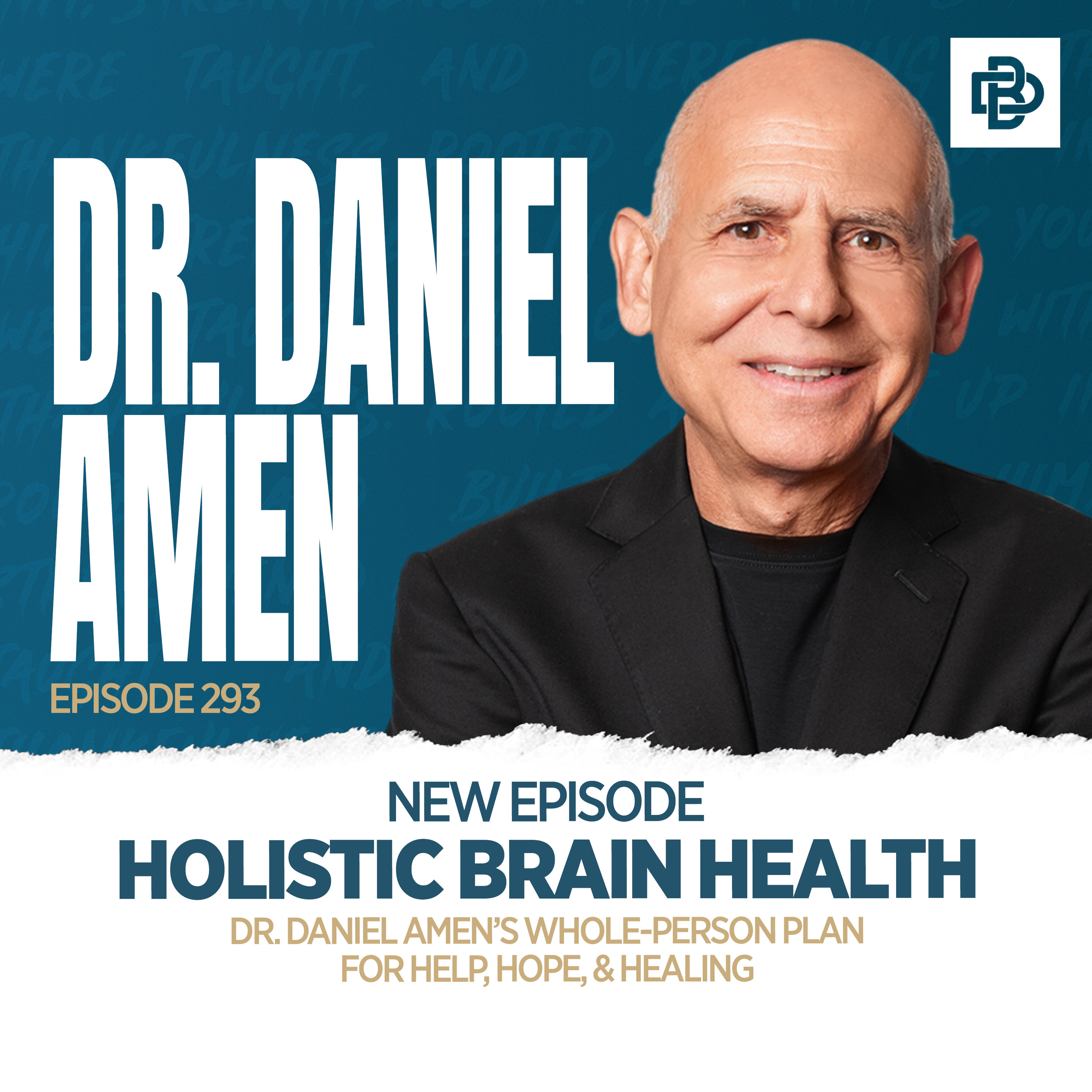
The Built Different Podcast with Dr. Zach Clinton - Holistic Brain Health: Dr. Daniel Amen’s Whole-Person Plan for Help, Hope, & Healing, Ep. 293
Get every episode summarized
Each time LifeAudio publishes, we email you a written briefing from the transcript — the topics, who appeared, and any specific claims, with the ad reads skipped.
Email me new episodesFree for 3 shows. No card needed.
About this episode
“Life Audio Build different as a production of the American Association of Christian Counselors to support this podcast and learn how you can help us to promote all our biblical content, spread the gospel, and provide mental health resources and training to…”From the transcript
In this episode, Dr. Zach Clinton sits down with renowned psychiatrist and brain health expert Dr. Daniel Amen to discuss his Amen Whole 4 Plan, a powerful framework designed to address some of the most pressing challenges facing our nation today. Dr. Amen explains how true healing requires a holistic approach, focusing on four key areas of life: biological, psychological, social, and spiritual health. Rather than treating symptoms in isolation, this model emphasizes caring for the whole person to bring lasting help, hope, and healing to individuals, families, and communities. Together, we explore how improving brain health can transform our mental, emotional, and spiritual well-being. If you’re looking for practical insights on how faith, science, and lifestyle choices intersect to produce lasting change, this conversation offers a hopeful roadmap forward.
Links:
Find Out More About Dr. Daniel Amen: https://danielamenmd.com/
Find Out More About Amen Clinics: https://www.amenclinics.com/
Take a Brain Mastery Course or Purchase One of Dr. Amen’s Bestselling Books: https://danielamenmd.com/programs-books/
Get Clinically Excellent, Distinctively Christian Care & Counsel through the AACC: https://christiancareconnect.com/
Discover more Christian podcasts at lifeaudio.com and inquire about advertising opportunities at lifeaudio.com/contact-us.
Get every episode summarized
Each time LifeAudio publishes, we email you a written briefing from the transcript — the topics, who appeared, and any specific claims, with the ad reads skipped.
Email me new episodesFree for 3 shows. No card needed.
Transcript ready
551 searchable segments. Every word is indexed and playable.
Full transcript
LifeAudio — The Built Different Podcast with Dr. Zach Clinton - Holistic Brain Health: Dr. Daniel Amen’s Whole-Person Plan for Help, Hope, & Healing, Ep. 293. Machine-transcribed; use the interactive transcript above to jump the player to any line.
Life Audio Build different as a production of the American Association of Christian Counselors to support this podcast and learn how you can help us to promote all our biblical content, spread the gospel, and provide mental health resources and training to people everywhere. Just go to AACCFoundation.org, again, that's AACCFoundation.org. Want to keep God's Word with you wherever you go? The Key James Bible Study KJV at by Salem Media makes it easy to read, study, share, and pray daily with the Timeless KJV translation. Enjoy features like offline access, audio Bible listening, smart search, and tools to highlight bookmark and take notes, all designed to keep your Bible study simple and organized. Best of all, it's free to download in the Google Play Store, growing your faith every day. Search for Key James Bible Study KJV and download the app today. Welcome to Built Different. I'm Zach Clinton, your host, and each week I come to you exclusively on the Life Audio
Podcast Network. I'm proud to partner with Life Audio and bring you entertaining, life-changing, family-friendly podcasts for a new generation. At Built Different, our mission is to provide encouragement, hope, and challenge to help push you past your limits and reach goals you never thought possible. Colossians 2 verse 6 says, so then just as you received Christ Jesus' Lord, continue to live your lives in Him, rooted, and built up in Him. Amen? Now let's roll. Hello, everybody and welcome back into the Built Different podcast. As always, I'll be your host today, Dr. Zach Clinton, and we're here in a boxing ring. I mean, we got punching bags all around us, and today we talked a lot about fighting for religious freedom, fighting for our rights, fighting for our bodies, fighting for our health. Today, we're talking about fighting for our brain health, and there is no better person in the world to have that conversation with, and a dear friend, somebody that looked up to, he's been a role model, he's been somebody that has invested in my life personally,
but also just from afar. I just look up to this man in so many ways, Dr. Daniel Aiman. You're very familiar with the name. I know you probably are, but if you're not, this is the leading, I would say this, neuroscientist, brain health experts, psychiatrist in the world, somebody that God is continuing to use in mighty ways. And we're going to talk about a whole four program today. What that looks like, some of the challenges that are facing society and culture that are facing brain health, but also some of the solutions to get people back to the healthiest place that they could be. Dr. Daniel Aiman, my friend, thank you for joining me. I'm so proud of you, Zach. Thank you. I just want you to grow and grow and make a difference in the lives of so many people. And I think it's that one clip we did that ended up with like 50 million views. It's my most viral clip that don't do everything for your children. That's right. Don't do everything for your children. We'll talk a little bit about that today, Doc, but what I want to touch on just up front is you have so many different roles, so many different responsibilities.
I know that you're all over the place. Now you're making an impact just in culture and society at large, not just the individual life, but over mass population groups. And so with what God has opened doors for you, even here in recent, Lambus, interested, and excited to the most. Since the last time we sat down together, what have you been doing that you feel like me and God is using to have the greatest impact? So Pastor Paula White came to see me because your dad referred her to me, and she got so much better that she's like, you know, I may be in the White House. And I want to take your word to every American, and I'm like, and she asked me this one question that no one had ever asked me before, she goes, how big can you think? And I'm like, I can think big. How about the decade of brain health, 1990s, George Bush won, declared the 1990s the decade of the brain, and that brought more money for neuroscience and more focus to the brain,
and that was a really great thing. But ultimately, it's the health of your brain. It determines how happy you are, how connected you are, how much money you make, how long you live, it's really the quality of your life goes to the direct physical health of your brain. And one of the programs I'm really excited about is called the Amen Whole Four. My first week of medical school, I went to medical school at Oral Roberts University. And Sid Garrett was our dean, he comes into the room, and he draws four big circles on the board. He goes, never think of your patients as their diagnosis. Always think of them in these four circles. And the first one is biological. And we are in a brain body biological crisis in this country with Alzheimer's expected
to triple in the next 30 years, 50% of the population is diabetic or prediabatic, 75% of us are overweight or obese. And I published three brain imaging studies on 33,000 people that showed, as your weight goes up, the actual physical size and function of your brain goes down, which should scare the fat of anyone. If you think, when I figured that out, I lost 20 pounds because I'm like, no, I'm not being chubby. If that is in fact bad for my brain. So we're in this biological crisis, but we're also in a psychological crisis. The second circle, Dr. Garrett Drew, he said, you have to think of your patients' minds, how they think, their development, and we're in a psychiatric crisis, mental health crisis
that is so scary with 25% of the adult population on psychiatric drugs, epidemics of anxiety, depression, ADHD, autism, addiction, before the pandemic. And then everything got dramatically worse, not only the fear and the bad policy, but the virus itself activates your emotional brain and makes you more at risk for anxiety and depression. So biological crisis, psychological crisis, and the third circle he drew was the social circle. It's like, how's that job? How's there marriage? What's going on in their life? And we are lonely and more isolated than ever before. And the surgeon general put out a report recently that said if you're lonely, and 58% of
Americans report being significantly lonely, it has the same health effect of smoking 15 cigarettes a day, biological, psychological, social, spiritual. And 58% of young people lack a sense of meaning and purpose, not you. And you know how that just gets you up in the morning that I'm going to make a difference and I'm going to learn something new that you're engaged in your life, but if 58% of young people are not engaged in their life, but their noses in their phone that is only driving anxiety and depression further. So we have this hole for crisis, but here's the headline. Here's the thing. I'm most excited about. I believe the answer to these epidemics is not to see them as separate disorders, but it's different expressions of the same unhealthy lifestyle and toxic exposures that have exactly
the same cure. And that's what I call our amen hole for solution, where through faith-based organizations, because most psychiatrists, they're not touching the spiritual circle. And they were taught, oh, that's sort of a crutch. Why would I talk about your belief in God or why you're on the planet? That's right. If you don't believe in God, it triples your risk of depression, and it makes sense, right? If you just think we're here by random chance out of an explosion that happened billions of years ago, that there's really no meaning purpose to my life, well, that's depressing. That's depressing. And there is not one thing in my education as a doctor, as an neuroscientist, that makes me not believe in God, because the brain is so beautifully and wonderfully made.
And I just, I don't believe our relationship over the years is by random chance, that's right. And 15 years ago, I went to my church in Southern California. And I just finished writing, change your brain, change your body, which is my second book on the connection between physical health and mental health. And I was so happy that morning until I got to church, and I walked by hundreds of donuts for sale for charity. And I felt like someone just slugged me in the face. I'm going to church to get my soul fed. These people are trying to kill me, because there's not one healthy thing about donuts. And right around the donuts with bacon and sausage, cooking on the grill, in the grease, oh yeah. And I'm like, felt like I had hit again, and then I went, right before I went into the sanctuary, it's this monster, big church in Newport Beach, where I live, and saw them
cooking hundreds of hot dogs. And there's not one healthy thing about a hot dog. Not at all. And then as I sat down, the minister started talking about the ice cream festival they had the night before. And when Tana, my wife found me in church, because she dropped Chloe, our daughter off at children's church, typing on my phone, and she hates that, because she thinks of the phone as the other woman. And so I showed her what I was typing. Yes. Go to church, get donuts, bacon, sausage, hot dogs, ice cream. They have no idea they're sending people to heaven, early, save them, then kill them. I'm like, this is not the plan. And so I prayed, God would use me to change the culture of food at church. And while I'm praying this, I'm like, that's the dumbest prayer you've ever prayed. How is that ever going to happen? You're not connected to church in that way. And I'm like, it's my prayer, God, deal with it.
And then two weeks later, Pastor Rick Warren from Settleback Church called me, and I had never met Pastor Warren. He'd seen me on TV. He read my book, Healing ADD, and he said, I'm fat, my church is fat, who helped me. And together we created the Daniel Plan, a program to get the world healthy through churches. And thousands of churches did our program, and I saw the power. But Pastor Warren only saw that for a season. It's like, oh, let's lose 50 pounds. And I'm like, no, this is a program. It's a lifestyle. Keep doing it, because health is your daily decision. And ultimately, so I'm doing it at the White House, the decade of brain health, and creating a national brain health revolution, all based on one question, because I've been doing this a long time.
And I'm always thinking, how can I make it simple, simple, easy to do? One question. Is whatever I'm doing right now, good for my brain, or bad for it, and does it make the world better? There's so much in that question. But ultimately, is what I had for lunch, good for my brain, or bad for it, to stand up late, scrolling on your phone, is that good for your brain, or bad for it, bad for it? Yeah. Saying something rude to my wife, good for my brain, or bad for way too much stress, is going for a walk, it's good for my brain. And if I can just make decisions and answer that question with information and love, love of myself, love of my family, love of the reason God put me on earth, I just make better
decisions, and that's the idea behind the whole four. And we have 77 pilot sites starting this month, and I'm so excited because I think this is the reason God put me on earth. I'm going to stop this right there and jump in to say, you're listening to Bill Diffrent, I'm Zach Clinton, we need to break for a brief message from our sponsors. I'll be back with our guests to keep the conversation flowing right after this. You're listening to Life Audio. Want to keep God's word with you wherever you go? The Key James Bible Study KJV app by Salem Media makes it easy to read, study, share, and pray daily with the Timeless KJV translation. Enjoy features like offline access, audio Bible listening, smart search, and tools to highlight bookmark and take notes, all designed to keep your Bible study simple and organized. Best of all, it's free to download in the Google Play Store, growing your faith every day. Search for Team James Bible Study KJV and download the app today.
Amen, it's an incredible mission, it's an incredible vision, it's an incredible purpose. And Dr. Aiman, God is clearly continuing to use you with this Aiman whole four plan. I can't wait to unpack it a little bit deeper, but I want to get to the solutions with you. Like you said, there's so many problems in these four different buckets. But the biological solutions, like you said, when that massive majority of the population here in the West and the United States and North America are obese or overweight, it's like there are some things that we can be doing every day. Some decisions that we can be making, whether it's nutritional, whether it's being physical fit, whether it's movement, whatever it is, what would you say are just, I'm just thinking to somebody out there today that's saying, I want to help your brain, I want to help your life, I want to help your body. What are some first steps for somebody that maybe hasn't invested in that level of health before? So that one question, it's just such a simple question is what am I doing? Is it good for my brain or bad for it? And quite frankly, most seven year olds would get 90% on the test.
And I went to my daughter's second grade class, so seven years old. And I wrote 20 things on the board, I go separate these for me, good for your brain or bad for it, gratitude, good for your brain, playing football, bad for your brain, smoking cigarettes, bad for your brain, drinking alcohol, bad for your brain, marijuana, they were not ambivalent like society is, bad for your brain, talking back to your red-headed mother, bad for your brain. The only one they missed was orange juice, which they put in the good category because it's a market of it. But it's in the bad category because whenever you unwrap fruit juice, fructose from its fiber source, it actually turns toxic in your body, so bad for your brain. And you just have to start knowing and I recommend you play the game I played with Chloe when she was little, we called it Chloe's game, this is good for your brain or bad for it.
And so if I said avocado, let me go to thumbs up, God's butter. If I said blueberry, she put a little hands on her hips and go, are they organic? Because non-organic berries hold more pesticides than almost any other fruit, like of course they're organic. She goes, good for your brain, God's candy. And we just need to teach kids to love and care for their brain. What's good and what's not good. And so many people go, but everything in moderation, absolutely not. That's the gateway thought to cheat. As soon as you go, everything in moderation, you're going for the ice cream, you're going for the brownie, you're going for the cookie, you're going for something that's getting crazier risk of diabetes and obesity. You know, I'm even just thinking about that question, like you said, it's so simple, but it's so profound and it's so powerful, is this good for my brain or is this bad for
my brain? When it comes to food, Dr. Aiman, I know this, just with fast food, with sugar and different things like this, it has an impact on the brain, where it's almost like impulsive, where it just lures this back in. For some people, it's like magnetic, it's like an addiction, quite literally. How do we begin? Right? I know we answered that question, but why I guess is it so hard for us to get out of that looping cycle where we get so fixated on this because it's like, I know the answer, doc, like I know that's not good for me. But why do I keep going back to it? What would you say to that person? It's about love, and they're all these wonderful little questions with the Aiman whole form. Absolutely. The question for food is, do I love food that loves me back? Because you're in a relationship, I love french fries, I love ice cream, I love brownies, they hate me. And I don't know if you've ever been in a bad relationship I have.
I have too. And I'm not doing it anymore. No. I've married my best friend, and I'm for certain not doing it with food. Yes. And so I might look at the ice cream and go, I love you now, but I'm not going to love you later. Yes. I love you, but you hate me. And so making that daily decision, and we're all creatures of happiness. And so I have a sweet tooth. My grandfather was a candy maker, and I'm named after him, and he was my best friend when I was growing up. But no. He died early. He left me early because he made bad decisions around sugar. And so, but I make brain healthy hot chocolate every night, which is raw cacao, unsweetened almond milk, and a little bit of stevia. Put it in a blender, it's like 50 calories, so it's calories smart, and tastes great.
I love it. It loves me back. And we're creatures of habit, if you just like 20 things you love that love you back, and it needs to be calories smart, right? A lot of people go, oh, calories don't count. It's like, dude, you failed chemistry, calories absolutely count, but the quality of your calories actually matter more. I mean, you'll lose weight on an 800 calorie, twinky diet, but you also have cancer and be incredibly sick. Exactly. Do you love food that loves you back? That's the biological component here. The psychological doc I'm just thinking about, even your book, change your brain, change your pain, I've sat down with people that have had chronic pain in the past physically. And a lot of times they develop this negative expectation, where they wake up every single morning, and it's like, I just know what to expect. I'm going to feel this way. They develop this pessimism, kind of this doom loop, where it's just like this pit
of despair, this rumination, pathological obsession with their pain, and it's difficult for them to actually understand. I was just sitting down with Russell Johnson. He said that victory has a vocabulary. It's the idea that, man, we need to be thinking, right, as 2nd Corinthians 10, 5, Philippians 4, 8, having that expectation, cling to hope, changing our thought processes. So that way, potentially, we can develop these different mental ruts for the good, just as we can for the bad and neuroplasticity, can begin to kick in. So I'm interested for you, just what are some of the healthiest tips and tactics you might give somebody psychologically to develop the healthiest brain and body that they could have moving forward? So the first thing, and we've talked about this before, it's killing the ants, the automatic negative thoughts that steal your happiness, they perpetuate the doom loop. And so another question, is it true? Whenever you feel sad, mad, nervous, or out of control, right down what you're thinking? And it's like, is it true?
And the Amen Hall 4 is really based on Romans 12, 1 and 2, that getting healthiest worship and be transformed by the renewing of your mind. And all Christians know that verse, but they don't know the 2nd half of that verse, which is, then you can test to see if it fits God's good, pleasing, and perfect will. Does this thought fit God's good, perfect, and pleasing, well, and most of the bad thoughts absolutely don't, and I want to be in the center of God's will, which means I've got to transform my mind and think on whatever is true, right, lovely, worthy of praise, Philippians 4.8, let your mind dwell on these things. So don't believe every stupid thing you think, absolutely.
But one of the fun ones that I don't know if you and I've talked about before is the rule of 12. Have we talked about the rule of 12? No, but I saw you posted about it, I think just recently, so I would love read on packets. I love the rule of 12. It's based on a concept of psychological flexibility is associated with psychological health. And so many people, one thing goes wrong, and they like lose their minds, and I took Tanna to Paris for two weeks for 50th birthday, so seven years ago. And I just noticed, sometimes we go on vacation, something bad would happen, and it would like sort of mess up the day. And I'm like, I noticed that, so I told Tanna, I said, why don't we promise ourselves? We're going for two weeks, 12 things are going to go wrong. Let's just promise ourselves we're not going to be upset until the 13th thing goes wrong. And if the 13th thing goes wrong, then we can scream and yell and act like four-year-old
children. And three things went wrong, and nobody was upset the whole time. And I came home and I posted on it, I got like 10 million responses, and I teach all of my patients the rule of 12. It's like you are competent, you are a problem solver, you have solved so many problems in your life, stop letting the little thing steal. It's the thief that comes to steal and kill and destroy, and I want you to be flexible. My patients just like, get it immediately, it's like, oh, I don't have to be upset about that. I am flexible, so identify with the flexibility. Absolutely. I like what you said, the rule of 12, where you're allowing space for these things to potentially go wrong and not making them over-traumatic, but at the same time, I know we've talked a lot about just this act of gratitude, you always talk about going to sleep and night
and going on a treasure hunt, what went well today, and looking for the things that went right. That way we're not just waiting for the things that went wrong. Gratitude really, really matters, I know that duck. Talk to us now about the social aspects of life, and this is where something you and I have never talked about, but I know loneliness is the silent epidemic, and it's the undiagnosed diseases that are always the most dangerous and deadly. Like you mentioned, the stats about 15 cigarettes a day, loneliness is quite literally killing people, but for our next generation, because of this device right here, and parents, we talked about this a little bit, are putting it in child's hands. I've seen two and three-year-olds that are able to literally swipe no-on-phone calls, open up YouTube, click on whatever show they want, two-year-olds, three-year-olds, right? It's fascinating to me. Younger than that. Mine's nine-month-old grandson, his parents, and this was before we knew the toxicity. He figured out, and then was just fascinated with it every time I saw, you know, pop-up phone.
No, pop-up phone, right? No. Right. It became pop-up phone, no, and smart enough not to give in. But it was clearly addictive, and the younger kids get phones, the higher risk of suicide. They have in their 20s. In fact, if a child got a phone at five, that at 50% risk, five, zero percent risk, wow, having suicidal thoughts in their 20s, not one thing about that is okay. Not one thing. And we need to be cautious. But the question with the social circle, do you notice what you like about other people more than what you don't like? Because ultimately, we're training other people by what we pay attention to.
And I don't know if we've ever talked about, I collect penguins and I have way more than this rational for anyone, but it was almost 40 years ago, was 40 years ago. I took my son, I adopted my oldest, he was hard for me, and my supervisor, I'm in training at the time, since you have to spend more time with him. Which was sort of the last thing I wanted to do. But I took him to a place called Sea Life Park, which is in Hawaii where we were living at the time, and they had great sea animal shows, like a whale show and a dolphin and a sea lion show. And at the end of the day, he grabs my shirt and he goes, I want to see Fat Freddy, like who's Fat Freddy? It's like the penguin dad don't you know anything. So we went, there was one more show at the end of the day, and this little humble chubby, penguin comes on to the stage, bows, and then goes and climbs the ladder to high life
and goes the end of the board and bounces, and then jumps in the water and I'm like, whoa, then he gets out of the water, he bowls with his toes, counts with his whipper, jumps through a hoop of fire, I got my armor on my son thinking I'm a good dad, and just blown away. And then the trainer asked Freddy to go get something, and Freddy went and got it, and he brought it right back. And in my mind, time stood still, because in my mind, I'm like, I asked his kid to get something for me, and he wants to have a discussion for like 20 minutes. And I knew my son was smarter than the penguin. And so I'm a child's chiatry fellow at the time, I don't know anything, and so I go up to the trainer, I said, how'd you get Freddy to do all these really cool things? And she looked at my son, and then she looked at me, and she said, unlike parents, whenever Freddy does anything like what I want him to do, I notice him, I give him a hug, and I give him a fish.
And the light went on in my head that even though my son didn't like raw fish, my daughter does, that whenever he did what I wanted him to do, I didn't pay any attention to him, because I was like my own dad, I was busy, but when he didn't do what I wanted him to do, I gave him a lot of attention, because I didn't want to raise bad kids. So I was inadvertently reinforcing his bad behavior. So I collect penguins to just remind me, notice what you like more than what you don't like. And that principle works so well in relationships, but that's not what's being modeled on social media. Not being what's modeled in the news, it's not being what's modeled on television. You just see because they're trying to create drama. They model ineffective behavior that then the population models make sense.
And so if you notice, because you know my wife, Tana, if we're fighting, clearly I could go to what I don't like. And it's so ineffective, or I just go to what I do like about her. And that is so powerful and can shift a negative moment to a loving moment. And if that's your pattern, notice what you like more than what you don't, your relationships change. It's powerful. It's such a positive way. And you also are less lonely. Because what does someone else really want from you? They want you to notice them. Notice them. That's right. And if it's not about you or your politics, but you're curious about them, people want that. That's how you connect. So taking a genuine interest in other people, noticing what you like about them rather
than what you don't. And then active listening, you know, what they teach us is therapists to do, but it's clearly not modeled on TV or on social media. It's always talking over people and erupting people and I'm like, that's not going to get you connected. So powerful. We need people more than ever. There's power and partnership. There's comfort and companionship. And I want to kind of close this way, Doc, because I know you got to get to a panel discussion here in a moment, but also what I want to close on is the spiritual component and how potentially this amen hole for can really continue to impact and influence the big sea church at large. Because we know this that 90% of the human population believe that there is a God. But yet less than 70%, I would say maybe upper to 70% of therapists are not trained in incorporating spirituality within therapy and more. And so there's a massive gap here between those that are spiritually curious and they
actually want to incorporate spirituality and faith in the midst of therapy or therapeutic alignment because it produces potentially greater therapeutic outcomes. But then there's people that are afraid of potentially aligning those things. When we know this, that faith has a significant impact. You talked about it, meaning and purpose on health, brain health, bodily health, relational health, so much more. We need to just the faith factor here for a moment and how it potentially helps lead to the flourishing life. So the question is, am I living in a way that honors God and the reason I'm on the planet? Am I living in a way? And I'd love that so much because it goes, you're created for a purpose to help make the world better place. And in the center of faith, it's admitting I am the child of God.
And I am fearfully and wonderfully made. And I'd love that. And as I ask my patients, so why are you on the planet? Many of them have never thought about that. If you think about that, if it's all about you, it's sorted to pressing. And I've seen some of the world's most famous people that have hundreds of millions of followers. And when it's all about them, do you know what they say? And they all have the same thought. I think of it as the mother toxic thought, I'm not enough. And so Justin Bieber and Miley Cyrus, and I'm not enough, I looked at Miley, I'm like, so who would be enough? I mean, it's like, how does that happen?
And it's this craziness of constant comparison to other people. We need to be reminded of who we are because ultimately of who's we are, right? That the creator created us in the likeness of his image, so that we might have a relationship with God, so that we might then understand the meaning and purpose of life. And as my pastor likes to say, it looks right to what you were saying, doc, that if it's all about you, it's all about over. And so the recognition that we need people, we need relationships now more than ever. Dr. Aiman, what can our audience be doing to potentially get plugged in to the Aiman whole four program, the plan, just the different solutions that you talked about? Where can they find out more about you? Because again, I know that our audience is very committed to the process of health and I know they love you with an overwhelming sense of that word, so where can they find out more? Well, and just one more thought, you know, it's, I am here for a purpose, but my work is
in getting me into heaven. That's right. That it's my connection with Jesus that is getting me into heaven, so you stop having to work so hard. I think that is so important to hold on to how we are saved is our belief in Jesus. It's not our belief and our ability to do more. But we want to do more, because we're here for a purpose, but that's not the ticket. I think that's comforting for the doers like me, do more, and it's like, I do more because I love more, not because if I don't do more bad things are going to happen. I think that's absolutely. To be able to learn about the Amen Hall 4, Amen Hall 4, H-O-L-E, W-H-O-L-E, hyphen4.com,
and the compulomium in surround Hectocable Places. You're a blessing. Again, thank you for just your wealth of wisdom, knowledge, experience. Thanks for even clarifying there for some of our audience that the beautiful thing about Christianity and what we believe about our God. The truth about our God is that he doesn't make us climb the ladder. We don't have to work our way to heaven, but that he loved us so much that he sent his son descending that ladder for us to meet us in the midst of our depravity and the midst of our humanity. So that way, we wouldn't be defined by our scars, but we're defined by his. And that's a beautiful thing when we recognize that. It brings that sense of healing, and it makes us want to pursue the healthy life. Because then we have a mission, we have a purpose, and I want to be here for as long as God would have me to fulfill that very thing. So Dr. Daniel Amon, I'm perhaps my dad, Dr. Tim Clinton, myself, AACC, our whole family here. We love you. We appreciate you. Thanks for joining me today. So our entire audience have built different. Thank you guys for tuning in. I hope and pray that you would take some of those practical tips and strategies that Dr.
Amon gave us and that you would begin to apply them and integrate them into your life because you were made to live a healthy life, your body, your mind, your soul, your brain. All of those things matter. Why? Because you matter. And you have an incredible purpose right here, right now. Thank you for joining us. We love being a part of your life. Do you ever hear saints make their way through the culture and the church that seem nice in theory, but are actually theologically problematic? My name is Shara Donahue and I'm the host of the Bible. Never said that. A podcast where we examine these popular saints under the lens of biblical truth. We cover saints like God won't give you more than you can handle. Time heals all wounds and follow your heart. We also spend time exploring how people use Bible verses out of context. If you want to grow and discernment in truth, join us and subscribe at lifeaudio.com. The historical Jesus podcast is the sweeping saga of the life and times of Galilean Jesus
of Nazareth, as well as the faith, religion, and church founded to honor and disseminate his acts and teachings. Join me, Mark Vinet, on this fascinating journey through time exploring the many great works of Christian theology, literature, architecture, music, and art inspired by the words and deeds of Jesus Christ.
More episodes
More from LifeAudio

Hope For The Journey with Monica Schmelter - Where Are You Now God? Finding God...
LifeAudio

Timeless Wisdom with Dennis Prager - Why Did God Harden Pharaoh’s Heart? | Sunda...
LifeAudio

Your Nightly Scripture - Resting in the God Who Rejoices Over Me (Zephaniah 3)
LifeAudio

Your Nightly Prayer: Evening Prayers for Christian... - Trusting God Through Una...
LifeAudio