The Arc Mainnet Trading and Alpha Playbook
Get every episode summarized
Each time Smarter Crypto Trading with Ave AI publishes, we email you a written briefing from the transcript — the topics, who appeared, and any specific claims, with the ad reads skipped.
Email me new episodesFree for 3 shows. No card needed.
About this episode
Smarter Crypto Trading with Ave AI is made possible by:
“Most people don't realize this, but over 85% of the grass-fed beef sold in the U.S. is actually imported from overseas. It's a system that often pushes out American farmers and ranchers. That's why it matters to be intentional about where you buy your meat.”From the transcript
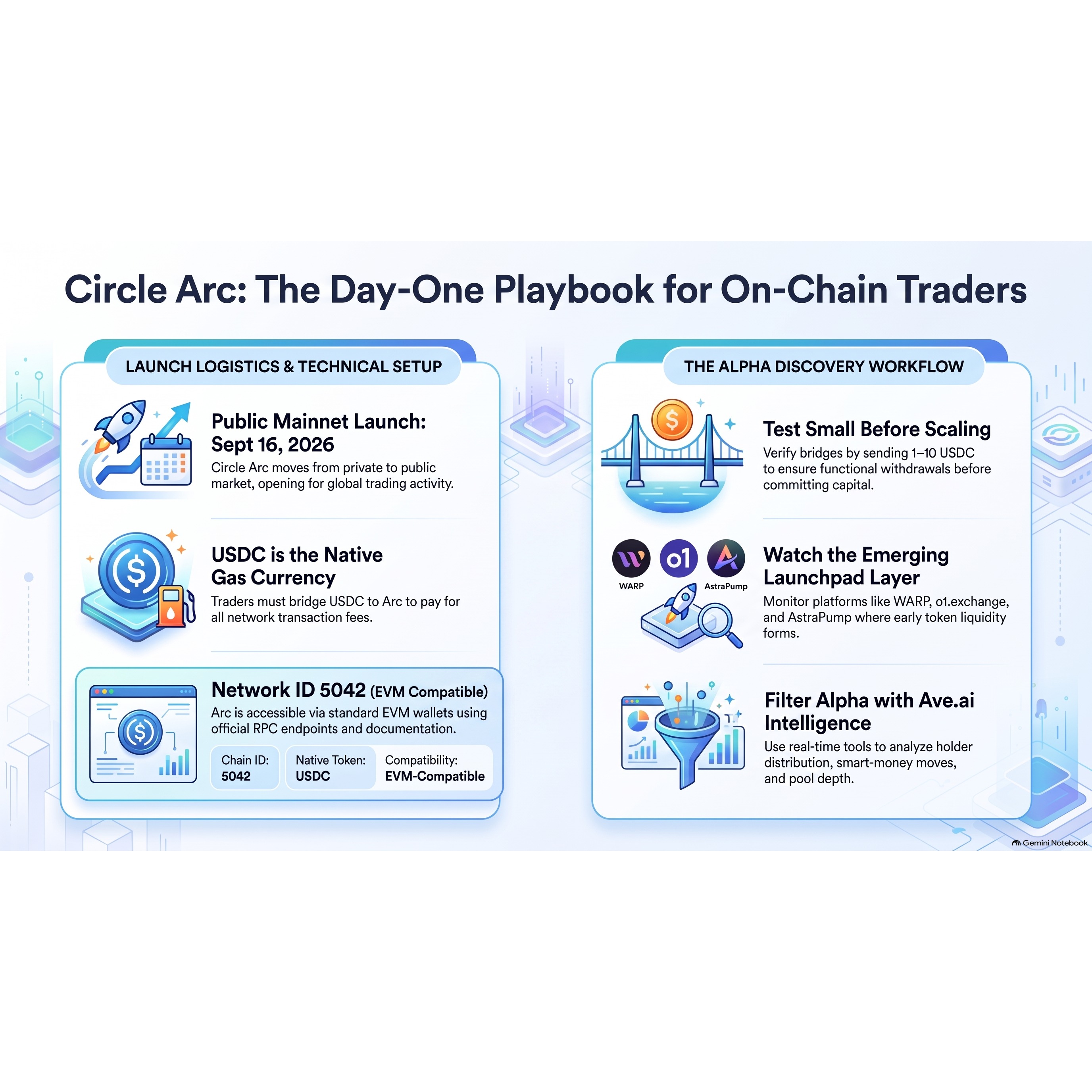
Circle is set to launch Arc, a new Layer 1 blockchain designed for institutional finance and stablecoin payments, on September 16, 2026. While the network features backing from major entities like BlackRock and Visa, market analysts expect it to simultaneously become a high-activity hub for speculative retail trading and meme coins. To navigate this upcoming launch, the data platform Ave.ai is highlighted as an essential tool for monitoring real-time liquidity, holder distributions, and smart-money movements. Successful participation will require traders to bridge USDC, which serves as the network's native gas token, while remaining vigilant against potential security risks.
Get every episode summarized
Each time Smarter Crypto Trading with Ave AI publishes, we email you a written briefing from the transcript — the topics, who appeared, and any specific claims, with the ad reads skipped.
Email me new episodesFree for 3 shows. No card needed.
Hosts & guests
Transcript ready
307 searchable segments. Every word is indexed and playable.
Full transcript
Smarter Crypto Trading with Ave AI — The Arc Mainnet Trading and Alpha Playbook. Machine-transcribed; use the interactive transcript above to jump the player to any line.
Most people don't realize this, but over 85% of the grass-fed beef sold in the U.S. is actually imported from overseas. It's a system that often pushes out American farmers and ranchers. That's why it matters to be intentional about where you buy your meat. That's why I choose good ranchers. Good ranchers connects you directly with local American farms and ranches. 100% American meat, pasture raised, no antibiotics, no added hormones, delivered straight to your door. Make the switch to better meat. Go to goodranchors.com to start your plan and get premium American meat delivered right to your door. That's goodranchors.com American meat delivered. Toyota's easy choice sales event is on. Whether you're looking for the performance of a camera, the versatility of Rav4, the efficiency of a Corolla, or all electric driving in the BZ. There's a Toyota that's just right for you. And with great deals across the lineup, now's the
time to find yours. But hurry, these deals won't last long. Toyota's easy choice sales event and soon. We make it easy. Toyota, let's go places. Imagine building this multi-billion dollar by security financial fortress, right? Like specifically for Wall Street is absolute elite. Right. The pristine architecture of the whole deal. Yeah, exactly. The best security on earth, the most serious people in expensive suits. And you know, the second the vault doors open on day one, 16,000 meme coins just flood the lobby, screaming and throwing liquidity everywhere. It is, I mean, it's the ultimate collision of architectural theory and just brutal market reality because you can engineer the most elegant financial system in the world. But it's permissionless. Exactly. A permissionless network means you surrender control the absolute second you push it live. You just never really know what you have until the crowd actually gets their hands on it. And for you listening today, you are arriving at just the absolute perfect time because well, today, September 14th, 2026, right
around the corner literally in exactly two days on September 16th. We are going to witness one of the most fascinating collisions of two completely different financial worlds in the history of the blockchain. It really is going to be wild. It really is. Circle is launching the public minute for its new layer one network, ARC. And the mission of this deep dive is to explore the incredible tension between ARC's original highly institutional design and the wild speculative retail trading tsunami that is about to just, you know, hit its shores. Yeah, total washover. Exactly. So whether you are an active on chain trader gearing up for launch day, or you're just insanely curious about how modern financial systems function under pressure, we are giving you a concrete day one playbook to navigate all this madness because this really is a pretty rare opportunity to watch a pristine piece of Wall Street infrastructure get stress tested by the chaotic retail market in real time. Yeah. And to truly understand the stakes of what's
about to happen on September 16th, we have to look the foundational blueprint of ARC, right? I mean, circle spent the entire private mayhemant phase working with over 100 builders. Oh, wow, over 100 over 100. And if you look at the founding validator list, it reads like, I don't know, the VIP guest list at Davos or something. We are talking about BlackRock, Visa, Mastercard, Galaxy, SPI group and standard turned. So definitely not the demographic you expect to see launching a token named after some developers pet cat. No, not at all. These are, you know, institutions that settle billions of dollars in global commerce. Right. Far from it. ARC was explicitly designed for high level institutional finance. The whole architecture is built for stablecoin payments, tokenized real world assets for an exchange and a genetic economic activity. Right. Okay. And crucially, it possesses the structural advantage that corporate accounting departments absolutely require, which is predictability. ARC uses USDC for its transaction fees. Okay, let's unpack this because using
USDC for gas is, it's a massive shift from how most people understand crypto, right? Because normally if you use a traditional blockchain, you have to pay a gas fee to the network validators just to process your transaction. And historically, you pay that fee in the network's native floating token like Ethereum or Solana or Avalanche. Right. Which introduces huge risk. Exactly. The underlying issue is volatility. If you're a traditional finance giant trying to settle, say, 10 million transactions in a quarter, you just cannot deal with your operational overhead suddenly doubling overnight simply because a crypto token spiked in value on the open market. Yeah, that volatility makes corporate budgeting completely impossible. You just can't plan. Right. But by using USDC, which is, you know, a stablecoin strictly pegged to the US dollar as the native gas token, ARC removes the headache of those fluctuating operational costs entirely. It's just flat. Exactly. A transaction costs a fraction of a cent in dollars today, tomorrow and next year. It actually makes enterprise scale blockchain
accounting feasible. So, you know, the blueprint is brilliant. It's sensible. And it's highly institutional. But there is always a butt when you open a network to the public, the architecture might be built for BlackRock, but the doors are technically open to everyone. Right. Which brings us to a very recent historical parallel that suggests this whole institutional narrative is not going to survive contact with the enemy. Oh, yeah. Traders are already referring to this as the Robin Hood chain playbook. Yeah, because Robin had chain was launched with a nearly identical narrative, right? Like the stated goal was serious financial tools, tokenized assets, bringing real world yields on chain. That was the pitch. Yeah. But permissionless networks fundamentally do not care about your marketing narrative. Once the infrastructure is live, liquidity arrives. And once liquidity arrives, you know, the launch pads, the trading bots, the speculators, they all just immediately follow. And on the Robin Hood chain, traders instantly hijacked the network's low fees and fast execution for speculative meme coins. The data from our sources on
this is just staggering. More than numbers. During its early trading rush, the network saw 16,639 new tokens created in a single day. Wait, 16,000 tokens in 24 hours in a single day. Yeah, it's just insane. You couldn't even like scroll through a list of that many tickers little owned conduct actual fundamental research on what any of them do. No, it's impossible. And the trading volume scaled violently to match all that chaos daily decentralized exchange volume hit $1.06 billion. And it eventually peaked at a reported $3.7 billion. Oh my God. And all of this activity happened on a chain that was explicitly marketed for serious real world assets. I mean, it is like building a high end exclusive country club for Wall Street executives. You manicure the greens, you build this beautiful clubhouse. But because the gates are technically open to anyone, a massive chaotic music festival immediately sets up camp on the 18th green. That is a perfect way to
picture it. Right. Like the executives are just standing there in their tailors, who is trying to discuss tokenized treasury bills. And right next to them, retail traders are just launching thousands of highly leveraged speculative tokens every single hour. And that is precisely the dynamic we are expecting on arc starting September 16th. The institutions have lead the pipes, but the retail trenches are going to push the water pressure to its absolute limit. So okay, if this music festival is inevitable, how does a trader actually walk onto the 18th green without getting trampled? Because when you have billions of dollars migrating to a brand new network, the infrastructure is going to bend and mistakes are going to be super expensive. How do we actually get in the door on day one? Well, the initial barrier to entry is just securing your gas. As we establish, arc requires USDC to process any transaction. Right. You can't buy sell or even transfer a token if you do not have arc native USDC in your wallet to pay the validators. You can't just show up with the theory of Marcilana and expect the network to function. Which means you have to bridge your assets over from whatever chain you're
currently on. And you know, bridging always sounds like teleportation, but mechanically, it's a lot more complex. We're even more complex. When you use cross chain messaging providers like across Axelar, Stargate or wormhole, you aren't actually shooting a coin through the internet. You are locking your USDC in a smart contract on Ethereum, for example, and a decentralized network of relayers verifies that lock. And then it mints or releases an equivalent amount of USDC on the arc network. And because that process involves multiple smart contracts across completely different chains, the golden rule for navigating any new network is test small first scale later. Okay. The sources explicitly recommend sending just like one to 10 USDC for your first transaction. You really want to confirm the entire life cycle. The whole round trip. Yeah. Exactly. You bridge the funds over, confirm they arrive in your wallet, interact with an arc smart contract, swap a token, sell it, and then critically withdraw it back out to your original network. Wait, I have to push
back on this cautious approach for a second. Sure. Because isn't the whole psychological appeal of a day one launch getting in fast and heavy to catch the very first wave of liquidity? I mean, taking the time to run micro transactions back and forth with pocket change feels like the exact kind of hesitation that makes you completely miss the boat while everyone else is capturing early multipliers on their capital. I get that. That is the fear of missing out talking for sure. But let's look at the actual mechanics of a trade. A bridge that successfully gets your assets onto arc is entirely useless if the return route fails. Oh, that's true. Historically, during massive network launches, the exit bridges get congested. They break down entirely or they even suffer targeted exploits. You might make a massive paper profit on some day one token. But if you cannot bridge that liquidity back to a major network because the withdrawal contracts are failing, your realized profit is zero. Wow. Yeah, your capital is just trapped. Exactly. Trapped in a silo. So testing the full cycle guarantees your exit route mechanically exists before you
commit substantial capital. That is a very sobering reality check. Paper profits are literally just pixels on a screen until they hit a stable network. Exactly. So assuming we test the route and the pipes hold up, there is another technical hurdle we have to clear, right? Getting our wallets to actually talk to arc. Fortunately, arc was designed to be EVM compatible. EVM stands for Ethereum Virtual Machine. And this is a crucial architectural choice by circle. It means the underlying code execution environment is identical to Ethereum, which is a massive relief for day one adoption. I mean, if you've ever tried to trade on a non EVM chain on launch day, you know the immense friction of having to download a completely new browser extension, write down a new 24 word seed phrase and learn a completely foreign interface. It's exhausting. It really is. But because arc is EVM compatible, you can use the exact same Metamask, Rabby, or Coinbase wallet you already use. Your public address, you know, the one started with 0X that remains exactly the same. Yeah. But while the wall
it remains the same, you still have to manually point that wallet to the new arc network. And this raises an important question, right? It brings up an intense security risk regarding early access. How so? The wallets don't just magically connect to the blockchain. They rely on something called an RPC, a remote procedure call. You can think of the RPC as the literal phone line connecting your wallet interface to the blockchain nodes. Oh, and during a high attention launch, malicious actors will spit up fake RPC websites. Exactly. So if you connect your wallet through a fake phone line, they can just intercept the transaction you think you're signing and replace it with a malicious contract designed to drain your entire wallet. Precisely, you will also see cloned bridging websites and highly sophisticated fishing accounts mimicking official channels. The official chain ID for ARC is 5042. Okay, 5 0 42. You must manually verify your RPC parameters against the official ARC developer documentation. Never simply copy and paste network configuration settings from a viral post on X
or a telegram channel, no matter how legitimate the sender appears. Okay, so we've safely crossed the bridge. We verified our RPC. We have our USDC for gas and we know our exit route works. We are officially inside the country club. We made it inside. Where does the actual trading happen? Because tokens don't just appear out of thin air. Well, new chain speculation always clusters around the launch pad layer. Launch pads are essentially templated smart contract employers. They provide the foundational infrastructure where non technical users can spin up a new token, pair it with USDC and create a tradable market in minutes. If you want to know what is going to trade on ARC, you have to look at where the tokens are physically being born. And according to our sources, traders are heavily monitoring three specific platforms ahead of September 16th. First is warp, which specializes in meme coin launching and cross chain infrastructure. Yeah, then there's a one dot exchange, which is building out sophisticated trading and order routing infrastructure natively for ARC. And finally, astropump, which is targeting rapid token creation. Right, but the strategic
pivot you have to make here is tuning out the noise. Because right now, these platforms are running massive pre-launch marketing campaigns. Totally. They're everywhere. They're announcing partnerships, teasing user interfaces, hyping their potential. You have to completely ignore the marketing. The only data that matters is where the actual liquidity, the actual users and the actual trading volume organically migrate after the main net goes live. Here's where it gets really interesting. Judging a new ecosystem by its pre-launch marketing is like judging a new restaurant by a massive flashy billboard on the highway. That's a great way to look at it. The billboard might look incredible, but checking the on chain liquidity is like physically walking inside the restaurant to see if anyone is actually eating the food. If the tables are empty, the billboard is completely irrelevant. Exactly. The liquidity represents the diners in your restaurant. Without it, you just have an empty building. But that creates a practical problem. How do you watch liquidity move in real time? Right. You cannot sit at your desk refreshing three different launchpad websites. By the time a token's
momentum is obvious on a basic web interface, the early entry opportunity is entirely gone. So you need an intelligence layer to sit between you and the raw blockchain data. Our sources point heavily to utilizing avi.ai as your primary arc dashboard to filter the madness. Yeah, that's true. Because the hardest part of day one isn't finding a token to buy. It's filtering out the 15,990 noise tokens to find the 10 that actually matter. And the workflow with an intelligence layer like av.ai requires a very specific methodology. The first phase is discovery. You aren't waiting for a token to trend on social media. You are scanning the network for newly active contracts. The second they deploy, you are looking for the spark before the forest fire. The next phase, and this is where traders usually get completely wiped out is checking liquidity. We need to break down how automated market makers or AMMs actually work. Right. Because it's not like a traditional stock market with an order book of buyers and sellers matching up. Exactly.
An AMM liquidity pool functions more like two interconnected buckets of water resting on a scale. Let's say one bucket holds the new token and the other bucket holds USDC. Okay, I'm picturing it. If you want to buy the token, you have to put USDC into that bucket and physically remove tokens from the other bucket. The ratio between the two buckets dictates the price. So if the pool has massive liquidity, say a million dollars in each bucket, you can scoop out a cup of tokens and the overall ratio barely changes. You get the price you expect it. Right. Low slippage. But if the liquidity pool is extremely thin, say it only have $500 of actual USDC in it, taking out even a small amount of tokens throws the entire scale out of balance instantly. This is exactly why checking liquidity depth is paramount. You might look at your wallet interface and because the last micro transaction happened at a high ratio, your wallet tells you your token holdings are worth $10,000. Oh, I see where this is going. Yeah. If you try to sell $10,000 worth of tokens into a bucket that only contains
$500 of USDC, the price instantly collapses to zero before your order even finishes processing. You suffer a massive slippage. That is just a terrifying illusion. Yeah. The screen literally says you are rich, but the underlying mechanics of the pool mean you cannot actually extract the value. Exactly. Once you verify the liquidity is deep enough to support your entry and exit, the next phase is inspecting holder distribution. Because the blockchain is essentially a public glass box, we can see exactly how the token supply is divided. You are looking to see if the supply is distributed across thousands of independent wallets or if two or three clustered addresses control a massive percentage of the circulating supply. And if three wallets hold 60% of the supply, that completely alters the risk profile of the trade. Oh, massively. It doesn't inherently mean the token is a deliberate scam, but it means those three wallets have the mechanical power to just drain the USDC bucket the second they decide to cash out, leaving everyone else with worthless tokens, which logically leads to the next phase.
Following the smart money, the blockchain's transparency means smart money cannot hide their trades. You aren't just watching a token's price go up. You are leveraging obby.ai to track the specific wallets that consistently buy before the price goes up. Oh, whoever. You track the wallets that win, identify their early entry points, and analyze where their capital is flowing next. And that leads to the final and arguably most crucial piece of the intelligence puzzle. Watching the exit because finding a hidden gem on day one is only half the trade. If you write it all the way up and all the way back down, you haven't actually accomplished anything. Right. What's fascinating here is finding the entry is where traders focus, but monitoring the exit is how traders survive. Aive.ai provides tools like their Avesmiper bot, which allows traders to monitor the mempool. And the mempool is essentially the waiting room where transactions sit before they are officially written to the blockchain block. Exactly. By monitoring this waiting room, you can spot massive pending cell orders from large wallets before they even execute. So what does this
all mean? If I'm understanding right, the wallets that buy first are important, but the wallets that begin to sell first are the ultimate signal. Absolutely. If you are sitting there looking at a token that is suddenly trending everywhere on social media and you decide to buy in, you were likely several rotations behind the smart money. You're already late. Right. The people who identified the token through on-chain discovery hours ago are now using that social media hype to generate the liquidity they need to exit. Right. If you buy the trend, you are mechanically serving as their exit liquidity. It is a harsh reality of permissionless markets. The ultimate advantage does not come from blindly throwing capital at the first token you see on ARC. Definitely not. The advantage is derived entirely from information speed. Turning raw chaotic on-chain data into actionable intelligence by discovering earlier, verifying liquidity faster, following the capital flows and watching the exit before the crowd realizes the party is over. It really is a fascinating dynamic. In two days, we are going to watch two completely isolated crypto worlds slam into each other on the exact
same infrastructure. On one side, you have Circle, USDC predictability, BlackRock, Visa, MasterCard, and the dream of flawless institutional settlement. On the other side, you have the launch pads, the token snipers, the meme coins, and just the absolute chaos of the retail trenches testing every single smart contract for weaknesses. It is going to make ARC one of the most closely watched network launches of 2026 because it proves that you can build the most sophisticated, buttoned up financial infrastructure on the planet. But the moment you open a permissionless network to the public, the market, not the ARC. It is going to decide exactly what to do with it. Yeah, the tools are built for institutions, but the first major narrative of the network will undoubtedly be decided in the trenches. Which leaves us with a lingering question for you to mull over as we approach the September 16th launch. Okay, let's hear it. If retail traders, launch pads, and meme coins speculators completely dominate the network activity and bandwidth in the early days of this sophisticated chain built for Wall Street. How will those traditional
financial giants react? Oh, that's a good question. Right. Will institutions like BlackRock and Visa quietly lean into the chaos to capture the massive transaction fees being generated by the retail frenzy? Or will they eventually try to construct walled gardens and private subnets on top of ARC to keep the music festival completely isolated from their pristine 18th green? It is a profound structural tension. And how it resolves will likely define the future playbook for institutional blockchain integration. It really will. Well, thank you for joining us on this deep dive. Keep your eyes on the chain. So verify your RPC links, test your bridges with pocket change first, and we will see you next time. Before I switch to wealthfront, my APY was probably 0.1. One size switch is twitching with a wealthfront cash account, earn up to 4.2% APY on your cash. I can trust. Wallfront is taking care of me. Make your money earn more. Get started at wealthfront.com. Clients were paid $1,000 for their testimonials creating a conflict of interest. How come so? 3.3% APY as of January 30th, 2026 is represented at variable and earned on funds
wet to program banks. 0.65% new client boost with 3 months on up to $150,000. Direct deposit $1,000 a month and fund an investing account for a 0.25% increase. Cash account offered by wealthfront brokerage LLC member, Fennel SIPC, not a bank. There's nothing like being in the stands cheering on your favorite team. Game time is your hack to unlocking amazing tickets in just a few taps. It's easy to use and the game time guarantee means you can trust you'll get 100% authentic tickets at the best price. Fees are always included, so what you see is what you pay. Take the guesswork out of buying sports tickets with Game Time. Download the Game Time app and create an account to start searching for tickets to upcoming games and events.
More episodes
More from Smarter Crypto Trading with Ave AI

The On-Chain Convergence of Tokenized Stocks and Meme Coins
Smarter Crypto Trading with Ave AI

The BNB Chain Ecosystem: Beyond the Native Token
Smarter Crypto Trading with Ave AI

Data and Narrative: The New Formula for Meme Alpha
Smarter Crypto Trading with Ave AI

The Rise of Stock Memes
Smarter Crypto Trading with Ave AI