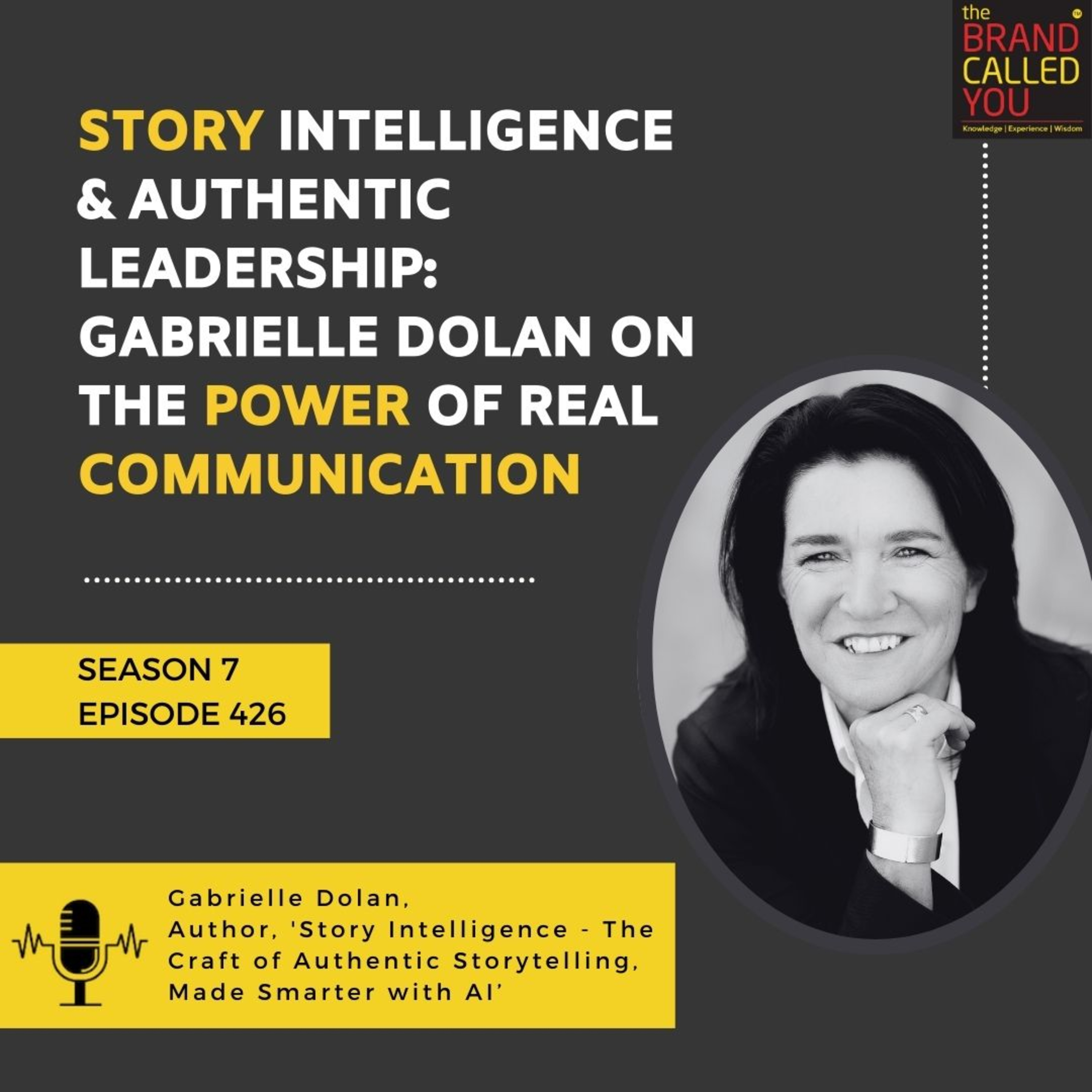
Story Intelligence & Authentic Leadership: Gabrielle Dolan on the Power of Real Communication
Get every episode summarized
Each time The Brand Called You publishes, we email you a written briefing from the transcript — the topics, who appeared, and any specific claims, with the ad reads skipped.
Email me new episodesFree for 3 shows. No card needed.
About this episode
In this episode of The Brand Called You, host Ashutosh Garg sits down with Melbourne-based author Gabrielle Dolan, a global storytelling expert and author of Story Intelligence: The Craft of Authentic Storytelling Made Smarter with AI.
Gabrielle shares her journey from corporate leadership to becoming a worldwide advocate for authentic storytelling, revealing why storytelling is not just a “soft skill” but a strategic leadership superpower. She also discusses how leaders can harness AI to enhance storytelling without losing authenticity, avoid common communication pitfalls, and inspire trust across their teams.
Key Takeaways:
Storytelling as a Leadership Superpower: Move beyond just sharing information—use stories to influence, engage, and connect with your audience.
Authenticity Over Performance: Powerful stories come from clarity, honesty, and relevance, not exaggeration or theatrics.
- AI as a Creative Partner: Leverage AI for idea generation and refinement while keeping your authentic voice at the center of your storytelling.
Get every episode summarized
Each time The Brand Called You publishes, we email you a written briefing from the transcript — the topics, who appeared, and any specific claims, with the ad reads skipped.
Email me new episodesFree for 3 shows. No card needed.
Hosts & guests
Transcript ready
346 searchable segments. Every word is indexed and playable.
Full transcript
The Brand Called You — Story Intelligence & Authentic Leadership: Gabrielle Dolan on the Power of Real Communication. Machine-transcribed; use the interactive transcript above to jump the player to any line.
Welcome to another episode of The Brand Called You, a what-custom podcast show that brings you leadership lessons, knowledge, experience and wisdom from thousands of successful individuals from around the world. I am your host Ashutosh Gargant, today I am delighted to welcome a well-known and respected author from Melbourne, Australia, Gabriel Dolen. Gabriel, welcome to the show. Thanks Ashutosh, I am really excited to be here to talk about all things brand and storytelling with you. Thank you. Gabriel is an author of a book titled Story Intelligence, The Craft of Authentic Storytelling Made Smarter with AI. She is also a global expert on authentic storytelling and real communication. So Gabriel, before we come to your book a few questions for you, you spend years in senior leadership roles before becoming a global authority and storytelling. What was the moment when you realised that storytelling was not a soft skill, but a strategic
leadership capability? Well, it was probably Ashutosh in those last couple of years, I worked for one of Australia's largest banks and I was in those senior leadership roles, but also I was in project management and change management roles leading to the digital transformations across the organisation. What I found is that when I shared a story, it wasn't a silver bullet, like it wasn't a magical silver bullet, but people seemed to get the message better. The response would be, you know, well, I guess that makes sense, so sort of their defences went down. So I started to think, you know, this is a skill. This is absolutely a communication skill, it's an influencing skill. I had done a lot of design and delivery of leadership programmes in my career, so I thought that this is a skill that I think people need to learn and I maybe could be that person to teach them. So that was, that's what I did 21 years ago. Wow. And moving from a leadership role at a major bank to building a global practice and storytelling
is a significant shift. Yes. What personally fears the doubts did you have to confront during this transition? Yeah. So, as I left my corporate career, I had, you know, I was married, we had two children, two and five at home, I had never run a business before. I had certainly never taught people storytelling before. So there certainly was a bit of a fear of what if this doesn't work out. Having said it was a fear, I also thought that if it doesn't work out, I would have spent, I would have been at home with the kids for, you know, back and get another job. So even though that was a legitimate risk, I would say, or not even a risk, there was a legitimate concern, it certainly didn't stop me. And it did take a while to educate the market of the imports of storytelling, but we eventually got there. Well said. Jagen Free Fridays has become a global movement.
Tell me about Jagen Free Fridays and what does this initiative reveal about the deeper communication problems you see in modern leadership? Yeah. So Jagen Free Fridays came about, it was a little bit of a fun activity I did, you know, because I'm all about helping people create in a more authentic and real way. And I think storytelling is absolutely one way to do that. But the other way is to use less Jagen and acronyms. I'm not against Jagen, I'm not against acronyms, but it's, we just did this excessive overuse of it. And I had a client, you know, send me something about this ridiculous Jagen and there was on a Friday. And I just had a thought, what if we just tried to use less Jagen on a Friday and so this whole concept of Jagen Free Friday, okay, not been a little fun challenge to raise? It's a fun, it's a fun challenge to raise awareness to what I think is a serious communication problem, is that when we're using acronyms, it's running a big risk that people are not
understanding what we're saying. Well said. And I wish there would be not Jagen Free Friday, but Jagen Free Weeks, you know, so most all going to be. Well, yeah, I thought, I thought a week might be way too much, but let's start with one day. Absolutely, absolutely. Let's come to your book now, Gabriel. You got a book titled Story Intelligence, the Craft of Authentic Storytelling made smarter with AI. And my first question for you is, you introduced the concept of story intelligence. How is this fundamentally different from traditional storytelling or communication training? Yeah, so it's, it's, it's interesting. And a lot of people have a different definition of what storytelling is. You see it in organ, big storytelling or business storytelling or narrative, I like, I wanted the title of the book to be Story Intelligence, because I think it's quite closely tied to emotional intelligence, which we all know. But I thought, is, is there a definition of story intelligence?
Like, is there actually, so I googled everything and I couldn't find one. So I thought I had to come up with my own. So after a lot of two in and throwing with my edit options, the definition I came up with Story Intelligence is the ability to purposefully and skillfully use authentic storytelling to communicate with clarity and to connect, engage and inspire. And I think when you're, when that's a definition I know, but when you pull that apart, I think it's, um, it is an ability. It is to purposefully and skillfully use it. I think the other key word in that is authentic storytelling and the whole reason that anyone would want to get better at this is to communicate with clarity or to connect with their customers or engage their employees or inspire their, you know, children, for example, it's not just a business skill. So, yeah, it was quite a process to come up with that definition. Hmm. Well said. Story Intelligence help leaders move from simply sharing information to actually influencing
behavior and give me an example if possible. Yeah, actually, I spent the last 21 years teaching people had it. And you're right because a lot of the times we think we're communicating because we're just passing on information where there's a heavy reliance on facts and figures. If I could share a story with you that I think really gives a great example of what I mean by storytelling is that I worked with a risk team. So I was running some training for the entire risk team and the head of risk her name was Rosemary. And Rosemary said to me that the one of the biggest issues I have in my business is that when I talk about risk management to the business issues I support, they just look at me and go, go to the risk manager, that short job and she said, it doesn't matter how many times I've told them, I cannot manage your risk for you. All I can do is help you manage your risk. She said, she doesn't get through and she said, I've tried everything, I've tried everything and nothing's worked. And she tried everything except a personal story. So I'm going to share, I'm going to quickly share the story that she shared.
She said, when I was a child, I grew up in a farm and growing up in a farm was all these dangers we needed to be aware of, but mum would teach us what to do. So we knew what to do when we came across red back spiders in the timber heap. We knew about the potential traps in the dam after heavy rain and we knew what to do if we ever came across a snake in some of them. And I was running down a path one day and I just froze because in front of me was this massive copperhead snake, but I remembered everything mum told us to do. So I played statues and I slowly walked backwards and two of those enough space between snake and I ran back to the house to tell mum. And I'm sharing this with you because it reminds me of the role we play in risk. All I can do is give you the skills, knowledge and advice. So when you come across your own copperhead snake, regardless of what that looks, you will know what to do. So perhaps, so the story is like a non-work related story, but it's attached to a work message. But actually, if I could ask you a couple of questions, does that story help you understand
the role of a risk manager better and the role that you would play? So it actually helps you understand the message better, which is that this is what we made communicate with clarity. The second, the second question I want to ask you is, do you think you'll remember that story? The story is that all of it's better to remember. Yes, exactly. And then we can talk about why we do that, but we don't remember facts or figures or data. We remember stories. And if you have to retell that to someone else without losing the meaning, do you, you know, whether we're communicating to our team or to stakeholders or to customers, do they understand what you're saying, like really understand it, really understand it? Can they remember it when the meetings over the presentations finish the conversations ended? And can they retell it to someone else? And like you said before, a story will help you do that where just logic data will
not. Correct. Well said. Well said. Why do audiences today have such a strong radar for inauthentic stories, particularly from organizations and leaders? I think we've probably always had a bit of a strong radar about inauthenticity, but we're in a world of distress. So the latest Edelman report that produces report every 20 years, it's the first time that it's the lowest barometer in grants across four and first in low trust in employer. We've got low government and organizations, but employers. So I think, I think we're more skeptical because of that. I also think with the world of AI generated content, I mean, you've just got to see deep fake videos. We actually don't know if it's true or any more. So we've just become really more conscious of the fact is this true. So I think because of that, we all of us are now raised up about whether that's true
or not. And you know, it doesn't have to be deep fake video for us to think is this true. It's just when we're hearing content, it just doesn't, either it's not true. And then the aspect of that, if we're using a lot of AI generated content or more leaders are using AI generated content, it doesn't feel real. So, you know, I always say to people, AI, your AI generated content story, but does it sound like you? So we, you know, we can use AI as a tool, but you don't want to, you don't want to lose your voice in the process of that. Well said. Gabrielle, what are the most common ways leaders unintentionally undermine trust when telling stories? What they do is they make stories up. So they either make up stories or they exaggerate their own story. So when I were leaders, they will often exaggerate a story because they think it's not big enough or important enough, or they truly believe that as long as the story gets the point across,
there's no harm done. And I hear this a lot. People say it's a little walk away and I often respond to that to say, okay, so I've just told you, I've just told you Rosemary's story about the snake. Imagine if the way you reacted to that story, and then, you know, you sit with said to Rosemary, oh, I grew up in a farm, you grow up, and she, I grew up in it up. So she told you the story, where's her credibility? That's more than a little white lie and it's more than a lie. It actually feels like a betrayal of trust. So I think the biggest mistake that people can make is make up stories, exaggerate stories, or share stories about messages that they do not believe in. So if you're sharing stories about messages you do not believe in, that's turning into manipulation as opposed to influence or inspiration. Great response. You also argue that storytelling is not about performance, but about clarity.
Can you expand or explain this distinction? Yeah, I often, people all often say, oh, I should be in june, is it? So they're not good at telling stories. And I say, this isn't a, this isn't about a performance. This isn't about being on stage and delivering a TED talk, although yes, if you're doing that, absolutely, if you use the story. But this is just, you know, how do you present, how do you present, you know, one of the questions? So it becomes less about the performance of delivering the story, more of being, or does the story get the message of course. So that's, that's what I mean by that statement. Well said. My next question is, how should leaders balance vulnerability with credibility when sharing personal stories? Yeah, that's a, that's a really good question, Ash, it's because there is a bit of a line because I truly believe that some of the most powerful stories leaders can share
are personal stories as in the non-work related stories. But the example I just gave you, it's about the, you know, coming across a snake, it's not about your deepest darkest fears and it doesn't have to be overly vulnerable. But it's just that didn't happen at work. So they're, they're the most powerful and they're most relatable. You may have a really vulnerable story. So it, it may actually be a really vulnerable story, my, my advice to people is, um, share story does not move and what I feel before you reveal. So it could be, you could be sharing a story about something quite traumatic that has happened to you, but it might have happened 20 years ago and you've recovered from it and you're more than comfortable sharing it. Um, it could be too raw, which means the emotion is too raw for you, which makes the audience uncomfortable. The end result is they will probably just feel sorry for you as opposed to really understanding your message. So you, you, you want to, and you also, and you don't want to be the overshareer.
Don't you know, you know, you know, some people share stories and it's like oversharing and it's like, oh, can't unsee that. So you don't want to be the overshareer anymore. Hmm. Amazing. Uh, what role does storytelling play in times of uncertainty change or organizational fatigue? Yeah. Look, I, um, I think, I think we're a long way from story, uh, for organizations that have storytelling because I think, uh, I don't, I don't, I still don't see a lot of organizations doing it very, very, you know, um, systematically. So first of all, you know, all your employees should have the ability to share stories well, you know, the leaders, uh, front line staff, the share story as well. And how do you can actively find those short stories? Um, I still have some people go, is there ever too much stories? Human beings, we are hardwired to tell stories and we're hardwired to listen to stories.
And I don't think anyone ever gets sick of well told stories. I think what we all get sick of and we've got, we get fatigued about is boring. Empowering power, point present, which we've essentially fatigued with boring power point presentations and data overload, um, I think we're a long way from, um, being, uh, story fatigued. Hmm. Amazing. You, you also bring AI into the storytelling conversation. Why was it important to include AI in the discussion? Yeah. Well, the book came about because I had more and more people asked me, you know, will AI replace storytelling? It wasn't so it wouldn't. Um, and then I had more and more people asked me how you could, could you use AI to help find your stories? Now my initial response to our shit, I talked about the four different types of stories in the book. So personal, professional, parable public. And my first response was AI could be very good at helping you find those public stories and parables, but it wouldn't be able to help you with your own personal stories.
Well, throughout writing the process and experimenting myself, actually changed my opinion on that because you can use AI as your storytelling coach. So if someone was coming to me and say, and said, you know, I've got a presentation next week on innovation and I want to share a personal story, but I just can't think of anything. The first thing I would do to them is ask them a whole heap of questions, like, you know, well, can you think of a time when you tried something and it worked or, or you was, you didn't try something and you should have, I'll ask them all these questions. And what that would have mean is think of a story. And so I get AI to do that for you. So don't get AI to write the story, but literally get into chat GPT or whatever you're using and say, act as my storytelling coach, I'm trying to find a story on, if I ask me a whole lot to find a story, but the trick here or the critical bit here is you don't want
to lose your voice. So you know, it will help you write a story, but then you have to make sure it's true. You've got to make sure it sounds like you and you because you don't want to lose your voice at all during the process of using AI as your creative partner. Very interesting. Where should leaders draw the line between AI assistance and human judgment in storytelling? Yeah. I think like I just said, you can AI to stitch with story money. It's got to sound like you. So one way, a few ways I, I suggest to do this is if you've got a, if AI has helped you generate anything and whether it's a story or just an article or content, read it out loud. And if it sounds like you then change things and you know, put on little personal anecdotes or you might have you always put that in and because you, the moment it starts to sound
like AI, people will go, well, AI wrote that and we spoke before about the lack of trust. And as leaders, it's, I see it as a really, it's a growing trend that leaders are almost outsourcing their writing of content to AI, some real engines or a credibility. Right. You sound like everyone else, so, so you need to avoid that. I've time for two more questions for you, Gabriel. How can story intelligence be applied in everyday moments such as meetings, performance conversations or downhalls? Yeah, absolutely. So I say any, any situation where you need to communicate your message cross better in a more engaging way, story can work. So absolutely with your team as a leader, speaking to your team, if you're giving a presentation, use stories like start with a story. If you're doing one-on-one coaching, you go, you know, in the book, I've got different
chapters of where you can do stories and one of them's actually around personal speeches like you, you might have to give a wedding speech or a 21st speech for you or even a eulogy. In fact, in the book, I have my father's entire eulogy because I wanted to showcase how you can just use multiple stories. So I would say any time you think, how is there a better way for me to communicate my message? Normally, a story would stop. Well said. And we'll ask questions for you, Gabriel. If an organisation could fix just one communication habit using story intelligence, what should it be? I would say it is rolling out values and rolling out your strategy more effectively. In fact, I don't even know how you can communicate values effectively without stories. So that's where I see the greatest benefit for storytelling in organisations is around values and culture.
Well said. And on that note, Gabriel, I just want to say thank you so much for speaking to me about storytelling. I mean, as we spoke during our conversation, stories are probably the only thing that is really remembered in any conversation. And it is over generations and thousands of years, the only way our own history has been passed down from generation to generation. Thank you for speaking to me about storytelling, story intelligence and your book. Good luck and all the way best. Thanks, Sash. Thank you for listening to the brand called You, Videocast and Podcast. A platform that brings you knowledge, experience and wisdom of hundreds of successful individuals from around the world. Do visit our website www.tbcy.in to watch and listen to the stories of many more individuals. You can also follow us on YouTube, Facebook, Instagram and Twitter. Just search for the brand called You. Just search for the brand called You.
Just search for the brand called You. Just search for the brand called You. Just search for the brand called You. Just search for the brand called You. Just search for the brand called You. Just search for the brand called You. Just search for the brand called You. Just search for the brand called You. Just search for the brand called You.
More episodes
More from The Brand Called You

Who Leads When AI Thinks? | Adrian Wolfberg, Author & CEO, Organizational Insigh...
The Brand Called You

Love Your Profit: Kirsten Graham, CEO of Six Figure Business Coaching, on Financ...
The Brand Called You

Leading with Purpose: Soyini Coke, Principal at Annona Enterprises & Host of Cap...
The Brand Called You

Unlocking Human Potential: Sam Kukathas, Founder of Soul Purpose Leaders, on Tra...
The Brand Called You