Get every episode summarized
Each time Pick Up and Deliver publishes, we email you a written briefing from the transcript — the topics, who appeared, and any specific claims, with the ad reads skipped.
Email me new episodesFree for 3 shows. No card needed.
About this episode
Pick Up and Deliver is made possible by:
“It's a beautiful day here in suburban Chicago and I'm walking home at the end of a delightful but long day at work. I'm looking forward to talking to you about some board games.”From the transcript
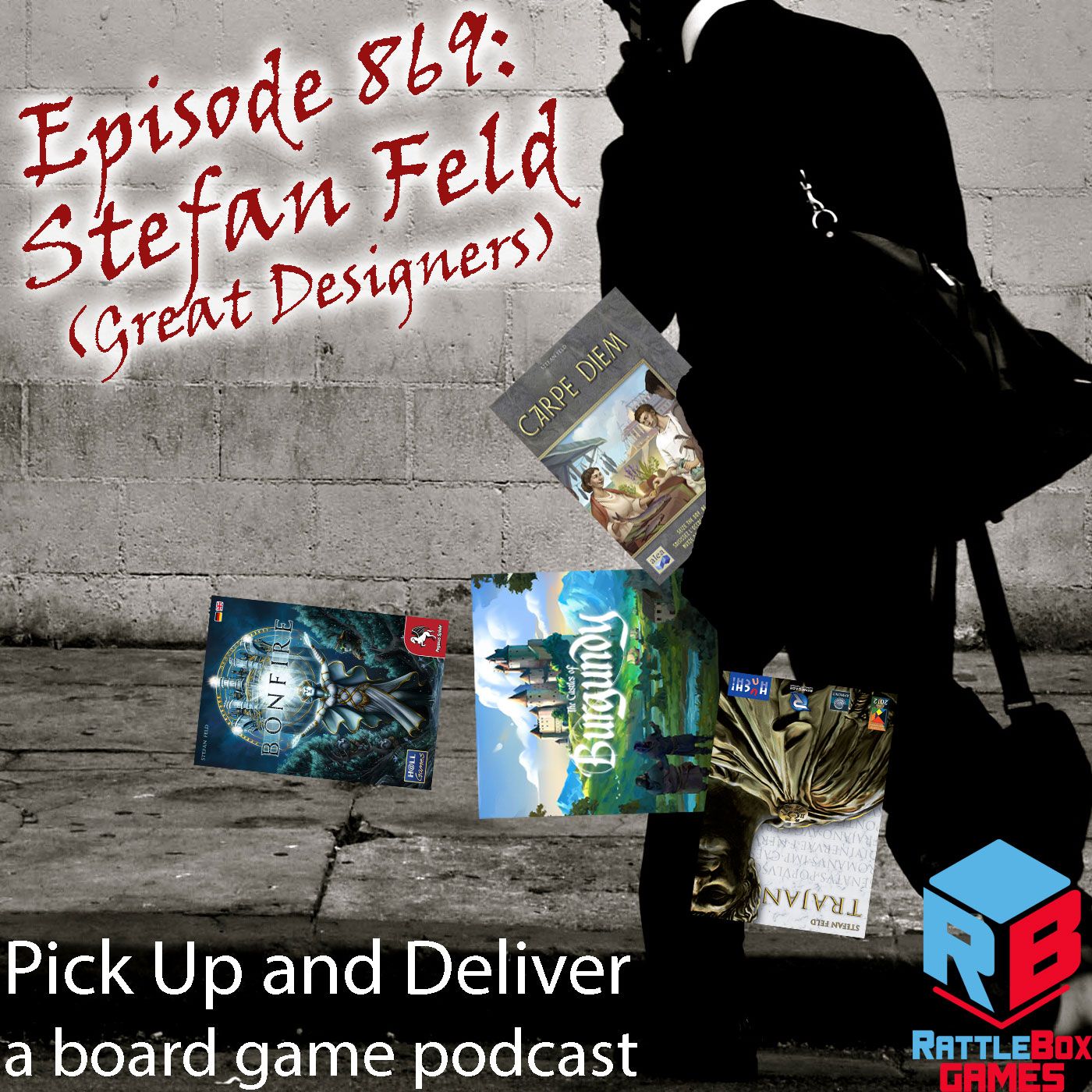
- The Castles of Burgundy (2019)
- Carpe Diem (2018)
- Trajan (2011)
- Bonfire (2020)
- Bruges (2013)
- Forum Trajanum (2018)
- AquaSphere (2014)
- La Isla (2014)
Get every episode summarized
Each time Pick Up and Deliver publishes, we email you a written briefing from the transcript — the topics, who appeared, and any specific claims, with the ad reads skipped.
Email me new episodesFree for 3 shows. No card needed.
Transcript ready
243 searchable segments. Every word is indexed and playable.
Full transcript
Pick Up and Deliver — Stefan Feld (Great Designers). Machine-transcribed; use the interactive transcript above to jump the player to any line.
Welcome to Pick Up and Deliver the podcast where I pick up my audio recorder as I step off the train and deliver an episode to you while I walk home. I'm Brendan Riley. Well, greetings listeners. It's a beautiful day here in suburban Chicago and I'm walking home at the end of a delightful but long day at work. I'm looking forward to talking to you about some board games. Thinking about what kind of episode I have made before but haven't made recently, I was looking over my list of games that I've played a lot and I was thinking about Stefan Feld a little bit. He's a designer. I enjoy a lot of his games. I have played many of them and I was looking through and I realized as far as I could find in the annals of my Rattobox Games website about the podcast that I have not done a great
designers episode about Stefan Feld. That's what I'm doing. Stefan Feld, the great designers. So what I like to do for these episodes, I will talk about the games of these designers that I like the most and explore a little bit about what I like about them and what captures my interest about those designers. Looking over my list, I have played 13 different Stefan Feld games. Four of them I have played more than 10 times. Four of them I have played between two and 10 times and the rest I have played one time each. If you're unfamiliar with Stefan Feld's work entirely, he is a designer of medium to heavy weight, Euro Games. Sometimes he designs games that are sort of light, medium light. I would say I don't think I've played anything of his that I would call less than medium light. Some of the games are relatively simple but they still have emergent complexity that I
think pushes them at least to the level of medium light. His designs tend to be very interesting mechanically but not very robust thematically. His designs generally don't have a strong correlation between theme and mechanism. Even if sometimes they do come up with a logic that allows you to understand the mechanism, often it's barely held together. It doesn't usually feel like the thing you're doing has anything to do with the narrative that the games are supposing. I have heard, and this is from other podcasts I haven't done any research on him myself, I have heard that Feld designs his games without theme and it's usually up to the publishers to put a theme on them or not. I don't know if that's still the case but that would explain the mechanics first approach to his designs.
If I thought what I would do today is I'll talk about the four games of his that I played extensively and a little bit about something special about each one and then I'll cover the others as I have time. So the game of his I've played the most is the castles of Burgundy. I've logged 48 plays of this game, probably three to five of them on the table and all the rest asynchronous. For a while I was playing it on Bwata's you pretty regularly and now I mostly play on board game arena. I have played a few times on Yukata as well. I think board game arena is the best interface of the game. I do have the deluxe edition and have played it a few times on my table and I really like it but it doesn't hit the table all that often. So what is it that makes castles of Burgundy special? One of the things is it is a game where your actions are driven by dice but Feld has
built in a number of different ways that you can use the dice so that even as you are constrained by the randomness of what you've rolled you have a lot of flexibility about what you can do with those randomly rolled dice. It is a tile placement game at its heart. You are buying tiles and putting them onto your personal map. The different tiles do different things and you are accumulating points and bonuses based on which tiles you purchase. Each turn you are going to roll a couple dice and those dice are going to determine what you can do. You get to do two dice. You also have some tokens that you can start with a couple and you can get more. These are tokens that change the value of the dice or they ameliorate your bad luck a little bit. And it is this wide range of things you can do with this narrow scope, these two dice that makes for a really fascinating game design. The levels of competition that you have with the other players are really interesting because
there is a speed component in terms of filling out your board quickly and finishing zones on your board is a huge part of the early game scoring because the zones on your board as you fill them you get bonus points based on when you fill them. When you are playing if you don't fill you want to fill a couple zones during the first round when you get the highest bonus for filling the zones. Then as the game goes on it becomes valuable to fill the zones because you get bonuses for filling all of a certain color. The game also has a variety of different other elements that allow you to score in different ways and it just gives you an flexibility to really be able to find a path to points. It is the quintessential point salad in that almost everything you do gets you some points. So there are some things you could do that won't but generally you gain points throughout for your work.
They have released a number of different maps for the game so you could start with different boards like Arknova. The variability is really high but it is tactical variability by which I mean each time you play you are having to make decisions based on what you rolled and what tiles are available and those will change each round but they are all from the same pool each time. So each time you play the same sets of tiles are going to be available unless you are adding in one of the expansion modules. But the way that you deploy those, the order that you choose to deploy them is where the points come from. I think this game is endlessly great. I really like the way it plays. There is a little bit of player to player action. I want to entirely like a work placement game about taking the thing that someone else wanted before you get it and getting ahead of them on the merchant track.
But generally it is heads down solo, heads down, play your own board kind of game. There is a reason I have played this 48 times I think it is fantastic. That is Castle's O'Berrying D. My favorite of this stuff in Feld Games. Next up we have another game that I like almost as much. This is Carpe Diem. Carpe Diem is a game where you are building a, this is Roman themed. It has a whole bunch of Roman themed games where you are building a neighborhood or something a, a state of different tiles. And again it is about selecting and playing the tiles. So in that part it is not entirely dissimilar from Castle's O'Berrying D. The big difference is when you are grabbing the tiles instead of grabbing them for immediate points. You are grabbing them to set up points that you will score at the end of each round. The light castles of Burgundy, the tiles come out in phases and you draft them in phases.
You get points for, for completing elements. But this one is a little more directly competitive because your turn order matters a lot when you get to the scoring part because you get to pick which scoring junction you want to go for. And if another player goes for the one you wanted it can be pretty hard on your points. Now the graphic design on the first edition is pretty bad. I know that they redesigned it for the second edition and I think the art made it a little bit better. But this is the main complaint. They did also change the way the pieces move and I think they made it worse. I really liked the way the pieces move in the first edition so I am glad I have that one. I know mathematically it doesn't really matter but I think narratively it's important. The point scoring in Carpe Diem is particularly interesting. There's this grid of cards and at the end of each round in turn in order based on sort
of this track that you can move up by doing certain things. You put one of your player pieces on one of the spots in between two of these cards and then you score both cards. If you can score the card you get the points for it. If you can score it more than once you get the points multiple times and if you can't score it you lose four points. So there's an interesting element of sometimes you can't score it or one of them you can score really well so you take the negative four on the other or sometimes you can't score any of them so you just take the one that you think your opponents will get the most points out of. But these junctions between the cards are one use for the whole game. So as you go along you have your choices about what you're going to score reduce and that makes for a really interesting tightening of the board. There's also like most stuff in fel games there's a variety of other ways you can score as well. So the art is a downside with this one but it is still one of my favorites I really like
the variety of things you have to worry about as you're placing your tiles makes for interesting play. So the third most played game I have in my Stefan Feld collection and again mostly Carpe Diem is probably if I'm just going with plays on the table. Carpe Diem is probably my highest plays on the table game. I wouldn't be surprised if I have close to ten plays on the table of that one. I've logged thirty two plays mostly on Yucata. Now Trajan is the other way I've never played it on the table but I've played twenty nine times digitally. This was entirely on Bwata Xu back and I almost exclusively played against Kevin Burrent. Hey Kevin I don't know if he listens anymore but if he does hey Kevin Trajan is a really interesting game full of mini games. That is the quintessential complicated Feldean game of lots of other things you can do and trying to keep track of what you can do.
It's got this delightfully obtuse action selection mechanism where you are using a Rondel and these little colored dots and you pick up the dots and move them like a like a Moncala and when you drop the piece and when you drop the last piece then you're going to do the thing in that Rondel space and the little pieces that are in the space determine how much you get to do. It's really hard to explain without getting too complicated or too into the weeds except if I used to say like these other games it's about being tactical with what you're able to play, what you're able to get, how you're able to make the pieces overlap. I really enjoyed it when I got to play it regularly. I'm not sure how much I would enjoy it on the table it's very beefy and I haven't picked up a copy although if I found a copy for cheap I would get it or when I'm in trades and it's one of the things that's available I do trade for it or try to trade for it because
it is a game I do enjoy and I would enjoy having it. I just haven't gone on my way to get it. It is probably the most obtuse of the Steffenfeld games I've played but I really like it. That's Trajan. The last of the games that I've played more than 10 times as Bonfire. I played Bonfire 13 times maybe 3 on the table or 4. This is a specific category of Feld game that has several different things you can do that involve a cheneleiding, a set of coordinated things and getting points for having gotten a good combination of those coordinated things. That's really obscure but Bonfire works this way, aquisphere works that way and I believe I haven't played it yet but I believe the druids of Adora work this way. What you're trying to do is coordinate between a variety of different things you can accumulate and you get a score for a kind of matrix of options between there.
I really like to Bonfire but it ended up being one of those games where I just didn't have the opportunity to play it very much and as I am trying to decide what games to keep or get rid of, this is one of those ones where I was like I have other games that sort of scratch this itch and by getting rid of it I can hopefully get other games. I did the same thing with aquisphere a few years ago. These are games I enjoy but just didn't really wow me the way that some of the other ones did. Now Bonfire I find the best of that sort of breed although like I said I haven't tried druids of Adora yet so we'll see how that goes when I get a chance to play that one. Maybe that one will stick but this is a brand of Steppenfeld game that I do really enjoy but I just haven't found the right one to really grab me. They are the closest in gameplay to the Vladimir Suchi games where you have again these variety of different like bonuses and things you can get and how they scale off each other.
Another one that feels this way is Bora Bora. It's a little different but very similar in terms of this cascade of different things you can get. The next four that I've played more than once but not ten times in fact five, four, four and three are forum, trojanum, aquisphere, la isla and bruge. Now bruge I never understood. I've played it a couple times only on yukata and getting my mind around how it worked I never, I haven't gotten that yet. That is one I would like to try on the table. Forum trojanum I really like. I've played that once on the table. It is one I'd like to come back to. It feels like Carpe Diem plus. It's a bit more complicated than Carpe Diem but feels like in the same neighborhood as that and in a way that I really like. Aquisphere as I said feels like very similar to bonfire and while I like the theme it was one of those ones where I only need so many medium weight games in my collection and that
one wasn't doing it for me, dramatically. Then la isla is maybe the lightest stuff in Feldgame I've played and I really like the flow of it. It is an excellent little puzzle game with just delicious little choices you get. Three cards per round and you have to put one in A, one in B and one in C. Maybe there's four cards, ABC and D. And each card can do one of four different things but you have to play, you have to decide how to set those cards and use each one one for each of the four ways that you can play a card. It's a really delicious little choice and it's a nice little area control game. I would say the main problem with it is very seamy. It's the same thing. So it's a delicious choice but not that deep. So I've enjoyed that one and that one stayed in my collection because it is a little lighter. Finally I have played Borbora, Civilution in the year of the dragon Notre Dame and the Oracle of Delphi.
Very quickly I like Civilution but it was very intense. I did not like in the year of the dragon or Notre Dame the intensity of the penalties in those games was too much for my taste. The Oracle of Delphi and Borbora are both games that I recognize they're very good. I just haven't had a chance to play them more in depth. So that's my take on the great designer, Stefan Feld. I'm curious, what's your take on Stefan Feld? What do you like about his games? What do you dislike about them? Which games would you recommend I try if I didn't list one? Which one should I go for? Head over to board game geek guild 3269 and share your thoughts there. I'd love to hear them. Well that's about it for me today. I want to say thanks for joining me on my walk. I hope you next walk is as fun as this one was. Bye bye.
Brought to you by Rattlebunk State.
More episodes
More from Pick Up and Deliver

Night at the Zoo; The Emerald Flame; Elder Sign: Omens of the Pharaoh (expansion...
Pick Up and Deliver

Top of the Stack, October 2026
Pick Up and Deliver

5 Things I Like About Trickerion (Message from the Deep)
Pick Up and Deliver

Emptying the Dust Bin – June – August 2026
Pick Up and Deliver