Smothers: Oil Above $80 Will Add Long-Term Consumer & FOMC Pressures
Get every episode summarized
Each time Schwab Network publishes, we email you a written briefing from the transcript — the topics, who appeared, and any specific claims, with the ad reads skipped.
Email me new episodesFree for 3 shows. No card needed.
About this episode
“but I do want to welcome in our next guest. Take a look at the broader market, obviously with everything going on in oil and the Middle East right now. Welcome in Dale Smothers, President NCEO at RDS wealth management.”From the transcript
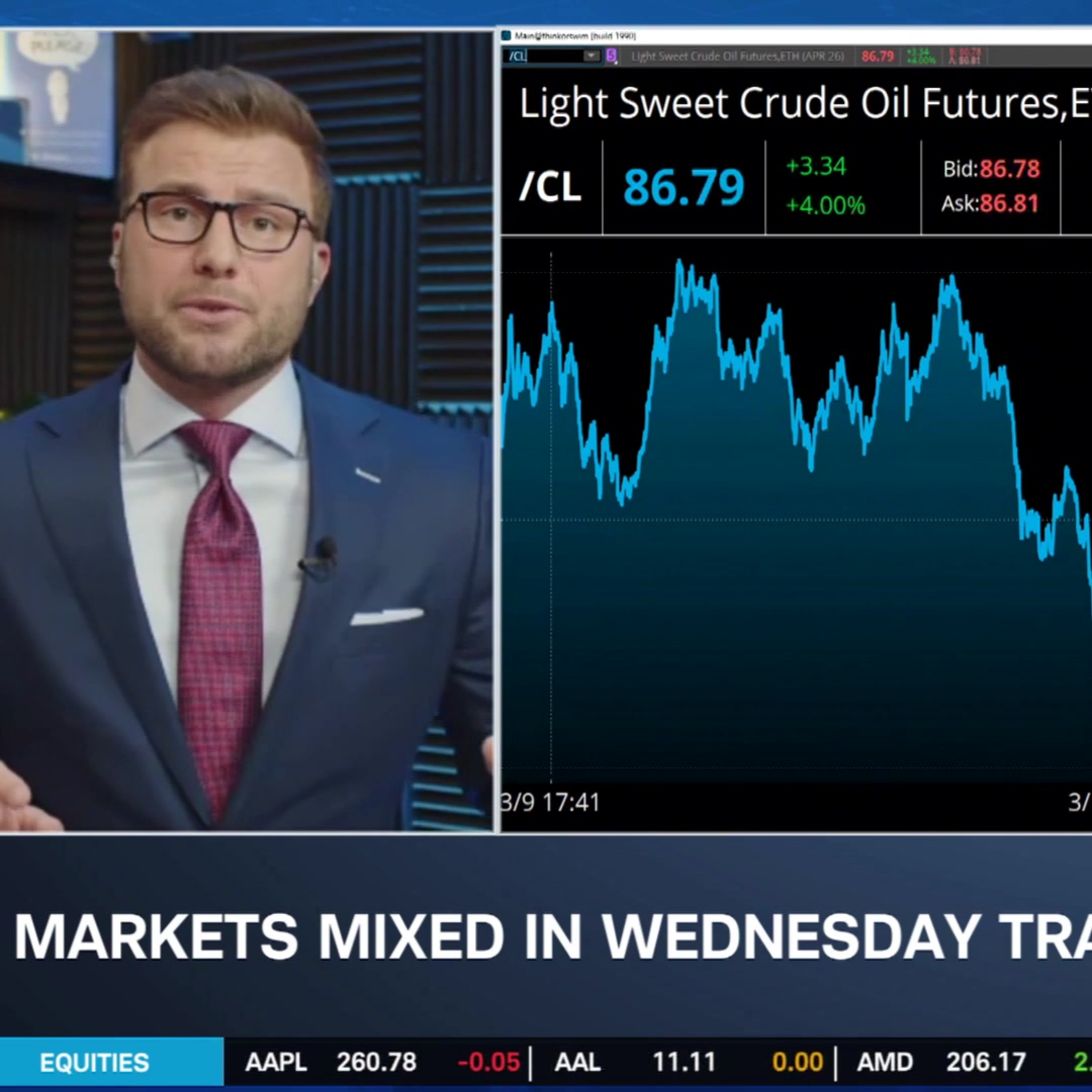
"We can survive" with crude oil hovering around $80, but anything above that will hurt consumers, says Dale Smothers. If the commodity reaches $100 or higher, Dale expects pressures to pinch consumer staple stocks the most and will have much wider global implications. Additionally, "inflation has not been an issue up until this point," says Dale, meaning energy price spikes paired with tariff policy will create a big interest rate conundrum for the Fed.
======== Schwab Network ========
Empowering every investor and trader, every market day.
Options involve risks and are not suitable for all investors. Before trading, read the Options Disclosure Document. http://bit.ly/2v9tH6D
Subscribe to the Market Minute newsletter - https://schwabnetwork.com/subscribe
Download the iOS app - https://apps.apple.com/us/app/schwab-network/id1460719185
Download the Amazon Fire Tv App - https://www.amazon.com/TD-Ameritrade-Network/dp/B07KRD76C7
Watch on Sling - https://watch.sling.com/1/asset/191928615bd8d47686f94682aefaa007/watch
Watch on Vizio - https://www.vizio.com/en/watchfreeplus-explore
Watch on DistroTV - https://www.distro.tv/live/schwab-network/
Follow us on X – https://twitter.com/schwabnetwork
Follow us on Facebook – https://www.facebook.com/schwabnetwork
Follow us on LinkedIn - https://www.linkedin.com/company/schwab-network/
About Schwab Network - https://schwabnetwork.com/about
Get every episode summarized
Each time Schwab Network publishes, we email you a written briefing from the transcript — the topics, who appeared, and any specific claims, with the ad reads skipped.
Email me new episodesFree for 3 shows. No card needed.
Transcript ready
185 searchable segments. Every word is indexed and playable.
Full transcript
Schwab Network — Smothers: Oil Above $80 Will Add Long-Term Consumer & FOMC Pressures. Machine-transcribed; use the interactive transcript above to jump the player to any line.
but I do want to welcome in our next guest. Take a look at the broader market, obviously with everything going on in oil and the Middle East right now. Welcome in Dale Smothers, President NCEO at RDS wealth management. Dale, great to see you this morning. You know, I'm looking at the board a bit of a mixed picture again, a little bit less of a roller coaster feeling than we had with Monday and Tuesday here, but you say you're cautiously optimistic right now on the markets. You take me through where the optimism is coming from, but also where you have some concerns. Sure, and good to be with you, Marley. You know, I think you're going to see this continued roller coaster until the straight of her moves is opened. Oil is the key driving factor in the short term for the US economy and the market. You know, $80 a barrel of oil, we can survive with that. Anything over 80, especially if you get to 100, even 120, that becomes very stressful for the US economy, not to mention the fact that we've got tariffs that are essentially on every import that comes into the US,
inflation becomes a big key factor that we want to watch there. If we see oil stay this high for a long period of time, it's all about fear though. I think what you're seeing is the volatility due to fear and uncertainty rather than fundamentals. And that is one of the reasons that we are optimistic is that the fundamentals of the overall market haven't changed. We continue to see earnings growth. We continue to see this cyclical trend from technology rotating into the consumer staples in the broader market. Energy is one of those clearly that is driving the S&P 500 a little higher. I don't think that that type of spike continues, but I think utilities is a place that continues to grow. I think you see commodities continue to grow. And this broadening out of the overall market gives us reason to be optimistic, not to mention the fact that while we're seeing this trend leave technology into other sectors, good news is we aren't seeing money leave the market altogether. Marley, we're just what, 3% from all time highs in the S&P 500
a little under, 3% now with today's move. This gives us reason to believe that if technology picks back up, we think new money comes in. And we've seen a lot of these tech names grow into their valuations over the last six months because they've been pretty stale to say the least since October. Yeah, and Dale, you say commodities right now. I'm going to say oil. So let's talk about oil. You highlighted some levels there, anything over 80. Then you mentioned if we got over 100 up near 120, potentially a barrel, we have seen that. It was brief, but we did see it. If we were to see crude push back up above 100 or even potentially up near that, we touched about 119 before, which sectors of the economy would feel that the fastest? Yeah, I think consumer staples are immediately going to fill that. You're going to see inflation affect the entire market. There's going to be even more uncertainty around what the Fed will do. And this is going to essentially impact the macro markets. I think you're also going to see some geopolitical risk evolve here
because you think about Russia right now selling barrels of oil on the open market at some all-time highs that we've at least relatively recent highs. This is going to be some ramifications that will feel probably for generations to come. If we continue to see oil trading over $100 a barrel, and I don't think that's good for anyone. Now, the good news is, I think America has positioned itself with energy independence. And specifically, one of the key exporters of oil, maybe we can bring some of that home, but the oil market is a global market. And so how are you going to tell an oil distributor say in America that they can't sell to someone willing to pay higher cost than what they can get here in America? It's a lot of a tightrope walk, if you will, for the administration if oil continues over $100 a barrel. It certainly is, Dale. And our guest coming up here in about 20 minutes has a scenario we're going to discuss about what it would look like if there was an export ban on oil here in the US. So stay tuned for that.
But on the flip side of this argument, let's say we don't go over 100. It doesn't sustain that long. Tensions ease here. How quickly are we going to see oil prices fall? And how much residual impact is there really going to be to the markets and the inflation number? Because that's a lot of the conversation we're having is if this continues, does it become inflationary? There's some disagreement about that. But how much residual impact is there going to be if this does come to a resolution in the near term? I think here's one thing we can say without a doubt is that inflation has not been an issue up to this point, at least with the most recent announcement of tariffs and Liberation Day almost a year ago today. We have back in April a global tariff, essentially, across all countries that import into America. But because energy was not super expensive at the time, we've seen inflation stay pretty flat, which is great for American consumers.
If we continue to see this tariff agenda push forward and higher energy cost, I think it's almost no argument at all that inflation comes back. If we see energy cost stay low or even go lower because we've got some of the bad actors in the Middle East eradicated from the equation, we could see oil hit some all-time lows, which could be good things for the overall American consumer. We have a K-shaped economy that is forming and we talk a lot about this affordability crisis. High oil equals a much harder challenge for affordability. Lower oil cost allows us to at least focus on the things that are impacting affordability at its root, which I think have to do a lot with interest rates, access to money, cheap money, and the ability to pay it back with higher earnings, a lot of geopolitical and, of course, domestic politics go into this. Oil is the hinge pin for all of this we're discussing today. It certainly is, and it's also been the primary driver
of the volatility that we've seen to any of these headlines coming out, we're seeing big moves in the VIX. The VIX is mid-20s right now. We're about 24 right now, so elevated, but it's certainly not signaling mass hysteria at this point, also significantly off of the 50 plus levels that we saw in some of the tariff scare in last year. So what does that indicate to you, Dale, about how much fear there actually is in the market right now for investors? You make a good point with that VIX index. It's a key indicator that we watch here at RDS wealth to know kind of what the trends are headed to in the market. It's a measure of fear and essentially volatility in the S&P 500. The VIX being mid-20s right now tells me that the market is, again, cautious, and whether they're optimistic or pessimistic, they're cautious. Now, I think you can read certain things in the market as almost an inkblot test. CPI coming back like it did, you dive a little bit deeper.
Energy was higher than we would hope for it to be. Housing may be a little bit higher than we would hope for it to be. You've got a lot of things that you can look at either from an optimistic lens or a pessimistic lens, but VIX being 25 for me tells me that for our investors for the clients that we are helping navigate this journey to and through retirement for, we have to be cautious and disciplined in our approach. And one of the ways we're doing that is by being heavy right now with the overall index. Again, we've seen this trend, this rotation out of tech into the broader index. So S&P 500, SPY for us is a good holding that we have there. And as we see volatility hit specific names, Marley, we're going into those names a little bit heavier, perhaps with the money that hasn't moved nearly as much. And right now, we're seeing a lot of that in software and technology specifically. So to answer your question, I think that the VIX at 25 is that point where it could go one way or the other. Anything that trends that VIX a little bit lower
is going to be an optimistic, what we would call tailwind for the market, and we want to be a part of that. Absolutely, Dale, thanks for being with us. Always great to talk to you. And you mentioned software there. We're seeing Oracle more than 11% higher giving a boost to that space right now. But Dale, we really appreciate your insight, Dale Smothers, President and CEO at RDS wealth management.
More episodes
More from Schwab Network

Stock Market Today: FICO Worst Day in Decades, CCL & BE Top SPX #shorts
Schwab Network

Tuesday's Final Takeaways: Consumer Confidence Sinks, Oura Delays IPO
Schwab Network

Daniel Newman on Anthropic's Value, AI Safety & MU Earnings Expectations
Schwab Network

Bitcoin's "One-Two Punch" in Crypto Regulation, Clears Fog on Blockchain Outlook
Schwab Network