Get every episode summarized
Each time The Telepathy Tapes publishes, we email you a written briefing from the transcript — the topics, who appeared, and any specific claims, with the ad reads skipped.
Email me new episodesFree for 3 shows. No card needed.
About this episode
The Telepathy Tapes is made possible by:
“Hey everyone is Kai, Mark your calendars for October 7th because season 3 of the Tulefti tapes, the reincarnation records is coming.”From the transcript
At 17 months old, Caelum Miller suffered a near-fatal drowning that left him with a severe traumatic brain injury. Doctors told his family he would likely remain in a vegetative state for the rest of his life. But his parents refused to close the door on what might be possible.
Years later, Caelum learned to communicate through facilitated communication and began sharing thoughts, memories, and experiences that his family says challenged everything they understood about his consciousness.
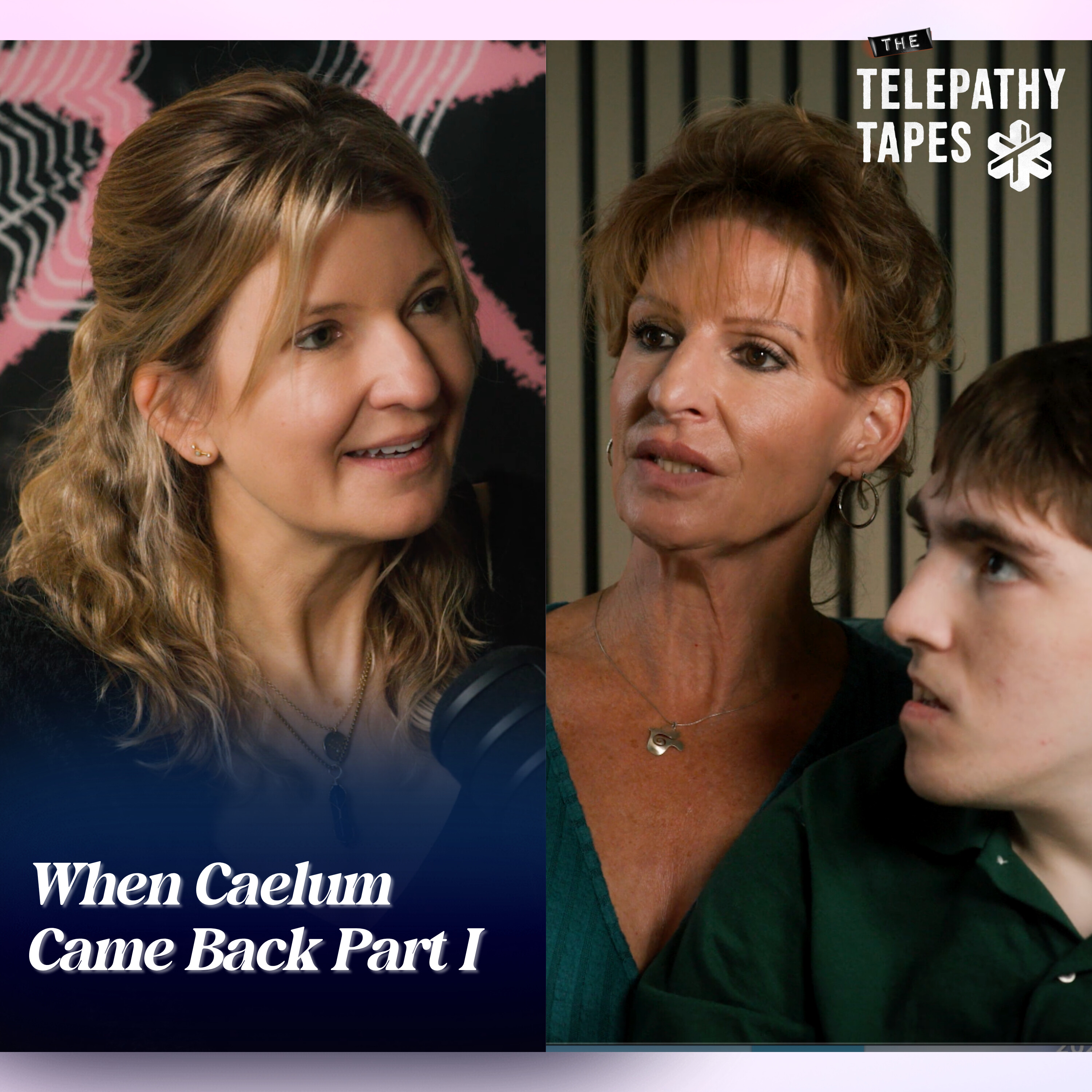
In this episode, Caelum and his mother, Anne-Marie, tell the story of his remarkable recovery and the moment communication changed everything. Caelum describes what he says he experienced while outside his body, including an encounter with a deceased musician he had never met, and shares his perspective on God, consciousness, and what he believes happens beyond this physical world.
We also hear from Anne-Marie about the skepticism surrounding facilitated communication, the years of journals documenting Caelum's words, and what it has meant for their family to discover a voice they were once told they would never hear.
_______
Join The Telepathy Tapes Backstage Pass to get ad-free episodes, never-before-heard interviews, behind-the-scenes documentary footage, and access to our private Discord community. This is your invitation to come closer. To help shape what’s next. To be more than a listener… to be a co-creator of this paradigm shift. So if you’ve felt moved, if you’ve felt seen, if you’ve felt the call, subscribe today and join us: thetelepathytapes.com.
_______
Thank you to our sponsors!
- Alloy - Try the original estrogen-powered M4 skincare from Alloy. Visit myalloy.com and use code TAPES for $20 off your first order!
- Ka'Chava - Go to kachava.com and use code TAPES for 15% off your first order.
- Shopify - Start your business today with the industry’s best business partner, Shopify. Sign up for your free trial at Shopify.com/tapes.
- Progressive - Insurance isn't one-size-fits-all. Visit Progressive.com and find a rate that works for you with the Name Your Price® tool.
- BiOptimizers - Make this the year you finally get your sleep, your energy, and yourself back. Get 15% off at bioptimizers.com/tapes when you use my code, TAPES.
- Quince - Elevate your summer wardrobe. Go to Quince.com/tapes for free shipping on your order and 365-day returns.
- Luminara - If you’re curious about energy healing and ready to experience it for yourself, Luminara is offering 20% off your first session for listeners of The Telepathy Tapes. Just go to luminara.care and use code TAPES20.
- Lola Blankets - For a limited time, our listeners can get 40% OFF select Lola Blankets products with code TAPES at checkout, go to lolablankets.com.
See Privacy Policy at https://art19.com/privacy and California Privacy Notice at https://art19.com/privacy#do-not-sell-my-info.
Get every episode summarized
Each time The Telepathy Tapes publishes, we email you a written briefing from the transcript — the topics, who appeared, and any specific claims, with the ad reads skipped.
Email me new episodesFree for 3 shows. No card needed.
Hosts & guests
Transcript ready
359 searchable segments. Every word is indexed and playable.
Full transcript
The Telepathy Tapes — S2E53: When Caelum Came Back Part I | Talk Tracks. Machine-transcribed; use the interactive transcript above to jump the player to any line.
Hey everyone is Kai, Mark your calendars for October 7th because season 3 of the Tulefti tapes, the reincarnation records is coming. Hi everyone, I'm Kai Dickens and welcome to The Top Tracks, brought to you weekly by TTT Media. In this series we explore the threads that we've together our understanding of reality, science, spirituality, consciousness, and even unexplained phenomena. Because every era has ideas once dismissed as impossible until someone was willing to investigate them seriously. And on this show, we do just that. Today we welcome Ann Marie, Caleb, and his brother Jacob. As we hear a remarkable story of perseverance. At 17 months, Caleb experienced a non-fatal drowning. After a month in a coma and severe traumatic brain injury, the doctor said that Caleb would likely live in a vegetative state the rest of his life and a remarkable choosing of hope. The family did everything they could to rally around Caleb.
The family's perseverance paid off, beating so many of the odds. And what surprised and shocked doctors the most was Caleb's ability to learn to communicate via facilitated communication. And when he started typing, he changed the family's views on life and reality and even death forever because Caleb expressed information that he should have no way of knowing and what he has learned and gleaned from that near death experience. So welcome to the TalkTracks, Caleb and Ann Marie. It is such a pleasure to have you both here. Why don't you start by introducing yourselves where you're from? Okay. And tell us a little bit about your backstory. What led you here today? Sure. So I'm Ann Marie Miller. And this is Caleb. Miller, our youngest son. And we're from LeVern, California. And this is a very long story, but Caleb was a 17-month-old when he sustained a traumatic brain injury from a non-fatal drowning in our backyard pool. And somehow he made his way
through a closed gate. We still don't know how that happened even to this day. My husband and Hacks had to open the gate to get in there. I started CPR and aspirations poolside. And then Caleb was taken to our local hospital where it took over an hour to resuscitate him. Oh my goodness. Yeah. And up into that point, Caleb was healthy. Everything was a typical developmental progress. Yes. And he was the youngest of six. So he had a lot of interactions with his older siblings. So he was a little advanced for his age at that time. Very curious, very stubborn. Always wanting to learn things. So sometimes that curiosity can be problematic as it was in this case. But he was resuscitated at the hospital and then he was transferred to children's hospital where he was for a month. And at that time they wanted us to withdraw care at the beginning and donate organs.
And we were like, no, we're not doing that. We kind of thought, well, maybe there is some possibility of repair recovery. A 30 days later he came out of a coma and he was transferred to a rehab facility where then the conversation became, you know, you need to institutionalize him. And just go home and raise your other children. And we said no to that too. And we thought, okay, we're going to bring him home and see what could be possible for him. Wow. Wow. Okay, you're lucky to have your parents that you do. It's incredible. When active, just persistence and hope, right? To just not listen to the worst outcomes, but try to create the best ones for your family. Yes. And just see what was possible. I mean, we didn't want to close any doors, which they were recommending to us. It's like, let's go home and see what we could find and what could give us some more hope if we pursue and let him show us what he can do. Yeah. Yeah. So, okay. So what happened next in the journey? So we found an institute in
Philadelphia called the Institutes for the Achievement of Human Potential, which when I first came upon that title, I thought that's a really cool name. I wonder what they do there. And what they do is they teach parents how to rehab their brain injured children at home. They have a huge comprehensive program that they offer you. You have to take training as parents and then they evaluate your child. And then they tailor everything specifically to your child. So we took Caleb there about it was 10 months after his injury is accident and started with this organization. And there, there are family now. We've been with them for many, many years now. But the first thing they did was focus on getting his physiology and order and cleaning up the diet and all kinds of things like that. And then taught us that children who are immobile can take in copious amounts of intellectual materials if they're given the right opportunity to do so. So we had that as a huge
component of the early progress with Caleb, which also included language development. And so when he started that program when he was two years and four months old and then when he was three and a half, they introduced facilitated communication. And the first thing that came out of his mouth was, or his typing, was I am very intelligent and I know how to read. And at that time it was the only time that my husband and I did not have the video going to record that. But it was just so moving. I brought me to tears because it was like, oh my gosh, we have the ability to communicate. And he can tell us how he's feeling if he's thirsty. Sorry. If he needs something, I mean, and we had done something prior to facilitated communication using a choice board. So he could say yes or no to things. But then for him to be able to complete sentences and really expound on what he was feeling
and thinking was just, I mean, I'm still very emotional about it thinking back all these years. That's how he was able to express himself from the get go, which also led to me cleaning up his reading materials because Caleb was very motivated by reading, love to read. So a lot of his mobility program was attached to his intellectual program, which is reading. And so it took us tens and tens of hours. We spent a lot of time. Caleb was very spastic and the typing was extremely slow about like this. But then I would just sit with him for hours on and off during the day until we got into some kind of a rhythm. And he became more and more efficient as time went on. Wow. I think it's so important for audiences to understand though that Caleb had a traumatic brain injury. And that spelling through facilitated communication was possible. And it sounds like the same thing so
many parents of severely autistic children here were true for you, which well, they were often those parents are being told their child isn't in there and isn't competent. Were you being told that as well? Or were you being told something different that he was in there despite the TBI? Oh no, they were telling us that he there was no hope for his recovery. The brain injury was so massive that there was not going to be anything but a persistent, persistent vegetative state. Didn't even bring up anything that would be meaningful as far as his recovery or his potential for recovery, which included any kind of communication. But we knew, I mean, I knew the first or second day that he was in the intensive care unit. I kept telling him, I see you in there. I mean, I remember telling him that I see you in there. And then he started to show us that he was in there at the onset of his injury. He was critically blind. He was immobile and he was also insensate. Couldn't feel anything. And so we started working to change those things. But we all, even his older
brothers and his sister and dad, we all knew that he was in there because of the way that he was responding. And we also found out through the institutes too that any sound that he was making was language in his own brain, kind of like a stroke patient. The words not coming out the way that we could understand, but that they're speaking. But when it translated into him being able to communicate through facilitated communication, it just confirmed everything that we already knew. The medical doctor is actually kind of astounded. His pediatrician wrote us a personal check to fund our trip, the second trip to the institutes because he was so moved by what he was able to witness in Caleb's recovery. So that became, you know, really a significant plus to have a medical doctor now verifying it back to us, which we already knew. What? Beautiful. And so what were some of the first things Caleb started expressing to when he had language? Was
he able? Because at the time he was probably watching a little over two. Yeah. So pretty young to be expressing that he's intelligent. What were things early that the validated for you? It was his words. Well, we took a lot of time again with the facilitated communication him training me. And I would intentionally ask him, you know, what's your favorite fruit? And I would use his FC board and I would pick fruit that would have, you know, letters that were far away. So I knew exactly what he was doing. So I could be confident in that he was making his choice accurately for me to know. But as we refined that and got really proficient in moving quickly, we were all sitting down as a family one we used to watch PBS. And so that was one of our favorite programs to watch. And this particular evening, there was a show on called Playing for Change. And a music producer
named Mark Johnson had gone around filming street musicians throughout the country, very talented ones. And so he was putting together a compilation, kind of a documentary about this. And while we were all watching it, mind you, this is the first time the whole family is together watching this program. Caleb started to cry and very emotional crying. And we were kind of looking at each other like, why is he crying? Well, he kept it up. So one of his older brothers said, get his card so he can say. So Caleb typed, you know, we said, what's wrong? He said that black man in the video so went to God after they made the music. And so we were like, well, what do you mean? And so we're kind of confused. And he said the black man in the video. So they had shown three black musicians. So we waited for them to come back to one and we said, is that him? And he said no. And then they went to the second one.
And we said, is that the man? And he said no. So by deduction, we know it was the third one. But he was still very emotionally upset about this. So we decided to just turn the show off the movie off and then his dad said, you know, I'll check it out and we'll figure out what it was later. Well, a couple weeks later, my husband called me from work and said, I have, you need to sit down. And I said, okay, what? He said, I found out who the other musician was. His name is Roger Ridley. And I want to show Caleb when we get home from work. So my husband came home from work. Caleb sat on my lap. My husband pulled up the video of Roger Ridley. And Caleb got super excited, like very happy. And so we're all looking at each other like, what is this? And we got his FC board and he typed, I'm so happy to see my friend again. And we said, your friend, and he
said, yeah, I saw him when I was with God. And we thought, okay, well, we came to find out after that that Roger Ridley died the year before Caleb had his accident. Yes, it was well. You want to type? Okay, please. For listeners at home, I'll be summarizing Caleb's typing. And his answer here was, when I had my accident, I was not here for over an hour. I was with God in all the glory. So I have a middle school daughter who is very into fashion and has great taste, but I also want to teach her financial discernment. Having great style doesn't have to mean paying full price for everything. It means knowing what's worth spending money on, recognizing a great find, and understanding that buying something pre-owned can actually be the smarter choice sometimes.
That's why we've been looking on what's not for things like jeans, sunglasses, and jewelry. They have a lot of the brands I've grown to love and treasure, but they also have newer brands that I've never heard of, but my daughter certainly has. In fact, we recently bought a pair of heaven mayhem silver chunky hoop earrings for only $35, which is like 60% savings. And for myself, I snagged a pair of my favorite brand jeans, Coss, for like 50% off, and the seller was so helpful in describing the fit. And for those of you who haven't heard of it, what not is the largest live shopping marketplace in the United States, and you can shop name brands without the retail prices. The sellers go live, show you the items up close, explain the sizing and condition, and answer your questions in real time. It makes shopping feel fun and personal, and it's something my daughter and I can do together that's more engaging than just shopping online. And it's so great to help rebuild her sense of style while learning how to make thoughtful choices with money. I love what not, I use it all the time, and you will too. Download what not today and get $20 off your first purchase. See what not, wh-at-t-n-o-t in the app store, sign up, and start finding the best
deals on the products you love with $20 off your first purchase, terms apply. If you ever set foot my house, I think you'll be able to count 6-8 Lola blankets. They're beloved by me, by my kids, by my pets, by my mother. The softness is unlike anything else. And they now have pet beds, because pets like mine were taking over their owners' blankets so much that Lola created an entire pet collection with blankets, beds, and pads for our furry friends. And the Lola pet bed pairs that signature ultra soft faux fur with an orthopedic foam base that supports your pet's joints. The cover comes off for machine washing, and durable double stitching helps it hold over time. Your pet gets a plush place to settle in, and you might actually get your blanket back. The softest season is here, and Lola Blanket just dropped their fall collection. The Westwood collection. Cozy up in their most covetable palette yet, with new, atominal colors and Western inspired prints. For a limited time, our listeners can get 40% off, select Lola Blanket products with code tapes at checkout. Just head to LolaBlankets.com and use code tapes to get 40% off your order. After you purchase, they'll ask
where you heard about them. Please support our show and let them know we sent you. Wrap yourself in luxury with Lola Blankets. Around 3 o'clock each day, I'm ready for a little treat, and I'm definitely one of those salty and sweet people. And one of my absolute favorite flavors is salted caramel. And salt seems like such a small thing, but it brings the whole flavor to life. Suddenly, something sweet becomes so much more interesting. And that's why I'm so excited to try Kachava's new salted caramel flavor. Kachava is already part of my afternoon routine, so this sounds like a delicious way to mix things up. Caramel with that little salty edge. And Kachava brings more than flavor. Just two scoops provides plant-based protein, fiber, greens, and so much more in one simple shake. There are no artificial flavors, colors, or sweeteners, and no preservatives. It's a way to satisfy that craving for something delicious while supporting whole body nutrition. And there are so many flavors to choose from. Chocolate, vanilla, shy, matcha, coconut, asai, strawberry, and coffee. I love having something to look forward to in the middle of a busy day that also helps me take care of myself. So embrace your own salty side. Go to kachava.com and use code tapes for 15% off your first order. That's kachava. K-A-C-H-A-V-A.com code tapes.
It was a sort of like a near death experience for you, Caleb, because a lot of people have this experience where they go somewhere and come back, and they explain that being quite a significant experience. So Caleb is typing again, and he wrote, I would not categorize it as near death, but rather other consciousness. I guess for you, what were you thinking when that happened, like back to the story? Well, so the first time he actually said any of that was before the Roger Ridley experience, but he and I were sitting in the living room and dad and older brother Jacob were playing some kind of a board game, and he was feeling left out. And so he was fussing, and I had never wanted to talk about the accident. We never mentioned the, we didn't talk about it. We didn't talk about any of this in front of him. We were very intentional that way, but for some reason I had him on my lap, and I was compelled to just ask, you know, do you remember when you were in the hospital? And he typed, yes. And then I, and then he typed to me, do you remember when I was temporarily not here? And I said, oh,
you mean when you were at the second hospital? That was my point of reference. And he typed no, and I said, or then he typed again, when I was temporarily not here, and I said, well, what do you mean? He said, when I wasn't here, I was with God. And that was the first time that he said anything. He never had those dreams where you're in your dream and you're like talking and yelling. And there's like nothing coming out. I just remember calling my husband Michael, Michael, and they were so involved in their game. He and Jacob that I, he didn't come in there. And I didn't know what to say when he typed that. Yeah. So I just said, well, how was it? And all he typed was, God loves us all the time always. And that's all he would say. Wow. Was your family really religious? Or was this kind of coming out of left field for your family? No, I mean, we were very spiritual family, but you know, just kind of basic, but we, you know, we weren't average church goers, but we did have our own prayer time and everything, but we weren't really, I mean, I had personally done a lot of spiritual seeking in my life,
but it wasn't something that we would, you know, besides saying grace and prayers together periodically, but it wasn't. So this was a big step. I mean, we're believers, of course, but for a three year old to be telling you this. And then it was profound. Yeah. It was life changing for me in that moment. Yeah. Wow. Yeah. And then what happened next? After that is when Caleb started to share more about his feelings, but we would watch very interesting documentaries about science or things that were more spiritually based. And then we would have kind of like questions or he would want to talk about things. He would be able to recount things that there was no way that we knew that he knew because we never said anything. One example of that was when he was still in a coma, my husband had told him to go find Graminancy, his mother, my mother-in-law,
to, you know, we were just trying to offer things to him when he was not awake. And he recounted that story back to us a couple years after he learned how to do facilitated communication. He saw her and then she said it was okay for him. But he recounted that conversation and we were like, how did he even know that there was no way to know that the other time we say how he knew? No, he was just aware. And I think that's the other thing about when he's typing. He's able to just bring in information that we, you know, as normal typical humans aren't really accessing. So he has a way to access information. And he kind of has talked about that over the years, but not until more specifically with some of the questions. Yeah. What's he writing here? Okay, Caleb started spelling and he just wrote, remember when I was able to tell you about the firemen. Oh, yes. So we were at this little restaurant in our town and
we were sitting out on the patio. This was probably a couple years after his accident. And there was a, the fire department building was right behind this restaurant and there was a walkthrough and we were sitting out there. And so the crew, the paramedics and the firemen that were there at our house that day happened to walk by my husband and I didn't know any of them by name. And they all obviously remembered Caleb and said hello to him. And then when we got home, we were talking with Caleb and he named every single one of them by name. And we were just looking at each other like, how does, how did he know that? How did you know that, Caleb? And he wrote, I was pulled out of the pool by my dad and then my mom started CPR after the team of firemen started to work on me. I was watching all of this transpire from out of my body. I recognized them by their energy signatures. Beautiful. Along the journey, learning facilitated communication. You know, how was the rest of your family where other people learning to spell with him or to type, you know, type with him
were people accepting that he was in there and communicating? All of his siblings, I mean, they immediately believed. Plus, Caleb has a unique way of speaking that the rest of us don't talk like that. So for them, that was fairly straightforward. He does do facilitated communication with two of his older brothers. And they started that early on too. But primarily, it was me and then the two brothers. But outside of that, there was a lot of skepticism from even close friends. I think they just couldn't understand even with the Roger Ridley story kind of confirming that Caleb is able to tell us something that is verifiably accurate by his typing. There still was a lot of hesitation. So it was kind of divided into two schools, I think, or two groups of people, which are the believers and then the ones that just think that, you know, mom or someone else is typing. And
I'm never hesitated or concerned of myself with that because of, again, the way that Caleb speaks and the things that he shared with us are there are things that he could not have known that he's able to tell us again. And so, you know, one of the things that's so important in Caleb, I'm so glad you're here. Actually, I want to see you want to spell something. I see him reaching for the board. Caleb is typing again and he just wrote, we are so unaware as a society that other things could be possible outside of our own understanding. You know, I've been learning about spelling or typing as I've been working on the Tlepti tapes. And one of my favorite moms and also speech language pathologist on the dirty is Libby, who is the mother of John Paul. And at one point, she was talking about the progression of spelling and how, you know, after facilitated communication was so attacked, everyone's like, don't touch. And I love what she said. She said, but for some people, they absolutely have to be touched to throw out facilitated communication is a crime against those individuals because for some folks, you will always need touch. You will
always need feedback or pressure in order to be able to coordinate your body to get things out. And I just think it's such an important message that people have reacted to spelling and typing critics, right? Don't touch, don't touch. And that's fine. And there's so many independent typeers, but some individuals will never be able to do it that way. And I'm just so grateful that you're here and sharing Caleb all that is in there and all that you have to say in your story. Because I hope it will inspire others to just get their kids typing. Well, I mean, to be able to have your child have the opportunity to express themselves. I mean, really, does it matter how it looks or where you're touching them or, I mean, for years, it was always, you know, it's obvious, Caleb is typing when we look back when we see videos of him because he's very deliberate and where he's typing. And, you know, after all these years of doing it, this is the comfortable way for him to be able to access his thoughts and share them. So, you know, I think
that's true that we have other families where their child is more independent with their mobility and all of that, but they still like to have that reassurance of touching at the elbow or touching at the shoulder because that's what prompts them to have that comfort and being able to just go ahead and express themselves. Yeah, I think that's such an important note. For every person, it's a different journey and you have to figure out works for the individual. The other thing that he is an accomplished painter with facilitation also, but then it's what he says about his paintings. He's quite a poet. We have a really good friend that, you know, had a conversation with me a couple weeks ago about how he would love to be able to know what Caleb's abilities are, like, almost like looking through Caleb's eyes into the world, but we have that with facilitated communication because he's able to share those things with us. Oh, he's a lot of type. Go ahead, Caleb. Do you want to type something, Caleb, or should we have your mom read some journals? Yeah. Yeah. All right, I would love for you to go through some of,
first of all, beautiful journal. Thank you. So cool, Caleb. Yes, I know. You're very excited about. So a few years ago, we started noticing when Caleb was talking about, you know, serious subjects or content that was deeply spiritual, that he has a tell. That's what we kind of call it, that he will yawn and then he will continue typing and then some of the things that come out after that are profound and so deep that, you know, you have to read it two or three times to really wrap your head around what he's saying, but it's something that is a significant thing that we notice. And so we write down in his journal when he's yawned because that's kind of like, okay, now we're going to see what else he's going to share with us. And so we've documented that in his journals over all these years too. That's so cool. So when he's spelling, one of you will be like dictating what he's writing as he goes into the journal. Yes, I mean, somebody always has to be there. I've tried using
like a recording, like it was just a two of us and it just, it's not as efficient. So someone always has to be there with the book, you know, because I'm, I have to read it after we're done because I'm not typing it so I have no idea what it says. And sometimes honestly, when I've read what he's written, you know, I, it will bring me to tears because it's just so profound and deep and very moving. And he has a lot of those entries over all these years. I think for audience at home, we were listening and not watching. It's important to just talk about the journal. So, so Ann Marie just grabbed the journal and it's this beautiful leather journal with just score, I mean, tons and tons of pages in it, you know, filled with writings and looks like a little bit of artwork or postcards in there. And I just remember this from even working on the Slept the tapes the past few years is sometimes people would start spelling and one of us has to
dictate, eat, eat, and you really, it looks like a cluster of letters. And then afterward, you often have to figure out the spaces and the period, especially when someone's going really fast away, Caleb does. Well, so on Caleb's FC board, he actually, there's a, a little thing that is a space. So he was taught or he taught me, I should say. So he puts the spaces in between, but sometimes when he gets very animated, the typing is very fast. And so I, his brothers too, there's no distractions. And someone needs to be right there writing it down. And you have to keep up. Plus read some of beautiful writings. We got your mom's reading glasses. Do you have favorites yourself and Marie in there? There's so many. This was, he was talking about his accident. I'll just start at the beginning. What do you remember about your experience? And he said, I really don't remember falling into the pool. I recall being outside my body watching everything. Mommy was
screaming in a way that humans don't sound. And I was very upset. Then Daddy started to tell Mommy to try and work on me. What happened afterwards? Well, I stayed a little bit longer to watch what was happening. I felt a tremendous pull upwards. He yons. As I watched, Mommy work and Daddy was praying and saying he was sorry in the corner behind the orange tree. Then I was in the presence of God immediately. It is hard to describe it. It is the omnipotence alone of great love and strength. And then the question was, how did you converse with God? And Caleb replied, it is not in a way we do here. It is though your heart and mind are one and absorbed into his consciousness. And how did that feel? A true sense of all in one space within me. I began to realize that we are
all the manifestation of God's love. This crosses all races, creatures, and all that has been created in this divinity. We are all one within him. What do you have to say about other saying God is within us? Caleb said, he is our creator. So in that sense, yes. However, he wants us to demonstrate how we can finally become him. And how do we realize that as a collective by the act of true love, not unconditional, but with the full realization that we are all him in this world, the divisiveness and the distance from our true awareness of the basic love for one another has and continues to be the separation. What can we do as a family specifically for you? Caleb, sharing my messages is a key component to this answer. However, we are also not all united behind me. This does not
impede me, but the main thing is to convey the pricelessness of our time together, even in my condition, or others who have seemed similarly impaired. We are more aligned with divine power in God's love than most of the individuals currently on the planet. My purpose is very clearly to create the opportunity for this dialogue. Wow. Beautiful, Caleb. He wants to type. He's grabbing the board. Of course. Caleb's typing, he just wrote, my experience is not unique to me. There are so many of us here to change humanity. So Caleb, I never want to assume anything. And that's why I'd love to know when you said there's many of us here to help you man. Who you mean by us? Okay, so Caleb is typing again and he just wrote, the children who are impaired and others who the world believes are not fully present. Thank you for that. That's a beautiful answer. And before your mom, you leave, I want to ask you a question. I'm going to have your mom go through some
journal entries and talk a little bit more, but then would you want your brother Jacob to share some thoughts too? Yeah. Okay, because you know what, we haven't had many brothers on this show. We've had a lot of moms, a few dads. I don't think many siblings at all. So we're going to have Jacob come in, we'll get you back in your wheelchair and you could just chill out. Okay, for a little bit. You did a great job. I need a hug. He said he needs a hug. I want a hug. We're going to end today's episode here, but our next episode will meet Caleb's brother Jacob, explore more of Caleb's journals, learn more about his afterlife experience and his multi-dimensional abilities. You won't want to miss it. That's it for this episode of The Talk Tracks, but new episodes will be released every Wednesday. So stay tuned as we work to unravel all the threads, even the veiled ones that knit together our reality. And please remember to stay kind, stay curious, and that being a true skeptic requires an open mind. To dive in deeper, subscribe to our backstage pass by visiting our website. With it, you'll unlock
access to bonus content like telepathy tests, ask me anything interviews with myself and guests. You'll be able to enjoy the podcast ad free, connect with other members on our telepathy tribe discord, and here and see exclusive content from the telepathy tapes vault. Visit our website at the telepathytapes.com for more info on how to subscribe to our backstage pass. Thank you to my amazing collaborators, producers Catherine Ellis and Selena Kennedy, technical directing, audio mix, and finishing by Jeremy Cole, opening and closing music by Elizabeth PW, and original logo and cover art by Ben Candoire Design. I'm Kai Dickens, your executive producer, writer, and host. Hey, everyone is Kai. Mark your calendars for October 7th because season three of the telepathy tapes, the reincarnation records, is coming. If season one set out to explore whether or not consciousness extends beyond the brain, this season will explore whether or not consciousness survives death. I don't think a three-year-old is supposed to be having nightmares about how they died in a fiery plane crash. For millennia, young children have reported something extraordinary.
They remember their names, they remember places. Oftentimes the kids remember how they died and was something traumatic. And in some cases, these memories can be verified. Lowing kids to talk about it is very important. Pass life memories can heal. What if memory doesn't begin at birth? What if some part of us arrives already caring a story? If reincarnation is real, I don't think we're supposed to remember. This season, we step into one of the most controversial and quietly persistent ideas in human history. Reincarnation. We are taught from a very early age in the Judeo-Christian culture that reincarnation doesn't exist. It's not an escape from the demands of religion. We'll meet people who speak with striking clarity about other lives and the researchers around the world who've spent decades studying these cases. Once you observe this in a child and the evidence is very compelling, you have to open up to another explanation for what is going on.
Welcome to the reincarnation records. The reincarnation records will drop on October 7th on the Tulapiti tapes main feed. Expect your paradigm to be shattered once again.
More episodes
More from The Telepathy Tapes

S2E54: When Caelum Came Back Part II | Talk Tracks
The Telepathy Tapes

S2E52: BONUS: The Wisdom of Connection with Dr. Zach Bush
The Telepathy Tapes

S2E51: Willow Smith on Creativity, Consciousness, and Music | Talk Tracks
The Telepathy Tapes

TRAILER: The Reincarnation Records (Telepathy Tapes Season 3)
The Telepathy Tapes