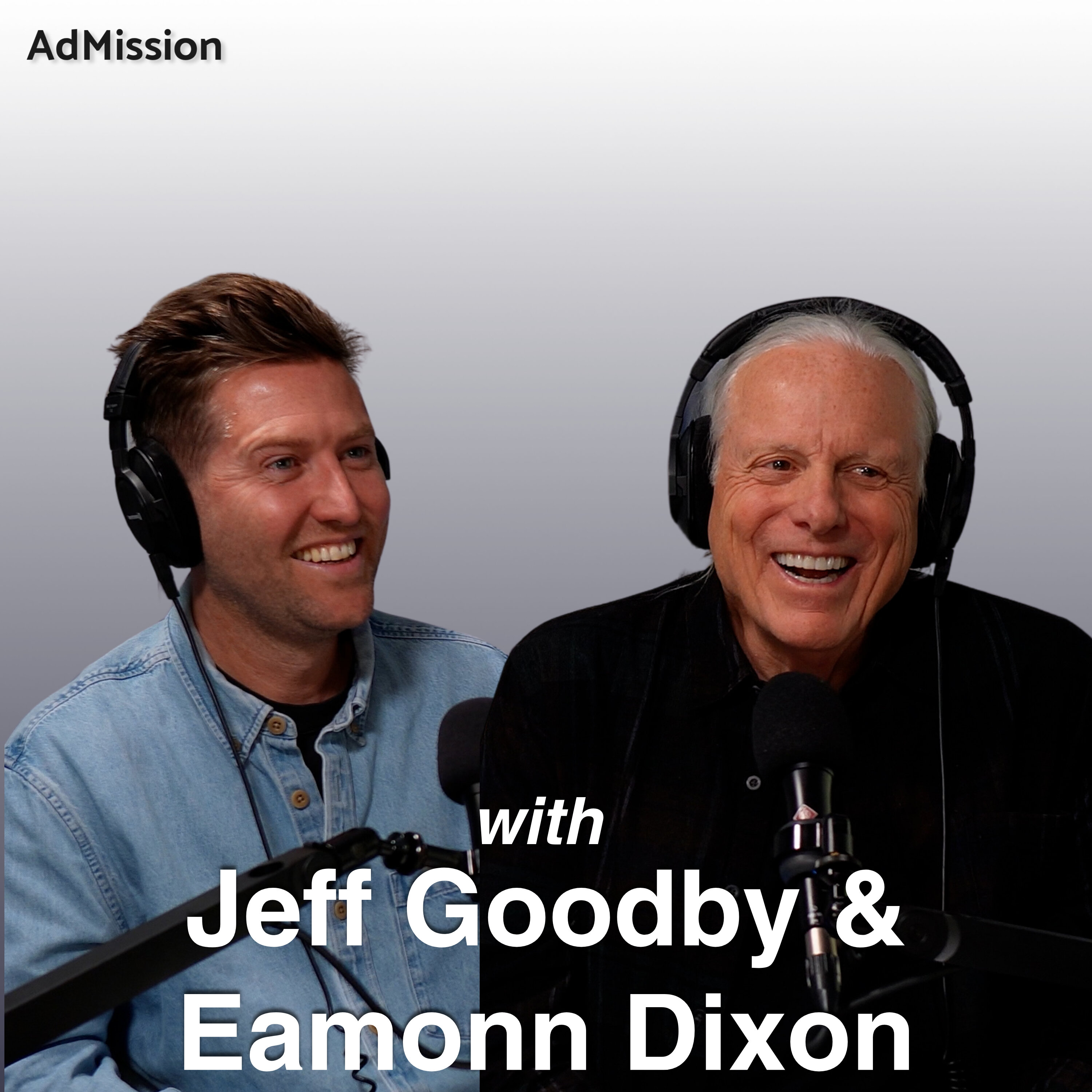
'Put a Dent in the Universe': Creating Iconic Ads with Jeff Goodby & Eamonn Dixon
Get every episode summarized
Each time AdMission publishes, we email you a written briefing from the transcript — the topics, who appeared, and any specific claims, with the ad reads skipped.
Email me new episodesFree for 3 shows. No card needed.
About this episode
“You want to pick five, four, three, two, one. This is a very special edition of admission. We've got Freddie over there in New York, Freddie Young. But in the studio, we have got Jeff Goodby, of Goodby Silverstein and Partners.”From the transcript
In this special edition of Admission, advertising legends Jeff Goodby and Eamonn Dixon join Russell Howcroft and Freddie Young to share the untold stories behind iconic campaigns like "Got Milk?" and how to stand out in a crowded market. Together, they unpack the art of pitching simple ideas, what top execs really look for when hiring talent, and why AI will never replace human intuition in creativity.
See omnystudio.com/listener for privacy information.
Get every episode summarized
Each time AdMission publishes, we email you a written briefing from the transcript — the topics, who appeared, and any specific claims, with the ad reads skipped.
Email me new episodesFree for 3 shows. No card needed.
Hosts & guests
Transcript ready
566 searchable segments. Every word is indexed and playable.
Full transcript
AdMission — 'Put a Dent in the Universe': Creating Iconic Ads with Jeff Goodby & Eamonn Dixon. Machine-transcribed; use the interactive transcript above to jump the player to any line.
You want to pick five, four, three, two, one. This is a very special edition of admission. We've got Freddie over there in New York, Freddie Young. But in the studio, we have got Jeff Goodby, of Goodby Silverstein and Partners. Jeff, it is a thrill to have you here in the studio. And we also have Aiman Dixon, who is also from Goodby, Goodby Silverstein, New York, the ECD of the New York office. Well, I don't even know where to start, other than to say, to have you both here in the studio with us to talk on admission, is a genuine thrill for me, so you're very welcome here. We're so happy to be here. Thanks for having us. And this has been such a good time to come here with this NFL game going on. We're having such a good time. Well, let's be. I mean, I don't know whether you've noticed, but certainly our media has decided to really go for it with regard to NFL, the NFL promotion. But the good news is that both of you
have called a tram here. So I just, you know, so Aiman, you are a Melbourneian, correct? I am. So did you persuade Jeff that it would actually, you know, the way to get to 38W, or the admissions studios is via a tram? I think, well, we were talking about last night. I think a friend of his, a friend of ours, Esther might have been the one that said, if you come to Melbourne, you have to go on a tram. You have to go on a tram, so I'll lean forward. But I've been on it before. I've been on it. Okay. And so you've been to Melbourne before, or you've been on the San Francisco tram a lot. A lot, but I've been to Melbourne before, and I've taken this round. Okay. There's some advertising companies along the route here. Yeah, that's it. And so it took me, when I, one of the, oh, enduring memories of, I've only been to San Francisco once, which is sort of mid 80s. And yes, I did get on a tram. But the people that were driving the tram, they played a big role in sort of the atmosphere, the atmospherics, because they play it, they're ding, ding, ding, ding, ding, ding, ding, is that, is that true? Is that still happen? It certainly does.
It happened right outside our office for years and years. Loud banging and the sound of the wheels, and it's just part of the life there. It's great. Oh, and Jeff, so 1983, am I right? That 1983 is when you and your partner, Rich Silverstein, decided to go into the ad game. Is that correct? Well, we're in the ad game. We were working at an agency in San Francisco, Ogame and Meyder, which was run by Hal Rani, who was like the premier creative guy in the country, if not the world at that point, and very difficult character to work for. But I learned everything that was valuable to know and advertising from that guy. Tell us more about that, because I'll let a little note to you notice, Hal Rani tell, I've written here, tell. Because it's a name, it's a name that those of us that are into the, the ad world, you know, we've read a lot, and you know, we've had lots of conversations in lots of wonderful forums. Hal Rani, of course, is a name you do hear a lot.
So maybe just for the admission listeners, not everyone, maybe not everyone, would have heard of Hal Rani. I mean, Freddie, have you heard of Hal Rani? No, I have not. There we go. Wow. Give us the Rani story. Well, imagine a guy that looks like Ernest Hemingway, okay, and he doesn't look like an advertising guy. He dresses in khakis, smokes constantly, and he's got a great voice, you know, his voices, made for TV and radio. He did his own voiceovers a lot. And at the time that I got there, I just remember, he, first of all, he called me up, I didn't know who he was, and look, Freddie, didn't know who he was. And I went back to J. Walter Thompson, where I was working. I told one of the writers there, and he said, you have an interview with God. I said, oh, okay. So I had a blue breath. The voice about this, right? Yeah, no girl. Fresh, you're right. So I go over there and talk to him,
and he had seen some work that I had done. And he said, well, maybe he'd like to come work here. And I said, definitely, very much. And he said, well, how much money would you like to make? And I said, I don't know. I said, I want to come work here, you know, and he gave me a number. And he said, we will pay you $26,000. And I said, holy shit, that's great. Yeah, not in 90, not in 90, cold. 83? 83. Yeah. And he said, shit, that's not so much money. So I knew I should've asked for more. Yeah, yeah. But anyway, I came in, oh, so there's no further communication from the guy. And I go and quit my job at JWT, and I'm waiting to hear from him. And finally, I called there. And I got his assistant, Nikki, on the phone. And I said, Nikki, how hired me the other day? And I quit my job after the lake, know what happens next.
And she covered the phone up. But I could hear what she was saying. And there's a Jeff Goodby on the phone. And he says, you hired him the other day. And he said, I did. I don't remember that. And he said, I haven't come in on Saturday. Wow, I can't. So I did. I came to work on Saturday, and they were doing a pitch. Of course. And I went in there, and I went into the conference room, and I put the reel into the machine. And I was like, holy shit. This is like another level is expected of me here. This is like stuff I'd never seen before. It was so good. So a Saturday. You're in there on a Saturday. So, I'm an, I think, my view. I'm sure Freddie aligns with this. Advertising's got to be a certain obsession. So being in on a Saturday to win a new business pitch. I'm sure that that's still the case. But so just tell me about your New York Goodby experience.
And whether that sort of obsession is required. Well, I wouldn't say it's every Saturday. They were in at work. But yeah, I mean, I've been out there for three years. I was in the San Francisco office for six years with the, the tram's dingin' passer offices every 10 minutes, annoying hell out of us. But it was, it had such a charm to it. And I moved out to New York with my two little kids. And it was a pretty big leap. But it's been an amazing experience so far. You know, when I left Jeff and Rich and Margaret, who's our CCO, sort of just said, go out there and see what happens. I actually remember the day when Margaret took me to the, the Ritz, which is just up the road and sort of said, hey, do you want to go out to New York and see if we can make something of this out here. And I walked back in and Rich Silverstein, who if you know him, he's, every time you see him, he's got something to say. And he said, and I was walking in the building and he said, what, so what do you say? What do you want to do? And I said, oh yeah, I've got to go home and ask my wife about and see what she thinks, you know, classic. And he said, oh well, if you go out and you screw it up,
don't worry about it. And so having that kind of confidence, I guess, just to be myself out there has been pretty amazing. And we've built a pretty great group of people. There's a lot of ex San Francisco people that have come out and we're trying to maintain the soul of what, you know, the agency, the legacy, the agency in New York. But it's a different place, but it's been really fun. Well, I'm a new Roman boy. So, you know, we love it when Mill Bunions get into the Northern hemisphere. Like our friend here, Freddie. And you know, take, I mean, ECD of Goodby's, New York City, pretty damn good. And of course, there's another Mill Bunion who we, who we had an admission discussion with only 48 hours ago, which of course is Brett Gospur. Brett Gospur being, you know, all markets, but the US CEO. He's a Mill Bun Boy as well. Yeah, so it's pretty interesting. And Freddie, Freddie, of course, isn't Mill Bun Boy in New York City. So Freddie, I know you've got a couple of questions. Why don't you fly her away? Oh, thanks Russ. So guys, thanks so much for coming. But Jeff, I've been burning to ask you this one.
So you've made so many, like, let's call it, like, canonical pieces of advertising. That are so, like, ingrained into, like, the minds of creatives as they're up and coming. They've sort of, like, become rules or, like, maxims for, like, how to, like, playbooks for advertising. Like, you think about, sort of, got milk. That's been in every textbook I've ever read. And it's like the whole, you know, we don't sell milk. We sell the panic of, like, when you run out of milk, like, don't sell the drill, sell the hole. That sort of thing. You've created all these campaigns that have birthed these rules. Do you still, do you think in terms of those rules? Do you find, like, the pieces you've made in the past are helpful to you and your teams coming up with new ideas today? Well, I got to tell you, I'm very lucky to work with people like Amon, that, you know, constantly bring me this stuff. And my job is to really just go, hey, is this something that really is going to, like, change the world when we put it out there? And that's the goal, you know, or just Steve Jobs called it, put it in the universe.
If you think that you're best friend, or your sister or brother, or your mom and dad, or anybody that, you know, would think of this idea, then don't do it. It's got to be better than that, you know? It's got to be, and really what we're doing in many cases is taking something that everybody knows, like, the panic of running out of milk, and dramatizing it in some way that has never been seen before. So, that never been seen before a part is very important. You know, we're not necessarily saying something new. We're saying something that people have heard before, and so it has to be heard in a different way. So, I mean, when you're looking at a book for someone that wants to come and work for you, it could be New York City. What are you looking for when you go, actually, I can see that particular cat can fit in. Well, it's a great question because we're on the lookout for great creatives all the time. I think truthfully, ideas, people who can speak in the language of ideas and not just executions. I mean, we talk a lot about, like, what's the angle?
I kind of like that way of looking at it, you know, to Jeff's point, just sort of showing, you know, here's somebody using a product in an interesting way, or there's a celebrity slapped on, or there's some, you know, funny, executional detail, some tinsel. I'm a bit more focused on the Christmas tree a lot of the time, and trying to figure out if people can actually come up with real ideas, because at the end of the day, I mean, you know, like, especially these days, there's just a lot of no sayings out there. There's a lot of things along the way, especially in the US, there's a lot of testing as well, a lot of consumer testing. And so if you've got a core of an idea that's strong enough and simple enough, and you can explain to somebody in a sentence, and they go, well, never thought about it like that, it, you know, not only to Jeff's point, is it going to be something that's going to resonate with other people, but I think it's also just going to be something that other people can actually add to and build from, versus just having to like delicately hold on to. Is originality hard to find? I think it's lying around on the ground all the time, and people don't pick it up. I mean, I told that story about gut milk all the time, but it was on a, I told somebody to scroll it on a board as part of a meeting that we were doing, and I was just looking at it going, that could be a tagline. It's so little and stupid.
And if there were great stories before it, it would just be amazing. And, you know, and like you said, it's really, it just immediately encapsulates the feeling of the paranoia that you don't have milk. I love the use of the word stupid there. No, I do, I do, because there's something, something very charming about a lot of the work, I think, would this be fair? A lot of the good be worked. There's a stupidity. I don't really mean that, but you know what it's okay. Yeah, yeah, yeah, there's a nonsense to it. There's a, yeah, there's a nonsense. There's, okay, there's a stupidity. There's a, it's, it can be observational, but I was observational to the point where it's just completely crazy or silly. Right? Is that fair? I, you know, anyone was talking about making things that connect to clients and that can be, that people are excited to work on. I mean, that's what I want. I want people to be excited to come in the building and work on Cheetos, Orange Dust, or work on Got Milk or have things where, I can come into the middle of that and make something better than anybody's ever made.
I love that feeling, you know. Wonderful. Doritos. I mean, we better cover it off. We're here. We're here because it's NFL time. So we've got the 49, I assume you're a 49ers man, Jeff. Not really. I grew up in the East Coast and I'm a New England Patriots fan. You're a Patriots guy. So that was, okay, are you here? I was running out. I'm not really, we're actually here because we want to go to the football game. It's as simple as that. I like it. He lives here. He grew up here. He just wanted to go home and see his parents. I wanted to come to the football game. Okay. And Super Bowl. So Super Bowl Doritos 23. This is a great story. And, you know, and, you know, you might think that everyone's heard, but not necessarily. So why don't you, why don't you tell us your really super life story? In fact, your grand children, even your great-grandchildren, we'll be telling this story. Yeah. So, so we're, you know, we were lucky enough to have Frida Lais, the Client of ours, and, you know, done some really amazing work for them, including a lot of Super Bowl ads, which is also a based unto itself when you go through that process.
And, you know, I've been in the States for 10 years at that point and really grown to love the NFL, you know, and like sort of the culture of it. I think just the Super Bowl is just, it's such a spectacle. And it's also just as a big sports fan as, as anyone in from Melbourne is. I always really just wanted to go to a game. And so I remember we were going through the process of making a Super Bowl ad and I sort of said to one of the clients. If any tickets become available at any given point in moment, you know, just, just let me know. And of course, you know, wake up on Super Bowl Sunday and there's no tickets, you know, that it come away. So I'm sitting there with my wife trying to plan out what we're going to do for the day with our kids. And I get this call from our clients saying, oh, somebody's dropped out. There is a seat at the stadium. Now I was in San Francisco at the time and the Super Bowl was in Arizona and Phoenix. And she said, you've just got to get here in time. And so, you know, again, like the story of moving to New York, I went to my wife and I said, Hey, I want to go do this thing. What do you think? And she said, yeah, go for it. If you want to do it. So I quickly got a flight and I landed in Arizona and race my way to the stadium. And by this point, you know, the fanfare of the whole city had been built up kind of like Melbourne is right now and it was just it was like a.
It was almost just like a barren wasteland. There was nobody around because everyone had gone to pubs or homes or the ground itself to watch. So obviously got this. We've been going through the city. Get to the ground, walk in, you know, and the sort of national anthem is being played. And I was like, wow, this is pretty wild. Let's think that like three hours ago, I was just sitting in my living room. And anyway, so the game goes through and we were sort of in this in these seats or kind of right behind the goal post in the end zone. And it came down to one final kick. And the ball was kicked by this guy called Harrison Butcher. And it went over the thing. And I caught this ball. The Super Bowl ball and very good. And so and but you also had a Doritos ad in the Super Bowl as well. We did. Yeah, we had a and that that was actually also one of the only ads because they only run a few in the stadium, which run in there as well, which was pretty. It was a pretty crazy experience. How's the going, Iman? Hey, Jeff, you said some luck in life and he or you he works hard. I'm sure a little bit of both. Yeah, a little bit of both. It's funny. You guys talking about the work that your shop is produced. And I think another word instead of stupidity.
It might be, I think restraint is very much a theme. And that's that's running right from Got Milk to MBAs. I love this game. Even Cheeto dust. They as a like you know a fellow ad person seeing these ideas out in the world. I feel a sense of like almost concern for them. It like as they get pitched. Like they feel very vulnerable to a client, perhaps saying something like I was that it like is that all you've really presenting. So I'd like to know how you guys go about. So think about selling what are in essence really simple ideas and how you protect them throughout that process. Well, we make for anyone make them sound really complicated and smart. That's real one. It's real wild yet. No, I tell my guys all the time you have to take your own head off and put on the head of the client and see yourself presenting this stuff. Yeah. And go what are her concerns? What what what does she want to do in life? What's what's your goal?
What does she want this thing to be? Does she afraid of going to a party and having people talk about this thing? So you got to have all those fears in your head ready ready to feel it like through her eyes through her brain. And that's how that's how you sell you don't really have to sell. That's how you discuss difficult ideas, crazy ideas. It's very hard to do what you've done right lots of people try lots of people try and yet you've done it. So 83 you started now. 10 years later Omnacom came into the picture. So my assumption is that that contributed to how did you do it? Well, this is it's kind of a long story, but we wanted. Jay Shiett, at Shiett, they had brought over this this form of of strategy that they called planning at the time, which was which was invented at an agency in London called bosemasyme pilot and Sydney pilot had this idea of going and talking to real people about about an advertising strategy of challenge.
And we wanted to incorporate that somehow into what we did. So we we want to be MP, which we thought frankly in 1983 was the best agency in the world. If you know them at all, their work was ridiculous. And did they become BMP? Did he made them? It did and that's part of the story. So so we went over there and we we they asked if they could buy some stock in our company because we're an independent company at the time. And we said sure, but we want John steel your your planner. And so we we got a player to be named later in this trade and in steel came over and became our vice chairman or something and but had a planning and he brought that in and he was the best planner in America for many, many years. You've seen the books that he wrote and stuff. Yeah, so we're now a 30% owned by BMP. Well BMP is publicly traded at the time in London. And there's a hostile takeover from the French agency BDDP. If you remember that name.
Yes, I do. And in the last thing that that English agencies want is to be fucking taken over by the French. So so they started looking around for somebody else to buy them to get them out of this. And and I'm the calm came in Bruce Crawford who was then the the and he was a wonderful guy just died last year. He he Crawford came in who had been the head of the Metropolitan Opera in New York is really elegant guy very good at talking to English people. And he said, well, we could buy you and say, and so they did and so they were 100% owned. They became part of DDB. And Crawford came to me at a financial thing and said, okay, we own 30% of your agency. We don't want to own just 30%. We either will own none of it or 100%. And so you could buy the 30% back for whatever they paid you for it, which was not that much. But it would have been good. You're a young a younger man and therefore, you know, you got some coin and that was good for your mortgage or whatever.
Yes. So I thought that was a good idea. So I went back to my partners and they were like, oh man, I just bought a summer house and I got a boat. And my kid is in private school now. So so I went back to Crawford and said, well, how much would you give us for 100% so I gave us a number and I went, that sounds good. And you know what else? There's another thing going on at the time, which was, in the Berlin, it was the third partner besides me and Rich Silverstein. A really good guy that maintained a good relationship with really smart, great writer and great presenter. Like was a big force in the company when we started it. Thought big and you know, was a big part of our success to start out. We started, Rich and I started not really wanting to expand the company as quickly as Andy wanted to. He wanted to sell to people, he wanted to open offices, he wanted to be global and we just wanted to make shit. And we were like people that made things. And so we got a little scared of that. So this was a way to divide up the value of the company without having an NDB somebody that took me to court for the rest of my life.
I'm not so silly as I did get to work with John Steele. So I know exactly what you're talking about when it comes to trapped or strategic brain and back to Got Milk. He was involved with Got Milk. Oh my God. Yeah, yeah. I think he was the guy that was in a focus group at the Central Valley of California where a woman said, the only time I noticed milk is if I run out of it. Bang. He came back and said, this is it. Yeah. But the part that was so magnetic about that was that it was to advertise the product by the absence of it, which was really strange. Well, there's my peck shot, of course. I mean, we don't actually get to say a bottle of milk or a count of milk, do we? Well, there's always an empty one, but that's about it. Okay, because I've just got the milk on the lip in my mind. Yeah, and we were not the milk on the lip people. We were the the empty. Yeah. Oh my God. Yeah. The milk on, I gotta tell you a story about that. So we did a leave behind when we pitched the business that had everybody working on the business where they were the milk must have.
So all of us were head milk. And so we ended that in one of my creative people came to me and said, you know, this could be like a print campaign or something like. And I said, now it's a good presentation piece, but it's not a campaign. The campaign's over here. So another agency actually took the got milk thing didn't use got milk with it. They took they made the milk mustash. And then they convinced the national people to rent got milk, the two words got milk from the California milk people. This is too much too much of an answer. It was a million dollars a word. Oh, yeah. Wow. Two million dollars a year. Well, so John Steel of course is, you know, like the planners planner. And so Freddie, I'm sure that I've shown you John Steel's book around planning. And if I haven't, you better get on Amazon right now. Truth lies in advertising, absolutely superstar. And he used to when he was working at WPP, he used to put on a event at the shadow to food, which was David Oglefish shadow in France.
You did that every year, I think it's pretty good. Pretty. Yeah, it was funny. You were saying I now realize Russ, it wasn't a you that told me about John Steel, but my current GSD who talking about truth lies and advertising told me there is only one book on advertising that's worth reading. And that's it. So that's a it's a good recommendation. But looking around the table, guys, I think we have, you know, pretty well accounted almost like every sort of era of advertising over the past sort of 40 or so. Years we have, you know, sort of very like print, art direction led through to the sort of like self referential stuff of the 90s, like visual maximalism. And to today. So like, amen. If I could challenge you to describe sort of the era of advertising that we're in like right now. Like what are we up to? What's advertising up to as an industry right now? It's kind of funny. I don't, you know, we the problems seem to be the same that we always have had and the challenges always in community, communicating, connecting with people.
And obviously the media has changed a ton. You know, I think social media, especially, you know, the doom scrolling world that we live in right now. And I think especially with younger people, I think that's probably one of the biggest challenges of like how to connect with them when they've sort of grown up in a space where they've probably been told they're doomed and they don't have much to live for most of the time. You know, I don't understand too dark, but you know what I mean? I think the era we're in right now is is still the same like I look at the Got Mill campaign, the depravation strategy that Jeff was talking about. It's you could still do something very similar like that right now. It's just the sort of like the form and the shape that it takes and communicating with people and connecting with them is going to be different. And I think that that's, you know, that's something that, you know, over my time in the industry and especially since I've, you know, had the had the joy of working at this agency. Just the ability to sort of always strip it back to what is the challenge we're trying to create. And then when you start to think about the medium that we're sort of putting it through having people who can sort of do that in a way that actually is going to shop and connect with people is is is it. So I don't know if that answers the question Freddie because it's a bloody big question you just asked, but.
But I think that we just always just try and try and look at the actual problem we're trying to solve and then trying to figure out. How do you do it to Jeff's point earlier in a way that they're actually getting people to remember it because I think it's it's probably harder than ever in terms of just the amount of content that's thrown at each other. So I'm. I'm looking at the George Lois lowest George Lois book, you know celebrity. I love looking at that and the very idea that you get yourself a celebrity and back in the piece of advertising and. I think the advertising world went through a period where it said I need you don't do that at Pirates the Brand which I've always thought was all shit actually. So I'm just is there something that's going on now with regard to like the re celebrity of advertising so you think about the you know the Johnny Walker campaign with. Carbada you know so is there something going on there it's almost and when you look at that piece of advertising I feel like I'm looking at something was done in 60's so is there something going on in that front. I think there was a period where we were cynical about using celebrities we thought it was kind of a crutch that you know idiots use.
And now it's quite the opposite and by the way the celebrities are much more willing to do it than they were then. And then it's kind of a cool thing to do among celebrities and in aim on you should talk to him about it because he's done more celebrity advertising in one year than I've done in my entire career. Well I think celebrities are going to be the right use of celebrities. I was talking to someone recently about I'm at the Snickers campaign if we're talking about great campaigns you know that you're not you when you're hungry. The first spot in the use of Betty White in that spot in the Super Bowl was just like the most genius use of celebrity you know it wasn't just waxed on there it was done in such a way where you know obviously the strategy back to the point I was saying is was just perfect at that execution showing up in that way on the Super Bowl with with such a beloved personality but used in just the most brilliant way. And so I think that that's always the challenge I think you know I'm sure Jeff sees this a lot there's a lot of teams that just like they just write in a celebrity and they're like oh we get this to do it and we work with a lot of partner agencies that say oh if you just put celebrity and you're going to get X amount extra hits or you know I balls on it it's got to be about the right use of celebrity.
That that brings me to the origin of that that orange dust campaign for Cheetos and the MC Hammer thing you should tell that story. So I mean Freddie touched on this before but but the Cheetos campaign which about in 2019 you know we would have the client for a while and I think it's sort of like I don't know the work the work that was with the was showing up on TV and I guess the brand in the way it's just been embraced by culture at the time we're just adults with each other and so the same at the time who was a brilliant brilliant brilliant person she just said let's start to reassess this you know and she didn't say the dust at the time actually the dust was a thing that we were told not to go anywhere in the year. It was disgusting and gross and no one wanted to touch it but you know I was given the opportunity to come in and sort of like see if we could figure it out and I remember it's about yeah let's magic when you think about it the right way and I remember there was this this this teams the amazing Brazilian team brought this idea of of this that when you've got the dust on your hands you can't do anything else you know you can't do anything else and of course you get to to MC Hammer's can't touch this and we're talking about the Super Bowl and.
Why we go here we are so I remember we went to this meeting in the night before actually that that a lot of the team that have worked on the brand for a long time were like they don't like dust we shouldn't present anything to do with dust whatsoever and so we had this the classic sitting in a hotel lobby at 3 and then I before a presentation arguing about what we're going to present and when I'm going forward with it I remember when I presented that spot and you know I was singing the song and doing the whole song and dance of a presentation and and and you know the same at the time just said that's it that's that's that's a spot and of course then whenever you're on a celebrity spot you've got to go and get celebrity and MC Hammer I think who you know and you know it's obviously you know a huge star in the late 80s and early 90s I'd probably been parodied you know in different ways over time and I remember when we we presented the script to him he's just said this is this first all you thought it was hilarious but secondally thought this is the first time I've done anything where it feels like you're actually like giving giving to to and building on it versus taking away and making a joke out of it so it was pretty cool we had to then persuade him to drive
up like his you know early 90s self which was another whole story but but again I mean that was just a really good use of celebrity in the sense that it was just kind of fun and surprising and interesting versus just whacked on there you know it was great about that anyone is it a 30 second spot in 30 second spots are rarely remembered on the Super Bowl anymore I mean I tell clients to spring for the 60 you know I mean it's makes a big difference so I mean and I was just told us about the you know the role that clients play you know sometimes I think you know the ad world we forget that it needs a buyer you know you can have as many ideas as you like but someone's got to say yes and then rather check so just you know some thoughts on some great buyers of advertising Jeff boy we've been lucky to work with a lot of great buyers of advertising you know it's telling somebody last night about the working on Norwegian cruise line we have to be old to remember that but we we did a campaign for them that was beautiful black and white TV black and white print ads and the line was it's different out here and it had beautiful shots of them the ship and stuff and and the buyer of the advertising interesting that you ask it was his name was Adam Aaron and he came in as the CEO in sort of
marketing guru of of the place he took me to dinner and he said I don't like any of the advertising you're doing I'm going to fire you I'll give you one last chance good that is good right and I said okay well what do you think the next the next thing should be I just want to get a feeling for what you're thinking you said I don't know but I think that people go on cruises to get laid I said what what are you talking about well yeah he said that's what it's for yeah even if you're like 80 years old you think you're going to rekindle this wonderful relationship with this person out on the ocean and if you're not if you're if you're 25 you think you're going to meet somebody new well it's either going to be funny or it's and you said I want funny okay I said so it's going to be like elegant it's going to be and I said it's going to be like a Calvin Klein Ed it's going to be like black and white it's going to be sexy and the business wouldn't crazy and people went on the ships and they they actually want like I didn't get laid yeah yeah yeah so so you know the test
like it is the measures not really a fair test come on I'm just imagining the asterix on the headliner the daddy you may not necessarily get laid you know I like if there's not going to be the money back Freddy it's as funny I mean you talking before about celebrity and how and also Jeff what you said about how they're like willing to participate in advertising nowadays I mean one of the biggest shocks for me coming over to the US was suddenly this was a tool that was available to us like back in Australia you could never envisage saying oh should we get you know Russell Crowe and that being like a legitimate option on the table so as I moved here like two years ago that was one thing that just blew my mind I'm curious to hear of any other sort of like I've no cultural shock transition stories of yours about moving from Australia to the US and how you went about navigating that as a creative I mean there's so many I like I first of all the the size and scale of everything just blew me away you know I moved I was at an agency before before
could be could be service and opponents sorry sorry rich we're called AKQA in San Francisco which was a innovation you know technology sort of yeah very much in that pocket and my partner and I at the time we really wanted to stretch ourselves and see if we could sort of like move further into that space but just we're working on Anne house of bush and and Audi and Levi's and coming from Australia where especially Melbourne where you're working on brands it don't quite have the size the size and scale of that that was one thing that just blew me away and then to be honest to four years later when I moved up up the road into Chinatown to to work with Jeff I think just like even more so just the ability to like to sort of like come up with an idea and then you know in the right idea and I have one client that always used to stay money full as good ideas and that they're always sort of stuck with me as well and so you could run like that right that down right you could write a script where you could say we want to do this you know set a budget was originally I don't know I mean $1.00 to a shoot if you had the right idea it could you could turn into anything you know
it could go from I would just want to do a campaign to it's it's going to be a ginormous massive thing I also the one of the biggest things I think that I think one of the reasons the trains do so well and in the US is Americans and especially in California people are just so nice to each other there's just a sort of there's a sort of like people say a lot but they don't necessarily say everything and I think that I found over time that you had to sort of like really read between the lines of what what what people were saying you know of course when you're around the right people and you work with with the right the right people over there like you know we talked about some today but they're just just brilliant at the way that they can sort of like find their way through things but I that was probably one of the biggest culture shocks I found because in Australia we will just say whatever I'm minded and you give in time you tell something something shit or you tell something you're really excited about it whereas in America people like oh that's really interesting and you're like what does that mean as Jeff knows I'm fascinated by the seal commercial I there's something so interesting about it it's like you know we're going to get sealed but we're
going to make him look like a seal right and then and then in a way and I don't want to be say the wrong thing there's a certain formula to it as a piece of advertising the way it's structured you know so you have that moment you drink it then you go into a new world etc and then you've got seal as a seal so I just want to know that it worked exceptionally well that's that's my hope for that campaign oh it worked so you know it it was the number one Google Google thing on the Super Bowl number one and I think a lot of it was like how did they get him to do that exactly yeah so seal as a seal I mean honestly I mean that that that's is that one of the ideas so it comes across your disk you're the boss you're the boss and you go seal as a seal really well I I mean I would love to take credit for the campaign I didn't actually work on that but I no no no no no I know but all the people I know that worked and it was one of those ones and again this the team that wrote that spot the same Brazilian team that worked on all of the Cheetos work with me just they have a way of coming up with the most stupidly simple and sticky concepts and I think that
that was one of those ones where you know it's probably one of those briefs that was very complicated it was probably like oh we're trying to connect with this audience we're trying to do this we're going to do this and the Super Bowl there's all these rules and and then you just come up with an idea like that which just is so visually striking I also what the other thing that I think is you'll see these days that there's a lot of and Freddie obviously you're taking this but there's a lot of trends towards this more cinematic dark moody kind of like way of filming things like trying to look almost like Oppenheimer whereas that spot was so bright and loud and almost just embodied the the the branded itself and the experience of it and I think on the Super Bowl it just it just sort of like it was just grabbed everyone's attention and I mean talking about things that like you know we're in the side guys straight away I mean like I listen to a lot of podcasts outside of advertising and that was the spot that everyone talked about that was the one thing everyone talks about and there's a million other brands that were on there that probably had much bigger budgets much bigger you know it's sort of lengths like Jeff was saying but it just um but I think that key visual I think they presented a key visual and everyone said what the fuck is this I gotta say that the beauty
of it was that song because you know you take the idea of steel as a seal and you go that sounds really stupid yeah yeah yeah but then when you have him sing that song and he looks good he looks good as a seal he died and you are thinking the whole time how did they get him to do that how did they get him he's like an older guy his he's smart about his career he's been really good and then he did this I think what's so interesting about that is the consumer the consumer rewards the advertiser right so the consumer says thank you thank you for getting seal to look like a seal and giving me that complete and they buy it right I don't know sometimes I think it's no more complex than that they reward the advertiser but there's there's something about him seeing that song in the words of that song that that you're right it captures like high caffeinated kind of feeling the whole the whole look of the thing is highly caffeinated oh yeah I think what was really interesting about that spot and you think about a lot of advertising is it just went for it
said we're going to do this and we're going to just going to go we're not going to we're not going to try and like be something that's not it just was so extreme in the way that they went for it and on the Super Bowl I mean when everyone's just like vying for all the eyeballs and all the attention it's people do probably try to show too much strain I think sometimes or they try and do it in a way that's disingenuous to the product or or the celebrity they're using whatever it might be that's right it's yeah it's funny I mean as you were saying before about this sort of cinematic kind of serious thing there was there's a real joy in the key visual of that and to get on the biggest stage as well I think the Super Bowl I've noticed a trend yeah like you were saying before of people trying to undercut the moment a little bit I'm thinking of certain a certain sort of what do we call Bitcoin trading platform that went with sort of like a karaoke only spot a lot of people are trying to subvert expectations and so I think there's something really quite distinct nowadays like to get up and be joyful and to be loud and almost to be like happy that this is
an ad and we're going to have fun for the next 30 seconds I love it so back to Jeff how did you do it so 93 on a calm gets involved with your business now so that's that again that's a long time ago right and yet you've managed to keep the brand you've managed to say this is still could be Silverstein and partners that that itself takes a lot of skill because as all of us well those of us that have been involved with advertising and those of us that watch advertising most of the groups WPP, Omnicon, Havass etc in effect they've got an Excel spreadsheet and they are a forever merging agencies in order to try and make the P&L work and they're burning you know seemingly famous brands like wine, ah comes to mind so part of how did you do it how did you actually stick to not dealing with that silly spreadsheet and they do have the spreadsheet it's not in effect they do have the spreadsheet partly by making money frankly and you know making money inoculates you
against a little bit of the meddling that you might otherwise get we never make enough money for them like we but luckily we attract people like I made this analogy to John Ren that where I said listen we're like the clownfish in the reef that leads all the other fish to the reef and then they all get eaten but the clownfish never gets eaten that's the important part and you want the clownfish to not get eaten and I would write him notes that's that were signed to the clownfish and I think you thought I was out of my mind yeah so the other thing which of course you've done unbelievably well is say you know what we're going to do these cars west coast and so no we're not going to do the Hong Kong or the Shanghai or the Sydney or the London etc so they must have been pressure over a long period of time to exploit the brand I suppose oh there always was yeah there always was I think I think the reason why Bruce Crawford the original CEO was interested in us as he saw it as the beginning of another network yeah sure so you had ddb you had bbdo he thought we were
the third network and I think that's what was really the problem is the rich and I resisted that network and Andy embraced it you know that's what kind of broke us up in 93 I wanted to maybe finish up with this guys I imagine a huge part of your job now is just talent development as well as idea development I saw something the other day about a guy you know a very wealthy man saying he's in a room full of people and he can tell you who's going to be a millionaire but he can't tell you who's going to be a billionaire I'm wondering if you're looking at a room full of creatives are you able to spot sort of you know as they're starting out their careers who are the ones that are going to shoot right out and and what do they if so what do they look like they're they're so different from one another I mean there are some people that are just great in a room and they can make anybody believe anything and they're not necessarily the best creatives and then there are other people that are great creatives they can't do that thing and you look for somebody they can
kind of do both and you know amen was talking before about you know looking at people's books I think I've found that I hire people on the basis of one thing like just one crazy thing in their book and I go wow that thing is a 10 the other stuff in your book is like three or two but that is a 10 and I'm going to figure out how to make you do more of those you know I mean I mean there's there's there's people who are to Jeff's point I think just just really great writers or our directors or designers or whatever they might be and then to a point this great there's people are great presenting and that's like you were saying before that's like a big part of our job is being out of go to a room and a group of people and actually like persuade them to sort of like by what you're saying I personally think when I I meet a lot of creatives especially when you get them in a time to know and interview sometimes but when you actually get them in people who really give a shit about what they do like they actually really take it seriously because it's very easy to be cynical it's very easy to sort of like have one you know just come up with an idea and someone knocks it and says now they're not going to do that and you go oh well whatever everyone's an idiot I'm really smart but people who actually like
open to really trying to listen to other people and actually sort of like move things forward and try to find solutions you have to sort of give a certain amount of a shit to do that and I think that that is an underrated quality I really do I think it's an underrated quality I think it's one thing that Australians do extremely well is like we don't take opportunities for granted and I think that I think and you know and to Jeff's point earlier around the size and scale of these clients and like you know that they're looking for a partner they've got they've got huge things they're trying to achieve in that kind of a solution from you and people are willing to sort of invest in that and take it seriously I think I think is pretty underrated what I'm hoping is that we're going to get back into a nonsense territory like writer territory because I suppose like discuss is there a are we going to get back to yep you know what advertising's always been about writing and we're going to double down on writing I think writing is what makes it what drives advertising in many ways I mean it's the difference between things that look good and and don't stick with you and things
that look good and do stick with you and and I do have an anecdote about that with AI because we were working for twisted tea which is like a alcohol based tea thing that people drink on boats and and so we're working on this and this is the human element so somebody said okay we have this idea that this stuff is like intensely refreshing or something it was because some kind of phrase like that so we put it into the AI and it came out with a hundred this hundred headlines that were terrible but it took a human to find the one that actually was good and it was um it's what they drink on the Sun yeah perfect no human would ever do that yeah it took a human to go that's funny yeah I agree so tell us about I'm it tell us the the role that AI is playing in your in your ad world yeah it's it's kind of hard because you know I the visual side of it is incredible it really is like we can build like we had a pitching up a weeks ago and it was a fast pitch ride it was
probably like a week to get to a tissue session you know where we sort of shared a bunch of ideas and then we had like a week to get to the final presentation and the the quality of the visual world that we could create now um you know I started calling our directors sloppers but which is probably not probably not a problem don't like that very much but that the that using the AI slopper the craft that you can get into it now so quickly is incredible so that's a big part of it I you know like we're talking about writing the first meeting that we had we didn't show any visuals whatsoever we just presented ideas and lines to we just presented like here's territory here's like a summary of what it is all manifesto and then we probably and I just presented 10 lines that were written you know by by by credit is both both both archer etters and riders and to me that is the best way to get to like what do you actually want to say what's the tone you're trying to create what's the world you want to build because it's so easy to get distracted by the visual side of and see something shiny and sparkly and you want to sort of like write run towards that but then it just becomes super hollow if it doesn't actually have any sort of like wake behind it so the whole
thing of AI and there's you know you get the world of production and all of those different things and where it's going to go in the future but I mean I agree with Jeff I think that sort of like that idea about like identifying what is actually the point of it is still the human skill of the whole thing whereas you can get you know you can get into this world of of the production but more on the creative side and all the concepts are I think that that's where that's where it's it's it's it's still our job only humans know what's going to work on a human I think and that that's our job and I and I think that people use the AI too much too early in the process of ideation and and what you get is stuff that people have already thought of I mean the AI scrapes stuff that's already been done already been thought of it doesn't give it to you in a new form or anything it it is a prediction machine that just tells you this is this is liable to be the thing that you should think of when this happens and and that's not going to give you a new way that's going to charm another human it's it doesn't it's not going to do it uh so
amen Jeff uh to be in a room with and Freddie here of course live from New York City to be in a room with you guys to talk about advertising well I've thoroughly enjoyed myself I could go on through you know at least another hour quite easily because uh there's lots of stories when it comes to this world that we that we live in oh I have lived in I live in still a little bit but there's so many stories that come as a result of this incredible creative enterprise that is the world of advertising uh amen I'm in Dixon Mel Burnian congratulations on being ECD of could be Silverstein right that is and partners there's an amazing achievement and look how young you are so this is just the beginning uh and Jeff Jeff could be Hall of Famer of course um you know advertising executive of the decade only a decade right advertising executive of four of four decades one of the icons of the advertising business and I suspect how Ryan would agree as well great to see you both that was fun we're very lucky to be in this business thanks for having us
thanks for listening you can subscribe to admission wherever you get your podcasts and follow us on instagram at admission podcast you can send us a message and add an idea anything you reckon we should talk about you can also follow me Russell Harkroft on x or link Dean and of course you can hear me on three out of three breakfast every morning with the inimitable Ross Stevenson chat to you next week Freddie say your ass
More episodes
More from AdMission

How Brett Gosper Brought the NFL to Australia
AdMission

Distinct Brand Assets & Brand Owned Media
AdMission

AI makes execution instant; Imagination makes it matter
AdMission

The Masterclass in Modern Marketing: With Mark Ritson
AdMission