Get every episode summarized
Each time Civil Engineering Made Simple publishes, we email you a written briefing from the transcript — the topics, who appeared, and any specific claims, with the ad reads skipped.
Email me new episodesFree for 3 shows. No card needed.
About this episode
“When you walk past a massive skyscraper or sprawling suspension bridge, your eyes are naturally drawn upward. All the glory goes to the glass, the steel, and like the architectural design reaching into the clouds. But this is what we're getting into today.”From the transcript
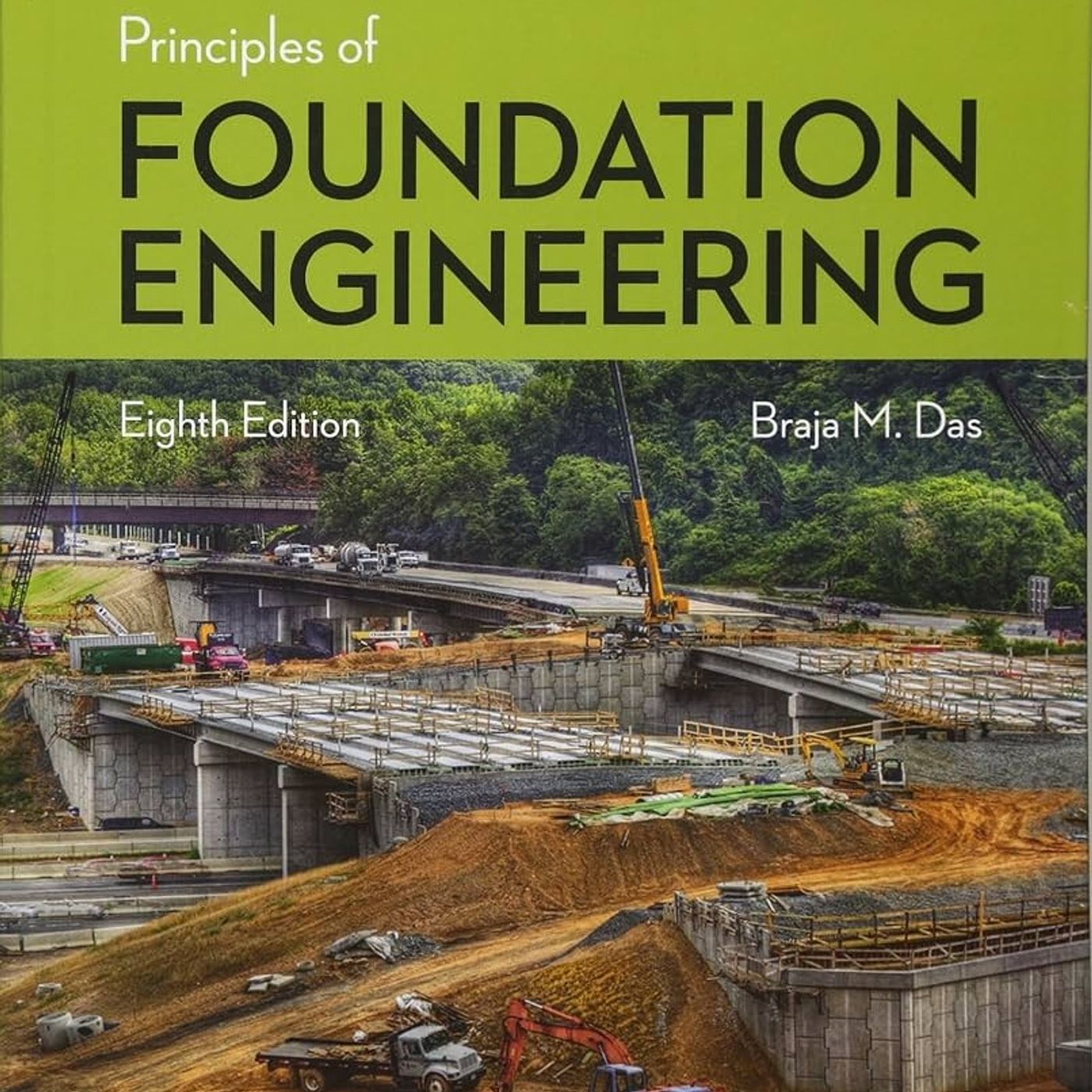
Get the Book now from Amazon:
https://www.amazon.com/Principles-Foundation-Engineering-Braja-Das/dp/1305081552?&linkCode=ll2&tag=cvthunderx-20&linkId=fd8e61de252f91807e00e6886f2cbeb7&language=en_US&gaOptInStatus=true&ref_=as_li_ss_tl
You can listen and download our episodes for free on more than 10 different platforms:
https://linktr.ee/civil_engineering_made_simple
Produced by:
https://www.podcaistudio.com/
Get every episode summarized
Each time Civil Engineering Made Simple publishes, we email you a written briefing from the transcript — the topics, who appeared, and any specific claims, with the ad reads skipped.
Email me new episodesFree for 3 shows. No card needed.
Hosts & guests
Transcript ready
210 searchable segments. Every word is indexed and playable.
Full transcript
Civil Engineering Made Simple — Principles of Foundation Engineering. Machine-transcribed; use the interactive transcript above to jump the player to any line.
When you walk past a massive skyscraper or sprawling suspension bridge, your eyes are naturally drawn upward. Right. Yeah, you're looking at the skyline. Exactly. All the glory goes to the glass, the steel, and like the architectural design reaching into the clouds. We marvel at the visible structure. But this is what we're getting into today. There is this quiet, incredibly high-stakes battle happening right beneath the sidewalk, completely out of sight. Yeah, it's literally an engineering war against the earth itself. It really is. And you know, for you listening, whether you're an engineering student, a young professional or just a self-taught learner, we're taking you straight into the mechanics of that battle today. Because frankly, if you lose that underground battle, it doesn't matter how beautiful or over-engineered the superstructure is. The whole building will just fail. Right. So welcome to this custom-tailored deep dive. Our mission today is to explore the comprehensive world of foundation design. And we're using the eighth edition of Braja M. Desa's textbook, Principles of Foundation Engineering, from 2016 as our source code.
Yeah, we want to provide a comprehensive, scientifically clear summary of how structures are safely supported by the ground beneath them. So to really understand this, we have to split the underground world into two distinct but, you know, deeply intertwined disciplines. Because I hear people use geotechnical engineering and foundation engineering interchangeably all the time. Oh, yeah, constantly. But they are entirely different phases of the design process. I mean, geotechnical engineering is basically the pure science of the materials. So that's just the dirt itself, right? Exactly. It deals with the physical, chemical, and mechanical properties of soil and rock. When you're acting as a geotechnical engineer, you're studying the origin of a soil mass. It's grain size distribution, it's permeability, it's sheer strength. You're kind of looking at soil mechanics in a vacuum. Yeah, precisely. Like how a specific layer of clay or sand behaves when it's subjected to stress or water flow or even, you know, seismic activity. Which means foundation
engineering then is the practical application of that. You take those pure geotechnical parameters and you use them to actually design the physical structural supports. Right. You're calculating the actual dimensions of the footings or how deep a retaining wall needs to go. You're figuring out how to safely transfer the load of a massive building into that highly specific soil profile. So it's basically the interface where structural engineering physically meets geotechnical engineering. It is. And to build anything, we really have to start right at that interface near the surface, which brings us to shallow foundations. Yeah. In foundation engineering, a shallow foundation, most commonly a spread footing is designed to take the concentrated load coming down from a column or a load bearing wall. And well, distribute it horizontally over a larger area of soil, kind of like ridening the base. And the design of these footings traditionally relies on allowable stress design, right? Or ASD. Correct. ASD is a very deterministic approach. You basically calculate the ultimate load like the absolute maximum stress the soil can take before
catastrophic failure. And then you apply a factor of safety. So you don't just build right up to the limit. Oh, never. You divide that ultimate load by say a factor of three or four to establish your allowable load. The structure's working loads must never, ever exceed that allowable limit. But you know, calculating that ultimate limit isn't just about guessing how hard the ground is, is it? No, not at all. It requires highly specific mathematical modeling, which brings us to Carl Terzagi, the father of modern soil mechanics. Basically, yeah. Terzagi created this bearing capacity theory and his equation for ultimate bearing capacity calculates the exact load per unit area that will cause a sudden catastrophic shear failure in the soil. And he broke the soil's resistance down into three specific mathematical components, right? Like each with its own bearing capacity factor. Right. The n factors. You have nc, nq, and n gamma. Let's break down how those three factors actually work in physics. Because nc represents the soil's cohesion, right? Yeah. So if you're building on
clay, for instance, you have these microscopic electrostatic bonds between the clay particles that physically hold the soil together, nc mathematically quantifies how much load those internal molecular bonds can resist before they shear apart. Okay. That makes sense. And then you have nq, which accounts for the search arch. Exactly. Imagine your footing is buried, um, two meters underground. The weight of that two meters of soil sitting above the bottom of the footing acts as a confining pressure. Like it's holding everything down. Right. So when the footing tries to push down and force the soil beneath it out to the sides, the soil on top pushes back down. Nq calculates the resisting contribution of that overlying weight. Okay. So nc is cohesion. Nq is the weight on top. And finally, n gamma accounts for the unit weight and internal friction of the soil directly beneath the footing. Yeah. Because when the soil fails under a footing, it doesn't just, you know, compress straight down. It follows this curved failure surface. Right. A wedge of soil immediately beneath the footing pushes a radial shear zone outward. And that in turn tries to push a passive
zone of soil upward. Exactly. So n gamma calculates how the shear weight and internal friction of that specific mass of moving soil, resisting shoved out of the way. But and I think this is a huge point from the book. The soil doesn't always fail in that perfect textbook manner. Oh, definitely not. The mechanics of the failure change drastically depending on the relative density of the soil. Terzagi Yo's model primarily describes what we call general shear failure, which happens in dense sand or, uh, stiff over consolidated clay. Yeah, because the soil is densely packed, when it fails, it fails suddenly and catastrophically. The failure surface extends all the way up to the ground surface and the soil actually heaves upward alongside the footing. Okay, let's unpack this for you listening. General shear failure is like pushing a wide flat board into packed sand. Eventually, the sand bulges up and totally gives way around the edges. That's a great way to picture it. And this happens at a relatively small settlement, usually when the foundation has sunk only about
four to 10 percent of its own width. It's an immediate brittle failure. But if you're building on medium dense sand, you get local shear failure instead. Right. In local shear failure, the soil compresses significantly under the footing before any actual shear planes develop. The failure surface starts to form, but it, um, it never reaches the ground surface to get massive, unacceptable settlement, but without the sudden catastrophic heaving. Exactly. And then if the soil is very loose sand or extremely soft clay, you experience punching shear failure, which is like stepping on snow and high heels. It just punches right through. Yes, perfectly said, there is no heaving at all. The soil directly beneath the footing simply compresses and the footing shears vertically straight down into the earth. So how do we know which failure will happen before we actually build something? Like how do we get those parameters? Well, engineers rely on the relative density of the sand and the depth of the foundation. They use Institute field testing to gather empirical data. One of the most ubiquitous tools is the standard penetration test or SPT. Oh right. The blow counts.
I've seen them do this on sites. Yeah. The SPT involves driving a split spoon sampler into the bottom of a borehole. You basically drop a 140 pound hammer from a height of exactly 30 inches repeatedly. And you just count the wax. Literally. Yes. You count the number of blows it takes to drive the sampler the last 12 inches into the soil. This blow count is then corrected for field variables like, you know, the energy efficiency of the specific hammer to generate a standardized and 60 value. And that in 60 value correlates directly to the relative density and internal friction angle of the soil. Exactly. They also use plate load tests in the field where they place actual steel plates, usually 25 millimeters thick and up to 762 millimeters in diameter at the foundation depth. And they just press down on it. Yeah. They apply a hydraulic load to the plate and measure the exact settlement curve of the soil. But wait, there is a massive scale effect issue here, isn't there? I mean, a 762 millimeter steel plate is tiny compared to a, you know, 30 meter wide building foundation. A small plate only stresses the soil a few feet down.
But a massive building stresses the soil dozens of meters deep. Yeah. That's a that's a fundamental limitation of the plate load test. You cannot directly extrapolate the settlement of a one meter plate to a 30 meter footing precisely because of the stress distribution. Oh, right. According to Boosiness, a elastic theory of footing stresses the soil to a depth roughly equal to twice its width. Exactly. So a small plate completely misses deeper, potentially weaker soil layers that the actual building will absolutely affect. Engineers have to use scale correction formulas. And more importantly, they must combine plate load data with deep soil boring. Just to make sure there isn't like a hidden layer of soft clay 20 meters down that's going to ruin the project. Right. Because you can have a foundation that is mathematically perfectly safe from shear failure. The soil won't suddenly rupture. But due to the immense load, the building might still slowly sink into the earth over time. This physical reality forces engineers to look beyond just bearing capacity. We have to analyze settlement. Yeah, preventing sudden shear failure is only half the battle. Managing that
slow settlement is the other and settlement is really divided into two primary categories. Let's get into the first one, elastic settlement. So elastic settlement happens almost instantly when the structural load is applied. It is analyzed using the modulus of elasticity of the foundation material and the soil as the load transfers the actual matrix of soil grains deforms and compressives. So it's an immediate structural deflection. Exactly. But the second type consolidation settlement is far more complex and dangerous. This is a long term process, primarily in saturated cohesive soils like clay. Because when you place a building on wet clay, the load is initially entirely supported by the water trapped in the microscopic pores of the clay, right? And water is essentially incompressible. Right. This creates excess pore water pressure. Over time, that immense pressure slowly forces the water to squeeze out of the clay matrix. As the water escapes, the load gradually transfers from the water to the soil skeleton, causing the clay to compress and the building to settle.
And because clay has extremely low permeability, this water escapes incredibly slowly. The calculations for primary consolidation can often span years. Yes, exactly. You might be calculating primary consolidation over say 6.3 years. Okay, I have to ask a practical question here. What happens when you run the numbers and you realize the soil is just too weak or the settlement is going to be too extreme like taking years for standard spread footing? Do you just abandon the site? Well, no. When spread footings would end up taking up more than half the buildings total area, engineers switched to matte or raft foundations. Oh, like strapping on snowshoes instead of boots to walk on fresh powder. That's a perfect analogy. A matte foundation is a massive, continuous, concrete pad covering the entire footprint of the structure. It maximizes the contact area with the soil drastically reducing the bearing pressure. And it provides immense rigidity, right? Yeah, a thick matte bridges over localized pockets of weak soil, forcing the structure to settle as a single cohesive unit. This effectively eliminates differential settlement, which is a real
danger. If a building sinks evenly, it's fine. But if one corner sinks three inches and the other doesn't, it introduces massive shear stresses, cracks concrete, shatters windows, exactly. And what are the typical configurations for these mats? According to the source, you have flat plates of uniform thickness. You also have flat plates thickened specifically under columns to prevent punching shear. Sometimes they use beams and slabs or slabs with basement walls, acting as massive stiffeners. What about water? If you're building a giant concrete box, deep underground, doesn't it want to float? Yes, buoyancy is a huge issue. In areas with high water tables that upward hydrostatic forces immense. So mats are often combined with piles to essentially pin the structure down and control that buoyancy, which perfectly tees up our next fundamental question. What happens when the soil near the surface is simply beyond saving or the forces on the building are too complex for just a mat foundation? That's when you have to go deep. You use pile foundations. So when specifically do engineers mandate deep pile foundations? There are a
few key conditions from the text. First, obviously if you have highly compressible or weak upper soil layers. Second, if you have horizontal forces from wind or earthquakes, piles anchor the building. Right. Overturning moments. Exactly. Third, uplift forces like we mentioned with buoyancy or for transmission towers and offshore platforms. And fourth, to prevent loss of bearing capacity from soil erosion or scour at bridge abutments and piers. Ah, right. When river currents wash away the surface soil. Okay, but here's where it gets really interesting for me. If the soil is essentially mush, how does a slender pile actually hold up a massive bridge or tower? What is it grabbing on to? Well, piles transfer loads in two distinct ways. The first is point bearing capacity, which is pretty intuitive. You just rest the tip of the pile on bedrock, right? Right. Or a very strong soil layer. The load goes straight down the shaft into the rock. But if bedrock is hundreds of feet deep, you have to rely on the second mechanism, skin friction or fictional resistance.
So just the friction at the soil pile interface along the length of the shaft? Exactly. The microscopic roughness of the pile creates friction against the soil grains. The cumulative friction multiplied over the entire surface area of a long pile provides massive resistance. And what are these piles made of? They use steel, concrete, timber and composite materials. A really fascinating one is cast in place concrete piles. Oh, how cased piles are made. Where they drive a steel casing into the ground with a heavy mandrel, right? Yeah. Once it hits depth, they remove the solid mandrel and just pour concrete into the empty steel pipe. And didn't the book mention something about creating a pedestal? Yes. You can artificially expand the point bearing capacity. They drop a hammer on fresh concrete at the bottom of the casing, which forces it outward into a massive bulb or pedestal deep underground. That is so clever. And there's also the continuous flight auger or CFA piles, right? Yeah, that's a very modern technique. You use a massive continuous auger with a hollow stem
to drill the hole. As you slowly pull the auger out, you pump highly pressurized concrete straight down the hollow stem. So the hole is filled exactly as the auger leaves, meaning the weak soil never even has a fraction of a second to collapse. Precisely. It's an incredible technique. But, you know, while piles solve depth and weight issues, sometimes the soil itself is the active enemy of the structure. Yeah, this brings us to the most difficult soils in engineer phase geotechnical nightmares. Very much so. The text highlights three specific difficult soils. First, you have collapsible soils. These are soils that possess high strength when dry, but suddenly settle or collapse when wetted, right? Yeah, like Lewis. They have water soluble bonding agents. When a water main breaks or it rains heavily, those bonds dissolve and the whole soil matrix collapses in on itself. Terrifying. And the second nightmare is expansive soils. These are clays that contain specific minerals, primarily Montmarrilinate. They swell and shrink
massively as moisture content changes. All right, the H2O molecules literally force their way between the clay platelets. Exactly. This creates massive upward swelling pressure that will absolutely destroy a shallow foundation. And the third one is man-made sanitary landfills. Right. They are highly compressible, completely unpredictable artificial soil deposits. As organic matter decomposes, you get sudden voids and sinkholes. So how do engineers actually mitigate these hostile environments? Well, for expansive soils, one major method is using drilled shaft pile foundations to completely bypass the active zone. The active zone being the layer of soil where all the swelling and shrinking actually occurs. Exactly. You anchor the piles in the stable soil below and you intentionally leave clearance and air gap under the grade beams and the building. So when the soil swells up, it just swells into empty space. You never even touches the building. But what if you can't bypass it? You have to use ground modification, right? Yeah. Soil improvement. For loose soils, you can use mechanical stabilization, like heavy compaction or blasting or vibroflotation, which is vibrating a massive probe deep in the
sand while blasting water to force the sand to settle densely. And for the expansive clays. You use chemical stabilization. You actually mix lime, cement, or fly ash deep into the wet clay. Oh, this triggers a cation exchange. The calcium in the lime swaps with the sodium on clay platelets. Yes. It causes the clay to flocculate, instantly turning highly plastic, swelling mud into a stiff, stable material. So what does this all mean for you, the listener? It means foundation engineering isn't just about pouring concrete. It's a dynamic battle against the earth's natural behavior. You have to literally alter the earth's chemistry or completely bypass its unstable layers. It's an incredible feel. It really is. So to recap, we started from the basics of soil mechanics and shallow foundation shear failures. We moved to settlement and mat foundations, dive deep into pile foundations, and finally tackle difficult shape shifting soils. And to fulfill the educational focus of this deep dive, I want to pose a specific review question
for you listening to test your understanding. Go for it. Based on our discussion, if you are tasked with designing a foundation for a transmission tower that will experience significant upward pulling forces, would you choose a shallow mat foundation or a deep pile foundation? And what is the primary mechanism that will resist that upward force? Just give you a second to think about that. So if you answered a pile foundation resisting via skin friction or uplift resistance, you are absolutely correct. Awesome. Any final thoughts before we wrap up? Yeah, I want to live everyone with a broader concept to mull over. As our cities grow denser and we run out of good land, we are increasingly building on sites we previously rejected, like old landfills, coastal marshes, and highly expansive clays. Consider this. In the future, will foundation engineers be designing structures for natural soil, or will the future of geotechnical engineering rely entirely on creating artificial synthetic ground before we ever lay a single brick? That is wild to think about. Thank you for joining us on this deep dive, and everyone listening,
keep questioning the ground beneath your feet.
More episodes
More from Civil Engineering Made Simple

Concrete: Microstructure, Properties, and Materials
Civil Engineering Made Simple

Bridge Engineering: Substructure Design (Principles and Applications in Engineer...
Civil Engineering Made Simple

Principles of Foundation Engineering, SI
Civil Engineering Made Simple

Principles of Geotechnical Engineering
Civil Engineering Made Simple