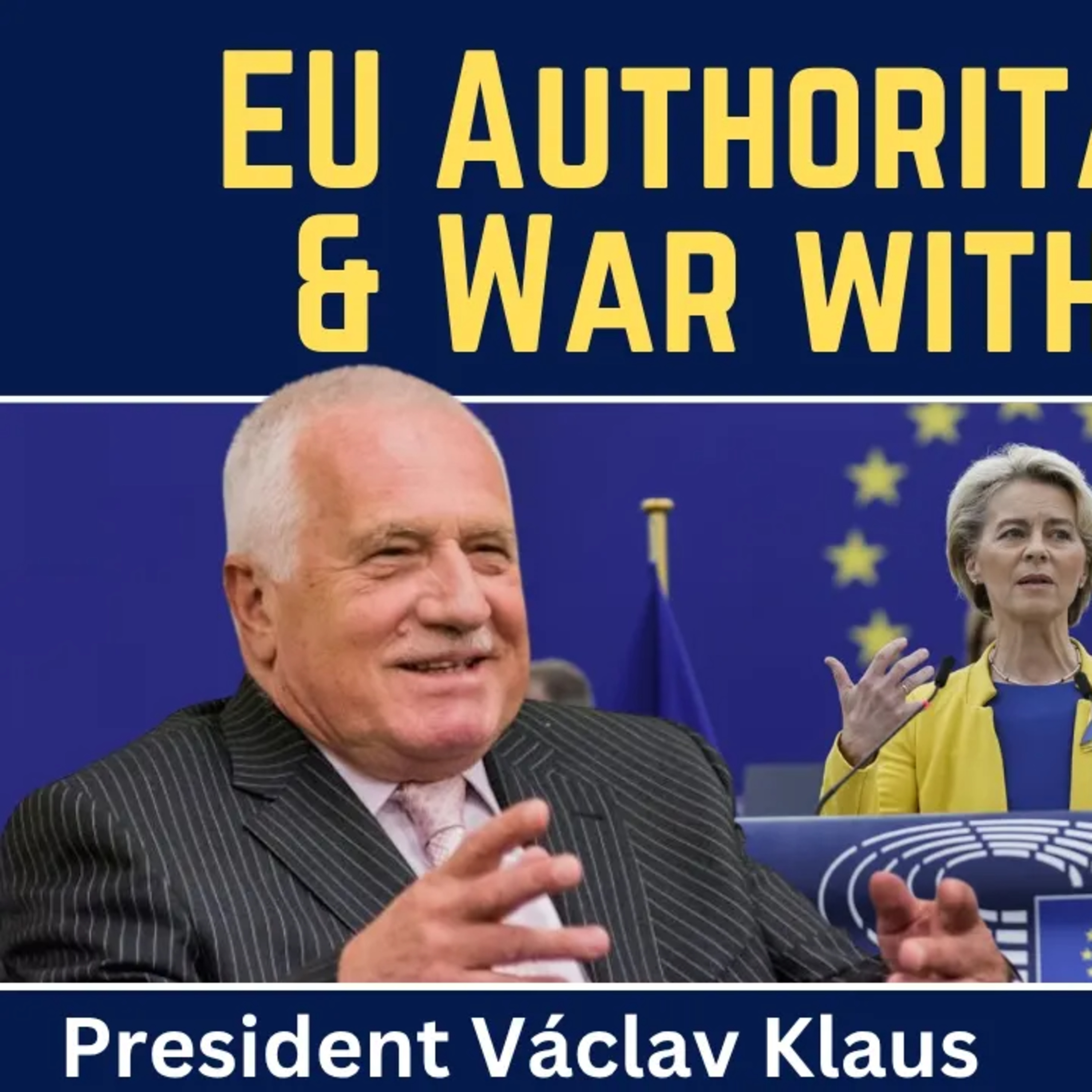
President Václav Klaus: EU Authoritarianism & War with Russia
Get every episode summarized
Each time Glenn Diesen - Greater Eurasia Podcast publishes, we email you a written briefing from the transcript — the topics, who appeared, and any specific claims, with the ad reads skipped.
Email me new episodesFree for 3 shows. No card needed.
About this episode
“Today we are joined by President Vatslav Klaus, who served as the first Prime Minister of the Czech Republic and thereafter served as the second President of the Czech Republic. So thank you for coming back on the program, sir.”From the transcript
Václav Klaus is a Czech economist and politician who served as prime minister (1993–97) and president (2003–13) of the Czech Republic. Follow Prof. Glenn Diesen: Substack: https://glenndiesen.substack.com/ X/Twitter: https://x.com/Glenn_DiesenPatreon: https://www.patreon.com/glenndiesen Support the research by Prof. Glenn Diesen: PayPal: https://www.paypal.com/paypalme/glenndiesenBuy me a Coffee: buymeacoffee.com/gdiesengGo Fund Me: https://gofund.me/09ea012fBuy merchandise: https://diesen-shop.fourthwall.com/en-nokBooks by Prof. Glenn Diesen: https://www.amazon.com/stores/author/B09FPQ4MDL
Get every episode summarized
Each time Glenn Diesen - Greater Eurasia Podcast publishes, we email you a written briefing from the transcript — the topics, who appeared, and any specific claims, with the ad reads skipped.
Email me new episodesFree for 3 shows. No card needed.
Hosts & guests

Transcript ready
114 searchable segments. Every word is indexed and playable.
Full transcript
Glenn Diesen - Greater Eurasia Podcast — President Václav Klaus: EU Authoritarianism & War with Russia. Machine-transcribed; use the interactive transcript above to jump the player to any line.
Welcome back everyone. Today we are joined by President Vatslav Klaus, who served as the first Prime Minister of the Czech Republic and thereafter served as the second President of the Czech Republic. So thank you for coming back on the program, sir. It's great to see you. My question to you was about this speech by the EU Commission's President Ursula Van der Leyen, who, well, in what is known as the State of the Union Address, she, she made the speech and you pushed back with an article being very critical and I wanted to know what your main criticism was about her speech. So good morning, very good thank you for calling me. You said new president. Madame von der Leyen is not a new president. She has been in her office since 2019, but in her speech now last Wednesday speech, she pretends to start a
new as if nothing happened in the past, but she is responsible for the developments in the European Union in the last six years and probably will stay there in that position in the future. So there is nothing new. There is a continuation of a wrong way of going ahead. Plus a very aggressive and arrogant speech, which is something I can't stand really. So therefore, it motivated me to write a speech, to write a comment, it just now published in various, various servers and newspapers. So I'm ready to talk about it. One of the things your critical of was her language, that is she argued that our democracies are dismantled by, in her words, lackeys and puppets of authoritarians. Again, you often linked
this kind of rhetoric to your time under communism. I spent 40 years of my life, which is almost half of my life in the communist era. So we are sensitive, maybe oversensitive to using such phrases, because that was what I and we were listening to the radio speeches discussing American imperialism and locusts and puppets in the hands of American imperialism. Now to hear it again, after almost 40 years after the fall of communism is really tragic. Maybe we are oversensitive, but that's probably justified. We spent decades in communism, so we can be oversensitive. Yeah, no, that makes sense. You also mentioned something, a comment you had made about opening
the way for Canada to become the EU's first associated member. US-Wolus others reacted to this. Of course, that US president reacted very radically to it and said that it's really, I don't remember the word, but ridiculous, and hostile idea, of course. But what really we spent years discussing the EU, and I know that there is not the institution of an associated membership doesn't exist in Europe. It was rejected by European member states. And of course, the EU tried, the European Commission tried to present this idea some eight years ago
in a memo, but it was rejected. But now she announces, Madame von der Lenn announces as if it's a normal idea to have an associated member. So it's demonstrated that she doesn't pay attention to the people in Europe, in European member states of the EU. Well, as you pointed out, she's been the commission's president since 2019, so she's not new. But she complains about the bureaucracy and the need to kickstart the European economy. Wouldn't this be a reference about her own performance to some extent? This is another important point. She allows herself to criticize bureaucracy in the EU, with it's a joke because she introduces one bureaucratic rule, one bureaucratic institution after
another. Every day, there is something new, and it shows that she doesn't understand anything. But my point is that my another communist experience is that in everything was prohibited in the communist era, just what was allowed was to criticize bureaucracy because even the system considered something wrong, of course, bureaucracy is the result of a system, not something additional to the system. So, so bureaucracy is a definitional part of the institution called European Union in my eyes. So when she criticized it's a joke. It's not a serious statement. Another issue though in your article was her statements that Russia cut us off from gas suppliers.
And I think this is, if you had any thoughts about this, because a huge problem now for the Europeans appear to be the energy prices. I mean, this is producing the industrialization. So how do you see this? Well, I guess her comments also in light of the energy challenges we're currently facing here. No, probably she knows what's going on, but she pretends not to know because to say that Russia cut us off from the gas suppliers, a joke. It's not a serious statement. We did it ourselves. It was the European decision, of course, in my eyes wrong decision, but in any case, our decision, EU decision, not Russia decision, Russia would be absolutely happy to deliver gas to the European customers and to get to get the money for it. So, so Russia didn't cut us off from
that and that that madam from the lane even mentioned that is almost understandable for me, unbelievable. Yeah, well, how about she also makes this comments about taking the future into our own hands again. And I thought this was interesting because it's a comment about her role, but seemingly also it says something about the relationship between the EU and European nations and Europe as a continent. I thought this was quite interesting. Madam from the lane permanently substitutes the word Europe for the word European Union. This is something what I can't stand. I can't survive that. Of course, we know that Europe is a continent, European existing permanently, whereas European Union is a man-made institution created by an organizational decision. So,
she permanently pretends to speak on behalf of Europe. I don't think it's allowed to say anything like that, but she is not alone in this respect. This is a typical position. This is a typical attitude presented in Brussels almost every day, but I can't accept it. I remember when we entered the European Union 23 years ago already. I remembered that I visited the European countries and everyone was telling me all the presidents and prime ministers were telling me welcome to Europe. And I said, excuse me, we belong to Europe for centuries all the time. What has changed was entering the European Union, but the people of the Brussels people
Brussels, Brusselsians, or more, Brussels, or I call it sometimes. They are Europe, but they are not. Well, in the 90s and 2000s, there was a lot of discussions around this because the British were always making the point, what is Europe? Is it the concentration of power in Brussels, or is it the nation-state? The nation-state is Europe. And then you have other countries like Russia saying, well, we are the largest country in Europe, but we're the only one who's not part of your Europe. So, it does create a lot of conceptual problems. On the topic of Russia, though, because this has been a key theme now. We've seen over a time. I saw that you're the current Prime Minister of the Czech Republic, Andrei Babish. He was warning that we should talk more about peace. And also your colleague in Slovakia, the Prime Minister of Slovakia, Robert Fizzo. He was worried that European leaders often make rhetoric about war to distract from problems at home. And if they
are provoking a war with Russia, then he doesn't want to send Slovakian soldiers to fight the Russians. Do you see the situation getting dire? Well, I am really especially with the new position of Chancellor Meritz in Germany. I am afraid for the first time in my life. And this is already a long life. I was born in the Second World War. But for the first time in my adult life, I am afraid of the war. When I see the European rhetoric, especially the Chancellor Meritz, I am getting afraid. So, I support Prime Minister Babish if he is able to say no to that. And especially Prime Minister Slovakian, Prime Minister Fizzo made a very good point yesterday. So I agree with both of them.
I just had one more question on that because I have some friends in the EU Parliament who makes the point to me that many in the EU genuinely thought that they were winning the war against Russia. And now they are struck a bit by panic when it is perceived as not being the case anymore. Do you think we have this rhetoric from people such as Meritz? They are hopeless because if you look at the results of the elections in Germany yesterday, again, so that in one of the parts of Germany, in another part, Pomeran, Mechlamburg's, the party of Mr Meritz got the leading part for decades in Germany, got in that part of Germany five percent of the vote. No, to be Meritz, I would be afraid of
making strong statements about that. So this is this strong rhetoric is usually a signal of the lack of support at home and they try to change it by making strong speeches as regards the international politics. And this is very dangerous and I am really afraid of that. Yeah, I think the news numbers that came in said 4.9 percent. So that's a complete collapse while Ivede came in first in Mechlamburg, Pomerania. Similar numbers, well, this were even worse than the numbers that came in from Saxony, Unhalt. But Meritz says that he will remain steadfast and patient, which sounds like we're not going to change anything. But I wanted to ask because that kind of links a bit to what you wrote in the article. This is our last question that is, on the
land she said that we to protect ourselves from undemocratic forces, which are seemingly the people winning now, the elections. We have to set up a center for democratic resilience. You have some history in the communist era. What does that mean? Well, such institutions are really crazy, artificial and we know that it will not change anything. Madame from the land suggested several such institutions. See, she mentioned that she wants to create the European critical raw materials corporation. It will solve the problem of the non-existence of the positive of such raw materials in Europe, on the European territory, to create the to create a corporation. This is not a solution. This shows really the whole plus attempt
to pretend that they are working and making some decisions. So the same is the center for democratic resilience. It's a joke. It's not a serious statement. I know you have a very busy day ahead of you. I appreciate squeezing me in the how great day. Thank you. Thank you very much. Thank you. Good bye.
More episodes
More from Glenn Diesen - Greater Eurasia Podcast

Alex Krainer: Bond Market Collapse & the New Chinese Economic Order
Glenn Diesen - Greater Eurasia Podcast

Trita Parsi: Middle East Unraveling — Are We on the Path to World War?
Glenn Diesen - Greater Eurasia Podcast

Alex Christoforou: Massive Attack on Moscow - EU Prepares for War
Glenn Diesen - Greater Eurasia Podcast

Seyed M. Marandi: U.S. Strike Imminent - Toward Total War in the Middle East
Glenn Diesen - Greater Eurasia Podcast