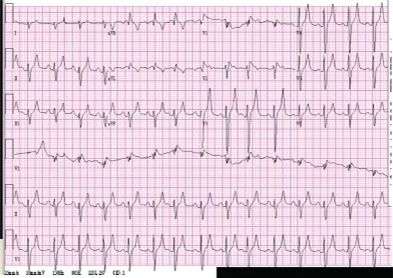
Podcast 759: Hyperkalemia and Myth of Kayexalate
Get every episode summarized
Each time Emergency Medical Minute publishes, we email you a written briefing from the transcript — the topics, who appeared, and any specific claims, with the ad reads skipped.
Email me new episodesFree for 3 shows. No card needed.
About this episode
Contributor: Nick Tsipis, MD
Educational Pearls:
- Acute hyperkalemia is characterized as serum K of 5.4 or higher in non-hemolyzed samples
- Hyperkalemia is commonly associated with end stage renal disease, acute kidney injury or acute renal failure
- Cardiac dysrhythmias are the primary concern with hyperkalemia, common EKG changes (and approximate serum levels) can include:
-
- Peaked T waves that start to show at serum K of 6
- Second sign is lengthening of PR and QRS intervals due to extended repolarization
- Severe hyperkalemia manifests as a sine wave around serum of 8-9
- Three approaches to treat hyperkalemia:
-
- Stabilize cardiac membrane with calcium
- Shift potassium back into the cell, insulin and albuterol are common agents used.
- Potassium binding for excretion
- Cochrane review showed no significant effects of Kayexalate on serum K in 4 hours
- Bowel necrosis is a rare adverse event that can occur with Kayexalate
- More myths and misconceptions about hyperkalemia addressed in reference below!
References:
Gupta AA, Self M, Mueller M, Wardi G, Tainter C. Dispelling myths and misconceptions about the treatment of acute hyperkalemia. Am J Emerg Med. 2022;52:85-91. doi:10.1016/j.ajem.2021.11.030
Mahoney BA, Smith WA, Lo DS, Tsoi K, Tonelli M, Clase CM. Emergency interventions for hyperkalaemia. Cochrane Database Syst Rev. 2005;2005(2):CD003235. Published 2005 Apr 18. doi:10.1002/14651858.CD003235.pub2
Li T, Vijayan A. Insulin for the treatment of hyperkalemia: a double-edged sword?. Clin Kidney J. 2014;7(3):239-241. doi:10.1093/ckj/sfu049
Summarized by Mason Tuttle| Edited by Nick Tsipis, MD
Get every episode summarized
Each time Emergency Medical Minute publishes, we email you a written briefing from the transcript — the topics, who appeared, and any specific claims, with the ad reads skipped.
Email me new episodesFree for 3 shows. No card needed.
Know when Nick Tsipis, MD turns up
Follow Nick Tsipis, MD and once a week we email you every new episode they appeared on — including guest spots the show notes never mention, because we read the transcript.
Follow Nick Tsipis, MDFree. Pick your own day and time.
Hosts & guests
No transcript yet
This episode has not been transcribed. Request it and it moves to the front of the queue.
More episodes
More from Emergency Medical Minute

Podcast 1021: Pulmonary Edema From Naloxone Administration
Emergency Medical Minute
Podcast 1020: Benign Paroxysmal Positional Vertigo (BPPV)
Emergency Medical Minute
Podcast 1019: Trauma Blunt Cardiovascular Injuries (BCVI)
Emergency Medical Minute
Podcast 1018: Occult Ventricular Fibrillation on Echocardiography
Emergency Medical Minute